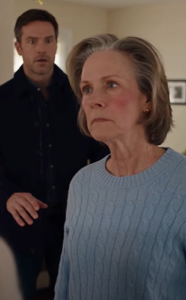
 My daughter-in-law told the photographer to leave me out of her wedding picture while my son stood three feet away with his hand extended toward me.
Then Brittany leaned close enough for several guests to hear and said, “She makes the picture look cheap.”
I was seventy-seven years old, and before that afternoon ended, my son would remove the white boutonniere from his tuxedo and stop a reception with three hundred guests waiting inside.
My name is Grace Carter. Until that moment, I had been trying very hard to disappear gracefully.
The photography platform had been built at the edge of the ballroom specifically for Brittany’s wedding portraits. It rose about eight inches above the polished floor and was framed by ivory flowers, pale eucalyptus, and a gold arch taller than any doorway in my house. Two assistants kept shifting the lights by inches. A stylist carried a lint roller. Another woman had a box containing emergency powder, hairpins, tissues, stain remover, and what looked like an entire sewing kit.
Everything had been planned.
The angle of Brittany’s train.
The placement of the champagne tower.
The height of the candles.
The exact shade of cream in the table linens.
Even the distance between the crystal vases had been measured.
I knew because I had heard about every decision for nine months.
Brittany had called it a “curated experience.” Noah called it “the wedding Britt wants,” always with a patient smile that told me he believed compromise was one of the duties of love.
I had never objected.
When she moved the ceremony from the church Noah grew up in to the Grand Halston Conservatory because the church carpet photographed “too red,” I said the conservatory was lovely.
When she replaced the chocolate cake Noah had wanted since childhood with a six-tier white almond cake decorated with hand-painted sugar flowers, I told him he could have chocolate cake on his birthday.
When she decided the groom’s family should wear “soft coastal tones,” I bought the pale blue dress she approved. It cost less than some of the shoes I saw in the bridal suite, but it fit me well, fell below my knees, and made my gray hair look almost silver in the mirror.
My pearl earrings had belonged to my mother.
My shoes were comfortable because I had arthritis in my right knee.
My handbag was old because it had been a gift from my late husband, Thomas, on our twenty-fifth anniversary, and I had never found a reason to replace something I still loved.
Those were apparently the details that made the picture look cheap.
“Groom’s family, please,” the photographer called.
Noah turned immediately.
He had been standing beside Brittany beneath the gold arch, tall and handsome in a black tuxedo, his dark hair combed back more carefully than usual. I could still see the boy in him, though. I could see the six-year-old who once wore one red sock and one blue sock to school because he said matching was boring. I could see the fourteen-year-old who pretended not to cry when his father went into surgery. I could see the twenty-three-year-old who drove through a snowstorm because I had the flu and he was convinced I would forget to eat.
Now he was thirty-eight and newly married.
“Mom,” he said.
He held out his hand.
That was all it took for me to step forward.
I had been standing near the edge of the platform because Noah had specifically told me before the ceremony, “Don’t wander away when they start family photos. I want one with you beside me.”
So I started toward him.
Brittany stepped into my path.
She did it smoothly, almost elegantly, still wearing the camera-ready smile she had practiced all morning.
“We don’t need her in this one,” she said.
Noah frowned. “That’s my mother.”
“I know.”
The photographer lowered his camera slightly.
Brittany glanced at me from my shoes to my handbag, then leaned nearer.
“She makes the picture look cheap.”
The sentence was quiet, but not private.
Her maid of honor heard it.
One of the lighting assistants heard it.
Brittany’s aunt, who was standing near the champagne display, heard it too. I knew because her eyes widened before she quickly looked away.
I looked down at myself.
Pale blue dress.
Comfortable navy shoes.
Old handbag.
Pearl earrings.
For one absurd second, I wondered whether I truly had misunderstood the dress code. Perhaps the fabric was wrong. Perhaps the hemline was too simple. Perhaps there was some rule about wedding photographs that women of my generation had never been taught.
Then I looked at Noah.
His hand was still extended.
His face had changed.
“Brittany,” he said.
She kept smiling. “It’s just one formal portrait.”
“With my family.”
“Your family is in the next set.”
“I’m looking at my family.”
Silence gathered around us.
I could feel people pretending not to listen.
There are moments when a mother has to decide whether being right matters more than making something easier for her child. I had made that decision many times in Noah’s life. When he was ten and embarrassed because I volunteered in his classroom too often, I stayed home the next week. When he was twenty-seven and dating a woman I knew was wrong for him, I kept my opinion to myself until he asked. When he chose Brittany, I decided that loving him meant trying to love the life he chose too.
I did not want his wedding day to become a battlefield with me standing in the center.
So I stepped back.
“It’s all right,” I said.
Noah looked at me. “It isn’t.”
I gave him the look mothers learn over decades.
Not now.
Not here.
Let me make this easier for you.
“You two take your picture,” I said.
Then I turned toward the small steps at the side of the platform.
That should have ended it.
Instead, Brittany caught my arm.
“Then please move out of the frame.”
Her fingers closed above my elbow.
I remember three things very clearly.
The pressure of her hand.
The surprised sound someone made behind me.
And the sudden absence of floor beneath my right foot.
She pulled me sideways.
Not hard enough to look like a shove from across the room.
Hard enough that a seventy-seven-year-old woman already turning toward a step had no chance to recover.
My heel found the edge.
My balance vanished.
The platform struck my hip first. Then my forearm. My handbag slid across the polished floor, opened, and spilled everything I had carefully packed that morning: tissues, peppermints, reading glasses, a small comb, my lipstick, and the folded photograph of Thomas I kept in the inside pocket.
Someone gasped.
The photographer dropped his camera from his face.
The string quartet stopped mid-phrase.
Noah reached me before anyone else moved.
“Mom?”
He dropped to his knees so quickly that one trouser knee hit the floor with an audible thud.
“Are you hurt?”
“My arm hurts,” I said.
I tried to smile because that was my instinct whenever he looked frightened. “My pride more.”
He did not smile.
His hand hovered near my wrist without touching it. “Don’t move yet.”
“I’m all right.”
“Mom.”
“I said I’m all right.”
He looked up at Brittany.
I had seen my son angry.
I had seen him furious at a drunk driver who nearly hit a child near our street. I had seen him angry at a hospital administrator who misplaced his father’s records. I had seen him slam a kitchen drawer after learning his business partner had lied about money.
I had never seen him look at anyone the way he looked at his wife then.
“What did you just do?” he asked.
Brittany’s expression was not remorse.
It was panic because people were watching.
“I was trying to get one family picture.”
“She was leaving.”
“She was still in the frame.”
“You pulled her.”
“I barely touched her.”
Noah stared at her.
Then Brittany said something worse.
“She doesn’t know her place.”
The room seemed to get quieter.
Noah became completely still.
He helped me sit up, then waited while I tested my ankle and knee. My hip ached. My forearm had already begun to redden. He helped me to my feet with one hand at my elbow and the other near my back.
I could feel his anger through the care he was taking.
“I know her place,” he said.
Brittany swallowed.
He looked directly at her.
“It’s beside me.”
For the first time all day, uncertainty reached her face.
It lasted perhaps two seconds.
Then she straightened her shoulders and turned toward the ballroom entrance.
“Security.”
No one moved.
Her voice sharpened.
“Security, I want her removed.”
I thought I had misheard.
So did Noah.
“What?”
“She’s causing a scene. She can wait somewhere else until we’re finished.”
“You pulled my mother off a platform.”
“I did not pull her off anything.”
Several guests murmured.
Brittany’s mother, Diane, hurried toward us in a champagne-colored gown with a tight expression.
“Everyone needs to calm down,” she said. “Grace, I’m sure this was an accident.”
“I’m not discussing this with you,” Noah replied.
Diane blinked. “Noah, sweetheart, there are guests watching.”
“That seems to be everyone’s main concern except whether my mother is hurt.”
Brittany lifted one hand. “Can someone please get security?”
That was when Samuel Bennett stepped out from among the guests.
Most people in the ballroom knew Samuel as the founder and owner of Bennett Signature Events, the company responsible for the flowers, lighting, catering, portrait platform, table design, service staff, and nearly every polished detail Brittany had spent months showing off on social media.
He was sixty-nine, broad-shouldered, silver-haired, and dressed in a dark suit with no flashy tie or pocket square. He had the calm manner of a man who did not need to announce when he entered a room because people who mattered already knew who he was.
He walked past Brittany.
Straight to me.
“Grace,” he said softly. “Are you all right?”
Brittany stared at him.
“You know her?”
Samuel looked genuinely surprised by the question.
“Yes.”
Years earlier, long before Bennett Signature Events had become one of the most respected event companies in the region, Samuel’s business had nearly collapsed.
He had expanded too fast.
Two large corporate clients paid late.
A lender tightened terms.
Payroll was due.
I had spent thirty-eight years in financial administration. I understood numbers, risk, timing, and the difference between a bad business and a good business trapped in a bad month.
Samuel’s business was not worthless.
It was suffocating.
I had known him through Thomas, who had hired Samuel’s small company for a retirement banquet. After Thomas died, Samuel occasionally called to check on me. When he told me what was happening, he did not ask for money.
I asked to see the numbers.
Then I made a private investment.
Enough to stabilize payroll and give him months instead of days.
I told no one except my accountant.
Samuel rebuilt slowly. He repaid me years later with a return far better than either of us expected. I never joined his company. Never wanted my name on a wall. Never asked for favors.
Noah knew only that I had once “helped Samuel get through a rough patch.”
Brittany knew nothing.
Samuel never forgot.
Now she had ordered his staff to remove me from his event.
He looked at my wrist, then at the platform, then at Brittany.
“Would you like us to continue?” he asked me.
The ballroom went silent.
It took me a moment to understand what he meant.
Brittany understood immediately.
Her eyes widened.
“Of course you’re continuing,” she said. “We have a contract.”
Samuel did not look at her.
He looked only at me.
“Grace?”
I turned to Noah.
He was staring at the white flower pinned to his lapel.
Then he reached up.
Unfastened the boutonniere.
Held it for one second.
And dropped it onto an empty chair.
“No need,” he said.
Samuel waited.
Noah faced the woman he had married less than two hours earlier.
“The reception is over.”
Brittany stared at him.
“What?”
“I said it’s over.”
“You can’t be serious. There are three hundred people here.”
“So?”
“My parents paid for this.”
Noah’s voice stayed steady.
“That doesn’t buy you the right to put your hands on my mother.”
Brittany’s face went white.
Her mother moved between them. “This is a misunderstanding.”
“No,” Noah said. “A misunderstanding is using the wrong seating chart. This was a choice.”
For a moment, no one spoke.
Then the photographer approached me.
He looked miserable.
“I’m sorry, Mrs. Carter.”
“You didn’t do anything.”
He hesitated.
“I took one picture before everything happened.”
“What picture?”
“When Noah turned toward you.”
He looked at my son.
“When he held out his hand.”
At the time, I had no idea that photograph would become the most important picture from the entire wedding.
I also had no idea Brittany was about to tell three hundred guests a version of what happened that would force that photograph—and several other things—to matter far more than any of us expected.

