olite smile, quick glance at the rust along my tailgate, then another glance toward the row of polished German SUVs behind me. When I handed him my keys, he held them carefully between two fingers. “It still starts,” I told him. His cheeks turned red, and I walked inside before he could decide whether I was joking.
The clubhouse smelled like cedar polish, white lilies, expensive cologne, and salt drifting in through open French doors. String lights crossed the exposed rafters, champagne flutes caught the afternoon sun, and every table had been dressed in ivory linen for Allison and Grant Whitmore’s engagement celebration. My younger sister swept past me in a champagne-colored dress with her blond hair pinned perfectly above one shoulder. She looked me up and down, took in my plain gray dress and flat shoes, and gave me that familiar little smile. “You made it,” she said, sounding less pleased than surprised.
“Traffic wasn’t bad.” I leaned forward to hug her, but she had already turned toward a photographer.
That was Allison. She had spent thirty years mastering the art of making rejection look accidental. When we were children, she never told me I couldn’t play with her friends; she simply forgot to tell me where they were meeting. When we were teenagers, she never asked Mom to exclude me from shopping trips; somehow there was never enough room in the car. As adults, nothing had changed except the settings had grown more expensive. Instead of being forgotten at the mall, I was now being forgotten at yacht clubs.
Near the entrance, a seating chart had been pinned to a decorative wooden board wrapped in eucalyptus branches. I found my name halfway down the page: Leah Mercer. Someone had drawn a thick black line through it and rewritten it near the bottom beside “Overflow.” I stared at the marker for perhaps two seconds before I heard my mother laughing near the bar. Marlene Mercer caught my eye, touched two fingers to her wineglass, then subtly pointed toward a folding table beside the kitchen doors.
I didn’t ask why. Asking questions in my family was simply volunteering to be lied to.
The overflow table held two catering employees on their break and the driver who worked for Grant’s mother. I introduced myself, took the empty chair facing the room, and set my purse beneath my feet. Sitting with my back to a door still bothered me, even after years of pretending it didn’t. I automatically noted the exits, the locked glass door behind the bar, the emergency gate leading toward the marina, and the distance between my chair and the nearest wall.
Old habits don’t disappear because your sister rented a ballroom.
My father, Robert, noticed me from across the room but didn’t come over. He was standing with Grant and three men from his investment firm, smiling in a way I remembered from childhood whenever important people visited our house. Dad had always believed proximity to status improved a person. Grant belonged to Blackwood Harbor, came from a wealthy family, and knew enough people with boats to make my father treat him like visiting royalty.
I worked for the government. That was the explanation my family had been given years earlier, and it was all they had ever cared to remember.
They knew I had joined the military against Dad’s wishes. They knew I traveled often. They knew I had worked around recruiting and training commands during one assignment, and because that explanation was convenient, it became the entire story in their minds. Allison had started calling me “the recruiter” with a smirk. Grant eventually upgraded that to “discount recruiter.” I had stopped correcting either of them.
There were some things you explained to family. There were other things you protected from them.
I was halfway through a plate of shrimp and salad when Grant’s friend Blake approached my table carrying a glass of red wine. I recognized him from dinner the night before, mostly because he had spent forty minutes describing his hedge-fund internship as though he had survived a siege. He stopped beside me, looked down at my gray dress, and smiled.
Then he tipped the glass.
Cold wine splashed across my collarbone and soaked through the front of my dress. For one second the room seemed to freeze. Blake widened his eyes theatrically. “Wow. Sorry. Didn’t see you sitting all the way back here.”
Laughter fluttered from the tables near the dance floor.
Allison had her hand over her mouth. Grant was whispering something into her ear while both of them watched me. Mom looked down at her plate. Dad didn’t move.
I kept my right hand flat on the table and took one slow breath. There are moments when anger arrives hot, and there are moments when it arrives so cold that everything becomes extraordinarily clear. This was the second kind. I could smell the wine, hear ice shifting inside Blake’s empty glass, and feel a drop sliding beneath the neckline of my dress.
Dad finally approached. For half a second, some embarrassing part of me thought he might defend me. Instead, he bent close enough that bourbon rolled off his breath.
“Don’t make a scene,” he whispered. “Grant’s family has business partners here.”
I stared at him.
He nodded toward Blake’s shoes. “You splashed him when you stood up. Just apologize and let it go.”
I looked down. One dark-red drop had landed near Blake’s polished loafer.
Then I looked back at the man who had raised me.
“Apologize?” I asked.
“Think about Allison for once.”
There are sentences that hurt because they are cruel. Others hurt because they confirm something you spent years trying not to know. My father had watched a man deliberately pour wine on me, and somehow I was still the problem that needed managing.
I picked up a napkin, wiped my collarbone, folded the napkin neatly, and placed it beside my plate. Then I raised my eyes to Blake.
I didn’t threaten him. I didn’t smile.
I simply held his gaze.
Three deployments had taught me that stillness could communicate things shouting never could. Blake’s grin weakened. His shoulders tightened. Without realizing it, he shifted one foot backward.
“Something wrong?” I asked.
“No.”
“Then we’re good.”
I picked up my fork and continued eating.
Across the room, Grant had stopped laughing.
Later, Allison cornered me near the restroom. “Why do you always do that?”
“Do what?”
“That weird intimidation thing.”
“I ate a shrimp.”
“You know exactly what I mean.”
I looked at her carefully. “Blake poured wine on me.”
“He was joking.”
“So was I.”
Her mouth tightened. “Grant says you have a superiority complex.”
That almost made me laugh. Grant, a man who had spent forty minutes describing the marina staff as “the help,” thought I had a superiority complex.
“I’ll try to survive his diagnosis.”
Allison stepped closer. Her perfume was the same expensive floral scent Mom bought her every Christmas. “This weekend matters to me, Leah. Grant’s parents are here. Admiral Cross is here. There are people who actually matter to our future.”
There it was.
Actually matter.
I glanced through the open doors toward the marina, where sailboat masts rocked against a gray evening sky. “Then you should probably get back to them.”
She expected an argument. I could see that clearly. What she got instead was my back as I walked away.
I slept badly that night in one of the club’s guest cabins. Not because of Blake or Allison or even Dad. I had survived worse things than rich people with bad manners. What kept returning was my father leaning toward me and saying, “Think about Allison for once.”
At four in the morning, I finally got up and stood at the window watching fog drift above the docks.
My family thought my silence meant weakness. They had always thought that.
By the end of the weekend, they would discover how badly they had misunderstood it.
### Part 2
Grant had organized a sailing regatta the next morning because apparently an engagement party wasn’t complete until wealthy men competed over who could look most nautical. The sky had turned the color of dirty steel, and a hard October wind whipped whitecaps across the harbor. Men who had probably never hauled a line in their lives arrived in spotless deck shoes and brand-new sailing jackets, slapping one another on the shoulders while club staff quietly prepared the boats behind them.
Grant stood at the helm of a rented forty-foot sloop wearing mirrored aviators. “Everybody listen up,” he announced. “I’ve been around boats my whole life.”
One of the club employees behind him closed his eyes briefly.
I hid my smile.
I had brought an old navy-blue fleece and salt-stained boat shoes from my truck. Three summers earlier, during leave, I had crewed on a research vessel off Maine because I needed several weeks where nobody knew my rank, my unit, or what I had seen overseas. The ocean had been good for that. Water didn’t care about résumés.
Allison noticed my shoes. “Couldn’t buy something new?”
“They still work.”
“That’s always your standard.”
“Usually.”
She rolled her eyes and climbed toward the bow.
Mom stayed aboard the support boat wrapped in a cream blanket while Dad positioned himself beside Grant’s future father-in-law. A second older man sat farther aft in a dark windbreaker and baseball cap, watching the preparations without saying much. I recognized him from photographs near the yacht club entrance: retired Rear Admiral Gideon Cross.
Grant had mentioned him roughly fifteen times since my arrival.
Admiral Cross was apparently the person Grant most desperately wanted to impress.
We cleared the marina and headed toward the first buoy. The wind strengthened beyond the breakwater, turning conversation into shouting. Allison stood too high on the deck despite repeated warnings from the crew, one hand gripping the rail while she complained about spray ruining her hair.
The boom swung as we changed direction.
I saw it coming and shifted automatically.
Allison saw it too.
Instead of ducking, she turned toward me and shoved both palms against my chest.
My heel caught a coil of rope. The deck disappeared beneath me, and my hip struck near a cleat hard enough to send pain flashing through my side. I twisted before my head hit the deck, taking most of the impact across my forearm.
For a moment I stayed on one knee while saltwater ran from my hair.
Allison stared down at me.
There was no shock on her face. No instinct to reach out.
Only anticipation.
She wanted me angry.
Grant’s voice crackled through the boat’s radio. “Guess all that military training didn’t teach Leah how to stay on her feet.”
Laughter carried from the second boat.
I looked toward the support vessel. Mom had seen everything. She turned deliberately toward the horizon. Dad lowered his binoculars and shook his head as though my falling had embarrassed him.
Something inside me settled.
Not broke.
Settled.
My left knee had started throbbing where an old training injury never completely stopped reminding me it existed. I pressed one hand against the deck and rose slowly.
“You okay?” one of the actual crew members asked.
“Fine.”
Allison folded her arms. “Maybe stay seated if you’re unstable.”
I looked at her.
She had spent our entire childhood pushing until she found the exact point where I reacted. Then she would run to Mom crying that I had frightened her. I used to fall for it. At twelve, fifteen, eighteen, I still believed there was some perfect explanation that could make our parents see what was happening.
At thirty, I knew better.
I wiped seawater from my face, stepped around her, and took a secure position farther aft.
The rest of the sail passed without incident, although I noticed Admiral Cross watching me twice from the support boat. Not staring exactly. Studying.
Back at the dock, Grant clapped me on the shoulder. “Tough fall.”
I moved just enough that his hand dropped without touching me.
His smile narrowed. “Still sensitive?”
“About what?”
“All of it.”
I waited.
He had no idea what to do with silence either.
That afternoon he arranged a recreational shooting demonstration on the club’s private beach range. I almost left when I saw it. Guns and champagne weekends were not my preferred combination, but club safety staff were supervising, and most guests seemed more interested in posing for photographs than actually firing anything.
Grant spotted me standing near the back.
“Well,” he called, “here’s our military expert.”
Several heads turned.
I felt Allison’s attention sharpen immediately.
Grant held up a pistol. “Come on, Leah. Show us what taxpayers paid for.”
“I’m good.”
“What happened? Recruiting office doesn’t cover this?”
A few people laughed.
I looked toward Dad.
He gave me the smallest nod toward Grant, an instruction I understood perfectly: Play along. Make him happy. Don’t embarrass your sister.
Something about that made me walk forward.
Grant handed me the firearm under the supervision of the range officer. I checked it safely and efficiently, then returned it without performing the little show he had clearly hoped for.
The laughter disappeared.
The instructor Grant had hired for the weekend, a former reservist named Mason Pike, stared at me.
“Where did you learn weapons handling?” he asked.
“Military.”
“Where?”
“A few places.”
Grant laughed too loudly. “She’s being mysterious because she probably spent four years checking paperwork.”
I looked toward the water.
Admiral Cross had been seated beneath a canopy with iced tea in one hand. He had stopped drinking it.
His eyes weren’t on my face.
They were on my hands.
Pike asked, “You deployed?”
“Yes.”
“How many times?”
Grant cut in immediately. “Come on, nobody wants Leah’s life story.”
“That’s convenient,” I said.
His jaw shifted.
Admiral Cross leaned back slowly, still watching me.
The first time I learned how dangerous curiosity could be was years earlier when a senior officer realized an assignment record didn’t match the story being told about it. People trained long enough in certain worlds recognize one another through habits more than uniforms. Where someone stands. How they scan a room. Whether their hands shake when everyone is watching.
Cross had begun noticing.
I could feel it.
That evening, the engagement party moved into a smaller lounge overlooking the marina. Grant spent most of dinner loudly describing his sailing experience. Allison repeatedly mentioned the beach demonstration, but every version became slightly different until Grant had apparently taught me something.
I didn’t correct them.
Halfway through dessert, Admiral Cross walked behind my chair.
He slowed.
“Ms. Mercer?”
I looked up. “Sir.”
His eyes rested on me for one long second.
“Have we met?”
“No, sir.”
“Certain?”
“Yes.”
He nodded, but something in his expression remained unsettled. “Enjoy the weekend.”
“You too.”
Grant watched the entire exchange.
The moment Cross left, he leaned across the table. “What was that?”
“What was what?”
“You called him sir.”
“He was an admiral.”
“He’s retired.”
I shrugged.
Grant stared at me another second, then smiled.
But this time there was nothing amused about it.
There was fear hiding underneath.
And men like Grant did not react well when fear made them feel small.
### Part 3
At two seventeen the next morning, footsteps crunched across the gravel outside my guest cabin. Most people would have slept through them. I hadn’t slept like most people in years. Long before the shadow reached my window, I was sitting upright with my feet on the floor, listening to someone approach with the exaggerated care of a drunk teenager sneaking past his parents.
I waited until the figure reached my porch.
Then I opened the door.
Blake froze with one hand lifted toward the handle. In the other he held shaving cream and a roll of plastic film. His face went blank.
For three seconds neither of us spoke.
“What are you doing?” I asked.
“Nothing.”
I looked at the supplies.
He looked at the supplies.
“Right.”
“It was a joke.”
“Of course.”
I stepped back and held the door open farther. “Anything else?”
His throat moved when he swallowed.
“No.”
“Good night, Blake.”
He dropped the shaving cream into the grass, turned around, and walked away much faster than he had arrived.
I stood there listening until his footsteps disappeared toward the main lodge. The prank itself was childish. What bothered me was the pattern. Wine. The shove on the boat. Now this. Every time someone crossed a boundary, the rest of my family quietly moved the boundary farther.
Eventually people stopped remembering there had ever been one.
At breakfast, Blake wouldn’t look at me.
Grant noticed.
“What did you do to him?” he asked.
“Nothing.”
“He says you threatened him.”
Allison set down her coffee. “Seriously, Leah?”
I buttered a piece of toast. “Ask him what he was carrying outside my cabin at two in the morning.”
Blake’s face turned bright red.
Dad sighed as if everyone at the table had become exhausting except the person who had actually gone to my cabin. “Can we get through one weekend without drama?”
I nearly laughed.
“I’d love that.”
Grant leaned forward. “You walk around acting like everyone should be afraid of you.”
“I don’t need anyone to be afraid of me.”
“Then stop trying so hard.”
I met his eyes. “I’m eating toast.”
Admiral Cross was seated two tables away. I saw the corner of his mouth move.
Grant saw it too.
That was when I knew the day was going to get worse.
His schedule called the next event a “field challenge,” which sounded serious until I saw inflatable barriers, traffic cones, climbing ropes, and corporate team-building equipment arranged across a section of private beach. Grant wore tactical-style clothing that looked freshly purchased. The event existed entirely so he could perform competence for Admiral Cross.
For the first hour I stayed near the back.
Then came the second range exercise.
Grant carried over a scoped rifle and placed it on the table. “Your turn.”
“No.”
“What’s wrong?”
“Nothing.”
“Then shoot.”
“I already entertained you yesterday.”
His friends laughed uneasily.
Grant’s eyes hardened. “One target. Two hundred yards. Unless you can’t.”
I understood the trap before I touched the rifle.
Something about the setup felt wrong.
The range safety officer had prepared the equipment earlier, but Grant had been hovering around the table for nearly ten minutes. I checked the rifle under supervision and looked through the optic. The settings had been altered.
I glanced toward him.
He smiled.
There it was.
Not incompetence.
Sabotage.
He wanted me to miss badly enough to erase everything Admiral Cross had noticed the previous day.
For one tempting moment, I considered setting the rifle down and explaining what he had done in front of everyone. But complaints were exactly what Grant wanted. He would call it an excuse, and Allison would repeat it at Thanksgiving for the next decade.
Instead, I asked the range officer to confirm the lane was clear.
Then I settled behind the rifle.
Cold sand pressed through my jeans. The wind came from the left, strong enough to lift strands of hair across my cheek. I ignored Grant. I ignored Allison whispering behind me. I ignored Dad saying something about finally settling the question.
The world became very small.
Target.
Wind.
Breath.
I fired.
A metallic ring came back from downrange.
Grant’s smile disappeared.
I fired again.
Another ring.
Three more followed, close enough together that Pike lowered the binoculars and stared at me.
The range officer walked down to inspect the target after everything was made safe. When he returned, he held the paper up without commentary.
The grouping was tight.
Very tight.
Pike looked at the optic, adjusted one of the controls, then looked directly at Grant.
“You changed this?”
Grant scoffed. “Why would I touch it?”
Pike’s expression said he didn’t believe him.
Admiral Cross stood beneath the canopy.
“That isn’t recreational experience,” he said quietly.
Nobody answered.
Cross looked at me. “Is it, Captain?”
The word slipped out so naturally that I wondered whether he even realized he had said it.
Grant heard.
So did Dad.
Allison’s head snapped toward me.
I stood and brushed sand off my knees. “You’re assuming a lot, Admiral.”
His eyes narrowed.
“But I’m wrong?”
“I didn’t say that.”
Grant stepped between us. “She isn’t a captain.”
Cross finally looked at him. “I didn’t ask you.”
Silence moved through the small crowd.
Grant flushed.
I should have known that moment would be the beginning of the end. Humiliation is dangerous when it lands on someone incapable of examining himself. Grant didn’t ask why a retired admiral was suddenly interested in me. He didn’t wonder whether perhaps his assumptions had been wrong.
He decided I had embarrassed him.
By lunchtime he was telling everyone he had arranged another activity in the boathouse.
“A self-defense demonstration,” Allison said excitedly.
I looked up from my coffee.
“With who?”
She smiled.
“You.”
“No.”
“Oh, come on. Grant says you military people are always bragging about hand-to-hand training.”
“I have never discussed hand-to-hand training with Grant.”
“That’s not the point.”
“It usually is.”
She leaned closer. “He thinks you’ve been disrespectful.”
I stared at my sister.
“He poured wine on me?”
“That was Blake.”
“You shoved me on the boat.”
Her expression flickered.
“You imagined that.”
“And someone altered the rifle.”
“Grant wouldn’t do that.”
“You didn’t ask whether he did.”
She folded her arms.
For the first time all weekend, I saw something behind the irritation in her face.
She knew.
Maybe not everything, but enough.
She knew Grant had been pushing me. She knew Blake had gone to my cabin. She knew the fall on the boat had not been accidental.
And she wanted the show anyway.
“Why?” I asked.
“What?”
“Why do you need this so badly?”
She looked away. “Need what?”
“To see me humiliated.”
Her jaw tightened.
“You always thought you were better than me.”
I almost answered automatically, but the words stopped.
There it was.
Not Grant.
Not the engagement.
Not childhood misunderstandings.
Allison had built her entire relationship with me around proving something I had never claimed.
“I never thought that,” I said.
“Well, everyone else did.”
“Who?”
“Teachers. Coaches. Grandma. Dad before you threw your life away joining the military.”
That surprised me.
Dad had spent years telling me Allison needed more support because everything came easily to me. Apparently he had told Allison something different.
Before I could respond, Grant appeared in the doorway.
“Boathouse. Three o’clock.”
“I said no.”
He smiled.
“Afraid?”
I looked at him, then at Allison.
Behind them, Dad stood near the hallway pretending not to listen.
“No,” I said. “But you should be careful what you ask people to prove.”
Grant laughed.
Three hours later, forty guests were gathered around a padded mat near the marina, Allison had her phone raised to record, and my mother was standing in the front row.
The second I walked into that boathouse, I understood something that should have been obvious years earlier.
They weren’t waiting to see whether Grant could beat me.
They were waiting to see me break.
### Part 4
The boathouse smelled like damp rope, motor oil, and cold seawater. Wind rattled the large sliding doors every few seconds, making the entire structure groan around us. Folding chairs had been arranged along one side of the floor, and guests crowded behind them with drinks in their hands as though Grant were about to perform a magic trick.
Mom stood with her arms folded over an expensive cream cardigan.
Dad pulled me aside before I reached the mat.
“Just let him have this.”
I thought I had misheard him.
“What?”
“He’s been embarrassed all weekend.”
“So?”
“So Allison has to marry into this family.”
I stared at him.
Dad lowered his voice. “You don’t always have to prove something.”
A laugh escaped me before I could stop it.
He frowned. “What’s funny?”
“I’ve spent this entire weekend trying not to prove anything.”
“Then keep doing that.”
He patted my arm as though the matter were settled.
I walked away.
Allison was near the back holding her phone horizontally. “Try not to hurt him,” she called.
A few people laughed.
Grant stepped onto the mat wearing a sleeveless athletic shirt and the confidence of someone who had never had his limits tested by anything more dangerous than his own reflection. He had probably thirty-five or forty pounds on me. Maybe more.
I removed my shoes.
Pike, the former reservist, came closer. “This doesn’t seem smart.”
“Tell him.”
“I did.”
“And?”
“He thinks you’re bluffing.”
I looked toward Grant.
“Most people do.”
I stepped onto the mat and kept my arms relaxed.
Grant circled once.
“Come on,” he said. “At least pretend you know what you’re doing.”
“I’m not fighting you.”
“Sure.”
“I mean it.”
His face tightened. “You’ve been making me look stupid since you got here.”
“That hasn’t required much participation from me.”
A few guests made involuntary sounds.
Grant’s cheeks darkened.
Dad shut his eyes.
I regretted the comment the second I made it, not because it was untrue, but because I knew exactly what it would do.
Grant stepped close.
“You think you’re special?”
“No.”
“You think wearing a uniform makes you special?”
“No.”
“Your family says you’re a failed recruiter who couldn’t cut it in a real unit.”
That got my attention.
I looked past him at Allison.
She lowered the phone slightly.
So that was the story she had been telling.
Grant smiled because he finally saw something in my face change.
“You’re nothing but a discount recruiter,” he said louder. “A fraud who spent years letting people think she did something important.”
“Grant,” Pike warned.
He ignored him.
“Let everyone here see what a fraud looks like.”
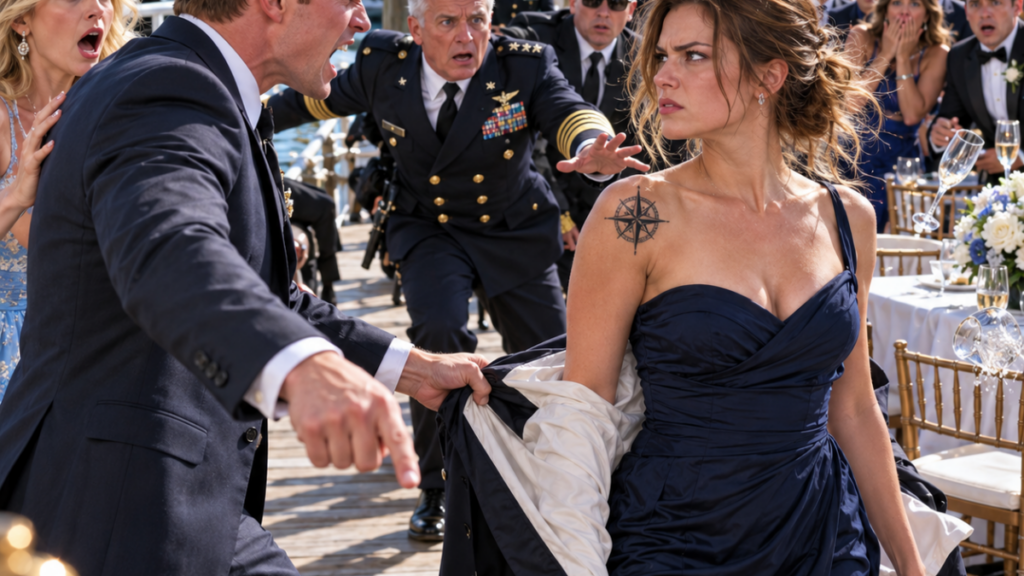
Then he grabbed the front of my jacket.
I heard Mom inhale.
For one absurd second, I thought he might release it.
Instead, Grant yanked hard.
The fabric tore from collar to seam with a sharp ripping sound that cut through the boathouse like breaking canvas. The jacket came off one shoulder, caught at my elbow, then slid to the floor behind me.
Cold air hit my bare arms.
I wore a plain white tank top underneath.
Nobody laughed immediately.
Grant looked triumphant.
Then Mom made a short sound behind her hand.
A laugh.
Small, involuntary, unmistakable.
Dad stared toward the marina.
Allison kept filming.
I stood perfectly still.
I had been cold before. Truly cold. The kind of cold that made fingers stop functioning while the sky flashed miles away. This was nothing.
But humiliation is not about temperature.
It is about discovering who enjoys watching.
Grant spread his hands toward the crowd. “There she is.”
I could have picked up the jacket.
I didn’t.
The black compass rose on my left shoulder was fully visible now, its points extending over muscle beneath a thin pale scar. A second narrow scar crossed through part of the design and disappeared beneath the back of my tank top. Along my collarbone sat a small sequence of numbers and letters, plain enough that almost nobody noticed them.
Almost.
A chair crashed to the floor.
Everyone turned.
Admiral Gideon Cross was standing.
His face had gone pale.
For several seconds he simply stared at my shoulder.
Then he moved.
Two members of his private security detail stepped forward automatically when he pushed through the crowd. Cross shoved past them.
“Move.”
His voice changed the room instantly.
Grant was still holding torn fabric in one fist. “Admiral, I was just—”
Cross walked past him.
Didn’t glance at him.
Didn’t acknowledge him.
He stopped three feet from me.
His eyes traveled from the compass rose to the markings beneath it and back again.
I knew exactly what he recognized.
Years earlier, before I commissioned, I had come through Combat Control. The compass rose was not an official decoration, and no regulation required it. It had started among a handful of people after a deployment none of us discussed outside secure rooms. The numbers represented coordinates stripped of enough detail to mean nothing to outsiders.
To people who knew the operation, they meant everything.
Cross knew.
I could see the realization happening behind his eyes.
His shoulders straightened.
Then the retired rear admiral raised his hand and saluted me.
The entire boathouse went silent.
Grant laughed once, uncertainly.
“Admiral?”
Cross kept his eyes on me.
“Who authorized that mark?”
“Nobody.”
His jaw tightened.
“You earned it.”
“Yes, sir.”
His hand remained raised another second before he lowered it.
Behind him, Mom’s hand had fallen away from her mouth.
Dad finally looked at me.
Allison’s phone was lowering inch by inch.
Cross spoke quietly.
“Were you with the joint special operations group outside Qarif?”
The room meant nothing anymore.
Only the question mattered.
“I can’t discuss that.”
His eyes closed briefly.
That was answer enough.
Grant stepped forward. “What exactly is happening?”
Cross turned.
“What’s happening,” he said, “is that you just tore the clothes off a United States Air Force officer whose service history you apparently know nothing about.”
Dad made a sound.
“Officer?”
Cross looked back at me.
“How long ago did you commission?”
“Three years.”
“Current rank?”
I hesitated.
There were some truths I had kept from my family because operational security required silence. Others I had kept because I grew tired of offering pieces of myself to people who only used them for comparison.
“Captain.”
My mother whispered my name.
Grant stared at me as though I had changed shape.
Cross’s eyes returned to the scar crossing my shoulder.
“You came up through Combat Control.”
“Yes, sir.”
He turned slowly toward the room.
“So while all of you have spent this weekend laughing about a recruiter, you’ve been humiliating someone who served in one of the most demanding special operations communities in this country.”
Nobody moved.
Grant finally found his voice.
“She never told us.”
I looked directly at him.
“You never asked.”
His face hardened.
“She’s lying.”
Admiral Cross’s expression changed.
Not anger exactly.
Contempt.
Grant pointed toward me. “Come on. Look at her. She drives a wrecked truck. She shows up dressed like that. She sits at the kids’ table—”
“Overflow table,” I corrected.
Dad flinched.
Grant’s voice rose. “And now suddenly she’s some secret war hero?”
“I never said that.”
Cross stepped between us slightly. “She didn’t need to.”
Grant looked around desperately, searching for someone still willing to laugh.
No one was.
That was the moment his humiliation stopped being entertainment.
It became rage.
And I watched his shoulders change before anyone else understood what was coming.
### Part 5
I had seen that shift before. The tightening jaw. The sudden narrowing of vision. The way a person’s weight moves before conscious thought catches up with emotion. Grant wasn’t trained enough to hide any of it.
Pike saw it a fraction later.
“Grant, don’t.”
Grant ignored him.
“She set this whole thing up,” he snapped. “She came here wanting to embarrass me.”
I almost smiled.
“You invited me.”
Allison finally lowered her phone. “Grant, maybe we should just—”
“Stay out of it.”
The way he spoke to her made something change in her face.
Small.
But real.
Admiral Cross held one hand out. “This ends now.”
Grant stepped around him.
“You think you can stand there and make me look like some idiot?”
“I haven’t made you anything.”
That sentence finished it.
Grant came at me.
There was no technique in what followed, no elegant contest worth describing. He was bigger, furious, and committed to hurting me. I moved on instinct, redirected his momentum, and brought him to the mat before he understood how quickly the situation had changed.
The entire exchange lasted seconds.
Grant hit the padded floor hard enough to lose whatever confidence remained, but I disengaged immediately and stepped away.
Pike and one of the club security officers moved between us.
“Stay down,” Pike ordered.
Grant pushed himself onto one elbow, stunned more than injured.
For the first time all weekend, nobody laughed.
Allison rushed toward him. “Oh my God.”
Mom grabbed Dad’s arm.
Dad turned on me.
“What the hell is wrong with you?”
I stared at him.
The absurdity was so complete that for a moment I couldn’t answer.
Grant had poured humiliation over me for two days. Allison had shoved me on a moving boat. Blake had come to my cabin at two in the morning. Grant had torn my jacket off in front of forty people and then rushed me in anger.
And Dad was furious with me.
“Nothing,” I said finally. “Nothing is wrong with me.”
“You could have hurt him.”
“He tried to hurt me.”
“You didn’t have to prove a point.”
“I moved him away from me.”
Mom stepped forward. “Leah, please. Everyone is upset.”
I laughed softly.
“Now everyone is upset?”
Her face crumpled.
That question hurt her because she knew exactly what I meant.
Where had their concern been when wine ran down my dress? When Allison shoved me? When Grant tore my clothing? They had demanded calm from me because calm was convenient. The moment consequences reached someone they valued, suddenly peace became everybody’s responsibility.
Admiral Cross turned toward Dad.
“Mr. Mercer, I would recommend you stop talking.”
Dad looked offended. “This is a family matter.”
Cross glanced at the torn jacket on the floor.
“No. It stopped being a private family matter when a man attacked your daughter in a room full of witnesses.”
Allison looked from Cross to me. “Attacked?”
I stared at her.
“He ripped my jacket off.”
“He was demonstrating—”
“He ripped my jacket off.”
Her mouth opened.
Nothing came out.
Grant sat upright now, rubbing one shoulder while club security stood near him. “I want her removed.”
Cross actually laughed.
It wasn’t a pleasant sound.
Grant flushed. “I’m a member here.”
“Not for long, I suspect.”
“What’s that supposed to mean?”
Cross looked toward the club manager, who had appeared at the back of the room during the confrontation. The manager’s expression was grim.
“It means,” Cross said, “Blackwood Harbor has rules about assaulting guests.”
Grant’s face changed.
For perhaps the first time, consequences had arrived in a language he understood.
Membership.
Reputation.
Access.
He looked toward Dad for support.
Dad looked away.
Interesting.
I bent down and picked up my jacket.
The seam had split almost completely. I pulled what remained of it around my shoulders and walked toward the door.
Mom followed.
“Leah.”
I kept walking.
“Leah, stop.”
I stepped outside onto the dock.
Cold wind immediately caught the torn fabric. The harbor was steel gray beneath low clouds, and halyards slapped rhythmically against aluminum masts.
Mom came after me.
“We need to talk.”
“No.”
“Please.”
“No.”
She reached for my wrist.
I moved away before she touched me.
“Don’t.”
My voice came out quiet enough that she stopped instantly.
Her eyes filled.
“We didn’t know.”
I looked at her.
That excuse almost impressed me.
“You didn’t know what?”
“About your career.”
“That Grant shouldn’t tear my clothes off?”
She went pale.
“That Allison shouldn’t shove me? That Blake shouldn’t pour wine on me? Did you need my rank for any of that?”
She had no answer.
Dad arrived behind her.
“Your mother means we didn’t understand.”
“No. You understood everything that mattered.”
He rubbed both hands over his face.
“Can we not do this out here?”
I glanced toward the water.
“Where would you prefer? The overflow table?”
His jaw tightened.
For years I would have feared that expression.
Now I saw it for what it was.
A man losing control of the version of me he had built.
Admiral Cross emerged from the boathouse and approached us slowly.
“Captain Mercer.”
Dad flinched at the title again.
Cross nodded toward a sailboat tied several slips down. “That Whitmore’s charter?”
“Yes,” Dad answered before I could.
Cross ignored him and looked at me.
“You noticed the inspection card earlier.”
I raised an eyebrow.
He smiled faintly. “You weren’t subtle.”
I glanced toward Grant’s boat. Several safety certifications listed near the mast had expired.
“Not my problem.”
“No,” Cross agreed. “But it may become his.”
Dad stepped forward quickly. “Admiral, whatever happened inside, Grant is under enormous pressure. His family has several businesses connected to this club.”
Cross looked at him.
“And?”
Dad hesitated.
I almost felt sorry for him.
He had spent his entire adult life believing status was gravity, that important names bent rooms around themselves. Now he was learning that the most powerful person there didn’t care who Grant’s father played golf with.
Cross’s voice stayed calm. “The club board will review what happened today. So will management.”
Dad swallowed.
“Couldn’t we handle this privately?”
Cross looked at me.
“That is not my decision.”
Dad turned immediately.
“Leah.”
There it was.
For the first time all weekend, he needed something from me.
Behind him, Allison helped Grant toward the clubhouse while Grant shouted at a security officer about lawsuits. Blake had disappeared entirely. Mom stood beside Dad with tears running silently beneath her eyes.
I felt strangely empty.
I had imagined moments like this before. Not this exact absurd scene, but some version where my family finally understood who I was and regretted how they treated me.
In those fantasies, their regret healed something.
Standing on the dock, I discovered the truth.
Too-late respect felt almost exactly like disrespect.
Both were about them.
Then a distant sound reached us across the water.
Low.
Rhythmic.
Growing.
Admiral Cross looked toward the tree line.
I already knew what it was.
Rotor blades.
And whoever was arriving had not come for Grant.
### Part 6
The sound grew from a distant pulse into a wall of noise that rolled across Blackwood Harbor. Guests spilled out of the clubhouse and shaded their eyes as a military helicopter appeared beyond the trees, banking toward the large grass field beside the marina. Rotor wash struck the tents first, snapping loose napkins into the air and sending table decorations tumbling across the lawn.
Dad stared at the aircraft.
“What is this?”
I didn’t answer.
The helicopter descended.
Wind tore at my already ruined jacket. Mom grabbed a railing while Allison stood several yards away with one arm around Grant, whose expression had shifted from anger to confusion.
The aircraft touched down.
The side door opened.
A man in worn fatigues stepped onto the grass.
Colonel Samuel Reed had more authority walking across a parking lot than Grant had managed to manufacture during an entire weekend. He didn’t wear polished shoes. He didn’t scan the crowd to see who noticed him. He just stepped away from the aircraft and headed directly toward me.
Dad intercepted him.
Of course he did.
“Robert Mercer,” he shouted over the engines, extending his hand.
Colonel Reed walked past him.
Not rudely.
Almost worse.
He simply didn’t register Dad as relevant.
Reed stopped in front of me.
His eyes moved once over the torn jacket.
“You hurt?”
“No, sir.”
“That yours?”
He nodded toward Grant.
“Unfortunately, he belongs to my sister.”
Grant’s face tightened.
Reed looked at him for one second.
Then back at me.
He removed his field jacket and placed it around my shoulders, pulling the front closed against the wind.
“We’re done here.”
Something behind my ribs loosened.
“Yes, sir.”
He leaned closer.
“Come home, Captain.”
The title carried farther than he intended.
Mom made a strangled sound.
Allison stared at me.
Dad’s face went slack.
Grant looked between Reed, Cross, and me as though someone had secretly replaced reality while he wasn’t watching.
Reed greeted Admiral Cross with the brief familiarity of two men who had worked around the same world long enough to recognize each other.
“Gideon.”
“Sam.”
Cross looked at me.
“You knew?”
Reed’s mouth twitched. “I know enough.”
Grant pushed away from Allison.
“This is ridiculous.”
Nobody responded.
“I said this is ridiculous!”
Reed turned slowly.
Grant pointed at me. “She came here pretending to be nobody.”
I almost admired the sentence.
Pretending to be nobody.
That was Grant’s entire worldview in six words. If you didn’t advertise your accomplishments, you didn’t have them. If you drove an old truck, you had failed. If you sat quietly at an overflow table, you belonged there.
Reed’s expression remained neutral.
“She didn’t pretend anything.”
“She let us think she was some recruiter.”
“Was she assigned to recruiting?”
“For a while,” Reed said.
Grant looked triumphant.
Then Reed continued.
“After an operational rotation most people in this country will never hear about.”
Grant’s victory disappeared.
Dad stepped closer.
“Operational?”
I looked at Reed.
He stopped there.
Good.
Some things were not family entertainment.
Mom pressed both hands together. “Leah, why didn’t you tell us?”
The question struck me as so absurd that I laughed.
“You never wanted to know.”
“That’s not fair.”
I turned toward her.
“Really?”
She recoiled slightly.
“When I enlisted, Dad didn’t speak to me for four months because I turned down the graduate program he wanted. You told everyone I was going through a phase.”
Mom started to answer.
I kept going.
“When I came home after my first deployment, you asked whether Allison could use my bedroom because she wanted more closet space.”
Her eyes dropped.
“When I missed Christmas because of an assignment, you told me I should stop expecting everyone else to plan around my job. When I finally came home, nobody asked where I’d been.”
Dad’s face had gone gray.
“So no,” I said. “I didn’t send you a résumé.”
Allison released Grant’s arm.
“You could have told me.”
I looked at her.
“You told your fiancé I was a failed recruiter.”
Her face changed.
“I didn’t say failed.”
Grant interrupted. “You absolutely did.”
Allison stared at him.
He realized his mistake too late.
For the first time that weekend, the two of them looked at each other without me between them.
Interesting.
Admiral Cross cleared his throat.
“Captain Mercer, the club manager would like a statement when you’re ready.”
I nodded.
Grant stepped forward.
“She’s pressing charges?”
Cross’s brows rose.
“I didn’t say that.”
Dad immediately looked at me. “Leah, please.”
There was panic in his voice now.
Not for me.
For Allison.
For Grant.
For the engagement.
For the Mercer name.
“Please what?” I asked.
“Think before you destroy your sister’s future.”
Something inside me finally went quiet.
All the confusion.
All the childhood bargaining.
Gone.
I stared at my father and realized he would never understand unless understanding benefited him.
“I’m not destroying anything.”
“Leah—”
“Grant made his choices. Allison made hers. You made yours.”
Mom started crying harder.
“We made mistakes.”
“Yes.”
“We can fix them.”
“No.”
The word came easily.
Mom blinked.
I had spent years believing strength meant enduring. Staying calm. Taking the higher road. Refusing to give people the reaction they wanted.
Sometimes strength meant leaving.
Colonel Reed shifted beside me but said nothing.
He knew better than to rescue me from a conversation I needed to finish myself.
Dad looked toward the helicopter, then back at me.
“You’re really going to walk away from your family over one weekend?”
I stared at him.
“One weekend?”
His face fell.
That was when I understood he remembered.
Every smaller humiliation.
Every holiday where Allison’s needs became law.
Every phone call I made from overseas that ended because dinner was starting.
Every time I came home and discovered my family knew less about my life than strangers in my unit.
This weekend wasn’t the cause.
It was the receipt.
I pulled Reed’s jacket tighter around myself.
“I’ll give the manager my statement.”
Dad exhaled in relief.
Then I continued.
“And after that, I’m leaving.”
Mom stepped forward.
“With us?”
“No.”
The helicopter waited behind me.
For once, so did people who had actually come because I mattered.
### Part 7
The yacht club manager took my statement in a small office overlooking the docks. Admiral Cross sat in only long enough to confirm what he had witnessed, then stepped outside to give me privacy. I described Grant tearing my jacket and advancing on me afterward, along with the earlier incidents involving Blake and the altered range equipment, without embellishing any of it.
When I finished, the manager removed his glasses.
“I’m sorry.”
I had heard those words from people all afternoon.
His were the first that didn’t irritate me.
He wasn’t asking me to make him feel better.
“Thank you.”
“Mr. Whitmore’s membership access is suspended pending review.”
I nodded.
“What happens after that is up to the board.”
“Understood.”
Outside, Allison was waiting alone.
For once, Grant wasn’t beside her.
She looked smaller without him.
“Can we talk?”
I considered saying no.
Then I remembered something Colonel Reed once told me after a mission went sideways: closure was rarely something another person gave you, but sometimes you could give it to yourself.
“Five minutes.”
We walked toward the end of the dock.
Allison wrapped both arms around herself against the cold.
“Grant says you’re trying to ruin him.”
“I’m not responsible for what Grant says anymore.”
“He says Admiral Cross is going to have him blacklisted.”
“I haven’t spoken to Admiral Cross about Grant’s career.”
“He says his club membership, the charter insurance, his business contacts—everything is suddenly at risk.”
I looked across the water.
“That sounds stressful.”
She flinched.
“Do you hate me?”
There were years when I would have loved that question.
It meant she finally cared what I felt.
Now I had to think about the answer.
“No.”
She looked surprised.
“I don’t hate you, Allison.”
Tears appeared in her eyes.
“Then help me fix this.”
There it was.
I closed my eyes briefly.
“I knew it.”
“Knew what?”
“You don’t want me. You want me useful.”
“That isn’t fair.”
“Then tell me you came here to apologize without asking for anything.”
She opened her mouth.
Nothing came out.
Wind pushed hair across her face.
“I’m sorry,” she whispered eventually.
“For what?”
“All of it.”
“What is all of it?”
Her eyes flashed.
“Why are you doing this?”
“Because you’re thirty years old. You don’t get to say ‘all of it’ like you accidentally forgot my birthday.”
She looked away.
I waited.
Finally she said, “I’m sorry I moved your name to the overflow table.”
“You did that?”
Her face answered before her mouth did.
“I thought Grant’s partners should sit near us.”
I nodded slowly.
“I’m sorry about Blake.”
“You laughed.”
“I know.”
“And the boat?”
She swallowed.
“I shouldn’t have pushed you.”
There it was.
The admission.
Small but clean.
“And today?”
She started crying.
“I didn’t know he was going to rip your jacket.”
“But you were filming because you knew he planned to humiliate me.”
She covered her face.
“Yes.”
The truth hurt less than I expected.
Maybe because I had already been living with it.
“I’m sorry,” she said again. “I was jealous of you.”
I stared at her.
“Allison, you had everything Mom and Dad could give.”
“That’s not what I mean.”
“Then what?”
She wiped her eyes.
“When we were kids, everybody thought you were capable. Grandma asked you for help. Teachers loved you. Dad talked about where you’d go to college. Then you joined the military and suddenly Mom and Dad were furious with you, and for once I was the daughter who did everything right.”
I listened.
“I liked it,” she admitted. “I liked being the good one.”
“So you kept needing me to be the bad one.”
She nodded.
I felt sadness then.
Not reconciliation.
Sadness.
“You could have built a life without tearing mine down.”
“I know.”
“And you still can.”
Hope flickered across her face.
“Does that mean—”
“Not with me in it.”
The hope disappeared.
“Leah.”
“I forgive you.”
She stared.
“I mean that. I don’t want to spend another decade carrying this.”
She reached for me.
I stepped back.
“But forgiveness isn’t access.”
Her hand dropped.
“You’re my sister.”
“That’s biology.”
She started crying again.
I let her.
For once I did not rush forward to soothe the person who had hurt me.
When I returned toward the lawn, Mom and Dad were standing beside the catering trucks. Mom hurried over.
“Did you talk to Allison?”
“Yes.”
“Thank God. She needs you.”
I almost smiled.
“I’m sure she’ll figure things out.”
Mom stared at me.
“You’re leaving?”
“Yes.”
“What about Christmas?”
The question was so normal it nearly broke my heart.
“I won’t be there.”
Her face collapsed.
“Leah, please don’t punish us forever.”
“This isn’t punishment.”
“What else would you call it?”
“Peace.”
Dad stepped forward.
“We’re your parents.”
“You are.”
“You can’t just erase us.”
“I’m not erasing anything.”
I looked between them.
“I’m finally accepting what’s already there.”
Mom whispered, “I love you.”
I waited for the words to land.
They didn’t.
All my childhood I had imagined hearing them in exactly the right moment would fix everything. Instead, they sounded like words said at a closing door because the speaker had finally realized it could close.
“I believe you think you do,” I said.
She sobbed.
Dad’s face tightened.
“Do you know what this will do to your mother?”
There he was again.
Even now.
Someone else’s pain was my responsibility.
Mine never had been.
“I hope you both take care of yourselves.”
I walked toward the helicopter.
Near the catering trucks stood my seventeen-year-old cousin Ethan. He was the only relative who had brought a dry jacket to my cabin after Blake poured wine on me.
He looked uncertain.
I stopped beside him.
“You okay?”
He nodded.
Then shook his head.
“I didn’t like how they treated you.”
“Neither did I.”
He almost smiled.
“Am I allowed to text you?”
My throat tightened unexpectedly.
“Anytime.”
Behind me, Mom called my name.
I didn’t turn around.
Colonel Reed held out one hand as I climbed aboard.
The door closed.
Noise vanished.
Through the small window, Blackwood Harbor began shrinking beneath us.
My family became figures on wet grass.
For years, distance from them had felt like failure.
As the shoreline disappeared beneath the clouds, it finally felt like freedom.
### Part 8
Six months later, I woke before sunrise in a small apartment outside Hurlburt Field and made coffee while rain tapped quietly against the balcony door. My phone sat on the kitchen counter without missed calls from Mom because I had changed my number three months earlier. The silence used to feel unnatural.
Now it felt expensive.
Something I had paid for.
Something worth protecting.
The official fallout from Blackwood Harbor had been less dramatic than my family probably expected and more permanent than Grant did. His club membership was suspended, then terminated after multiple witnesses submitted statements. The insurance company reviewing his charter operation found enough unrelated compliance problems to make his life complicated without any help from me.
Admiral Cross never needed to destroy him.
Grant had already done most of the work himself.
Ethan told me months later that Allison postponed the wedding indefinitely. He was careful not to gossip, and I was careful not to ask for details. Apparently Grant blamed everyone except himself until Allison finally moved back into her own apartment.
I didn’t celebrate.
I didn’t call her either.
Consequences were not revenge.
That distinction mattered to me.
Mom sent letters through Ethan twice before I asked him kindly not to carry messages anymore. The first was twelve pages long and mostly explained why she had behaved the way she did. She described Allison as sensitive, Dad as stubborn, herself as caught in the middle, and me as “so independent that we never realized you needed us.”
That line stayed with me for days.
Independence had become another excuse for neglect.
The second letter was shorter.
“I am sorry I laughed when he tore your jacket,” she wrote.
That sentence I believed.
I still didn’t respond.
Dad sent one email through an old address I rarely checked. His apology was four paragraphs long, and the first three were about how difficult the situation had become for the family. In the final paragraph he wrote, “I should have defended you.”
I printed that sentence.
Then I shredded the page.
Not because I hated him.
Because I no longer needed proof that he understood.
My life had been built around surviving without it.
Colonel Reed never asked what I planned to do about my family. That was one reason I trusted him. People who truly care about you rarely demand immediate forgiveness just because discomfort makes them impatient.
One afternoon after training, he found me sitting outside with coffee.
“You sleeping?”
“Mostly.”
“Eating?”
“Too much.”
“Good.”
I smiled.
He sat beside me.
After a minute he said, “You miss them?”
I considered lying.
“Sometimes.”
“That doesn’t mean you made the wrong decision.”
“I know.”
And I did.
Missing people was not evidence that they belonged in your life. Grief did not automatically mean you should rebuild what hurt you. Sometimes grief was simply the cost of accepting that the family you wanted had never existed in the form you imagined.
I started seeing a counselor on base a month after Blackwood Harbor.
Not because I was falling apart.
Because I was tired of being proud of how well I could endure everything.
That realization embarrassed me more than I expected.
For most of my career, endurance had been an asset. Cold, exhaustion, fear, chaos—you learned to function anyway. Somewhere along the way, I had started applying the same philosophy to family.
Pain became another environment.
Adapt.
Continue.
Don’t complain.
My counselor asked me one afternoon, “What would happen if you stopped measuring strength by what you can tolerate?”
I didn’t have an answer.
I spent weeks finding one.
I began with small things.
I replaced the truck.
Not because Grant had mocked it. The truck had reached 218,000 miles and finally surrendered its transmission in a grocery store parking lot. I bought a modest dark-blue SUV and laughed alone in the dealership when the salesman asked whether I wanted something “more impressive.”
“No,” I told him. “I want something reliable.”
I moved into an apartment with windows facing the water.
I started running again after physical therapy finally improved the knee I had ignored for years.
On Sundays, I ate breakfast with people from my unit.
Nobody seated me at an overflow table.
Admiral Cross called once.
“I owe you an apology,” he said.
“For what?”
“For turning your service into a spectacle.”
“You didn’t.”
“I saluted you in front of forty civilians.”
“That was difficult to miss.”
He laughed.
Then his tone softened.
“I recognized the mark and forgot the room.”
“I understand.”
“I hope I didn’t make things worse.”
I looked through my kitchen window at sunlight moving across the bay.
“No, sir.”
There was a pause.
“You know, your service didn’t make their behavior wrong.”
“I know.”
“You could have been exactly what they thought you were, and it still would have been wrong.”
That sentence mattered more than the salute.
Maybe because it named the truth underneath everything.
My family’s mistake wasn’t failing to recognize someone impressive.
Their mistake was believing I needed to be impressive before I deserved basic dignity.
If I really had been an unsuccessful recruiter driving an old truck, Blake still shouldn’t have poured wine on me. Allison still shouldn’t have pushed me. Grant still shouldn’t have ripped my clothing. Mom still shouldn’t have laughed. Dad still should have defended his daughter.
My rank had exposed them.
It had not changed what they owed me.
In early summer, Ethan visited Florida with his parents and asked whether he could see me. We ate burgers near the beach while he told me about college applications and complained about calculus.
Eventually he became quiet.
“Aunt Marlene keeps asking about you.”
“I figured.”
“Uncle Robert too.”
I nodded.
“Allison doesn’t anymore.”
That surprised me.
“She said if you want to talk someday, you know how to find her.”
I looked at Ethan.
“That’s probably the first respectful thing she’s done for me.”
He smiled sadly.
“Do you think you ever will?”
I watched waves break beyond the restaurant deck.
“Maybe.”
He waited.
“But not because I owe her.”
He nodded.
That distinction mattered too.
No contact was not a lifetime contract signed in anger. It was a boundary. If someday I wanted to reconsider it, I could. If I never did, that was also mine to choose.
I didn’t need to decide my entire future just because everyone else wanted an answer.
Before Ethan left, he handed me a small paper bag.
“What’s this?”
“Something Grandma had.”
Our grandmother had died years earlier.
Inside was an old photograph of Allison and me as children sitting on the edge of a lake dock. I was eight. She was six. Both of us had scraped knees and terrible homemade haircuts.
On the back, Grandma had written, “My two stubborn girls.”
I laughed.
Then, unexpectedly, I cried.
Not for the engagement party.
Not for Grant.
For the sisters in that photograph who had once sat shoulder to shoulder without keeping score.
Ethan looked alarmed.
“I can take it back.”
“No.”
I wiped my face.
“I want it.”
That photograph went into a drawer in my bedroom.
Not hidden.
Not displayed.
Just kept.
That was how I finally learned to hold my past.
I didn’t need to burn it.
I didn’t need to worship it.
I could simply acknowledge that it happened.
A year after Blackwood Harbor, I returned to Maine during leave and spent a week aboard the same research vessel I had crewed years earlier. On the final evening, the weather cleared and the Atlantic turned copper beneath the sunset. I stood alone near the stern wearing a faded fleece, listening to water slide along the hull.
The compass rose on my shoulder was visible.
Nobody asked about it.
Nobody needed to.
My phone buzzed once.
A message from an unfamiliar number appeared.
“Leah, this is Allison. I won’t contact you again after this unless you choose to answer. I just wanted you to know I understand now that saying I’m sorry doesn’t entitle me to anything from you. I hope you’re safe. I hope you’re happy.”
I read it twice.
Then I locked the phone.
I did not answer that evening.
Maybe someday I would.
Maybe I wouldn’t.
The important thing was that the decision belonged to me.
I rested both hands on the rail while the boat moved north through darkening water. For most of my life, I thought family was something you endured because leaving meant admitting you had failed.
I had been wrong.
Sometimes leaving is not abandonment.
Sometimes it is the first honest thing you do.
The people I trusted now did not need to see scars, medals, rank, or classified pieces of my past before deciding I deserved respect. They knew when to ask questions and when to sit beside me without asking anything at all.
That was family too.
Maybe the better kind.
The wind strengthened as darkness settled over the ocean, cold enough to sting my cheeks. I closed my eyes and let it hit me.
A year earlier, I had stood barefoot in a boathouse while my mother laughed, my father looked away, my sister filmed, and a man held my torn jacket in his fist.
I had believed the most important moment came when Admiral Cross recognized the mark on my shoulder.
It didn’t.
The most important moment came later, when my parents begged me to stay and I realized I no longer needed them to understand me before I could leave.
Recognition had never been the prize.
Freedom was.
And for the first time in my life, I had stopped waiting for my family to give it to me.
THE END!

