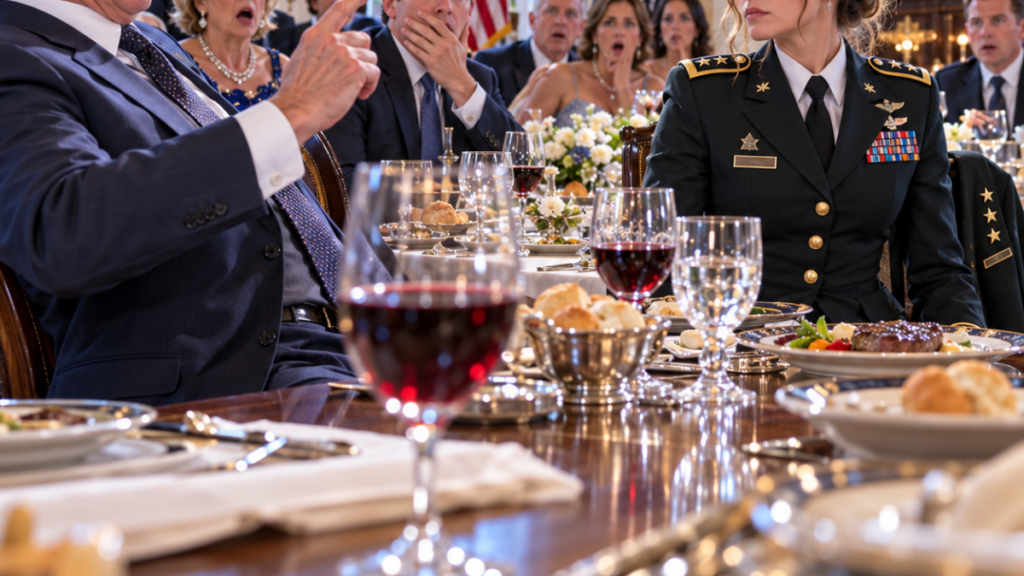
My Fiancé’s Father Didn’t Know I Was The New Army General. He Thought I Was Just Some Girl Dating His Son. At Dinner, He Started Lecturing Me About Military Command… Then I Told Him My Rank…
I thought the hardest part of marrying Daniel would be combining two complicated careers. I was wrong. The real challenge began at a Sunday dinner when his retired Army father spent nearly an hour explaining military leadership to me as though I had never stood inside a command center. Daniel knew exactly what was happening, but he had hidden one important fact from his family for years. I let the lecture continue until one question finally forced me to tell the truth.
### Part 1
Three weeks before the dinner that changed everything, Daniel Mercer sat across from me at our kitchen table with the expression he wore whenever he had bad news and was trying to decide how much of it to reveal at once. I had seen that look when a bridge inspection had gone wrong, when his company had lost a federal contract, and once when he had accidentally backed my car into a concrete planter. That Thursday evening, however, nothing was broken, nothing was burning, and there was no urgent call coming from his office. There was only a grocery bag between us, chicken sizzling in a skillet, and Daniel turning his water glass in slow circles.
“Just say it,” I told him. “Whatever it is, your face is making it worse.”
He laughed once, but the sound carried no relief. “My parents want us to come for dinner Sunday.”
“That’s the crisis?”
“No. That’s the opening sentence.”
I turned down the burner and looked at him properly. Daniel and I had been together for four years, engaged for less than a month, and somehow I had still never sat across a table from his parents. There were reasonable explanations at first: his parents lived outside Columbus, Georgia, while our work had moved us through Virginia, Texas, and Washington; his mother had undergone knee surgery; my schedule had become increasingly unforgiving. But four years was long enough that “bad timing” had begun sounding like a polite fiction.
Daniel carried our plates to the table and sat down. “My dad is going to ask what you do.”
“I assume most fathers ask that.”
“Yes, but my father is not most fathers.”
That, I already knew. Walter Mercer had retired from the Army as a command sergeant major after nearly three decades of service. Daniel described him as disciplined, intensely loyal, stubborn enough to argue with a thunderstorm, and incapable of sitting through a war movie without pointing out every uniform mistake. Their house displayed unit photographs beside family portraits, and Walter still woke before sunrise even though no formation had required his presence in nearly fifteen years.
“What exactly have you told him?” I asked.
Daniel looked at his plate.
That was when I became concerned.
“Daniel.”
“I told him you work with federal facilities.”
I stared at him. “I do work with federal facilities.”
“I know.”
“That is like saying an airline captain works around airplanes.”
His mouth twitched. “Technically true.”
“How long have you been describing me this way?”
He inhaled slowly. “About three years.”
The answer was so ridiculous that I actually laughed. “Your parents think you’ve spent four years dating a building manager?”
“I said you were involved with installation planning.”
“Oh, excellent. A building manager with spreadsheets.”
“Mara.”
I leaned back and folded my arms. “Why?”
He stopped smiling. “Because my dad has opinions.”
“Everyone has opinions.”
“He has opinions about women in senior command.”
The room changed in a way only a few words can make a room change. Outside our open kitchen window, somebody was mowing a lawn, and every few seconds the mower dipped in volume when it passed behind a neighboring house. The chicken smelled faintly of rosemary and lemon. I remember those details because they gave my mind something harmless to hold while I considered Daniel’s admission.
“What kind of opinions?”
Daniel rubbed the back of his neck. “The kind that begin with, ‘I’m not saying women can’t lead, but…’”
“There’s always a productive second half to that sentence.”
“I know.”
“And you thought the solution was to hide me?”
“I thought the solution was to let him meet Mara before he met Brigadier General Ellison.”
I said nothing.
Only two weeks earlier, I had assumed command of one of the largest Army installations in the region after thirty-one years of service. I had worn a uniform since I was nineteen, commanded troops on multiple assignments, spent years moving through positions where every decision carried more weight than the one before it, and learned long ago that rank could change the temperature of a room before I even spoke. I understood why Daniel sometimes wanted to protect our private life from that gravity.
What bothered me was that he had decided I needed protecting from his father.
“You should have told me,” I said.
“I should have.”
“You should have told him.”
“I tried twice.”
“And?”
Daniel grimaced. “The first time, he started talking about promotion politics before I even got to your name. The second time, he spent twenty minutes explaining why the Army was putting people in senior positions too quickly.”
“And you gave up.”
“I postponed.”
“That is an engineer’s word for giving up.”
He smiled despite himself. “Fair.”
I ate another bite while I thought about it. I could have refused the dinner. I could have told Daniel that if his father required a sanitized version of me before deciding whether I was acceptable, then perhaps Walter Mercer could wait until the wedding to discover whom his son had chosen. A younger version of me might have done exactly that.
Instead, I found myself curious.
People behaved differently around rank. Some became stiff, some excessively agreeable, some strangely competitive. Very few forgot it. The possibility of meeting Daniel’s father before the title entered the room had an odd appeal.
“All right,” I said.
Daniel blinked. “All right?”
“We’ll go Sunday.”
His shoulders dropped. “You’re sure?”
“I’ve testified before congressional committees, sat through eight-hour operational briefings, and once spent an entire flight beside a colonel who explained cryptocurrency to me without being asked. I think I can survive pot roast.”
He laughed hard enough to cough.
Then his face sobered. “He’s going to test you.”
“That sounds dramatic.”
“You haven’t met him.”
“What does ‘test me’ mean?”
“He’ll ask about the Army. He’ll say something controversial and see whether you agree. If he thinks you don’t know enough, he’ll start teaching.”
“Teaching what?”
“Whatever topic he decides you don’t understand.”
I picked up my glass. “And what do you suggest I do?”
Daniel looked at me for several seconds. “Honestly? I have no idea.”
That answer interested me more than any warning he had given.
On Sunday afternoon we drove south beneath a hard blue Georgia sky, leaving the commercial edges of Columbus behind until the highway narrowed and pine trees pressed closer to both shoulders. Daniel kept both hands on the wheel. Twice he started speaking and stopped.
“You’re thinking loudly,” I said.
“My father is going to say something.”
“I gathered that.”
“He may not realize he’s insulting you.”
“That happens more often than people think.”
“You’re very calm.”
“I’m always calm before contact.”
He glanced over. “That is exactly the kind of sentence that makes me nervous.”
A few miles later, we turned onto a gravel road lined with cedar trees. At the end stood a low brick house with white trim, a vegetable garden beside the garage, and two flags lifting in the afternoon wind. The first was the American flag. Beneath it flew a faded Army flag that had obviously been outside through more Georgia summers than anyone remembered.
A man stepped onto the porch before Daniel had even switched off the engine.
Walter Mercer was shorter than I expected, broad through the shoulders, silver-haired, straight-backed, and completely still. Even from the passenger seat, I could tell he was evaluating us.
Daniel looked at him, then at me.
“One last chance to turn around.”
I opened the door.
“You’ve been warning me about this man for three years,” I said. “Now I want to meet him.”
I thought I was walking toward an awkward family dinner.
I had no idea Walter Mercer was about to spend the evening explaining my own command to me.
### Part 2
Walter waited at the bottom of the porch steps, one hand hooked casually into the pocket of his jeans. His expression did not change when Daniel hugged him, though he slapped his son twice on the back with enough force to make the gesture sound almost official. Then Daniel stepped aside and introduced me simply as Mara Ellison. I watched recognition fail to appear in Walter’s face, which confirmed that Daniel had not secretly repaired the omission before we arrived.
“Mara,” Walter said.
“Mr. Mercer.”
“Walter.”
He extended his hand. His grip was firm without becoming theatrical, and I noticed the quick visual inventory he made while we shook: posture, shoes, hands, eyes. Veterans do that sometimes without meaning to. So do commanders.
“Daniel says you work around the post.”
“He’s mentioned that, yes.”
Walter gave a small nod, apparently satisfied. “Good work if you can tolerate bureaucracy.”
“I’ve developed some experience with it.”
The corner of Daniel’s mouth twitched.
Before Walter could ask more, his wife appeared in the doorway and saved us. Ruth Mercer was warm in exactly the way her husband was reserved. She hugged Daniel, took both my hands, and said, “Thank God. I was beginning to suspect he’d invented you.”
“I’ve wondered the same thing about you,” I said.
Ruth laughed immediately. Walter took an extra second.
Inside, the house smelled of slow-cooked beef, onions, coffee, and the faint dusty sweetness of old wood. The living room told Walter’s story before he did. One wall held photographs from different decades: Walter younger and leaner in woodland camouflage, Walter standing in desert sand beside a line of soldiers, Walter receiving a plaque, Walter and Ruth at what appeared to be a retirement ceremony.
A shadow box hung beside the hallway. Ribbons, unit patches, insignia, and a pair of chevrons rested behind polished glass.
I stopped long enough to look.
“Desert Storm,” Walter said behind me.
I turned. “You were there?”
“Third Armored.”
I nodded. “That must have been a hell of a deployment.”
His eyes sharpened slightly, as though he had expected the generic phrase people usually offered. “It had its moments.”
“Thank you for your service.”
He gave me the restrained nod of someone who had heard those words thousands of times and still wasn’t comfortable answering them.
Ruth called us to the dining room before the silence grew awkward. She had made pot roast, green beans, potatoes, cornbread, and peach cobbler waiting beneath a towel on the counter. Daniel sat beside me, Walter across from us, and Ruth at the other end.
For twenty minutes, dinner was almost disappointingly normal.
Ruth asked where I had grown up. I told her about western Pennsylvania winters, my mother’s tiny backyard, and the steel town where half the families could identify one another by the cars parked outside church. She asked how Daniel and I met.
“Work,” I said.
Daniel grinned. “She thought I was annoying.”
“You were annoying.”
“I asked three questions.”
“You asked three questions after everyone else had been dismissed from the meeting.”
Walter looked between us. “What kind of meeting?”
“Facility assessment,” Daniel said quickly. “Virginia.”
“Federal project?”
“Yes.”
Walter looked at me. “You work for Defense?”
“In coordination with it.”
That answer was deliberately broad, but it was true.
“What exactly do you do?”
“I work with installation leadership, infrastructure planning, readiness issues, personnel requirements, long-term operational priorities.”
Walter nodded as though translating that into a category he understood. “Civilian side.”
“Sometimes.”
Daniel reached for his water.
Walter did not notice.
“Well, that work matters,” he said. “Soldiers shouldn’t have to worry whether a building is falling apart while they’re trying to train.”
“I agree.”
“Army’s gotten too dependent on contractors, though.”
“There are areas where that conversation is worth having.”
He looked pleased by the answer. “Exactly.”
I could almost feel Daniel begging me not to enjoy this.
Ruth redirected the conversation to their neighborhood, telling us that the family two houses down had finally removed a dead oak threatening everyone’s power lines. For several minutes we discussed weather, property taxes, and Daniel’s current bridge project. Walter listened, but I could tell he had not finished with me.
He was waiting.
Eventually, Ruth asked about wedding plans.
“We’re still deciding whether to do something small,” I said.
“Small is better,” Walter said. “Weddings have turned into military operations.”
“That depends on the operation,” I said.
Daniel closed his eyes briefly.
Walter leaned back. “You’ve spent enough time around installations to pick up the language.”
“A little.”
He nodded. “Daniel told me you’ve moved quite a bit.”
“Work has required it.”
“You like that?”
“Sometimes. Sometimes I’d prefer to own a couch long enough to remember where I bought it.”
Ruth laughed.
Walter’s expression softened for the first time. “That sounds like Army life.”
“It has similarities.”
For one moment, I thought the evening might remain there—pleasant, cautious, ordinary.
Then Walter laid down his fork.
“So let me ask you something.”
Daniel’s knee touched mine beneath the table.
Not affectionately.
As warning.
Walter leaned forward.
“You work around senior Army leadership,” he said. “What do you think about where the Army is headed?”
Ruth’s fork stopped halfway to her plate.
“In what sense?” I asked.
“Command.”
Daniel said, “Dad.”
“I’m asking a question.”
“You’re never just asking a question.”
Walter ignored him. “I’m curious what someone on the civilian side sees.”
I could have ended the situation then. One sentence would have done it.
Instead I answered the question.
“Every generation believes the institution is changing faster than it should,” I said. “Sometimes they’re right. Sometimes they’re reacting to the fact that the problems changed before the doctrine caught up.”
Walter studied me.
“Diplomatic answer.”
“Accurate answer.”
He smiled slightly.
Not warmly.
The way a chess player smiles when an opponent finally makes a move.
“The problem,” Walter said, “is that the Army has started confusing credentials with leadership.”
Daniel stared at his plate.
Ruth quietly reached for her iced tea.
And I realized Daniel had been right.
His father was about to test me.
### Part 3
Walter tapped one finger lightly against the edge of his plate. “A résumé can tell you where somebody went to school, what assignments they held, what boxes they checked. It can’t tell you whether soldiers will follow them when everything goes wrong.” His voice remained calm, almost friendly, which made the conversation stranger than if he had simply been rude. “People outside the uniform often don’t understand that.”
“I think plenty of people inside the uniform forget it too,” I said.
His eyebrows lifted.
Daniel looked at me sideways.
Walter considered my answer, then nodded once. “Fair.”
For another minute I thought he might stop. Instead, he leaned back and continued with the steady confidence of a man who had spent years delivering corrective counseling and had never lost the rhythm. “The Army I came up in wasn’t perfect. We had bad officers, bad NCOs, stupid policies, all of it. But there was still an understanding that command had to be earned.”
“I agree.”
“Do you?”
“Yes.”
Something about my answer bothered him. Perhaps it was too quick. Perhaps he had expected resistance and did not know what to do with agreement.
He wiped his mouth with his napkin. “Then you probably understand what I mean when I say the Army has become too interested in appearances.”
“Appearances in what sense?”
Walter glanced toward Daniel before returning his attention to me. “Making leadership look a certain way instead of asking whether the person can actually lead.”
There it was.
Not explicit enough for Daniel to interrupt without starting an argument. Not vague enough that any of us misunderstood.
Ruth said quietly, “Walter.”
“I’m discussing leadership.”
“You’re circling something.”
“I’m not circling anything.”
“You’ve been married to me for forty-two years. You circle badly.”
Daniel looked down to hide a smile.
Walter ignored both of them. “My point is that standards matter. Especially in senior command.”
“They do.”
“You don’t put someone in charge because the appointment makes a good headline.”
“No.”
“You don’t promote someone because the institution wants to prove something.”
“No.”
His expression sharpened. “So we agree.”
“On the principle.”
That answer made him pause.
“What does that mean?”
“It means principles are easy to state in general terms. The difficulty is deciding when they actually apply.”
Walter sat back.
For the first time that evening, I saw something change in his eyes. He was no longer lecturing a civilian. He was trying to determine why the civilian was not behaving like one.
“You’ve studied this,” he said.
“A little.”
Daniel coughed into his fist.
I did not look at him.
Walter continued. “Let me give you an example. Fort Moore has had enormous changes in leadership and mission over the years. That post needs somebody who understands combat formations, training cycles, family readiness, infrastructure, politics, Washington pressure—the whole machine.”
“That’s true.”
“You can’t learn that from policy papers.”
“No.”
“You learn it by being responsible when the decision costs something.”
“Yes.”
His voice grew more animated because he believed he had finally reached the heart of his argument. “Exactly. That’s what people miss. Command isn’t sitting in an office issuing guidance. It’s waking up knowing thirty thousand people can feel the consequences of whether you’re right or wrong.”
I held his gaze.
“More than thirty thousand, depending on what you count.”
Walter stopped.
Ruth looked at me.
Daniel slowly placed his fork beside his plate.
Walter’s eyes narrowed. “You know the numbers?”
“I’m familiar with them.”
“How?”
Daniel whispered, “Mara.”
I glanced at him. His face carried a question now.
Was I ready?
I had been ready since Walter sat down.
What I had not expected was how little anger I felt. Walter’s assumptions were insulting, yes, but they were also revealing. He had been given several opportunities to recognize that the person across from him might know more than he assumed, and each time his certainty had protected itself.
So I gave him one final chance.
“What do you think Fort Moore’s biggest leadership problem is right now?” I asked.
Walter seemed surprised that I had turned the question around.
“Right now?”
“Yes.”
He thought about it. “Retention. Training tempo. Maintaining standards while Washington keeps changing priorities.”
“All real pressures.”
“What would you say?”
“Integration.”
“Of what?”
“Everything you just named. People treat retention, training, infrastructure, families, readiness, and modernization like separate problems because they sit in separate briefings. They aren’t separate. If housing fails, retention suffers. If retention suffers, units lose experience. If units lose experience, training efficiency drops. Then leaders compensate with tempo, which puts more pressure on families, which hurts retention again.”
Walter’s expression became still.
I continued. “The job isn’t solving five problems. It’s recognizing the one system connecting all five.”
The refrigerator hummed in the kitchen.
Somewhere outside, a truck passed on the road.
Walter stared at me.
“What did you say your job was?”
Daniel closed his eyes.
I set my fork down, folded my hands in my lap, and decided the experiment had lasted long enough.
“I didn’t,” I said.
Walter looked at his son.
Daniel said nothing.
Then Walter looked back at me.
“My name is Brigadier General Mara Ellison,” I said. “I assumed command of Fort Moore last month.”
Nothing moved.
Not Walter’s hands.
Not Ruth’s glass.
Not Daniel’s shoulders.
For nearly five seconds, the dining room seemed to lose sound entirely.
Walter finally blinked. “What?”
“I command the installation you’ve been describing.”
He stared at me as though I had suddenly begun speaking another language.
“That’s not possible.”
Ruth inhaled sharply.
Walter seemed to hear his own words and immediately regretted them.
“I didn’t mean—”
“I know.”
“You’re…” He stopped.
“Too young?”
“No.”
“Female?”
His jaw tightened. “I was going to say I didn’t realize.”
“That part is obvious.”
Daniel murmured, “Mara.”
I turned to him. “It’s fine.”
Walter’s eyes moved between us. “You knew?”
Daniel nodded.
“For how long?”
“Since I met her.”
Walter looked as if this betrayal might actually be worse than my rank. “Four years?”
“Dad—”
“Four years?”
“You never asked the right question.”
“I asked what she did.”
“You asked whether she was some kind of contractor and then answered yourself.”
Walter pushed his chair back several inches, then stopped as if standing would make the moment more dramatic than he wanted. His face had gone pale beneath the weathered color of his skin. For the first time since we arrived, the certainty was completely gone.
Ruth covered her mouth, though whether she was shocked or preventing herself from laughing, I could not tell.
Walter looked at me again.
“General Ellison.”
“Mara is fine.”
“I just spent forty minutes explaining Army command to a brigadier general.”
Ruth lowered her hand.
“Closer to fifty.”
He turned toward her.
“You were timing me?”
“I was suffering with precision.”
Daniel bent forward, pressing his lips together.
Walter did not laugh.
He sat perfectly still, staring at his plate.
Then something happened that surprised me more than the lecture.
He looked up and said, “I owe you an apology.”
### Part 4
Walter did not soften the apology with excuses. He did not say he had been misunderstood, that standards had changed, or that people were too sensitive now. He simply placed both hands flat on the table and looked directly at me.
“I made assumptions before you walked through my front door,” he said. “Then I spent dinner looking for evidence that proved those assumptions right.”
I had spent enough time in senior leadership to recognize how rare that sentence was.
“You didn’t know,” I said.
“That is not a defense.”
“No.”
“I also talked down to you.”
“A little.”
Ruth made a quiet sound that might have been amusement.
Walter glanced at her. “Apparently for fifty minutes.”
“Forty-eight,” she said.
Even Daniel laughed then.
Walter rubbed his forehead. “Wonderful.”
The tension broke just enough for everyone to breathe again, but the evening did not become magically comfortable. Walter asked a few questions about my command, each one more careful than the last. I answered what I could without turning Sunday dinner into a briefing.
When we left, Walter walked us to the porch.
The sun had dropped behind the trees, leaving the road violet-gray beneath the cedars. His handshake was different from the one he had given me when we arrived. The first had been an evaluation.
This one felt like an acknowledgment.
Daniel waited until we were halfway down the gravel road before speaking.
“Well.”
“That’s your assessment?”
“I’m an engineer. We use technical language.”
I looked out the window.
“You’re angry.”
“Not at your father.”
Daniel glanced over.
That worried him more.
“At me?”
“You hid my life from your family for three years because you didn’t want an uncomfortable conversation.”
“I wanted them to meet you without rank getting in the way.”
“That explanation worked until tonight.”
He tightened his hands on the steering wheel.
“And now?”
“Now I’m wondering whether you were protecting me or protecting yourself.”
He did not answer immediately.
That told me enough.
“I didn’t want him judging you before he knew you,” he said.
“He judged me anyway.”
“I know.”
“And I walked in without knowing how much groundwork you had laid for exactly that judgment.”
Daniel stared ahead.
“That wasn’t fair.”
“No.”
“I’m sorry.”
I believed him.
But believing an apology and being finished with the problem are not the same thing.
For the next several days, life returned to its normal pace. At work, my schedule began before sunrise with readiness updates and ended most evenings with a stack of briefing packets I carried home and pretended I would read before falling asleep. The strange Sunday dinner became something I replayed only when silence gave my mind room.
On Thursday morning my aide knocked on my office door.
“Ma’am, I have a Walter Mercer asking for you.”
I looked up.
“Did he say what he wants?”
“Only that it’s personal.”
“Put him through.”
A few seconds later Walter’s voice came through the phone.
“General Ellison.”
“Mara.”
He paused. “I’m not sure I’m there yet.”
Despite myself, I smiled. “You’ll survive.”
Another pause.
“I was wondering whether you had time to meet somewhere.”
“What for?”
“I’d rather explain in person.”
The veteran’s memorial garden stood just beyond the busiest section of the installation, where the traffic noise faded beneath pecan trees and old oaks. Bronze plaques lined a gravel path, each one carrying names, units, dates, and fragments of history too heavy for the amount of space they occupied.
Walter was waiting beside a granite marker when I arrived.
He straightened automatically.
“Old habits,” I said.
“They get worse with age.”
We began walking.
For several minutes he said nothing. He stopped at one plaque and ran his eyes down the names slowly.
“I knew four of these men.”
I stayed quiet.
“One was twenty-three. Thought instant coffee was a food group. Another cheated at cards so badly we eventually stopped inviting him because watching him cheat was insulting.”
A smile crossed Walter’s face and disappeared.
“I come here when I start remembering the Army as better than it actually was.”
That sentence surprised me.
He looked at the plaque.
“Memory edits things.”
“Yes.”
“It keeps the discipline and throws away the stupidity.”
“Usually.”
“It keeps the people you respected and somehow forgets how long it took them to earn that respect.”
I knew where he was going now.
Walter turned toward me.
“I told you Sunday that good leaders have to read people.”
“You did.”
“I spent twenty years teaching NCOs not to make decisions before they had enough information.”
“You probably taught it well.”
“Apparently not to myself.”
We continued down the path.
“I saw a woman younger than I expected,” he said. “I heard ‘federal facilities.’ I knew Daniel had never served. And somewhere in my head, I decided I understood the whole picture.”
“You weren’t the first.”
“That doesn’t make me feel better.”
“It wasn’t intended to.”
He gave a short laugh.
Then his expression became serious again.
“Why didn’t you stop me?”
“I wanted to understand you.”
“That’s all?”
“No.”
I looked toward the rows of plaques.
“I also wanted to know whether you were trying to humiliate me or whether you genuinely believed you were helping.”
“And?”
“You genuinely believed you were helping.”
His face tightened.
“That may be worse.”
“Sometimes.”
We reached a bench but remained standing.
Walter stared at the gravel.
“You know what bothered me most after you left?”
“What?”
“Not that you outranked me. Not even that I embarrassed myself.”
He looked up.
“What bothered me was that if you had been exactly who I thought you were—a civilian woman who worked around installations—I still would have had no reason to talk to you that way.”
That was the moment my opinion of Walter Mercer began to change.
Not because he apologized to a general.
Because he realized he should have respected the woman he thought had no rank at all.
### Part 5
Walter and I spent nearly an hour in the memorial garden. We talked about leadership, but for the first time there was no performance in it. He told me about the best officer he had ever served under, a captain named Denise Harper who had arrived at his unit in the early 1980s when many of the men believed a woman had no business leading them.
“The first week, they tested everything she said,” Walter told me. “Not openly. Nothing you could write someone up for. Just little resistance. Slow compliance. Questions they wouldn’t have asked a male captain.”
“What happened?”
“She let them expose themselves.”
I smiled. “Interesting strategy.”
“She knew the regulations better than anybody. Knew the equipment. Knew the soldiers. Never raised her voice unless somebody was about to get hurt.” Walter shook his head. “Three months later, the same men who doubted her would have walked through fire if she asked.”
“And you?”
“I was one of the men doubting her.”
That admission hung between us.
“How old were you?”
“Twenty-two.”
“And you changed.”
“I thought I had.”
“You did.”
He looked unconvinced.
“Walter, growth isn’t a vaccination. You don’t become immune to being wrong.”
He considered that.
“Sounds like something they teach generals.”
“No. Generals usually learn it the expensive way.”
That finally made him laugh.
Before we separated, Walter asked whether Daniel and I would come to dinner again.
“Ruth is insisting,” he said.
“Is she making pot roast?”
“She said we need to rerun the entire evening correctly.”
“That sounds dangerous.”
“She also told me she plans to remind me about the first dinner every Thanksgiving until one of us dies.”
“I like her.”
“She’s becoming a problem.”
The second dinner took place ten days after the first.
Daniel was more nervous this time.
“You know he’s going to overcorrect.”
“What does that look like?”
“I don’t know. He may salute you at the mailbox.”
“I’ll have him arrested.”
Daniel glanced at me.
“That was a joke.”
“I can never tell anymore.”
Walter opened the door before we knocked.
“Mara.”
No rank.
No hesitation.
“Walter.”
He shook my hand.
Ruth appeared behind him carrying a wooden spoon. “See? Nobody exploded.”
“Dinner hasn’t started,” Walter said.
The same smells filled the house. Pot roast, onions, cornbread. Ruth had actually recreated the entire menu.
“The best way to repair a bad memory,” she said, “is to force everybody to live through it again with better manners.”
“I object to this theory,” Walter muttered.
“Your objection has been noted and ignored.”
Dinner began easily. Walter asked about work, but he did not ask questions designed to demonstrate what he knew. He asked what had surprised me about the command, what problem consumed more time than expected, what had changed since his era.
I gave him real answers.
“Information speed,” I said. “When you served, a bad decision might take hours to spread beyond a unit. Now someone records ten seconds, posts it without context, and by lunch the Pentagon may be asking questions.”
Walter frowned. “I would have hated that.”
“You would have been magnificent on social media.”
“I don’t know what that means.”
“It means absolutely not.”
Ruth laughed.
Halfway through dinner, Walter cleared his throat.
The table quieted.
“I want to say something.”
Daniel became still beside me.
Walter looked at me.
“At the first dinner, I said real leadership reveals itself under pressure.”
“You did.”
“I still believe that.”
“I assumed you would.”
He nodded. “But I’ve been thinking about the fact that you sat here and listened to me for almost an hour. You could have ended that conversation in thirty seconds.”
“Yes.”
“You could have humiliated me.”
“Yes.”
“You didn’t.”
I waited.
Walter looked down at his hands.
“For ten days, I’ve been asking myself whether I would have shown the same restraint.”
Nobody interrupted him.
“I don’t know that I would.”
“That doesn’t make me a better person.”
“No,” he said. “But it taught me something about the kind of leader you are.”
I glanced at Daniel. His eyes were fixed on his father.
Walter continued.
“Command isn’t proving you can win every room. Sometimes it’s knowing you don’t have to.”
The words were simple.
But I knew what they cost him.
“Walter,” I said, “you found your own way to that conclusion.”
“Took long enough.”
“I’ve worked with colonels who needed fifteen years.”
Ruth smiled. “So he’s above average.”
“Let’s not get reckless,” I said.
Walter laughed.
Something shifted at the table then. Not dramatic reconciliation, not instant closeness. Something quieter.
Trust.
After dessert Daniel and Ruth carried plates into the kitchen, leaving Walter and me alone.
He turned his water glass between his palms.
“Can I ask something personal?”
“You’ve developed a taste for danger.”
His mouth twitched.
“Why the Army?”
I had been asked that question hundreds of times.
Usually I gave the short answer.
College money. Opportunity. Service.
That night, I gave him the real one.
“Because when I was nineteen, I needed somewhere that would demand more of me than I demanded of myself.”
Walter nodded slowly.
“And did it?”
“Every day.”
He looked toward the shadow box in the hallway.
“Yeah,” he said. “That sounds familiar.”
For the first time, we were no longer a general and a retired command sergeant major.
We were simply two people who had given most of our adult lives to the same institution and survived long enough to understand what it had taken.
Then Daniel came back from the kitchen and asked his father a question that changed the mood completely.
“Dad, why did you never ask me what Mara actually did?”
Walter looked at him.
Daniel did not look away.
The second dinner was not finished after all.
### Part 6
Walter leaned back in his chair. “I did ask.”
“No,” Daniel said. “You asked questions that already contained the answer you wanted.”
Ruth stopped in the doorway.
I remained quiet.
This was no longer my conversation.
Daniel rested his forearms on the table. “Three years ago, I tried to tell you Mara was senior Army leadership. You interrupted me to complain about promotion standards. Last year I tried again, and you spent half an hour telling me what was wrong with general officers you’d never met.”
Walter’s face tightened.
“I remember.”
“So I stopped trying.”
“That was your decision.”
“Yes.”
Daniel nodded.
“And it was cowardly.”
That surprised everyone.
Walter’s expression changed first.
Daniel looked at me.
“I told myself I was protecting Mara from you. I wasn’t. I was protecting myself from having to challenge you.”
I had spent the week wondering whether he understood that distinction.
Now I knew.
Walter looked down.
Daniel continued. “You taught me to stand behind my decisions. Then I chose the woman I want to marry and spent three years editing her life because I was afraid you wouldn’t approve.”
“I never asked you to do that.”
“You made it easy to predict what would happen.”
Walter’s jaw tightened.
Ruth walked to the table and placed a hand on the back of her chair.
“Daniel,” she said quietly, “he’s right about one thing. Your father didn’t ask you to lie.”
“I know.”
“And you’re right about another. He made honesty expensive.”
Walter looked at her.
She met his eyes calmly.
Nobody spoke for several seconds.
Then Walter said, “That’s fair.”
Daniel blinked.
I think he had expected a fight.
Walter turned toward him. “I’m not going to pretend I like hearing it.”
“I didn’t think you would.”
“But you’re right.”
Something in Daniel’s shoulders loosened.
Walter looked at me.
“You were angry with him after the first dinner.”
It was not a question.
“Yes.”
“For hiding your rank?”
“For deciding what part of me your family was allowed to see.”
Daniel lowered his eyes.
Walter nodded slowly.
“That would bother me too.”
“It bothered her a lot,” Daniel said.
“I noticed.”
I almost smiled.
Walter folded his hands. “Then maybe all three of us made assumptions.”
Ruth lifted one eyebrow. “Don’t drag me into this. I made a pot roast.”
That broke the tension.
We laughed, and the laugh mattered because nobody used it to escape the conversation. We stayed there.
Daniel apologized again, this time without defending the reason behind what he had done. He admitted that he had spent years managing his father instead of confronting him. Walter admitted that his children had learned to avoid certain subjects because he could turn disagreement into a lecture.
“I thought I was teaching,” Walter said.
“Sometimes you were,” Daniel replied. “Sometimes you were just making sure nobody else got a turn.”
Walter winced.
Ruth nodded. “I have been telling you this since 1997.”
“Why 1997?”
“I remember the exact barbecue.”
Walter stared at her.
I looked at Daniel.
“Your family archives disputes.”
“You’re marrying into a very organized system.”
By the time we left, the second dinner had done more than repair the first.
It had uncovered a fault line that had been running through the Mercer family long before I arrived.
In the car, Daniel did not speak until we reached the main road.
“I’m sorry,” he said.
“I know.”
“I should have told them years ago.”
“Yes.”
“I should have told you exactly why I hadn’t.”
“Yes.”
He exhaled.
“You’re not making this easy.”
“I’m not supposed to.”
He nodded.
Then he reached across the console and held out his hand.
I looked at it before taking it.
“I don’t need you to fight every battle for me,” I said. “But I do need to know you won’t hide me to avoid one.”
“You won’t ever have to wonder again.”
“That’s a promise you have to keep, not a sentence you have to say.”
“I know.”
We drove the rest of the way home with our hands linked across the console.
Over the next month, Walter and I spoke several times. Sometimes he called to ask about something he had heard concerning the Army. The first few conversations began with him saying, “I’m asking, not telling,” which Ruth had apparently required him to practice.
Sometimes I called him.
That surprised me.
He had a useful memory for the human side of military life. He understood how policies that looked efficient on paper could land badly in a company area. I never treated his experience as current doctrine, and he never again treated his experience as the only version of the Army that mattered.
One afternoon he called while I was reviewing an installation housing proposal.
“I have a question,” he said.
“Proceed.”
“That sounds official.”
“You called me during work.”
“Fair.”
He paused.
“Do you ever worry the rank makes people stop telling you when you’re wrong?”
Every senior leader worries about that.
The bad ones stop worrying.
“Yes,” I said.
“What do you do about it?”
“I keep people near me who are unimpressed by stars.”
He laughed. “Ruth could help.”
“I considered recruiting her.”
“Absolutely not.”
For a moment neither of us spoke.
Then Walter said, “I spent most of my career thinking leadership meant being the person with the answer.”
“And now?”
“Now I think maybe it means making sure the truth can reach you.”
I leaned back in my chair.
That was a better definition than some I had heard at professional military schools.
“You should write that down.”
“I’m retired. I’m done writing things down.”
“You called a general during business hours to discuss leadership philosophy.”
There was a pause.
“Point taken.”
When we hung up, I looked through my office window at the installation stretching beyond headquarters.
The strangest part of the entire situation was not that Walter had changed his mind about me.
It was that I had begun changing mine about him.
### Part 7
Two months after our first dinner, Daniel and I finally chose a wedding date. We wanted something small, close to Columbus, with fewer speeches than people kept threatening to give. Ruth immediately began building a guest list that violated the word “small” in several measurable ways.
Walter surprised everyone by staying out of the planning.
“I commanded enough operations,” he said. “I know when I’m outside the chain of command.”
Ruth stared at him.
“Who are you?”
He pointed at me. “Her fault.”
Wedding planning did not erase the tension completely. Families do not transform because one conversation goes well. Walter still interrupted sometimes, still slipped into old habits, still occasionally began a sentence with, “Back when the Army had sense,” before catching himself.
The difference was that now he caught himself.
And when he didn’t, Ruth did.
One Saturday afternoon, Daniel and I went to his parents’ house to review catering options. Walter was outside replacing a loose board on the porch steps, though according to Ruth the board had not been loose until Walter decided he needed a project.
He motioned me over.
“Can I show you something?”
Inside, he led me to the hallway and removed the shadow box from the wall.
Behind it was an old photograph I had never noticed.
A group of soldiers stood in front of a vehicle, young enough that Walter looked almost like a different person. Near the center was a woman wearing captain’s bars.
“Denise Harper?” I asked.
He nodded.
“The officer you told me about.”
“Same one.”
He handed me the photograph.
“She retired as a colonel.”
“Did you stay in touch?”
“For a while.”
Walter looked at the image.
“She used to say something whenever one of us got too sure of ourselves.”
“What?”
“‘Certainty is expensive. Make sure you can afford it.’”
I smiled.
“I like her.”
“You would have.”
He took the photograph back but did not return it behind the shadow box.
Instead, he placed it on the small table beneath.
“I hid that picture back there when we moved into this house.”
“Why?”
“No reason.”
“That usually means there’s a reason.”
Walter sighed.
“She wrote me after I made command sergeant major. Told me she was proud. Told me not to become one of those old NCOs who thinks the Army ended the day he retired.”
I tried not to laugh.
“You ignored the advice.”
“For approximately fifteen years.”
“Better late than never.”
He looked at me.
“That’s what bothers me.”
“What?”
“That everybody says that when somebody finally does what they should have done from the beginning.”
I understood him immediately.
Walter did not want credit for correcting something he should not have believed.
“That’s because change still matters,” I said. “It doesn’t erase what came before.”
“Exactly.”
“You embarrassed me at dinner.”
“I know.”
“You made assumptions about women in command.”
His mouth tightened.
“Yes.”
“And then you examined those assumptions instead of defending them.”
He waited.
“That doesn’t erase the first part. It just determines what happens next.”
Walter nodded slowly.
“Does this mean you forgive me?”
I considered the question.
There is a kind of forgiveness people ask for because they want the consequences to disappear. I had no interest in that version.
“I’m not carrying anger toward you,” I said. “But I’m also not going to pretend the dinner didn’t happen.”
“I don’t want you to.”
“Good.”
He looked relieved.
“That’s probably as close as I deserve.”
“Stop assigning yourself punishments. It’s exhausting.”
He laughed.
That evening, while Ruth and Daniel argued over whether eighty guests still counted as a small wedding, Walter and I sat on the porch.
The American flag moved slowly above the yard.
He told me stories from his career that had nothing to do with proving anything: the lieutenant who got lost during a land-navigation exercise and emerged behind the chow hall, the soldier who mailed twenty pounds of rocks home from Germany because he believed they were historically significant, the first time Walter met Ruth while wearing a dress uniform he had spent forty minutes ironing.
“You were trying to impress her.”
“I was twenty-four.”
“So yes.”
“I deny everything.”
From inside the house, Ruth shouted, “He changed shirts three times.”
Walter closed his eyes.
“Your intelligence network is a problem.”
“It’s excellent.”
For the first time since I had met him, I saw Walter not as Daniel’s intimidating father or as a retired command sergeant major.
I saw the entire man.
Proud. Flawed. Funny when he forgot to guard himself. Capable of being wrong. More importantly, capable of staying in the room after discovering it.
When Daniel and I left that night, Walter walked us to the car.
Before I opened the passenger door, he said, “Mara.”
I turned.
“I’m glad you didn’t leave after that first dinner.”
“So am I.”
“No, I mean it.”
His expression was serious.
“I spent years thinking respect was something people proved they deserved from me.”
He paused.
“I had that backward.”
I did not answer immediately.
Walter nodded toward the house where Ruth stood behind the screen door and Daniel was carrying leftover food toward the car.
“People deserve respect first,” he said. “Then they show you what they do with it.”
There are lessons that arrive early in life.
And there are lessons stubborn people spend decades walking toward.
Walter Mercer had finally reached one of his.
### Part 8
Our wedding took place on a bright October afternoon beneath oak trees outside Columbus. Ruth won the argument over guest count, though she continued insisting that ninety-two people was “practically immediate family.” Daniel stopped trying to correct her after she threatened to invite another twenty out of principle.
I wore civilian clothes.
That decision confused Walter.
“You sure?” he asked one week before the ceremony.
“It’s my wedding, not a change of command.”
“Fair.”
“You sound disappointed.”
“I was hoping to watch half my relatives discover what you do.”
I laughed. “You’ve developed an unhealthy interest in other people being surprised.”
“I went through it alone. I want company.”
By then, most of Daniel’s immediate family knew. Walter had apparently taken private pleasure in correcting several relatives who referred to me vaguely as “the woman who works on base.”
According to Ruth, his favorite line had become, “Not exactly.”
I warned him not to turn my rank into entertainment.
He agreed.
Mostly.
The ceremony itself was simple. Daniel looked more nervous walking toward me than he had during any bridge inspection, and Walter sat in the front row beside Ruth with an expression of fierce concentration, as though successful marriage might depend on his ability to supervise the proceedings.
When Daniel took my hands, the noise around us seemed to recede.
Four years of moving between states, missed weekends, long nights, classified calls, construction deadlines, deployment memories, family mistakes, and one disastrous pot roast dinner had somehow brought us here.
Daniel’s vows were not elaborate.
Neither were mine.
But he included one sentence meant only for me.
“I promise never to make you smaller so someone else can stay comfortable.”
I looked at him.
He held my gaze.
That promise mattered more than any romantic phrase he could have chosen.
At the reception, Walter waited until after dinner to approach me.
He carried two glasses of iced tea.
“No lecture?” I asked.
“I’m retired from lecturing.”
“Ruth says otherwise.”
“She’s biased.”
He handed me a glass.
For a moment we stood at the edge of the lawn watching Daniel talk with friends.
Walter cleared his throat.
“I’ve been thinking about that first dinner again.”
“I suspected this day was going too well.”
He smiled.
“No apology this time.”
“Good.”
“I just realized something.”
“What?”
“I thought you were hiding your rank because you wanted to trick me.”
“I remember.”
“Then I thought Daniel was hiding it because he wanted to protect you.”
“He believed that too.”
Walter nodded.
“But I finally understood why you didn’t care whether I knew.”
I waited.
“Because your rank wasn’t the most important thing about you.”
The answer was close.
“Not at dinner.”
He looked at me.
“That’s what I mean.”
I turned toward the reception. Ruth was trying to convince a group of Daniel’s cousins to dance. Somebody had moved the dessert table for reasons no one understood.
Walter continued quietly.
“When I was young, rank felt like proof. Every stripe meant somebody had finally recognized what you could do. Later, I started thinking everybody should know exactly what I had earned.”
“That’s common.”
“You never needed me to know.”
“No.”
“That bothered me at first.”
“I noticed.”
He laughed.
“Now I think I understand.”
He looked down at his glass.
“People who are certain of themselves don’t always need the room to confirm it.”
I nodded.
“That’s closer.”
Walter smiled.
Several months later, after the wedding noise had faded and life had become ordinary again, Ruth invited us for Sunday dinner.
Pot roast.
Of course.
When Daniel told me, I laughed so hard I had to sit down.
“You realize your mother is never going to cook anything else for us.”
“She says it’s tradition now.”
“That meal nearly caused a family crisis.”
“Exactly. Traditions need origin stories.”
We drove the same road through the Georgia pines, turned onto the same gravel drive, passed the same cedar trees.
The flags were moving in the wind.
Walter opened the door before we reached the porch.
Some things never changed.
“General,” he said formally.
I stopped.
He kept his face completely straight.
“Careful.”
He broke into a grin.
“Mara.”
“Better.”
Inside, Ruth had already set the table.
We took the same seats we had occupied months earlier.
This time nobody seemed tense.
Halfway through dinner, Walter asked me how things were going at Fort Moore.
“Busy.”
“Anything you can talk about?”
“A little.”
He nodded.
Then he did something that would have been impossible at our first dinner.
He waited.
He did not offer his own theory.
He did not tell me what the Army needed.
He did not explain command.
He simply listened.
I told him about soldiers who were doing extraordinary work without recognition, about families carrying burdens civilians rarely saw, about young officers learning that leadership was less glamorous than they had imagined. I told him the installation was changing, because the Army always changed.
Walter asked thoughtful questions.
Occasionally he disagreed.
So did I.
But disagreement no longer felt like a contest.
After dessert, Ruth carried dishes toward the kitchen. Daniel followed her.
Walter and I remained at the table.
The same table where he had once explained my profession to me.
He ran one hand over the worn wood.
“Funny thing,” he said.
“What?”
“I thought that first night you were the one being tested.”
I smiled.
“You weren’t?”
“Maybe.”
He looked toward the kitchen, then back at me.
“But I wasn’t the one who failed.”
I did not rescue him from the statement.
He did not need rescuing.
After thirty-one years in uniform, I had learned that authority can force silence, but it cannot force understanding. Rank can end an argument. It cannot make another person examine himself.
Walter had done that part on his own.
I could have revealed my position within five minutes of meeting him. I could have watched embarrassment replace certainty and walked away feeling victorious. For a few satisfying seconds, perhaps I would have been.
But victory was never what I wanted.
I wanted to know the family I was marrying into.
I wanted Daniel to understand that love could not require hiding uncomfortable truths.
I wanted Walter to see me without a star on my shoulder telling him how much respect he was supposed to show.
Eventually, all three things happened.
Not perfectly.
Not instantly.
But honestly.
When Daniel and I finally stood to leave, Walter walked us onto the porch. The evening air was warm, cicadas loud in the trees.
He shook my hand.
No test.
No performance.
Just the firm, familiar grip of someone who had finally learned who I was.
“See you next Sunday?” he asked.
“If Ruth makes something besides pot roast.”
From inside the house, Ruth shouted, “Not happening.”
Walter sighed.
“Forty-three years and nobody respects my authority.”
I laughed and walked toward the car.
Behind us, the American flag shifted gently beneath the porch light.
Months earlier, I had arrived at that house wondering how long I could sit quietly while a stranger underestimated me.
I left understanding something different.
Sometimes strength is correcting someone immediately.
Sometimes it is walking away.
And sometimes it is knowing exactly who you are, remaining still long enough for someone else’s assumptions to collapse under their own weight, and then deciding what kind of person they become after the silence.
Walter Mercer had been wrong about me.
Daniel had been wrong to hide me.
Neither mistake disappeared simply because they apologized.
But both men did something that mattered more than saying the right words afterward.
They changed what they did next.
And that, after a lifetime spent around people who could issue orders far more easily than they could admit mistakes, was the kind of leadership I respected most.
THE END!

