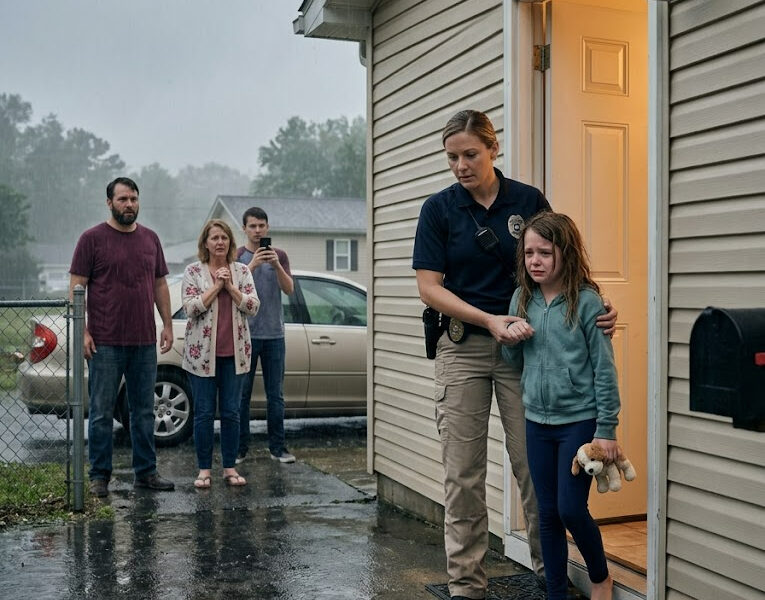
“My dad said he’d only be gone for thirty minutes,” seven-year-old Ashley whispered to a 911 dispatcher after surviving four days alone with nothing but tap water, an oversized shirt, and a stuffed puppy named Buddy. Neighbors immediately branded Andrew a heartless father who had abandoned his sick daughter, filming as police carried the dehydrated child from the house and declaring that no loving parent would disappear without warning. But investigators found an untouched shopping list, a pharmacy receipt for Ashley’s medicine, and groceries purchased less than an hour after Andrew left—proof that he had been trying to return exactly as promised. Then search crews followed a strip of flattened brush beside a storm-flooded road and discovered his pickup buried beneath mud and branches, the cereal and medication still inside. Andrew was missing, but strange marks in the mud led toward a drainage tunnel where something moved beneath the debris…
The Thirty-Minute Promise
Section One — Four Days Alone
“My daddy said he’d only be gone for thirty minutes.”
The child’s voice was so faint that Eric Lawson pressed one hand against his headset, afraid the smallest movement might make him lose her.
Rain rattled against the emergency-dispatch center’s windows. Beyond the glass, the sky over Bellwood County had been dark since morning, the latest storm in a week of flooding that had closed roads, swallowed ditches, and turned ordinary creeks into fast-moving brown rivers.
Eric glanced at the call timer.
“Can you tell me your name?”
“Ashley.”
“And how old are you, Ashley?”
“Seven.”
The answer came after a pause, followed by shallow breathing.
Eric had spoken to frightened children before. Some cried so hard they could barely speak. Others became loud and restless, answering every question at once.
Ashley sounded different.
She sounded tired beyond fear, as though she had used nearly all of it already.
“Are you alone in the house?”
“Yes.”
“How long has your daddy been gone?”
“But now it’s been four whole days.”
Eric sat upright.
At the next desk, a dispatcher immediately began tracing the landline while Eric kept Ashley talking.
Her father, Andrew Mercer, had left on Monday afternoon to collect medicine and groceries. Ashley had been sick with a fever, and rain had been tapping softly against the front window when Andrew backed his old pickup down the driveway.
“He said I could watch cartoons,” she whispered. “And that I shouldn’t open the door.”
“What did you do after he left?”
“I waited.”
Ashley had stood beside the curtain with Buddy, a stuffed puppy, tucked under one arm. She planned to surprise Andrew when his truck returned. Thirty minutes passed. Then an hour.
The rain became heavier.
That first night, she fell asleep on the couch while the porch light remained on. When she awoke, the light was still burning, and Andrew’s truck was still gone.
She waited through Tuesday because her father had never failed to return before.
By Wednesday, hunger made her stomach hurt. She found soup in the refrigerator, but it smelled bad. She drank water from the kitchen faucet and poured some into a plastic cup for Buddy.
“He gets thirsty too,” she explained.
On Thursday morning, she remembered what Andrew had taught her about emergencies. She dragged a dining chair beneath the wall telephone, climbed onto it, and dialed 911.
Eric dispatched police and paramedics.
Officer Natalie Perez arrived nine minutes later as rain swept across a narrow street of small rental houses. Neighbors gathered beneath porches and behind a chain-link fence. One woman held up a phone, already recording.
The mailbox leaned toward the flooded curb. Behind the front curtain, a small shadow moved whenever headlights appeared at the corner.
Natalie climbed the steps and knocked gently.
“Ashley? My name is Officer Natalie. I’m here to help you.”
The door opened two inches.
One frightened eye appeared.
“You’re not going to yell at me?”
Natalie crouched until she was level with the opening.
“No one is going to yell at you.”
Ashley slowly pulled the door wider.
She was barefoot and wearing an oversized plaid shirt that probably belonged to Andrew. Her hair was tangled. Her lips were cracked, and dark shadows rested beneath her eyes. Buddy was pressed so tightly against her chest that one cloth ear remained folded flat.
Natalie had expected signs of neglect.
Instead, she saw a child who had survived by holding onto trust long after food, energy, and certainty had run out.
Inside, the house was quiet but not abandoned. Andrew’s work boots stood beside the back door. His clothes remained in the closet. Several bills were stacked neatly near an uncapped pen.
Two notes lay on the kitchen table.
One was a grocery list:
Rice. Chicken. Soup. Electrolyte drinks. Crackers. Ashley’s medicine.
The second was a reminder about an urgent pediatric appointment scheduled for Monday.
No suitcase was missing. No drawers had been emptied. Nothing suggested a father preparing to disappear.
Outside, the neighborhood had already reached a verdict.
“He probably snapped,” someone said.
“Single father, sick child, no money,” another replied. “Maybe he couldn’t handle it.”
The woman filming whispered that the story would be everywhere by morning.
One man called Andrew a monster.
Natalie heard them but remained focused on Ashley.
“I’m going to carry you outside now.”
“Please don’t leave Buddy.”
“I won’t.”
Ashley nodded.
Natalie lifted her and was shocked by how little she weighed.
The child rested her head against Natalie’s shoulder but continued staring down the street.
An SUV turned the corner.
“Is that Daddy?”
“No, sweetheart.”
Ashley’s body suddenly went limp.
Buddy slipped from her arms.
Natalie caught the stuffed puppy with one hand and tightened the other around the child.
“Unconscious minor,” she radioed. “Probable severe dehydration. Send medical support now.”
The neighbors fell silent. The recording phone dropped to the woman’s side.
Natalie looked toward them.
“This does not look like a father who planned to abandon his child.”
At the hospital, Ashley received fluids while officers began searching for Andrew. His phone went directly to voicemail. His truck was missing from home, work, and every place neighbors knew he visited.
Suspicion remained possible.
A seven-year-old had still been left alone.
But at the rental house, Natalie examined the grocery list again. Near the bottom, Andrew’s neat handwriting became rushed. He had underlined Ashley’s medicine twice.
A pharmacy employee remembered him arriving soaked from the storm. He had collected the prescription twenty-eight minutes after leaving home and asked whether it required refrigeration because he planned to stop for groceries.
A receipt confirmed that he bought rice, chicken, soup, electrolyte drinks, crackers, and Ashley’s favorite cereal less than an hour later.
Andrew had been doing exactly what he promised.
The question was no longer why he left.
It was what stopped him from returning.
Storm reports showed a low section of Miller Road had flooded before barricades were installed. Andrew often used that route between the shopping district and his neighborhood.
Search crews returned after dark.
Below a damaged guardrail, one rescuer noticed brush flattened in a wide path down the embankment.
At the bottom, buried beneath mud, branches, and flood debris, lay Andrew’s pickup.
The driver’s door hung open.
Groceries were scattered across the cab. The cereal box remained wedged behind the seat. Ashley’s medication was sealed inside the pharmacy bag.
Andrew was gone.
Then a rescuer found a trail in the mud—deep marks made by someone dragging one injured leg toward a concrete drainage opening.
He dropped to his knees, aimed his flashlight beneath a tangle of branches, and called Andrew’s name.
For several seconds, nothing moved.
Then a pale hand reached weakly out of the darkness.
Section Two — What the Water Hid
Andrew was alive, but barely.
The crash had driven his pickup off the washed-out shoulder and down the steep embankment. The passenger side struck the ground first, trapping the truck at an angle while muddy water poured into the ditch.
Andrew’s left ankle had been crushed between the pedals and dashboard. Somehow, he freed it, forced open the driver’s door, and crawled away before water entered the cab.
The trail showed what happened next.
He had dragged himself across mud and wet grass, pulling with both arms while one leg trailed uselessly behind him. When floodwater blocked his route to the road, he moved toward higher ground beside a drainage culvert.
Fallen branches formed a narrow pocket above the rushing water. They concealed him from passing vehicles but kept debris from crushing him. A broken plastic storage lid nearby collected rainwater. It provided just enough to keep him alive.
Rescuers cut through the branches.
Andrew’s face was gray beneath a coating of mud. His lips were split, and his soaked clothing had dried and become wet again more times than anyone could determine.
As they placed oxygen over his mouth, he tried to speak.
One rescuer leaned closer.
“My daughter,” Andrew whispered.
“What about her?”
“She’s home alone.”
He repeated Ashley’s name and address until someone told him she had been found.
“She called 911,” the rescuer said. “She’s in the hospital. She’s alive.”
Only then did Andrew close his eyes and allow them to place him on a stretcher.
News of the rescue traveled through the neighborhood faster than the accusations had.
The woman who recorded Ashley being carried from the house watched footage of Andrew’s stretcher emerging from the flooded ditch and covered her mouth.
The man who called him a monster crossed the street without speaking and switched off the porch light that had glowed for four days.
No discovery could erase what Ashley endured. Andrew had left a seven-year-old alone, even if he believed the errand would be brief. The accident did not eliminate that risk.
But it changed the central truth.
He had not abandoned her.
He had been trapped three miles away, injured and desperate to return.
At the hospital, Natalie sat beside Ashley’s bed while Buddy rested near her pillow. Nurses had dressed her in clean pajamas, but she insisted on wearing Andrew’s oversized shirt over them.
Natalie waited until Ashley was awake.
“They found your daddy.”
Ashley stared at her.
“Is he mad because I called?”
“No. You did exactly what he taught you.”
“Did he forget me?”
Natalie moved Buddy closer to the child’s arm.
“He never forgot you. He was trying to come home the whole time.”
Ashley’s face crumpled.
She did not scream. Quiet tears slipped into her hair as four days of fear finally found somewhere to go.
Andrew regained fuller consciousness later that evening.
When a nurse explained how much time had passed, he turned his face toward the wall.
His memories came in fragments.
The truck sliding sideways.
Branches striking the windshield.
Brown water filling the ditch.
Vehicles passing above while he shouted until his voice disappeared.
He remembered thinking Ashley would ask a neighbor for help.
Then he realized he had never told her which neighbor she could trust.
He had taught her to call 911, but the telephone was mounted too high for her to reach safely. He had left food, but most of it had already spoiled. He had promised thirty minutes because the words sounded reassuring, not because he could guarantee them.
The accident was not his fault.
The absence of a backup plan was something he could no longer ignore.
Andrew was allowed to visit Ashley two days later.
He entered her room using crutches, one ankle immobilized in a brace. His hospital robe hung loosely over his shoulders.
Ashley looked at him without moving.
For one painful moment, Andrew expected her to reach out.
She did not.
“Daddy?”
“I’m here.”
“You said thirty minutes.”
His hands tightened around the crutches.
“I know.”
“You were gone for four days.”
Andrew lowered himself into the chair beside her bed. He did not explain that the truck had crashed. He did not ask her to understand what flooding or injury meant.
He placed both hands where she could see them.
“I was trying to come back,” he said. “But you were alone, and you were scared. I’m sorry.”
Ashley looked down at Buddy.
“I gave him water.”
“You took good care of him.”
“He was scared too.”
Andrew nodded, unable to answer.
After a long silence, Ashley pushed the stuffed puppy toward him.
Andrew held Buddy against his chest.
Then Ashley reached for his free hand.
A photograph of that reunion eventually appeared online, though Natalie had asked reporters not to identify the child. The image showed Andrew crying beside the hospital bed while Ashley’s small fingers rested inside his.
To the public, it looked like the ending.
For Ashley and Andrew, it was only the beginning.
County child-welfare workers opened a review. They asked why Ashley had been left alone, what food had been available, and whether anyone had been designated to help.
Andrew answered without anger.
He admitted he had mistaken a short errand for a harmless one. Money was tight, Ashley had a fever, and he did not want to take her into heavy rain. He believed leaving her with cartoons for half an hour was safer than bringing her.
He had confused good intentions with preparation.
They were not the same.
Before Ashley could return home, officials required a written safety plan, trusted emergency contacts, accessible food, and a phone she could reach without climbing.
Andrew agreed to everything.
He did not ask to be excused because he had suffered too.
A parent’s pain, he understood, did not cancel a child’s.
Section Three — The People Who Watched
Andrew and Ashley returned home twelve days after the rescue.
The porch light had been replaced. The old one had burned continuously until its bulb failed. Andrew installed a new fixture but left the switch untouched.
Ashley would decide when it stayed on.
Inside, the house looked similar, but almost everything about their routines changed.
A cordless phone sat on a low table. Emergency numbers were printed in large letters beside it. Two trusted neighbors had keys and written instructions. Sealed snacks, bottled water, and shelf-stable meals occupied the lowest pantry cabinet.
Andrew practiced emergency calls with Ashley until she could state her name, address, and his phone number without looking.
He did not tell her nothing bad would happen again.
He had learned the danger of promises no one could control.
Instead, he said, “If something goes wrong, you will know what to do, and people will come.”
The neighborhood reacted unevenly.
Some people apologized directly.
Mrs. Caldwell, the woman who filmed the porch, arrived with grocery bags and asked whether Andrew wanted her to delete the video.
“Yes,” he said. “And don’t post Ashley’s name again.”
Her face reddened. “I’m sorry. I thought people needed to know.”
“They needed to help. That’s different.”
He looked through the screen door. Ashley was coloring at the coffee table with Buddy tucked beneath her arm.
“If you want to help now, learn the emergency numbers on the refrigerator. She needs neighbors who know what to do. She doesn’t need more people talking about her.”
Mrs. Caldwell wrote the numbers down.
Others avoided Andrew because embarrassment was easier than accountability.
The man who called him a monster began crossing the street whenever they approached each other. Another neighbor insisted that anyone would have assumed the worst under the circumstances.
Natalie heard that defense repeatedly.
“You can be concerned without inventing a motive,” she told one reporter. “Those are not the same thing.”
The rescue also brought attention Andrew did not want. News vans appeared outside the house. Strangers sent messages calling him a hero for surviving.
He rejected that description.
Ashley was the one who survived four days alone.
Eric, the 911 dispatcher, visited after receiving permission from the family. He brought Ashley a child-sized headset and a certificate recognizing her bravery.
She studied him suspiciously.
“You’re the phone man?”
“I’m the man you called.”
“You stayed with me.”
“Yes.”
“Even when I didn’t know what to say?”
“Especially then.”
Ashley placed the headset on Buddy before trying it herself.
Andrew stood in the kitchen doorway watching them. Later, after Eric left, he folded the certificate and placed it inside a frame.
Ashley noticed.
“Why are you putting it up?”
“So you remember you knew what to do.”
She stared at the certificate.
“I waited too long.”
“You were seven,” Andrew said. “You called when you were able. None of this was your fault.”
He repeated that sentence often because guilt had settled into Ashley in unexpected places.
She apologized for eating the last crackers.
She asked whether the ambulance had cost too much.
She worried that Andrew’s accident happened because she needed medicine.
During storms, she slept with Buddy pressed over one ear to block the rain.
Andrew found a counselor who specialized in childhood trauma. At first, Ashley refused to speak during sessions. She drew pictures instead.
In nearly every picture, a small house stood beneath a black cloud while one yellow square glowed near the door.
The porch light.
Weeks passed before she drew a truck returning.
Andrew attended counseling too.
He had nightmares about hearing Ashley call from somewhere above the drainage ditch. He woke convinced water was filling the room. Sudden rain made his injured ankle ache and his chest tighten.
He kept those fears from Ashley until the counselor explained that hiding every emotion could teach her that fear was shameful.
One evening, thunder shook the windows.
Ashley found him standing in the hallway, staring toward the front door.
“Are you scared?”
“A little.”
“Me too.”
They sat on the floor together with a flashlight between them.
Neither pretended the storm was harmless.
They listened until it passed.
Trust returned slowly through ordinary repetition.
Breakfast appeared before school.
Medicine was measured at the same time each night.
Andrew explained where he was going and who would remain with Ashley. He sent check-in messages and came home when expected.
He never demanded praise for keeping his word.
The county review remained open for several months. Andrew attended parenting classes, submitted to home visits, and answered difficult questions without blaming the storm or the truck.
When the caseworker finally closed the review, she told him, “You made a dangerous decision.”
“I know.”
“You also responded responsibly afterward.”
Andrew nodded.
He had learned that accountability did not require him to accept the neighborhood’s cruelest version of him.
He could acknowledge what he had done wrong without agreeing that he had abandoned his daughter.
Both truths could exist.
He had loved Ashley.
And love alone had not made his plan safe.
Section Four — No More Thirty Minutes
Autumn arrived with cooler evenings and clear skies.
Andrew returned to work part-time after his ankle healed enough for driving. A family friend stayed with Ashley after school, and Mrs. Caldwell became one of the approved emergency contacts.
Ashley did not immediately become comfortable watching him leave.
The sound of his truck keys made her stop whatever she was doing.
Andrew never told her not to worry.
He showed her the plan.
“Mrs. Caldwell is coming at three.”
He pointed to the note on the refrigerator.
“I’ll be at the warehouse. My phone is charged. Your phone is on the table. I will text when I arrive and when I leave.”
“What if it rains?”
“Then I’ll take the main highway instead of Miller Road.”
“What if the highway floods?”
“I’ll stop somewhere safe and call you.”
“What if your phone breaks?”
“Mrs. Caldwell has my work number, and you can call 911.”
Ashley considered each answer carefully.
Then she nodded.
The first afternoon Andrew returned to work, she watched through the curtain until the truck disappeared. When he came home, she ran to him but stopped several feet away.
“You came back.”
“I did.”
He did not say, Of course I did.
For Ashley, it was not yet obvious.
He knelt carefully on his healing ankle.
“I told you the plan, and we followed it.”
Months passed.
The porch light became less important. At first, Ashley turned it on every time Andrew left, even during daylight. Eventually, she forgot.
The grocery list from the day of the crash remained folded inside Andrew’s wallet. Its creases softened, and the ink faded slightly.
It had once proved that he intended to return.
Now it reminded him that intention was not enough.
One Saturday morning, Andrew found Ashley at the kitchen table copying the list in purple crayon.
Rice.
Chicken.
Electrolyte drinks.
Soup.
Medicine.
At the bottom, she added:
Buddy snacks.
Andrew smiled. “What kind does he like?”
“The crunchy kind.”
“Of course.”
He reached for his keys.
Ashley froze.
The change in her face lasted less than a second, but he saw it.
“Do you want to come?”
She looked at the rain beginning to tap against the window.
“Is it safe?”
“We’ll check the roads before we leave.”
Andrew opened the county traffic map on his phone. Miller Road was clear, but he chose the main highway anyway.
“We can also stay home,” he said.
Ashley looked down at the list.
“No. We need Buddy snacks.”
She put on her coat, tucked the stuffed puppy under one arm, and followed Andrew outside.
Before starting the engine, he checked her seat belt. Ashley buckled Buddy into the empty seat beside her.
Rain streaked the windshield, light and steady.
Andrew felt his chest tighten as the wipers began moving. For a moment, he saw the washed-out shoulder and brown water rushing toward the truck.
Then Ashley’s hand touched his arm.
“Are you scared?”
“A little.”
“Me too.”
He looked at her in the rearview mirror.
“We can still go.”
“Yes,” she said. “But not on the bad road.”
“Not on the bad road.”
At the grocery store, Ashley pushed a small cart while Andrew walked beside her. They bought everything on the purple list, including a box of crackers she declared suitable for stuffed animals.
At the pharmacy counter, Andrew paused.
The bright white bag looked exactly like the one rescuers had found inside the pickup.
Ashley noticed his expression.
“That’s where you went before?”
“Yes.”
“You really got my medicine?”
“I did.”
She studied him.
“I thought maybe you forgot.”
Andrew crouched beside her.
“I didn’t forget you. But I understand why it felt that way.”
Ashley leaned against him.
He held her without asking her to stop being afraid.
On the drive home, the rain ended. Pale sunlight broke through the clouds and reflected across the wet highway.
Ashley held the purple list in one hand and kept the other wrapped around Andrew’s fingers whenever he stopped at a red light.
When they reached their street, the porch light was off.
Ashley looked at the house.
“Aren’t we going to turn it on?”
“Do you want to?”
She considered the question.
“No. We’re already home.”
Andrew parked and carried the groceries inside while Ashley took responsibility for Buddy’s crackers.
That evening, he placed the purple list beside the original one inside a small wooden frame.
The first list represented the day he meant to return and could not.
The second represented the day Ashley chose to trust the road again.
Andrew never promised her thirty minutes after that.
He told her where he was going.
He showed her the plan.
He made sure someone would be there if life changed course.
Most importantly, he came back—not once as proof, but over and over, through hundreds of ordinary days.
Years later, Ashley would remember little about the strangers who judged her father or the cameras outside the house.
She remembered the porch light.
She remembered Buddy’s bent ear.
She remembered the voice on the phone that stayed with her until help arrived.
And she remembered Andrew entering her hospital room on crutches, placing both hands where she could see them, and refusing to hide behind the accident.
He had not abandoned her.
But he had left her unprepared.
That truth became the foundation of the life they rebuilt.
Not a perfect life.
Not one without storms.
A life in which fear could be spoken, mistakes could be admitted, and love was measured not by promises made before leaving, but by the care taken to make sure no child was ever left without a way to reach someone again.
THE END
Disclaimer: This content is entirely AI-generated for fictional and entertainment purposes only. Any resemblance to actual persons, living or dead, events, or locations is purely coincidental, and the creator assumes no liability for any interpretation of this content.
Disclaimer: This story is fictional and created for entertainment purposes only. Any names, characters, places, or events are fictitious or used fictitiously. No real person or organization is intended to be portrayed.