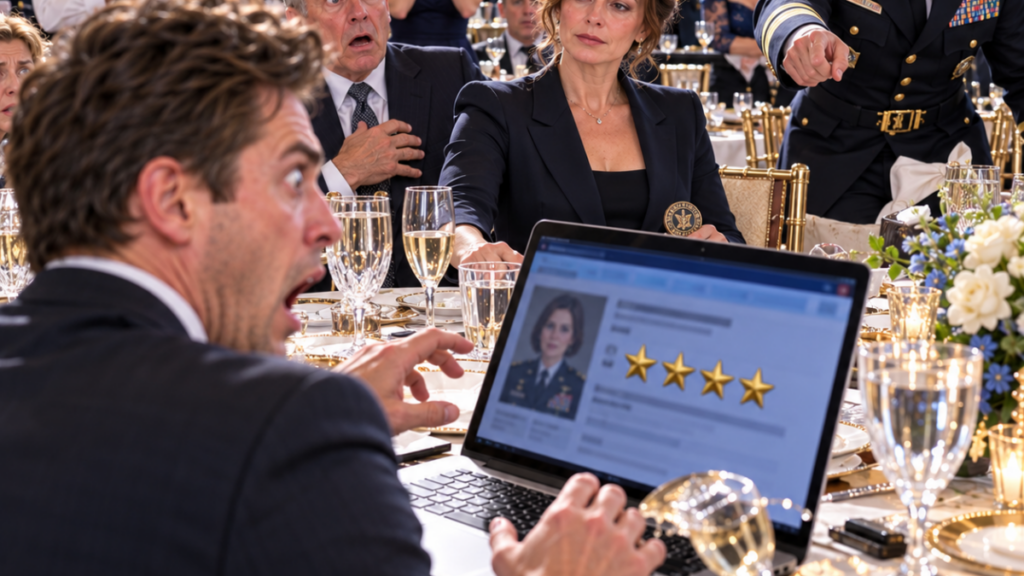
« Je lui donnerai des ordres avant Noël prochain », lança-t-il en riant bruyamment pour impressionner mon père. Je ne dis rien. Il ouvrit l’annuaire du ministère de la Défense pour se moquer de mon poste. Le résultat de la recherche afficha quatre étoiles dorées. Son rire s’interrompit brusquement. « Monsieur… Levez-vous et appelez-la Madame. »
Le fiancé de ma sœur cadette a passé tout un dîner de famille à expliquer pourquoi mes quatorze années sous l’uniforme n’avaient servi qu’à remplir des formulaires. Il a plaisanté en disant qu’il me donnerait probablement des ordres d’ici Noël prochain, puis a ouvert un portail de recrutement du gouvernement pour prouver à quel point je n’étais pas importante. Je l’ai mis en garde. Il a ri de nouveau. Quelques secondes plus tard, son expression a tellement changé que mon père, ancien militaire, s’est levé de table, a fixé l’écran et lui a ordonné de m’appeler « madame ».
### Partie 1
Je m’appelle lieutenant-colonel Claire Maddox, mais dans la maison à deux étages de mes parents, près de Columbus, dans l’Ohio, j’étais toujours Claire, la fille qui oubliait d’appeler quand le travail la prenait et qui savait encore dans quel placard de la cuisine maman cachait le café hors de prix. Pendant quatorze ans, j’ai servi dans l’armée, et pendant près de la moitié de cette période, ma famille n’a compris que très vaguement ce que je faisais. Ils savaient que je travaillais dans la logistique, la conformité et la planification opérationnelle interarmées ; ils savaient que je voyageais constamment ; ils savaient qu’il y avait des mois entiers où je répondais aux questions sur mon travail par une variante de : « Rien d’assez intéressant pour gâcher le dîner. » Ce qu’ils ignoraient, c’est que mon affectation actuelle m’avait placée au sein d’un groupe de surveillance interarmées de la défense, chargé d’examiner les programmes, l’accès des contractants, les chaînes d’approvisionnement opérationnelles et les manquements réglementaires dont la plupart des civils n’entendaient jamais parler, sauf en cas de problème grave.
Je n’avais jamais caché mon travail par honte. Je le cachais parce que la discrétion était devenue aussi naturelle pour moi que de vérifier les sorties de secours en entrant dans une pièce bondée ou de ranger mes clés dans la même poche chaque matin. Dans mon univers, ceux qui avaient besoin de savoir le savaient déjà, et ceux qui n’en avaient pas besoin tiraient rarement profit de détails supplémentaires. Cette habitude m’avait suivie à la maison, où mon père me demandait encore parfois si je « gérais des entrepôts quelque part » et où ma mère disait aux voisins que je « travaillais dans l’administration de l’armée ». Je n’ai jamais corrigé ces affirmations, car cela aurait nécessité vingt minutes d’explications, et aussi parce qu’une étrange part de moi appréciait d’avoir un endroit au monde où mon CV n’entrait pas avant moi.
That Friday evening was supposed to belong to my sister, Emily. She was thirty-one, four years younger than me, with the same dark hair we got from Mom and a habit of touching the edge of her glass whenever she was nervous. She had become engaged three weeks earlier to Grant Mercer, a civilian contractor liaison who worked for a large defense support company and who, according to Emily, was ambitious, well connected, brilliant, and “finally the kind of man Dad will respect.” The last part bothered me more than I admitted because Emily had never needed Dad’s approval until Grant started measuring everyone in the family by whether they could be useful to him.
Grant arrived wearing a navy suit that probably cost more than my first car and a steel watch that flashed under the chandelier every time he moved his wrist. He brought my mother flowers, a bottle of bourbon for Dad, and a polished black case containing a laptop he placed beside his chair as if he had walked into a quarterly briefing instead of an engagement dinner. Within fifteen minutes, he had mentioned two general officers, three regional procurement offices, one major depot, and a senior executive he claimed had personally asked for his opinion during a conference call. Dad listened with the patient expression he had perfected during twenty-four years as an Army master sergeant, while Mom smiled too brightly and Emily watched Grant as if she were waiting for the rest of us to recognize what she believed she had already discovered.
I recognized something else. Grant never asked a question unless it created an opening for him to talk about himself, and when Dad finally turned toward me and asked how my recent trip through northern Virginia had gone, Grant’s attention sharpened instantly. “Claire’s still doing logistics, right?” he asked before I could answer. Emily’s fingers stopped against her wineglass, Dad glanced at me, and I said carefully, “Something like that.” Grant smiled as if I had just stepped exactly where he wanted me, and in that moment I understood that the dinner he had been performing all evening had finally found its target.
### Part 2
“It must be frustrating,” Grant said, cutting his roast chicken with the edge of his fork, “being in that long and still doing support work.” His tone was gentle enough that someone passing through the room might have mistaken it for concern, but I had spent too many years around senior officers, contractors, politicians, and ambitious staffers not to recognize condescension wrapped in courtesy. I asked what made him think I was frustrated. Grant gave a small laugh, leaned back, and said, “Fourteen years is a long time to stay on the administrative side of things, especially when the private sector is where the real decisions get made now.”
Mom immediately reached for the bread basket and asked Emily whether she had chosen flowers for the wedding. Emily opened her mouth, but Grant kept going as if my mother had not spoken. He explained that uniformed personnel often misunderstood how much influence major contractors exercised over supply networks, sustainment priorities, equipment schedules, and budget planning. Some of what he said was technically true, which made the arrogance more irritating; competent contractors were essential to national defense, and anyone who pretended otherwise was either inexperienced or dishonest. What Grant did not understand was the difference between participating in a system and possessing authority over it.
Dad asked, “What exactly do you do at Mercer Strategic Solutions?” Grant’s smile widened because that was the question he had been waiting for. He launched into an explanation filled with phrases like enterprise coordination, executive-level integration, strategic routing, and priority sustainment architecture, while avoiding the simpler truth that his team helped manage contractor relationships for several regional support programs. There was nothing insignificant about that work, but Grant told the story as if combat units moved only because he permitted them to and colonels waited outside his office hoping he would approve their fuel. By the time he finished, even Mom had stopped pretending to rearrange serving dishes.
Then Dad looked at me. “And what were you doing at Fort Belvoir?” he asked. I said, “Joint review meetings,” because that was true, and added that I had been coordinating a compliance review related to several regional logistics systems. Grant actually laughed. Not a polite chuckle, not a surprised breath, but a full, amused laugh that made Emily lower her eyes toward her plate.
“Claire,” he said, “that’s exactly what I mean. You review paperwork after people like us make the real decisions.” I felt something cold and familiar settle behind my ribs, not anger exactly, but the sensation I had whenever someone confidently explained my own job to me. I told him that oversight was slightly more complicated than paperwork. Grant waved one hand as if dismissing a junior employee during a meeting and said, “No offense, but if your office disappeared tomorrow, half the people in my building wouldn’t notice for a week.”
Dad’s fork stopped halfway to his plate. Mom’s expression tightened, and Emily whispered, “Grant.” He looked at her with genuine surprise, as though he could not imagine what objection she might have. Then he grinned at my father and delivered the line that would eventually end his evening far differently than he expected: “Honestly, Arthur, by next Christmas I’ll probably be giving your daughter orders.”
Nobody spoke for several seconds. I heard the refrigerator compressor start in the kitchen and the soft tick of the old wall clock behind Dad’s chair. Dad lowered his fork, looked directly at Grant, and said, “Civilian contractors don’t give Army officers orders.” Grant laughed again, but this time there was an edge to it. “Maybe not on paper,” he said, “but we both know who controls the resources.”
I could have ended it there. I could have told him my rank, my assignment, the level of authority attached to my office, and the names of people who sat in meetings where his company appeared as one line on a spreadsheet. Instead, I took a drink of water and said, “You should probably stop while this is still just embarrassing.” Grant’s face changed at once, because men like him rarely heard warnings as kindness; they heard them as challenges.
He pushed back slightly from the table and smiled. “Embarrassing for who?” he asked.
### Part 3
Dessert arrived under the kind of silence that made every small sound feel amplified. Mom brought out her peach cobbler, Dad poured coffee, and Emily tried to restart the evening by talking about a venue they were considering near Cincinnati. Grant barely listened. He had decided there was a contest happening, and because I refused to compete, he seemed increasingly desperate to create one.
He asked my exact rank. I told him, “Lieutenant colonel.” His eyebrows lifted in exaggerated surprise, then he nodded slowly as if confirming a theory. “Okay,” he said. “That explains it.” I asked what exactly it explained, and he replied that lieutenant colonels were often stuck in the middle: senior enough to believe they mattered, junior enough not to realize how many decisions happened above them.
Emily whispered his name again. This time there was irritation in her voice, but Grant brushed his thumb across her wrist and said, “Relax, babe, we’re talking shop.” I saw her expression change at the word babe, not because she disliked it, but because of the way he used it—to close the discussion rather than include her in it. Dad noticed too. He looked at Emily for a second longer than usual before returning his attention to Grant.
“I spent twenty-four years in the Army,” Dad said. “I knew a few lieutenant colonels who mattered.” Grant laughed lightly and replied, “Different era, Arthur. Everything’s integrated now.” Then he looked at me. “No offense, Claire, but rank without access is just a title.”
That sentence should have warned me what was coming. Instead, I assumed he would keep talking until he exhausted himself. I was wrong.
Grant reached beside his chair and pulled the black laptop case onto his lap. Emily immediately said, “Seriously?” He unzipped it anyway and removed a rugged government-approved laptop, setting it directly beside Mom’s dessert plates. The machine looked absurd beneath the chandelier, gray composite casing surrounded by linen napkins, china cups, and a crystal dish filled with whipped cream.
I stared at it, then at him. “Grant, leave it in the case.” He smiled. “Why?” I told him because he was sitting in a private residence, on a home network, while apparently preparing to access a work system for no legitimate business purpose. The smile widened.
“Claire,” he said, “I know my own access rules.”
“Then follow them.”
Dad looked from me to Grant. “What are you doing?”
.
Grant turned the laptop so Dad could see the screen as it booted. “I’m settling a family debate in thirty seconds.” He took a credential card from his wallet and held it between two fingers. “There’s a personnel directory tied into our contractor portal. If Claire’s position is as important as she thinks, we’ll see it.”
“I never said my position was important,” I replied.
“That’s kind of the point.”
Emily reached across and touched his sleeve. “Grant, stop. This is weird.”
He pulled his arm away without looking at her. It was a small movement, almost nothing, but I saw her flinch. Then he inserted the card into the reader.
The room seemed to become narrower around us. I placed my napkin beside my plate and said, slowly enough that nobody could misunderstand me, “Do not use your credentials to search my record.”
Grant began typing.
I repeated myself. “That is not a request.”
He looked up, smiling at Dad rather than me. “See? This is what bureaucracy does to people. Everything becomes dramatic.”
Dad’s face had gone still. He knew my voice. He had heard it once when I was twenty-one and a drunk driver nearly backed over Emily in a grocery store parking lot, and again years later when an uncle tried to drive home after Christmas dinner. It was the voice I used when the discussion was over but consequences had not yet begun.
Grant typed my name into the directory.
“Last warning,” I said.
He pressed Enter.
For several seconds, nothing happened except a spinning icon at the center of the screen. Grant leaned back with a triumphant smile. Then the page refreshed, and every trace of satisfaction disappeared from his face.
### Part 4
.
At first, I could not see the screen clearly because Grant had angled it toward Dad. What I saw instead was Grant himself. His shoulders stiffened, his mouth remained slightly open, and the hand resting beside the keyboard slowly curled inward as though he had touched something hot.
Dad leaned closer. His reading glasses slid slightly down his nose. Emily asked, “What is it?”
Grant did not answer.
I already had a good idea.
My ordinary personnel profile would have shown exactly what I had told him: Lieutenant Colonel Claire Maddox, United States Army. But because of my current assignment, certain searches routed through an executive access gate that displayed additional handling instructions before releasing even basic information. The four gold stars Grant saw were not my rank; they were part of the insignia identifying the senior four-star command authority under which my task force operated. Beneath them sat a crimson restricted-access banner indicating that portions of the profile required a mission-related purpose and higher authorization than Grant possessed.
That distinction mattered enormously. Grant apparently did not understand it.
His eyes moved rapidly across the screen. “That can’t be right.”
Dad’s head lifted. “What does it say?”
Grant swallowed.
I said, “Close the laptop.”
Instead, he scrolled.
A warning box appeared.
I watched the last of the color drain from his face.
Grant had expected a bland directory entry proving I was some forgotten warehouse staff officer. What he found was a limited profile connecting my assignment to a joint regulatory and operational oversight element responsible for reviewing contractor access, compliance failures, regional sustainment controls, and program integrity. The page did not reveal classified missions, operational details, or restricted case files. It did, however, make one fact unmistakably clear: my office operated far above the organizational level Grant had spent dinner mocking.
Dad leaned farther toward the screen. I saw his eyes pause on the command insignia, then drop toward my duty title. He had been retired for eleven years, but military hierarchy was still a language his body understood before his mind finished translating it. His shoulders straightened. The comfortable posture of a grandfather at his daughter’s engagement dinner vanished, replaced by the rigid composure of the master sergeant who had spent half his adult life identifying who possessed authority and who merely pretended to.
Grant whispered, “Senior joint compliance liaison?”
Emily looked at me. “Claire?”
I kept my eyes on Grant. “Close it.”
He clicked backward.
Another message filled the screen.
This one made his hands shake.
I could not read every word from my seat, but I recognized the structure immediately. His session had triggered an access notice because he had attempted to open a profile outside his normal business scope. Systems like that recorded credential identity, device information, account activity, and the reason codes associated with a search. Whether anyone would care about a single improper query depended on the circumstances, but Grant knew enough to understand the implication.
“Wait,” he muttered. “No, no, no.”
Dad stood.
The chair legs scraped once across the hardwood floor, and everyone looked at him.
He did not shout. Dad rarely needed to. “Take your hands off the keyboard.”
Grant froze.
Dad pointed toward the laptop. “Now.”
Grant slowly lifted both hands.
Emily’s face had turned pale. Mom stood in the doorway between the dining room and kitchen holding a serving spoon she had forgotten to put down.
Dad looked at Grant with an expression I remembered from childhood, the one that meant he had already offered patience and was no longer interested in excuses. “You spent this entire evening insulting my daughter’s service because you wanted to impress me,” he said. “Then she warned you three times not to use your work credentials for a personal search, and you did it anyway.”
“Arthur, I was only—”
“Don’t interrupt me.”
Grant closed his mouth.
Dad looked at the screen again, then at me. Something complicated passed through his face—surprise, confusion, and a kind of startled pride I was not ready to examine. Then he turned back toward Grant.
“Close the lid,” he said. “Step away from the table.”
Grant obeyed.
Dad waited until he was standing. “Now address the officer you’ve been mocking all night properly.”
Grant stared at me.
For the first time since he had entered the house, he looked smaller than the room.
His voice came out almost inaudibly.
“Yes, ma’am.”
And that was when Emily finally took off her engagement ring.
### Part 5
She did not throw it. She did not announce that the wedding was over, and she did not give us the dramatic confrontation Grant probably would have preferred because drama would have allowed him to cast himself as the victim. Emily simply slid the ring from her finger, placed it beside her dessert fork, and stared at it as if she had never seen it before.
Grant noticed immediately. “Emily, come on.”
She looked up. “You used your government access to humiliate my sister.”
“That is not what happened.”
“You literally told us what you were doing.”
He glanced around the table, searching for an ally. “It was a joke.”
I almost laughed at that, not because it was funny but because I had heard the sentence too many times in too many forms. Cruelty became a joke after it failed, arrogance became confidence after it was challenged, and reckless behavior became a misunderstanding once consequences appeared. Grant had spent hours insisting every word he said reflected expertise; now he wanted all of us to believe none of those words meant anything.
Emily pushed the ring another inch away. “You also ignored me every time I asked you to stop.”
His jaw tightened. “Because you were overreacting.”
The silence that followed was different from the earlier silence. Before, everyone had been watching me and Grant. Now they were watching Emily.
She nodded slowly. “There it is.”
“What?”
“That thing you do.”
Grant blinked.
“You decide what happened, what everyone meant, who’s being reasonable, who’s being emotional.” Her voice stayed quiet, but her fingers were trembling against the table. “I thought it was confidence.”
“Emily—”
“I thought I liked that you always knew what to do.”
Mom sat beside her.
Emily looked at Grant with tears gathering in her eyes. “I’m starting to think you just can’t stand anybody else being right.”
Grant shoved his chair backward. “This is insane. Claire is sitting here enjoying this because she knows she can ruin my career.”
Every eye turned toward me.
I set my coffee down. “I’m not going to touch your career.”
He gave a bitter laugh. “Right.”
“I’m serious. I’m going to recuse myself from anything involving your employer the moment I’m back in the office.”
His expression shifted, because that was not the answer he expected.
I continued. “But your access was logged when you authenticated. Whatever happens next will come from whatever security process your company and the government already have in place. I won’t interfere to hurt you, and I won’t interfere to protect you.”
Grant stared at me.
For the first time all evening, he had no clever reply.
He packed the laptop with clumsy hands. The zipper caught twice because his fingers were shaking, and when Emily remained seated, he looked at her as though waiting for her to stand automatically. She did not.
“Are you coming?” he asked.
“No.”
His face hardened. “So you’re choosing this?”
Emily looked down at the ring. “I’m choosing not to leave with you tonight.”
“That’s not what I asked.”
“It’s the answer you’re getting.”
Grant looked at Dad, then Mom, then me. Whatever he saw in our faces convinced him that another speech would not save the evening. He muttered something about an early meeting and walked out through the front door without saying goodbye.
We heard his car start thirty seconds later.
Nobody spoke until the sound disappeared.
Then Mom looked at me and asked the question I had avoided for years.
“What exactly do you do?”
I rubbed both hands over my face.
Emily laughed once through her tears.
Dad sat down again. “I’d like to know that too.”
So I told them as much as I could. I explained that my job was not glamorous, that nobody saluted when I entered an office, and that I spent more time reading audit findings and reviewing operational risks than doing anything they would ever put in a recruiting commercial. I told Dad that the four-star emblem on the screen belonged to the senior command authority over the task force, not to me, because the last thing I wanted was my family believing I had secretly become a general.
Dad stared at me for three full seconds.
Then he laughed so hard he had to remove his glasses.
“Thank God,” he said. “For a minute there, I thought I had somehow missed my own kid becoming a four-star general.”
Even Emily smiled.
The tension broke just enough for us to breathe again.
But the relief lasted less than forty-eight hours.
Monday afternoon, as I walked out of a meeting in Virginia, my phone buzzed with a message from an unfamiliar number.
It was Grant.
Please call me before this gets worse.
### Part 6
I did not call him. Instead, I forwarded the message to my personal archive, returned to my office, and completed the recusal memorandum I had already planned to submit. The document was dry, procedural, and deliberately boring: I disclosed a personal relationship between my immediate family and an employee of a contractor whose work could potentially fall within my organization’s review authority, and I requested removal from any matter involving that company for the foreseeable future. My director read it, raised one eyebrow, and asked whether I expected a problem. I said, “Possibly, but not one I intend to own.”
By Tuesday morning, the problem had developed without my help. Grant had apparently been contacted by his company’s security office after his credential generated an anomalous access review. I did not receive the details officially because, after filing my recusal, there was no reason for me to receive them. Grant supplied the details himself through a series of increasingly frantic messages.
They suspended my portal credentials.
This is getting blown out of proportion.
I need you to explain that it was a family misunderstanding.
Claire, please.
The fourth message arrived just before lunch.
Emily says she won’t talk to me until I fix this.
That one told me more than the others.
I finally called him from a conference room using my personal phone.
He answered before the first ring had fully finished.
“Claire?”
“Grant.”
He exhaled. “Thank God.”
“Why?”
“Because you can clear this up.”
“No.”
Silence.
Then, “What do you mean, no?”
“I mean I’m not involved in the review.”
“You’re the reason there is a review.”
I looked through the glass wall toward a hallway filled with people carrying folders and coffee cups, each moving through the ordinary machinery of a workday. “No, Grant. Your decision to use your credentials for a personal search is the reason there’s a review.”
“I was checking a directory.”
“After the person you were searching told you not to.”
“That has nothing to do with security policy.”
“It has everything to do with judgment.”
His breathing changed.
“I could lose my clearance.”
“I don’t know what will happen.”
“You know people.”
“Yes.”
“You have authority.”
“Some.”
“And you’re just going to sit there?”
I closed my eyes for one second. “You misunderstood me at dinner. Authority does not mean I get to erase a process because it’s inconvenient for my sister’s fiancé.”
“Ex-fiancé, apparently.”
That stopped me.
“What?”
He laughed bitterly. “She gave the ring back this morning.”
I said nothing.
“This is what you wanted, right?”
“No.”
“Come on.”
“Grant, I barely knew you.”
“You hated me.”
“I disliked how you treated people.”
“That’s the same thing.”
“No. It isn’t.”
He began talking faster, telling me Emily had humiliated him, my father had treated him like a private at basic training, and his company had locked him out of several systems while investigators reviewed his access history. Somewhere inside the flood of excuses, he mentioned that the dinner search was not the first time he had used the directory for curiosity. I stopped him immediately.
“What did you just say?”
Another silence.
Grant realized his mistake.
“I didn’t say anything.”
“Yes, you did.”
“It was nothing.”
“How many personal searches have you made?”
He hung up.
For several seconds, I stared at the screen of my phone.
Then I placed it facedown on the conference table and sat very still.
I had believed the dinner incident was an isolated act of arrogance. One reckless decision made by a man trying too hard to impress my father.
Now I wondered whether the search had triggered attention because it was not isolated at all.
That evening, Emily called me. She sounded exhausted rather than heartbroken.
“He keeps saying you destroyed his career.”
“I didn’t.”
“I know.”
That surprised me.
Emily continued. “I think I also know why he’s so scared.”
I waited.
She took a breath.
“Claire, I found something in the apartment.”
### Part 7
Emily came to my hotel instead of explaining over the phone. She arrived carrying an overnight bag, a cardboard storage box, and the drained expression of someone whose future had changed too quickly for her emotions to keep pace. I made coffee, locked the door behind her, and told her before she said anything else that if she had found classified material, protected government data, or anything she believed might be illegal to possess, she should not show it to me.
“It’s not classified,” she said. “At least I don’t think it is.”
“That sentence is not reassuring.”
She almost smiled.
Inside the box were printouts, handwritten notes, business cards, conference badges, and folders filled with Grant’s personal career planning. Most of it was harmless ambition: lists of people he wanted to meet, companies he hoped to work for, salary targets, and notes from professional events. Then Emily showed me a yellow legal pad.
On several pages, Grant had written names beside job titles, organizations, family relationships, and small personal details.
Retiring next year.
Daughter at Georgetown.
Wants private-sector board seat.
Potential introduction through R.
I looked at Emily.
“Where did you find this?”
“In the bottom drawer of his desk.”
“This could still be ordinary networking.”
“I thought so too.”
She turned several pages.
More names appeared.
Some were defense employees.
Some were contractor executives.
Some were people I recognized only because of my work.
Next to a few names Grant had written phrases like leverage point, access through spouse, and useful if promotion opens.
My stomach tightened.
“This isn’t proof he broke a law,” I said.
“I know.”
“But it explains why he treats every conversation like a transaction.”
Emily sat across from me, staring into her coffee. “Do you know what the worst part is?”
I waited.
“My name is in there.”
She turned to a page near the back.
Emily Maddox — father retired Army, sister active officer. Strong family optics. Possible DC network after marriage.
I read it twice.
Emily’s voice cracked. “I thought he loved that I understood his work.”
I pushed the pad away. “He may have loved you too.”
She shook her head. “Don’t do that.”
“What?”
“Don’t make it easier.”
I looked at my sister.
Her eyes filled.
“I spent months explaining away every time he talked over me, every time he corrected me in front of friends, every time he told me somebody was useful or useless based on their job. I told myself he was driven. I told myself he was under pressure. I told myself confidence looked arrogant when you weren’t used to being around successful people.” She wiped her cheek. “I don’t want another excuse.”
So I stopped giving her one.
We talked until after midnight. Not about Grant’s clearance or the investigation, but about the relationship Emily had actually been living inside. She told me he chose restaurants based on who might see him there. He criticized her clothes before work events. He discouraged friendships he considered “low value.” When she disagreed with him privately, he called her sensitive; when she disagreed in public, he accused her of embarrassing him.
The dinner had not changed Grant.
It had revealed him.
Two weeks later, the formal review concluded enough for Grant’s employer to act. I learned about the outcome from Emily, not through work. His access privileges remained suspended while the company reassigned him to a role that did not require the same level of system access, and several prior searches were reportedly being examined to determine whether they had legitimate business purposes.
Grant called me one final time.
I almost ignored it.
Instead, I answered.
His voice was calmer than before.
“I’m being moved to an administrative warehouse office.”
“I heard.”
“Emily won’t speak to me.”
“That’s her decision.”
“I lost everything over one stupid dinner.”
“No.”
He went silent.
I continued. “You lost access because of choices you made with your credentials. You lost Emily because of choices you made with her. The dinner only put both in the same room.”
He breathed heavily into the phone.
“You think you’re better than me.”
“No, Grant.”
I looked out across the evening lights beyond my office window.
“I think you spent so much time trying to prove you were above everyone that you never noticed what it was costing you.”
He hung up without replying.
I never spoke to him again.
But the person I still needed to face was my father.
### Part 8
The following Sunday, I drove back to Ohio and found Dad on the rear porch drinking black coffee in a faded Army sweatshirt. October had sharpened the air, and brown leaves scraped across the yard whenever the wind pushed through the maple trees. He poured me a cup without asking, the same way he had since I was twenty-two, then waited until I sat beside him.
For a long time, neither of us spoke.
Finally, Dad said, “I owe you an apology.”
I looked at him. “For what?”
“For not asking.”
I knew immediately what he meant.
He stared across the lawn. “I spent years telling people how proud I was that you stayed in the Army, but I never really asked what you were doing. I assumed if it mattered, you’d tell me.”
“That’s partly my fault.”
“No.” He shook his head. “You had reasons for being private. I had no reason for being uninterested.”
“You weren’t uninterested.”
“I was comfortable.”
That word stayed between us.
Dad turned his coffee cup slowly in both hands. “I understood infantry. I understood platoons, companies, battalions. I understood dirt, weapons maintenance, field problems, young lieutenants who thought maps made them smarter than sergeants.” A faint smile crossed his face. “Your career moved into a world I didn’t recognize, so instead of learning it, I kept translating it into something I already understood.”
I remembered all the times he had asked whether I was “still doing supply,” and all the times I had answered yes because it was easier.
“I let you,” I said.
“Maybe.”
He looked at me.
“But when Grant talked down to you, I should have stopped him sooner.”
“You did eventually.”
“After I saw a screen that told me you were important.”
There it was.
The real reason this conversation mattered.
Dad’s voice dropped. “I don’t like that about myself.”
I leaned back against the porch chair. “You didn’t need to know my assignment to know he was being disrespectful.”
“Exactly.”
We sat quietly.
Inside the house, Mom and Emily were moving dishes around the kitchen. Emily had officially canceled the wedding three days earlier. There had been tears, angry voicemails, awkward calls to relatives, and the painful logistical work of separating two lives that had already begun merging, but she sounded more certain each day.
“She’ll be okay,” Dad said.
“I know.”
“She’s tougher than she thinks.”
“So are you.”
He gave me a sideways look. “That sounded suspiciously like something your mother would say.”
I smiled.
After a minute, Dad asked, “Why didn’t you tell us more about your job?”
I thought carefully before answering.
“Because I liked coming here and not being Lieutenant Colonel Maddox.”
He nodded.
“At work, every room has rank, authority, responsibility, consequences. Even when people are friendly, the structure is there. Here I could be the daughter who gets yelled at for leaving coffee cups upstairs.”
Dad laughed.
« Et », ai-je ajouté, « j’ai appris il y a longtemps que la personne qui parle le plus fort dans une pièce n’est généralement pas celle qui a le plus d’autorité. Je ne voulais pas devenir quelqu’un qui a besoin que tout le monde sache ce dont il est capable. »
Papa m’a longuement observé.
« Grant en avait besoin. »
“Oui.”
« Il fallait que tout le monde le sache. »
“Oui.”
La porte de derrière s’ouvrit et Emily sortit, portant une assiette de brioches à la cannelle encore chaudes. Sa bague de fiançailles avait disparu. Elle paraissait fatiguée, mais plus légère.
Sa mère la suivait.
Emily s’est assise sur la marche du perron et a déclaré : « Pour que ce soit clair, je ne sortirai plus jamais avec un autre entrepreneur de la défense. »
J’ai ri. « Cela me semble inutilement vague. »
Papa a dit : « Je soutiens cette politique. »
Sa mère lui a tapoté l’épaule.
Pour la première fois depuis des semaines, Emily a ri si fort qu’elle a dû poser son café.
Rien dans cette fin n’était simple. Grant n’est pas devenu un méchant en prison, je n’ai pas reçu de médaille pour avoir survécu à un dîner insupportable, et Emily n’a pas immédiatement rencontré l’homme parfait qui aurait effacé l’humiliation de la relation dans laquelle elle avait failli se marier. Dans la réalité, les conséquences sont rarement aussi faciles à résoudre.
Grant a conservé son emploi, bien que son rôle ait été réduit le temps que son accès à l’emploi soit réévalué. Emily a déménagé dans un appartement plus petit, a annulé les dépôts qu’elle pouvait récupérer, a perdu de l’argent sur ceux qu’elle ne pouvait pas et a commencé à recréer ses propres habitudes. Papa a commencé à poser de meilleures questions sur mon travail, même si je répondais encore à la moitié d’entre elles par : « Je ne peux pas vraiment en parler. »
Quant à moi, je suis retourné en Virginie et j’ai continué à faire exactement ce que je faisais avant que quiconque à cette table ne sache quelle était ma mission.
C’était la partie que Grant n’avait jamais comprise.
L’autorité véritable n’avait jamais eu besoin de sa reconnaissance.
Mon travail avait de l’importance avant même qu’il n’ouvre son ordinateur portable. Mon grade existait avant qu’il ne s’en moque. Ma responsabilité était bien réelle pendant qu’il riait, qu’il se vantait et qu’il supposait que mon silence était un signe de faiblesse.
Le portail gouvernemental ne m’a pas transformé en quelqu’un de puissant.
Cela a tout simplement forcé Grant à regarder la personne qui était assise en face de lui depuis tout ce temps.
Et à ce moment-là, la personne la plus importante présente dans la pièce n’était plus impressionnée par lui.
Ma sœur.
LA FIN!

