At six o’clock on a Tuesday morning, I turned a rusted valve on my Texas ranch and accidentally exposed a forty-four-year conspiracy.
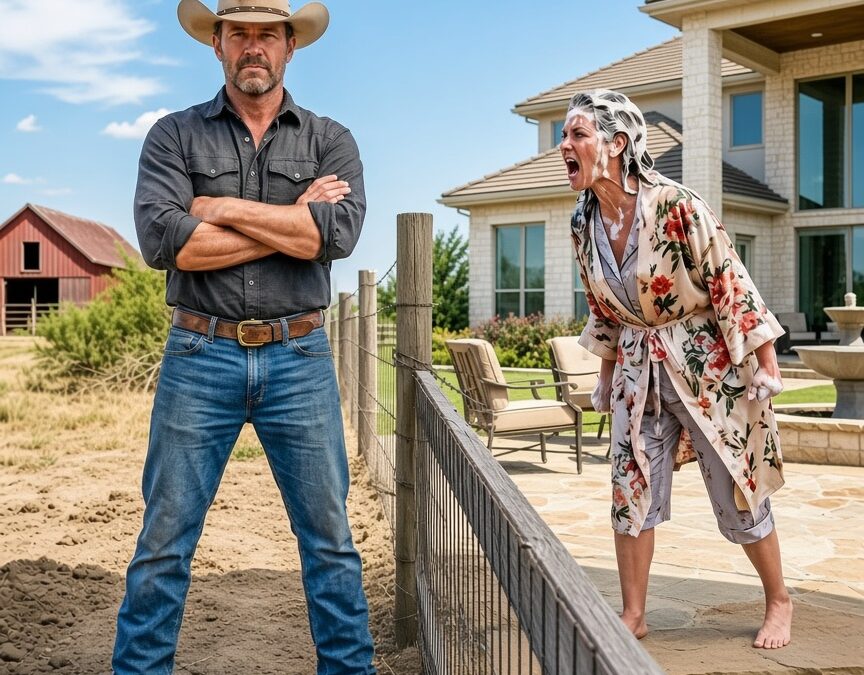
Ten seconds later, the president of the neighboring homeowners association came charging out of her million-dollar mansion wearing a silk bathrobe and enough shampoo in her hair to wash a horse.
Twenty minutes after that, three sheriff’s deputies were standing in my driveway.
By the end of the week, a developer would be sitting in jail, federal investigators would be examining twenty-four luxury homes, and a woman who had spent months trying to drive me off my own land would be begging me to save her neighborhood.
All because I followed a drought restriction.
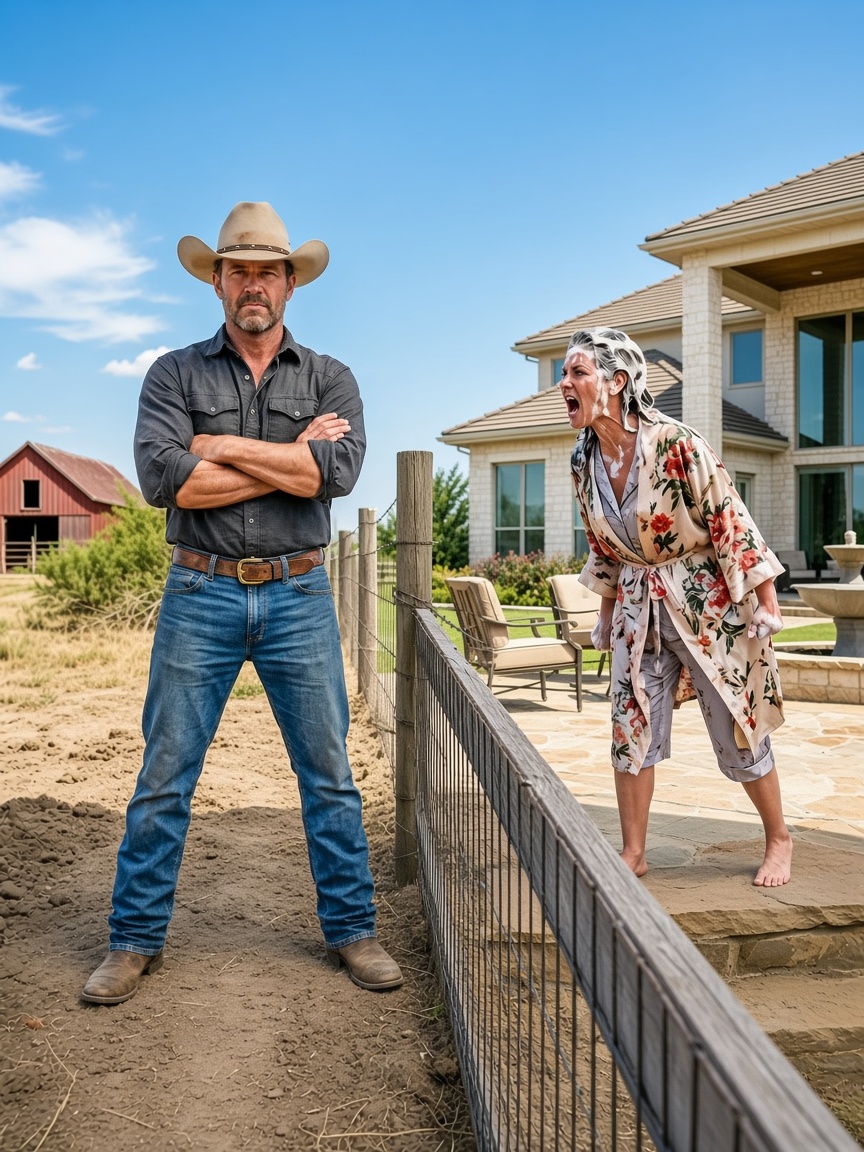
My name is Jackson Briggs. I’m sixty-two years old, a retired Navy engineer, and the third generation of my family to work the same forty acres outside Cedar Ridge, Texas.
I’ve repaired machinery in places where one bad calculation could kill an entire submarine crew. I’ve spent months beneath the Atlantic with nothing but steel between me and several thousand feet of water. I’ve seen grown men lose their composure over a broken coffee machine and remain perfectly calm during an actual emergency.
But nothing in twenty-six years of military service prepared me for Delilah Thornfield.
The morning everything started, I woke at five, made black coffee, and stood on my porch watching the first light reach the cedar trees.
The ranch was quiet.
My horses were still in the lower pasture. The cattle were moving slowly toward their morning feed. A mockingbird was making a racket on the workshop roof.
It was the kind of morning that reminded me why I had come home after retirement.
Then I picked up my wrench.
The county had ordered me to reduce municipal water consumption by seventy percent because of the ongoing drought. The notice had arrived the previous Thursday, delivered personally by Delilah, who had no official reason to be on my porch.
She had stood there in an expensive cream-colored pantsuit, holding the envelope between two manicured fingers.
“Perhaps now you’ll understand that rules apply to everyone, Mr. Briggs.”
I had looked at the county seal, then at her.
“Is there a reason the county mailed this to you instead of me?”
Her smile had tightened.
“I happened to be at the administrative office.”
“Convenient.”
“You’ve been wasting water for months.”
“My cattle drink from a private spring.”
“That’s what you keep claiming.”
“Because it’s true.”
She had leaned closer.
“You could make all these problems disappear, Jackson. You know that.”
I knew exactly what she meant.
Three weeks earlier, she had offered me nearly three times the appraised value of the eight acres surrounding my family’s spring.
Not the ranch house. Not the barns. Not even the good grazing pasture.
Just the spring.
I had turned her down without negotiating.
She hadn’t taken it well.
Now the county wanted me to reduce municipal consumption. Fine. I could eliminate it entirely.
My grandfather had built a gravity-fed water system from our spring decades before anybody imagined building a luxury subdivision along our southern fence. It supplied our livestock troughs, workshop, irrigation channels, and household reserve tank. The municipal connection existed primarily as a backup.
Switching away from it required closing one valve and opening another.
So at six o’clock that Tuesday morning, I walked down to the connection box near the southern property line.
I set my coffee on a flat limestone rock, fitted my wrench over the old valve stem, and turned.
The metal resisted.
I put my weight into it.
The valve groaned, moved another quarter turn, and seated firmly.
I checked the indicator.
Closed.
Perfectly legal. Exactly what the county had instructed me to do.
I picked up my coffee.
That was when the screaming started.
“You son of a bitch!”
I turned toward Whispering Oaks.
Delilah Thornfield was running across her back patio.
Barefoot.
Her bathrobe flapped around her knees. White shampoo foam covered the top of her head and slid down one side of her face. She had apparently rushed out of the shower without rinsing or grabbing a towel.
For a moment, I thought there must be a fire.
Then she pointed at me.
“You cut off our water!”
I looked at the valve.
Then back at her.
“I cut off my water.”
“My shower stopped!”
“That sounds inconvenient.”
“Every house on this block lost pressure!”
That got my attention.
I knew the municipal layout. My ranch had its own service connection. Whispering Oaks was supposed to receive water through a separate subdivision main.
Closing my valve should have affected nobody but me.
“Are you certain?” I asked.
She marched toward the fence.
“Do I look like I’m making this up?”
There was shampoo dripping off her chin.
I considered the question carefully.
“You look like you ought to rinse your hair.”
She made a sound I had previously heard only from angry geese.
Then she pulled out her phone.
“I’m calling the police.”
“Go ahead.”
She dialed 911 and announced that I had sabotaged critical infrastructure, endangered an entire residential community, and deliberately shut down its water supply.
I stood beside my valve, drinking coffee.
What bothered me wasn’t the accusation.
It was the speed.
I had barely finished closing the valve when she appeared.
And she hadn’t asked what happened.
She had known.
Deputy Calvin Harris arrived twenty minutes later with two younger deputies.
Harris and I had known each other for years. He was a broad-shouldered man with a weathered face and the patience of someone who had spent thirty years settling arguments between neighbors who should have known better.
He stepped out of his cruiser, looked at Delilah, and stopped.
“Ma’am, are you injured?”
“No! I’ve been sabotaged!”
He glanced at the shampoo in her hair.
“All right.”
She pointed at me.
“Arrest him.”
Harris ignored that.
“Morning, Jackson.”
“Morning, Calvin.”
“What happened?”
“I complied with the drought order.”
“By doing what?”
“Closing my municipal supply valve.”
He walked over and inspected the connection box.
“That’s it?”
“That’s it.”
Delilah stamped her foot.
“He shut off our entire neighborhood!”
Harris straightened.
“Mrs. Thornfield, this valve belongs to his service connection.”
“It’s connected to our infrastructure.”
I looked at her.
Harris looked at her.
She seemed to realize she had said something she shouldn’t have.
“How do you know that?” Harris asked.
“I’m the HOA president. I know how our utilities work.”
“Then perhaps you can explain why his private connection affects your subdivision.”
She folded her arms.
“I don’t have to explain engineering to you.”
“No,” Harris said. “But somebody does.”
He called the county water department.
Marcus Rivera arrived fifteen minutes later.
Marcus had inspected my property so often during the previous three months that I had started keeping his favorite coffee in the workshop. Every complaint Delilah filed seemed to bring him back.
He was a careful man, the sort who trusted gauges more than opinions.
He opened the connection box, attached his testing equipment, and studied the readings.
Then he frowned.
“Jackson, open your municipal valve for ten seconds.”
I did.
Marcus watched the gauge.
“Close it.”
I did.
He checked another meter, made a radio call, and repeated the test.
His expression changed.
Harris noticed.
“What is it?”
Marcus pointed at the readings.
“When Jackson opens his valve, the pressure at Whispering Oaks increases.”
“So?”
“When he closes it, their pressure falls.”
Harris considered that.
“Should that happen?”
“Absolutely not.”
Delilah stepped forward.
“Then he needs to turn it back on.”
Marcus looked toward the subdivision pump house.
“Not until I understand why.”
She stopped moving.
I watched her face.
The anger was still there, but something else had appeared underneath it.
Fear.
Marcus lowered his voice.
“There has to be another feed somewhere.”
He turned toward my southern pasture.
Toward the ridge.
Toward the spring.
And I suddenly remembered the offer Delilah had made for those eight acres.
Three times market value.
Cash.
No negotiations.
I looked at her.
She was watching Marcus, not me.
That was when I knew this was about more than a shower.
I had lived on Briggs Ranch for sixty-two years, except for my time in the Navy.
My grandfather, Samuel Briggs, had taught me nearly everything worth knowing about the place.
He was a hard man with a gentle touch around animals. He could rebuild a tractor engine, find water beneath dry limestone, and tell whether rain was coming by watching the birds settle in the cedar trees.
When I was a boy, he used to take me down to the spring.
He would kneel beside the stone-lined channel, let water run over his fingers, and say, “Jackson, people will fight over land. But when things get bad enough, they’ll kill over water.”
I thought he was being dramatic.
Granddad had a gift for that.
He also loved talking about our property records.
The oldest documents traced the tract to a Spanish-era land grant from 1783. The legal history had been carried through subsequent transfers and recognitions under the Republic of Texas and the state.
Granddad kept copies of everything.
He trusted a properly recorded deed more than a handshake, and he trusted neither when money was involved.
The spring itself had supplied the ranch for generations.
During the 1960s, Granddad improved the old channels, installed holding tanks, and built a system that used the elevation of the ridge to maintain pressure.
I helped him work on it as a teenager.
He taught me to read a pressure gauge before he taught me to drive.
Later, in the Navy, I learned just how much those lessons mattered.
A system is only as reliable as its weakest connection.
And when something behaves in a way it shouldn’t, you don’t ignore it.
You find out why.
Whispering Oaks had appeared in 2019.
Before that, the land south of my ranch had been rough grazing country. The soil was thin, the limestone close to the surface, and the summers brutal.
Then Thornfield Regional Development bought it.
Bulldozers arrived. Roads appeared. Construction crews worked from dawn until dark.
Within a year, twenty-four luxury homes stood where cattle had once wandered.
Every house had a landscaped yard. Several had swimming pools. One had a private tennis court. The entrance featured an enormous stone fountain that ran even during drought restrictions.
I had nothing against the homeowners.
Most were decent people.
A retired firefighter named Tom Ellison lived near the entrance. He and his wife occasionally brought over peach cobbler. A young couple on the western loop had once helped me retrieve a runaway calf.
The trouble started when Delilah moved into the largest house.
She arrived with a moving truck, a black Range Rover, and enough furniture to fill a hotel.
Within three months, she was HOA president.
Within four, she had filed her first complaint against me.
The horses smelled.
The chickens made noise.
My workshop was unsightly.
My truck lowered property values.
My fences didn’t match the neighborhood’s architectural standards.
I reminded her that my ranch wasn’t part of her HOA.
She informed me that surrounding property owners had responsibilities to the community.
I informed her that my responsibilities did not include repainting my barn to match her kitchen cabinets.
Things deteriorated after that.
The water complaints came later.
Too much irrigation. Excessive livestock consumption. Unauthorized runoff.
Every allegation required paperwork, inspections, or a formal response.
I kept copies of everything.
By the time the drought order arrived, I had filled two binders.
That Tuesday afternoon, after Marcus and the deputies left, I took out a yellow legal pad and wrote down every event I could remember.
I was halfway through the second page when my niece called.
Ellie Briggs was thirty-four, smart, stubborn, and considerably better with legal records than I was.
She had worked as a county paralegal before opening her own records research business.
“Uncle Jack,” she said, “you need to see something.”
“What did you find?”
“Delilah filed a historical easement petition last week.”
I set down my pen.
“Against my property?”
“Specifically the southern spring tract.”
“On what basis?”
“She claims the spring infrastructure has served surrounding properties for decades and should be recognized as a shared utility corridor.”
I laughed.
“That’s nonsense.”
“I know.”
“Then what’s the problem?”
“She attached a survey from 1982.”
That year sounded familiar.
“Who prepared it?”
“That’s what I’m trying to establish. The copy in the filing is incomplete.”
“What does it show?”
“A proposed underground utility line crossing your south pasture.”
“No such easement was granted.”
“I know that, too.”
There was a pause.
“Jackson, somebody has been treating that proposed corridor as though it became a real one.”
Before I could answer, a truck came up my driveway.
Marcus Rivera stepped out.
He entered the workshop without his usual smile.
“Put Ellie on speaker,” he said.
I did.
Marcus leaned against the workbench.
“Federal water conservation auditors are coming next week.”
Ellie asked, “Why?”
“Whispering Oaks has been collecting conservation incentives for three years.”
I stared at him.
“That subdivision waters its lawns every day.”
“Exactly.”
He explained that the development had reported substantial reductions in municipal consumption. Those reports had helped it qualify for a package of conservation credits and related financial benefits.
“How much money?” I asked.
“Potentially more than a quarter million dollars in repayment exposure, before penalties.”
Ellie went quiet.
I looked through the window toward the southern ridge.
Marcus continued.
“The auditors have requested original water-source certifications. Some of the figures don’t match county records.”
“Does Delilah know?”
“She received notice.”
That explained her panic.
Then Marcus added something worse.
“Someone has been accessing old utility maps associated with your parcel.”
“Who?”
“The access history is incomplete. Some records were deleted.”
Ellie said, “That’s not normal.”
“No,” Marcus agreed. “It isn’t.”
I turned toward the highest shelf in my workshop.
There, behind a stack of old Navy manuals, sat a black iron lockbox.
Granddad had given it to me shortly before he died.
I was thirty-two then, home on leave.
He had pressed the box into my hands and said, “Don’t open this unless they come for the water.”
I had assumed it contained old family papers.
Now I wasn’t so sure.
That evening, before opening the box, I checked my trail cameras.
At 2:13 that morning, two men had entered the southern pasture.
They carried flashlights and shovels.
They stopped near the spring channel and began digging.
One looked directly toward the camera.
Then the image went black.
Someone had torn it from its mounting.
I replayed the footage three times.
The men wore dark jackets with no visible markings.
Their faces were indistinct.
But they had known exactly where to dig.
I called Harris and sent him the video.
Then I went to the workshop.
The lockbox was heavier than I remembered.
I found the key in an old coffee can beneath Granddad’s workbench, exactly where he had always kept it.
The brass had turned dark with age.
I inserted it into the lock.
Turned.
The mechanism clicked.
Inside were bundles of documents tied with twine, engineering drawings, old correspondence, property records, and one envelope bearing my name.
I opened the envelope first.
Granddad’s handwriting was uneven but unmistakable.
“Jackson, if you’re reading this, someone has finally come back for the spring.”
I stopped.
Then I read the rest.
In 1982, a man from Dallas had approached Granddad with an offer to buy the spring acreage.
Three times market value.
Just the spring.
Granddad had refused.
The man had warned him that the land would eventually be needed for development.
Granddad wrote that he had begun investigating the proposed utility corridor afterward.
He discovered that surveyors had been studying the underground limestone basin beneath our ridge.
It wasn’t an ordinary shallow spring.
Three underground channels fed a natural pressure chamber beneath the limestone. The spring was the visible outlet of a much larger water-bearing formation.
The man from Dallas wanted access to that system.
Granddad’s final warning was short.
“They don’t need to own the ranch if they can take the water underneath it. Keep the records. Watch the south line.”
I spread the documents across the workbench.
There were pressure diagrams, elevation measurements, flow estimates, and a folded survey dated 1982.
At the bottom was a company name.
Thornfield Regional Development Group.
I sat there for a long time.
Forty-four years.
The same family name.
The same spring.
The same offer.
My phone rang.
Ellie.
“Did you open it?”
“Yes.”
“What did you find?”
“Your 1982 survey.”
She inhaled sharply.
“And?”
“Thornfield.”
Neither of us spoke for several seconds.
Then Ellie said, “I’m coming over. I’m bringing Jake Morrison.”
Jake arrived first.
He was fifty-eight, a licensed surveyor with sunburned skin and a reputation for being nearly impossible to fool.
He examined Granddad’s maps for twenty minutes.
Finally, he looked up.
“Jackson, your grandfather was a remarkable engineer.”
“He never had a degree.”
“Didn’t need one.”
Jake tapped the drawing of the underground limestone chamber.
“This basin could maintain substantial flow under the right conditions. But somebody would need a professionally designed intake and pressure-control system to supply a subdivision.”
“Could they build one without me knowing?”
He looked at the southern property line.
“If they buried it deep enough.”
Ellie arrived with a laptop, survey overlays, and a drone.
She placed the 1982 corridor over the modern Whispering Oaks utility map.
The alignment was nearly exact.
Jake leaned closer.
“Well, I’ll be damned.”
The old proposal ran straight from my spring toward the location of the subdivision pump house.
We went outside.
By noon, Jake had used ground-penetrating equipment to identify a metal line buried beneath my southern pasture.
It was roughly three feet down.
Too straight to be natural.
Too large to belong to Granddad’s old ranch system.
We marked its location and carefully exposed a section.
Steel pipe.
Modern fittings.
Fresh enough that the protective coating remained largely intact.
Twenty feet farther along, we located a buried access chamber.
Its steel lid had been covered with soil and brush.
Jake opened it.
Inside were manifolds, regulators, bypass valves, and a set of flow-control connections.
This wasn’t improvised plumbing.
It was professionally installed infrastructure.
Ellie photographed the chamber.
Jake examined the manufacturing markings.
“Most of this equipment is less than five years old.”
I crouched beside him.
“Can you tell where it goes?”
He pointed south.
“Straight toward Whispering Oaks.”
Inside the chamber, a metal identification plate carried the name Thornfield Developments Utilities.
I stared at it.
The answer had been beneath my feet all along.
They hadn’t merely wanted access to my spring.
They had already taken it.
Jake traced the line toward the property boundary while Ellie checked permits.
There was no recorded easement authorizing the connection.
No approved crossing agreement.
No consent from me or my grandfather’s estate.
The pipe had been installed without our permission.
Then Ellie found the geological report.
It was buried among the subdivision’s early development filings.
She read it once, frowned, and read it again.
“Uncle Jack.”
I turned.
“What?”
“The original water study flagged the subdivision’s local groundwater supply as unreliable.”
“How unreliable?”
“Severely limited yield. Seasonal contamination risk. Unsuitable for sustained residential demand without an alternative source.”
Jake took the report.
He read the relevant page.
Then he looked toward the neighborhood.
“They built twenty-four expensive homes on land that couldn’t reliably supply them.”
“And connected them to mine,” I said.
Ellie nodded.
A vehicle approached along the dirt track.
White Mercedes.
Delilah.
She stopped so abruptly that gravel scattered beneath the tires.
She climbed out and stared at the open chamber.
For one second, the color disappeared from her face.
Then she recovered.
“What do you think you’re doing?”
I stood.
“Inspecting my property.”
“You’ve excavated HOA infrastructure.”
Jake stepped forward.
“This chamber is approximately thirty feet inside Mr. Briggs’s recorded boundary.”
“The boundary is disputed.”
“No, ma’am,” Jake said. “It isn’t.”
Ellie held up the survey.
“We have the deed chain, parcel coordinates, and current boundary measurements.”
Delilah ignored her.
She looked directly at me.
“You should have sold when I offered.”
I took one step closer.
“Did you know this pipe was here?”
She said nothing.
“Did you know your neighborhood was taking water from my spring?”
Her jaw tightened.
“You have no idea how complicated this is.”
“Then explain it.”
She glanced at Jake’s camera.
Her eyes narrowed.
“This isn’t over.”
She got back into her car and drove away.
Jake watched the dust settle.
“She’ll come back harder.”
He was right.
That night, someone cut my south pasture fence.
At three in the morning, the horses panicked.
I ran outside and found the gate hanging open, the wire severed cleanly near a fencepost.
The horses had scattered toward the creek.
I found Daisy, my oldest mare, tangled in barbed wire.
She was twenty-one and had been on the ranch since she was a foal.
Her front leg was bleeding.
She trembled while I cut her loose.
“Easy, girl,” I whispered. “Easy.”
I called Doc Harmon, our veterinarian.
He arrived before sunrise and spent nearly an hour treating her injuries.
“She should recover,” he said, “but she’ll need rest.”
I rubbed Daisy’s neck.
Doc looked at the cut fence.
“Somebody do that?”
“Yes.”
“Then somebody needs to answer for it.”
My surviving trail camera had recorded a landscaping truck near the fence at 2:41 a.m.
The logo appeared to read AOA Landscaping, a contractor I had seen working in Whispering Oaks.
Two figures got out.
One carried bolt cutters.
The footage didn’t clearly identify either person.
But the timing was enough to justify another call to Harris.
At nine that morning, county animal welfare officers arrived.
They had received a complaint that my animals were being neglected and improperly contained.
I showed them Daisy’s treatment records, the severed fence, and the video.
One officer sighed.
“Mr. Briggs, I think someone is wasting our time.”
“Join the club.”
By noon, three private utility trucks arrived at my gate.
Their logos had been partially covered.
The men wore reflective vests and hard hats.
The leader handed me a document authorizing emergency access to the spring.
I read it.
The county seal was wrong.
The legal citation referred to a provision that had nothing to do with water utilities.
And the signature block didn’t match any county authorization I had ever seen.
I handed it back.
“No.”
The man shifted his weight.
“Sir, we’re authorized to stabilize a critical water supply.”
“By whom?”
“The county.”
“Then call the county and have them send somebody I recognize.”
His expression hardened.
“We need access now.”
I folded my arms.
“Not happening.”
One of the other men moved toward the gate.
Before he reached it, Harris’s cruiser came up the road.
Marcus had already warned the sheriff’s office that unauthorized crews might try to reach the exposed connection.
Harris examined the document.
Then he looked at the workers.
“Who issued this?”
The leader hesitated.
Harris repeated the question.
The man gave a name Harris apparently didn’t recognize.
Within minutes, the deputies had detained the crew while checking the paperwork and their authority to enter.
A search conducted during the investigation revealed pipe couplings, valve assemblies, and installation equipment.
The trucks also carried work orders bearing Thornfield company markings.
One sheet was labeled “Phase Two — Spring Integration.”
My property was shown as part of a proposed utility expansion.
Not merely a source of water.
A future development tract.
I looked at the drawings.
My workshop was gone.
The horse pasture had been divided into residential lots.
The spring acreage was marked as a utility reserve.
They had planned a neighborhood over the place where my grandfather was buried.
For the first time, I felt anger strong enough to make my hands shake.
Harris noticed.
“Jackson.”
I looked at him.
“Don’t give them what they want.”
He was right.
Someone was trying to make me reckless.
I took a breath.
“Take the paperwork,” I said. “All of it.”
That evening, Marcus called.
“The federal audit has been moved up.”
“How far?”
“Forty-eight hours.”
I looked toward the south ridge.
“Does Delilah know?”
“She was notified this afternoon.”
I closed my eyes.
Two days.
She had two days to explain a water system that wasn’t supposed to exist.
The following morning, I found three more men digging near the spring.
They wore utility vests.
Their truck had no visible company name.
I stopped my pickup on the ridge and got out.
“What are you doing?”
One man said, “Emergency stabilization.”
I almost laughed.
That phrase was becoming popular.
“You’re trespassing.”
“We have instructions.”
“From whom?”
He didn’t answer.
The third man stepped away and made a phone call.
Three minutes later, sirens approached.
Deputies came up the road quickly.
One shouted for me to keep my hands visible.
I did.
Then I realized what the scene looked like.
My old Remington rifle was secured behind the seat of my pickup, visible through the rear window.
Three utility workers were standing near a trench.
And Delilah’s Mercedes was parked on the ridge.
She had staged another confrontation.
“He threatened to shoot them!” she shouted as Harris arrived.
I stared at her.
“I never touched the rifle.”
“He said he’d kill anyone who approached the water line!”
Harris looked from her to me.
“Jackson, stay right there.”
“I will.”
One worker nodded.
“He threatened us.”
Then Ellie arrived.
She got out holding her tablet.
“Calvin, before anybody makes a decision, watch this.”
She had launched her drone earlier after spotting the unfamiliar truck near the ridge.
The footage showed the workers arriving, unloading equipment, and beginning to dig.
It showed me pulling up later.
It showed me walking toward them with empty hands.
It showed the entire conversation from above.
There was no weapon in my hands.
No threatening movement.
No confrontation beyond my demand that they leave.
Harris watched the video twice.
Then he turned to the workers.
“Which part was the threat?”
Nobody answered.
Delilah started speaking.
Harris held up one hand.
“Ma’am, not another word until I’ve finished asking questions.”
Ellie opened a second file.
“There’s more.”
She had been reviewing archived footage from the camera mounted over my ranch gate.
The camera’s microphone sometimes picked up voices from the nearby ridge when the wind was right.
At 5:40 a.m. on the morning of the original water shutoff, Delilah had been standing on her patio with her phone.
The recording was faint but intelligible.
“Call in twenty minutes,” she said. “We’re taking him off that land today.”
Harris stared at the screen.
I felt something cold settle in my stomach.
She had been planning my removal before I ever touched the valve.
Delilah’s expression changed.
“That recording is out of context.”
“Then provide the context,” Harris said.
She looked toward the workers.
None of them met her eyes.
Finally, she muttered, “You don’t understand what happens if this audit goes forward.”
“What happens?” I asked.
She looked at me.
For a moment, I thought she might answer.
Instead, she got into her car.
Harris told her she was not free to interfere with the investigation and arranged for her statement to be taken.
I stood beside my truck watching the deputies work.
The entire campaign suddenly made sense.
The complaints.
The drought order.
The land offer.
The false emergency access documents.
The staged confrontations.
She wasn’t simply trying to inconvenience me.
She was trying to create enough official trouble to separate me from the spring.
That evening, my workshop became an unofficial command center.
Ellie spread documents across the bench.
Jake studied the underground pipeline drawings.
Marcus brought county records.
Harris had arranged for investigators to preserve relevant evidence, and we made sure every original document was handled properly.
At eleven, Sarah Palmer arrived.
Sarah was an investigative reporter for the Cedar Ridge Ledger. She was in her forties, spoke plainly, and had the rare ability to make powerful people uncomfortable by asking simple questions.
Ellie trusted her.
Sarah placed two folders on the table.
“I found the man who approached your grandfather.”
I stood.
“Who?”
“William Thornfield.”
She opened a corporate filing from 1982.
William Thornfield had been a principal in Thornfield Regional Development Group.
He was also the father of Brad Thornfield, Delilah’s former husband.
Sarah had traced several failed land acquisitions involving the spring tract.
Different company names.
Different representatives.
The same underlying ownership interests.
All connected to the Thornfield family.
“Your grandfather refused them,” Sarah said. “So they tried buying adjoining land.”
Jake pointed at the modern development map.
“And eventually they bought this.”
Whispering Oaks.
Sarah nodded.
“They built the subdivision using a utility concept that had been proposed decades earlier.”
Ellie examined a stack of contractor payment records recovered during the investigation.
“Brad was involved.”
“How involved?” I asked.
She turned the ledger toward me.
Regular payments for pipe maintenance, pressure adjustments, and underground service work.
Several entries bore Brad’s approval initials.
“Very.”
Marcus looked sick.
“Then the conservation reports weren’t an innocent mistake.”
Sarah opened another folder.
The subdivision’s marketing materials had promised reliable long-term water infrastructure.
Its financing documents referenced favorable water availability studies.
The original geological warnings had been omitted or replaced by optimistic projections.
I sat down.
Twenty-four families had bought homes based on those representations.
Some had invested their retirement savings.
Others had taken out mortgages that would follow them for decades.
They weren’t all villains.
Most had no idea.
“They sold people houses they couldn’t properly supply,” I said.
Sarah nodded.
“And they used your water to conceal it.”
Marcus’s phone rang.
He listened for a moment.
Then he said, “You’ve got to be kidding me.”
He ended the call.
“An anonymous hazardous waste complaint has been filed against Briggs Ranch.”
Ellie looked up sharply.
“What kind?”
“Illegal chemical disposal near the spring.”
Jake swore.
I looked toward the dark window.
“She’s trying to shut down the site before the auditors arrive.”
Marcus nodded.
“If the area becomes an active contamination scene, access could be restricted.”
The next morning, environmental investigators arrived.
They found three blue chemical barrels partially buried near the southern ridge.
I had never seen them before.
The surrounding dirt was freshly disturbed.
The barrels were clean enough to suggest they had not been there long.
Still, the investigators had a job to do.
They established a restricted perimeter, documented the containers, and began testing.
The spring area was temporarily inaccessible.
I watched Delilah from across the fence.
She stood on her upstairs balcony holding a glass of wine.
When she noticed me looking, she smiled.
I went back inside.
Anger wasn’t going to solve this.
Evidence might.
Sarah began tracing the barrel identification numbers.
Ellie searched shipping and contractor records.
Jake compared the disturbed ground with recent drone photographs.
By midafternoon, they had a lead.
One barrel number matched a shipment delivered to a contractor yard associated with a Thornfield company.
The environmental investigators verified the information and expanded their inquiry.
Initial testing did not establish the widespread contamination alleged in the complaint.
By evening, the restricted area had been reduced, and the spring access route was cleared for the scheduled audit.
Delilah’s delay had bought her only a few hours.
But those hours were enough for one final attempt.
The storm arrived after ten that night.
Heavy rain swept across the ranch. Thunder rolled over the ridge, and the cedar trees bent beneath the wind.
At 11:07, Jake called.
“Jackson, there’s equipment moving toward your spring.”
I was already reaching for my boots.
“Who?”
“Two utility trucks. An excavator. Several men.”
I called Harris.
Then I drove toward the south ridge.
Floodlights cut through the rain.
An excavator stood near the exposed pipe chamber.
Four workers were unloading equipment.
And beside them, wearing a dark overcoat that probably cost more than my pickup, stood Brad Thornfield.
I recognized him from Sarah’s photographs.
He was in his fifties, tall, gray-haired, and perfectly composed.
He looked like a man who had spent his life assuming somebody else would deal with the consequences of his decisions.
I stepped out into the mud.
“Get off my land.”
Brad turned.
“Mr. Briggs.”
“Shut down that machine.”
“We’re carrying out emergency infrastructure work.”
“No, you’re not.”
He held up a folder.
“We have authorization.”
“From whom?”
He didn’t answer directly.
“The neighborhood requires water.”
“Then you should have built it a legal water system.”
His expression hardened.
“You don’t understand the financial implications.”
“I understand trespassing.”
Jake arrived behind me.
Then Marcus.
A moment later, Harris’s cruiser came over the ridge with two more vehicles.
Brad handed the sheriff a document.
Harris examined it beneath his flashlight.
“This is a consultant’s recommendation,” he said. “Not an access order.”
Brad remained calm.
“The situation is urgent.”
“That doesn’t give you permission to excavate private property.”
The excavator operator began shutting down the engine.
Then one of the contractors spoke.
“I’m done.”
Everyone turned.
The man was soaked through, mud covering his boots.
He looked at Brad.
“You said this was approved.”
Brad said, “Get back to work.”
“No.”
The contractor shook his head.
“You told us we’d get double pay if we restored the connection before the auditors arrived.”
Brad’s face went rigid.
“Be careful what you say.”
The man looked at Harris.
“I didn’t sign up for a federal investigation. We were told this was a civil dispute and the owner would eventually have to cooperate.”
Harris asked him to step aside and provide a formal statement.
The other workers stopped moving.
Brad looked at me.
“You should have sold.”
It was almost exactly what Delilah had said.
And almost exactly what Granddad had written about William Thornfield.
Three generations of Briggs men.
Two generations of Thornfields.
The same spring.
The same demand.
I looked at Brad.
“Your father said that to my grandfather.”
For the first time, his composure cracked.
He glanced toward the old limestone channel.
“Your grandfather was a difficult man.”
“He was an honest one.”
Brad gave a bitter laugh.
“Honesty doesn’t keep twenty-four mortgages from collapsing.”
“No,” I said. “But fraud doesn’t either.”
Harris ordered the unauthorized work stopped. The machinery and documents were secured as part of the investigation, and Brad was detained while officers sorted through the evidence and the workers’ statements.
By midnight, the ridge was quiet again.
The rain had eased.
Water still ran through Granddad’s stone channel.
I stood beside it, soaked to the skin.
Ellie came over.
“You all right?”
I nodded.
She looked at the spring.
“Tomorrow is going to be ugly.”
“Yes.”
“Those homeowners are going to be scared.”
“I know.”
She hesitated.
“Some of them might blame you.”
I looked toward the lights of Whispering Oaks.
“Then they’ll have to learn the truth.”
The federal auditors arrived at eight the next morning.
They came with state investigators, county representatives, and enough equipment to keep Marcus busy for hours.
They inspected the buried chamber.
They documented the unauthorized line.
They reviewed the pressure tests, utility diagrams, contractor records, and historical surveys.
They examined the conservation reports and compared the subdivision’s claimed municipal consumption against the actual infrastructure.
I handed over copies of Granddad’s records.
One investigator spent a long time studying the 1982 correspondence.
“Your grandfather preserved quite a bit,” she said.
“He believed in keeping receipts.”
She smiled faintly.
“That was wise.”
By late morning, the investigators had enough preliminary evidence to identify serious discrepancies in the development’s water-source certifications.
They were careful about what they said.
There would be further testing, legal review, and a criminal investigation.
But one conclusion was already clear.
Whispering Oaks had been drawing water through an unauthorized connection to my family’s spring.
And the people who had built that connection had concealed it.
At noon, Delilah called an emergency HOA meeting.
I nearly didn’t attend.
Ellie convinced me.
“Those people deserve to hear what happened from someone who isn’t lying to them.”
So I went.
The community center was packed.
Residents filled every chair. Others stood along the walls.
Tom Ellison, the retired firefighter, was near the front with his wife.
I recognized several families.
People who had waved at me from their driveways.
People who had complained about my horses.
People who had never spoken to me at all.
Delilah stood behind a podium.
Her hair was perfect.
Her dress was immaculate.
There wasn’t a trace of shampoo anywhere.
She began by describing the water interruption as a temporary infrastructure problem.
She said outside interference had complicated repairs.
Then she pointed toward the back of the room.
Toward me.
“Mr. Briggs has deliberately obstructed essential water service to this community.”
People turned.
I stayed seated.
She continued.
“He has repeatedly refused to cooperate with necessary utility access.”
Tom Ellison raised his hand.
“Delilah, whose utility line is it?”
She ignored him.
“The board has worked tirelessly to protect your property values.”
A woman in the second row stood.
“Then why are there investigators at the pump house?”
Delilah hesitated.
“Routine compliance review.”
That was when the federal compliance officer rose.
“Mrs. Thornfield, I need to correct that statement.”
The room went quiet.
He identified himself and explained that the investigators had documented an unauthorized water diversion from my private spring.
He displayed a diagram of the buried chamber and the line running into Whispering Oaks.
A murmur spread through the room.
Tom stood again.
“Are you saying we’ve been using Mr. Briggs’s water?”
“Yes,” the officer said. “That is what the physical evidence indicates.”
A woman near the aisle put her hand over her mouth.
Another man asked whether the water was safe.
The officer explained that immediate safety and supply questions were being evaluated separately from the legality of the connection.
Then Marcus described the pressure tests.
Jake explained the property boundary.
Ellie presented the recorded deeds and the unapproved 1982 corridor proposal.
“There is no recorded easement granting this subdivision access to the Briggs spring,” she said.
Delilah tried to interrupt.
Ellie continued.
“The historical petition filed last week does not create an easement. It is a claim under review, not proof of an existing right.”
Sarah then presented the corporate records linking the original acquisition attempts to William Thornfield.
She described the shell companies, the development filings, and the contractor payments.
The room became increasingly restless.
A man near the front stood.
“I paid $1.4 million for my house.”
Nobody answered.
He turned toward Delilah.
“The sales documents said the water supply was secure.”
Delilah gripped the podium.
“It is secure.”
“Then why did we lose water when he closed his valve?”
She had no answer.
Tom Ellison looked at her for a long moment.
“You knew.”
“Tom—”
“You knew that line crossed his property.”
“This is complicated.”
“No,” he said. “It’s getting pretty simple.”
Harris stepped forward.
He explained that investigators were examining forged access documents, false reports, unauthorized excavation, and evidence suggesting a coordinated effort to force access to the spring.
He did not pretend the criminal process was finished.
He said charges would be determined through the proper legal proceedings.
Then he played the recording from my gate camera.
Delilah’s voice filled the room.
“Call in twenty minutes. We’re taking him off that land today.”
Silence followed.
She stared at the screen.
Then at Harris.
Then at me.
For the first time since I had met her, she seemed unable to find the next sentence.
A woman in the front row began crying.
“My husband and I put everything into that house.”
Another resident asked whether their insurance would remain valid.
Someone else demanded to know whether the HOA had paid for the illegal connection.
Questions came from every direction.
Delilah raised her hands.
“You need to understand that everything we did was intended to protect this community.”
Tom shook his head.
“You protected the people who lied to us.”
The federal officer explained that the unauthorized diversion would have to cease and that the county and homeowners would need to establish a lawful temporary supply arrangement while the investigation continued.
There would be restrictions.
There would be costs.
There would almost certainly be litigation.
But nobody was going to be abandoned without an attempt to arrange essential service.
That mattered to me.
I didn’t want twenty-four families left without drinking water.
I wanted the theft to stop.
I wanted the people responsible to answer for it.
Those were different things.
Delilah stepped away from the podium.
She looked directly at me.
“You ruined everything.”
I stood.
The room went still.
“No,” I said. “I turned off my own water.”
She stared at me.
“You could have cooperated.”
“I would have listened if somebody had come to my porch and told me the truth.”
Her mouth tightened.
“You don’t know what you’re talking about.”
“I know my grandfather turned down your former father-in-law’s offer forty-four years ago. I know somebody installed a pipe on my land without permission. And I know you spent months trying to make me look like the problem.”
I paused.
“That’s enough for me.”
Harris approached Delilah with another investigator.
He informed her that she was being taken into custody under warrants obtained during the investigation.
She looked around the room as though someone might intervene.
Nobody did.
When they escorted her out, the residents parted silently.
I didn’t feel triumphant.
I looked at the faces around me.
Angry.
Frightened.
Betrayed.
These were people who had bought homes, raised children, and planned retirements.
They had trusted documents bearing official-looking signatures.
They had trusted a developer.
They had trusted their HOA president.
Now they were learning that the beautiful neighborhood they lived in depended on a secret pipe running through somebody else’s pasture.
As the meeting broke up, Tom Ellison came toward me.
He looked older than he had that morning.
“Jackson.”
“Tom.”
“I owe you an apology.”
“For what?”
“I believed some of the things she said.”
I shrugged.
“She was good at saying them.”
He looked down.
“We didn’t know.”
“I know.”
“My wife and I aren’t rich people. We sold our old place and put most of our savings into that house.”
I looked at him.
“I’m sorry.”
He nodded.
Then he asked the question I had been expecting.
“What’s going to happen to our water?”
“I don’t know yet.”
He looked toward the window.
“Would you consider helping us?”
I thought about Granddad.
About the spring.
About the night somebody had cut my fence and nearly killed Daisy.
Then I thought about Tom and his wife.
“I’ll talk to the county about a temporary arrangement,” I said. “Something legal. Something metered. Something everybody understands before a drop moves.”
Tom exhaled.
“That’s more than we deserve.”
“No,” I said. “You deserve to know what you’re paying for.”
The months that followed were complicated.
There were lawsuits.
There were depositions.
There were engineering assessments, insurance disputes, and emergency meetings.
The Thornfield development companies faced civil claims from homeowners who said they had been misled about the water supply.
Brad Thornfield eventually entered a plea agreement on charges arising from the unauthorized utility work and related fraudulent filings.
Delilah’s case proceeded separately.
Investigators also began examining other developments connected to the Thornfield businesses.
I learned more about corporate ownership structures than I ever wanted to know.
The county helped establish a temporary water arrangement for Whispering Oaks while permanent alternatives were evaluated.
For a limited period, I agreed to a carefully regulated supply contract that protected my ranch’s needs first, required proper measurement, and made clear that no permanent property right was being granted.
Some people thought I should refuse outright.
After everything that had happened, I understood the sentiment.
But Tom Ellison hadn’t cut my fence.
His wife hadn’t filed false complaints.
The young couple with the newborn on the western loop hadn’t buried a pipe beneath my pasture.
They had been deceived, too.
I wasn’t going to punish them for trusting the wrong people.
The HOA leadership was replaced, and the association was later restructured under new rules.
The county also recorded additional protections and clarified the existing rights associated with my spring and the surrounding property.
My lawyer insisted on that.
So did Ellie.
I didn’t argue.
The legal bills were substantial, but the recovered damages and settlements eventually covered much of what the fight had cost me.
More importantly, the unauthorized connection was removed and the spring system restored to a configuration I could inspect and maintain myself.
Jake supervised the work.
Marcus checked the pressure readings.
And I stood there watching every fitting go into place.
Nobody was burying another mystery beneath my land.
Daisy recovered.
She walked with a slight stiffness for a while, but by winter she was back to stealing feed from the younger horses.
I considered that a victory.
The workshop returned to being a workshop.
The binders went into a cabinet.
The sheriff stopped appearing at my gate every other morning.
And the south pasture finally became quiet enough that I could hear the spring again.
One Saturday in December, Ellie came over to help me rebuild Granddad’s old water wheel.
It hadn’t turned properly in years.
The bearings were worn, several wooden paddles had rotted, and one support beam needed replacing.
We spent most of the day cutting lumber, fitting hardware, and arguing over measurements.
At one point, Ellie held up a board.
“You’re sure this is the right length?”
“Yes.”
“Because the drawing says forty-two inches.”
“It’s forty-two.”
She measured it.
“Forty-one and three-quarters.”
I looked at her.
“That’s within tolerance.”
She laughed.
“That’s exactly what you used to tell me when I was twelve and you helped me build a birdhouse.”
“And the birdhouse worked.”
“It leaned.”
“The birds didn’t complain.”
By sunset, the wheel was turning.
Water spilled over the paddles and into the lower channel, making the same steady wooden sound I remembered from childhood.
We built a small fire beside the spring.
The air was cold enough to make our breath visible.
Ellie sat on an overturned bucket, holding a mug of coffee.
I sat in Granddad’s old folding chair.
For a while, neither of us spoke.
Then she asked, “Do you think he knew?”
I watched the wheel.
“Knew what?”
“That the Thornfields would come back.”
I thought about the lockbox.
The 1982 survey.
The letter with my name on it.
The decades Granddad had spent keeping records nobody else thought were important.
“He knew somebody might,” I said.
“But not who?”
“Maybe he suspected. Maybe he just understood people.”
Ellie stared into the fire.
“He could’ve sold the spring acreage and lived comfortably for the rest of his life.”
“He was comfortable.”
“He worked until he was eighty.”
“He liked working.”
She smiled.
“That sounds familiar.”
I looked toward the ridge.
The lights of Whispering Oaks were visible through the cedar trees.
The fountains were gone now.
Several homeowners had replaced their thirsty lawns with native grasses and stone landscaping. The neighborhood looked less like a resort and more like a place that actually belonged in Texas.
I liked it better that way.
Ellie followed my gaze.
“Funny thing,” she said. “If Delilah had never complained about your water, nobody might have discovered the pipe for years.”
“Maybe.”
“She caused her own downfall.”
I shook my head.
“Not entirely.”
“What do you mean?”
“She had plenty of chances to stop. She could’ve told the truth when Marcus found the pressure problem. She could’ve stopped filing complaints. She could’ve left the spring alone.”
“But she didn’t.”
“No.”
“Why?”
I considered that.
“Because every time she got away with something, she started believing she’d get away with the next thing, too.”
Ellie nodded slowly.
Then she reached into her coat pocket and handed me a folded paper.
“What is this?” I asked.
“Found it while organizing Granddad’s documents.”
I opened it.
It was an old photograph.
Granddad stood beside the water wheel in the early 1970s, one hand resting on the wooden frame.
I was beside him, maybe nine years old, wearing oversized rubber boots and holding a wrench almost as long as my arm.
I stared at the picture.
I hadn’t seen it in decades.
Ellie leaned over.
“Look at your face.”
I laughed.
“I was convinced I built that whole thing.”
“Did you?”
“I tightened two bolts.”
“Important bolts?”
“According to Granddad, the most important ones.”
I looked at the photograph again.
He had been smiling.
Not for the camera.
At me.
I remembered that afternoon.
We had worked until sunset, and when the wheel finally started turning, Granddad had put his hand on my shoulder.
He told me a good system didn’t need to be fancy.
It needed to be understood, maintained, and protected.
I hadn’t thought about those words in years.
Ellie stood and added another log to the fire.
“I’m glad you opened the box.”
“So am I.”
“You think there’s anything else he left behind?”
I looked toward the workshop.
“Knowing him? Probably six more boxes.”
She laughed.
The wheel kept turning.
Water moved through the old stone channel, clear and cold, exactly as it had when I was a boy.
I thought about the people who had tried to claim it.
William Thornfield, arriving in a gray suit with a generous offer and a hidden agenda.
Brad Thornfield, building a subdivision around an unauthorized water supply.
Delilah Thornfield, standing on her patio covered in shampoo, screaming because one old rancher had closed a valve.
They had money.
Lawyers.
Developers.
Consultants.
Connections.
They had spent decades trying to turn something they didn’t own into something they could sell.
And in the end, the entire scheme had unraveled because they forgot one simple thing.
A water system has to obey physics, no matter how convincing the paperwork looks.
Close the wrong valve, and the truth shows up on the pressure gauge.
I folded the photograph and slipped it into my jacket.
Ellie finished her coffee.
“Uncle Jack?”
“Yeah?”
“Do you ever wish you’d just ignored that drought order?”
I looked at her.
Then toward the spring.
“No.”
“Not even a little?”
I smiled.
“If I hadn’t followed it, I’d still have a stolen pipeline beneath my pasture.”
She considered that.
“Fair point.”
I stood, stretched my aching back, and walked over to the wheel.
The water pushed against the wooden paddles.
Slow.
Steady.
Uninterrupted.
Granddad had built it to last.
He had also taught me that protecting something didn’t mean locking it away from the world.
It meant knowing its value, understanding its limits, and refusing to let somebody else decide what it was worth.
The wind moved through the cedar trees.
A horse called from the lower pasture.
Ellie began gathering our tools.
I stayed beside the spring another minute.
Then I looked up at the darkening Texas sky and said, quietly enough that only I could hear it, “You were right, Granddad.”
People would always come looking for water.
Some would ask.
Some would bargain.
And some would try to take it.
But the next time somebody came to Briggs Ranch with a grand plan for my spring, they would find a recorded boundary, a complete set of engineering drawings, a properly maintained valve, and an old Navy engineer who knew exactly how the whole system worked.
Because I had learned something from all of it.
Greed might keep coming back thirsty.
But it still had to get past the man holding the wrench.
THE END
Disclaimer: This is fictional AI-generated content created solely for entertainment purposes and is not intended to offend, target, defame, or harm any individual, group, or organization.
Disclaimer: This story is fictional and created for entertainment purposes only. Any names, characters, places, or events are fictitious or used fictitiously. No real person or organization is intended to be portrayed.

