
The first time Marjorie Vickery threatened to have me arrested, she was standing on land I had purchased for one hundred dollars.
She arrived in three black SUVs with six private security guards, a leather folder full of documents, and the kind of confidence that comes from spending ten years making other people afraid to disagree with you.
“You have until sunset,” she told me. “Remove your stakes, clear out your equipment, and stay away from our shoreline.”
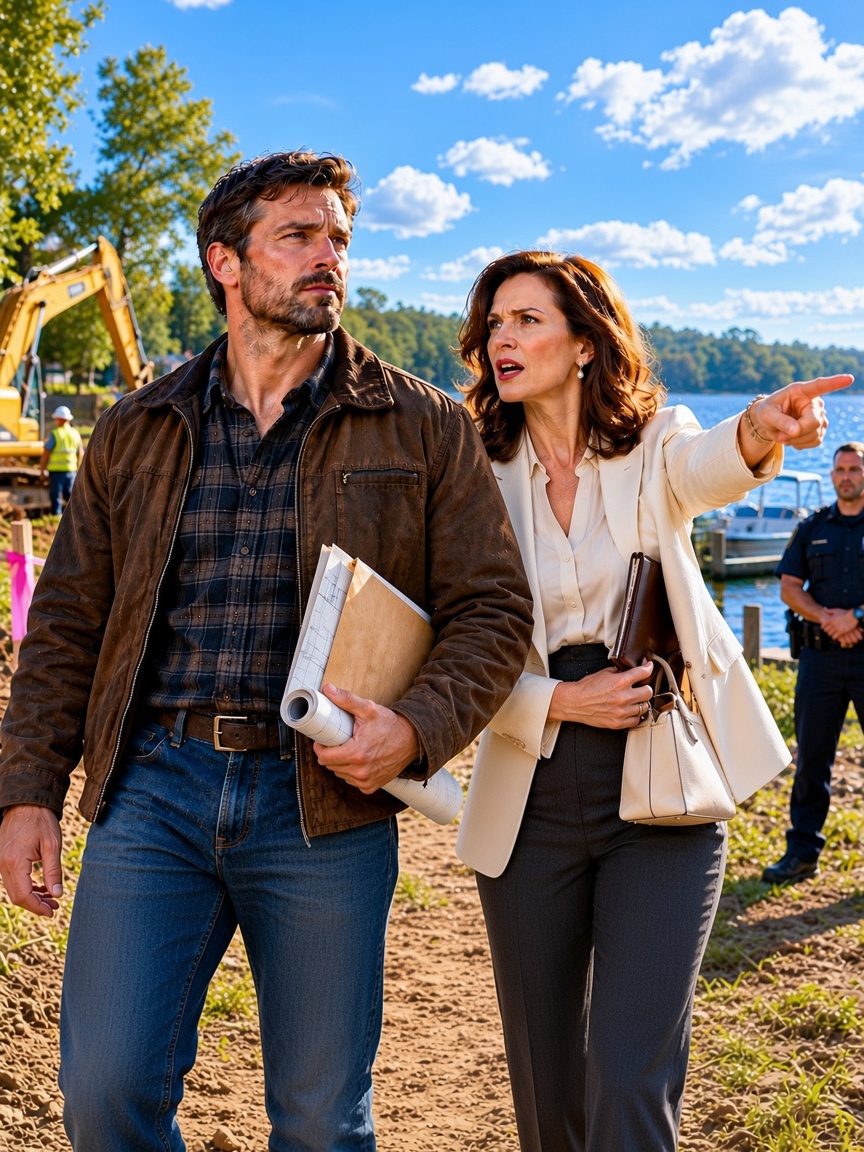
I looked at the glossy map she had unfolded across the hood of her vehicle. Someone had colored the entire waterfront green and labeled it Brierstone Shores Community Property.
Then I looked beyond her shoulder at the thirty-eight boat slips stretching into the lake.
Every one of those slips was being rented to residents.
Every one was connected to a shoreline she claimed the homeowners association owned.
And every lease I had managed to examine carried a parcel number that matched the deed sitting inside my truck.
“Marjorie,” I asked, “if the HOA owns this shoreline, why are you renting boat slips on my property?”
Her expression changed.
It was subtle. A slight tightening around her mouth. A quick glance toward the security guard standing nearest her.
But I saw it.
I had spent twenty years dealing with contractors, developers, and property owners who believed they could settle a dispute by speaking louder than everyone else. I knew the difference between someone who was angry and someone who was frightened.
Marjorie was frightened.
She just hadn’t realized how much she had to lose.
What she didn’t know was that, less than an hour before she arrived, a marine development company had confirmed a $250,000 escrow deposit toward purchasing my property.
The agreed price was $6.5 million.
And by the time this was over, that money would be the least surprising part of the story.
My name is Gideon Rowley. I was forty-four years old when I bought Parcel 47B on Brierstone Lake, and until that purchase, the most remarkable thing about my financial history was that I had managed to keep my mortgage current through two construction downturns.
I wasn’t a wealthy investor.
I wasn’t a real estate genius.
I was a construction manager who had started his career carrying survey equipment through muddy fields and gradually worked his way into supervising commercial projects.
I knew how to read a site plan. I understood grading, drainage, soil reports, and access requirements. More importantly, I knew that the numbers printed on a modern property map were only as reliable as the records behind them.
That knowledge was the reason I ended up buying a piece of land nobody else wanted.
It happened on a rainy Tuesday the previous spring.
I had been searching an online liquidation auction for a used compact excavator. A development company had gone bankrupt, and a court-appointed receiver was selling off everything from office furniture to construction equipment.
Near the bottom of the listings, between a damaged utility trailer and a pallet of electrical conduit, I saw something unusual.
PARCEL 47B — BRIERSTONE LAKE.
Opening bid: $100.
The photographs were terrible.
One showed a hillside covered in tangled brush. Another showed a fallen pine tree lying across what might once have been a footpath. The third was so blurry that I couldn’t tell whether the gray strip at the bottom was water or an old concrete foundation.
There were no utilities listed.
No driveway.
No improvements.
An inspection note mentioned erosion concerns and limited access.
I opened the county’s online parcel viewer. According to the colored map, the property was a narrow wedge of woodland pressed against the back of an established lakefront community.
It looked nearly useless.
Still, something bothered me.
The listing described 2.6 acres.
The digital map appeared to show less than half that amount.
I enlarged the image, checked the scale, and measured the approximate boundaries. The numbers didn’t agree.
I downloaded the deed description attached to the auction.
The legal language was old-fashioned, full of bearings, distances, and references to monuments that probably hadn’t been touched in decades.
But one phrase caught my attention.
“Thence continuing along the ordinary high-water boundary of Brierstone Lake…”
I read it again.
The online map showed almost no waterfront.
The deed described a boundary following the lake.
I wasn’t certain what that meant, but I knew enough to recognize that somebody had made a mistake somewhere.
The auction closed at five that afternoon.
Nobody else bid.
For one hundred dollars, plus recording and administrative expenses, I became the owner of Parcel 47B.
I didn’t tell anybody for almost a week.
Not because I was keeping a secret, but because I wasn’t convinced I had bought anything worth talking about.
My first visit didn’t improve my confidence.
I parked beside a gravel road, climbed over a fallen tree, and spent twenty minutes fighting through blackberry vines before reaching the center of the parcel.
There was an old concrete pad beneath the weeds.
A few rotting posts stood nearby.
Farther down the slope, I found a rusted metal survey box partly buried beneath pine needles.
When I finally reached the water, I stopped.
Brierstone Lake was beautiful.
The shoreline curved around a quiet bay, and the water beyond it was deep blue beneath the afternoon sun. Across the lake, expensive houses climbed the wooded hills. White boats moved between docks, leaving narrow wakes behind them.
For the first time, I could imagine building something there.
Nothing elaborate.
A modest cabin with a screened porch. A small workshop. Maybe a place where I could drink coffee on Saturday mornings without listening to construction equipment or answering phone calls about concrete deliveries.
I was standing there making plans when two residents approached along a narrow trail.
They were an older couple walking a golden retriever.
The man introduced himself as Walter Dunore.
“You the fellow who bought the abandoned lot?” he asked.
“That would be me.”
“Mind if I ask what you paid?”
“A hundred dollars.”
Walter laughed so hard he had to stop walking.
His wife gave him an embarrassed look.
“Sorry,” he said. “It’s just that nobody’s wanted this mess for years.”
“I noticed.”
“HOA says there’s no useful waterfront left around here.”
I glanced toward the lake.
“Looks like water to me.”
Walter smiled.
“Good luck telling Marjorie that.”
I learned who Marjorie Vickery was less than an hour later.
She appeared beside a split-rail fence in a white blouse, dark slacks, and sunglasses that probably cost more than my truck tires.
She didn’t introduce herself.
“Are you the new owner?”
“Yes.”
She surveyed the brush and broken concrete.
“I understand you purchased this through an auction.”
“That’s right.”
“How much?”
“One hundred dollars.”
Her smile was immediate and unpleasant.
“Well, I suppose you got what you paid for.”
I didn’t respond.
She pointed toward the water.
“You should understand that all valuable lakefront property in this section belongs to Brierstone Shores. Whatever you purchased is leftover development land.”
“I’ll check the records.”
“You can check whatever you like. Our association has controlled this waterfront for years.”
“Then I’m sure the records will make that clear.”
She removed her sunglasses.
For a moment, she looked irritated that I hadn’t argued.
Then she said, “We take our property rights very seriously here, Mr. Rowley.”
“So do I.”
That was our first conversation.
It should have been our last.
Instead, it started a chain of events that would eventually destroy her presidency, expose a financial scheme, and put millions of dollars in my bank account.
I began by comparing the recorded deed against the county’s digital map.
The discrepancy was larger than I initially thought.
The deed described 2.6 acres and approximately 810 feet of shoreline.
The digital map showed a narrow hillside lot with almost no contact with the lake.
I called a surveyor I knew professionally, Tucker Blevens.
Tucker was forty-eight, broad-shouldered, permanently sunburned, and one of the most stubborn men I had ever met when it came to property boundaries.
He could spend three hours looking for a brass monument buried beneath a parking lot and consider it a productive afternoon.
When I explained the problem, he asked me to email the deed.
Twenty minutes later, he called back.
“Gideon, where did you get this?”
“Court liquidation.”
“How much?”
“A hundred dollars.”
There was a long silence.
“Don’t build anything yet.”
“Why?”
“Because either this deed is wrong, or that county map is missing a substantial piece of property.”
“Which one do you think?”
“I think somebody needs to find the original plat.”
He was right.
But while Tucker began researching the property, something else happened that changed the value of the land completely.
The county announced a major improvement project for the southern end of Brierstone Lake.
The lakeside road would be upgraded.
A navigation channel would be dredged.
Several shallow approaches would be widened to accommodate larger commercial vessels.
Most residents barely noticed the announcement.
I read every page.
One engineering report identified a naturally deep channel near Parcel 47B.
Unlike much of the surrounding shoreline, where the lakebed rose sharply or became too shallow for commercial traffic, the water beside my property remained unusually deep close to shore.
That mattered.
A logistics dock needs more than an attractive view.
It needs sufficient water depth, stable ground, adequate access, and room for vehicles and equipment.
My neglected parcel appeared to have nearly everything except a cleared entrance.
A few weeks later, I received a phone call from a woman named Helena Fitzpatrick.
She introduced herself as the development director for North Point Marine.
“We understand you own land on Brierstone Lake,” she said.
“Apparently.”
She laughed.
“We’re interested in discussing a potential acquisition.”
“What kind of acquisition?”
“A purchase.”
I looked around my kitchen.
“Of the whole property?”
“Yes.”
“You’ve seen the photographs?”
“We’ve seen more than the photographs, Mr. Rowley.”
North Point sent engineers to inspect the site.
Then came soil tests, environmental assessments, navigation studies, and meetings with people who wore expensive suits and asked questions about shoreline stabilization.
I was careful not to promise anything I couldn’t verify.
The boundary survey was still underway.
The county map remained inaccurate.
And I had already encountered a homeowners association president who believed she controlled the entire shore.
Helena listened to all of it.
“We’re not purchasing a brochure,” she told me. “We’re purchasing a location. If the title and access can be established, we’re prepared to pay for what that location is worth.”
Negotiations continued for months.
North Point wanted the land because it was one of the few sites on the lake that could support its proposed marine logistics operation.
I wanted a price that reflected the site’s actual commercial potential.
Eventually, we agreed on $6.5 million, subject to clear title, legal access, due diligence, and necessary approvals.
When the purchase agreement arrived, I read it three times before signing.
I had bought the property for one hundred dollars.
Now a legitimate company wanted to pay me six and a half million.
I kept thinking someone would discover a mistake.
Instead, North Point deposited $250,000 into escrow.
The confirmation arrived on a bright June morning while I was checking Tucker’s survey stakes.
And that was when Marjorie Vickery arrived with her guards.
She stepped out of the center SUV as if she were inspecting a construction project she had personally authorized.
Six men in matching security shirts spread across the gravel path.
One carried a bundle of white signs.
Another carried a hammer.
Marjorie stopped ten feet away from me.
“Mr. Rowley, you’re trespassing on association property.”
I looked down at my boots.
“That’s an interesting claim.”
She opened her folder.
“We’ve received information that you’re attempting to sell community waterfront.”
“I’m selling my property.”
“You cannot sell what you don’t own.”
She unfolded her map across the hood of the SUV.
The shoreline was colored bright green.
According to her diagram, the HOA owned everything between the woods and the water.
She pointed at the green band.
“This is community waterfront. Your lot is behind it.”
“Where was that map recorded?”
She blinked.
“What?”
“Which county book and page?”
“This is our official association map.”
“That wasn’t my question.”
Her expression hardened.
“Our attorneys have reviewed it.”
“Then they should be able to provide the recorded instrument.”
She ignored that.
Instead, she gestured toward one of the guards.
He walked to an orange survey stake, pulled it from the ground, and drove a white sign into the hole.
PRIVATE HOA PROPERTY.
I watched him do it.
“Those are survey markers,” I said.
“They’re unauthorized.”
“That’s a licensed surveyor’s work.”
“Your surveyor has no authority to claim our waterfront.”
She handed me a single-page purchase offer.
Seventeen thousand dollars.
That was what the HOA would pay for what she described as my “remaining nonwaterfront parcel.”
“You should consider yourself fortunate,” she said. “That’s a tremendous return on a hundred-dollar investment.”
I looked at the offer.
Then I looked at the docks.
Thirty-eight slips.
Pontoons, fishing boats, and expensive recreational vessels sat neatly arranged along floating walkways.
“Who collects the slip rentals?” I asked.
“The association.”
“How long have you been doing that?”
“That’s none of your concern.”
“Do the leases identify the facility as Parcel 47B?”
She stopped moving.
I continued.
“Because I’ve seen one of those leases, Marjorie. And the parcel number matches my deed.”
One guard took a step toward me.
“You need to hand over your documents,” he said.
“No.”
“Sir—”
“I’m not handing private property records to a security guard.”
Marjorie caught the man’s arm.
“Enough.”
For the first time, her voice sounded strained.
She folded the map, closed the folder, and ordered everyone back into the vehicles.
Before leaving, she pointed toward the shoreline.
“Sunset, Mr. Rowley. After that, we’ll remove your markers ourselves.”
The SUVs disappeared down the road.
I stood beside the white sign for a while.
Then I photographed it, recorded the location, and called my attorney.
Natalie Ashcom was forty-one and had the unsettling ability to make people regret speaking before she had even asked a question.
She specialized in real estate disputes.
When I showed her Marjorie’s map, she examined it carefully.
“Where’s the recording information?”
“There isn’t any.”
“Do they have a deed?”
“They haven’t shown me one.”
“Then this is a picture, Gideon. A colorful picture.”
“She says it proves the HOA owns the shoreline.”
“Ownership doesn’t transfer because somebody colors a map.”
I should have felt relieved.
Instead, Natalie gave me a warning.
“She’s not necessarily trying to win in court.”
“What do you mean?”
“She’s trying to make your buyer nervous. If North Point walks away, she can pressure you into accepting that seventeen-thousand-dollar offer.”
I thought about Marjorie’s expression when I mentioned the slip leases.
“You think she knows the land is mine?”
“I think she knows something she doesn’t want examined.”
Within forty-eight hours, the HOA sent me a nineteen-page enforcement packet.
It demanded that I terminate the North Point contract, remove my property markers, and pay an $18,500 violation processing fee.
Natalie read it, then sent a formal demand for the recorded documents supporting the HOA’s claim.
A week later, the association responded.
They enclosed the same colored map.
They also included a board resolution declaring the waterfront community property.
The resolution was signed by Marjorie.
There was still no deed.
“She’s attempting to manufacture ownership through association paperwork,” Natalie said.
“Can she do that?”
“She can write whatever she likes. That doesn’t make it legally effective.”
The situation became more serious when North Point forwarded a letter it had received from the HOA.
Marjorie accused me of attempting to sell land belonging to 112 homeowners.
She warned North Point that purchasing the property could result in years of litigation.
Helena called me personally.
“We’re not terminating the agreement,” she said. “But we need this resolved.”
“I understand.”
“Our investment committee won’t authorize closing while title is disputed.”
“I’ll get it resolved.”
“I hope so, Gideon. We like this site.”
After that conversation, the six-and-a-half-million-dollar contract felt less like a victory and more like a clock ticking somewhere behind me.
Marjorie understood that pressure.
She began using it.
When Tucker returned with his crew, two HOA security vehicles blocked the access road.
The guards threatened to have the surveyors arrested.
I recorded the confrontation with my truck’s dashboard camera and called the sheriff’s office.
I didn’t move their vehicles.
I didn’t threaten anyone.
I let the deputy document what happened.
Natalie had given me one instruction that I followed throughout the dispute.
“Never give her a legitimate reason to make you the problem.”
So I kept records.
Photographs.
Dates.
Names.
Copies of letters.
Every threat and every obstruction went into a folder.
Then Tucker called me shortly before midnight.
“Gideon, I found something.”
“What?”
“The HOA’s map doesn’t just move the boundary.”
He paused.
“It erases your parcel.”
The following morning, we drove to the county records archive.
The building was an aging brick structure beside the courthouse. Inside, the air smelled of old paper and furniture polish.
Curtis Renshaw, the senior records clerk, had worked there for more than thirty years.
Tucker explained what we needed.
Curtis disappeared into the storage room and returned carrying a cardboard tube.
He unrolled a large survey across an oak table.
The document predated the formation of Brierstone Shores.
There it was.
Parcel 47B.
Two point six acres.
Eight hundred ten feet of lake frontage.
The original survey showed a continuous boundary along the water, fixed by permanent monuments.
And right through the middle of that shoreline sat the dock facility the HOA had been renting for years.
Tucker leaned over the drawing.
“Well,” he said, “that explains the enthusiasm.”
Curtis found the founding documents for Brierstone Shores next.
They listed every parcel transferred into the association’s common holdings.
Lots 1 through 46.
Several designated recreation tracts.
A clubhouse parcel.
Roadway interests.
But not 47B.
Not once.
The parcel had remained with a separate development company.
That company eventually failed.
Its remaining assets were sold through a court-supervised liquidation.
And I had purchased the parcel at auction.
For one hundred dollars.
I stared at the original plat.
“Are you telling me the HOA never owned it?”
“That’s what the recorded chain of title indicates,” Tucker said. “But we’ll verify the monuments in the field.”
He did exactly that.
Using the original bearings and coordinates, Tucker located two buried brass survey caps near the bank.
They matched the archived plat.
The boundary passed through the area occupied by the HOA’s dock access infrastructure.
He carefully explained that ownership of the shoreline did not automatically establish ownership of the lakebed or every structure floating above it.
Those issues required separate analysis.
But the ramps, anchoring installations, and access improvements placed on my land presented an obvious legal problem.
The association had apparently been using private property without a recorded right to do so.
That discovery changed everything.
I had originally thought Marjorie was trying to steal valuable waterfront because she saw an opportunity.
Now I began to suspect she had a much larger reason for wanting me gone.
The answer arrived through Walter Dunore.
He called one evening and asked if he could bring over some paperwork.
Walter was seventy-two, a retired electrician who had lived at Brierstone Shores for nearly fifteen years.
He arrived carrying a manila envelope and wearing a baseball cap with a faded fishing logo.
“I don’t want trouble,” he told me.
“Neither do I.”
“But I’ve paid for a boat slip since I moved here. And when I heard what Marjorie was saying about your property, I remembered something.”
He placed his lease on my kitchen table.
Near the top of the first page was the location description.
Dock Facility — Parcel 47B.
I read it twice.
“How much do you pay?”
“Five hundred twenty dollars a month now. It used to be less.”
“Do all the slips rent for about that?”
“Depends on size. Some are more.”
“And how long has the association operated them?”
“Since at least 2017, maybe earlier.”
I did the rough math.
Thirty-eight slips.
Hundreds of dollars each month.
Year after year.
Even allowing for vacancies and rate changes, the gross revenue could easily reach millions.
Walter watched my face.
“Is something wrong?”
“Possibly.”
“Am I going to lose my boat slip?”
“I don’t know. But I’m not interested in punishing residents who paid their bills in good faith.”
He seemed relieved.
Before leaving, he hesitated at the door.
“Marjorie always told us those docks were the association’s biggest asset.”
I looked down at the lease in my hand.
“They may have been somebody’s biggest asset,” I said. “Just not the association’s.”
Marjorie invited me to the clubhouse three days later.
Natalie advised me not to attend alone, so she accompanied me.
Six guards stood outside the building.
Inside, Marjorie sat at a long conference table with two board members and a young man operating a video camera.
She had arranged the room as if I were appearing before a disciplinary committee.
“Mr. Rowley,” she began, “we’re prepared to resolve this dispute generously.”
She slid a document toward me.
The association would purchase the entire parcel for $17,000.
I would cancel my North Point contract.
I would abandon all claims involving the docks.
And I would release the association, its officers, contractors, and affiliated companies from any liability arising from past use of the property.
I read the release twice.
It was longer than the purchase agreement.
“Why do you need this?” I asked.
“Standard protection.”
“From what?”
“Future nuisance claims.”
“If the HOA owns the shoreline, why are you asking me to release claims about its use?”
Marjorie glanced toward Natalie.
“Your client is being unreasonable.”
Natalie folded her hands.
“My client asked a straightforward question.”
Marjorie leaned forward.
“Let me make something clear. We have substantial legal resources. If Mr. Rowley refuses this offer, we can keep this matter in court for years.”
I said nothing.
She continued.
“Your buyer won’t wait forever. Eventually, you’ll be left with a worthless hillside and a mountain of legal bills.”
I looked at the document again.
“I’m not selling a property under contract for six and a half million dollars for seventeen thousand.”
Her palm struck the table.
“Then we’re finished.”
She ordered the guards to escort us out.
Natalie stood calmly.
“We know where the door is.”
As we walked to the parking lot, she looked at me.
“Did you notice the camera?”
“Yes.”
“Good.”
Later, through lawful discovery, that recording would become part of the evidence.
Marjorie’s threat to prolong litigation for the purpose of destroying my sale was preserved in the association’s own files.
But the most damaging evidence didn’t come from that meeting.
It came from the woman who had spent four years managing the HOA’s money.
Gloria Nickerson was fifty-seven and served as treasurer of Brierstone Shores.
She wasn’t particularly outspoken.
Residents described her as careful, dependable, and sometimes painfully thorough.
She believed the dock rentals funded landscaping, road repairs, insurance, and maintenance.
For years, she had accepted summaries prepared by the association’s management office.
Then the boundary dispute made her look more closely.
She began comparing bank statements, lease revenue, invoices, and annual reports.
The numbers didn’t reconcile.
Large payments had gone to a company called Vickery Waterfront Services.
Marjorie controlled that company.
The invoices described dock repairs, piling reinforcement, management consulting, navigation assessments, and emergency maintenance.
Some were for tens of thousands of dollars.
When Gloria requested completion reports and supporting documentation, Marjorie refused.
Then she told Gloria not to share the invoices with residents.
That was when Gloria called Natalie.
They arranged a meeting at an independent accounting firm two towns away.
I arrived expecting a handful of questionable invoices.
Gloria brought three binders, a laptop, and a canvas tote full of supporting records.
The forensic accountant, Raymond Hollis, spent most of the afternoon reviewing them.
He was a quiet man with wire-rimmed glasses who rarely spoke before finishing a calculation.
That day, he barely spoke at all.
He arranged the records into categories.
Slip revenue.
Maintenance expenses.
Vendor payments.
Bank transfers.
Loan disclosures.
By late afternoon, the table was covered.
The association’s recorded gross slip revenue since 2017 exceeded two million dollars.
Some expenses were legitimate.
But hundreds of thousands had flowed to Marjorie’s company through invoices with missing or inadequate documentation.
Raymond pointed to one entry.
“Piling reinforcement.”
He moved his finger down the spreadsheet.
“Same work description. Different invoice number.”
Then another.
“Again.”
Gloria looked sick.
“I approved summaries based on what management provided.”
Raymond didn’t accuse her of anything.
He simply asked for the original supporting records.
Some existed.
Others did not.
The most troubling discovery involved a $3.1 million financing arrangement connected to a proposed luxury marina expansion.
The HOA had used its dock revenue and claimed waterfront rights to support the financing application.
In the documents, the association represented that it legally controlled the dock facility.
The colored map Marjorie had shown me appeared in the supporting materials.
The same map that erased Parcel 47B.
The same map that had never been recorded.
And at the bottom of Gloria’s stack was a confidential redevelopment proposal showing how the association expected to profit from premium waterfront leases and future marina operations.
The proposed development covered my land.
All of it.
Suddenly, the seventeen-thousand-dollar offer made perfect sense.
Marjorie didn’t merely want to stop me from selling.
She needed me to sign away my claims.
She needed my parcel absorbed into the HOA’s control before the investors and lenders discovered that the association had built its waterfront business on land it couldn’t prove it owned.
I sat staring at the documents.
“All this time,” I said, “she’s been telling everyone I’m trying to take community property.”
Natalie closed one of the binders.
“She’s been trying to protect a financial arrangement. Whether the conduct amounts to fraud is for investigators and the courts to determine.”
“What do we do?”
“We establish title. We preserve the evidence. And we stop her from changing the property while the case is pending.”
Natalie filed an action to quiet title and sought temporary protection against further alteration of the disputed land.
She also sent formal preservation demands covering the leases, financial records, correspondence, and surveillance footage.
Then she notified the lender of the title dispute using authenticated documents.
I didn’t ask for a massive damages award.
Not yet.
I wanted the land protected and the North Point contract preserved.
Marjorie responded by escalating.
One Tuesday morning, I arrived at the parcel and found an excavator grading the access track.
The machine had already torn out several survey stakes.
Fresh dirt covered part of the route Tucker had marked.
I approached the foreman.
“Who’s paying for this work?”
“The HOA.”
“Do you have a county permit?”
He held up a work order.
It was signed by Marjorie Vickery.
“That’s not a county permit,” I said.
“I’m just doing the job.”
“Then stop until we can establish whether you’re authorized to be here.”
He refused.
I called the sheriff’s office and began recording.
A deputy arrived about thirty minutes later.
The foreman admitted that he had no county permit and had relied entirely on the HOA’s instructions.
The deputy documented the disturbed survey markers, equipment tracks, and work order.
The crew left.
I stood beside the excavator’s fresh cuts in the dirt, furious.
But I didn’t touch anything.
By then, I understood something important.
Marjorie kept trying to force a confrontation she could portray as aggression.
Every time I refused, she created another piece of evidence against herself.
Her next move was spectacularly public.
The HOA announced a grand launch for the Brierstone Premium Waterfront expansion.
There would be investors, bank representatives, real estate agents, residents, and local business owners.
The event would take place directly on the docks.
Promotional materials described the association as the owner and developer of the waterfront.
Marjorie intended to show everyone that she controlled the shoreline.
She probably believed the spectacle would intimidate me.
Instead, she gave Natalie a deadline.
Our emergency motion was scheduled for consideration on the morning of the launch.
The day arrived bright and windy.
Blue-and-white banners decorated the dock.
Flower arrangements lined the gangways.
Rows of white chairs faced a temporary stage.
At the center stood an architectural model of the proposed luxury marina.
Every part of Parcel 47B had been painted in the association’s colors.
I stood outside the event perimeter with Natalie and Tucker.
We weren’t there to interrupt anyone.
We were waiting for the court’s order to be formally communicated.
Marjorie appeared at the podium in a cream-colored suit.
She smiled at the crowd.
“For nearly a decade,” she announced, “Brierstone Shores has protected this waterfront for the benefit of our community.”
People applauded.
She spoke about heritage, responsible development, and preserving the lake for future generations.
Then the association’s attorney, Douglas Puit, walked onto the stage.
He handed her a document.
She tried to wave him away.
He leaned close and said something.
Her smile disappeared.
She looked down.
I couldn’t see the paper from where I stood, but I knew what it was.
The court had issued a temporary order prohibiting further alteration of the disputed area pending additional proceedings.
Douglas took the microphone.
“Ladies and gentlemen, we need to suspend discussion of certain portions of the proposed development until a pending legal matter is addressed.”
The applause stopped.
An investor in the second row raised his hand.
“Does the association actually own the land shown in this model?”
Marjorie grabbed the microphone.
“Of course we do. A private individual is attempting to take waterfront property that belongs to our residents.”
Tucker stepped forward with copies of his survey, which Natalie had arranged to provide to the appropriate representatives.
The bank’s lead representative, Diane Kesler, examined the original plat and the current boundary survey.
“Where is the recorded deed transferring this parcel to the association?” she asked Douglas.
Douglas looked toward Marjorie.
Marjorie looked toward the audience.
“We’ve controlled that waterfront for years.”
“That wasn’t the question,” Diane replied.
Then Gloria stood up.
She had been sitting in the third row.
Her hands were shaking.
“I need to say something as treasurer.”
Marjorie turned sharply.
“Gloria, this is neither the time nor the place.”
“I disagree.”
The crowd became quiet.
Gloria held up a folder.
“The financial reports presented to residents have not adequately disclosed payments to a company controlled by our president. I’ve requested supporting records, and I haven’t received satisfactory documentation.”
Marjorie stared at her.
“You are violating your obligations to this association.”
“My obligation is to the members,” Gloria answered.
A board member named Philip Grady stood.
“I move that we suspend this event and call an emergency board meeting.”
Several people began gathering their belongings.
The investors moved toward the parking lot.
Diane Kesler was already speaking on her phone.
Marjorie tried to regain control.
She accused Gloria of betrayal.
She accused me of greed.
She accused Natalie of trying to destroy the community.
But the room had changed.
People were no longer waiting for Marjorie to tell them what to believe.
They were asking for documents.
By noon, the marina launch was suspended.
Before the afternoon ended, the bank demanded a formal explanation of the association’s claimed waterfront rights and its representations concerning dock revenue.
I watched workers remove the banners from the stage.
One of them folded a large sign that read BRIERSTONE SHORES — EXCLUSIVE WATERFRONT OWNERSHIP.
It went into a cardboard box.
For the first time since I had met Marjorie, I felt that the facts might finally be catching up with her.
But she still had one weapon left.
Access.
The only practical road down to my parcel passed through the HOA development.
A security gate stood across it.
Marjorie sent North Point a letter claiming that the association controlled the road and would never authorize commercial access.
Without vehicle access, the proposed logistics dock would be nearly worthless.
Helena called me again.
“Gideon, we need to resolve this.”
“I know.”
“Our engineers can’t design a commercial operation around a road we’re not legally allowed to use.”
I had no answer.
For the first time, I was genuinely afraid the deal would collapse.
That evening, I spread the old documents across my dining table.
I studied the 1984 plat.
There was a narrow line running from the public road toward the lake.
It crossed the area where the HOA had installed its security gate.
Beside it was a notation I had noticed months earlier.
Maintenance access.
I called Tucker.
“Do you remember that old route?”
“Of course.”
“Could it be an easement?”
“Possibly.”
“Can we find out?”
He was quiet for a moment.
“Meet me at the archive tomorrow.”
Curtis Renshaw spent almost four hours searching the historical index.
When he finally returned, he carried a document bearing a county recording stamp.
It was an easement agreement dated 1984.
The instrument granted the owner of Parcel 47B a permanent sixteen-foot right of way from the public road to the lakefront parcel.
The right ran with the land.
It bound successors.
And there was no recorded termination.
I read the document while Tucker examined the plat.
“The gate,” I said.
“Right across the corridor,” Tucker replied.
“Can they block it?”
“Not if this easement remains enforceable and covers the use you’re proposing. The court will have to address the scope.”
Natalie reviewed the document and added it to our filings.
At the next hearing, the HOA argued that the easement had expired through decades of nonuse.
But its attorney produced no recorded release, termination, or other sufficient basis for extinguishing it.
The judge examined the original instrument, the surveys, and the evidence concerning the gate.
Two weeks later, the court confirmed the continuing validity of the easement and ordered the association to stop obstructing lawful access within its scope.
I remember reading the ruling in Natalie’s office.
For months, Marjorie had treated the gate as proof of her authority.
Now the gate represented a restriction the association had placed across somebody else’s recorded right of way.
Mine.
The next HOA meeting was standing room only.
Residents demanded explanations.
Why had their dues paid for a security gate that interfered with a recorded easement?
Why had the association claimed ownership of land it couldn’t document?
Why were dock revenues being paid to a company controlled by the president?
Marjorie blamed previous boards.
Gloria produced meeting minutes showing that Marjorie had personally approved the gate upgrade and ordered restrictions against outside landowners.
A retired schoolteacher asked how much the upgrade had cost.
When Gloria answered, several residents groaned.
Philip Grady called for an independent review of the association’s finances.
The motion passed.
Within days, the lender suspended further disbursements under the marina expansion financing while it reviewed the title representations and related obligations.
The luxury marina project stalled.
Marjorie’s control began to unravel.
The title case continued, but the evidence was consistent.
My recorded deed.
The original plat.
Tucker’s independent survey.
The brass monuments.
The HOA’s founding documents.
The court-supervised liquidation records.
The permanent easement.
Against all of that, the association had a colored internal map and a resolution Marjorie had signed herself.
Eventually, the court entered judgment confirming my ownership of Parcel 47B within its established boundaries.
The association was ordered to cease unauthorized occupation of the parcel and participate in an appropriate remediation process for the structures it had placed there.
The dock situation was complicated.
Thirty-eight boat slips couldn’t simply be pulled loose and dragged into the lake.
There were environmental requirements, engineering concerns, navigation safety issues, and the interests of residents who had rented slips in good faith.
Natalie worked with the relevant parties to make sure the legal process addressed those concerns.
I didn’t want boats damaged.
I didn’t want innocent residents punished.
I wanted the unauthorized use of my land resolved lawfully.
The HOA was forced to establish a substantial financial reserve for dock remediation and related obligations.
The amount approached one million dollars.
I thought about the seventeen-thousand-dollar offer Marjorie had pushed across the table.
It seemed almost absurd now.
But the financial consequences were only beginning.
The board called a vote of no confidence.
Marjorie sat at the head of the clubhouse table while residents who had once been afraid to challenge her demanded her removal.
One board member spoke about the undocumented payments.
Another discussed the failed marina financing.
A third asked why legal counsel had not been given complete title records before the association threatened me.
Marjorie tried to interrupt.
Philip Grady told her to let the speakers finish.
I heard about the meeting afterward from Walter.
“She kept saying she’d done everything for the community,” he told me.
“What did the residents say?”
“They asked her to show the receipts.”
He smiled faintly.
“She didn’t like that.”
The vote passed.
Marjorie Vickery was removed from the presidency.
She collected her leather folder and walked out of the clubhouse without speaking.
There were no guards beside her.
Nobody stood when she left.
The independent forensic audit uncovered dozens of payments to Vickery Waterfront Services that lacked adequate supporting documentation.
Investigators reviewed the transfers, invoices, and representations made in connection with the financing.
The audit findings were referred to state authorities.
What had begun as a property dispute developed into a separate financial investigation.
Months of interviews followed.
Subpoenas were issued.
Bank records were examined.
Eventually, prosecutors filed charges based on the evidence they believed supported financial fraud offenses.
Marjorie denied wrongdoing at first.
She claimed the payments were legitimate management expenses.
She said the boundary confusion had been inherited from earlier developers.
She insisted that everything she had done was intended to protect Brierstone Shores.
But the documentary record told a different story.
The false ownership representations, the questionable payments, and the effort to pressure me into signing a sweeping release were examined separately from the title dispute.
In the end, the criminal proceedings resulted in a judgment holding her responsible for misused funds and requiring restitution.
Her waterfront services company lost its association business.
The community she had controlled for nearly a decade moved forward without her.
I didn’t attend every hearing.
I attended the ones where my testimony was needed.
The rest of the time, I went back to work.
I still had construction projects to manage.
Bills to pay.
A house to maintain.
And a purchase agreement that had been suspended for so long that I was beginning to wonder whether North Point would ever return.
People assumed I was celebrating.
Some neighbors congratulated me.
Others asked what I planned to do with six and a half million dollars.
I always gave the same answer.
“I haven’t sold anything yet.”
The court had confirmed my title.
The easement had been established.
The HOA’s unauthorized claims had been defeated.
But the transaction still had to close.
North Point had every right to reconsider.
Companies change plans.
Budgets disappear.
Projects get delayed or cancelled.
I knew that better than most people.
Winter came.
The lake turned gray.
The shoreline trees lost their leaves, exposing the old concrete pad and the steep slope where I had once imagined building a cabin.
One afternoon, I drove down to the property alone.
I walked to the bank and stood watching the water.
The docks were quiet.
Several slips had been vacated as part of the remediation process.
The old HOA signs had been removed.
For the first time in months, nobody challenged me.
I should have felt victorious.
Instead, I felt tired.
I had spent nearly a year dealing with lawyers, surveys, financial records, hearings, and threats.
I had purchased the land because I wanted somewhere peaceful.
Now I knew more about Brierstone Shores’ finances than I ever wanted to know.
I wondered whether I should keep the parcel.
Build the cabin.
Forget North Point.
Let the whole ordeal become an expensive story I told friends over dinner.
Then my phone rang.
Helena Fitzpatrick.
“Gideon,” she said, “are you still interested in selling?”
I looked out over the lake.
“That depends.”
“On what?”
“Whether you’re still interested in buying.”
She laughed.
“We are.”
I sat down on the old concrete pad.
“The original price?”
“Six point five million.”
I didn’t speak for several seconds.
Helena continued.
“Our legal team has reviewed the judgment and access documentation. Subject to final closing requirements, we’re ready to move forward.”
I closed my eyes.
For almost a year, I had imagined that moment.
When it finally arrived, I didn’t shout.
I didn’t laugh.
I simply asked, “When do you want to close?”
North Point completed its final due diligence.
The title company reviewed the recorded judgment, survey, and easement.
The remaining contract conditions were satisfied.
The closing was scheduled for a Thursday morning in late winter.
I arrived at the title office wearing a navy jacket and the same watch I had owned for twelve years.
Helena was already there.
She shook my hand.
“Long road,” she said.
“Longer than I expected.”
The closing agent placed the documents in front of me.
I signed the deed.
The settlement statement.
The required disclosures.
The final acknowledgments.
When the last signature was complete, the closing agent confirmed the transaction.
Six million five hundred thousand dollars.
That was the purchase price, including the deposit already held in escrow, before taxes, fees, and other closing costs.
I stared at the final statement.
Then I remembered the liquidation auction.
The blurry photographs.
The fallen pine.
The rusted survey box.
The one-hundred-dollar bid.
I had purchased a forgotten piece of land because I noticed that the acreage on the deed didn’t match the county’s digital map.
I had nearly lost the sale because a powerful woman wanted everyone to believe that her colored diagram mattered more than recorded ownership.
And now the transaction was finished.
Helena smiled.
“You all right?”
“Yeah.”
“You look surprised.”
“I am.”
“You negotiated this price.”
“I know.”
“Then why the surprise?”
I looked at her.
“Because a year ago, I thought I was buying a place to put a cabin.”
She laughed.
“That’s a very expensive cabin site now.”
After closing, I took several days off.
Not to celebrate.
I needed time to understand what had happened.
The money was real, but I didn’t suddenly feel like a different person.
I still woke up early.
I still checked the weather before driving to construction sites.
I still noticed crooked retaining walls and badly graded driveways.
The biggest change was that I no longer had to accept work simply because I needed the paycheck.
I paid off my mortgage.
Set aside money for taxes.
Met with financial and legal advisers.
Helped a few relatives in ways I had wanted to for years.
And then I returned to managing projects, though I became much more selective about which ones I accepted.
North Point announced plans for its marine logistics facility, including a public waterfront access area subject to the necessary permits and operational restrictions.
That mattered to me.
I had never wanted the lake to become a private kingdom.
The people of Brierstone Shores deserved a waterfront they could enjoy without being manipulated by someone who controlled the signs, gates, and financial records.
A new HOA board was elected that spring.
Gloria joined the financial review committee.
Philip Grady helped implement stronger oversight procedures.
Residents received clearer financial statements and more direct access to association records.
Walter called me one afternoon.
“You should see the clubhouse meetings now,” he said.
“Why?”
“People actually ask questions.”
“Sounds dangerous.”
He laughed.
“Marjorie would have hated it.”
A few weeks later, I returned to Brierstone Lake for one final walk.
The old security gate still stood near the road.
But the sign that once declared exclusive HOA access was gone.
A new marker acknowledged the recorded right of way.
I parked beside the entrance and walked down the sixteen-foot corridor.
The road had been cleared.
The shoreline was quiet.
North Point’s preliminary site work had begun farther along the property, and a few survey stakes marked future construction areas.
Tucker was waiting near his truck.
He had come to check one last set of boundary references before the new owners began work.
He watched me approach.
“Well,” he said, “there goes your hundred-dollar investment.”
“Best hundred dollars I ever spent.”
“Technically, you spent more on recording fees.”
“Don’t ruin the story.”
He grinned.
We stood looking across the water.
After a while, he asked, “Do you regret selling?”
I considered the question.
There had been a time when I wanted nothing more than a small cabin on that bank.
A quiet place.
A porch.
A view of the lake.
But that version of the future had changed the moment the original survey revealed what the land really was.
“No,” I said. “I think it ended the way it was supposed to.”
Tucker nodded.
“Most people would’ve ignored that auction listing.”
“Most people would’ve trusted the online map.”
“And most people would’ve taken the seventeen thousand once Marjorie showed up with six guards.”
I smiled.
“That’s probably what she was counting on.”
We heard an engine behind us.
A black SUV moved slowly along the lakeside road.
I recognized the vehicle.
Through the rear passenger window, I saw Marjorie Vickery.
She was looking toward the water.
For a moment, our eyes met.
I couldn’t tell what she was thinking.
Maybe she was remembering the day she arrived with six guards and ordered me off my own property.
Maybe she was thinking about the marina expansion that never happened.
Or the position she had lost.
Or the financial consequences that followed when people finally examined the records she had spent years telling them not to question.
The SUV kept moving.
It didn’t stop.
No guard stepped out.
Nobody approached me with a violation notice.
Marjorie disappeared around the bend.
Tucker watched the vehicle go.
“Think she’ll ever admit she was wrong?”
“Doesn’t matter.”
He looked at me.
“Really?”
I nodded toward the survey stakes.
“The records are right. That’s what matters.”
We walked down to the water together.
The lake was calm, and the afternoon sun reflected off the far hills.
I thought about how easily the entire story could have ended differently.
If I had accepted the county’s digital map without checking the deed, I might have built a cabin on the wrong part of the property.
If I had trusted Marjorie’s confident claims, I might have surrendered the shoreline.
If I had signed her seventeen-thousand-dollar offer, I would have released claims I didn’t yet understand.
And if Gloria hadn’t questioned the financial records, the association’s members might have continued paying into a system whose most important transactions they couldn’t properly examine.
I hadn’t defeated Marjorie by shouting louder.
I hadn’t needed to threaten her.
I hadn’t needed six guards, expensive suits, or a glossy map.
I had needed a recorded deed, an independent survey, an attorney who understood the law, and enough patience to let the evidence speak.
The most important thing I learned wasn’t that a hundred-dollar property could become worth millions.
It was that people sometimes confuse authority with ownership.
Marjorie had controlled the gate.
She controlled the signs.
She controlled the board meetings.
For years, she controlled the story residents were told about their waterfront.
But none of those things gave her title to my land.
And once the documents came out, all the confidence in the world couldn’t change a single boundary line.
Tucker climbed into his truck.
I stayed beside the lake for another minute.
The breeze moved through the pines behind me.
Somewhere across the water, a boat engine started.
I looked toward the place where I had first found that cracked concrete pad and imagined a cabin.
Then I turned and walked back toward the road.
I had arrived at Brierstone Lake with a hundred-dollar deed and a plan for quiet weekends.
I left with a completed $6.5 million sale, a cleared title, and a lesson I would never forget.
Marjorie Vickery had spent years convincing an entire community that the shoreline belonged to her association.
I spent one hundred dollars buying the land that proved it never had.
THE END
Disclaimer: This is fictional AI-generated content created solely for entertainment purposes and is not intended to offend, target, defame, or harm any individual, group, or organization.
Disclaimer: This story is fictional and created for entertainment purposes only. Any names, characters, places, or events are fictitious or used fictitiously. No real person or organization is intended to be portrayed.

