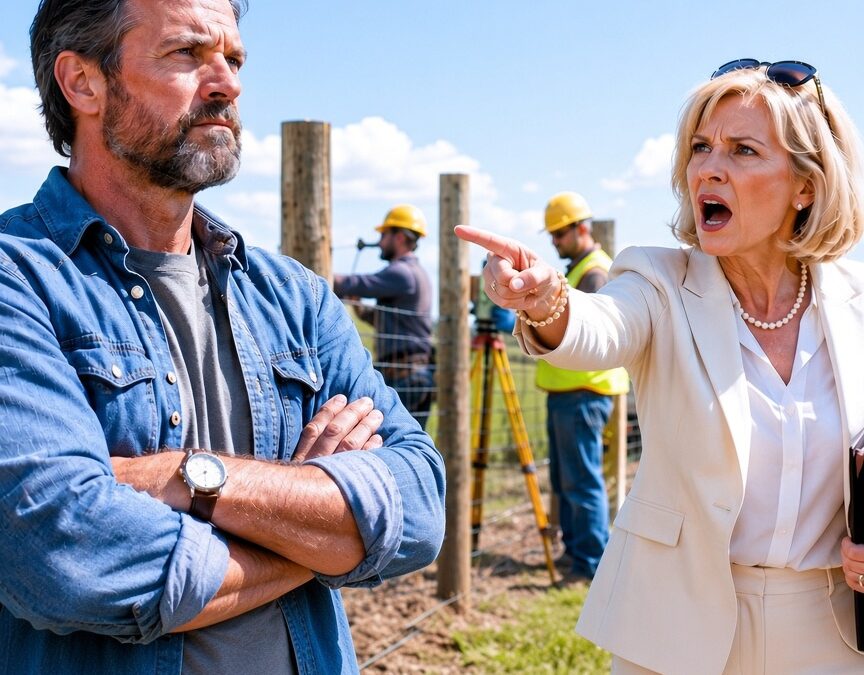
The first thing Ethan Brooks noticed that Monday morning was the sign.
It stood in the damp soil at the eastern edge of his farm, precisely where he had been turning his tractor for the better part of twenty years. It was a new sign, made of polished aluminum, mounted on two steel posts that had been driven deep enough into the ground to make a statement. Across its white surface, in black capital letters, someone had printed a warning that made Ethan stop halfway through his first sip of coffee.
HOA PROPERTY. NO TRESPASSING.
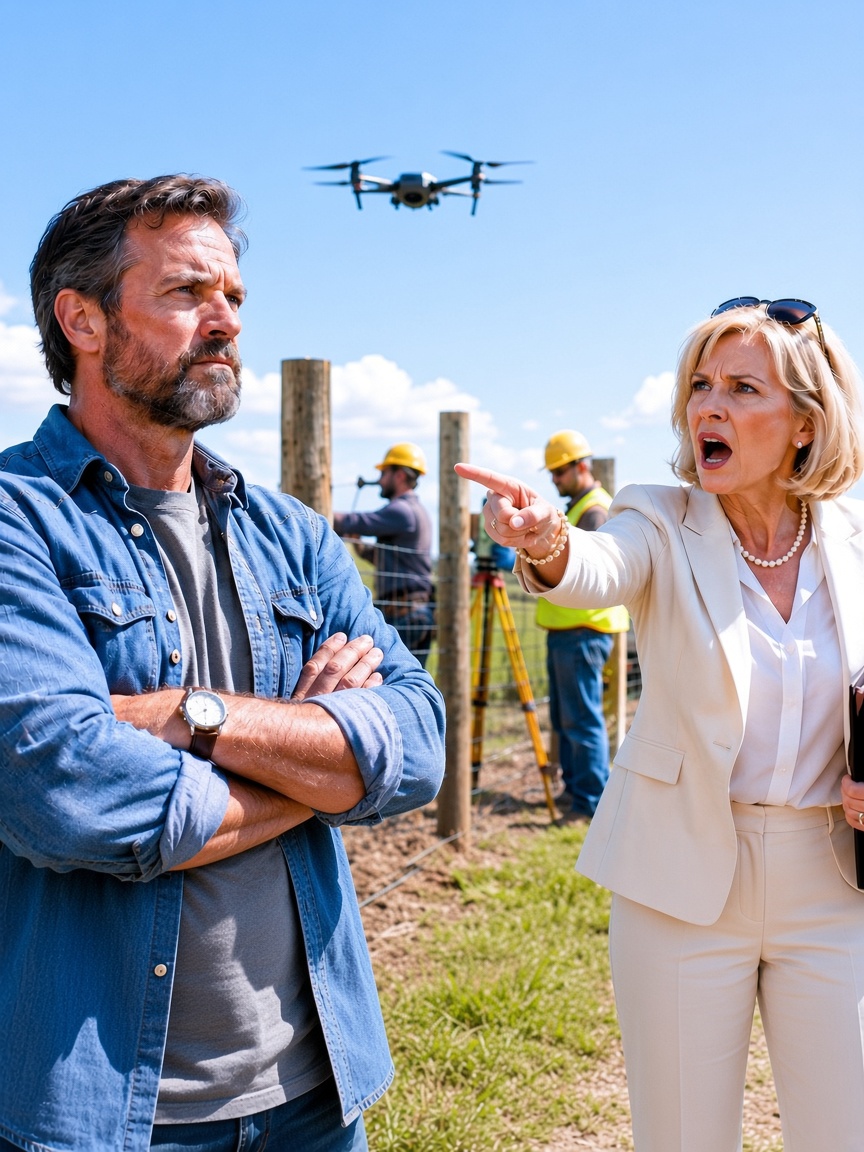
Ethan stood there for several seconds, studying the sign with the careful attention he usually reserved for a broken irrigation line or a sick animal. At sixty-one, he was not a man who surprised easily. He had raised two children, buried his father, survived a bad harvest and a worse divorce, and spent fifteen years settling property disputes for people who seemed to believe that shouting could alter the location of a boundary marker. But this was something new. Someone had apparently decided that the eastern portion of his seventy-acre farm no longer belonged to him.
“Good morning, Mr. Brooks.”
The voice came from behind the fence line.
Ethan turned and saw Karen Whitmore standing beside a black SUV parked on the subdivision road. She wore pressed beige trousers, a white blouse, and sunglasses that probably cost more than his oldest tractor tire. Her dark hair was arranged in a way that suggested she had devoted considerable attention to it before coming out to confront a farmer at seven in the morning.
Karen was forty-eight, recently elected president of the Whispering Pines Homeowners Association, and apparently convinced that the title came with authority extending far beyond the neighborhood she represented.
She smiled when Ethan looked at her, but there was no warmth in it.
“I see you found our notice.”
“I did.”
“Good. That should clear up any confusion about the property line.”
Ethan glanced back at the sign.
“Which property line would that be?”
“The eastern boundary of Whispering Pines. The board has reviewed the original development plans, and we’ve determined that your agricultural property falls within the association’s jurisdiction.”
Ethan took another sip of coffee.
“All seventy acres?”
“Yes.”
“That’s interesting.”
Karen shifted her weight, apparently disappointed that her announcement had not produced the argument she expected.
“Mr. Brooks, I understand this may come as a surprise, but property ownership comes with responsibilities. Your family has been operating outside our community standards for years. The board has decided that the situation needs to be corrected.”
Ethan looked across the field toward the old red barn his grandfather had built in 1958. Beyond it stood the farmhouse where his father had grown up, the equipment shed, two cattle pastures, and rows of cultivated land stretching west toward the wooded hills.
The farm had been there long before Whispering Pines existed.
Long before Karen Whitmore had purchased her house.
Long before any developer had imagined turning the neighboring acreage into three hundred expensive homes with matching mailboxes and an architectural review committee.
And Ethan knew something Karen apparently did not.
The land beneath their feet had a history that could not be rewritten by a homeowners association.
“Have you had the boundary surveyed?” he asked.
Karen gave a small, impatient laugh.
“Our property management company has all the necessary documentation.”
“That wasn’t what I asked.”
“The board has reviewed the maps, Mr. Brooks.”
“Actual recorded surveys?”
“I’m not going to debate technicalities with you.”
Ethan nodded.
“Fair enough.”
Karen removed a folded document from her leather handbag and held it toward him.
“This is a formal notice. You have thirty days to bring your property into compliance. That includes removing unauthorized agricultural equipment visible from the subdivision, repainting your outbuildings in approved colors, and submitting plans for any future construction.”
Ethan did not take the paper immediately.
“Karen, my farm isn’t part of your association.”
“That is your interpretation.”
“No. That’s what the recorded documents say.”
Her smile disappeared.
“I would strongly advise you not to make this difficult.”
Ethan looked at the sign again.
“Are you planning to put a fence along this line?”
“As a matter of fact, yes. The association intends to establish a permanent boundary so there can be no further misunderstandings.”
“Right where you put that sign?”
“Exactly.”
Ethan considered her for a moment.
Then he said something Karen would remember for a very long time.
“If you’re completely certain that’s your boundary, go ahead and build your fence.”
She blinked.
“You’re agreeing?”
“I’m saying I won’t stop you from building where you believe your property begins.”
For the first time that morning, Karen looked satisfied.
“I’m glad we could resolve this professionally.”
She climbed into her SUV and drove away, leaving Ethan standing beside the sign with his coffee growing cold.
He watched her disappear around the bend.
Then he looked down at the metal post driven into the ground.
“Granddad,” he murmured, “you wouldn’t believe this one.”
What Karen did not know was that her sign was standing nearly forty feet beyond the boundary she thought she understood. And the land she was preparing to fence off belonged to an owner considerably less forgiving than Ethan Brooks.
Three days after that fence was completed, three white government trucks would come rolling down the gravel road.
By the time they left, Karen Whitmore would no longer be talking about community standards.
But the trouble had started long before that Monday morning.
The Brooks farm occupied the western edge of Mill Creek County, a quiet part of rural Virginia where the mornings smelled of cut grass, damp timber, and diesel fuel. The land had been in Ethan’s family since his grandfather, Thomas Brooks, purchased the original parcel in 1954.
Thomas had been a stubborn man with a practical education and a deep distrust of anyone who sold property without knowing where its corners were. He had insisted on a professional survey before buying the farm, even though the seller assured him that the old stone wall marked the correct boundary.
The survey revealed that the wall was wrong by nearly twenty feet.
Thomas had paid the surveyor, moved the fence, and kept a copy of every document.
Ethan’s father, Robert, inherited that habit.
By the time Ethan took over the farm, three generations of deeds, plats, easements, tax records, and boundary photographs filled a steel filing cabinet in the study.
To most people, the cabinet would have looked like a collection of boring paperwork.
To Ethan, it was the history of his family written in measurements.
He had also spent almost fifteen years working as a licensed land surveyor before returning to the farm full-time. His work had taken him across Virginia, West Virginia, and parts of North Carolina, sometimes into muddy fields where neighbors were threatening lawsuits over a few feet of dirt.
He had seen friendships destroyed over fences.
He had watched families argue about roads that had existed longer than any of them had been alive.
And he had learned one lesson that guided him through almost every disagreement he encountered.
People could argue about where land belonged.
The recorded boundary did not argue back.
When Whispering Pines was developed on the acreage east of his farm, Ethan had paid close attention.
The developer, a regional company called Sterling Residential, originally approached him about purchasing an additional twenty acres to expand the subdivision. Ethan declined. He had no interest in watching bulldozers tear through the pasture where his father had taught him to ride.
The company proceeded with the land it already owned.
During the development process, a formal agreement was recorded confirming that the Brooks property remained outside the subdivision and was not subject to its homeowners association. There were separate provisions addressing drainage, utility access, and an old maintenance corridor near the eastern property line.
That corridor was particularly important.
Decades earlier, a narrow tract adjoining the Brooks property had been transferred to the federal government as part of a watershed protection and land-management project. The land formed an irregular strip along a wooded drainage area, widening considerably near an abandoned access road.
Most residents never noticed it.
On ordinary neighborhood maps, the corridor looked like open green space.
On preliminary development drawings, it was barely distinguishable from the subdivision’s landscaping buffer.
But on the recorded federal and county surveys, its ownership was unmistakable.
Ethan knew all of this because he had studied the documents years earlier when the subdivision’s construction crews accidentally damaged one of his fence corners.
The developer had apologized and repaired the damage.
The matter ended there.
For more than a decade, the relationship between the farm and Whispering Pines remained peaceful.
Residents liked the view of the fields.
Children waved at Ethan’s cattle from the walking trail.
Some neighbors stopped at his farm stand for tomatoes, sweet corn, and eggs.
Ethan occasionally helped people recover lawn equipment that had slid into the drainage ditch, and once pulled a delivery truck out of the mud with his tractor after the driver followed a faulty GPS route.
Then Karen Whitmore moved into the neighborhood.
At first, she seemed harmless enough.
She attended community meetings, volunteered for landscaping committees, and spoke frequently about maintaining property values. She had moved from Richmond after a divorce and purchased a large house near the entrance to Whispering Pines.
Her background was in corporate property management, a profession she mentioned whenever anyone questioned her understanding of regulations.
Within two years, she was serving on the architectural review committee.
Within four, she had become HOA president.
She ran on a platform of stricter enforcement and neighborhood improvement.
Her campaign emails promised to eliminate inconsistent standards, protect investments, and restore what she called “the original vision of Whispering Pines.”
Several residents welcomed the idea.
The previous board had been slow to address potholes, broken streetlights, and a neglected playground. People assumed Karen’s energetic approach might finally get things done.
They soon discovered that her definition of improvement was unusually personal.
A retired firefighter received a violation notice because his mailbox was charcoal gray instead of black.
A young family was told to remove a basketball hoop from their driveway even though other homes had identical equipment.
A widow named Margaret Ellis received two separate letters demanding that she replace decorative stones around her flower beds because their color had not been approved.
Karen attended meetings with a binder full of photographs, each image documenting what she considered evidence of neighborhood decline.
She seemed to enjoy reading violations aloud.
People began joking privately that she had turned the HOA into a neighborhood police department.
Daniel Ruiz did not find the situation especially funny.
Daniel lived two houses east of Ethan’s farm, on a corner lot where the subdivision road curved toward the old county highway. He was fifty-seven, a retired high school history teacher, and had served three years on the HOA board before deciding that gardening was a more pleasant use of his retirement.
He remembered when the association’s biggest controversy involved replacing the clubhouse carpet.
One evening, after Karen had sent another round of warning letters, Daniel walked over to Ethan’s porch carrying a bag of homemade biscuits.
Ethan was repairing a worn leather harness at the kitchen table.
“You seen the latest neighborhood newsletter?” Daniel asked.
“Can’t say I have.”
“You’re missing a masterpiece.”
Ethan raised an eyebrow.
“Should I be concerned?”
“Apparently we’re entering an era of strict accountability.”
“Sounds expensive.”
Daniel laughed and settled into the porch chair.
“She’s looking at your farm, Ethan.”
That got Ethan’s attention.
“What about it?”
“She’s been telling people your sheds are an eyesore. Says the farm equipment lowers property values. At the last meeting, she asked whether the association had authority over adjoining agricultural land.”
Ethan set the harness aside.
“What did the board tell her?”
“Preston said he’d need to review the recorded documents.”
“Preston?”
“The new association attorney. Preston Hale. Young fellow, probably thirty-two. Seems bright enough.”
“And Karen?”
“She said the developer’s original map was very clear.”
Ethan gave a short laugh.
“Original map?”
“That’s what she called it.”
“There were several original maps.”
Daniel leaned forward.
“Something I ought to know?”
“Nothing that isn’t public record.”
“You’re enjoying this already, aren’t you?”
“Daniel, I spent fifteen years watching people confuse a drawing with a deed. It’s a common mistake.”
“Karen doesn’t strike me as someone who enjoys being corrected.”
“Then she’d probably hate surveying.”
Daniel laughed again, but his concern remained.
“I don’t want to see you dragged into some ridiculous fight.”
“Neither do I.”
“You planning to do anything?”
Ethan poured them both some sweet tea.
“Not unless she gives me a reason.”
The reason arrived the following week.
Karen came to the farm accompanied by Preston Hale and two board members, Lydia Foster and Mark Ellison.
Ethan was near the equipment shed replacing a hydraulic hose when the group approached.
Karen walked ahead of everyone else.
“Mr. Brooks, we need to discuss your property.”
Ethan wiped his hands with a rag.
“Morning.”
She unfolded a printed map.
“Following our review of the development documents, the board has determined that your farm falls within the association’s community planning area.”
Preston looked uncomfortable.
Ethan noticed.
“Planning area?” Ethan asked.
“That’s correct,” Karen replied.
“Is that the same thing as association jurisdiction?”
Karen frowned.
“For practical purposes, yes.”
“No, it isn’t.”
Mark looked down at his shoes.
Karen straightened.
“Mr. Brooks, I appreciate that this property has been in your family for some time. But longstanding use doesn’t exempt someone from legitimate community regulations.”
“Actually, in this case, the recorded exemption does.”
“There is no exemption that supersedes the association’s governing authority.”
Ethan studied her.
“Have you read the recorded declaration?”
“I have read the relevant documents.”
“The actual recorded declaration?”
“I’m not going to play word games with you.”
Ethan turned toward Preston.
“Have you?”
The attorney hesitated.
“I’ve reviewed the materials provided by the board.”
“Did those include the final recorded subdivision plat?”
Preston glanced at Karen.
“Not yet.”
For a moment, nobody spoke.
Then Karen folded the map with an irritated snap.
“This discussion is over. You’ll receive formal notification of the required changes.”
She turned away.
Preston lingered for a moment.
“Mr. Brooks,” he said quietly, “do you happen to have the recording reference for that exemption?”
“I do.”
“Would you be willing to provide it?”
“Absolutely.”
Ethan wrote the reference on a scrap of paper and handed it over.
Preston looked at the numbers.
“Thank you.”
Karen called from the road.
“Preston, we’re leaving.”
The attorney folded the paper and hurried after her.
Ethan watched them go.
He had worked with enough attorneys to recognize the expression on Preston’s face.
The young man had just realized that his client might be standing on a very weak argument.
The first violation notice arrived the next morning.
It demanded the removal of Ethan’s equipment shed, replacement of his eastern fence, and submission of agricultural operations for HOA review.
A second notice arrived by certified mail two days later.
It included a warning that continued noncompliance could result in escalating penalties.
Ethan kept both notices.
He did not answer them.
Instead, he carried his father’s old metal document box into the kitchen, cleared the table, and began laying out the surveys.
The kitchen smelled of coffee and the apple pie he had baked the previous evening. Outside, rain tapped gently against the windows.
Ethan studied the records until well after sunset.
He placed the association’s planning map beside the final subdivision plat, then compared both against the survey showing the federal watershed tract.
Within twenty minutes, he found the problem.
The association had been using an old preliminary development sketch that showed a proposed landscape buffer along the edge of the farm. The drawing had never been intended to establish ownership.
More importantly, the line Karen was treating as the subdivision boundary had been copied from an early planning overlay that did not accurately show the federally owned corridor.
The difference was not obvious to an inexperienced reader.
At one point, the error amounted to little more than forty feet.
Farther south, where the federal tract widened around the drainage basin, the discrepancy became substantial.
A fence following Karen’s proposed line would not simply be misplaced.
Depending on how far she extended it, the association could end up enclosing nearly ten acres of federal land.
Ethan leaned back in his chair.
He checked the measurements again.
Then he checked the recorded references.
There was no ambiguity.
The farm remained entirely outside the HOA.
The new subdivision boundary stopped well short of the land Karen intended to claim.
And the intervening acreage belonged to the United States.
Ethan sat quietly for a while, looking at the maps.
Then he laughed.
Not loudly.
Just enough to startle his old Labrador, Cooper, who had been sleeping beneath the table.
“Well,” Ethan told the dog, “that’s going to be awkward.”
The next morning, Ethan drove into town.
The Mill Creek County Recorder’s Office occupied the first floor of an old brick government building near the courthouse. Ethan had visited it hundreds of times during his surveying career.
Martha Collins still worked behind the counter.
She had known his father, remembered his grandfather, and had never once tolerated careless paperwork.
“Ethan Brooks,” she said when he entered. “What kind of trouble are you bringing me today?”
“Not mine, hopefully.”
“That usually means somebody else’s.”
He handed her the recording references.
“I need certified copies of these plats, the exemption agreement, and the federal tract description.”
Martha put on her reading glasses.
“What’s going on?”
“Homeowners association says it owns my farm.”
She looked over the top of her glasses.
“Your farm?”
“Apparently.”
“All seventy acres?”
“That was the announcement.”
Martha stared at him.
Then she laughed so hard that a clerk at the next counter looked up.
“Oh, Ethan. Please tell me somebody wrote that down.”
“They did. Sent it certified mail.”
“Well, that’s thoughtful of them.”
Martha retrieved the documents and laid them across the counter.
Together they examined the recorded boundaries.
When Ethan showed her Karen’s proposed fence line, Martha stopped smiling.
“Who prepared this?”
“That’s what I’m trying to find out.”
“This isn’t the recorded boundary.”
“No.”
“And this line here?”
“Federal tract.”
She traced it with her finger.
“Good Lord.”
Ethan nodded.
“She intends to build a fence.”
“Across this?”
“That’s the plan.”
Martha looked up.
“Has anybody told her what she’s looking at?”
“I’ve asked whether she’s had a survey.”
“That’s not what I asked.”
“She says the board has everything under control.”
Martha removed her glasses.
“That’s usually what people say right before they discover they don’t.”
She prepared certified copies and helped Ethan confirm the federal land records and agency contact information.
Before he left, she gave him a serious look.
“Ethan, don’t let them damage your property.”
“I won’t.”
“And don’t let anyone confuse silence with permission.”
“I know.”
He thanked her, paid the copying fees, and drove home with a folder full of documents that could settle the matter in a single meeting.
But Karen was not interested in a meeting.
She was interested in a victory.
Two days later, she posted a lengthy announcement to the neighborhood’s online group.
The HOA, she wrote, had uncovered a longstanding boundary inconsistency involving the Brooks farm. She accused previous boards of allowing an adjoining landowner to benefit from community property without proper oversight.
She promised a permanent fence to restore the rightful boundary.
The announcement received dozens of approving comments.
Some residents praised her for finally taking action.
Others asked whether the land could eventually become a walking trail or community garden.
Karen responded enthusiastically.
Daniel sent Ethan a screenshot.
“Please tell me you’ve seen this nonsense,” he wrote.
Ethan called him.
“She’s building the fence?”
“Apparently next Thursday.”
“Good to know.”
Daniel went silent.
“Ethan, did you just say good?”
“I said good to know.”
“That’s not the same thing, and you know it.”
Ethan smiled.
“Come over for dinner. I’ll show you something.”
That evening, Daniel arrived to find Ethan’s kitchen table covered in maps.
Ethan walked him through the recorded subdivision boundary, the farm exemption, and the federal watershed corridor.
Daniel listened without interrupting.
When Ethan finished, Daniel stared at the map.
“Wait a minute.”
Ethan nodded.
“She doesn’t own that land.”
“No.”
“You don’t own it either?”
“No.”
“Then who does?”
“The federal government.”
Daniel looked back toward the proposed fence line.
“How much land are we talking about?”
“If she follows the route she’s marked and closes the southern section, probably close to ten acres.”
Daniel sat down.
For several seconds, he said nothing.
Then he began laughing.
He laughed until his shoulders shook.
“Ethan, she’s about to spend association money fencing in federal property?”
“That’s what her current plan indicates.”
“And you told her she could?”
“I told her I wouldn’t interfere with construction on land she claimed was hers. I didn’t authorize anything.”
Daniel wiped his eyes.
“You are a dangerous man.”
“I’m a retired surveyor.”
“Same difference.”
Ethan’s expression became serious.
“I want to be clear about something, Daniel. I’m not going to let anyone damage my land, and I won’t interfere with federal property. If the crew starts crossing my recorded boundary, I’ll stop them. But I’m not responsible for approving her construction plans.”
“Why not just show her the documents?”
“I offered to discuss the recorded survey. She refused. Preston has the recording reference. Walter, if he’s the contractor she hired, ought to ask for verification. They have everything they need to avoid this.”
Daniel stared at the papers.
“You really think she’ll build it?”
“I think Karen Whitmore has spent too much time telling everybody she’s right to admit she might be wrong.”
He folded the survey.
“And that’s a very expensive position to be in.”
The fence crew arrived at seven thirty Thursday morning.
Three work trucks turned off the county road carrying steel posts, rolls of wire, concrete mix, and a small tracked drilling machine.
The crew leader was Walter Gaines, a fifty-nine-year-old contractor who had installed agricultural and commercial fencing across the region for nearly three decades.
He stepped out of his truck and found Karen waiting beside the HOA’s new boundary sign.
She had brought a clipboard, a large paper map, and two members of the board.
Walter looked at the drawing.
“Where’s the survey staking?”
Karen pointed toward the tree line.
“Everything is marked on the map.”
“I’m asking whether a licensed surveyor set the actual corners.”
“Our property management company verified the boundary.”
Walter studied the map.
“That’s not quite the same thing.”
Karen’s mouth tightened.
“Mr. Gaines, I hired your company to install a fence, not to question the board’s decisions.”
Walter had heard variations of that sentence before.
He also knew the danger of building on an uncertain boundary.
“Ma’am, I’m happy to install the fence, but I need confirmation of the route. My estimate assumes you’ve established the legal line.”
“I have.”
“Do you have the survey?”
Karen handed him the preliminary planning map.
Walter examined it.
He noticed the faint notation identifying the drawing as a conceptual development plan.
“This doesn’t look like a recorded survey.”
Karen tapped her clipboard.
“The board has approved this project. We are not delaying it over unnecessary paperwork.”
Walter paused.
Then he asked her to sign an acknowledgment identifying the route as homeowner-directed and confirming that the association was responsible for obtaining any necessary property permissions.
Karen signed without reading beyond the first paragraph.
“Can we begin now?”
Walter looked toward the field.
“Yes, ma’am.”
From his porch, Ethan watched the trucks unload.
Cooper lay near his boots.
Daniel arrived carrying two cups of gas-station coffee.
“Well,” Daniel said, “today’s the day.”
“So it seems.”
“Doesn’t feel right just watching.”
“You don’t have to.”
“Then why are you?”
“Because they’re not on my land.”
Daniel looked toward the workers.
“You checked?”
“Three times.”
Ethan had placed temporary markers along his true boundary the previous evening. His security cameras covered the eastern pasture, and his survey equipment had confirmed the position of the old iron monuments.
The fence crew was operating beyond his property, following the line Karen had supplied.
Walter approached the farmhouse around midmorning.
“Mr. Brooks?”
Ethan met him near the gate.
“Walter. Been a while.”
The contractor recognized him immediately.
“Didn’t realize this was your place.”
“Been mine a long time.”
Walter looked uneasy.
“I’m building a fence for the association. They’ve given me a route that comes pretty close to your property.”
“I noticed.”
“Got any objections?”
“Not to work outside my boundary.”
Walter studied him.
“You sound careful about how you’re saying that.”
“Old occupational habit.”
“Karen says the association owns everything east of this line.”
“Karen says a lot of things.”
Walter gave a reluctant smile.
“I’m not trying to get in the middle of a fight.”
“Neither am I.”
“Any chance you know where the real boundary is?”
Ethan looked at him.
“I do. And I’d strongly suggest you obtain the recorded survey before continuing.”
Walter exhaled.
“I told her the same thing.”
“Then you’ve done what you can.”
Walter returned to the crew.
For the next several hours, Karen directed the installation with increasing enthusiasm.
She ordered the line extended around a stand of oak trees.
She instructed workers to include a grassy clearing near the drainage basin.
At one point, she insisted that the fence continue farther south than the original estimate had allowed.
Walter told her the additional work would increase the price.
“That’s fine,” she replied. “This is an investment in the neighborhood.”
By late afternoon, the steel posts formed a long, uneven arc across the landscape.
Wire fencing followed.
A locked access gate was installed near the service road.
By the end of the second day, the enclosure was complete.
Karen stood beside the gate while Lydia took photographs.
She posed with her hands folded in front of her and the new fence stretching behind her.
Then she posted the pictures online.
“After years of uncertainty, Whispering Pines has successfully reclaimed and secured land that rightfully belongs to our community,” she wrote. “This is what decisive leadership looks like.”
The response was immediate.
Residents congratulated her.
Several suggested adding benches and walking paths.
One board member proposed landscaping the newly enclosed acreage with flowering trees.
Daniel read the post on his phone while sitting at Ethan’s kitchen table.
“She says she’s reclaimed community land.”
Ethan continued cleaning his glasses.
“She hasn’t.”
“She’s talking about putting a gazebo out there.”
“That’s ambitious.”
“Ethan, there’s a photograph of her holding the gate key.”
“I imagine there is.”
Daniel looked at him.
“You have the patience of a man who knows where the bodies are buried.”
“No bodies.”
“Just federal survey markers?”
“Just federal survey markers.”
That evening, Ethan opened his laptop.
He downloaded the footage from his security cameras and the aerial images he had taken with his farm drone.
The drone imagery showed the fence’s position in relation to the drainage basin, tree line, and recorded monuments.
He reviewed the measurements, matched them against the certified plats, and prepared a concise report.
He attached the documents to an email addressed to the appropriate regional federal land office.
The subject line read: Possible unauthorized enclosure of federally managed land in Mill Creek County.
The message was factual.
It identified the tract, recording references, approximate location of the new fence, and observed construction dates.
Ethan explained that the fence appeared to enclose almost ten acres of land administered by the federal government. He made clear that he was reporting a suspected encroachment and requesting verification, not making a determination on the government’s behalf.
He attached the photographs and survey references.
Then he sent the email.
He made no public announcement.
He did not contact Karen.
He did not post anything online.
He shut down the laptop, fed Cooper, and went outside to check the cattle.
For three days, nothing happened.
Karen continued celebrating.
The HOA discussed using the enclosed area as a community recreational space.
She even ordered a small ceremonial plaque describing the land as a restored neighborhood asset.
Meanwhile, Ethan irrigated his vegetable field, repaired a broken gate hinge, and helped Daniel replace the battery in his riding mower.
Daniel asked every evening whether he had heard anything from the federal office.
“Not yet,” Ethan answered.
On Wednesday afternoon, an investigator called.
His name was Thomas Coleman.
He identified himself as a regional land-management compliance officer and confirmed that Ethan’s report had been received.
“We’ve reviewed the parcel references you submitted,” Coleman said. “We’re going to inspect the site.”
“Glad to hear it.”
“Would you be available to confirm the location of your property markers?”
“Yes.”
“Has the association contacted you about the fence?”
“Not since they installed it.”
“Do you have any reason to believe they obtained authorization from this office?”
“No, sir.”
“Understood.”
Coleman paused.
“Mr. Brooks, your documentation is unusually thorough.”
“I used to survey land for a living.”
“That explains it.”
They agreed on a time.
When Ethan hung up, he returned to his chores.
Thursday morning arrived clear and cool.
At nine fifteen, the first white government truck turned onto the gravel road.
Two more followed.
Their doors carried federal agency markings, and their tires raised a long trail of dust as they approached the newly installed fence.
Neighbors noticed immediately.
Margaret Ellis was walking her dog when the trucks passed.
A contractor repairing a roof stopped working to watch.
Two residents stepped out of their driveways.
Daniel, who had been watering his tomato plants, turned off the hose.
“Well,” he said to nobody in particular, “there they are.”
The vehicles stopped beside the locked gate.
Coleman stepped out of the first truck.
He was fifty-three, broad-shouldered, with closely cropped gray hair and a calm manner that suggested he had spent many years dealing with people who insisted that government records were wrong.
Two colleagues joined him, one carrying survey equipment and the other a tablet.
They photographed the gate and the fence.
Then Coleman looked toward the road.
“Who authorized this construction?”
Karen appeared less than five minutes later.
She had seen the trucks from her kitchen window and driven down in her SUV, assuming there was some routine inspection she needed to supervise.
She stepped out wearing a navy blazer and carried a folder of HOA documents.
“Good morning. I’m Karen Whitmore, president of the Whispering Pines Homeowners Association. Can I help you?”
Coleman introduced himself.
“We’re here to inspect a fence recently installed on federally managed property.”
Karen smiled automatically.
“Oh, there must be some confusion. This fence was installed by our association. We recently corrected a longstanding boundary issue.”
“Were you the person who authorized the project?”
“Yes. I oversaw it personally.”
“Did you commission a licensed boundary survey?”
“Our management company reviewed the plans.”
“That isn’t what I asked.”
Karen’s smile became tighter.
“The board approved the project based on the development maps.”
“May I see those maps?”
She handed him the same preliminary drawing she had shown Ethan.
Coleman unfolded it across the hood of his truck.
He studied the title block.
Then he looked at the recorded parcel information on his tablet.
“Mrs. Whitmore, this appears to be a preliminary planning document.”
“It is the map our association has always used.”
“Do you have the final recorded subdivision plat?”
“I would have to check.”
“Do you have a permit or authorization to construct fencing on federal land?”
Karen frowned.
“Federal land?”
Coleman turned the tablet toward her.
“The property enclosed by this fence is part of a federally owned watershed management tract.”
Karen stared at the screen.
“I think you’ve made a mistake.”
“We’ve checked the recorded legal description and the relevant federal land records.”
“That can’t be right.”
“It is.”
“No, this land belongs to the association.”
“Do you have a deed supporting that claim?”
Karen opened her folder.
She removed several pages, scanned them, and put them back.
“I have our development plan.”
Coleman waited.
Karen searched again.
By then, more than twenty residents had gathered along the road.
Daniel stood near the back.
Ethan remained beside his porch until Coleman motioned him over.
“Mr. Brooks, thank you for coming.”
Ethan shook his hand.
“Morning.”
Karen turned sharply.
“You called them?”
Ethan looked at her.
“I reported a possible boundary encroachment.”
“You reported the association?”
“I sent them the recorded documents and photographs of the fence.”
Her face flushed.
“You deliberately let us build this!”
Ethan remained calm.
“Karen, I asked whether you had a survey. I told you my farm was outside your association. Your own contractor asked about boundary verification.”
“You could have told me!”
“I told you the boundary needed to be checked.”
“You knew what would happen!”
“I knew the maps didn’t agree. I didn’t decide where to put your fence.”
Coleman stepped between them.
“Mrs. Whitmore, right now we’re discussing the construction on federal property. We’ll need documentation identifying everyone involved in authorizing the work.”
Karen stared at him.
“Are you saying we have to take it down?”
“We’re documenting the encroachment today. The agency will determine the required corrective action through its formal process. Unauthorized fencing will not be allowed to remain merely because it has already been installed.”
“But we paid for it.”
Coleman looked at her.
“Payment doesn’t establish ownership.”
For a moment, the only sounds came from the wind moving through the trees and the distant engine of a tractor.
Someone in the crowd whispered, “Oh, my God.”
Karen turned toward the neighbors.
“Everyone needs to understand that this was an honest mistake.”
Daniel said nothing.
Margaret Ellis folded her arms.
One of the inspectors continued photographing the fence.
Another walked along the line with a positioning receiver, recording points for the site report.
Coleman asked Karen whether anyone had conducted a title search, ordered an independent survey, or contacted the federal land office before construction.
Her answers became shorter.
“No.”
“Not that I’m aware of.”
“The board believed the map was accurate.”
At last, Coleman closed his notebook.
“Mrs. Whitmore, you’ve enclosed land your association has not demonstrated any legal right to occupy. The agency will provide written findings and directions. Until then, you need to stop any additional activity within this enclosure.”
Karen’s voice was barely above a whisper.
“What happens now?”
“That depends on the inspection findings and how the association responds.”
Ethan looked across the field.
The fence stood exactly where Karen had ordered it.
New posts.
Fresh wire.
A locked gate.
Thousands of dollars in materials and labor.
All of it installed around land the association did not own.
Karen had spent weeks insisting that every resident respect property boundaries.
Now she was standing beside three federal vehicles explaining why she had not checked one herself.
The confrontation ended without anyone being arrested, escorted away, or publicly threatened.
That almost made the humiliation worse.
Coleman and his team simply continued their work, documenting the fence with professional efficiency.
Karen stood beside her SUV for several minutes after the initial interview.
Then she drove home.
Nobody applauded.
Nobody confronted her.
The people standing along the road simply watched her leave.
By lunchtime, nearly everyone in Whispering Pines knew what had happened.
The neighborhood group, which had celebrated Karen’s fence installation only days earlier, erupted with questions.
Had the HOA really built on federal land?
Who approved the spending?
Would residents have to pay for removal?
Why hadn’t anyone hired a surveyor?
Could the federal government fine the association?
Karen posted a short statement that evening.
She described the inspection as an unexpected jurisdictional disagreement and urged residents not to spread inaccurate rumors while the board gathered additional information.
The statement made matters worse.
Daniel read it aloud to Ethan on the porch.
“Jurisdictional disagreement,” he repeated. “That’s a creative way to describe building a fence around somebody else’s property.”
Ethan leaned back in his chair.
“They’ll have a chance to review the records.”
“You think she’ll admit what happened?”
“I think the paperwork will make that decision easier.”
Within the week, the association received written notice confirming the encroachment and directing it to prepare a removal and restoration plan.
The enclosed federal tract required inspection for disturbed vegetation, soil damage, and alterations to the drainage area.
The agency also requested documentation of the construction work and any equipment activity inside the protected corridor.
What had begun as a neighborhood boundary dispute had become a serious financial problem.
Karen called an emergency board meeting.
This time, she did not invite the neighborhood.
Only the five board members, Preston Hale, and the property management company’s representative attended.
The meeting began at six thirty in the clubhouse conference room.
Karen placed the federal notice on the table.
“This is an administrative misunderstanding,” she announced.
Preston looked at the letter.
“No, Karen. It’s a documented encroachment.”
She turned toward him.
“You’re supposed to represent us.”
“I do represent the association. That’s why I’m telling you what the letter means.”
Lydia Foster rubbed her temples.
“How much is this going to cost?”
Preston turned to the property manager.
“Have we received an estimate from the contractor?”
The manager hesitated.
“Walter Gaines says the original installation invoice is due in full. Removal would be a separate project.”
Mark Ellison looked stunned.
“We’re paying him to tear down the same fence we just paid him to build?”
“That’s correct.”
“Can we refuse?”
Preston shook his head.
“He completed the work as directed. The contract specifically placed boundary verification and necessary permissions on the association.”
Karen leaned forward.
“He should have known the property wasn’t ours.”
Preston opened the contract.
“He asked for a survey. According to the signed acknowledgment, you confirmed the route.”
“He’s the professional!”
“He’s a fencing contractor, Karen. He isn’t the association’s land surveyor.”
A heavy silence settled over the room.
Lydia asked the question everyone else had been avoiding.
“Did we ever actually vote on the final fence route?”
Karen hesitated.
“We voted to authorize the boundary improvement project.”
“That isn’t what I asked.”
Karen looked down at the papers.
“The map was included in the project materials.”
Mark shook his head.
“I remember approving a fence. I don’t remember authorizing us to enclose ten acres.”
“The board supported the project,” Karen snapped.
“We supported the idea,” Lydia replied. “You selected the route.”
Preston finally spoke.
“We need to stop assigning blame long enough to comply with the federal notice. Every additional day of delay could make this more expensive.”
Karen sat back.
For the first time since winning the presidency, she was not controlling the room.
The restoration estimate arrived eleven days later.
It included removing steel posts, wire fencing, concrete footings, and the access gate; transporting debris away; repairing disturbed areas; reseeding damaged soil with approved vegetation; and paying for required environmental oversight.
The total was far larger than anyone expected.
The association’s reserve fund could cover only part of it.
The remaining expense would require a special assessment unless the board found another lawful source of funding.
Residents who had paid their monthly dues without complaint were suddenly facing the possibility of a substantial additional bill.
Margaret Ellis, who lived on a fixed retirement income, was furious.
A young couple with two children had recently stretched their finances to purchase their first house and could barely afford the unexpected expense.
Several homeowners demanded to know why their money had been used to build a fence on property the association did not own.
Karen attempted to defend her decision in a written explanation.
She blamed inaccurate development records.
She questioned whether the contractor had exercised sufficient professional judgment.
She suggested that the previous board should have identified the issue years earlier.
But the documents presented a stubborn problem.
The correct boundaries had been recorded.
The farm exemption had been available.
Preston had requested additional verification.
Walter had warned about the absence of a survey.
And Karen had repeatedly stated, in writing and in front of witnesses, that the association had already confirmed the boundary.
Her own emails became some of the strongest evidence against her explanation.
One message instructed the contractor to extend the fence farther toward the drainage basin.
Another rejected a proposed delay for survey verification.
A third celebrated the acquisition of land she described as belonging to the community.
She had signed the installation acknowledgment.
The route had been her decision.
And no amount of explanation could turn that decision into a legally valid property boundary.
As the board’s internal review progressed, Preston advised the members to preserve all correspondence and cooperate fully with the federal agency.
He also recommended that Karen remove herself from decisions involving the investigation because her personal role had become a potential conflict.
Karen responded angrily.
“You’re suggesting I step aside from my own project?”
“I’m suggesting that the association needs independent judgment right now.”
She looked around the table for support.
Nobody answered.
Two days later, Karen resigned as HOA president.
Her resignation email cited personal circumstances and the need for the association to move forward without distraction.
It did not include an apology to Ethan.
It did not admit that she had used the wrong map.
And it did not explain why she had ignored repeated opportunities to verify the boundary.
By then, however, the neighborhood no longer needed her explanation to understand what had happened.
The fence itself was being taken down.
Walter’s crew returned on a bright Tuesday morning.
The same men who had installed the posts now removed them under a restoration plan coordinated with federal officials.
The steel gate came down first.
Then the wire.
Then the posts.
Heavy equipment carefully extracted the concrete footings, leaving holes that had to be filled and stabilized.
The work took longer than the original installation because the crews were required to minimize additional disturbance.
Ethan watched from his field while planting late-season vegetables.
Walter approached him during a lunch break.
“Well,” the contractor said, “this is a first.”
Ethan smiled.
“Building a fence twice?”
“Getting paid to build one and then getting paid to undo every inch of it.”
“That has to hurt somebody.”
Walter glanced toward the subdivision.
“Not my favorite kind of job.”
“You warned them.”
“I did.”
“Then you did your part.”
Walter shook his head.
“I knew the map didn’t look right. Should’ve pushed harder.”
Ethan considered that.
“Maybe. But a contractor can’t force a client to make good decisions. You can only decide what work you’re willing to accept.”
Walter nodded slowly.
“Next time, no recorded survey, no fence.”
“That’s a good policy.”
They shook hands.
Walter returned to work.
By sunset, the gate and most of the wire had been removed.
Within another week, the posts were gone.
The federal agency continued its restoration oversight until the disturbed areas met the required conditions.
The association paid the bills.
Residents paid the assessment.
And the expensive boundary improvement project ended with a strip of land looking almost exactly as it had before Karen Whitmore decided it needed a fence.
The emergency neighborhood meeting was held two weeks after Karen’s resignation.
The clubhouse was packed.
People stood along the walls and crowded near the entrance. Several homeowners carried copies of their dues statements. Others had printed Karen’s old emails and photographs of the fence.
Daniel arrived early and found a seat near the front.
Ethan did not intend to attend.
He was not a member of the association and had no interest in watching neighbors argue over money.
But Daniel called him shortly before the meeting.
“Ethan, I think you should hear what they’re saying.”
“Why?”
“Because half these people think the federal government came out here because you sued somebody.”
“I didn’t sue anybody.”
“I know that. They don’t.”
Ethan sighed.
He changed out of his work clothes, drove the short distance to the clubhouse, and entered quietly through the side door.
The interim president, Lydia Foster, was explaining the financial statement when someone noticed him.
Whispers moved through the room.
Then a man in the second row raised his hand.
“Can Mr. Brooks tell us why he didn’t warn the association before we spent all this money?”
The room fell silent.
Ethan remained standing near the back.
Lydia looked uncomfortable.
“Mr. Brooks isn’t required to answer questions from the association.”
Ethan raised a hand.
“It’s all right.”
He walked toward the front.
“My name is Ethan Brooks. Most of you know me. My family’s been farming next door since before this neighborhood was built.”
A few people nodded.
“I want to clear up three things. First, my farm has never belonged to this association. The recorded documents make that clear. Second, the federal land that was fenced wasn’t mine either. I had no authority to give anyone permission to build there. Third, before construction, I asked whether the boundary had been surveyed and directed the association’s attorney to the recorded exemption.”
He paused.
“The contractor also requested survey verification. The association chose to proceed without it.”
A woman near the front spoke.
“But you knew they were making a mistake.”
“I knew their map didn’t match the recorded records. I didn’t know exactly what route the finished fence would follow until they built it.”
“Why not tell us?”
“I don’t have access to your board’s internal decisions. I don’t belong to your association. And when your president came onto my farm and claimed authority over my property, I explained that she was wrong. She didn’t want to hear it.”
The woman lowered her eyes.
Ethan continued.
“I didn’t build that fence. I didn’t approve the contract. I didn’t spend your money. And I didn’t ask the federal government to punish anybody. I reported a structure on public land with the relevant documents so the proper owner could investigate.”
The room was quiet.
Then Margaret Ellis stood.
“I received a fine because the rocks around my flower bed were the wrong shade of brown,” she said. “That woman told me rules exist for a reason. I think it’s reasonable to expect the same care from someone spending our money.”
A murmur of agreement moved through the room.
Ethan looked at Margaret.
“Rules can serve a purpose,” he said. “But only when people understand which rules actually apply.”
He turned back toward Lydia.
“If this association wants to avoid another mistake like this, get a licensed surveyor involved before making boundary decisions. Verify your documents. And when somebody raises a concern, don’t assume disagreement means they’re being difficult.”
Lydia nodded.
“Thank you, Mr. Brooks.”
Ethan stepped away from the front.
He did not wait for applause.
He simply returned to his chair and listened as the residents discussed how to repair the association’s finances and restore trust in its leadership.
Before the meeting ended, several motions were introduced.
The board would require independent boundary verification before approving any project affecting property lines.
Major capital expenditures would require more detailed notice to homeowners.
Legal opinions involving land ownership would need to reference recorded documents rather than preliminary drawings.
And all board meeting minutes would be made available through a secure homeowner portal.
The proposals passed overwhelmingly.
Daniel leaned toward Ethan as the meeting ended.
“Looks like you accidentally helped rewrite the HOA rules.”
Ethan shook his head.
“Maybe they just learned how to read the old ones.”
A month later, new elections brought a different board into office.
The new president was a local accountant named Rebecca Miller, a practical woman in her early fifties who had spent years volunteering for the neighborhood food drive and had no apparent interest in regulating anyone’s mailbox.
Her first act was to arrange an independent financial review.
Her second was to meet with the county planning office and verify the subdivision’s legal boundaries.
Her third was to visit Ethan Brooks.
She arrived on a Saturday morning with Daniel and two other board members.
No attorneys.
No warning letters.
No laminated notices.
Ethan was repairing a gate when their vehicle pulled into the driveway.
Rebecca stepped out.
“Mr. Brooks, I’m Rebecca Miller. I think we’ve met at the county fair.”
“I remember. Your husband bought half my sweet corn.”
She smiled.
“He still talks about it.”
Ethan set down his tools.
“What can I do for you?”
Rebecca glanced toward the fields.
“We came to apologize.”
Ethan said nothing.
She continued.
“The association had no right to claim authority over your farm. The previous administration ignored information it should have reviewed, and its conduct created unnecessary problems for you and the neighborhood.”
“That about covers it.”
“We’ve corrected our records. Your exemption is clearly identified in the association’s legal files, and we’ve adopted procedures to prevent boundary projects from moving forward without proper verification.”
“Good.”
Rebecca hesitated.
“We also wanted to ask whether there’s anything we can do to improve the relationship between the association and your farm.”
Ethan looked toward the pasture.
His cattle were grazing near the old fence.
Beyond them, the subdivision’s rooftops rose above the trees.
For years, he had lived beside hundreds of families without any serious trouble.
One person’s determination to control something she did not understand had nearly turned those families into enemies.
He had no desire to let that happen.
“There’s something you can do,” he said.
Rebecca took out a small notebook.
“Of course.”
“Put it away.”
She blinked.
Ethan smiled.
“You don’t need to write this down.”
He leaned against the gate.
“Before you tell somebody they’re wrong, make sure you’re right.”
Rebecca considered the words.
Then she nodded.
“That seems fair.”
“And tell your residents they’re welcome to keep buying vegetables from my farm stand. I don’t need a neighborhood permit to sell tomatoes grown on my own land.”
Daniel laughed.
Rebecca smiled.
“I think we can manage that.”
Ethan invited them onto the porch.
They stayed for almost an hour, talking about ordinary matters that had nothing to do with lawsuits, boundaries, or federal land.
By the time they left, Ethan felt that the neighborhood might finally be returning to normal.
Karen Whitmore did not attend the new board’s first public meeting.
She had stopped posting in the neighborhood group.
Her SUV remained in her driveway most mornings, and residents who passed her while walking their dogs noticed she no longer stopped to discuss community standards.
At first, she tried to explain what had happened.
She told one neighbor that the developer had provided inaccurate documents.
She told another that federal land records were unnecessarily complicated.
She complained that Preston had failed to protect the association from liability.
But the explanations no longer carried the authority they once had.
People had seen the maps.
They had paid the assessment.
They had watched the fence go up and come down.
Most were not interested in arguing.
They simply nodded politely and moved on.
Within three months, a real estate sign appeared in Karen’s yard.
By the following spring, the house had sold.
Nobody organized a farewell gathering.
Daniel heard that she had moved closer to Richmond, although nobody seemed certain.
Ethan never asked.
He had spent enough years dealing with difficult property disputes to know that winning an argument did not require spending the rest of your life celebrating another person’s embarrassment.
What mattered was that the boundaries were correct.
The farm remained his.
The federal land had been restored.
And the homeowners association had finally learned that its authority stopped where its legal documents said it stopped.
Life settled into the ordinary rhythm Ethan preferred.
He planted corn in the spring and harvested it in late summer.
He repaired equipment before it broke badly enough to cost real money.
He checked his cattle every morning and drove into town on Fridays to buy feed and visit the hardware store.
Daniel continued stopping by the porch several evenings a week.
Sometimes they talked about baseball.
Sometimes they complained about the weather.
Occasionally, they laughed about the fence.
One autumn evening, nearly a year after the government trucks appeared, Daniel arrived with a newspaper clipping.
“You’re famous again.”
Ethan looked up from the porch swing.
“That sounds unfortunate.”
Daniel handed him the clipping.
A local newspaper had published a short feature about the HOA’s revised financial controls and boundary verification policies.
The article mentioned the previous year’s unauthorized fencing project and described how the resulting expenses had pushed the association to adopt new procedures.
It did not mention Karen by name.
Ethan approved of that.
He read the article and handed it back.
“Seems like they’ve learned something.”
Daniel sat down.
“You know, people still ask me whether you knew exactly what was going to happen.”
“What do you tell them?”
“That you had a pretty good idea.”
Ethan smiled.
“I knew the documents. That’s all.”
Daniel watched the sun lowering over the fields.
“Would you do anything differently?”
Ethan thought about the question.
He remembered Karen standing beside the sign, declaring ownership over land she had never measured.
He remembered Preston hesitating with the recording reference in his hand.
He remembered Walter asking for a survey and being told not to delay construction.
And he remembered the federal inspector standing beside the locked gate, calmly explaining the difference between paying for a fence and owning the property inside it.
“I might have put my warning in writing sooner,” Ethan said at last. “Given everyone one more clear chance to check the facts.”
Daniel nodded.
“That’s fair.”
“But I wouldn’t have argued with her for weeks. She didn’t need another argument. She needed an accurate survey.”
Daniel leaned back.
“She got one.”
“That she did.”
The two men sat quietly while Cooper slept at their feet.
Across the pasture, the last sunlight caught the tops of the oak trees.
The subdivision beyond them looked peaceful.
No construction crews.
No warning signs.
No arguments over fences.
Just houses, lawns, and the distant sound of children playing.
In the years that followed, the story became a favorite piece of neighborhood history.
New homeowners heard about the incident during casual conversations at cookouts and community gatherings.
Some found it hard to believe that an HOA president had actually claimed authority over a seventy-acre farm.
Others doubted that anyone would build a fence around federal land without checking the deed.
Daniel was always happy to confirm the details.
He would describe the white government trucks arriving in a cloud of dust.
He would imitate Karen’s confident expression before the inspector showed her the records.
And he would finish by explaining that the entire disaster could have been avoided by hiring a surveyor before hiring a fencing crew.
The story usually drew laughter.
But the residents who had paid the unexpected assessment remembered the lesson more seriously.
A boundary was not a suggestion.
A preliminary drawing was not a deed.
And an elected neighborhood position did not grant ownership over someone else’s land.
The new HOA board continued publishing its minutes, reviewing large expenses carefully, and consulting qualified professionals when a decision involved legal boundaries.
Ethan’s farm remained exempt from the association’s rules.
The old iron property markers were maintained and documented.
Whenever a damaged corner needed attention, Ethan made certain that the replacement was properly surveyed and recorded.
He no longer worked professionally as a surveyor, but the habits never left him.
One spring morning, a young couple who had recently moved into Whispering Pines stopped at his farm stand.
They bought tomatoes, fresh eggs, and a jar of homemade peach preserves.
As Ethan placed the items into a paper bag, the husband looked toward the eastern field.
“Are you the farmer from that HOA fence story?”
Ethan smiled.
“Depends which version you heard.”
“The one where the president tried to take your farm and accidentally claimed federal property.”
“That would be me.”
The wife laughed.
“We thought somebody was exaggerating.”
“People usually add a few details.”
“But the government trucks were real?”
“Very real.”
“And she actually built the fence?”
“She did.”
The husband shook his head.
“That’s unbelievable.”
Ethan handed over the bag.
“Not as unbelievable as you might think. Most property disputes start with someone being absolutely certain about a line they’ve never measured.”
The couple thanked him and walked back toward the subdivision.
Ethan watched them go, then returned to arranging the produce on his table.
He had no reason to think about Karen anymore.
The farm needed attention.
The tomatoes needed picking.
And the eastern field, once threatened by an association that had never owned a square foot of it, remained exactly where it had always been.
Later that afternoon, Ethan went into his study and opened the old steel filing cabinet.
He removed the certified survey copies, examined them briefly, and placed them back beside the original deed.
On the inside of the cabinet door was a faded photograph of his grandfather standing beside an iron boundary marker.
Thomas Brooks wore work boots, a dusty hat, and the same expression Ethan remembered from childhood: serious, patient, and unwilling to accept an answer that had not been checked.
Ethan looked at the photograph for a moment.
His grandfather had understood something long before subdivisions, homeowner boards, and neighborhood websites complicated the landscape.
Owning land meant knowing where it began and where it ended.
It also meant respecting the land that belonged to someone else.
Ethan closed the cabinet and returned to the porch.
Outside, the afternoon sun stretched across seventy acres of fields that had supported his family for three generations.
There was no HOA sign.
No unauthorized fence.
No official standing at the roadside demanding answers.
Only the quiet certainty of property lines properly measured and legally recorded.
Karen Whitmore had believed that authority came from the title printed beside her name.
Ethan Brooks had known that authority over land came from something far less impressive to look at: accurate records, lawful ownership, and boundaries that remained true whether anyone liked them or not.
She had spent thousands of dollars trying to prove him wrong.
All he had done was ask her to check the map.
And when she refused, the land itself eventually supplied the answer.
THE END
Disclaimer: This is fictional AI-generated content created solely for entertainment purposes and is not intended to offend, target, defame, or harm any individual, group, or organization.
Disclaimer: This story is fictional and created for entertainment purposes only. Any names, characters, places, or events are fictitious or used fictitiously. No real person or organization is intended to be portrayed.

