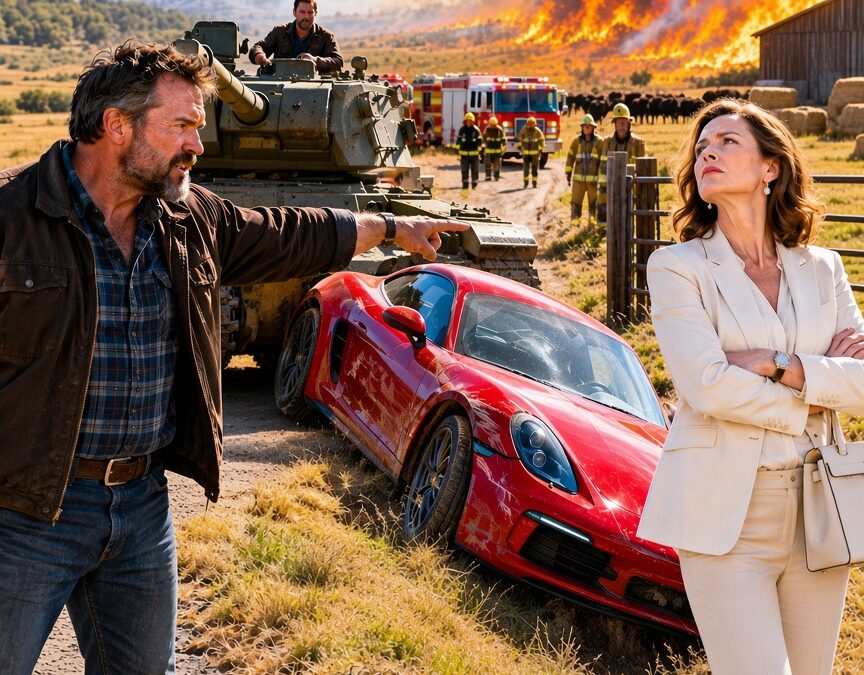
The first thing Rhett Calderwood heard was the sound of cattle screaming.
Not the ordinary complaints of hungry animals waiting for feed. These were sharp, frantic bellows coming from behind the hay barn, where sixty-four head of cattle were crowding against a fence with nowhere left to run.
Then he smelled the smoke.
Across the gravel driveway, a red Porsche 911 sat sideways in front of his eighteen-foot ranch gate, blocking the only entrance wide enough for a fire engine.
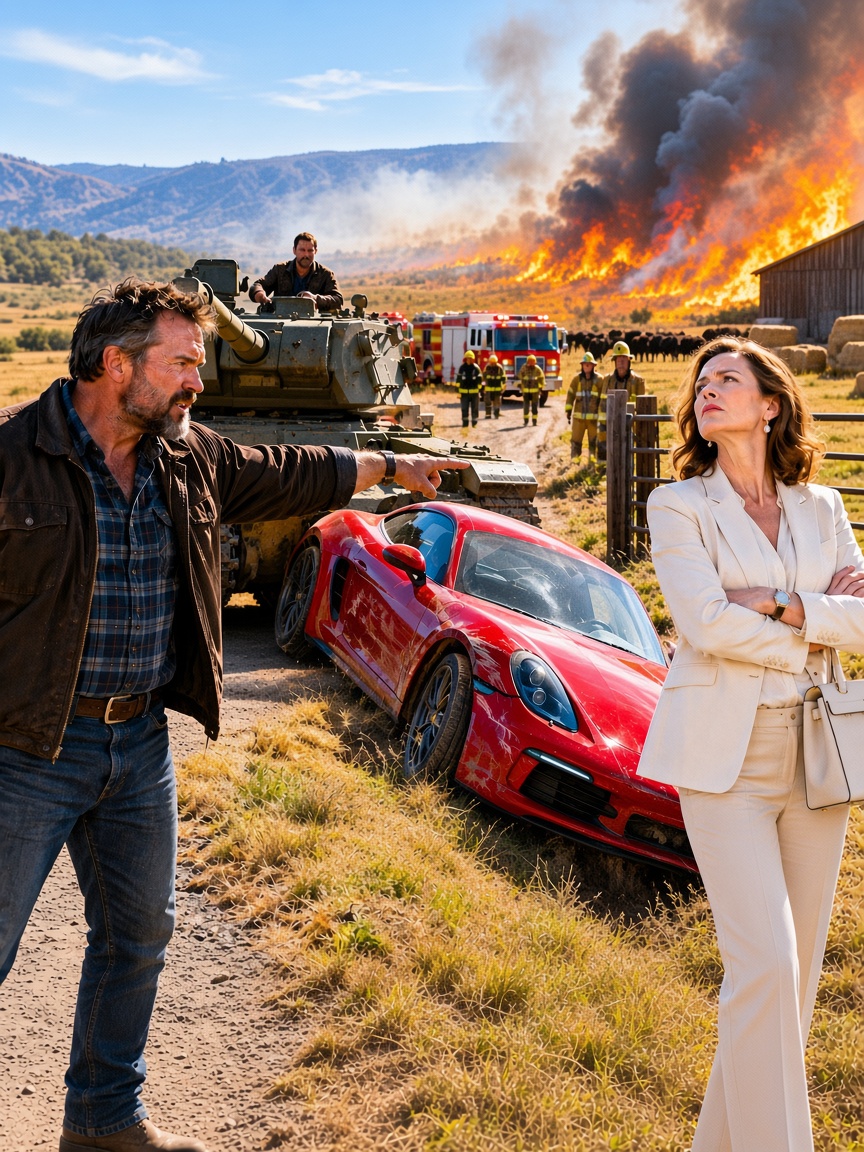
Beside it stood Daphne Tillingast, president of the Brierstone Preserve Homeowners Association, holding up her phone.
“Sign the access agreement,” she told him, “and I’ll move my car.”
Rhett stared at her.
Behind him, flames were spreading through the grass toward a barn containing nearly forty tons of winter hay. Three ranch hands were trying to push terrified cattle through a narrow opening in the north corral. The wind was getting stronger.
“Daphne,” he said, “this is your last chance. Move the Porsche.”
She smiled at her phone.
“Everybody watching? He’s threatening me again.”
A rescue truck appeared on the county road, lights flashing. Its driver stopped behind the Porsche and leaned out his window.
“WE NEED THAT GATE OPEN!”
Daphne didn’t move.
Rhett looked toward the equipment shed.
Inside, beneath a row of fluorescent lights, stood thirty tons of restored American military history.
A World War II Sherman tank.
Its weapons had been permanently disabled decades earlier. Its engine, however, worked beautifully.
Rhett turned to his oldest friend.
“Benton. Clear everybody away from the entrance.”
Benton Arlage looked from the burning barn to the Porsche.
“You sure?”
“No,” Rhett said. “But I’m out of time.”
Three minutes later, the ground began to tremble.
Daphne turned toward the noise, still recording.
The Sherman rolled out of the shed, its steel tracks grinding over the gravel.
She laughed.
“Oh, this is perfect. He’s going to threaten a woman with a tank.”
Rhett didn’t answer.
He drove toward the empty Porsche at walking speed.
Daphne’s laughter stopped when thirty tons of steel touched the rear quarter panel of her $120,000 car.
And what happened next would expose something far worse than an illegal attempt to seize a ranch road.
It would uncover a forged signature, a multimillion-dollar development scheme, and a financial secret hidden inside the very Porsche Daphne had used to threaten him.
But that morning, Rhett Calderwood knew none of it.
He only knew that his animals were trapped, his barn was burning, and one woman had decided her authority mattered more than everybody else’s safety.
Twenty-two years earlier, Rhett had bought 146 acres of Colorado grassland with the money he’d saved from his military service and the sale of a small repair business.
The property sat east of a low ridge, where the plains stretched toward the horizon and the wind could change direction without warning.
There was a farmhouse built in 1948, two equipment barns, a cattle shed, several fenced pastures, and a gravel road running from the southern county highway to the main yard.
Rhett had paid for the road’s maintenance himself.
He’d replaced its culverts, resurfaced its worst sections, and rebuilt the iron entrance gate after a winter storm knocked down the original wooden posts.
Nobody else had ever contributed a dollar.
That suited him.
He had spent fourteen years in the Army working on armored vehicles. After leaving the service, he wanted land, machinery, and enough distance from other people to make his own decisions.
He wasn’t antisocial. He helped neighbors repair tractors, donated beef to the county food pantry, and volunteered his restoration shop for veterans’ events.
He simply had little patience for people who confused a title with authority.
For most of those twenty-two years, his closest neighbors had been ranchers.
Then Brierstone Preserve arrived.
The development began with twelve luxury homes west of his property. Within a decade, it had grown into forty-one residences behind decorative stone walls, ornamental gates, and landscaping maintained by a private irrigation system.
The smallest house was worth more than Rhett’s entire original investment in the ranch.
The homeowners association regulated exterior paint, holiday decorations, lawn height, driveway materials, and even the acceptable brightness of porch lights.
None of those rules applied to Calderwood Ranch.
The subdivision’s recorded boundaries stopped at Rhett’s western fence.
He had never joined the HOA, signed its covenants, or granted it access to his land.
That distinction had never been controversial until Daphne Tillingast became president.
Daphne was forty-nine, divorced, and exceptionally skilled at making ordinary conversations feel like disciplinary hearings.
She had moved into Brierstone four years earlier and won the HOA presidency after promising stricter security, improved property values, and more aggressive enforcement of neighborhood standards.
She delivered on the enforcement.
Residents received warnings for leaving garbage bins visible after collection hours. A retired couple was fined for replacing their front door with a shade of blue the architectural committee hadn’t approved. Another homeowner spent six months appealing a penalty over a bird feeder.
Daphne considered these victories.
She maintained a spreadsheet of violations and regularly reminded residents that rules were what separated Brierstone from the surrounding countryside.
At HOA meetings, she liked to say, “Property values don’t protect themselves.”
Rhett had heard the phrase once, at a county planning hearing.
He’d thought it sounded like something a person said when she wanted to spend somebody else’s money.
Their first real confrontation happened on a Monday morning in October.
Rhett was checking the hydraulic system on a hay loader when he heard a sports car accelerating along the county road.
A red Porsche swung toward his entrance, crossed the gravel shoulder, and stopped sideways in front of the gate.
The driver’s door opened.
Daphne stepped out wearing a camel-colored coat, dark sunglasses, and shoes completely unsuited to ranch gravel.
She unfolded a large color map across the Porsche’s hood.
“Mr. Calderwood,” she called. “We need to discuss access.”
Rhett approached slowly, wiping grease from his hands.
“Access to what?”
“The southern corridor.”
“Never heard of it.”
She tapped the map.
“This road.”
“That’s my driveway.”
“It’s identified as a strategic access route for Brierstone Preserve.”
“Identified by who?”
“Our planning consultants.”
Rhett examined the map.
A red line entered through his southern gate, followed his private gravel road, passed between the hay barn and cattle pens, and continued toward a proposed development south of Brierstone.
He looked up.
“Your consultants drew a road through my property.”
“They identified an existing transportation asset.”
“It’s a ranch road.”
“That’s a narrow interpretation.”
“It’s the legal interpretation.”
Daphne sighed.
“Mr. Calderwood, I don’t think you understand the opportunity here.”
She produced a document from a leather folder.
It proposed granting the HOA a permanent, transferable easement across his land.
The agreement would allow construction vehicles, emergency equipment, service trucks, and future development traffic to use the road.
It also included language permitting improvements and widening.
Rhett read the first two pages.
Then he looked at the map again.
“Your road goes through my hay barn.”
“The alignment can be adjusted.”
“And my cattle pens.”
“Those structures can be relocated.”
“Who’s paying for that?”
“We can discuss compensation after you’ve agreed in principle.”
Rhett handed back the document.
“No.”
Daphne blinked.
“Excuse me?”
“No easement. No road. No discussion.”
She removed her sunglasses.
“You’re refusing to cooperate with a major community infrastructure project?”
“I’m refusing to give away my property.”
Daphne placed one hand on the Porsche.
“Do you know what this car costs?”
Rhett looked at it.
“More than I’d spend on one.”
“One hundred and twenty thousand dollars,” she said. “Probably more than all that scrap metal in your yard.”
Her eyes moved toward the restoration shed.
Beneath a canvas awning, the olive-drab hull of Rhett’s Sherman tank was visible beside two military trucks.
Rhett followed her gaze.
“That scrap metal runs.”
“How charming.”
“It’s also on my property. Just like this road.”
Daphne folded the document.
“You have seventy-two hours to reconsider.”
“Or what?”
“Or your operation becomes very difficult.”
Rhett took out his phone.
He photographed the agreement, the map, her license plate, and the position of her car.
Then he said, “Move your Porsche.”
For several seconds, Daphne stared at him.
Finally, she climbed back inside.
As she drove away, she lowered the window.
“Starting tomorrow, Mr. Calderwood, that gate takes orders from me.”
Rhett watched the car disappear.
Then he returned to the barn.
He had cattle to feed.
By seven the next morning, a metal sign had appeared beside his entrance.
BRIERSTONE HOA — AUTHORIZED ACCESS ONLY.
A smaller placard threatened unauthorized vehicles with a $500 fine.
Two private security guards stood beside a patrol SUV, stopping incoming traffic.
At 7:40, they delayed Rhett’s feed delivery.
The truck driver called him.
“Boss, there’s a couple of guys here saying I need a permit.”
Rhett drove his pickup down the lane.
The guards were wearing navy jackets with Brierstone security patches.
One held a clipboard.
“Sir,” the younger guard said, “we’re conducting access verification.”
“On whose authority?”
“The homeowners association.”
“Are you standing on the county shoulder or my property?”
The guard glanced down.
“I’m not sure.”
“Then you’d better find out before you stop another truck.”
Rhett photographed the sign and called the sheriff’s office.
He filed a report, showed the responding deputy his parcel survey, and asked that the obstruction be documented.
The guards left.
The sign remained.
By noon, Daphne returned with a communications assistant and a camera operator.
This time, she was recording before Rhett reached the gate.
“Here we are,” she announced, “with the neighboring property owner who refuses to respect community safety requirements.”
Rhett held up a copy of his deed.
“Your association has no authority over this land.”
Daphne turned toward the camera.
“Notice how aggressive he’s becoming.”
“I haven’t raised my voice.”
“That’s your opinion.”
“It’s also on your recording.”
She ignored him.
Instead, she announced that the HOA possessed historical access rights to the road.
Rhett asked for the recorded easement number.
She refused to provide one.
“It’s being handled by our attorneys.”
“Then your attorneys can contact mine.”
“You’re making a serious mistake.”
“Maybe,” Rhett said. “But it won’t be signing that paper.”
That afternoon, Daphne met Gavin Lockidge inside Brierstone’s private clubhouse.
Gavin was a commercial real estate developer who had spent eighteen months assembling financing for a project called Brierstone South.
The plan included eighteen luxury residential lots, a private lodge, and a landscaped recreation area.
The proposed transaction was worth approximately $5.6 million.
Gavin had investors ready.
He had contractors lined up.
He had preliminary county approvals.
What he didn’t have was adequate road access.
The existing route around the southern ridge was expensive to improve and unsuitable for the projected traffic without substantial work.
Rhett’s gravel road offered a shortcut.
More importantly, the project’s emergency-access plan relied on it.
Without documented legal access, the financing could not close.
Gavin studied the latest survey.
“Has Calderwood signed?”
Daphne poured herself coffee.
“He’s being difficult.”
“That wasn’t my question.”
“He’ll sign.”
“When?”
“Soon.”
Gavin leaned forward.
“Daphne, the financing deadline is three weeks away. The lender needs a recorded easement.”
“I understand.”
“Do you have one?”
She hesitated just long enough for him to notice.
“We’re finalizing the paperwork.”
Gavin closed the folder.
“I need that finalized before the next investor meeting.”
Daphne smiled.
“You’ll have your road.”
What Gavin didn’t know was that she had already described the road as secured in several project documents.
If the claim proved false, her promises to investors would collapse.
And Daphne had made other arrangements that depended on the deal going forward.
Two days later, Rhett sat in attorney Fiona Denbrook’s office in the county seat.
Fiona specialized in land-use disputes.
She was forty-five, precise, and unimpressed by threatening letters.
Rhett placed Daphne’s documents on her desk.
Fiona examined the map, then opened the county planning files on her computer.
For nearly twenty minutes, she said nothing.
Finally, she rotated her monitor.
“Rhett, look at this.”
The Brierstone South site plan showed a designated emergency-access route crossing his ranch.
Beside it was a note.
ACCESS EASEMENT SECURED.
Rhett read it twice.
“I never signed anything.”
“I believe you.”
“They’re telling the county they have my road.”
“That’s what this filing says.”
“Can they do that?”
“They can submit paperwork. Whether that paperwork is truthful is another question.”
Fiona printed the relevant pages.
“We need the complete title history, the underlying easement documents, and every communication involving this route.”
Rhett leaned back.
“Daphne’s trying to take the road.”
Fiona looked at him.
“No. She’s trying to convince everybody she already has it.”
That distinction bothered Rhett more than he expected.
A person could ask for something and accept refusal.
But Daphne had begun building a world in which his refusal supposedly didn’t matter.
Over the following week, the campaign intensified.
Brierstone residents received letters warning that the neighboring ranch contained armored military equipment.
One letter described the Sherman as a potential security concern.
It omitted the fact that its cannon had been permanently disabled and its weapon systems removed.
A small production crew began filming from the county road.
Their cameras focused on the tank, the iron gate, and Rhett’s aging equipment buildings.
Daphne wanted the ranch to look threatening.
She also sent Rhett an offer to purchase road-access rights for an amount far below the likely cost of building an alternative route.
He rejected it.
Then Benton Arlage noticed a stranger measuring the gate.
Benton was sixty-one, a former diesel technician who had worked with Rhett for nearly fifteen years.
He was quiet, patient, and could identify a faulty bearing by listening to an engine idle.
One afternoon, he found a man crouching beside the gatepost with a measuring tape.
“What are you doing?”
The stranger stood abruptly.
“Survey work.”
“For who?”
“Contractor.”
“Which contractor?”
The man hurried toward a van bearing the production company’s logo.
Benton photographed the license plate.
That evening, he told Rhett, “Something’s off about these people.”
Rhett nodded.
“Fiona thinks they’re trying to manufacture a dispute.”
“Then we should make sure we record the real one.”
They installed additional security cameras the next morning.
One covered the gate.
Another covered the road.
Two more watched the barns and cattle pens.
The cameras recorded continuously, with synchronized timestamps and backup storage.
Rhett hoped they would never matter.
That hope lasted until Thursday night.
At 10:17 p.m., an automated email arrived from the county recorder’s office.
A new document had been recorded against his parcel.
Rhett opened the attachment.
It was a permanent access easement in favor of Brierstone Preserve.
At the bottom appeared his signature.
Rhett Calderwood.
He stared at it.
The signature looked exactly like his handwriting.
The problem was that he had never signed the document.
He called Fiona.
She answered on the fourth ring.
“Rhett?”
“Somebody filed an easement.”
A pause.
“Did you sign it?”
“No.”
“Send it to me.”
He forwarded the attachment.
Thirty seconds later, she called back.
“Don’t contact Daphne tonight.”
“Why?”
“Because this is no longer just a disagreement over land.”
Rhett looked at the signature again.
“What is it?”
“Potentially a forged legal instrument. And we’re going to handle it carefully.”
The following Monday was the day everything changed.
Brierstone South had scheduled an investor showcase on land adjoining Rhett’s eastern fence.
Temporary tents had been erected.
Caterers arrived.
Event staff carried lighting equipment across the site.
A promotional brochure displayed a photograph of Rhett’s iron gate beneath the words SCENIC PRIVATE SOUTHERN ENTRANCE.
That morning, Fiona delivered a written notice prohibiting event traffic from entering his ranch.
At ten o’clock, Daphne arrived in the Porsche.
She drove directly across the entrance and parked sideways.
Then she stepped out, locked the doors, and dropped the keys into her coat pocket.
Rhett approached from the barn.
“You’re blocking my gate.”
“I know.”
“Move the car.”
“Sign the agreement.”
“No.”
“Then I suppose we’re both going to have an inconvenient day.”
A camera operator stood nearby.
Rhett recognized him from the production van.
Daphne glanced toward the lens.
“If you want to get through,” she said, “go ahead and ram it. I’d love to see whether you can afford a new Porsche.”
Rhett looked at the camera.
Then at Daphne.
Then he took out his phone and called the sheriff’s office.
He reported the obstruction and requested assistance.
Daphne continued talking for her recording.
She accused him of harassment, intimidation, and threatening community development.
Rhett didn’t respond.
He waited beside the gate, keeping his distance from the car.
Meanwhile, across the fence, event technicians were preparing a stage presentation.
The showcase included lighting effects and a brief pyrotechnic display.
It was an exceptionally bad day for fireworks.
The county had issued a high fire-danger warning that morning.
Dry grass covered the adjoining fields.
Wind gusts were strengthening from the west.
The event coordinator, a man named Tyler Beck, approached Daphne.
“Ma’am, we need approval to cancel the pyrotechnics.”
“Talk to the production manager.”
“He said you’re the final sign-off.”
“Then tell him to wait.”
“The fire department called about the weather advisory.”
Daphne glanced toward Rhett.
“I’m dealing with a property matter.”
Tyler hesitated.
“It’s a safety issue.”
“Then use your judgment.”
He returned to the event site.
Later, investigators would examine exactly who authorized the equipment to be activated despite the conditions.
At the ranch, Benton was performing final checks on the Sherman.
The tank was scheduled for transport to a regional military history exhibition later that week.
Its original weapons were inert, but the restored engine and drivetrain remained functional.
Benton started the engine.
The familiar rumble rolled across the yard.
Rhett heard it from the gate.
He barely looked back.
He was thinking about the sheriff’s arrival, not the tank.
Then Cody Marsh came running from the north pasture.
Cody was twenty-eight and had worked on the ranch since leaving agricultural college.
He was running hard enough that his hat fell off.
“RHETT!”
Rhett turned.
Cody pointed toward the hay barn.
“FIRE!”
A thin plume of smoke rose behind the building.
Then the wind shifted.
Flames appeared in the grass along the western fence.
Within seconds, smoke thickened into a dark column.
Rhett started running.
“Cody! Get the north corral open!”
He called two other hands toward the cattle pens.
“Move the herd away from the barn! Don’t let them bunch up at the corner!”
Then he dialed 911.
He gave the dispatcher the ranch address, the location of the fire, and the number of animals at risk.
“Is your main entrance accessible?” she asked.
Rhett looked back toward the gate.
The Porsche was still there.
“No,” he said. “A vehicle is blocking it.”
“Can it be moved?”
“I’m working on it.”
He ran toward Daphne.
Smoke was already visible above the roofline.
“Move your car. Now.”
She held up her phone.
“Here he comes again.”
“There’s a fire.”
“How convenient.”
“Look behind me.”
Daphne glanced toward the smoke.
For the first time, she appeared uncertain.
But only briefly.
“Your farm’s problem isn’t my problem.”
Rhett stepped closer.
“Sixty-four cattle are trapped near that barn. Fire trucks need this entrance.”
“Then sign the agreement.”
He stared at her.
“You cannot be serious.”
“I’m completely serious.”
“Give me the keys.”
“No.”
“Drive it away yourself.”
“No.”
The camera operator lowered his equipment.
“Mrs. Tillingast,” he said, “there really is a fire.”
She snapped at him.
“Keep filming.”
Rhett called the dispatcher again and reported that the owner of the obstructing vehicle was present and refusing to move it.
The dispatcher recorded the information.
Behind the barn, Cody and the ranch hands were struggling with the herd.
The cattle were frightened by smoke and the growing noise.
Several pressed against the corral fence.
A gate chain jammed.
One of the hands climbed over the rails to release it from the other side.
Rhett could hear the metal banging.
Then the first emergency rescue truck arrived.
It stopped behind the Porsche.
The driver leaned out.
“WE NEED ACCESS!”
Daphne turned toward him.
“I’m handling a private property dispute.”
The driver looked past her at the smoke.
“Ma’am, move your vehicle.”
“Not until—”
“MOVE IT!”
She stepped back, offended.
Rhett asked the dispatcher for the estimated arrival time of the fire engines.
“Approximately three minutes.”
Three minutes.
The barn’s western wall was already disappearing behind smoke.
A tow truck would take far longer.
Rhett looked toward the equipment shed.
He knew what the Sherman could do.
He also knew what damaging a Porsche could cost.
He’d spent years restoring vehicles and understood exactly how much destruction thirty tons of tracked steel could cause.
But the road had to be opened.
He walked around the car, confirmed that nobody was inside, and told the rescue crew what he intended to do.
Then he warned Daphne.
“I’m going to clear the entrance. You can move the Porsche yourself, right now, or it will be moved.”
She folded her arms.
“You wouldn’t dare.”
Rhett turned away.
He ordered everyone to retreat from the gate and surrounding shoulder.
Benton came running from the barn.
“What’s happening?”
“Get everybody clear.”
Benton saw the fire.
Then he saw the Porsche.
His expression changed.
“Rhett—”
“There’s no time.”
Benton immediately began moving people away from the entrance.
Rhett climbed into the Sherman.
The engine was already warm.
He eased the tank out of the yard.
Its tracks rattled over the gravel.
Daphne lifted her phone.
“Oh, this is unbelievable!”
She aimed it toward the approaching vehicle.
“He’s using a military tank to threaten me!”
The Sherman moved slowly.
Rhett maintained a clear line of sight toward the empty Porsche and the open shoulder beyond it.
The rescue crew had withdrawn to a safe position.
The camera operator was standing farther down the county road.
Daphne remained near the ditch until Benton shouted for her to move back.
The tank approached the Porsche’s rear quarter.
Rhett brought it forward with deliberate care.
Steel touched painted bodywork.
The Porsche shifted.
Its tires scraped sideways across the gravel.
Daphne screamed.
“STOP! THAT’S A HUNDRED AND TWENTY THOUSAND DOLLAR CAR!”
Rhett continued just far enough to clear the entrance.
The Porsche slid toward the drainage ditch.
Its rear wheels dropped over the edge.
For an instant, the car balanced at an awkward angle.
Then it tipped down the embankment.
The front struck the muddy bottom with a violent crunch.
Glass fractured.
A rear wheel hung above the ground.
The driver’s side was badly damaged.
Rhett stopped the Sherman.
The gate was clear.
He shut down the engine and climbed out.
Daphne was screaming about lawsuits.
He didn’t look at her.
He waved the rescue truck through.
Less than a minute later, the first fire engine entered the ranch.
A second followed.
Fire Chief Alana Reic climbed down from the lead engine and took command.
Her crews stretched hoses toward the hay barn, established a defensive line, and attacked the flames spreading through the grass.
Rhett returned to the cattle pens.
Cody had finally opened the north gate.
Together, the men pushed the remaining animals toward open pasture.
The cattle moved in a frightened mass.
One cow stumbled near the gate.
Rhett and Cody guided her upright and kept the herd moving.
Smoke burned their throats.
The heat was intense near the barn.
But the north pasture was clear.
Eventually, the last animal passed through.
Rhett closed the gate behind it.
Only then did he stop running.
He leaned against a fencepost, coughing.
Across the yard, firefighters were still working.
The fire took nearly two hours to contain.
Part of the hay barn was badly damaged.
A substantial amount of winter feed was lost.
The grass along the western boundary was blackened.
But the main cattle shed survived.
So did all sixty-four cattle.
Nobody was injured.
Chief Reic approached Rhett afterward.
“You own the tank?”
“Yes.”
“You moved the car?”
“Yes.”
She looked toward the gate.
“That entrance was blocked when our first unit arrived.”
“I know.”
“We’ll document the delay and the circumstances.”
Rhett nodded.
“I’ll cooperate with whatever you need.”
The chief studied him.
“Another fifteen minutes could have made this a very different fire.”
Rhett looked toward the damaged barn.
“That’s what I was afraid of.”
Daphne had already left.
Her Porsche remained in the ditch.
By midnight, Rhett was home, exhausted and smelling of smoke.
He ate half a sandwich standing at the kitchen counter.
Then his phone began buzzing.
The first message came from a neighbor.
Have you seen the news?
The second contained a video.
Rhett opened it.
The clip showed the Sherman pushing Daphne’s Porsche into the ditch.
It lasted thirty seconds.
There was no footage of the fire.
No rescue truck.
No emergency dispatcher.
No repeated requests for Daphne to move the vehicle.
The caption accused Rhett of deliberately destroying a woman’s expensive car during a property dispute.
By morning, several regional news outlets had picked it up.
One headline called him an angry rancher.
Another described the tank as a weapon.
Daphne appeared in an interview wearing a dark blazer.
“I was simply trying to protect our community,” she said. “He responded with military-grade intimidation.”
Rhett watched ten seconds before turning it off.
Then he called Fiona.
“She’s lying.”
“I’ve seen it.”
“What do we do?”
“Nothing publicly until we’ve preserved the evidence.”
Rhett looked toward the security monitor.
“Good thing Benton made us install those cameras.”
Fiona paused.
“Rhett, tell me they were recording.”
“Every second.”
“Then I want copies of everything.”
Within a week, Daphne’s attorney delivered a demand letter seeking $500,000.
It included the Porsche’s value, towing and transportation costs, legal expenses, and damages for emotional distress.
It also sought restrictions on Rhett’s use of armored vehicles.
Fiona read the letter without expression.
Then she placed it on her desk.
“They’re hoping you’ll panic.”
“Should I?”
“No.”
She opened a video file.
The ranch’s security footage showed Daphne parking the Porsche sideways across the gate.
Another camera showed the first smoke rising behind the barn.
A third captured the rescue truck arriving and stopping.
The recordings included Rhett repeatedly asking Daphne to move the car.
Everything was timestamped.
Everything was continuous.
Fiona watched the footage twice.
Then she looked at Rhett.
“This doesn’t automatically settle every question about the damage to the car. But it changes the facts dramatically.”
“What happens next?”
“We preserve the originals, give investigators what they need, and make sure the court sees the entire emergency instead of a carefully edited clip.”
Sheriff Joel Hartwell’s office began reviewing the incident.
Investigators compared the security footage with 911 recordings, emergency dispatch logs, the fire department report, and witness statements.
The evidence established that Daphne had deliberately blocked the entrance and refused to move her vehicle after learning about the fire.
It also showed that Rhett had warned bystanders and moved the unoccupied car to restore emergency access.
Whether the method was legally justified still required examination.
But Daphne’s public account was missing essential facts.
Then Fiona received an unexpected telephone call.
The caller was the camera operator from Daphne’s production crew.
His name was Owen Bell.
He asked for a private meeting.
When he arrived, he carried a laptop and a folder of printed emails.
Owen was thirty-three and looked as though he hadn’t slept properly in days.
“I didn’t know what she was planning,” he said.
Fiona invited him to sit.
“What do you mean?”
Owen opened his laptop.
A production schedule appeared on the screen.
Its title read FARM OWNER CONFRONTATION.
The contract had been signed a week before the fire.
It instructed the production crew to capture Rhett losing his temper during a dispute at the ranch entrance.
Additional notes requested footage emphasizing his military vehicles and aggressive behavior.
Owen scrolled through the emails.
“She wanted a confrontation. She said the footage would help convince the community that the ranch owner was dangerous.”
“Did she tell you to provoke him?”
“She said she’d handle that part.”
Fiona took notes.
Owen swallowed.
“When the fire started, I told her to move the car. She wouldn’t. Then she sent us the edited clip and told us to delete the rest.”
“Did you?”
“No.”
“Why not?”
He looked down.
“Because I watched those animals trying to get out. And I heard the fire crew yelling. I wasn’t going to help her pretend none of that happened.”
Fiona asked him to preserve every original file.
Owen agreed.
His evidence established that Daphne had planned to manufacture a confrontation long before the fire.
But the investigation into the gate incident was only one part of the problem.
The other began inside Brierstone Preserve.
Iris Wayne, the association’s treasurer, had spent thirty years auditing commercial bank accounts before retiring.
She was fifty-four and had little interest in neighborhood politics.
She had accepted the treasurer position because nobody else wanted to review the books.
For months, she’d noticed unusual expenses connected to Brierstone South.
Daphne had approved payments for marketing, consulting, and access assurance.
Some invoices contained vague descriptions.
Others had no supporting work product.
When Iris requested explanations, Daphne told her the details were confidential because of ongoing negotiations.
After the Porsche video circulated, Iris began asking more questions.
Why was the HOA paying for a development that hadn’t been formally approved by all its members?
Why were association funds being used to pressure a neighboring landowner?
And why did one consulting company receive repeated payments despite having no visible office, staff, or project history?
Iris requested the underlying banking records.
Daphne resisted.
The association bylaws, however, gave the treasurer access to financial documents.
Iris persisted.
On a Thursday afternoon, the records arrived.
She spread them across her dining room table and began tracing the payments.
One company appeared repeatedly.
Summit Crest Advisory LLC.
It had billed the HOA for marketing services and project coordination.
Iris searched its registration information.
The company was associated with a distant relative of Daphne’s.
That was suspicious enough.
Then she examined the attached transaction records.
Money had moved from the HOA development account into Summit Crest.
From there, substantial payments had gone to unrelated personal expenses.
One payment trail led to a luxury automobile dealership in Denver.
Iris reviewed the documentation.
The transaction references included a vehicle identification number and license plate.
She opened a photograph of Daphne’s Porsche.
The plate matched.
Iris sat motionless.
Then she checked the numbers again.
And again.
A significant portion of the money used to acquire Daphne’s personal car appeared to have originated in association funds.
The Porsche was titled to Daphne.
But homeowners’ money had helped pay for it through an intermediary company billing for services that apparently had never been performed.
Iris called the association’s outside accountant.
Then she called an attorney.
By the following Monday, the matter had been referred for independent review and to investigators.
The discovery transformed the dispute.
The Porsche was no longer merely a damaged luxury car.
It was potentially evidence of financial misconduct involving money collected from forty-one households.
And the woman who had repeatedly used its price to intimidate Rhett had unknowingly made it the most recognizable asset in the investigation.
Meanwhile, Fiona was examining the forged easement.
The signature bothered her.
It looked too accurate.
A forensic document examiner compared it with Rhett’s verified signatures.
Eventually, the examiner located an older equipment lease involving a contractor who had previously worked at Brierstone.
The signature on that lease matched the disputed easement with extraordinary precision.
Not merely in general style.
The tiny irregularities were identical.
The evidence indicated that the signature had been copied rather than independently written.
The easement’s accompanying map also misrepresented the road’s legal status.
The county recorder confirmed that no valid easement had previously granted Brierstone access across Calderwood Ranch.
Investigators began examining who had prepared, submitted, and relied upon the document.
Fiona explained the findings to Rhett one evening.
They were sitting at his kitchen table.
“So they copied my signature,” he said.
“That’s what the forensic evidence indicates.”
“From a lease?”
“Yes.”
“Something I signed years ago?”
“Yes.”
Rhett looked out the window toward the barn.
“They were planning this before Daphne ever came to the gate.”
Fiona nodded.
“It appears so.”
He considered that.
For weeks, he’d believed he was dealing with an arrogant woman who wanted to win an argument.
Now it seemed the argument had been a distraction.
Someone had built an entire development plan around property rights that didn’t exist.
And somebody had been willing to falsify documents to make those rights appear real.
Gavin Lockidge discovered the problem through his own attorneys.
During a final title review, they identified the disputed easement and the questions surrounding its authenticity.
The project’s access plan could not be verified.
The financing deadline was approaching.
Gavin called Daphne.
“Tell me the easement is legitimate.”
“It is.”
“Then why is the signature under investigation?”
“It’s a paperwork issue.”
“Daphne.”
“Gavin, these things happen in development.”
“Not like this.”
“We can resolve it.”
“You told me the road was secured.”
“It will be.”
“That is not the same thing.”
She tried another approach.
“Think about what you’re risking. The investors are ready. The lodge alone could become the most prestigious property in the county.”
Gavin interrupted her.
“I’m risking my reputation and my investors’ money if I proceed without legal access.”
He paused.
“Did Calderwood ever agree to any of this?”
Daphne said nothing.
Gavin closed his eyes.
“That’s what I thought.”
He suspended negotiations that afternoon.
His attorneys began reviewing the project documents and potential liability for misrepresentations.
Daphne called him repeatedly.
He stopped answering.
Then she tried Rhett.
Through her attorney, she offered to withdraw the $500,000 demand if he would agree to keep the financial issues out of public court proceedings.
Fiona delivered the offer without comment.
Rhett read it.
Then he handed it back.
“No.”
“Are you sure?”
“I’m not bargaining over somebody else’s money.”
Fiona nodded.
“That’s what I expected.”
“Get the road protected. Let the investigators handle the rest.”
She filed for an injunction to prevent further obstruction or interference with his entrance.
The supporting materials included the property records, the disputed easement, the security footage, and the emergency-response documentation.
At Brierstone, Iris called an emergency homeowners meeting.
Daphne attempted to prevent it.
She argued that the treasurer was exceeding her authority and undermining confidential business negotiations.
But the bylaws permitted a properly requested meeting.
For the first time in four years, Daphne did not control the agenda.
The clubhouse was packed.
Forty-one homeowners had received notice.
Nearly all attended in person.
Daphne arrived in a cream blazer with a leather folder tucked beneath her arm.
She took her usual seat at the front.
Iris stood beside a projector.
Three thick binders rested on the table.
“Tonight,” Iris began, “we are reviewing expenditures connected to Brierstone South.”
Daphne interrupted immediately.
“These materials contain privileged commercial information.”
Iris looked at her.
“Then you can explain why association funds paid invoices from a company connected to your family.”
A murmur moved through the room.
Daphne sat back.
“I reject that characterization.”
Iris displayed the first bank statement.
Then the second.
Then the invoices.
She showed the transfers into Summit Crest Advisory.
She displayed records linking subsequent payments to personal expenses.
Finally, she projected the vehicle transaction details.
The license plate appeared on the screen.
Several residents recognized it immediately.
Someone in the back whispered, “That’s her Porsche.”
Iris did not raise her voice.
“The association’s independent accountant has identified substantial payments requiring further investigation. These records have been referred to the appropriate authorities.”
Daphne stood.
“This is a personal attack.”
“No,” Iris replied. “This is an accounting review.”
A retired schoolteacher named Margaret Ellison raised her hand.
“May I ask something?”
Iris nodded.
Margaret stood slowly.
“Why did our association spend money trying to acquire a road that doesn’t belong to us?”
Daphne opened her folder.
“The southern corridor is essential to long-term community value.”
“That wasn’t my question.”
“The development would benefit everyone.”
“Did Mr. Calderwood agree to let us use his road?”
Daphne hesitated.
“Negotiations were ongoing.”
“Then why did the county paperwork say the easement was already secured?”
The room became quiet.
Daphne looked toward the association’s attorney.
He didn’t answer for her.
She began talking about strategic opportunities, development timelines, and the difficulty of dealing with uncooperative landowners.
Margaret remained standing.
“Did he sign it?”
Daphne stopped.
For the first time that evening, she had no prepared response.
Iris moved to the next agenda item.
Removal of the HOA president.
The vote proceeded under the association’s bylaws.
The ballots were counted twice.
Thirty-eight of the forty-one homeowners voted to remove Daphne Tillingast.
Effective immediately.
Her banking authority was revoked.
Her access to association financial systems was terminated.
The board authorized an independent forensic audit.
All Brierstone South contracts were placed under review.
Daphne rose so abruptly that her chair struck the wall.
“This is ridiculous!”
Nobody responded.
She pointed toward Iris.
“Walt! Escort her out.”
Walt Pruitt, the association’s security chief, stood beside the door.
He was a gray-haired former Marine who had spent years following Daphne’s instructions.
He didn’t move.
“Walt,” she repeated.
He looked at her.
“Mrs. Tillingast, you’re no longer authorized to direct association security.”
Daphne stared at him.
“I’m the president.”
“No, ma’am.”
Someone near the back began clapping.
A few others joined.
Daphne gathered her folder and walked out.
Nobody followed her.
Two days later, Gavin Lockidge formally withdrew from the Brierstone South deal.
The investors canceled their financing commitments.
Without verified access, the project could not proceed as represented.
The $5.6 million transaction collapsed.
Daphne’s partnership with Gavin ended.
The consulting company linked to her financial arrangements faced demands for records and repayment.
And the criminal investigation continued.
Sheriff Hartwell held a brief press conference confirming that investigators were examining the disputed easement and allegations involving association funds.
He declined to speculate about charges.
He emphasized that financial records, witness statements, and document evidence would determine the next steps.
Several weeks later, detectives arrived at Daphne’s home with a judicially authorized search warrant.
Her stone mansion stood on one of Brierstone’s largest lots.
She answered the door wearing a silk robe.
The detectives explained the warrant and began collecting records and electronic devices within its authorized scope.
Daphne watched from the front steps.
She tried calling her attorney.
Then Gavin.
Then the former HOA security chief.
Walt let the call go to voicemail.
Across the valley, Rhett was repairing the damaged hay barn.
The insurance assessment had been completed, and replacement lumber was stacked beside the foundation.
Benton was helping install new supports.
Cody was spreading fresh gravel along the equipment entrance.
Life had returned to its ordinary rhythm.
There were cattle to feed, fences to mend, and winter weather approaching.
Fiona called shortly after lunch.
“The development deal is officially dead,” she said.
Rhett set down his hammer.
“All of it?”
“All of it.”
“What about the gate?”
“The court has granted protection against further obstruction. We’ll continue making sure the order is enforced.”
Rhett looked toward the southern entrance.
The illegal HOA sign had been removed.
Only a small patch of disturbed dirt remained beside the post.
“Good,” he said.
Fiona paused.
“That’s all?”
“What else should I say?”
“Most people would be celebrating.”
“I’ve still got half a barn to rebuild.”
She laughed quietly.
“Fair enough.”
The legal proceedings continued over the following months.
The dispute over the Porsche required careful consideration of the circumstances.
Daphne’s attorneys argued that the damage had been excessive.
Fiona presented the complete footage, emergency dispatch records, fire reports, and witness testimony.
The court examined whether Rhett’s actions were reasonably necessary under the emergency conditions and what responsibility each party bore.
Daphne’s original $500,000 demand was not awarded.
The civil dispute was ultimately resolved on terms far removed from the result she had threatened to obtain.
Separate proceedings addressed the false easement and the financial misconduct.
The disputed easement was invalidated and removed as an enforceable claim against Rhett’s property.
The investigation into association funds resulted in repayment obligations and legal penalties for those found responsible.
The independent audit established that money intended for association purposes had been diverted through fraudulent invoices.
Daphne’s Porsche had been part of that trail.
The car she once displayed as proof of her superiority became one of the most recognizable pieces of evidence in the case.
For Rhett, the most important result was simpler.
The road remained his.
The gate remained his.
And no developer, HOA president, or private security contractor could claim access merely by putting a line on a map.
One cold morning in early spring, Daphne returned to the county road.
She was driving a rented gray sedan.
The Porsche had long since been removed from the ditch and assessed as heavily damaged.
The ditch itself had been repaired, though the ground still showed faint scars from the incident.
Rhett and Benton were loading the Sherman onto a heavy flatbed trailer for a regional history exhibition.
The tank had undergone another mechanical inspection.
Its olive-drab paint was clean.
Its tracks were secured for transport.
Daphne parked on the shoulder and stepped out.
She stood near the fence for several minutes before Rhett noticed her.
He finished securing a strap.
Then he walked toward the gate.
She looked thinner than he remembered.
Her coat was expensive, but her shoes were muddy from the shoulder.
For a moment, neither spoke.
Finally, Daphne said, “You got everything you wanted.”
Rhett rested one hand on the gate.
“I wanted you to leave my road alone.”
“You destroyed my car.”
“You blocked the fire trucks.”
“You could have found another way.”
“I asked you to move it.”
She looked away.
“You never understood what Brierstone South could have meant for this county.”
“Maybe not.”
“It would have brought investment. Jobs. Property values.”
“Then you should have built a legal road.”
She gave a short, bitter laugh.
“You make everything sound so simple.”
“Some things are.”
Daphne looked past him toward the Sherman.
“That tank ruined my life.”
Rhett shook his head.
“No.”
She turned back.
“You don’t get to tell me that.”
“The tank didn’t forge a signature. It didn’t move money out of the HOA account. It didn’t put your car across my gate.”
Her face tightened.
“None of this would have happened if you’d cooperated from the beginning.”
Rhett looked at her for a long moment.
Then he said, “You never wanted cooperation, Daphne. You wanted control over something that wasn’t yours.”
She opened her mouth.
Nothing came out.
The wind moved through the grass between them.
Behind Rhett, Benton called that the trailer was ready.
Daphne glanced toward the road.
“Do you ever regret what happened?”
Rhett considered the question.
“I regret the fire. I regret losing the hay. I regret what those cattle went through.”
“And my car?”
“I wish you’d moved it when you had the chance.”
Daphne looked at him with the same expression she’d worn the first morning they met.
Only now, there was no audience waiting for her instructions.
No security guards.
No development contract.
No association board willing to approve her demands.
She walked back to the rented sedan.
Rhett watched her drive away.
Then he returned to work.
A few days later, he repainted the iron gate.
Benton helped him remove the rust from the hinges and replace a worn latch.
They worked through the afternoon, listening to an old country station playing from a portable radio.
When the paint dried, Rhett mounted a new sign beside the entrance.
It was dark green steel with plain white lettering.
PRIVATE PROPERTY — NO HOA ACCESS.
Benton stepped back to inspect it.
“Think that’s clear enough?”
Rhett looked at the sign.
“Should be.”
“Daphne would probably complain about the font.”
“Good thing she doesn’t get a vote.”
Benton laughed.
The following Tuesday, the weekly feed truck arrived at eight fifteen.
The driver slowed near the gate, apparently expecting another security checkpoint.
Instead, he found Rhett standing beside the open entrance.
“Morning,” the driver called.
“Morning.”
“Any permits today?”
“Nope.”
“Any fines?”
“Nope.”
The driver grinned.
“That’s a nice change.”
He drove straight through.
Rhett closed the gate after him.
Across the pasture, the cattle grazed peacefully.
The rebuilt section of the hay barn stood beneath a clear Colorado sky.
Near the equipment shed, the Sherman waited on its trailer, ready for the exhibition.
Benton walked over carrying two cups of coffee.
He handed one to Rhett.
For a while, they stood without speaking.
Then Benton looked toward the drainage ditch.
“Can I ask you something?”
“Go ahead.”
“When you were driving that tank toward the Porsche, did you know it was going to end up down there?”
Rhett sipped his coffee.
“I knew it might.”
“And you did it anyway.”
“The fire engines needed the road.”
Benton nodded.
“Still. One hundred and twenty thousand dollars.”
Rhett looked toward the barn.
“Cody was inside that corral. Three men were trying to get those animals out. If the fire had reached the stacked hay before the engines got through, we might’ve lost more than a car.”
Benton watched him.
“Would you do it again?”
Rhett didn’t answer immediately.
He studied the road, the fence, and the place where Daphne had stood with her phone.
“I’d rather never have to make that choice again.”
Benton accepted that.
They drank their coffee while the feed truck unloaded.
The morning was quiet.
No cameras.
No lawyers.
No security guards writing down license plates.
Just a ranch owner watching a truck use the road he’d maintained for twenty-two years.
Before leaving, Benton glanced once more at the new sign.
“Funny thing,” he said.
“What?”
“Daphne spent months telling everybody who was allowed through this gate.”
Rhett looked at him.
“And?”
“Now she’s the only person in the whole county with a court order keeping her away from it.”
Rhett smiled faintly.
Then he turned toward the barn.
There was work to do.
The gate swung shut behind him, the latch settling into place with a familiar metallic click.
For twenty-two years, that sound had meant nothing more than the end of another trip down the driveway.
Now it meant something else.
Not victory over a neighbor.
Not revenge for a damaged reputation.
Not satisfaction at seeing an expensive Porsche hauled out of a muddy ditch.
It meant that a man’s refusal still counted, even when the person demanding his property had money, influence, and an impressive title.
It meant a signature couldn’t be manufactured simply because somebody needed a road.
And it meant that when a real emergency arrived, the difference between power and responsibility became impossible to hide.
Daphne Tillingast had once believed a $120,000 Porsche could stop an entire ranch.
For a few terrible minutes, it had.
But it couldn’t stop the fire.
It couldn’t stop the evidence.
And it couldn’t stop the truth from reaching the people whose money and trust she’d abused.
In the end, the Sherman returned to being exactly what Rhett had always intended it to be.
A restored piece of history.
The Porsche became a wrecked car, a legal exhibit, and a reminder of an extraordinarily expensive mistake.
And the old gravel road remained what it had been from the beginning.
Private property.
Owned by Rhett Calderwood.
With a gate that opened whenever he decided it should.
THE END
Disclaimer: This is fictional AI-generated content created solely for entertainment purposes and is not intended to offend, target, defame, or harm any individual, group, or organization.
Disclaimer: This story is fictional and created for entertainment purposes only. Any names, characters, places, or events are fictitious or used fictitiously. No real person or organization is intended to be portrayed.

