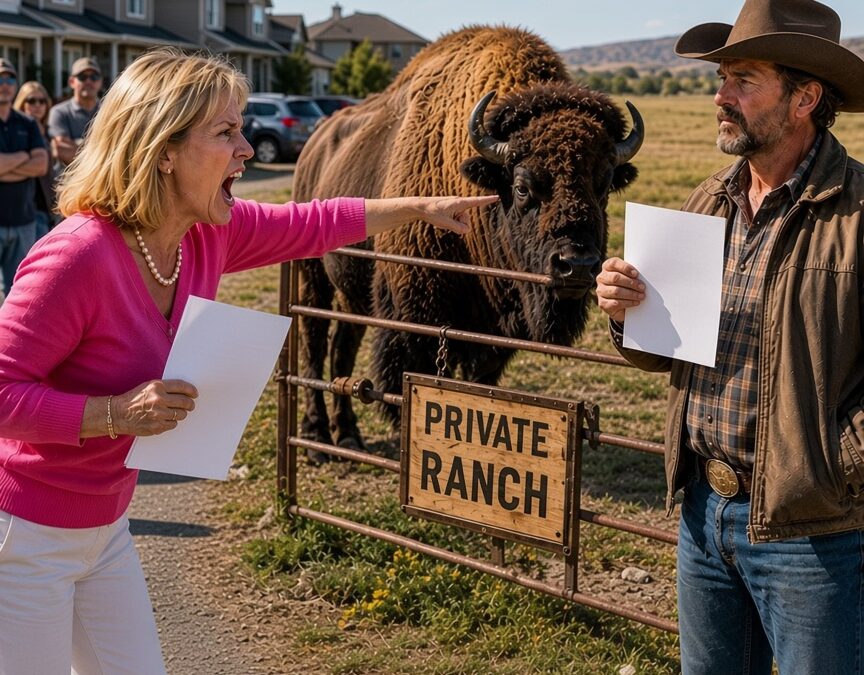
The first time Karen Whitmore threatened to take my bison, she arrived at my ranch with an animal removal truck, a construction crew, and a bill for $18,500.
She wore white designer boots that had probably cost more than my first pickup truck. She stood outside my locked gate, waving a violation notice in my face while two members of her homeowners association board watched from behind her.
“You have twenty-four hours, Daniel,” she announced. “Twenty-four hours to remove those animals, or we’ll remove them ourselves.”
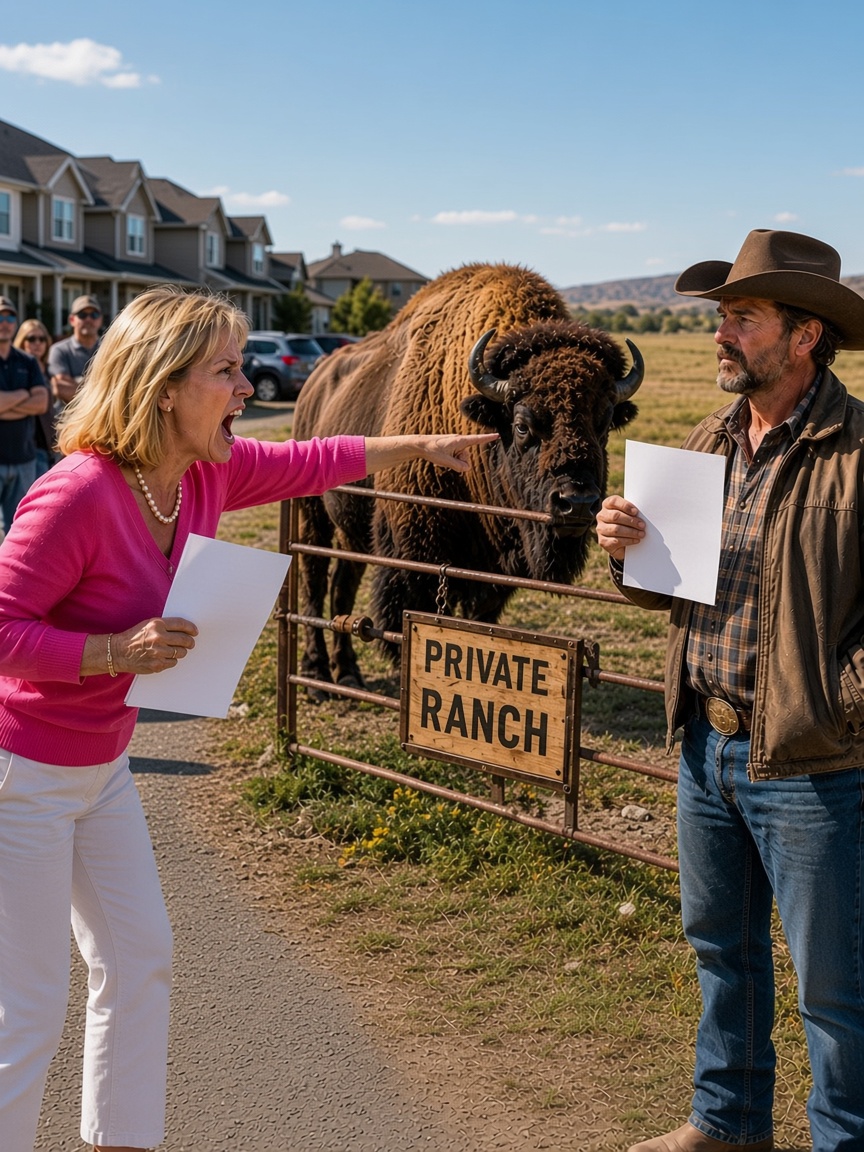
Beyond the fence, seven American bison grazed peacefully across my north pasture. The morning fog was lifting from the creek, and the animals were moving toward the cottonwoods as they always did. They had no idea a woman from the subdivision next door had decided they were a threat to civilization.
I looked at the truck blocking my driveway.
Then I looked at Karen.
“Who authorized that vehicle to come onto my property?”
She gave me a sharp, impatient smile.
“The association has already voted. Your property is creating a dangerous condition for our residents.”
“My property isn’t part of your association.”
“We’ve been over this.”
“Yes,” I said. “Several times.”
She slapped the violation notice against the gate.
“Then perhaps this will help you understand.”
Across the top, in large capital letters, were the words FINAL NOTICE OF ENFORCEMENT.
Below that was an itemized list of penalties totaling $18,500. Karen had included daily fines, administrative charges, legal review fees, and something called an emergency livestock hazard assessment.
I had never received an assessment from her association before. I had never paid dues, attended its meetings, voted for its board, or signed a single one of its covenants.
My grandfather had bought this ranch decades before the subdivision existed.
But Karen was standing there as though the paperwork in her hand gave her authority over every acre she could see.
“The pasture behind our homes is designated open space,” she continued. “The developer promised that land would remain available for community enjoyment.”
“The developer didn’t own my pasture.”
“That’s your interpretation.”
“No, Karen. That’s the deed.”
She turned toward the animal removal driver.
“Stay ready. If he refuses to cooperate, we’ll proceed under the board’s emergency authority.”
That was when I took out my phone and started recording.
Karen noticed immediately.
“Oh, good,” she said. “Record this. Maybe you’ll finally understand that this isn’t some private little kingdom where you can do whatever you want.”
She kicked the metal PRIVATE RANCH LAND sign attached to my gate.
“This is a residential community now, Daniel. You’re going to learn that the hard way.”
I didn’t raise my voice.
I didn’t unlock the gate.
I simply asked her one question.
“Are you ordering those men to enter my property without my permission?”
She stared at me.
Then she said, clearly enough for the camera to capture every word, “I’m ordering you to comply with the homeowners association.”
Three weeks later, that recording would be played in front of a room full of homeowners, attorneys, county officials, and the very people Karen had convinced to support her.
And when the truth about the subdivision’s boundaries finally came out, the $18,500 she had demanded from me would become the least of her problems.
But to understand how a homeowners association president ended up trying to confiscate seven bison from a ranch she didn’t own, you need to understand what that land meant to me.
My name is Daniel Mercer. I’m forty-two years old, and I own 186 acres outside Fort Collins, Colorado.
I didn’t inherit the ranch outright, and I certainly wasn’t handed a fortune.
My grandfather, Walter Mercer, spent most of his adult life working that property. He raised cattle, repaired equipment that should have been replaced years earlier, and treated every fence post like it had personally offended him whenever it leaned.
He was the kind of man who could identify an approaching storm by the smell of the wind and who believed a handshake meant something only when the person giving it was willing to stand behind it.
When I was ten, I spent an entire July helping him replace fencing along the east pasture.
I remember complaining about the heat, the insects, and the endless holes we had to dig.
Grandpa stopped working, rested both hands on the posthole digger, and looked across the grass.
“You know why we do this right, Danny?”
“So the cows don’t get out.”
He laughed.
“That’s one reason.”
“What’s the other?”
“So the next fellow knows where his responsibility ends and ours begins.”
I didn’t understand the significance of that answer until thirty years later.
Back then, the neighboring property was nothing but scrubland and a few scattered cottonwoods. There were no luxury homes, no landscaped entrances, no walking trails, and certainly no woman named Karen telling my grandfather what animals he could keep.
After Grandpa died, the ranch passed through a complicated series of family arrangements. My father became ill. My aunt wanted her share converted into cash. My cousins had no interest in agriculture.
By the time I was thirty-four, the cattle were gone, the barn roof needed replacing, and the property was becoming an expensive burden.
I worked as a civil engineering project manager then. I had a good salary, a small house in town, and enough savings to make a very uncomfortable decision.
I bought out the remaining family shares.
It took nearly everything I had.
For the first two years, I worked my regular job during the day and repaired the ranch on evenings and weekends. I replaced fencing, restored the irrigation system, repaired the barn, and spent more money on gravel than any reasonable person should.
My friends thought I was losing my mind.
My accountant asked whether I had considered selling to a developer.
I told him I had considered it.
Then I told him I wasn’t doing it.
The ranch was the last place where I could still hear my grandfather’s voice without having to try.
Eventually, I began working with a regional conservation grazing program that used bison to help restore native grassland.
The idea fascinated me.
Bison grazed differently from cattle. Their movement, feeding patterns, and relationship with the prairie could support restoration when the herd was managed carefully.
I spent months researching the requirements before bringing a single animal onto the property.
I consulted veterinarians, agricultural specialists, fencing contractors, and insurance agents. I upgraded the livestock barriers, reinforced the gates, improved water access, and developed a management plan.
When the first three bison arrived, I stood beside the north fence for nearly an hour watching them investigate their new home.
They were enormous.
They were beautiful.
And they were absolutely not pets.
Over time, the herd grew to seven.
I knew each animal by its markings and temperament, although I never made the mistake of believing familiarity made them harmless.
There was a mature bull I called Boone, a broad-shouldered animal with a scar near his left shoulder. There were three cows, two younger animals, and a yearling that had a habit of following the others a few seconds behind.
I kept my distance, maintained proper fencing, and followed the veterinary and agricultural requirements.
The ranch had its own parcel identification number, its own tax account, and a documented agricultural use.
For years, that was enough.
Then the neighboring land was sold.
A development company called Crestline Communities purchased the acreage east of my property and announced plans for an upscale residential neighborhood named Silverbrook Estates.
The marketing materials were impressive.
Stone entrance pillars.
Curving streets.
Large windows.
Homes with outdoor kitchens and three-car garages.
The advertisements promised mountain views, peaceful countryside living, and a connection to nature.
I watched construction equipment flatten the neighboring hillsides and told myself I had no right to complain about what another owner did with his own land.
That principle mattered to me.
I expected the same courtesy in return.
At first, the relationship was mostly harmless.
Families moved in. Children rode bicycles along the new sidewalks. People stopped near my fence to photograph the bison.
Some were genuinely interested in the animals.
Others seemed surprised that countryside living involved actual countryside.
One woman asked whether I could keep the bison inside the barn during her daughter’s outdoor wedding reception because they might appear in the background of the photographs.
I explained that the animals didn’t live in a barn and that I couldn’t safely rearrange a grazing operation for a wedding.
She looked offended.
Another resident complained that the pasture smelled like animals after a rainstorm.
I suggested that might be because animals lived there.
He didn’t appreciate the answer.
Still, most of my new neighbors were decent people. A few became friendly acquaintances. One retired teacher named Eleanor Briggs occasionally brought me homemade bread, and I helped her husband jump-start his truck during a January snowstorm.
I believed we could coexist.
Then the homeowners association elected Karen Whitmore president.
Karen was fifty-one, married to a financial consultant, and had moved into one of the largest homes in the subdivision.
She was organized, confident, and exceptionally good at making ordinary disagreements sound like emergencies.
At the first neighborhood meeting I attended as a courtesy, she spoke for twenty minutes about preserving architectural harmony.
She discussed mailbox colors, landscaping standards, driveway appearances, and holiday decorations.
None of that concerned me.
I wasn’t a member.
Then she mentioned the ranch.
“We also need to address the livestock issue along our western boundary,” she said.
Several people turned to look at me.
Karen smiled.
“Daniel, perhaps you’d like to explain your plans for those animals.”
I stood.
“My plans are to continue operating my ranch.”
“Of course,” she said. “But we need to consider the broader community.”
“The animals are properly contained, and the ranch is agricultural property.”
“Yes, but Silverbrook is a luxury residential development.”
I waited.
She continued.
“Certain visual elements are simply inconsistent with the atmosphere our homeowners purchased.”
I glanced around the room.
A few residents looked uncomfortable.
Others nodded.
I said, “The ranch was here before the houses.”
Karen’s smile tightened.
“And communities evolve.”
That was the first warning.
The second came two weeks later, when an envelope appeared in my mailbox.
Inside was a formal HOA violation notice.
It accused me of maintaining prohibited livestock, creating an offensive visual condition, and failing to comply with community safety standards.
I read the document twice.
Then I checked the address.
It was definitely intended for me.
I emailed Karen that afternoon.
I explained that my ranch was not part of Silverbrook Estates and was not subject to its covenants. I attached a county parcel map and offered to provide additional information if the board genuinely needed clarification.
Karen replied forty-three minutes later.
“Daniel, the board’s responsibility extends to conditions affecting the community, regardless of technical membership distinctions.”
I stared at those words.
Technical membership distinctions.
She had reduced the entire concept of property ownership to a technicality.
I answered politely.
“The association does not have authority to enforce its covenants against my separate agricultural parcel. Please withdraw the notice.”
Her next message arrived before dinner.
“The board has voted unanimously to impose daily penalties until the nuisance is corrected.”
The fine was $500 per day.
I printed the email and placed it in a folder.
That folder would eventually become three thick binders.
For the next two weeks, Karen escalated.
She sent notices accusing me of maintaining dangerous livestock, damaging neighborhood property values, and refusing reasonable community standards.
She copied board members on every message.
She also began copying homeowners who had never contacted me.
One email described me as a “hostile agricultural operator.”
Another claimed I was refusing to participate in a “community safety partnership.”
Then came a demand for $3,500 in administrative and legal review charges.
I called the association’s management company.
The receptionist sounded embarrassed.
“Mr. Mercer, I’m afraid you’ll need to speak directly with the board president.”
“Does your company understand that my property isn’t in the association?”
There was a pause.
“I can only tell you that the board has instructed us to process the notices.”
“Has anyone checked the recorded declaration?”
Another pause.
“I’ll make a note of your concern.”
That was when I realized Karen wasn’t going to stop because someone explained the facts.
She needed to be stopped by something she couldn’t dismiss.
But before I could organize a proper response, she crossed a line that turned the dispute from ridiculous to dangerous.
It happened on a Saturday morning.
I was carrying a bucket of mineral supplement toward the equipment shed when I noticed tire tracks near the eastern pasture.
The tracks didn’t belong to my truck.
They were wide, fresh, and ran from the subdivision’s maintenance access road toward my fence.
I followed them uphill.
Near the old service gate, I found six wooden posts set in wet concrete.
Orange construction tape stretched between them.
A laminated sign read:
SILVERBROOK ESTATES — HOA MANAGED CONSERVATION AREA.
RESIDENT ACCESS COMING SOON.
For a moment, I simply stared.
The posts were inside my pasture.
Not along the existing fence.
Not on the subdivision’s side.
Inside my property.
A section of livestock fencing had been loosened near the service gate. The chain had deep scratches, one hinge was bent, and the nearby water trough had been knocked sideways.
The bison were clustered farther north than usual.
That worried me more than the sign.
A startled bison can move with terrifying speed. If an animal panicked near damaged fencing, the consequences could be serious.
I walked toward the construction crew.
Four men were unloading additional posts from a flatbed truck.
“Who’s in charge here?”
A heavyset man wearing a gray sweatshirt turned around.
“I am.”
“What’s your name?”
“Rick Dawson.”
“Rick, you’re building on private property.”
He looked toward the subdivision.
“We’ve got authorization from the HOA.”
“You don’t have authorization from me.”
He frowned.
“I’m just following the site plan.”
“Then your site plan is wrong.”
I pointed to the original fence and the survey markers beyond it.
“This is an active livestock enclosure. Your crew has damaged the gate, and those posts are on my land. Stop working.”
Rick glanced at the other workers.
Then he said, “You’ll need to take that up with the association.”
“I am taking it up with the people standing on my property.”
He opened his mouth to respond.
Before he could, Karen appeared.
She walked across the grass with two board members following her.
Her expression told me she had been waiting for this moment.
“Daniel,” she said. “I see you’ve met our contractor.”
“I’ve told him to stop.”
Karen looked at Rick.
“Continue the installation.”
Rick hesitated.
I took out my phone.
“Karen, I’m recording this. You’re instructing a contractor to build a fence on my private agricultural land after I’ve told him to stop.”
She folded her arms.
“The developer promised this area would remain open for community use.”
“Then take that up with the developer.”
“You’ve been monopolizing land the residents believed was shared.”
“Because it’s mine.”
She laughed.
“People like you think old paperwork gives you the right to stand in the way of progress.”
I looked at the damaged service gate.
“Old paperwork is what establishes ownership.”
“Not everything is about what you can technically claim.”
I remember that sentence clearly.
Not everything is about what you can technically claim.
Karen was standing on land my grandfather had purchased, telling me that ownership was an inconvenience to her plans.
By then, several homeowners had gathered on the other side of the fence.
A man in a blue polo shirt called out, “When is the walking trail supposed to open?”
Karen turned toward him.
“As soon as we resolve the obstruction.”
I felt my patience thinning.
But I kept my voice level.
“There will be no walking trail through this pasture.”
Karen spun back toward me.
“You don’t get to make that decision unilaterally.”
“On my land, I do.”
For the first time, her expression changed from smug satisfaction to open anger.
“You’re going to regret being so difficult.”
I looked directly into the camera.
“It’s Saturday, May sixteenth, at approximately eleven twenty in the morning. The HOA president has instructed a contractor to continue construction on my property after I explicitly denied permission.”
Karen reached toward the phone.
I stepped back.
“Don’t touch me.”
She stopped.
Then she turned to Rick.
“Finish what you can today.”
Rick didn’t move.
I think he had finally begun to understand that the argument wasn’t about landscaping.
It was about trespassing onto an active livestock operation.
I told him I would contact the sheriff if anyone continued working.
He ordered his crew to load their tools.
Karen stood there glaring while the men packed up.
Before leaving, she pointed at me.
“This isn’t finished.”
She was right.
It wasn’t.
On Monday morning, another notice arrived.
This one claimed my bison had been trespassing onto HOA-managed conservation land.
The animals had never left the pasture.
I knew because the enclosure was secure except for the damage Karen’s contractor had caused, and my cameras covered the relevant gates.
The notice announced that the board had retained a private livestock removal service to assess and relocate dangerous animals if I failed to comply.
I read the word relocate three times.
Then I called my veterinarian.
Dr. Hannah Reeves had worked with my herd for years. She understood the animals, their handling requirements, and the risks associated with unfamiliar people approaching them.
When I explained the situation, she was silent for several seconds.
“Daniel, please tell me nobody is planning to drive a truck into that pasture and start chasing those animals.”
“That’s exactly what they’re threatening.”
“Then document everything. And don’t let anyone near the gates without proper authority.”
I assured her I wouldn’t.
That afternoon, I reinforced the service gate, locked every secondary entrance, and changed the security cameras to continuous recording.
I called the sheriff’s non-emergency line and explained the unauthorized construction and threatened livestock interference.
A deputy took an incident report.
He told me the civil ownership questions would need proper documentation, but that I should call immediately if anyone attempted to enter or interfere with the animals.
Then I went home and opened my grandfather’s old metal file box.
It was dented, dusty, and painted a faded shade of green.
Inside were decades of documents held together with rubber bands, paper clips, and envelopes that had turned yellow with age.
Grandpa had written dates in blue ink across nearly everything.
He had saved deeds, surveys, tax notices, easement agreements, and letters from neighboring landowners.
I spent hours sorting them.
Near midnight, I found a survey from the year the eastern acreage had been sold.
Attached was a recorded instrument describing the division of the original property.
One clause immediately caught my attention.
The retained ranch parcel was expressly excluded from residential development restrictions arising from the neighboring tract unless a subsequent recorded agreement provided otherwise.
I read it again.
Then I checked the parcel description.
It matched my ranch.
I searched the remaining documents for any later agreement.
There wasn’t one.
I sat at the kitchen table, surrounded by paper, and thought about Karen’s confident declaration that the neighborhood had changed.
The neighborhood had changed.
The deed had not.
The following morning, I drove to the county clerk and recorder’s office.
I requested certified copies of the relevant deeds, plats, declarations, and recorded easements for both my parcel and Silverbrook Estates.
The clerk who helped me was named Patricia.
She wore reading glasses on a chain and had the patient expression of someone who had spent years explaining the difference between what people believed and what public records actually said.
When I told her why I needed the documents, she looked over her glasses.
“Someone’s trying to enforce an HOA covenant against your ranch?”
“Yes.”
“Are you in the subdivision?”
“No.”
“Did you sign into the association?”
“No.”
She paused.
“Well, let’s see what the records say.”
An hour later, we had a stack of documents.
My parcel was separate.
There was no recorded declaration subjecting it to Silverbrook’s HOA.
There was no livestock restriction.
No walking trail easement.
No public access easement.
No conservation transfer to the association.
Then Patricia pulled up the subdivision plat.
The boundary stopped at my eastern property line.
Every square foot of Silverbrook’s recorded common area was on the subdivision side.
My pasture was outside it.
I asked whether she could print the relevant pages.
She did.
Then I showed her a copy of the glossy neighborhood brochure Karen had attached to one of her emails.
The brochure depicted an enormous green landscape behind the houses.
A dotted walking path appeared to continue toward my creek.
Patricia compared it with the recorded plat.
“Well,” she said, “that’s an optimistic drawing.”
“That’s one way to describe it.”
She tapped the official plat.
“This is the recorded boundary. The marketing picture doesn’t change it.”
I left with certified documents and the first genuine sense of relief I’d felt in weeks.
But I wasn’t finished.
I hired a licensed surveyor named Thomas Keene.
Thomas arrived two days later in a dusty white truck carrying survey equipment and a clipboard.
He was a quiet man who asked practical questions and seemed completely uninterested in neighborhood politics.
I walked him to the illegal fence posts.
He studied them.
“Who installed these?”
“The HOA next door.”
“Do they claim this is their property?”
“Yes.”
He looked toward the subdivision.
“Interesting.”
For most of the day, Thomas and his assistant measured boundaries, located existing monuments, compared recorded documents, and marked the property line.
I followed at a distance, carrying water and trying not to interrupt.
Late that afternoon, Thomas called me over.
He pointed to a new survey stake.
“Here’s your boundary.”
Then he pointed to the nearest HOA fence post.
“Here’s their construction.”
“How far inside?”
“About twenty-seven feet at the widest point.”
I looked down the slope.
The posts extended for nearly nine hundred feet.
Thomas continued.
“This isn’t a fence that’s off by a few inches. They’ve established an entirely new line inside your property.”
“Could someone reasonably have mistaken the boundary?”
He studied the old markers.
“Someone could have failed to check it. That’s different from having a reasonable basis to claim it.”
That distinction mattered.
Karen would later try to call the entire incident a misunderstanding.
But nobody had asked me for permission.
Nobody had obtained a survey.
Nobody had verified the recorded boundary.
They had simply decided that because the pasture looked attractive behind their homes, they were entitled to control it.
I contacted my insurance carrier and arranged for an adjuster to inspect the damage.
He documented the bent hinge, scratched chain, displaced water trough, disturbed ground, and fencing repairs.
Dr. Reeves inspected the herd and provided a written assessment of the safety risks created by unauthorized activity around the enclosure.
Then I called an attorney.
Her name was Rebecca Shaw.
She specialized in real estate disputes and had a reputation for being thorough rather than theatrical.
I arrived at her office carrying two binders, a flash drive, and the certified county documents.
Rebecca listened without interrupting.
Then she read.
For almost forty minutes, the only sounds were turning pages and the occasional click of her pen.
Finally, she looked up.
“Daniel, did you ever sign an agreement subjecting this ranch to the HOA?”
“No.”
“Did any previous owner after this exclusion instrument do so?”
“Not according to the records.”
“Has the association produced a recorded easement?”
“No.”
“And you told the contractor to stop before the work continued?”
“Yes. It’s on video.”
She leaned back.
“Then they’ve created several serious problems for themselves.”
I expected her to suggest another polite email.
Instead, she began identifying issues one by one.
The association had attempted to enforce covenants against a nonmember property.
It had imposed purported fines without establishing authority.
It had directed construction on land it did not own.
Its contractor had damaged livestock infrastructure.
And it had threatened to interfere with animals that required specialized handling.
Rebecca was careful not to promise an outcome.
She explained that a nuisance complaint, if genuinely supported by facts, could be pursued through appropriate legal channels regardless of HOA membership.
But Karen couldn’t simply invent jurisdiction over my land.
And a developer’s marketing promises didn’t create an ownership interest or access easement.
Rebecca picked up the brochure.
“Here’s the mistake they keep making,” she said.
She pointed at the green area extending across my pasture.
“They sold people a view. Now the association is acting as if it sold them the land.”
I looked at her.
“Can you make them stop?”
“We can make it very difficult for them to pretend they don’t know the facts.”
Her demand letter went out the next morning.
It required the HOA to withdraw every purported fine, cease enforcement attempts against my property, stop unauthorized access, preserve relevant communications, and remove the fence and signage.
It demanded proof of any claimed legal authority.
It also requested reimbursement for the documented damage and expenses.
Copies went to the association’s attorney, the contractor, the developer, the insurer, and the relevant county offices.
For the first time, Karen wasn’t receiving an email from a rancher she thought she could intimidate.
She was receiving a formal legal demand supported by certified documents.
Her response was astonishing.
She sent an email to the board accusing me of undermining the community.
She copied Rebecca.
Whether that was deliberate or a mistake, I never learned.
The message said:
“We cannot allow one stubborn property owner to destroy the expectations of hundreds of residents. Crestline assured buyers that the open land would remain part of the Silverbrook lifestyle.”
Rebecca forwarded it to me.
Below the message, she wrote five words.
“An expectation isn’t a deed.”
I printed that email too.
Two days later, Karen’s tone changed.
She wrote that she hoped we could resolve the issue through a friendly conversation.
She suggested the historical boundaries might have been unclear.
She said nobody had intended to damage my property or upset the animals.
Then she offered to suspend future fines if I agreed to discuss a walking trail.
I read the message at my kitchen table.
The same woman who had threatened to remove my bison was now offering to suspend penalties she had no authority to impose.
Rebecca advised me not to negotiate informally.
Any discussion would involve counsel, written terms, and an explicit acknowledgment that the HOA had no jurisdiction over the ranch.
Karen didn’t like that.
But she no longer had the luxury of ignoring it.
Meanwhile, the county opened a code enforcement file concerning the unauthorized fencing.
The sheriff’s office supplemented its incident report.
The contractor received notice that the ownership and permitting questions were under review.
And Crestline Communities finally responded.
That was when the second scandal emerged.
Several Silverbrook homeowners had been told during sales presentations that the land behind their homes would remain open and accessible.
One couple, Mark and Allison Peterson, had kept the original promotional materials.
Their brochure showed a shaded green area stretching behind the western homes.
A sales representative had apparently described it as a permanent nature buffer.
Mark contacted me after learning about the dispute.
He sounded embarrassed.
“Daniel, I owe you an apology.”
“For what?”
“I complained about your fence at a board meeting. I thought you were blocking a community trail.”
“There’s never been a community trail.”
“I know that now.”
He hesitated.
“When we bought the house, we were told that land was part of the open-space experience.”
“Did anyone tell you the HOA owned it?”
“Not in those exact words.”
“Did they tell you it was a working ranch?”
“No.”
That answer explained more than Karen’s entire stack of violation notices.
Some residents had been led to believe they were purchasing homes beside a shared amenity.
They weren’t.
They were purchasing homes beside someone else’s agricultural property.
The distinction should have been obvious.
But the marketing had blurred it, and Karen had exploited the confusion.
She began telling homeowners that I was refusing a reasonable compromise.
She said I didn’t care about children, families, or community safety.
She suggested I should donate a strip of pasture for a walking path because residents had relied on the developer’s promises.
One evening, Mark called again.
“Karen says you’re threatening to sue the entire neighborhood.”
“I’m asking the association to stop entering my land and repair what it damaged.”
“She says you’ll bankrupt the HOA.”
“Then she should probably stop spending its money on my property.”
Mark sighed.
“I think people are starting to ask questions.”
They were.
The county site inspection was scheduled for the following Thursday.
I arrived early with Rebecca and Thomas.
The weather was cold and clear. Frost still clung to the grass near the creek.
Karen arrived wearing a tailored navy blazer and the same white boots she’d worn during our confrontation at the gate.
This time, she wasn’t accompanied by an animal removal truck.
She was accompanied by the HOA’s attorney.
Two board members followed.
Rick Dawson, the contractor, stood beside his truck.
A Crestline representative arrived carrying a leather portfolio.
A county code enforcement officer and a sheriff’s deputy joined us shortly afterward.
The atmosphere was different from the first confrontation.
Nobody was shouting.
Nobody was waving violation notices.
And Karen wasn’t giving orders.
Thomas began at the northern boundary marker.
He explained the recorded legal description, the survey methodology, and the location of the property corners.
Then he led the group along the line.
At each marker, he showed where the ranch ended and the subdivision began.
Finally, he stopped beside one of the newly installed wooden posts.
“This post is approximately twenty-seven feet inside Mr. Mercer’s property.”
The code enforcement officer photographed it.
Thomas continued down the slope.
“The remaining construction follows a similar encroachment pattern for roughly nine hundred feet.”
Karen cleared her throat.
“The intention was to establish a safe conservation buffer.”
The officer looked at her.
“Do you have a recorded easement allowing the association to install fencing here?”
Karen glanced at the HOA attorney.
“No, but the developer’s plan—”
“Do you have a deed showing HOA ownership?”
“The marketing materials identified this area as open space.”
“I’m asking about a recorded ownership document.”
She didn’t answer.
The Crestline representative shifted his weight.
The officer asked whether the necessary authorization and permits had been obtained.
Rick said he had relied on the association’s instructions.
Karen said the contractor was responsible for confirming the site.
One board member said Karen had handled the project.
The other said he believed the developer had already approved everything.
I watched responsibility travel around the group without finding a place to land.
Then Rebecca opened her folder.
She presented the certified deed, the subdivision declaration, the survey, the agricultural classification, and the photographs of the damaged gate.
The officer reviewed them.
The deputy took notes.
Then Rebecca played the video.
On the screen, Karen stood beside the contractor, instructing him to continue working after I had explicitly denied permission.
Her voice came through clearly.
“Finish what you can today.”
Rick stared at the ground.
Karen folded her arms.
The deputy asked, “Mrs. Whitmore, were you aware Mr. Mercer was objecting to the construction?”
Karen hesitated.
“He was being uncooperative.”
“That wasn’t my question.”
She looked toward her attorney.
Her attorney quietly advised her to let him answer the legal questions.
The deputy made another note.
The inspection ended with a written enforcement notice concerning the unpermitted work and a requirement to address the encroaching fence and signage.
The contractor was instructed not to enter my land without authorization.
The sheriff’s office continued documenting the trespass complaint.
The county did not resolve every civil question that morning, and Rebecca made sure I understood that.
But the inspection established something essential.
The recorded boundary was not where Karen wanted it to be.
And the construction was on my side.
As everyone began walking back toward the road, Karen approached me.
For the first time since we’d met, she spoke quietly.
“Daniel, surely we can settle this without embarrassing the neighborhood.”
I looked at her.
“You brought an animal removal truck to my gate.”
“That was a precaution.”
“You threatened to take my livestock.”
“We were concerned about safety.”
“You had contractors damage my fence.”
She glanced toward Rebecca.
“I think we’ve all made mistakes.”
I shook my head.
“No, Karen. You made decisions. Now you have to deal with them.”
She opened her mouth, then closed it.
I walked away.
The HOA meeting the following week was held in the Silverbrook clubhouse.
I had never seen the parking lot so full.
Cars lined both sides of the street. Homeowners stood in small groups near the entrance, speaking in low voices.
Rebecca and I had been invited because the association’s counsel wanted to discuss the dispute and proposed settlement terms with the board and homeowners.
Karen sat at the front table.
She had arranged her papers into neat stacks and placed a bottle of water beside her.
She looked determined to maintain control.
The meeting began with routine announcements.
Then the HOA attorney stood.
He explained that the association had received certified records establishing that my ranch was outside Silverbrook Estates.
He confirmed that the association’s recorded covenants did not apply to my parcel.
He stated that the board had no documented authority to impose the livestock fines.
Then he described the unauthorized construction.
The room grew quiet.
A man in the third row raised his hand.
“Are you saying we built a fence on somebody else’s land?”
The attorney paused.
“The survey indicates that the construction encroached onto Mr. Mercer’s property.”
“How much?”
“Up to approximately twenty-seven feet.”
“Along how much of the boundary?”
“Nearly nine hundred feet.”
Someone whispered an obscenity.
Another homeowner asked, “Who approved this?”
Karen leaned toward her microphone.
“The board acted in good faith to protect property values.”
A woman near the back stood.
“Did you check who owned the land before spending our money?”
Karen’s face tightened.
“We relied on information provided during development.”
“That’s not what I asked.”
The woman remained standing.
“Did anyone check the deed?”
Karen looked at the other board members.
Neither spoke.
The woman sat down.
Then Mark Peterson stood with the original Crestline brochure in his hand.
“When we bought our house, we were told this green area was a nature buffer. We were led to believe there would be access.”
The Crestline representative, seated along the side wall, looked distinctly uncomfortable.
Mark held up the brochure.
“If the land belongs to Mr. Mercer, why were we shown this?”
The room erupted.
Several homeowners began speaking at once.
Some were angry at the developer.
Others wanted to know how much the association had spent.
One man demanded an explanation for the contractor invoices.
Another asked whether their insurance would cover the damage.
Karen tried to restore order.
“Everyone, please remember that this board has worked tirelessly—”
A homeowner interrupted.
“You sent a truck to take his animals!”
Karen froze.
The man continued.
“My daughter saw the video. You were threatening to remove bison from a ranch that wasn’t even part of our neighborhood.”
Karen turned toward me.
“You’ve been distributing recordings to make me look bad.”
I hadn’t distributed the footage publicly.
But several residents had recorded the earlier construction confrontation, and the dispute had become impossible to keep quiet.
Rebecca spoke before I could respond.
“The video documents what occurred. The central question is whether the association had legal authority to take those actions.”
Karen looked away.
The HOA attorney resumed.
He explained the potential costs associated with removing the fence, repairing the damage, reimbursing expenses, and resolving the legal claims.
Then he mentioned the outstanding fines.
A woman near the front asked, “How much did we fine him?”
The attorney looked down.
“The association issued notices totaling eighteen thousand five hundred dollars.”
The woman stared.
“For property we don’t control?”
“Yes.”
A low murmur spread through the room.
Karen reached for her water.
Her hand was trembling.
I didn’t feel triumphant.
I felt exhausted.
For weeks, I had worried about my animals, my fencing, my property, and the possibility that one reckless decision could cause an accident.
Now dozens of homeowners were discovering that their association dues had been used to finance a dispute that should never have existed.
I looked around the room and saw something Karen had apparently forgotten.
These weren’t just names on a dues ledger.
They were people with mortgages, families, budgets, and expectations.
Some had been misled.
Some had complained without knowing the facts.
And some had trusted a board president who had mistaken confidence for authority.
The meeting lasted almost three hours.
By the end, Karen’s carefully arranged papers were scattered across the table.
The homeowners demanded financial records.
They requested copies of the survey.
They wanted to know who had authorized the contractor and whether the association had sought legal advice before imposing the fines.
For the first time, Karen couldn’t answer with a speech about standards and community values.
The questions required documents.
And the documents weren’t on her side.
Settlement negotiations continued for another two weeks.
Rebecca insisted that every agreement be written, specific, and enforceable.
I wasn’t interested in humiliating anyone.
I wanted the fence removed, the damage repaired, the fines withdrawn, and my ranch left alone.
The final settlement required the association to cancel all $18,500 in purported penalties.
It also provided for reimbursement of my survey expenses, agreed attorney fees, veterinary inspection costs, and documented repairs to the service gate, fence hardware, and water trough.
The association accepted responsibility for arranging the removal of the unauthorized posts and signage.
The work had to be supervised and conducted under an agreed access plan.
No contractor could simply drive across my pasture again.
Crestline separately agreed to correct its marketing materials and send homeowners a written clarification about the boundary.
The letter stated that the ranch was privately owned agricultural property.
It was not HOA common area.
It was not a public trail.
It was not a neighborhood amenity.
And Silverbrook residents had no general right of access.
That letter caused another wave of anger.
But this time, most of it wasn’t directed at me.
Mark called after receiving his copy.
“I can’t believe we were allowed to think that pasture belonged to the neighborhood.”
“You weren’t the only ones.”
“Karen’s still telling people you refused to compromise.”
“I did compromise.”
“How?”
“I agreed not to pursue every possible claim if they repaired the damage and left the property alone.”
He was quiet for a moment.
Then he said, “That’s more generous than I would’ve been.”
I wasn’t sure about that.
I had spent enough money and time on the dispute already.
I didn’t want to devote the next two years of my life to fighting over a fence Karen had no business building.
I wanted to get back to the ranch.
The removal work began on a Tuesday.
Rick Dawson arrived with two employees, a supervisor approved under the settlement, and a written access plan.
He looked uncomfortable when he saw me.
“Morning, Mr. Mercer.”
“Morning.”
He glanced toward the posts.
“We’ll get everything out.”
“Make sure the concrete comes out too.”
“Yes, sir.”
“And stay inside the agreed work area.”
He nodded.
Before starting, he approached me again.
“For what it’s worth, I should’ve checked the property line.”
I looked at him.
“Yes. You should have.”
He didn’t argue.
The crew worked carefully.
They removed the wooden posts, extracted the concrete, collected the orange tape, and loaded the laminated HOA signs into their truck.
I watched from outside the work area.
When they finished, I walked the line with the supervisor and checked the ground for debris.
The pasture looked scarred, but it was mine again.
Rick signed the completion paperwork.
Then he left.
I never saw him at the ranch after that.
His company’s work was also referred for review concerning the permitting and authorization issues. I don’t know whether any formal discipline followed, and I never cared enough to pursue rumors about it.
The damage was repaired.
That mattered more.
Karen’s position unraveled over the following weeks.
The HOA’s financial records revealed legal expenses, contractor charges, and insurance costs that residents hadn’t expected.
The board’s decisions came under intense scrutiny.
One board member resigned.
Another publicly acknowledged that the association should have verified the recorded property boundaries before approving any work.
Karen tried to defend herself in a letter to homeowners.
She wrote that she had acted to preserve property values, protect families, and honor the promises made when Silverbrook was developed.
She insisted her intentions had been good.
But good intentions didn’t explain why she had ignored my deed.
They didn’t explain the damaged gate.
They didn’t explain the fines.
And they certainly didn’t explain why she had threatened to remove seven bison from land the association had never owned.
A special homeowners meeting was called.
The notice announced a vote on removing Karen as president under the association’s governing procedures.
I didn’t attend.
It wasn’t my association.
And after everything that had happened, I had no desire to become part of its internal politics.
Eleanor Briggs called me that evening.
“Well,” she said, without bothering to say hello, “it’s over.”
I was standing in the barn checking a water line.
“What’s over?”
“Karen.”
I set down my wrench.
“What happened?”
“She lost the vote.”
“By how much?”
“Enough that nobody bothered pretending it was close.”
I leaned against the workbench.
Eleanor continued.
“She gave a speech about protecting the neighborhood. Then someone asked why protecting the neighborhood required spending association money on somebody else’s ranch.”
I couldn’t help laughing.
“What did she say?”
“Not much worth repeating.”
There was a pause.
Then Eleanor’s voice softened.
“Daniel, I’m sorry we let this happen.”
“You didn’t do it.”
“No. But some of us should’ve asked questions sooner.”
I looked through the open barn door toward the pasture.
“Maybe next time you will.”
“We will.”
And to their credit, they did.
The new HOA board contacted Rebecca within a week.
Its president was a retired school administrator named Susan Hale.
Her first letter formally acknowledged that my ranch was outside the association’s jurisdiction.
She confirmed that the board would not attempt to enforce HOA covenants against my property.
Then she asked whether we could establish a practical communication arrangement for genuine safety concerns.
That was a reasonable request.
If a neighborhood dog escaped near my livestock fencing, I wanted to know.
If children approached the pasture, I wanted their parents to understand the risks.
And if one of my fences ever needed emergency repair near the boundary, I wanted a reliable way to notify the neighbors.
Susan came to the ranch one afternoon.
She wore jeans and hiking boots.
Not white designer boots.
Actual hiking boots.
I met her outside the gate.
“Thank you for agreeing to talk,” she said.
“I appreciate the letter.”
She looked toward the bison.
“They’re bigger than I expected.”
“They usually are.”
She smiled.
“I’m not going to pretend the association handled this well.”
“That would be difficult.”
“I’d like to make sure it doesn’t happen again.”
We spent forty minutes discussing the boundary, safety signage, emergency contact numbers, and how residents could report concerns without trespassing.
She didn’t ask for a trail.
She didn’t ask me to move the animals.
She didn’t mention property values.
At the end of the conversation, she extended her hand.
“Good neighbors?”
I shook it.
“As long as we stay on our own side of the fence.”
She laughed.
“Fair enough.”
Life slowly returned to normal.
I replaced the damaged gate hardware with stronger fittings.
I installed an additional camera near the eastern boundary.
And I ordered a new sign.
The old sign had simply said PRIVATE RANCH LAND.
The new one was larger and considerably more specific.
PRIVATE AGRICULTURAL PROPERTY.
ACTIVE BISON GRAZING AREA.
NO PUBLIC ACCESS.
NO HOA JURISDICTION.
DO NOT ENTER.
When the sign arrived, I mounted it on the gate myself.
I stood back to check that it was straight.
Then I took a photograph and sent it to Rebecca.
She replied with a single sentence.
“Beautifully documented.”
For the first time in months, I laughed without feeling tired afterward.
There were still awkward moments with some Silverbrook residents.
A few avoided eye contact when they saw me at the hardware store.
One man who had complained about the bison’s appearance suddenly became fascinated by the floor whenever we crossed paths.
But most people adjusted.
Some apologized.
Others simply began treating the fence as a boundary rather than a suggestion.
Mark and Allison Peterson invited me over for dinner one evening.
I accepted.
Their house overlooked the north pasture, and from their back deck we could see Boone moving slowly through the grass.
Allison handed me a glass of iced tea.
“Can I ask you something?”
“Sure.”
“Were you ever tempted to sell the ranch and get away from all this?”
I watched Boone lower his head to graze.
“During the worst of it? Maybe for about five minutes.”
“What changed your mind?”
I thought about the question.
Then I said, “My grandfather spent his life keeping that land together. I’m not letting someone who moved here three years ago convince me it isn’t worth the trouble.”
Mark nodded.
“I think we finally understand why you were so protective.”
“It’s not just sentimental,” I said. “The land is my responsibility. So are the animals. I can’t treat either one like something I can abandon because somebody complains.”
Allison looked toward the pasture.
“They’re actually beautiful.”
I smiled.
“They always were.”
Later that summer, I learned Karen had put her house on the market.
I heard it from Eleanor, who heard it from another homeowner.
I didn’t ask why.
Maybe she wanted a fresh start.
Maybe she couldn’t stand living in a neighborhood where everyone remembered the meeting.
Maybe the embarrassment had become too much.
Whatever her reasons, they belonged to her.
I had no interest in chasing her.
One afternoon, while I was picking up feed supplies in town, I saw her in the parking lot.
She was loading grocery bags into the back of a black SUV.
For a moment, I considered walking past without acknowledging her.
Then she looked up.
Our eyes met.
She closed the trunk.
“Daniel.”
“Karen.”
She glanced toward my truck.
“How are the animals?”
“Fine.”
“Good.”
An uncomfortable silence settled between us.
Then she said, “I suppose you’re happy with how everything turned out.”
I considered the question.
“I’m happy my ranch is secure.”
She looked away.
“You know, I really did think I was doing the right thing.”
“I believe you thought you were entitled to make the decision.”
Her expression tightened.
“That’s not the same thing.”
“No,” I said. “It isn’t.”
She folded her arms.
“The developer misled everyone.”
“The developer’s marketing created confusion. You chose what to do with it.”
She stared at me.
I continued.
“I sent you the parcel map. I explained the deed. I asked you not to enter the property. You had opportunities to check the facts.”
“I was under a lot of pressure from homeowners.”
“Then you should’ve told them the truth.”
She didn’t respond.
I wasn’t angry anymore.
That surprised me.
For weeks, I had imagined what I would say if Karen ever had to face me without a board, a contractor, or a stack of notices behind her.
Now she was standing in a grocery store parking lot, and all I wanted was to go home.
Finally, she said, “I guess we’ll never agree.”
“Not about what happened.”
I opened my truck door.
“Take care, Karen.”
Then I left.
That was the last conversation we ever had.
The following October, I found myself standing at the north fence on a cool evening.
The cottonwoods were turning gold.
The mountains were sharp against a clear sky.
The bison were spread across the pasture, grazing in the last sunlight.
Boone stood apart from the others, broad and dark, his breath faintly visible in the cooling air.
I had spent the afternoon repairing a section of fence near the creek.
My hands were sore, and there was dust on my jeans.
For some reason, I thought about my grandfather.
I remembered him standing beside me when I was ten, explaining why boundaries mattered.
At the time, I thought he was talking about keeping cattle where they belonged.
Now I understood he had been teaching me something larger.
A fence doesn’t make someone a good neighbor.
A deed doesn’t make someone respectful.
And a title like HOA president doesn’t give a person wisdom, restraint, or the right to control what belongs to somebody else.
Those things depend on choices.
Karen had choices.
She could have checked the county records.
She could have accepted the parcel map I sent.
She could have spoken to me without threatening fines.
She could have told the homeowners that the developer’s brochure wasn’t proof of ownership.
She could have stopped the contractor the moment I objected.
Instead, she kept escalating because she believed backing down would make her look weak.
By the time she realized the truth, she had turned a simple property boundary into an expensive public disaster.
I made choices too.
I could have shouted at her.
I could have ripped out the illegal posts myself.
I could have blocked the subdivision entrance with my truck or started an ugly public argument online.
There were moments when I wanted to do all those things.
But I knew what would happen.
Karen would point to my anger and call me dangerous.
She would use every emotional reaction as another reason to portray me as a threat.
So I documented.
I saved emails.
I photographed damage.
I obtained certified records.
I hired a surveyor.
I consulted a veterinarian.
I called the appropriate offices.
And I let my attorney present facts that Karen couldn’t shout away.
It wasn’t glamorous.
It wasn’t quick.
There was no dramatic moment when a judge slammed a gavel and announced that I had won.
There were meetings, invoices, surveys, legal letters, uncomfortable conversations, and weeks of waiting.
But the result was real.
The fines were gone.
The illegal fence was gone.
The damage was repaired.
The HOA had acknowledged the limits of its authority.
And my bison were still grazing on the same land my grandfather had worked.
A few days after the final repairs, I took the old metal file box from my office and carried it into the barn.
I had added the new certified deed copies, the survey, the settlement agreement, and the final correspondence.
I placed everything in labeled folders.
Then I found one of Grandpa’s handwritten notes tucked inside an old envelope.
It wasn’t anything official.
Just a scrap of paper with a date and a reminder about a boundary fence repair.
At the bottom, he’d written:
“Always know where the line is before you set the post.”
I stood there holding that piece of paper for a long time.
He had written it decades before Karen moved into Silverbrook Estates.
He had no idea his grandson would someday need a surveyor, an attorney, and a county inspection to prove something that should have been obvious.
But his advice had survived him.
I put the note back in the file box.
Then I closed the lid.
Outside, the evening wind moved through the grass.
The bison were beginning their slow walk toward the creek.
I watched them for a while before turning off the barn lights.
People sometimes ask whether I think Karen deserved to lose her position.
I tell them that wasn’t my decision.
Her neighbors made it after learning what she had done with their money and their trust.
My responsibility was never to punish Karen.
It was to protect my ranch.
And there’s a difference.
I didn’t need to destroy her life to defend mine.
I didn’t need revenge to prove ownership.
I needed the truth, the records, and the willingness to stand behind them.
That’s what I learned from the whole experience.
When someone tells you they have authority over your property, don’t assume their confidence makes it true.
Ask for the document.
When someone claims a fence is in the wrong place, check the survey.
When a contractor arrives with instructions from a person who doesn’t own the land, demand to know who authorized the work.
And when someone tries to turn a disagreement into a contest of who can shout the loudest, remember that a calm voice and a certified deed can be a remarkably effective combination.
Karen once stood outside my gate and told me that my ranch wasn’t a ranch anymore.
She said it was part of her community.
She said I would learn that the hard way.
In the end, someone did learn a hard lesson.
It just wasn’t me.
My ranch is still here.
The fences are repaired.
The gate is locked.
The county records are exactly where they belong.
And every morning, when the fog lifts from the north pasture, seven bison walk through the grass without the slightest concern for homeowners associations, designer boots, or violation notices.
They don’t know what Karen tried to do.
They don’t know what it cost her.
They only know that the grass is growing, the water is running, and the land beneath their hooves is still theirs to roam.
As for me, I stand by the fence sometimes and think about my grandfather.
Then I look toward the neat rows of expensive houses beyond the eastern boundary.
I don’t resent the people living there.
They have their homes.
I have mine.
And after everything that happened, we finally understand something that should never have required a legal dispute to establish.
A beautiful view doesn’t give you ownership of what you’re looking at.
And no matter how powerful someone believes they are, they cannot move a property line simply because they don’t like where it stands.
THE END
Disclaimer: This is fictional AI-generated content created solely for entertainment purposes and is not intended to offend, target, defame, or harm any individual, group, or organization.
Disclaimer: This story is fictional and created for entertainment purposes only. Any names, characters, places, or events are fictitious or used fictitiously. No real person or organization is intended to be portrayed.

