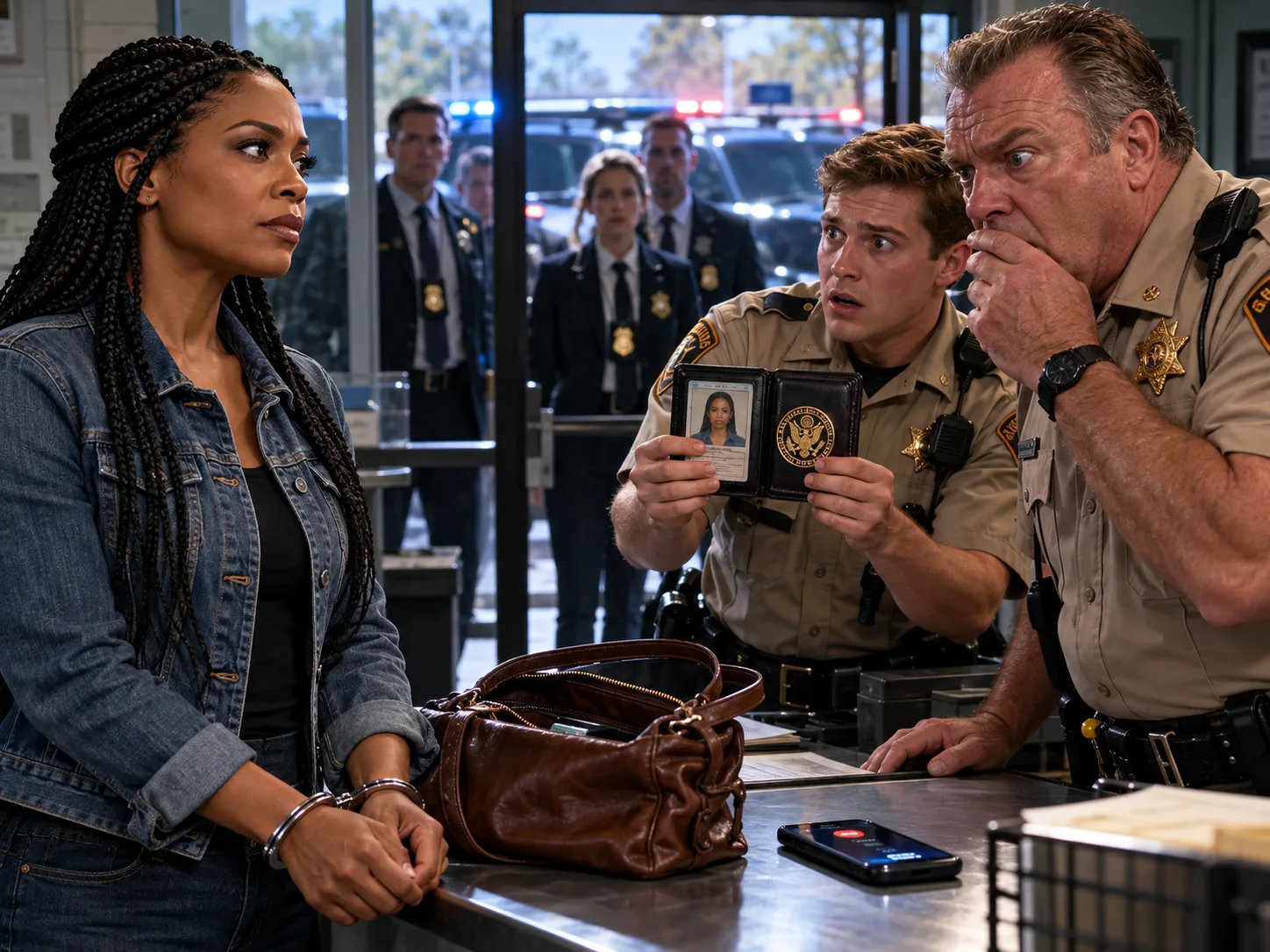
“OPEN THIS DOOR! FEDERAL LAW ENFORCEMENT!”
“DON’T YOU DARE LET THEM INSIDE!” Sheriff Dalton Voss shouted.
“Sheriff,” I said quietly, raising my handcuffed wrists, “your authority just reached its limits.”
For the first time since he had dragged me out of that Georgia diner, Dalton Voss looked genuinely frightened.
His eyes darted between the glass entrance doors, the federal judicial credential lying on the booking counter, and the young deputy standing beside me.
Deputy Ethan Cole was barely twenty-four years old. His hands trembled around the brown leather wallet that had just revealed my identity.
Outside, three dark federal vehicles blocked the parking lot.
A tall woman wearing a dark blazer stood at the entrance, holding an identification wallet beside her face.
Behind her were two federal agents and a United States deputy marshal.
Another firm knock rattled the glass.
“Sheriff Voss! Special Agent Elena Ortiz, Federal Bureau of Investigation. Open the door!”
Voss swallowed.
Then something unexpected happened.
He reached toward the computer behind the booking counter.
“Ethan, shut down the system.”
The deputy stared at him.
“Sir?”
“NOW!”
I watched Ethan’s expression change.
The uncertainty I had seen in the diner was still there. But something else was emerging beneath it.
Conscience.
“Deputy Cole,” I said, “don’t destroy anything.”
Voss spun toward me.
“You shut your mouth!”
I met his glare without moving.
“You arrested me without cause. You threatened to place me in an unmonitored cell. And now you’re attempting to interfere with potential evidence.”
His face darkened.
“You think that fancy identification makes you untouchable?”
“No,” I replied. “It makes me a witness who understands exactly what you’re doing.”
Outside, Agent Ortiz spoke again.
“We have a federal search warrant for this facility. Open the door immediately.”
Ethan slowly removed his hand from the computer keyboard.
Then he turned toward the entrance.
“I’m opening it, Sheriff.”
Voss lunged forward and grabbed his shoulder.
“That’s an order, Deputy!”
Ethan looked down at the sheriff’s hand.
For one long moment, neither man moved.
Then Ethan said something I would remember for the rest of my life.
“With respect, sir, I took an oath to the Constitution. Not to you.”
He stepped away and unlocked the door.
Federal agents entered with controlled, purposeful movements.
Agent Ortiz was a woman in her early forties, with dark hair pulled into a tight bun and an expression that suggested she had little patience for unnecessary explanations.
Her eyes found me immediately.
“Judge Whitlock?”
“Yes.”
“Are you injured?”
“My wrists are sore. Otherwise, I’m fine.”
She turned toward Voss.
“Sheriff, step away from the booking counter.”
Voss straightened his uniform.
“Agent, this is a misunderstanding. We detained an unidentified woman during an active criminal investigation.”
Ortiz glanced at my handcuffs.
“Then I’m sure your arrest report will explain the probable cause.”
Voss opened his mouth.
Nothing came out.
“Deputy Cole,” Ortiz continued, “please identify the arresting officer.”
Ethan’s gaze dropped.
“Sheriff Voss made the arrest.”
“And the alleged offense?”
“Suspicion of armed robbery.”
“Did you personally observe Judge Whitlock commit a crime?”
“No, ma’am.”
“Did you see a weapon?”
“No.”
“Did she threaten anyone?”
“No.”
Voss interrupted.
“This deputy is inexperienced. He doesn’t understand—”
“I understand enough,” Ethan said unexpectedly.
Everyone turned toward him.
His voice shook, but he continued.
“The robbery suspect was reportedly driving a red pickup truck. Judge Whitlock was driving a silver rental sedan. I told the sheriff that at the diner.”
The booking room fell silent.
Ortiz looked toward the deputy marshal.
“Please see that Judge Whitlock’s cuffs are removed and that she receives medical attention if needed.”
The marshal approached with a handcuff key.
When the steel finally opened, I rubbed the red marks around my wrists.
I had worn judicial robes inside courtrooms where dangerous criminals threatened witnesses and defendants shouted obscenities.
But somehow, standing in that little booking room, I felt something more troubling than fear.
I felt the weight of every person who had entered that building without a credential that could save them.
“What happens now?” I asked Ortiz.
“The Bureau has been investigating this department for several months. We obtained warrants based on evidence developed independently of today’s incident. Your detention accelerated our concern about witness safety.”
I nodded.
“Then I need to be clear about something. I’m a witness here, not the judge overseeing this investigation.”
“Understood.”
“I won’t direct your operation.”
Ortiz’s expression softened slightly.
“That’s exactly what I would expect, Judge.”
Across the room, federal agents began securing computers, filing cabinets, and evidence lockers.
Voss was directed to remain seated while agents determined his role in the offenses under investigation.
His transformation was extraordinary.
Twenty minutes earlier, he had claimed the law was whatever he decided.
Now he wanted a lawyer.
“I know my rights!” he protested.
“Good,” Ortiz replied. “Then you understand why we’re preserving them.”
I almost smiled.
Almost.
Because something about the detention hallway bothered me.
At the far end of the room stood a gray metal door.
It had no window.
Above it, a security camera pointed toward the opposite wall.
I remembered Voss’s exact command.
Lock her in the cell without cameras.
“Agent Ortiz,” I said, “what’s behind that door?”
A deputy standing near the hallway stiffened.
Voss immediately looked up.
“Storage.”
Ethan frowned.
“No, sir. That’s the old detention wing.”
Ortiz turned.
“Is it still operational?”
Voss shook his head.
“Been closed for years.”
Then we heard something.
A faint metallic sound.
Almost like someone dragging a cup across concrete.
Everyone stopped.
Ortiz moved toward the door.
“Is anybody inside?”
Silence.
She knocked.
“Federal law enforcement. If someone is inside, identify yourself.”
At first, nothing happened.
Then a woman’s weak voice emerged from behind the door.
“Please… don’t send me back.”
Ethan’s face drained of color.
Ortiz looked toward the nearest agent.
“Get that door open.”
Voss jumped to his feet.
“You can’t go in there!”
Two agents immediately blocked his path.
The lock clicked.
The heavy door swung inward.
And inside the darkness, a trembling woman raised her head.
“WHO IS NOAH BELL?” Agent Ortiz demanded.
“Please don’t tell the sheriff I said his name,” the woman whispered.
I stepped closer to the doorway.
“You’re safe for the moment. Tell us what happened.”
The room smelled of damp concrete and disinfectant.
A narrow metal bench stood against one wall. There was a toilet without a privacy partition, a plastic cup on the floor, and an old blanket folded beside the woman.
No camera.
No working call button.
No visible record showing anyone was being held there.
The woman appeared to be in her late fifties. Her gray hair hung loosely around a tired face, and her hands trembled even though the room was warm.
Agent Ortiz crouched several feet away.
“My name is Elena Ortiz. I’m with the FBI. What’s your name?”
“Mabel Raines.”
“How long have you been in here, Ms. Raines?”
She stared at the wall as though trying to remember what day it was.
“Two nights. Maybe three.”
“Why were you arrested?”
Her eyes filled.
“I asked where they took my nephew.”
I felt a familiar tightening in my chest.
“What is your nephew’s name?”
Mabel looked toward me.
“Noah. Noah Bell.”
The same name she had mentioned when we opened the door.
She gripped the edge of the bench.
“He’s nineteen. He works at the auto shop on Highway Seventeen. Smart boy. Never been in trouble. He fixes people’s cars when they can’t afford a mechanic.”
Ortiz encouraged her to continue.
“Two weeks ago, Noah saw deputies taking money from a man they had stopped near the highway. He recorded it on his phone.”
“What happened after that?”
“They arrested him.”
Mabel lowered her voice.
“Said he was involved in armed theft. Said he had evidence from a robbery.”
The description struck me immediately.
Armed theft.
A conveniently vague accusation.
The same allegation Voss had used to justify arresting me.
“Did you see Noah here?” Ortiz asked.
Mabel nodded.
“Three days ago. Through the hallway. His hands were tied in front of him. He looked exhausted.”
“Did he speak to you?”
“He whispered that the sheriff was moving people somewhere else. A place called Cedar.”
Ethan, standing in the doorway, flinched.
Ortiz noticed.
“Deputy Cole?”
Ethan swallowed.
“I’ve heard that name.”
“Explain.”
“There are transport forms marked Cedar. I assumed it was a county maintenance property. We’re never assigned to those runs.”
“Who handles them?”
“Sheriff Voss approves them personally. Sometimes a private contractor picks people up.”
Mabel grabbed my sleeve.
“Please. They told Noah that if he didn’t hand over the recording, his mother would never see him again.”
I covered her hand with mine.
“We’re going to tell the investigators everything you remember.”
I deliberately didn’t promise that Noah would be found alive.
Years on the federal bench had taught me how cruel false certainty could become.
Instead, I offered what I could honestly give.
“We’ll take what you’ve told us seriously.”
A paramedic arrived to examine Mabel while Ortiz ordered photographs of the detention room.
An evidence technician documented the broken call button, unused camera connection, and scratches on the interior side of the metal door.
One scratch caught my attention.
It was a row of vertical marks.
Seventeen of them.
“Are those yours?” I asked Mabel.
She shook her head.
“They were there when they put me in.”
I wondered how many frightened people had counted the hours in that darkness.
How many had eventually stopped counting.
As the paramedics helped Mabel stand, she reached into the pocket of her faded sweater.
“I kept something.”
She unfolded a narrow strip of paper.
It was dirty, torn at the edges, and covered in cramped handwriting.
“Noah slipped it beneath my door,” she said. “He told me to hide it.”
Ortiz accepted the paper carefully, preserving its condition.
Printed near the top was the name of a business.
CALDER RECOVERY SERVICES.
Below it were vehicle numbers, dates, and several amounts ranging from $800 to $7,500.
Beside one line, Noah had written:
People aren’t paying fines. They’re paying to get out.
Ortiz studied the document.
“Ms. Raines, do you recognize these names?”
“Some of them. They’re people who disappeared after traffic stops.”
An agent photographed the note and placed it in an evidence sleeve.
Across the hallway, Sheriff Voss had become unusually quiet.
I looked at him.
He wasn’t watching me anymore.
He was watching that paper.
And his expression was no longer merely frightened.
It was calculating.
Ethan approached Ortiz.
“Agent, there’s something else you need to see.”
He led her toward the records room.
I remained nearby while a marshal arranged my transport to a secure location. Before leaving, I watched Ethan unlock a cabinet behind the booking desk.
Inside were two enormous black binders.
One was labeled Official Intake Register.
The other had no title.
Ethan opened the second binder.
Dozens of names appeared in handwritten columns.
Some had no booking numbers.
Others had no release dates.
Beside many entries were amounts of money.
Five hundred dollars.
Two thousand dollars.
Ten thousand dollars.
Ortiz compared the names with those in the official register.
“None of these match.”
Ethan nodded.
“I noticed that last month.”
“Why didn’t you report it?”
His eyes dropped.
“Because the last deputy who complained lost his job.”
“Who was that?”
“My father.”
A long silence followed.
I looked at Ethan more carefully.
Until that moment, I had seen a frightened young deputy trying to survive under a brutal superior.
Now I saw something else.
A son carrying an old wound.
Ortiz turned another page.
“What happened to your father?”
Ethan hesitated.
“He died seven years ago. Highway accident.”
His voice cracked slightly.
“The sheriff said he was driving too fast.”
Ortiz didn’t respond.
She continued reading.
Then her expression changed.
“Deputy Cole, I need you to look at this entry.”
Ethan leaned forward.
It was a transport record dated three nights earlier.
The detainee’s name was Noah Bell.
The destination was listed as Cedar.
And beneath the signature line appeared two words.
ETHAN COLE.
Ethan stared at the page.
His face went white.
“That isn’t possible,” he whispered.
Ortiz looked directly at him.
“Deputy, this record says you personally authorized Noah Bell’s transfer.”
Ethan slowly shook his head.
“I never saw Noah Bell.”

