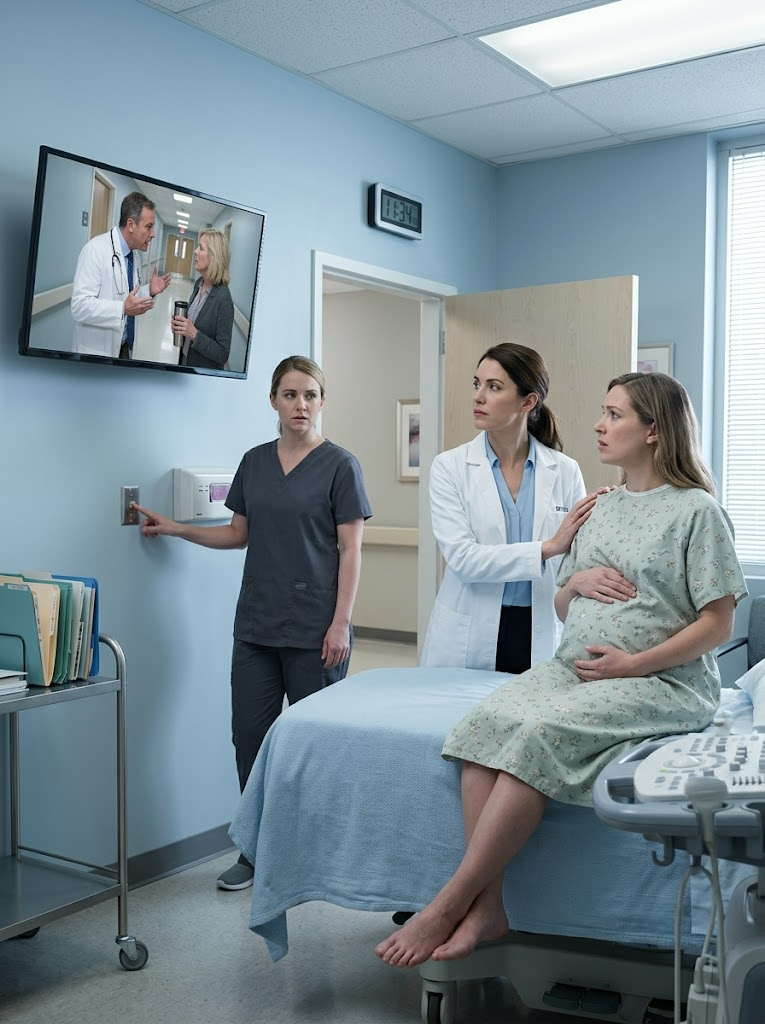
“Drink this—it’s for the baby,” my physician husband insisted while his mother stood beside my bed every morning holding the same silver cup. For months, Aaron used my dizziness, memory lapses, and exhaustion as proof that I was too unstable to drive, visit my parents, or make decisions about my own pregnancy. Then I secretly went to another clinic, where security cameras captured him pounding on the locked door while a doctor discovered an unrecorded medication-delivery device hidden near my cervix. Powder from Sylvia’s cup, residue on the altered ring, and a sedative in my blood all matched—yet Aaron immediately blamed his own mother when police arrived. Sylvia finally surrendered the packets he had ordered her to mix into my drinks, along with a handwritten schedule marking the hours he wanted me unconscious. Then investigators opened one final message from Aaron: “Keep her foggy until delivery. Once the baby is here…”

The Doctor Who Called It Protection
Section One — The Silver Cup
A faint ring of white powder clung to the inside of the silver cup my mother-in-law had carried into the clinic.
Dr. Evelyn Reed leaned toward the security monitor, studied the residue, and quietly told the nurse to preserve the recording and call 911.
Outside the locked examination room, my husband struck the glass with the flat of his hand.
“Anna, open this door,” Aaron shouted. “You’re confused, and these people don’t know your medical history.”
His voice had changed. The anger was gone, replaced by the measured authority he used whenever he needed strangers to believe I was irrational.
Dr. Reed pressed the intercom button.
“Mrs. Mitchell has withdrawn permission for you to participate in her care,” she said. “Move away from the entrance.”
Aaron stared through the glass at her. “I am her husband and her physician.”
“You cannot serve as both in this room.”
Beside him stood his mother, Sylvia, clutching the silver cup against her cardigan. Her hand had begun to shake.
Aaron leaned toward her and whispered something the microphone did not catch.
Sylvia looked down at the cup.
Then she glanced toward the security camera.
For the first time since I had met her, she seemed uncertain which expression Aaron expected her to wear.
A hard pressure tightened beneath my ribs.
Dr. Reed turned immediately. “Pain?”
“Pressure.”
The nurse helped me recline and strapped two monitors across my abdomen. One traced contractions. The other found my son’s heartbeat.
The rapid rhythm filled the room.
I fixed my eyes on the numbers and tried not to think about Aaron outside the door.
I was thirty-four weeks pregnant and had arrived at Dr. Reed’s clinic less than an hour earlier after nearly fainting in a grocery store. I had chosen her because she was outside Aaron’s hospital network and because my cousin had once described her as a doctor who listened before she spoke.
Aaron had not known about the appointment.
He knew now because he had tracked my phone.
The nurse dimmed the lights and began the emergency imaging Dr. Reed had ordered. Before touching me, she explained what she intended to do and asked for my consent.
That simple courtesy nearly brought me to tears.
For months, Aaron had insisted that explanations made me anxious. He said too much information encouraged obsessive thinking and that a good mother trusted the person protecting her pregnancy.
Dr. Reed turned the monitor toward me only after asking whether I wanted to see it.
Near my cervix rested a curved object resembling a narrow ring.
It was positioned too high for me to have inserted or removed myself. Nothing in the prenatal records I had brought from Aaron’s office mentioned it.
“What is that?” I whispered.
“It appears to be a medication-delivery device,” Dr. Reed said carefully. “But it has been altered. There is no acceptable reason for it to be there without your knowledge and consent.”
My mouth went dry.
Six weeks earlier, I had mentioned pelvic pressure after dinner. Aaron said driving to the hospital would be unnecessary and stressful. He locked our bedroom door, told Sylvia to keep everyone downstairs, and performed what he called a routine cervical examination.
I remembered cold metal.
A sharp sting.
My legs trembling while Aaron told me to stop resisting because I was making the examination difficult.
“What did you do?” I had asked afterward.
He kissed my forehead.
“I’m protecting the pregnancy.”
I trusted him because he was my husband.
I trusted him because he was a physician.
Most of all, I trusted him because he had spent two years restructuring my life until believing him felt safer than questioning him.
The nurse crossed the room and shut the blinds completely.
My phone began vibrating on the counter.
Tell them you have panic attacks.
A second message appeared.
They will transfer you if you act unstable.
I handed the phone to Dr. Reed.
She did not interpret the messages for me or tell me what I should feel.
“What would you like us to do with these?” she asked.
“Save them.”
My voice sounded unfamiliar, but steady.
The nurse photographed the screen, recorded the time, and placed the phone beside an evidence bag.
Aaron’s voice rose from the lobby. He identified himself first as my physician, then as my husband, and finally as the father of my baby. Each title had opened doors for him before.
Dr. Reed listened for less than a minute.
“You will not leave through the lobby,” she told me. “We’re arranging a direct hospital transfer for monitoring and removal of the device.”
“Will he follow?”
“He may try.”
She lowered herself until we were eye level.
“But he no longer decides who has access to you.”
The words struck something deep inside me.
My eyes moved toward my purse and the empty pocket where my keys should have been.
Aaron had taken them three months earlier after I became dizzy in a grocery-store parking lot. He said my condition made driving unsafe.
I understood now that the dizziness had never proved I needed him.
It had simply made me easier to control.
Sirens sounded in the distance.
On the security screen, Aaron reached toward the silver cup.
Sylvia stepped back.
He reached again, harder this time.
“Give it to me.”
Sylvia stared at him. “What was in those packets?”
“My prenatal mixture.”
“That isn’t what you called it at home.”
Aaron looked toward the camera.
Sylvia set the cup on the concrete ledge beside the entrance and raised both hands.
“I’m not touching it again.”
That was when Aaron stopped pretending his concern was about me.
He slammed his palm against the ledge and ordered her to pick up the cup before anyone came outside.
She refused.
Two police officers and the clinic security guard approached.
Aaron pointed immediately at his mother.
“She has been giving my wife unapproved herbal products,” he said. “I came to stop her.”
Sylvia’s expression changed.
Not because he had blamed her.
Because he had done it without hesitation.
She opened her handbag and removed several folded paper packets held together by a rubber band.
“Aaron gave me these,” she told the officers. “He marked the days and told me to mix one into Anna’s drink every morning.”
Aaron said she was confused.
Sylvia looked through the glass at me.
“I thought they were herbs,” she said.
Then her eyes dropped.
“At first.”
Section Two — Keep Her Foggy
The ambulance crew entered through a side hallway while police kept Aaron near the front entrance.
Before the paramedic tightened a strap, adjusted the blanket, or moved the monitor, he asked permission.
Each question reminded me how many choices Aaron had taken while calling them medical necessities.
Dr. Reed asked whether there was anyone I trusted enough to call.
My parents’ faces came to mind, followed by a wave of shame.
For two years, Aaron had convinced me they were intrusive and resentful of our marriage. After my mother asked why I had missed three family gatherings, he blocked her number from my phone. Later, he unblocked it and claimed the disagreement had been a misunderstanding.
By then, I had stopped calling.
“My father,” I said. “Please call my father.”
I still knew his number by heart.
At the hospital, a maternal-fetal specialist removed the altered ring without harming my son. The device was sealed, photographed, and documented. No corresponding entry appeared in any of my prenatal records.
Blood tests detected a prescribed sedative at a level inconsistent with anything I had knowingly taken. Traces of the same substance were later found on the ring and in the liquid remaining inside Sylvia’s cup.
The doctor who explained the results avoided dramatic language.
“The medication could account for the dizziness, fatigue, memory gaps, and muscle weakness you’ve described.”
Those were the same symptoms Aaron had used to justify taking my keys, controlling my appointments, limiting travel, and insisting I should never shop alone.
He had not merely responded to my weakness.
He had helped create it.
My father arrived before sunset wearing the heavy canvas jacket he kept in his truck, even though the August air was warm.
He stopped in the doorway.
“Am I allowed to come in?”
That question broke something inside me.
I nodded.
He crossed the room and took my hand. He did not ask why I had stayed away. He did not remind me that he and Mom had warned me about Aaron.
“Your mother is packing a bag,” he said. “We’re here for as long as you need us.”
Aaron called the hospital repeatedly.
First, he identified himself as my treating physician.
Then as my husband.
Then as the baby’s father.
None of those titles worked.
I signed restrictions removing him from my medical contacts and denying him access to my room, records, and treatment decisions.
My father watched without reaching for the pen.
The next morning, Sylvia asked to speak with me.
I refused.
She left a message with the patient advocate saying she had information and would provide it whether I forgave her or not.
She surrendered the remaining packets, text messages from Aaron, and a handwritten schedule hidden in her kitchen cabinet.
The schedule listed mornings when she was supposed to prepare my drink. It included dates for injections I had been told were vitamins and hours when Aaron wanted me asleep.
Beside one week, he had written:
Becoming restless. May try to visit parents.
Sylvia’s messages showed she had questioned him twice.
The first time, Aaron told her the medication was safe.
The second time, he said pregnancy had made me irrational and that interfering would endanger her grandson.
She accepted his explanation because it allowed her to believe obedience was an act of love.
Then investigators found the message that destroyed Aaron’s medical justification.
Keep her foggy until delivery. Once the baby is here, she’ll stop talking about leaving.
It was not a treatment plan.
It was a custody strategy written by a man who believed our child would become another lock.
Aaron claimed he had exaggerated to calm his mother. He said the ring had been intended to manage anxiety and that I had agreed verbally during an episode I could no longer remember.
The timeline contradicted him.
Our home security system confirmed that no other medical professional had entered the house that night. Messages I sent afterward asked why I was bleeding and why he refused to explain what he had done.
His reply consisted of one word.
Protection.
The message did not prove every thought in Aaron’s mind.
It proved he knew I was asking for an explanation and chose control instead.
Sylvia eventually admitted what she had tried hardest to hide.
Two weeks before I went to Dr. Reed, I had poured my morning drink into the sink after noticing its bitter taste.
Sylvia saw me and told Aaron.
He instructed her to prepare another cup and remain in the room until I finished it.
She obeyed.
“I was afraid he would keep the baby away from me,” she wrote in her statement. “I told myself Anna was being difficult because that was easier than admitting my son frightened her.”
I read her statement once.
Then I handed it back.
Her honesty mattered.
It did not erase the mornings she had stood beside my bed holding the silver cup while I swallowed.
The hospital continued monitoring me as the medication left my system. My dizziness eased. The heavy fog I had accepted as pregnancy slowly lifted. My contractions settled without progressing into labor, and my son’s heartbeat remained strong.
Dr. Reed visited after clinic hours with an updated care plan.
She sat beside me while I read every page. When I asked the same question twice, she answered twice.
Before leaving, she placed the papers in my hands.
“You do not have to earn the right to know what happens to your body.”
For years, Aaron had treated information as something he dispensed according to my behavior.
Now a physician was telling me knowledge belonged to me.
I looked at the care plan, my father asleep in the chair, and the locked hospital door.
For the first time, leaving Aaron no longer seemed like one impossible act.
It looked like a series of decisions.
The next one was waiting.
Section Three — The Life He Managed
After my discharge, my parents brought me to their house.
Leaving did not feel brave.
It felt humiliating.
Aaron had controlled our finances, transportation, passwords, insurance, and nearly every medical appointment. I had to replace identification documents, open a new bank account, change phone numbers, and explain repeatedly why my husband must not be contacted.
I had no car because Aaron had both sets of keys.
I had little money because my paycheck entered an account he monitored.
Even my maternity clothes had been chosen by him because he said shopping exhausted me.
Some mornings, I woke convinced I had misunderstood everything.
Perhaps Aaron had genuinely believed the medication was necessary. Perhaps I had agreed and forgotten. Perhaps the investigation would expose me as unstable exactly as he had predicted.
Then I remembered the altered ring.
The powder in the cup.
Keep her foggy until delivery.
Those facts became the railing I held whenever shame made the room tilt.
All communication went through attorneys and advocates. Aaron was barred from taking part in my medical care. His treatment records involving me were placed under professional review, and investigators began examining whether he had misused hospital resources.
No one promised a quick outcome.
That frustrated my father.
“He should be arrested already,” he said one morning.
My mother put down her coffee. “Anna doesn’t need you deciding the pace either.”
Dad looked ashamed.
“I’m sorry.”
It was the first time I had seen a man apologize without adding an explanation.
Aaron sent letters through his attorney.
In the first, he described himself as a concerned physician whose private marital decisions had been misunderstood. In the second, he accused my parents of manipulating me while I was medically vulnerable.
The third was addressed directly to me.
He wrote about our wedding day and the nursery he had painted. He reminded me of the night we first heard the baby’s heartbeat.
Then he wrote:
You know I would never hurt our son.
He did not write that he would never hurt me.
I gave the letter to my attorney and did not answer.
Sylvia requested contact several times. At first, her messages centered on Aaron’s career and reputation. She asked whether I understood what a criminal investigation could do to his future.
My advocate returned each message with the same response.
Anna will not discuss Aaron’s consequences with you.
Eventually, Sylvia’s tone changed.
She stopped asking me to save him.
She began providing information without conditions.
She revealed that Aaron had copied one of my signatures onto a consent form. She admitted he had asked her to tell relatives that I suffered from severe prenatal paranoia. She gave investigators access to a locked cabinet where he had stored syringes, sedatives, and medical supplies removed from his workplace.
I appreciated the cooperation.
I still did not speak to her.
Accountability was not a performance I was required to reward immediately.
My parents converted their downstairs study into a bedroom for me. My mother placed a lock on the door and handed me both keys.
“No one enters unless you invite them,” she said.
The first night, I locked the door and cried.
Not from fear.
From the unfamiliar relief of knowing the person outside would respect it.
The hardest part of recovery was recognizing how gradually Aaron had taken control.
He had not begun with medication or hidden devices.
He began by driving me to appointments because parking made me nervous. He took over bills because I worked long hours. He answered questions at the doctor’s office because he understood terminology better.
Every surrender seemed small and reasonable.
By the time I noticed I had no independent access to our life, he could point to my dependence as proof that I needed him.
My mother never asked why I had failed to see it sooner.
One afternoon, I asked her.
She folded baby clothes beside me.
“Because you loved him,” she said. “And because he worked hard to make control look like care.”
My son arrived four days before his due date.
I entered labor shortly after midnight and drove to the hospital with my parents. My written birth plan had been reviewed by every member of the team. No medication was administered without explanation. No examination happened without consent.
My mother stood beside the bed.
My father waited in the hall holding two paper cups of coffee he forgot to drink.
Dr. Reed stopped by before her shift ended.
When my son was placed against my chest, I felt joy, terror, and grief arrive together.
He opened his eyes briefly.
I whispered, “No one gets to call control love around you.”
Aaron was informed of the birth through legal representatives. He was not told our location until security arrangements were established.
Sylvia requested one supervised visit.
I said no.
Then, three months later, after she continued cooperating and stopped asking me to consider Aaron’s future, I agreed to twenty minutes with a supervisor present.
She entered the room without the silver cup, the folded packets, or the confidence she had once borrowed from her son.
She held my baby and cried quietly.
She did not call herself his protector.
She did not ask me to forgive her.
When the supervisor announced the visit was over, Sylvia immediately returned him to me.
That mattered more than her tears.
At the door, she turned.
“I knew enough to stop,” she said. “I didn’t.”
“No,” I answered. “You didn’t.”
She nodded and left.
For once, no one asked me to soften the truth.
Section Four — The Keys
The investigations continued for more than a year.
Aaron lost access to patients while the medical board reviewed his conduct. Criminal proceedings moved slowly, complicated by his claims that the medications had been prescribed for legitimate reasons and that our marriage gave context outsiders could not understand.
I learned not to measure my safety by whether the system had already decided his final punishment.
My protection came from boundaries that existed before any verdict.
Aaron could not contact me directly.
He could not enter my parents’ property.
He could not attend medical appointments or obtain my records.
He could no longer use professional language to override the word no.
The first time I drove again, my father offered me his old SUV.
I placed my son’s carrier in the back seat and sat behind the wheel for nearly ten minutes.
My hands shook.
The grocery-store incident returned in fragments: the dizziness, Aaron taking the keys, his arm around my waist as he told strangers his pregnant wife was confused.
“You don’t have to go today,” Dad said from the porch.
“I know.”
That was why I went.
I drove slowly around the block, then farther. My son slept through the entire trip.
When I returned, I carried him inside, hung the keys on a hook beside the door, and stood looking at them.
Aaron had once taken my keys and called it protection.
Now they were mine again.
Recovery did not arrive as one triumphant moment. It came through ordinary choices.
I selected my own pediatrician.
I opened mail without fearing what account or decision it might reveal.
I bought groceries and wandered through aisles longer than necessary because no one was timing me.
I chose a blue ceramic mug from a thrift store and used it every morning.
The silver cup remained sealed with the evidence.
Sometimes I remembered Sylvia standing beside my bed, watching to make sure I drank. Other times I remembered her placing the cup on the clinic ledge and refusing to touch it again.
Both memories were true.
People wanted simple roles.
Victim. Villain. Accomplice. Savior.
Reality was harder.
Sylvia had been manipulated by her son and had also chosen to participate. She eventually told the truth, but only after her own safety and access to her grandson were threatened.
Her cooperation mattered.
So did the harm.
I did not need to erase one fact to acknowledge the other.
My relationship with my parents healed slowly. We did not pretend the years of distance had never occurred. My father admitted there had been times he pushed too hard and made Aaron’s warnings about him seem credible. My mother admitted she had sometimes criticized my marriage in ways that made me defensive.
They apologized without asking me to declare everything repaired.
That was new.
One evening, while my son slept against my chest, Dad said, “I kept wondering what I should have done differently.”
“You could have kept calling.”
“I thought giving you space was respectful.”
“So did I.”
We sat quietly.
Control and respect can look similar from a distance. The difference is whether the other person is still free to choose.
Months later, Sylvia sent one final letter through the patient advocate.
She did not ask to see the baby.
She described the first morning Aaron gave her a packet. He said it contained minerals that would help me sleep. By the third week, she noticed my speech sometimes slowed after I drank it.
She asked him whether the mixture was safe.
He accused her of questioning his medical training.
She stopped asking.
“I told myself trust was loyalty,” she wrote. “Now I understand that loyalty without conscience is surrender.”
I read the letter and placed it in a drawer.
I did not forgive her that day.
Forgiveness was not a deadline.
It was not a door another person could knock on until I became too exhausted to keep it closed.
It was mine to define, or withhold.
A year after the clinic incident, I returned to see Dr. Reed.
My son sat on my lap, chewing the corner of a fabric book. The examination room looked smaller than I remembered.
Dr. Reed asked how I was sleeping, whether I felt safe, and whether I understood every part of my current treatment.
“Yes,” I said.
Before leaving, I paused beside the security monitor.
That was where I had watched Aaron demand the silver cup and blame his mother. It was where Sylvia’s certainty cracked and where mine began to return.
“I thought you saved me,” I told Dr. Reed.
She shook her head.
“I opened a door. You decided to walk through it.”
That afternoon, I drove home with my son asleep behind me. I parked, carried him onto the porch, and unlocked the door myself.
Inside, I hung the keys where I could see them.
Then I poured tea into the blue mug and sat beside the window.
For years, Aaron had taught me that safety meant surrendering decisions to someone stronger, smarter, or more qualified.
I know better now.
Safety is not the absence of choice.
It is having choices that no one can take from you.
My son woke and reached toward me.
I lifted him from the carrier and held him against my chest.
Outside, a car passed slowly, then continued down the street. Once, that would have tightened every muscle in my body.
This time, I watched it disappear and returned my attention to the child in my arms.
The silver cup remained sealed away.
The blue mug was warm between my hands.
And the keys were exactly where I had placed them.
THE END
Disclaimer: This content is entirely AI-generated for fictional and entertainment purposes only. Any resemblance to actual persons, living or dead, events, or locations is purely coincidental, and the creator assumes no liability for any interpretation of this content.
Disclaimer: This story is fictional and created for entertainment purposes only. Any names, characters, places, or events are fictitious or used fictitiously. No real person or organization is intended to be portrayed.