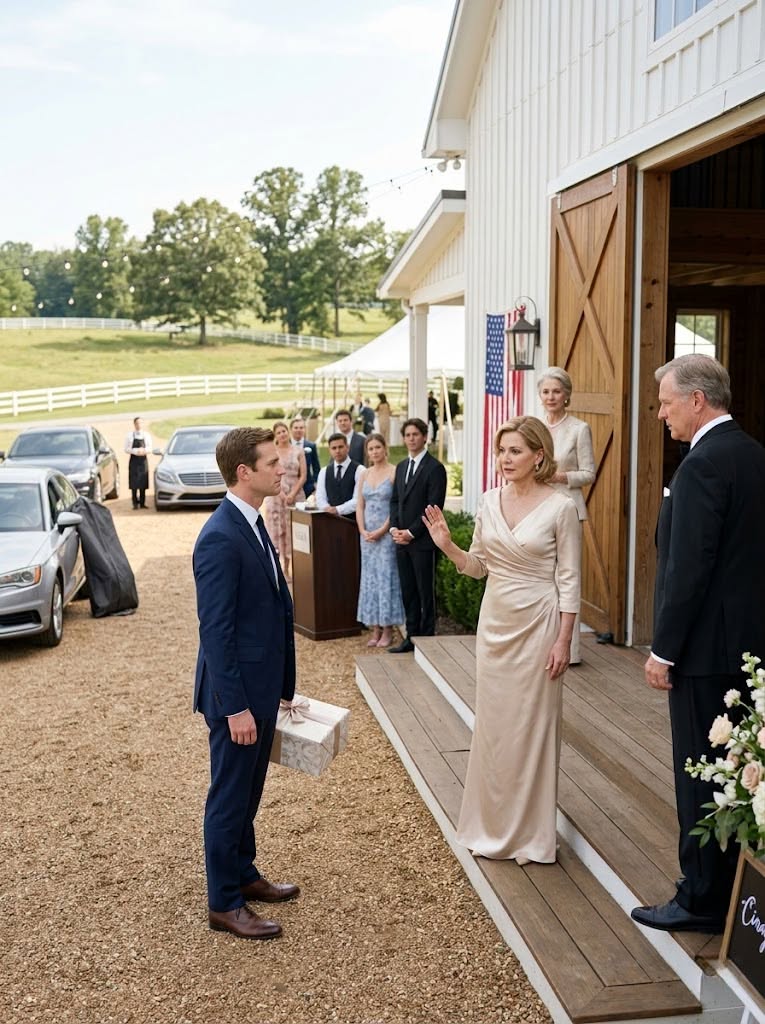
cnu My Stepmother Slapped Me Across the Face at My Graduation Party Because I Announced My Engagement “Without Permission”—Then I Woke Three Days Later With a Concussion and Found Her, My Father, and Two Relatives Outside My Hospital Room in Handcuffs… Because While I Was Unconscious, They Had Tried to Convince Police That I Simply Fell.
Without Permission
Part 1
I woke up to the sound of metal.
Not hospital machines. Not the soft beep beside my bed or the wheels of a cart passing in the hallway. This was sharper. A small, hard clink from the other side of the glass, followed by a woman’s angry whisper and a police officer saying, “Ma’am, stop pulling away.”
When I opened my eyes, the room split into light and pain.
The ceiling above me was white. Too white. My mouth tasted like copper, my left cheek throbbed, and the back of my head felt as if someone had driven a nail through it and left the hammer behind. I tried to turn, but the room tilted.
“Natalie.”
Ethan’s voice came from beside me.
He was sitting in a plastic chair with his elbows on his knees, still wearing the pale blue dress shirt he had worn to my graduation party. The collar was wrinkled. His eyes were red. He looked like he had not slept in days.
“What happened?” I whispered.
He reached for my hand slowly, as if afraid sudden movement might break me. “You’re in the hospital. You had a concussion.”
“From Diane?”
His jaw tightened.
That was answer enough.
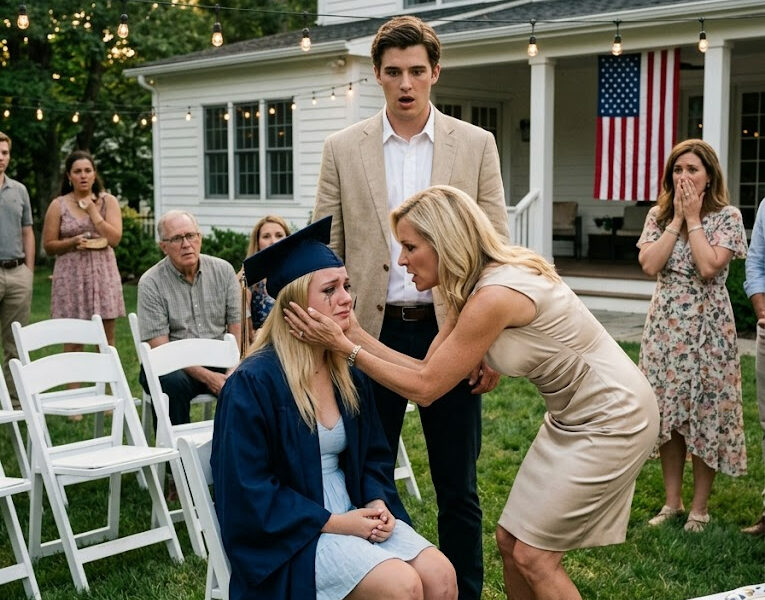
Memory returned in pieces, each one bright and cruel. My father’s backyard in Arlington. String lights over the patio. Folding tables covered with white paper cloths. My Georgetown classmates laughing near the fence. Ethan standing beside me, his hand warm against my lower back as I raised my left hand and announced our engagement.
For one second, people cheered.
Then my stepmother crossed the yard.
Diane had always moved quietly when she was angry. She did not storm. She approached with perfect posture and a calm face, which somehow made every room colder.
“How dare you,” she said.
Before I could answer, she slapped me so hard my lip split against my teeth. I remembered Ethan grabbing my arm. I remembered my father’s voice saying my name. I remembered the patio lights stretching into long white lines.
Then nothing.
I lifted my right hand and touched my cheek. Ethan stopped me gently before my fingers reached the swelling.
“Don’t,” he said. “It’s bruised.”
“How long?”
“Three days.”
I stared at him.
“You were in and out,” he said. “Mostly out. They kept you because of the concussion and the fall.”
The metal sound came again.
This time I turned despite the pain.
Outside my room stood two uniformed police officers. Beside them were Diane, my father, Aunt Carol, and my cousin Marissa. Diane’s wrists were cuffed in front of her. Carol was crying. Marissa looked furious and embarrassed. My father stood at the back, uncuffed for the moment, his face gray with exhaustion.
Nothing about it made sense.
“Why are they here?” I asked.
Ethan’s thumb moved once over my knuckles.
“Because while you were unconscious,” he said, “they tried to tell the police you did this to yourself.”
The pain behind my eyes sharpened.
“What?”
“Diane said you were drunk and dramatic. Your father said you stumbled. Carol and Marissa backed her up.”
“I don’t drink.”
“I know.”
“Everyone saw.”
“Not everyone was willing to say so at first.”
Diane saw me awake through the glass. Her face changed immediately. The fury softened into a performance of concern so practiced I might have believed it once.
“Natalie,” she called through the doorway. “Tell them this is a misunderstanding.”
One officer stepped in front of her. “Mrs. Whitmore, stay where you are.”
Whitmore. My father’s last name. My mother’s last name before she died. Diane had taken it, filled the house with her furniture, boxed up my mother’s photographs, and made herself the authority on what counted as family.
Now she stood outside my hospital room in handcuffs, still asking me to protect her.
Ethan stood. “She just woke up. You don’t speak to her.”
Diane’s eyes cut to him.
“This is family business,” she said.
For the first time since I had known him, Ethan’s voice turned cold.
“Family business ended when an ambulance took her out of that backyard.”
My father looked at me then. Not at Ethan. Not at the officers. Me.
“Nat,” he said, and the nickname hurt worse than my cheek. “Please. We can fix this.”
I looked past him to Diane’s cuffs, then to the folder one officer carried under his arm.
“What did you sign?” I asked him.
My father closed his eyes.
And in that silence, before anyone handed me a single document, I understood that the slap had not been the worst betrayal.
Part 2
The officer’s name was Ramirez. He had the careful voice of someone used to walking into family disasters and being told by everyone present that nothing important had happened.
He placed a folder on the rolling table near my bed.
“You do not have to review this now,” he said. “Your doctor would prefer you rest.”
“I want to see it.”
Ethan looked ready to argue, but he did not. That was one reason I loved him. He wanted to protect me without taking control of me.
Officer Ramirez opened the folder.
The first page was a brief incident summary. Assault at private residence. Fall with head injury. EMS transport. Witness disagreement at scene.
Witness disagreement. Such a neat phrase for people standing over my unconscious body and deciding whether my pain would inconvenience them.
The second page was Ethan’s statement. His handwriting slanted hard across the lines, as if he had pressed the pen through anger. Diane crossed the patio immediately after engagement announcement. Struck Natalie Bennett across left side of face with open hand. Natalie lost balance and hit back of head on stone border near flower bed. I called 911.
The third statement came from Ethan’s mother, who had seen the same thing.
The fourth came from my professor, Dr. Klein, who wrote that I had consumed no alcohol at the party and had been standing calmly when Diane approached.
Then came my father’s statement.
I recognized his signature before I read a word.
My daughter became emotional after announcing her engagement. She appeared lightheaded, stepped backward, and fell. My wife Diane attempted to steady her, but Natalie had already lost balance.
I stared at the page until the black letters seemed to move.
“He wrote that?”
“Yes,” Ethan said.
“While I was unconscious?”
“Yes.”
Officer Ramirez shifted slightly. “Your father later attempted to amend parts of his account after additional witness statements and security footage contradicted it.”
“Security footage?”
Ethan nodded. “The camera above the garage. The one your dad installed after the package thefts.”
Of course. My father had always been more careful with Amazon deliveries than with uncomfortable truths.
I looked toward the doorway. Diane stood with her chin high, furious that the world had refused to follow her script. Aunt Carol stared at the floor. Marissa whispered something to another officer and got told, firmly, to be quiet.
“Why are Carol and Marissa in handcuffs?”
Ramirez’s expression stayed neutral. “Because after EMS left, they attempted to remove your engagement ring from your hand before evidence photographs could be taken. Your fiance intervened.”
I looked at Ethan.
His face hardened.
“Diane said the ring made you look unstable,” he said. “She said if the engagement announcement wasn’t mentioned, this could all go away.”
The room seemed to shrink around me.
My engagement ring was still on my finger. The diamond looked small and bright under hospital light. Ethan must have kept it there through everything.
Diane leaned around the officer outside the room.
“Natalie, listen to me,” she said, soft now. Motherly for strangers. “You were overwhelmed. You fainted. Nobody meant for you to get hurt.”
“You hit me.”
Her mouth tightened. “I corrected you.”
Even Officer Ramirez looked up at that.
“You announced a major family decision in front of guests without discussing it with us,” Diane continued. “You embarrassed your father.”
“I graduated from college,” I said. “I got engaged. Those were mine to announce.”
“Not in my house.”
There it was. The oldest truth in a new dress.
After my mother died, Diane had worked slowly. First the framed pictures disappeared from the living room. Then my mother’s Christmas ornaments stayed in storage because they were “too sad.” Then Sunday breakfast changed from pancakes, my mother’s tradition, to Diane’s church brunch with people who called me quiet and watched her put an arm around my father like she had rescued him from the burden of grief.
When I objected, I was emotional.
When I cried, I was ungrateful.
When I stopped talking, I was cold.
By the time I left for Georgetown, my childhood home had become a place where I needed permission to remember who had loved me first.
Now Diane was demanding permission over my future too.
My father stepped forward, stopped by the officer’s raised palm.
“Nat,” he said. “Please don’t make a permanent decision while you’re hurt.”
I lifted his signed statement with shaking fingers.
“You already did.”
He flinched.
For years, I had waited for him to choose me before the damage was already done. In that hospital room, with stitches in my lip and his lie in my hand, I finally understood he had been choosing all along.
Just not me.
Part 3
Recovery did not look like strength at first.
It looked like sleeping with blackout curtains because light hurt my skull. It looked like losing my balance in the bathroom and crying from frustration because I needed Ethan to stand outside the door like I was ninety instead of twenty-two. It looked like reading the same paragraph six times and still not remembering what it said.
Diane’s attorney called the slap an unfortunate family misunderstanding.
My father’s first message called it one terrible moment.
One terrible moment.
I read that phrase while sitting on Ethan’s couch with an ice pack against my cheek. The words should have made me angry. Instead, they made me tired.
Diane had spent twelve years creating that moment.
She had not started with her hand. She started with boxes.
My mother’s recipe cards went into one. Her blue sweater into another. Family albums were moved to the basement because Diane said grief should not be “displayed.” By sophomore year of high school, I had to ask where my own childhood pictures were, and Diane told me, with a smile, “We are building a new chapter now.”
That new chapter had very little room for me unless I played the grateful supporting role.
So I did what Ethan and Officer Ramirez both advised.
I documented everything.
I requested my medical records, the EMS report, the police file, the 911 audio, and the garage camera footage. I wrote down every memory before headaches blurred the edges. I saved my father’s messages, Diane’s voicemails, and the texts relatives sent telling me not to destroy the family over a “misunderstanding.”
Then Aunt Carol called.
Her voice sounded small. “Natalie, I need to tell you something.”
I put the call on speaker because Ethan was in the room and I no longer trusted family conversations without a witness.
Carol cried through most of it, but the facts were clear. Diane had told her and Marissa to say I had been drinking. My father had not wanted to mention alcohol because he knew it was false, so Diane changed the story to stress and fainting. Carol admitted that she helped repeat it because Diane was standing beside her when the officer asked questions.
“And the ring?” I asked.
Carol went quiet.
“Tell me.”
“Diane said if the ring was gone, maybe people would stop focusing on the engagement announcement. She said it would look less intentional.”
I closed my eyes.
“Did my father hear that?”
Carol whispered, “Yes.”
After the call, I sat very still.
Ethan did not tell me he was sorry. He had learned that apologies from people who had not hurt you can sometimes feel like more weight to carry. Instead, he brought me a glass of water and sat beside me until I could breathe normally.
The case moved slowly. Real consequences usually do.
Diane was charged with misdemeanor assault. The false statements created a separate review, though my father was not arrested. Carol and Marissa received warnings and were required to give corrected statements. Diane’s attorney pushed for dismissal. Ethan’s family cooperated. Dr. Klein cooperated. The garage camera told the truth without shaking, apologizing, or protecting anyone.
For the first time, the official version of a family event did not belong to Diane.
My father asked to see me six weeks after the hospital.
I agreed only because a victim advocate offered to sit in the room with us. We met at a mediation office with beige walls and a pot of coffee nobody touched.
Dad looked older. Smaller. Like a man who had spent weeks discovering that avoidance can become evidence.
“I failed you,” he said.
I believed him.
That was the painful part. He was not lying. He was ashamed. His hands shook when he talked about seeing me fall. He cried when he admitted he knew Diane had hit me but let himself believe changing the story would protect everyone from something worse.
“Worse than what?” I asked.
He looked at me, tears running down his face.
“Losing the family.”
I thought of my mother’s pictures in the basement. My graduation party ending under ambulance lights. My fiance standing between me and relatives trying to remove my ring.
“Dad,” I said, “you lost me trying not to lose her.”
Part 4
Diane accepted a plea deal in September.
No jail time. Probation, anger management, court costs, and an order prohibiting direct contact with me unless I initiated it. It was not the dramatic punishment people expect in stories, but it put her name beside what she had done. Assault. Not misunderstanding. Not stress. Not family business.
That mattered.
My father was not charged, but he was required to sit for a formal follow-up interview about his original statement. Officer Ramirez later told me, carefully, that the file would reflect his correction and the circumstances under which the first statement was given.
That mattered too.
Diane’s control had always depended on softness. Soft language. Soft consequences. Soft relatives saying, “You know how she is,” as if cruelty were a weather pattern instead of a choice.
Paperwork made things harder to soften.
My headaches faded by October. My nonprofit job agreed to delay my start date and let me begin part-time. Ethan drove me to appointments, filled out insurance forms, and learned how to make soup badly but consistently.
One morning, I found him at my tiny kitchen table staring at my engagement ring in the ceramic dish where I had left it after the hospital.
He did not ask why I was not wearing it.
That was another reason I loved him.
“Do you want coffee?” he asked.
The ordinary question broke something open in me. I laughed, then cried, then laughed again because I was tired of my body turning every emotion into weather.
“I want to wear it,” I said.
“Today?”
“Today.”
He slid the ring onto my finger, not as a proposal this time, but as a return. Diane had tried to turn it into evidence of my disobedience. My relatives had tried to remove it to make the story cleaner. For weeks, I had let it sit untouched because joy had become tangled with fear.
But the promise had never belonged to them.
Ethan and I canceled the wedding plans we had barely started. No backyard reception. No family speeches. No long aisle where I would have to decide whether my father deserved to stand beside me.
We made a guest list on the back of an electric bill because that was the paper closest to us at the table. Every name had to pass one test: Could this person sit in a room with my happiness and not try to manage it? The list became shorter than I expected and easier than I feared. For once, exclusion did not feel cruel. It felt accurate.
It also felt adult, in a way my family had never allowed adulthood to feel.
Ethan wrote the final names in pen and did not ask me to reconsider.
In December, we married at the courthouse.
Twelve people came. Ethan’s parents. Dr. Klein. My college roommate. Two coworkers from the hotel where I had worked through school. Aunt Carol came alone, sat in the back, and cried quietly. She did not ask for forgiveness. She simply said, “Thank you for letting me witness something honest.”
My father was not invited.
The night before the ceremony, he sent a card through Aunt Carol. I almost threw it away. Ethan said he would do whatever I wanted. I opened it at midnight.
Natalie,
I hope someday I become someone safe enough for you to know again. I am sorry I taught you to make yourself smaller so my life could stay easier.
Dad.
I read it twice.
Then I put it in a drawer.
The next morning, I wore a blue dress because my mother had loved blue. Not Diane’s tasteful navy. Not the pale gray she used to call elegant. Real blue, bright enough to feel like sky.
At the courthouse, Ethan held both my hands.
When the clerk asked if I took him as my husband, I did not think about Diane’s slap or my father’s silence.
I thought about a rainy kitchen, Ethan’s voice, and the sentence that made me say yes.
I want to build a life where nobody makes you ask to be loved.
“I do,” I said.
And for once, no one in the room had permission to make that moment about anything else.
Part 5
A year after the graduation party, Ethan and I moved into a small townhouse with a narrow porch and one stubborn hydrangea bush by the steps.
The first thing I unpacked was not our dishes or towels. It was the box of my mother’s photographs I had taken from my father’s basement after the mediation. He did not fight me for them. Maybe he knew better by then. Maybe he was simply too ashamed.
I hung one picture in the hallway.
My mother stood at the edge of a lake in a blue sweater, laughing at something outside the frame. I remembered the sweater. I remembered the smell of her vanilla hand lotion. I remembered her singing badly while making pancakes on Sundays.
For years, Diane had made memory feel like rebellion.
Now it was decor.
My father called once a month. I did not always answer. When I did, the calls were short. He asked about work. I asked whether he was still seeing his counselor. He was. He had moved into the guest room after Diane’s plea. By spring, he told me they were separating.
I did not celebrate.
People sometimes mistake boundaries for revenge because both can leave the guilty uncomfortable. But revenge had not been my goal. I wanted safety. I wanted truth. I wanted to stop living as if Diane’s comfort outranked my reality.
Diane never apologized. She sent one letter through her attorney claiming she wished me healing and hoped we could “avoid further public hostility.” I kept it in the same folder as the police report.
Not because I needed to relive it.
Because I needed proof for the version of me who might someday be tempted to doubt herself.
That version still visited sometimes. Usually late at night. Usually when I remembered my father standing outside the hospital room, unable to answer a simple question.
Did you tell them I fell?
Healing did not erase that memory. It taught me what to do with it.
I stopped asking why Diane hated sharing space with my mother’s ghost. I stopped asking why my father found it easier to disappoint me than confront his wife. I stopped asking what I could have done differently at my own graduation party to deserve less violence.
Nothing.
That was the answer.
I had deserved a toast. A hug. A father who looked at my ring and saw his daughter loved by a good man. Instead, I got a hospital bed and witness statements.
But I also got something else.
A record.
The camera over the garage recorded what happened. The medical report recorded the injury. The police file recorded the lies. The corrected statements recorded the pressure Diane placed on everyone around her.
For most of my life, my family had survived by making everything arguable.
Facts ended the argument.
On our first anniversary, Ethan and I invited twelve friends to the townhouse. No formal dinner. No speeches. We ate takeout pasta from paper plates, drank cheap sparkling wine, and sat on folding chairs because our furniture budget had gone mostly to medical bills and moving costs.
At one point, I looked down the hallway and saw my mother’s photograph watching over the room. Nobody asked me to take it down. Nobody said it made the evening sad. Nobody treated love for someone dead as an insult to someone living.
Ethan found me standing there and slipped his arm around my waist.
“You okay?”
“Yes,” I said.
And I was.
A week later, my father left a voicemail.
“Nat, I know I don’t have the right to ask for anything. I just wanted you to know I found another box of your mother’s things. I can drop it with Carol if you don’t want to see me.”
I listened twice.
Then I texted back.
Leave it with Carol. Thank you.
It was not forgiveness. Not yet. Maybe not ever in the way people like to imagine it. But it was honest, and honesty had become the only door I was willing to open.
Sometimes I think about Diane standing outside my hospital room in handcuffs, still telling me to call it a misunderstanding. She had spent years teaching me that I needed permission to remember my mother, speak plainly, choose love, and take up space in my own life.
She was wrong.
I did not need permission to graduate.
I did not need permission to get engaged.
I did not need permission to tell the truth.
And when I finally built a home of my own, I made sure the first thing people saw when they walked in was the woman Diane tried so hard to erase, smiling in a blue sweater, bright as daylight, impossible to remove.
THE END
Disclaimer: This content is entirely AI-generated for fictional and entertainment purposes only. Any resemblance to actual persons, living or dead, events, or locations is purely coincidental, and the creator assumes no liability for any interpretation of this content.
Disclaimer: This story is fictional and created for entertainment purposes only. Any names, characters, places, or events are fictitious or used fictitiously. No real person or organization is intended to be portrayed.