cnu My Sister Locked My Six-Year-Old Daughter Barefoot in a Hotel Hallway for Three Hours and Said, “That Room Is for Family Only”—While My Parents Sat Inside and Did Nothing. I Quietly Took My Child, Changed Hotels, and Called Management… Then Learned Someone in My Family Had Invented a Fake Billing Emergency Just to Get Me Away From Her.
The Family Only Room
Part 1
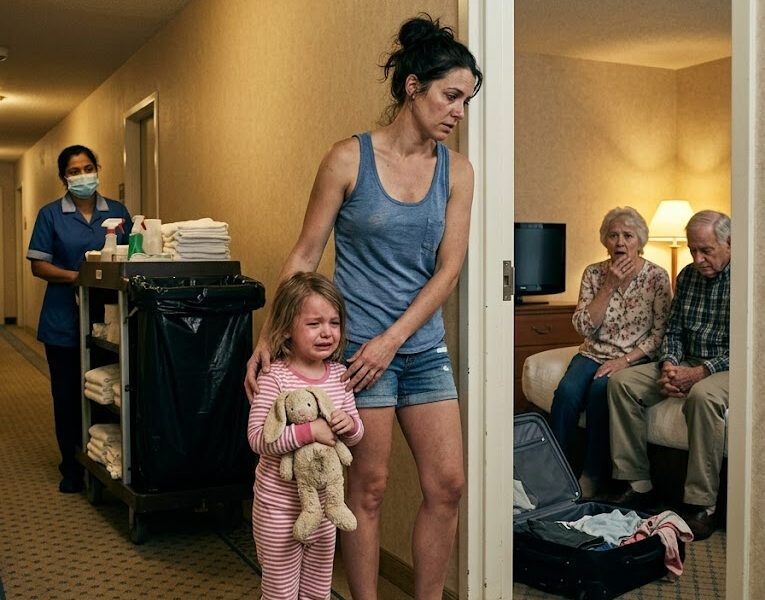
My six-year-old daughter was sitting barefoot beside a hotel ice machine when I finally found her.
Lily had pulled her knees to her chest on the patterned hallway carpet, clutching her stuffed rabbit so tightly that one floppy ear was trapped under both hands. Her pink swimsuit cover-up was twisted around her shoulders. Her cheeks were wet. Her little feet were gray with dust from walking the corridor without shoes.
When she saw me, she tried to stand and almost fell.
“Mommy,” she said, but her voice was so rough from crying that it barely sounded like her.
I reached her before I remember deciding to move. I dropped to my knees, pulled her into my arms, and felt her whole body shake against mine.
“What happened?” I whispered. “Why are you out here?”
She looked toward our hotel room door as if it might open and punish her for answering.
“Aunt Vanessa said I wasn’t allowed in.”
I carried Lily back down the hallway with my heart pounding hard enough to hurt. Our room door was closed. I used my key card and pushed it open.
Inside, the television was on. My sister Vanessa sat on one of the beds scrolling through her phone. Her two boys were stretched across the other bed eating chips. My parents were by the window, my father with his arms folded, my mother holding a plastic cup of iced tea.
No one looked surprised to see Lily in my arms.
That was the first thing that turned my fear into something colder.
“Why was my daughter in the hallway?” I asked.
Vanessa looked up slowly. “Because this room is for family only.”
The words were so blunt, so cleanly delivered, that for a second I thought I had misheard her.
“She’s six.”
“And dramatic,” Vanessa said. “Like her mother.”
Lily buried her face in my shoulder.
My father sighed the way he always did when he wanted to make my pain sound inconvenient. “Claire, don’t start. She was fine. This is a nice hotel.”
“She was alone.”
“She was outside the door,” my mother said. “Not wandering the street.”
That was their defense. A child had been locked out for hours, but at least the carpet was clean and the hallway was indoors.
I looked at each of them, waiting for one face to change. Waiting for shame. Alarm. Regret. Anything human.
Nothing came.
For years, my family had treated me as the person easiest to disappoint. I was the daughter who was too sensitive, the widow who grieved too long, the mother who worried too much. If I cried, I was unstable. If I defended myself, I was disrespectful. If I went quiet, they called it sulking.
This time, they were waiting for the same pattern.
Vanessa wanted me to yell so she could become the reasonable one.
My father wanted the scene so he could shake his head and say I was impossible.
My mother wanted me emotional enough that she could tell me to calm down.
I gave them nothing.
I carried Lily into the bathroom and shut the door. I sat her on the closed toilet lid, ran warm water over a washcloth, and cleaned the dirt from the soles of her feet. She kept her hands locked around her rabbit.
“Did I do something bad?” she whispered.
That question nearly broke me.
“No,” I said. “You did nothing wrong.”
“Aunt Vanessa said I was bothering the boys.”
“You were not.”
“Grandma heard me knocking.”
I stopped moving.
Lily looked at me with frightened honesty. “Grandpa too.”
I changed her clothes, packed our bags, and walked out of that room without another word. My mother asked if I was “really going to make everyone uncomfortable.” I kept walking.
That night, in a different hotel across town, Lily slept with every light on.
I sat beside her and made three phone calls.
The first was to the manager of the beachfront hotel. I told him everything: the fake billing problem that had pulled me downstairs, the locked door, the housekeeper who had seen Lily crying, the three hours beside the ice machine.
He checked my account while I waited.
“Mrs. Bennett,” he said slowly, “there was never a billing issue. Your card was fine. No one from this hotel asked you to come to the lobby.”
I closed my eyes.
That meant my father had not misunderstood the front desk.
He had lied.
Then the manager said something that made the room go still around me.
“We also have hallway cameras. I can preserve the footage, but you should know one detail immediately. Your daughter was not put out after you left by accident. Your father made that phone call while standing inside your room.”
Part 2
I did not sleep that night.
Lily dozed in short, frightened bursts, waking every time a door clicked somewhere down the hall. I stayed propped against the headboard with one hand on her back, staring at the small red light on the smoke detector and replaying the manager’s words.
Your father made that phone call while standing inside your room.
The cruelty was bad enough. The planning was worse.
The vacation had been my mother’s idea. Five nights in South Carolina, she said. Ocean air. Grandparents. Cousins. A chance for everyone to reconnect.
“Lily needs family,” she told me.
After my husband Daniel died in a construction accident, people said all kinds of things that sounded kind until you had to live with them. They told me I was strong. They told me time would help. They told me Lily was resilient. What they meant was that my grief was tolerable as long as it did not interrupt their comfort.
My family visited for the funeral, brought casseroles, and stayed long enough to be praised by neighbors. Then they drifted back into their usual roles.
Vanessa was the successful older daughter with the bigger house, louder opinions, and two boys my parents treated like state treasures. I was the younger daughter who had married a working man, lost him young, and now carried a sadness nobody wanted at birthdays.
Lily was welcome when she was cheerful.
When she missed her father, the room became awkward.
So I had started declining invitations. It was easier to be lonely in my own house than unwanted in someone else’s.
But that summer, my mother kept calling.
“Vanessa asks about Lily all the time,” she said.
That was not true, but I wanted it to be. I wanted Lily to have cousins on the beach, grandparents at dinner, family pictures where no one looked uncomfortable because Daniel was missing. I wanted one easy memory for my daughter.
I paid for my own room. I paid for our food. I paid for Lily’s pink swimsuit, her sunscreen, and the little blue bucket she used for shells. I rented the SUV because my father said it would be helpful if “everyone had access to one car.”
By the second day, everyone had access to it except me.
My father borrowed it for toiletries. Vanessa used it for wine. My mother needed it for snacks. Mark, Vanessa’s husband, took a rideshare to golf because, he joked, “apparently Claire’s rental has become municipal property.”
I laughed because that was easier than explaining how familiar it felt.
The afternoon Lily was locked out, she had been sun-tired and cranky. Not misbehaving. Not wild. Just six years old after too much beach and not enough rest. I brought her upstairs, opened our connecting room, and found Vanessa sitting on my bed while her boys watched cartoons.
“This room is not a daycare,” she said.
“It’s my room,” I answered.
“Mom said we could use it while housekeeping finishes ours.”
I should have told her to leave.
Instead, because Lily was exhausted and because I had been trained since childhood to reduce friction, I handed my daughter a juice box and stepped out when my father called about the supposed billing issue.
Now I knew he had made that call from inside the room.
At 7:10 the next morning, the hotel manager, Mr. Alvarez, called me back. His voice was formal now. Not unfriendly. Careful.
“I reviewed the hallway footage,” he said. “I also spoke with the housekeeper, Marisol. She reported hearing your daughter knock and cry repeatedly. She asked your sister if everything was all right. Your sister told her the child was being disciplined.”
My hand tightened around the phone.
“Disciplined for what?”
“The footage does not show any behavior from your daughter before she was removed. It does show your father placing a phone call, you leaving shortly afterward, and your sister escorting the child into the hallway less than two minutes later. Your mother and father remained in the room.”
I looked at Lily, still asleep with the lamp on.
“Can you preserve everything?”
“Already done,” he said. “Given the age of the child and the length of time involved, we are required to document this internally. I strongly recommend you file a police report.”
My second call was to the local police nonemergency line.
My third was to Mark.
He answered groggy. “Claire? What’s wrong?”
“Did you know your wife locked Lily out of my hotel room for three hours?”
Silence.
Then he said, very quietly, “Tell me everything.”
Part 3
Mark arrived at my new hotel before lunch.
He looked like a man who had dressed in a hurry and driven angry. His hair was still damp from a rushed shower. His golf shirt was wrinkled. When he saw Lily sitting beside me in the lobby with her rabbit in her lap and shoes firmly on both feet, his face changed.
“Hey, sweetheart,” he said gently, crouching several feet away. “I’m sorry.”
Lily leaned into my side.
He did not move closer. That mattered.
I handed him the written summary I had made before he arrived. Times. Names. Room numbers. The manager’s statement. Marisol’s name. The fact that my father had lied to get me downstairs.
Mark read it twice.
“Vanessa told me you left Lily with her and disappeared for the afternoon,” he said.
I felt the old anger rise, but I kept my voice level. “Of course she did.”
“She said Lily threw a tantrum and wanted to sit outside.”
“Lily is six.”
He looked toward the elevators. “Where are your parents?”
“Still at the other hotel.”
Mark stood. “Not for long.”
I almost told him not to go. Not because Vanessa deserved protection, but because I knew how my family worked. The first person to introduce facts became the person accused of attacking everyone. But Mark was not me. He had not been raised inside that pattern.
By three o’clock, the consequences began arriving.
The hotel removed Vanessa, my parents, and the boys from the property. Not dramatically. No handcuffs. No shouting in the lobby. Mr. Alvarez simply informed them that, due to a documented child safety incident and guest misconduct, their reservation was terminated. They had one hour to collect their belongings.
My father tried to argue.
The manager handed him a printed timeline and asked whether he wanted to discuss it with the responding officer present.
My father stopped arguing.
Vanessa called me twenty-seven times in one hour. I did not answer. Then came the family group chat.
Mom: Claire, this has gone far enough.
Dad: You embarrassed this whole family.
Vanessa: You are weaponizing your child because you hate that my boys have a father.
That one made my vision blur.
Mark replied before I could.
Mark: Do not use Daniel’s death to excuse what you did. I have seen the hotel report. I am taking the boys home.
The chat went silent for almost five full minutes.
Then my mother called.
I answered because some part of me still wanted to hear one sentence that sounded like remorse.
“Claire,” she said, “I know you’re upset, but involving police over a family misunderstanding is extreme.”
“What part was misunderstood?”
“Vanessa needed a break.”
“From my child?”
“From the tension you bring everywhere.”
There it was. The real complaint. Not that Lily was unsafe. Not that Vanessa had been cruel. The problem was that my pain had once again made the room less pleasant.
“Mom,” I said, “Lily sat barefoot in a hallway for three hours while you listened.”
“She was never in danger.”
“You don’t know that.”
“You’re being dramatic.”
I looked across the room at Lily, coloring at the small hotel desk. She had drawn a rectangle with a tiny person outside it. The person had yellow hair like hers.
“No,” I said. “I’m being accurate.”
My mother lowered her voice. “If you keep this up, you will destroy your sister’s marriage.”
“Vanessa did that when she locked a child out and lied about it.”
“Family doesn’t call police on family.”
That sentence landed exactly where Vanessa’s had.
Family only.
I finally understood the rule. Family meant protection for them, obligation for me, and nothing at all for Lily unless she was convenient.
“Then I guess we define family differently,” I said.
I hung up.
The police report did not lead to an arrest. It did create a record. The officer took my statement, Lily’s brief statement with a child advocate present, and the hotel manager’s preserved footage. He told me that leaving a young child unattended in a public hotel hallway for hours was not a harmless family dispute.
It was neglect.
Hearing that word from someone outside my family felt strange.
Not satisfying. Not triumphant.
Clarifying.
Part 4
We drove home two days early.
Lily slept most of the way, one hand resting on her rabbit and the other wrapped around two seashells she refused to pack. Every time we stopped for gas, she asked if I was coming back before I even opened the car door.
“Always,” I told her.
I said it every time, even when my throat hurt.
Back home in North Carolina, I made appointments. Pediatrician. Child therapist. My own counselor, whom I had stopped seeing six months after Daniel died because my mother said therapy was making me “too focused on myself.”
That sentence embarrassed me now. Not because I had believed her, but because I had obeyed.
Three days after the hotel removed my family, an envelope arrived by email from Mr. Alvarez. It contained the incident report, the room termination notice, and a letter confirming that Vanessa and my parents were banned from that hotel chain pending corporate review.
There was also a short statement from Marisol, the housekeeper.
The child knocked many times. She asked for her mother. The adult woman inside told me the child was learning a lesson. The grandparents were visible in the room.
I read that line until the words blurred.
Learning a lesson.
That weekend, my parents demanded a meeting.
I almost refused. Then Mark called and said he planned to attend because Vanessa was telling people I had abandoned Lily and staged the hallway story to punish the family.
“I don’t need you to defend me,” I told him.
“I know,” he said. “I’m coming because my sons need to see at least one adult tell the truth.”
We met at my parents’ house on Sunday afternoon. I brought Lily to my neighbor’s home first, where she baked cookies and watched movies under the supervision of a woman who had never once claimed blood was required for kindness.
When I arrived, Vanessa was already crying.
That used to work on me. Her tears always arrived before accountability. My parents would rush to soothe her, and whatever she had done would become secondary to how badly she felt about being questioned.
Not this time.
Mark sat apart from her. My parents sat together on the couch, presenting a united front. My father looked stern. My mother looked wounded. Vanessa looked betrayed.
“I hope you’re happy,” my sister said.
“I’m not.”
“My boys are confused. Mark took them home because of you.”
Mark leaned forward. “I took them home because of you.”
Vanessa turned on him. “She left Lily with me without asking.”
“For a few minutes,” I said. “Because Dad called me downstairs.”
My father shifted.
I placed the hotel timeline on the coffee table.
“There was no billing problem. The hotel confirmed it. The footage shows Dad making the call from inside the room.”
My mother’s face tightened. “Your father was trying to prevent a scene.”
“What scene?”
No one answered.
I looked at Vanessa.
“What did you ask him to do?”
Her eyes flashed. For the first time, the tears stopped.
“I said I needed five minutes without your kid whining,” she snapped. “Mom said Lily was too clingy. Dad said he’d get you downstairs. Nobody told Lily to sit there for three hours.”
“You locked the door.”
“She kept knocking.”
“Because she was scared.”
Vanessa’s voice rose. “My boys shouldn’t have to deal with your tragedy every vacation. Everything is always about Daniel being dead and poor Lily not having a father.”
The room went completely still.
My mother closed her eyes, not because Vanessa had said something cruel, but because she had said it too plainly. My father stared at the carpet. For the first time, I understood that they had not failed to see the damage. They had simply preferred the version of our family where I carried it quietly.
Mark stood up.
“We’re done,” he said.
Vanessa stared at him. “Excuse me?”
“You don’t get unsupervised time with my boys until we speak with a counselor.”
My mother gasped. “Mark, don’t let Claire poison you.”
He looked at her. “Claire didn’t make Vanessa cruel. She documented it.”
My father pointed at me. “You brought papers into a family conversation.”
“No,” I said. “I brought facts into a room where feelings have been used as weapons for too long.”
For once, nobody had an answer ready.
Part 5
The fallout was not instant, but it was steady.
Mark moved into the guest room while he and Vanessa began counseling. My parents blamed me for that. They blamed me when the hotel chain upheld the ban. They blamed me when relatives stopped asking for Vanessa’s version after Mark quietly sent them the documented timeline.
For a while, my phone filled with messages.
Mom: You are breaking this family.
Dad: You have always needed attention.
Vanessa: I hope you’re proud of yourself.
I saved every message and answered none of them.
Lily started therapy the following week. At first she drew doors. Closed doors. Tall doors. Doors with tiny people outside. Her therapist told me not to rush her past the image. Children often draw what they cannot yet say.
So I bought more crayons.
At home, I changed small things. I put a night-light in the hallway. I told Lily every time I left a room and every time I came back. I stopped saying, “It’s okay,” when it wasn’t. Instead, I said, “You are safe now.”
One evening, about a month after the trip, Lily climbed onto the couch beside me.
“Mommy?”
“Yes, baby.”
“Am I family?”
I had prepared myself for nightmares, tears, anger, fear of hotels, fear of hallways. Somehow I had not prepared for that.
I pulled her into my lap.
“You are my family,” I said. “You are not outside of anything that matters.”
“Grandma said family forgives.”
I closed my eyes for one second.
“Forgiveness does not mean letting someone hurt you again.”
She thought about that with the seriousness only children can bring to a sentence.
“So Aunt Vanessa can’t lock me out anymore?”
“No,” I said. “Never again.”
By fall, Lily’s drawings changed. The doors opened. The little yellow-haired person moved inside the house. Sometimes another person stood beside her, taller, with brown hair like mine. Sometimes she drew Daniel in the sky, not as a sad thing, but as a bright yellow circle watching over us.
My parents came by once.
They did not call first. They simply appeared on my porch with my mother’s banana bread and my father’s offended posture. I opened the door but left the storm door locked.
“We want to see Lily,” my mother said.
“That won’t happen today.”
My father frowned. “Claire, enough. We are her grandparents.”
“Then you should have acted like it.”
My mother’s eyes filled with tears. “Are you really going to keep punishing us?”
“No,” I said. “I’m going to keep protecting her.”
My father looked past me into the house. “Lily! Grandpa’s here!”
I closed the main door.
My hands shook afterward, but I did it.
The next summer, Lily and I went back to the ocean. Not with my parents. Not with Vanessa. We went with my neighbor Mrs. Lawson, her granddaughter Emma, and two folding chairs that sank into the sand no matter how carefully we placed them.
We stayed at a small motel with blue doors and no connecting rooms.
On the first night, Lily checked the lock three times. I let her. Then she placed her stuffed rabbit on the pillow, looked at me, and asked, “Can we leave the bathroom light on?”
“Of course.”
The next morning, she ran toward the water with Emma, laughing so hard she dropped her shell bucket. I watched from the shoreline while the tide curled around her ankles.
My phone buzzed in my beach bag.
A message from my mother.
Family should be together in summer.
I looked at Lily in her pink swimsuit, whole and bright under the sun. Then I typed back one sentence.
Family does not leave children outside locked doors.
I blocked the number.
Lily waved from the edge of the water.
“Mommy! Come see this shell!”
I put the phone away and walked toward my daughter.
For years, I had mistaken silence for peace. I had let my family define love as endurance, loyalty as obedience, and forgiveness as pretending the harm had not happened.
That ended in a hotel hallway beside an ice machine, with my child’s bare feet on dirty carpet and her small voice asking if she had done something wrong.
She had done nothing wrong.
And neither had I when I finally stopped opening doors for people who only knew how to shut them.
THE END
Disclaimer: This content is entirely AI-generated for fictional and entertainment purposes only. Any resemblance to actual persons, living or dead, events, or locations is purely coincidental, and the creator assumes no liability for any interpretation of this content.
Disclaimer: This story is fictional and created for entertainment purposes only. Any names, characters, places, or events are fictitious or used fictitiously. No real person or organization is intended to be portrayed.

