But there is one massive thing they did not know.Over the next four years, I did not just survive the poverty they forced upon me.
I secured the most exclusive, prestigious academic scholarship in the entire nation. A secret weapon that allowed me to transfer directly into my brother’s elite university for my senior year.
And right now, on graduation day, my parents are sitting in the VIP front row with their expensive cameras, waiting for Julian.
Instead, they are about to watch the dean of the university call my name as the valedictorian.
Before I tell you exactly how the look of pure, unadulterated horror washed over their faces, please take a second to hit that like button if you believe that hard work always beats toxic family favoritism.
And do not forget to let me know in the comments exactly where you are watching from today.
Now let us go back to where this nightmare actually began.
Graduation day was a morning I will absolutely never forget.
The sky over the campus was a perfect, crisp, mocking shade of blue. The massive university stadium was packed to the absolute brim with over 3,000 proud parents, grandparents, siblings, and alumni.
The air was thick with the overwhelming scent of expensive designer perfumes, fresh imported floral bouquets, and the undeniable aura of generational wealth.
I was standing backstage, hidden in the holding area, strictly reserved for the highest academic honor students.
I wore the standard black graduation gown, but draped heavily across my shoulders was the thick, braided gold sash of the valedictorian.
Pinned directly over my heart was the heavy bronze medallion of the Whitfield Scholarship. A piece of metal that represented tears, starvation, and ultimate victory.
I pushed the heavy velvet curtain aside just an inch to peer out into the stadium.
The seating arrangement was designed to highlight the donors and the elite.
I found them almost instantly.
My father, Richard, was sitting dead center in the VIP section. He was wearing his custom-tailored navy suit, the exact same suit he always wore to high-stakes commercial real estate closings or aggressive meetings with his corporate lawyer.
My mother, Eleanor, was sitting right next to him. She was wearing a pristine cream-colored designer dress and clutching a massive, ridiculous bouquet of white roses in her lap.
Between them sat a single empty chair, likely meant for their coats or expensive bags.
It was certainly not a seat saved for me.
It was never for me.
They looked incredibly smug.
My father was leaning over, talking animatedly to a wealthy-looking man sitting to his left, probably bragging about Julian’s incredible starting salary prospects, his vast network, and the corporate kingdom he was about to inherit.
My mother was smiling, waving gracefully at some acquaintance a few rows back.
They were completely and utterly oblivious.
They did not even know I was in the same state, let alone standing 20 ft away from them, preparing to completely dismantle their perfect reality.
I watched my father fiddle with his camera.
He was adjusting the massive telephoto lens, aiming it toward the general graduate seating area on the field, searching for Julian.
Julian, who was probably sitting with his fraternity brothers, nursing a hangover, and entirely unconcerned about his future because he had a massive safety net waiting for him.
My father had literally invested over a quarter of a million dollars into Julian’s Whitmore education.
He bought him a brand-new luxury SUV when he turned 18. He paid the rent for Julian’s massive off-campus apartment. He funded extravagant ski trips and summer vacations across Europe.
And in less than 15 minutes, my father was going to face the brutal reality that his ultimate golden investment had yielded absolutely nothing of true value.
The most bizarre part of that moment was my own heart rate.
I placed my hand against my chest and felt nothing but a steady, calm rhythm.
For years, I had fantasized about this exact day. I had dreamed of revenge. I had imagined screaming at them, throwing my success in their faces, and demanding an apology for the years of neglect.
But standing in the shadows of that stage, feeling the physical weight of my achievements on my shoulders, the burning anger was entirely gone.
It had burned itself out long ago, replaced by a cold, impenetrable armor.
I realized I did not need their validation anymore.
I did not need my father to look at me with pride.
I just wanted them to see the unvarnished truth.
But to truly understand the sheer magnitude of the silence that would soon fall over my family, we have to rewind the clock.
We have to go back four grueling years to the summer of 2021.
Because the real tragedy was not simply that my parents refused to write a check for my tuition.
It was the calculated cruelty of how they executed their decision and the sickening family secrets I uncovered the very same night I was thrown out of my childhood home like yesterday’s trash.
Growing up in our household was like living in a constant corporate performance review where the rules were rigged from the start.
Julian and I were fraternal twins, but the moment we developed distinct personalities, the silent sorting process began.
Julian was loud, charming, and naturally athletic.
He knew exactly what to say to make adults laugh.
In a normal family, these differences would be celebrated.
In my father’s house, they were metrics.
My father viewed parenting through the cold, unforgiving lens of business.
Everything was about the return on investment.
If you did not bring immediate visible prestige to the family name, you were a liability.
By the time we reached high school, the divide was a canyon.
Julian received private tutoring for his SATs, expensive golf lessons to prepare him for country club networking, and an endless stream of cash.
I was handed his hand-me-down clothes, a laptop with a broken screen that overheated every 30 minutes, and a constant barrage of subtle insults about my lack of aggressive ambition.
When I asked my mother why things were so different, she would always use the same tired excuse.
She would tell me that I was imagining things, that Julian just required more resources to shine, and that I was naturally independent.
It was a massive lie, a convenient narrative to cover up their blatant favoritism.
And that lie finally culminated in the most devastating conversation of my life, a conversation that completely shattered my concept of family.
The acceptance letters arrived on a warm Tuesday afternoon in April.
For months, the tension in our house had been thick enough to cut with a knife.
Julian and I had both applied to several universities.
When the mail carrier dropped the envelopes into the box, my heart hammered in my chest.
Julian ripped his open first.
He had been accepted into Whitmore University, a prestigious private powerhouse of a school that catered almost exclusively to the ultra-wealthy.
The annual tuition, room, and board came to a staggering $65,000.
I opened my letter a moment later.
I had been accepted into Eastbrook State.
It was a highly respected public university, known for its rigorous academics, but lacking the country club prestige of Whitmore.
My tuition would be about $25,000 a year.
It was expensive but manageable, or so I thought.
That evening, my father summoned us to the living room for a family meeting.
He settled into his large leather armchair, steepling his fingers.
He did not look like a father about to celebrate his son’s academic achievements.
He looked like a chief executive officer preparing to lay off half his workforce.
My mother sat stiffly on the sofa, her hands clasped tightly in her lap, staring blankly at the coffee table.
Julian leaned casually against the fireplace mantle, tapping a rhythm on his phone screen, looking entirely unbothered.
I sat on the edge of a chair, clutching my Eastbrook acceptance letter like a lifeline.
“We need to discuss the financial reality of the next four years,” my father began, his voice deep and authoritative.
“Julian, your mother and I have reviewed the numbers. We have decided to fully fund your education at Whitmore. We will cover the tuition, the housing, the meal plans, and provide a generous monthly allowance. You have immense leadership potential. You understand how to network. Whitmore is an investment. You will build connections there that will secure this family status for decades. It is a strategic move.”
Julian barely looked up from his screen. He gave a half shrug.
“Thanks, Dad. That is awesome.”
Then my father slowly turned his head to look directly at me.
The temperature in the room seemed to drop 10°.
“Arthur,” he said, his tone entirely devoid of warmth. “Your mother and I have decided not to fund your education. We will not be contributing a single cent.”
I froze.
The words echoed in my ears, but my brain refused to process the meaning.
I looked from my father to my mother.
“What do you mean? Eastbrook is a third of the price of Whitmore. I have already saved up over $2,000 from my summer job working at the hardware store. I just need some help bridging the gap so I do not have to take out massive loans.”
My father let out a short, harsh sigh, as if my lack of understanding was a personal insult to his intelligence.
“It is not about the cost, Arthur. It is about the return on investment. You are a smart boy, but you are not exceptional. You do not command a room. You are too quiet, too internal. Spending money on your college education is throwing good money after bad. There is no tangible return on investment with you. We are not running a charity. You will just have to figure it out yourself. Get a job. Take out loans. Struggle builds character.”
I felt physically sick.
The sheer cruelty of his words hit me like a physical blow.
He was not just refusing to pay for school.
He was explicitly telling me that I was inherently worthless.
I looked desperately at my mother.
I prayed she would intervene, that she would show a shred of maternal instinct.
“Mom,” I whispered.
She refused to meet my eyes.
She stared intensely at her hands.
“Your father is right, Arthur. We have to be practical. We cannot jeopardize Julian’s trajectory. You are resourceful. You will manage.”
Julian smirked, slipped his phone into his pocket, and walked out of the room without saying a single word.
He did not care.
He had his prize.
I did not argue.
I did not cry.
I stood up, walked to my bedroom, and began throwing my belongings into trash bags.
I could not spend another night under that roof.
I was suffocating.
I needed to get out.
As I carried my second bag down the dark hallway toward the front door, I stopped.
The door to my parents’ master bedroom was cracked open just an inch.
A sliver of light spilled out onto the hardwood floor.
I heard my mother’s voice.
She was on the phone.
I recognized the shrill, demanding tone coming through the speaker immediately.
It was my aunt Beatatrice.
Aunt Beatatrice was my mother’s older sister.
She was a bitter, deeply toxic woman who had recently finalized a vicious divorce.
She had walked away with a massive real estate settlement, sole custody of her bank accounts, and a severe superiority complex.
For reasons I never understood, she absolutely idolized Julian and openly despised me.
“I know it sounded harsh, Beatatrice,” my mother was whispering into the phone. “But Richard insisted on ripping the bandage off. And to be completely honest, I think you were right.”“Of course, I was right, Eleanor,” Aunt Beatatrice snapped through the speaker. “You cannot let guilt ruin your financial planning. If you split the college fund, Julian might not have enough liquidity to really thrive in that elite environment. He needs the right clothes, the right car, the right fraternity dues. Julian is the one who will eventually take care of you and Richard. He has the killer instinct. Arthur is just too soft. He is a drain on your resources. You have to back the winning horse. Cutting Arthur loose now saves you a lifetime of supporting his mediocre lifestyle.”
I stood frozen in the hallway, my chest tightened until I could barely draw a breath.
This was not just my father’s toxic business mindset at work.
My mother was fully complicit.
And behind it all, Aunt Beatatrice was acting as the unseen architect of my ruin, manipulating my parents into abandoning me to secure Julian’s throne.
They had literally held a covert committee meeting to evaluate my human worth, and they had officially priced me at zero.
I walked out the front door and never looked back.
I moved to the town where Eastbrook State was located 3 months before the fall semester began.
I found a tiny, dilapidated room in a run-down house shared with four other guys.
The walls were paper thin, the plumbing was a constant nightmare, and the rent was $300 a month.
One of my roommates was a guy named Marcus.
He was an engineering major, working full-time at a warehouse and surviving on cheap coffee and sheer stubbornness.
We bonded instantly over our mutual absolute lack of a safety net.
My freshman year was a master class in brutal survival.
I refused to take out a massive lawsuit-level pile of student loans that would trap me for decades.
Instead, I designed a schedule that left me constantly teetering on the edge of physical collapse.
I woke up at 4 in the morning to open a local diner.
The manager, a woman named Sarah, quickly realized I desperately needed the job and exploited me relentlessly.
She gave me the worst shifts, forced me to scrub grease traps, and constantly threatened to fire me over minor infractions.
I smelled like stale fryer oil constantly.
After my shift, I rushed to campus for classes from 9 until 3.
Then I worked a second job as a janitor in the university library.
I studied until midnight, slept for 4 hours, and repeated the cycle.
I missed every single college experience.
There were no football games, no frat parties, no late-night pizza runs.
I wore clothes from thrift stores until they literally fell apart.
I ate instant ramen until the sodium made my joints ache.
There were days when the exhaustion was so profound I hallucinated.
I would lean against a mop handle in the library and fall asleep standing up.
But every single time I thought about quitting, every time I considered calling my parents to beg for a loan, I heard my father’s voice echoing in my skull.
There is no return on investment with you.
That insult became my ultimate fuel.
The absolute breaking point, the moment the final fraying thread connecting me to my family snapped entirely, happened on Thanksgiving day of my freshman year.
I obviously could not afford the travel expenses to go home.
Nor was I invited.
I was sitting on my bare mattress on the floor of my freezing room, eating a cold turkey sandwich I bought from a gas station.
In a moment of pathetic weakness, a desperate urge to hear my mother’s voice, I dialed their home number.
My mother answered on the third ring.
“Hello, Arthur.”
“Hi.”
Her voice was completely flat, laced with a heavy dose of annoyance.
“Happy Thanksgiving, Mom. Is Dad around?” I asked, my voice cracking slightly.
I heard her cover the receiver with her hand, but it did not muffle the sound enough.
My father’s booming voice carried perfectly through the line.
“Tell him I am busy carving the turkey. I do not have time for a guilt trip today. I am not sending him any money.”
My mother returned to the line, her tone artificially bright and overly cheerful.
“Your father is just completely tied up right now, sweetie. And Julian brought his new girlfriend home, so it is just incredibly chaotic here. The house is full of guests. We love you. Have a good day. Bye.”
The line went dead.
I sat there staring at the cracked screen of my phone.
Ten minutes later, I opened social media.
Julian had just posted a new photo.
It was a perfectly staged, professional-looking shot of the dining room.
Crystal wine glasses caught the light. A massive, perfectly roasted turkey sat in the center of the table.
There was my father smiling proudly, my mother looking radiant, Julian and a stunning blonde girl laughing at something he said.
I zoomed in on the table.
I counted the chairs.
There were exactly four chairs.
Four place settings.
Four plates.
They had not even bothered to set an empty plate for me.
I did not exist in their world.
I was a ghost they had successfully exorcised.
I closed the laptop.
The deep, agonizing ache in my chest that I had carried for months suddenly vanished.
In its place, a profound, chilling emptiness settled over me.
I realized in that freezing room that I was an orphan with living parents.
And from that exact second forward, Arthur, the neglected, desperate son, died.
Arthur, the relentless survivor, took complete control.
When sophomore year began, the dynamic of my life shifted from pure physical survival to aggressive academic warfare.
I was enrolled in advanced microeconomics taught by Dr. Margaret Sterling.
Dr. Sterling was an absolute legend on the Eastbrook campus.
She was brilliant, utterly unforgiving, and had a terrifying reputation for failing half her class just to weed out the weak.
Students whispered about her in the hallways like she was a monster.
I did not care.
I needed her class for my degree, and I needed an A.
I sat dead center in the front row, recorded every lecture, took relentless notes, and treated her syllabus like it was a binding legal contract.
Our first major assignment was a massive term paper analyzing resource allocation in impoverished demographics.
I poured 70 hours of research into it.
When she handed the graded papers back at the end of a grueling 2-hour lecture, I flipped to the last page, bracing myself for a B-minus.
Staring back at me in bold, thick red ink was an A+.
Right beneath the grade was a handwritten note.
See me in my office immediately.
My heart hammered frantically against my ribs as I walked into the economics faculty wing.
I knocked on her door.
Dr. Sterling was sitting behind a massive, imposing oak desk surrounded by towering stacks of academic journals.
She peered over the rim of her reading glasses.
“Arthur,” she said, her voice sharp and piercing. “Close the door. Sit down.”
I sat rigidly in the leather chair opposite her.
“This term paper,” she began, tapping the document with her pen, “is master’s level analytical work. The depth of your understanding regarding systemic resource scarcity is extraordinary for a 20-year-old. Where exactly did you learn to evaluate human capital and resource allocation with such brutal precision?”
I swallowed hard, looking at the floor.
“I just look at things in terms of pure survival, Professor. When you do not have a financial safety net, when you are one missed paycheck away from eviction, you learn exactly what every single resource is worth. You calculate the cost of everything.”
Dr. Sterling studied my face for a long, uncomfortable minute.
It felt as though she was looking straight through my cheap, faded thrift store shirt and seeing the deep structural exhaustion anchored in my bones.
“Tell me your story, Arthur,” she demanded.
Her tone was no longer sharp.
It was an undeniable command.
And for the very first time in my life, I told someone the complete, unvarnished truth.
I told her about the family meeting.
I told her about the phrase return on investment.
I told her about Aunt Beatatrice’s manipulation.
I told her about the diner, the grease traps, the 4 hours of sleep, and the Thanksgiving photo with only four chairs.
When I finally stopped talking, the office was dead silent.
Dr. Sterling did not offer me meaningless pity.
She did not give me a sympathetic hug.
Instead, she offered me a weapon.
“Arthur, have you ever heard of the Whitfield Scholarship?” she asked, leaning forward.
I shook my head.
She explained that it was an incredibly exclusive, highly funded national foundation.
It was the academic equivalent of winning the lottery.
They selected only 20 university students nationwide each year.
The scholarship paid full tuition at any university in the country, provided a massive $10,000 annual living stipend, and guaranteed elite corporate internships at top-tier financial firms.
It required a direct nomination from a senior faculty member, a massive portfolio of academic work, and a deeply personal, rigorous essay regarding how you have overcome systemic barriers.
“I am officially nominating you,” she said, her eyes locked onto mine. “You have a mind that belongs at the absolute top of the financial sector. Do not let small-minded, arrogant people keep you in the dirt.”
I threw myself into the Whitfield application process like a man fighting for his last breath.
I spent weeks drafting and refining my personal essay.
The prompt demanded an exploration of defining your own intrinsic value against external metrics.
I poured my soul onto those pages.
I wrote about my father’s corporate parenting style.
I wrote about the Thanksgiving photo.
I wrote about redefining my worth when my own blood had priced me at zero.
But during this intense period of preparation, I made a massive, almost fatal mistake.
Because I was taking advanced finance classes, I was forced to join a mandatory study group.
There was a girl in my group named Chloe.
Chloe came from a very prominent, wealthy local family.
She drove a brand-new Porsche, carried a different designer handbag every week, and acted like she was everyone’s best friend.
One late night at the university library, I was completely exhausted, my guard was down, and I was stressing over the final edits of my Whitfield essay.
Chloe noticed.
“Oh my gosh, Arthur, you are applying for the Whitfield, too?” she asked, her eyes widening with faux excitement. “That is so crazy. We should totally peer-review each other’s essays. It is so insanely competitive. We really need all the help we can get to stand out.”
Like an absolute naive idiot, I trusted her.
I thought we were comrades in the academic trenches.
I emailed her a draft of my deeply personal essay.
Two days later, she casually mentioned that my essay was pretty good, but maybe a little too depressing and dark for a scholarship board.
A week before the national submission deadline, Dr. Sterling called me into her office.
I walked in expecting to discuss final edits.
Instead, I found her looking absolutely furious.
The temperature in the room was glacial.
My stomach immediately dropped.
“Arthur,” she said coldly, sliding a freshly printed document across her massive desk. “Can you please explain to me why a student named Chloe just submitted an essay to the National Foundation portal that contains three completely identical paragraphs to the draft we reviewed together last week? She submitted her final application 2 days ago. Yours is not in the system yet. If you submit your essay now, the National Plagiarism Software will automatically flag you as the thief, and you will be blacklisted.”
The room spun violently.
Chloe had stolen my trauma.
She had stolen my pain, my deeply personal story about my father’s rejection, and actively tried to pass it off as a metaphor for some fabricated hardship in her own privileged life.
She knew I was just a poor kid working at a local diner.
She figured I would not have the power, the resources, or the courage to fight back against a girl with a wealthy lawyer father.
“I did not copy her, Dr. Sterling,” I said, my voice shaking with an absolute white-hot rage. “She offered to peer-review it. I sent her the file. She stole my life.”
Dr. Sterling leaned back in her chair.
Slowly, a terrifying, predatory smile spread across her face.
“I know you didn’t, Arthur. Her previous academic record is mediocre at best. She entirely lacks the intellectual depth and the emotional vocabulary to write this piece. But more importantly, she made a fatal, arrogant error.”
Dr. Sterling tapped the paper with a manicured fingernail.
“She did not bother to research the foundation board. She did not know that I sit on the regional screening committee for the Whitfield Foundation. I have already contacted the dean of academic integrity with the timestamp drafts you emailed me weeks ago. Chloe’s application has been permanently disqualified and she is currently facing immediate expulsion for severe academic fraud. Submit your final draft tonight.”
I felt a rush of vindication so powerful it made me dizzy.
I submitted the essay.
Two agonizing months later, the email arrived.
I was a national finalist, but there was a massive, seemingly insurmountable hurdle.
The final round required an intense in-person panel interview at the foundation’s headquarters in New York City.
It was a Tuesday afternoon.
The interview was scheduled for Friday morning.
I checked my bank account.
I had exactly $42.16 to my name.
My rent was due in 3 days.
A last-minute flight to New York was hundreds of dollars.
Even a cheap roach-infested hotel was financially impossible.
I was completely trapped.
My father’s strategy of financial starvation was finally, ultimately going to work.
I sat on the floor of my grimy apartment, holding my head in my hands, completely and utterly defeated.
I was ready to draft an email withdrawing my application.
That is exactly when Marcus walked in.
He took one look at my face and demanded to know what was wrong.
I explained the situation, my voice dead and hollow.
Marcus did not say a single word.
He turned around, walked into his bedroom, rummaged under his bed for a moment, and came back out holding an old, battered cigar box.
He opened it and dumped a pile of crumpled 20 and $50 bills directly onto my lap.
“This is my entire emergency fund,” Marcus said fiercely, glaring at me. “It is about 400 bucks. Take it. Buy a bus ticket. Sleep on the bus. Shower at a truck stop sink. Do whatever you strictly have to do. But you are not letting those rich snobs win. You are not giving up.”
“Marcus, I cannot take this,” I choked out, tears threatening to spill. “What if you need a lawyer or your car breaks down or you have a medical emergency?”
“If you do not take this money right now, I will literally beat you up,” Marcus said, shoving the cash aggressively into my chest. “You are going to New York, and when you get that fancy corporate promotion and make your first million, you can buy me a massive steak.”
That night, I boarded an overnight Greyhound bus to Manhattan.
I was wearing a slightly oversized suit I had purchased at a Goodwill for $12.
I did not sleep a single minute on that 8-hour bus ride.
I just stared out the window into the pitch-black darkness, practicing my interview answers, repeating Dr. Sterling’s words in my head like a mantra.
I was going to war, and I was not coming back empty-handed.
The interview panel in New York City was designed to be terrifying.
I was led into a massive glass-walled boardroom on the 50th floor of a skyscraper overlooking the Manhattan skyline.
Five incredibly wealthy, powerful board members sat across a long mahogany table, grilling me relentlessly for an hour.
But I did not flinch when they asked me about my background.
I did not try to hide the diner, the overnight bus ride, or my father’s absolute rejection.
I owned every single piece of it.
I looked them in the eyes and told them that adversity was not a sob story.
It was the ultimate, unfiltered training ground for financial resilience.
I explained that a man who knows how to stretch $40 across two weeks knows how to manage a corporate budget better than a kid who was handed a platinum credit card at 16.
Three weeks later, I was back in the grimy kitchen of the diner, elbow-deep in hot soapy water, aggressively scrubbing the grease traps.
My cheap phone buzzed in my apron pocket.
I wiped my hands on a dirty towel and opened the email.
Dear Arthur, the Whitfield Foundation is incredibly honored to welcome you as one of this year’s 20 national scholars.
I dropped my phone.
It clattered against the tile floor.
I sank to my knees right there in the middle of the kitchen, surrounded by the smell of fried food and bleach.
And for the first time in three brutal years, I cried.
It was not a quiet cry.
My shoulders shook.
It was a full-ride scholarship.
It was an incredible $10,000 living stipend.
It was absolute, undeniable freedom.
But there was a crucial, life-altering stipulation hidden in the Whitfield contract.
To maximize the networking opportunities and corporate exposure, scholars currently attending state universities were highly encouraged, practically mandated, to transfer to one of the foundation’s elite partner schools for their final two years.
I pulled up the list of partner schools on my cracked laptop screen, and right there, sitting near the top of the alphabetical list, was Whitmore University.
Julian’s school.
The school my father gladly paid 65 grand a year for.
The school I was deemed not special enough to attend.
I printed the transfer papers and signed them that exact same afternoon.
I moved to the Whitmore campus for my junior and senior years.
I lived in a beautiful, quiet campus apartment fully paid for by the foundation.
I bought a decent, functioning laptop.
I finally quit the diner.
I threw myself into my advanced finance studies with a terrifying, singular intensity.
I maintained a flawless 4.0 GPA.
I secured a summer internship at a top-tier firm.
And most importantly, I kept my presence completely, absolutely secret from my family.
I deleted all my social media accounts.
I became a ghost, silently haunting the edges of their pristine, wealthy reality.
It was not until the spring semester of my senior year that the inevitable collision finally happened.
I was sitting in a secluded corner of the main campus library, deeply engrossed in a massive legal brief on corporate restructuring, when a familiar voice behind me said, “Arthur.”
I did not flinch.
I did not gasp.
I slowly closed my heavy textbook and turned around.
It was Julian.
He looked absolutely terrible.
He had dark, heavy circles under his eyes.
His expensive designer cashmere sweater looked stained and wrinkled, and he smelled faintly of stale beer and desperation.
He stared at me as if I were a terrifying hallucination.
“What? What are you doing here? Are you visiting someone? Did Dad finally crack and cut you a check?”
I stood up slowly.
I was suddenly acutely aware that I was taller than him, broader than him.
The years of carrying heavy trays, scrubbing floors, and surviving on adrenaline had built a physical resilience in me that he completely lacked.
He looked soft.
“I go to school here, Julian,” I said, my voice completely calm and deadpan. “I have been a student here for two entire years.”
His jaw literally dropped open.
“That is impossible. Dad told everyone you were flipping burgers at some state school. How in the world are you paying for Whitmore tuition?”
“I earned a highly competitive national scholarship,” I said, stepping slightly closer to him. “It is something you would not understand because it requires actual work. Now listen to me very carefully. You are not going to tell Richard or Eleanor that I am here. You are going to keep your mouth completely shut. If you say a single word to them, I will personally ensure the university administration takes a very close, uncomfortable look at your attendance records, which my sources tell me are absolutely abysmal.”
Julian physically backed away from me, looking genuinely unnerved by the coldness in my eyes.
He nodded quickly, swallowed hard, and basically ran out of the library.
I knew he would not say a word to my parents.
He was far too cowardly to disrupt the status quo, and he knew I had leverage.
The weeks leading up to graduation were a blur of intense preparation.
Because of my perfect GPA, my published research papers, and the immense prestige of the Whitfield Scholarship, I was officially named valedictorian of the Whitmore graduating class.
I was asked by the dean to deliver the keynote address to thousands of people.
I accepted immediately, which brings us right back to that perfect, crisp morning.
Graduation day.
Before I walked out to take my assigned seat on the stage, I had to walk through the main outdoor concourse to grab a bottle of water.
The concourse was packed shoulder-to-shoulder with milling families.
I kept my head down, carefully hiding the gold valedictorian sash under my arm.
Suddenly, cutting through the noise of the crowd, I heard that familiar, booming, arrogant voice.
My father.
I quickly ducked behind a massive marble pillar.
Richard and Eleanor were standing barely 10 ft away, chatting animatedly with an older, wealthy-looking couple.
I recognized the man instantly from local business magazines.
He was a massive commercial real estate developer my father had been desperately trying to court for years.
“So, Richard, Julian is graduating with high honors today, I assume,” the developer asked, taking a sip from his coffee cup.
My father laughed heartily.
A booming fake sound.
“Of course, of course. He has a few massive corporate job offers lined up already. You know how it is in our circles. You have to aggressively invest in the thoroughbreds to see the best returns.”
“Didn’t you have another son? A twin?” the developer’s wife asked innocently, tilting her head.
My mother stiffened visibly, her smile freezing.
My father waved his hand dismissively, exactly like he was swatting an annoying fly.
“Ah, yes, Arthur. Well, he took a very different path. He decided rigorous academics just weren’t for him. Last I heard, he was working at some greasy spoon diner in a run-down college town. It is a terrible shame, but you simply cannot force ambition into someone who just wants to be a minimum-wage lifer. You cut your losses and move on.”
I stood perfectly still behind that marble pillar, my blood turning to absolute ice.
They were still doing it.
Even today, on the culmination of my entire educational career, they were actively using my supposed failure to make themselves look superior.
They were actively lying to protect their fragile, toxic egos.
But the amazing thing was, I did not feel hurt anymore.
I did not feel a single pang of sorrow.
I just felt a cold, hypercalculated readiness.
I stepped back into the shadows.
I adjusted the heavy gold sash over my shoulders, making sure it lay perfectly flat.
I pinned the bronze Whitfield medallion to my chest so it caught the morning sunlight perfectly.
I walked back to the VIP staging area, taking my rightful place in line directly behind the dean of the university.
The massive ceremony began.
Introductory speeches were made.
The crowd clapped politely for the local politicians and the honorary degree recipients.
And then Dean Alistair stepped up to the main podium microphone.
The stadium speakers echoed powerfully across the manicured lawns.
“Ladies and gentlemen,” the dean’s voice rang out, commanding total silence. “It is now my supreme honor to introduce a young man who embodies the absolute pinnacle of academic excellence, relentless resilience, and unbreakable character. He is our sole Whitfield scholar, graduating today with a flawless 4.0 GPA. He has already secured a senior advisory position at one of the top financial firms in New York City.”
I took a deep, steadying breath.
I stepped out from the dark shadows of the backstage wings and walked directly into the glaring sunlight of the main stage.
“Please welcome your valedictorian, Arthur.”
The world seemed to stop spinning entirely.
I thought the shock on their faces was the ultimate payoff.
I was so incredibly wrong.
What happened next would destroy my father’s empire entirely.
I stepped out from the heavy dark velvet curtains of the backstage holding area and walked directly into the glaring, unforgiving morning sunlight of the main stage.
The massive university stadium stretched out before me.
An absolute sea of 3,000 faces, a vibrating blur of colorful summer dresses, sharp tailored suits, and thousands of waving graduation caps.
The applause from the crowd began as a polite, standard rumble when the dean first announced the valedictorian, but it quickly swelled into a deafening, thunderous roar as he finished reciting my extensive academic credentials.
I walked with a very slow, highly deliberate, and perfectly measured pace toward the center wooden podium.
The heavy gold valedictorian sash rested securely on my broad shoulders, a physical testament to the thousands of hours I had spent sacrificing my youth for my future.
The thick bronze Whitfield medallion pinned to my chest caught the bright morning sun, flashing like a brilliant warning beacon across the perfectly manicured green lawns of the stadium.
I did not look at the crowd right away.
I kept my eyes locked fiercely on the silver microphone stand waiting for me.
I needed to anchor myself deeply in the reality of the moment before I faced my past.
I reached the podium, gripped the polished wooden edges of the stand with both hands, took a deep breath of the warm summer air, and finally allowed my gaze to sweep slowly over the VIP section, sitting exactly 20 ft away from me.
The visual image of my biological family in that exact suspended second is permanently burned into the deepest recesses of my memory.
It was exactly like watching a horrific high-speed car crash unfold in extreme, agonizing slow motion.
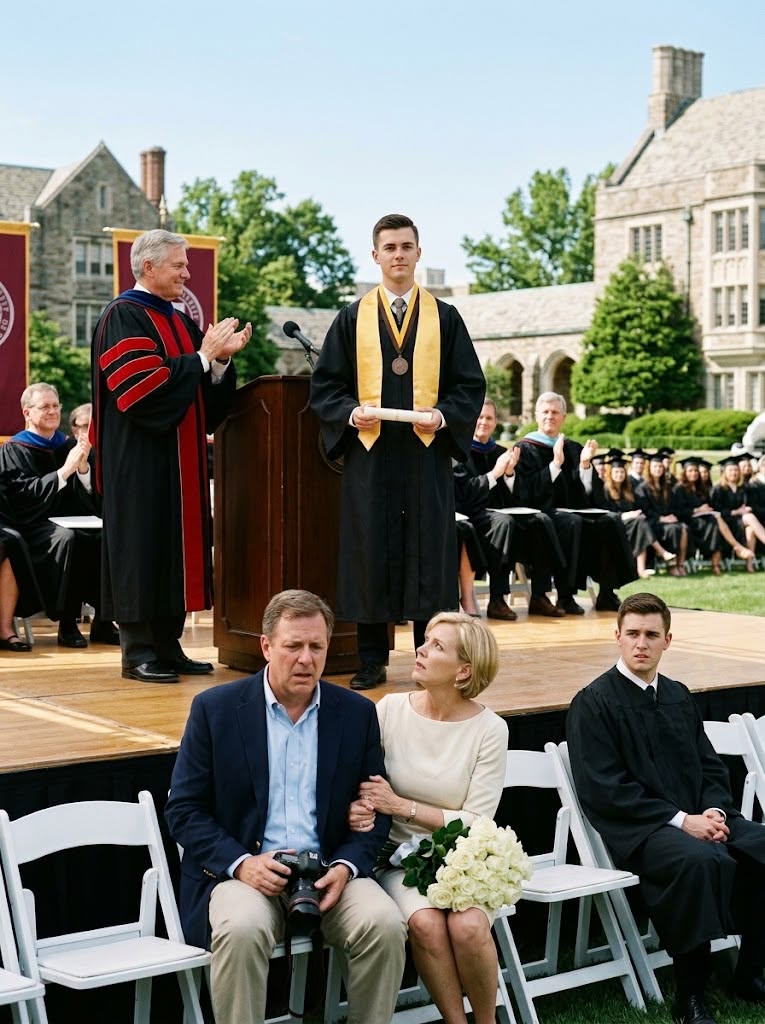
My father, Richard, was still holding his incredibly expensive telephoto camera, his index finger resting lightly on the silver shutter button, completely and utterly frozen in place.
His mouth was slightly open in an undignified gape.
All the arrogant, wealthy color had rapidly drained from his face, leaving him looking like a pale, terrified, remarkably fragile old man.
The heavy camera slowly slipped from his suddenly weak grip, entirely forgotten, and bounced off his knee before hitting the synthetic stadium turf with a dull, heavy thud.
He did not even blink.
He just stared at me, his eyes wide with a mixture of absolute disbelief and dawning terror.
My mother, Eleanor, was sitting right next to him in her pristine cream-colored designer dress, and her physical reaction was even more visceral and pathetic.
The massive, expensive bouquet of imported white roses she had proudly purchased for Julian slipped completely from her lap and crashed to the ground, scattering delicate white petals all over her expensive leather shoes.
She reached out with trembling hands and grabbed my father’s arm with a grip so incredibly tight I could actually see her knuckles turning entirely white from where I stood on the stage.
I watched her perfectly manicured lips move rapidly.
I could not hear her voice over the massive echoing applause of 3,000 people, but I had spent 18 years studying her passive-aggressive expressions.
I knew exactly what she was whispering.
She was saying, “Richard, what did we do? Oh my God, what did we do?”
And then there was Julian, the golden child, the million-dollar investment.
He was sitting in the fifth row of the general graduate seating area, surrounded by his rowdy fraternity brothers.
He was leaning forward so far he was almost falling out of his folding chair, his mouth hanging wide open in pure, unadulterated shock.
He looked frantically down at our parents sitting in the premium front row, then whipped his head back up to stare at me on the elevated stage, completely unable to mathematically process the reality unfolding directly in front of him.
The thoroughbred, the son who had been handed a quarter-of-a-million-dollar college fund on a silver platter, was sitting in the sweltering heat with the rest of the average crowd.
Meanwhile, the son who had been aggressively priced at zero, the son who was told he had absolutely no potential, commanded the highest, most respected platform in the entire stadium.
I stood there in the absolute commanding center of their completely shattered reality and let the thunderous applause wash over me for a long, deliberately agonizing moment.
I did not rush.
I wanted them to sit in the sheer, suffocating discomfort of the situation.
I wanted them to feel the crushing, undeniable weight of their own monumental miscalculation pressing down on their chests.
Then I leaned forward and confidently adjusted the silver microphone.
A brief, sharp screech of audio feedback echoed through the stadium, and the massive crowd instantly fell into a heavy, expectant, pin-drop silence.
3,000 people were waiting for my words.
“Good morning, graduating class of Whitmore University, distinguished faculty, and honored families,” I began, my voice booming across the stadium speakers, perfectly steady and completely unwavering. “Four years ago, I was given a piece of advice that completely altered the trajectory of my entire existence. I was told in no uncertain terms by people who held immense power over my life that I was a completely worthless investment. I was told directly to my face that I possessed absolutely zero potential. I was told that directing any financial resources toward my education or my future would be a catastrophic waste of capital because there would never ever be a return on that investment.”
A quiet, highly uncomfortable murmur rippled rapidly through the front rows.
This was clearly not the standard uplifting follow-your-dreams graduation speech they were expecting to hear.
This was not about changing the world with a smile.
This was a brutal reckoning.
I kept my eyes locked firmly on the back of the stadium, intentionally refusing to give my parents the satisfaction or the relief of direct eye contact.
I let them sweat.
“When you are told by the people who are biologically supposed to protect you that your intrinsic human value is essentially nothing, you are faced with an incredibly brutal, life-altering choice,” I continued, my voice gaining volume and intense emotional weight. “You can either quietly accept their absolutely flawed, toxic valuation, and live the rest of your life hiding in the shadows of their expectations, or you can decide to become the sole architect of your own worth. I chose the latter. I realized very early on that if I wanted a seat at the table of success, I could not wait for someone to politely hand me a chair. I had to go out into the forest, chop down the wood, and build the table myself.”
I spoke extensively about the harsh reality of surviving without a financial safety net.
I painted a vivid picture for the privileged audience.
I talked about the grueling, bone-aching hours working at a greasy, run-down diner before the sun even came up.
I talked about aggressively scrubbing industrial floor tiles, wearing oversized thrift store clothes that smelled like someone else’s attic, and living for years on a maximum of 4 hours of sleep a night.
I talked about the specific, agonizing mental pain of sitting in a freezing rented room, watching my wealthy peers complain about the size of their massive college fund allocations or whining about their expected corporate starting salary while I was literally counting loose pennies just to ensure I could afford a cheap bus ticket to a scholarship interview in New York City.
I did not sound bitter.
I did not sound angry.
I sounded incredibly victorious.
I laid out the stark, undeniable facts of my survival, not to gain their cheap pity, but to demonstrate the undeniable, terrifying power of human resilience when pushed to the absolute brink.
“Many of us sitting in this beautiful stadium today grew up falsely believing that our worth was strictly tied to a grand inheritance or a prestigious family name or the conditional approval of people who view familial relationships purely as calculated business transactions,” I said, my voice echoing off the concrete bleachers with absolute authority. “But let me tell you the absolute truth. The most valuable, untouchable asset you will ever possess in your entire life is your own unbreakable resilience. When someone looks you in the eye and tells you that you are not worth investing in, they are not exposing your hidden flaws. They are aggressively exposing their own incredibly limited, pathetic vision. They are showing you that they completely lack the capacity to see a diamond before it is painfully pulled from the dirt and polished by adversity.”
I finally lowered my gaze.
I looked directly down into the VIP section.
I looked straight into my father’s panicked eyes.
He was completely rigid.
His jaw clenched so tightly a visible muscle twitched violently in his pale cheek.
He looked like a man standing on the gallows.
My mother was silently crying, thick, heavy tears ruining her expensive designer makeup, her hands covering her mouth in absolute horror.
“I stand before you today on this stage not because someone generously paved an easy golden road for me,” I declared, my voice echoing with absolute, undeniable finality. “I stand here today as your valedictorian because I learned exactly how to pave the incredibly hard road myself. I learned how to turn painful rejection into pure, unadulterated rocket fuel. To anyone sitting in this massive audience today who has ever been overlooked, maliciously underestimated, or told they were simply not good enough by the very people who were supposed to love them the most. Hear my voice right now. You are the absolute master of your own valuation. Never, ever let small-minded, arrogant people calculate your worth.”
I took one deliberate step back from the microphone for three agonizing seconds.
There was total, stunning silence across the entire stadium.
And then the stadium completely erupted.
It was not polite, wealthy golf clapping.
People physically leaped to their feet.
The cheering was completely deafening.
A massive wave of sound that shook the wooden stage beneath my feet.
It was a massive, spontaneous standing ovation from 3,000 complete strangers.
I looked over at the esteemed faculty section, and Dr. Sterling was standing proudly at the front, wiping a single tear from her eye, clapping fiercely and nodding at me.
I looked back down at the premium front row.
My father and my mother were the absolute only two people in the entire VIP section who were not standing.
They sat frozen in their expensive, reserved seats, looking incredibly small, entirely diminished, and completely destroyed by the undeniable reality they had arrogantly created.
The immediate chaotic aftermath of the graduation ceremony was a wild blur of aggressive handshakes, flashing camera bulbs, and wealthy parents aggressively pushing through the crowd to congratulate me.
I was standing near the massive, intricately carved grand oak doors of the university’s main reception hall.
I was holding a crystal glass of sparkling water, speaking intensely with a highly prominent corporate lawyer who was aggressively interested in acquiring my resume for his prestigious firm.
The lawyer had just enthusiastically offered to personally connect me with the senior managing partner at his Manhattan office when I saw them pushing aggressively and rudely through the dense crowd of celebrating families.
Richard and Eleanor.
And right behind them, marching like a furious general, to my absolute disgust, was Aunt Beatatrice.
Beatatrice looked exactly like she had just swallowed a plate of sour lemons.
Julian was trailing at the very back of the group, looking completely and utterly humiliated, staring at the floor and desperately refusing to make eye contact with anyone in the room.
I politely excused myself from the corporate lawyer, placing my water glass on a passing waiter’s silver tray, and turned to face my biological family.
The massive confrontation I had vividly envisioned and planned for 4 years was finally happening right here in the grand hall.
But the dynamic had completely shifted.
I held absolutely all the cards.
I was standing on my own conquered territory now.
“Arthur,” my father said, his voice unusually tight, strained, and lacking all its usual booming authority.
He aggressively reached out to grab my shoulder, attempting to initiate a familiar, domineering paternal gesture to assert control in public.
I took one very deliberate, sharp step backward, smoothly evading his reach.
“Richard,” I replied, my voice completely flat, cold, and strictly professional.
I did not call him dad.
I had firmly decided I would never call him dad again for the rest of my life.
My mother let out a small, wounded, highly dramatic gasp, bringing a trembling hand to her chest.
“Arthur, honey, please, we are just so incredibly shocked. We cannot believe this. Why on earth did you not tell us you were attending Whitmore University? We would have… We could have celebrated together as a family. We could have supported you.”
“Celebrated?” I asked, raising a single, highly skeptical eyebrow, letting a sharp note of sarcasm bleed into my tone. “Celebrated exactly what, Eleanor? The fact that I barely survived the aggressive financial starvation strategy you both enthusiastically endorsed and implemented? Or perhaps the fact that I somehow managed to secure the highest academic seat at this elite university without tapping into a single penny of the precious college fund you reserved exclusively for your golden child?”
My father’s face flushed a deep, incredibly angry crimson.
He looked around nervously, his eyes darting back and forth, painfully aware of the extremely wealthy, influential families standing nearby who might overhear the devastating truth of his spectacular failure as a parent.
“Now you listen here, Arthur. Let us absolutely not air our dirty family laundry in public like commoners. What I did to you 4 years ago, it was a strategic move. It was tough love. I saw that you were getting complacent. I knew deep down that you needed a massive, aggressive push to reach your true hidden potential. And look at you now. You are the valedictorian. You are a Whitfield scholar. My parenting strategy clearly worked perfectly.”
The sheer breathtaking, psychopathic audacity of his statement almost made me laugh out loud right in his face.
He was actively, desperately trying to take full credit for the immense success he had vehemently and maliciously tried to destroy.
He was trying to rebrand his horrific, calculated neglect as a brilliant, visionary parenting strategy.
“Your strategy?” I asked, keeping my voice low but incredibly razor sharp, ensuring my words cut through the ambient noise of the reception hall. “You absolutely do not get to claim the beautiful harvest when you actively, deliberately tried to burn the entire field to the ground. Richard, you did not give me tough love. You gave me aggressive, calculated financial abandonment. You looked me in the eyes and told me I had zero return on investment. You literally priced me at nothing. Do not stand here in your expensive suit and insult my intelligence by pretending you had some brilliant master plan. You threw me away, and you are only standing here now because I proved your valuation entirely wrong.”
Aunt Beatatrice aggressively pushed her way to the absolute front of the group, her face pinched in her trademark bitter scowl, her expensive jewelry clanking aggressively.
“Arthur, you are being incredibly, unbelievably disrespectful to your parents right now. After everything they have done to raise you, feed you, and clothe you, you embarrass them in front of all these important people with that highly dramatic, ungrateful speech. You always, always had a flair for playing the pathetic victim. You should be thanking them on your knees.”
I slowly, deliberately turned my cold gaze to Aunt Beatatrice.
The intense anger I had kept strictly locked away and carefully managed for 4 years finally found its perfect target.
“Beatatrice, you are the absolute last person on this entire earth who should be lecturing anyone about family loyalty, gratitude, or financial ethics. I heard the phone call 4 years ago. I stood alone in the dark hallway and listened while you aggressively manipulated my weak mother into cutting me off so your precious Julian could have a much bigger piece of the financial pie.”
Beatatrice took a physical, stumbling step back, her eyes widening in genuine, unadulterated panic.
My mother looked entirely horrified, her mouth dropping open.
“You constantly project your own miserable, deeply toxic life onto everyone else around you,” I continued, my voice cutting through the noise of the reception hall like a surgical scalpel. “You ruined your own marriage. You aggressively dragged your poor ex-husband through a vicious, highly public divorce just to secure a massive real estate settlement you absolutely did not earn. You fought viciously for custody of bank accounts, not children. And then, bored with your own miserable wealth, you decided to play malicious financial adviser with my life. You are a bitter, deeply miserable woman, Beatatrice, and your opinions are entirely, completely worthless to me.”
“Arthur,” my mother cried out loudly, thick tears finally spilling over her eyelashes and running down her cheeks. “Please, please stop this right now. We are a family. We share the same blood. We can fix this terrible misunderstanding. We want you to come home with us for the massive celebration dinner tonight. We booked a highly exclusive private dining room at the country club just for us.”
“I am absolutely not going to the country club, Eleanor,” I said, stating her first name with cold, clinical precision. “I am not going back to your house. I do not have a home in your house, and I never truly did. And I strongly, highly suggest you save every single penny of your expensive celebration money because, from what I intimately understand about your current situation, you are going to desperately need it.”My father narrowed his eyes sharply, his aggressive corporate instincts suddenly kicking into overdrive.
“What exactly are you talking about, Arthur? Stop talking in riddles.”
“I am talking about Julian,” I said, finally shifting my gaze to look directly at my twin brother, who was still intensely staring at his expensive dress shoes, looking like he wanted the marble floor to magically open up and swallow him whole. “Julian, did you happen to tell Richard the absolute truth about your current academic standing? Did you tell him that you barely, by the skin of your teeth, managed to graduate today with a pathetic 2.1 GPA? Or did you conveniently leave out the massive fact that the highly lucrative corporate job offer Richard was loudly bragging about to the real estate developer earlier today actually completely rescinded their offer 3 weeks ago when they finally saw your disastrous final transcripts?”
My father whipped his head around so fast I thought he might snap his neck.
He stared at Julian with pure, unmasked fury.
“Julian? What the hell is he talking about? You looked me in the eye and told me you officially secured the junior executive position. You told me the contract was signed.”
Julian swallowed incredibly hard, his face turning a sickly shade of pale green.
“Dad, I… I can explain. They wanted a higher GPA for the final background check. I was going to tell you tonight, I swear. I just didn’t know how to break the news.”
My father looked like he was going to have a massive catastrophic stroke right there in the middle of the elegant reception hall.
His face turned purple.
His quarter-of-a-million-dollar golden investment, the son who was supposed to secure the family legacy, had yielded a completely unemployable, lying graduate with a mountain of credit card debt.
“While Julian is spending the next year desperately trying to figure out how to format a basic resume, I will be packing my bags for a real career,” I said, delivering the final, crushing, deeply satisfying blow. “I officially accepted a highly coveted senior advisory position at Vance Financial Strategies in New York City. I start my orientation on Monday morning. My starting base salary, not including my aggressive signing bonus, is significantly more than you made in your first 10 entire years of business, Richard. So, do not ever, under any circumstances, call my phone again asking to fix your broken family dynamic. I am officially permanently resigning from this family.”
I turned my back on them without a single ounce of hesitation and walked powerfully out the grand oak doors into the bright afternoon sun.
I left them standing there completely frozen in a tight circle of their own magnificent, highly expensive failure, already beginning to viciously fight among themselves.
Walking away from them felt exactly like walking away from the heavy, suffocating funeral of my old, miserable life, and I was absolutely wildly thrilled to see it buried deep in the ground.
Two highly successful, incredibly fast-paced years passed since that explosive graduation day.
Living and working in the heart of New York City was a relentless, high-speed corporate adrenaline rush, and I absolutely thrived in the chaotic environment.
I was working directly at the headquarters of Vance Financial Strategies, widely known as one of the most ruthless, highly effective and elite corporate restructuring and liquidation firms on all of Wall Street.
Thanks to my relentless work ethic born from years of diner shifts, I was aggressively promoted to senior adviser within my first incredibly short 18 months.
I was now personally managing massive, highly complex portfolios and handling multi-million-dollar corporate bankruptcies for failing titans of industry.
I had purchased a beautiful minimalist apartment overlooking the stunning Manhattan skyline, built a solid, loyal group of friends who valued my character, and maintained absolutely zero contact with my biological family.
I had entirely blocked their phone numbers, aggressively filtered their emails straight to the trash, and focused exclusively with laser precision on building my own untouchable empire.
But karma, as I intimately learned during my time in high finance, is not just some abstract spiritual concept or a fairy tale.
In the brutal corporate finance world, karma is highly documented, aggressively audited, incredibly precise, and completely, utterly inescapable.
It was a dark, heavily raining Tuesday afternoon in late November.
I was sitting comfortably in my massive corner office, reviewing a thick stack of distressed, failing corporate portfolios that our aggressive firm had recently acquired during a market downturn.
My executive assistant gently knocked and walked in, placing a massive, intimidating red priority folder directly in the center of my mahogany desk.
“Arthur, Mr. Vance wants you to personally handle this brand-new emergency restructuring case,” she said, tapping the thick file with her pen. “It is a mid-sized commercial real estate firm based out of the Midwest. They are currently drowning in a massive, highly publicized lawsuit regarding poorly managed illegal zoning permits, and they are desperately seeking an emergency corporate bailout and aggressive debt restructuring. The forensic numbers look absolutely horrific. The CEO essentially bled his own profitable company dry over the last 5 years, illegally funding lavish personal expenses and desperately trying to cover up incredibly bad, highly leveraged investments.”
I nodded, opened the heavy red folder, and casually looked at the primary applicant’s name printed in bold, stark black ink on the executive summary.
Townsend Commercial Real Estate.
CEO Richard Townsend.
My blood ran completely, shockingly cold for a fraction of a second.
I stopped breathing.
And then a very slow, highly calculating, deeply satisfied smile spread across my face.
It was my father.
His vaunted, arrogant real estate empire, the very empire he claimed I was too mediocre to inherit, was completely collapsing under the weight of his own massive ego.
I locked my office door and spent the next three uninterrupted hours diving incredibly deep into his private financial records.
The sheer, unadulterated level of absolute corporate incompetence was staggering.
Richard had aggressively leveraged his primary cash-flowing commercial properties to secure a massive, high-interest line of credit, which he then incredibly stupidly sank into a highly risky speculative residential development project.
That project immediately failed due to a massive class-action lawsuit from the city regarding environmental violations.
But the most truly damning, pathetic evidence was found deeply buried in the personal expenditure reports.
My father had been actively illegally siphoning critical company operational funds to maintain his wealthy country club lifestyle when the business started failing.
I found undeniable records of massive six-figure payments covering Julian’s constantly mounting ridiculous credit card debts.
There were massive checks written for expensive luxury car leases, high-end vacations, and exorbitant legal fees paid to expensive fixers to keep Julian out of a messy, highly embarrassing public intoxication and property damage scandal.
My father had literally sacrificed his entire business legacy, his life’s work, to continually and desperately bail out his absolutely useless golden child.
And now, facing total ruin, he was literally begging my Wall Street firm to magically save him from total, devastating bankruptcy.
Mr. Vance required all senior advisers to strictly conduct a mandatory recorded initial video conference with the distressed executive clients to formally assess their compliance and attitude before drafting any potential restructuring terms.
I scheduled the secure Zoom call for the very next morning at 9:00 a.m. sharp.
At exactly 9:00 a.m., holding a hot cup of coffee, I confidently joined the secure corporate video conference.
The screen flickered for a moment, and the feed from the Midwest connected.
Richard was sitting in his incredibly familiar wood-paneled home office.
He looked completely and utterly destroyed.
He had physically aged 10 grueling years in the incredibly short span of two.
His hair was significantly thinning and entirely gray.
His face was lined with deep, dark canyons of stress, and he was wearing a previously expensive suit that now looked far too large for his rapidly shrinking, defeated frame.
He was looking down at his messy desk, shuffling legal papers, nervously, completely unaware of who was on the other end of the encrypted call.
“Good morning, Mr. Townsend,” I said.
My voice was completely professional, crisp, commanding, and entirely lacking any trace of familial warmth.
Richard’s head snapped up violently.
He stared directly into the high-definition webcam, his sunken eyes widened in absolute, paralyzing terror.
He leaned incredibly close to his laptop screen, his mouth opening and closing silently like a suffocating fish pulled out of the water.
“Arthur,” he whispered, his voice cracking violently, completely stripped of its usual booming arrogance. “Arthur, what in God’s name are you doing on this secure corporate call? Where is the senior adviser? I demanded to speak with the senior adviser.”
“I am the senior adviser permanently assigned to your distressed portfolio, Mr. Townsend,” I replied, staring directly, coldly into the camera lens. “Vance Financial Strategies has officially tasked me with reviewing your desperate emergency restructuring application. Let us bypass the pleasantries and proceed directly to the financials. I have thoroughly reviewed your incredibly messy balance sheets, your hidden expenditures, and your pending lawsuits. I must admit, Richard, the level of negligent, borderline criminal mismanagement here is truly staggering.”
My father physically slumped deep into his expensive leather chair as if the remaining bones in his body had suddenly evaporated.
The crushing reality of his horrific situation crashed down on him with the undeniable weight of a speeding freight train.
His financial survival, his entire legacy, his massive house, and his entire future were now resting squarely and exclusively in the hands of the very son he had arrogantly discarded as a worthless zero-return investment.
“Arthur, please. I am begging you,” my father pleaded.
His arrogant, untouchable corporate persona completely, utterly shattered into a million pathetic pieces.
“You have to approve this. You have to help me structure a bailout. I am going to lose the house by next month. I am going to lose the firm I built from scratch. The massive lawsuit is draining every single ounce of liquidity I have left. Julian cannot find a job anywhere because his reputation is ruined, and the endless legal fees to keep him out of jail are completely destroying me. You have the ultimate power to approve this massive bailout loan. We are family, Arthur. Blood is thicker than water.”
I slowly leaned back in my ergonomic executive chair and steepled my fingers together, intentionally mirroring the exact arrogant posture he had used during our horrific family meeting four years ago.
I wanted him to recognize the exact reflection of his own cruelty.
“We are absolutely not a family, Richard. We are a highly regulated financial institution actively assessing an incredibly high-risk failing applicant,” I stated coldly, my voice devoid of any emotion. “And frankly, looking directly at your horrific numbers, spending my firm’s money on your rapidly failing company is throwing good money after bad. You completely lack strategic vision. You have illegally funneled massive amounts of critical capital into a massive depreciating liability. Your son Julian, while entirely ignoring sustainable ethical growth, from a purely objective, highly analytical standpoint, Richard, there is absolutely no return on investment with you.”
I used his exact, highly toxic words against him, weaponizing his own corporate cruelty.
I watched those words land like incredibly heavy physical blows directly to his chest.
He covered his pale, wrinkled face with his shaking hands and actually sobbed.
The great, untouchable Richard Townsend crying hysterically over a corporate Zoom call to the son he maliciously threw away.
I absolutely did not approve the emergency bailout loan.
I did not do it out of petty emotional revenge.
I did it because ethically and legally the company was genuinely a massive toxic asset that would never recover.
I formally drafted a heavy, binding recommendation for the immediate total liquidation of his remaining commercial properties to aggressively satisfy his angry creditors.
I essentially, with a few strokes of my keyboard, signed the absolute death warrant of his entire corporate empire, acting strictly, perfectly by the book.
Exactly 3 days after that devastating final Zoom call, my personal cell phone rang.
I had temporarily unblocked their numbers strictly to monitor any legal correspondence regarding the aggressive liquidation process.
I looked at the caller ID.
It was my mother.
I slowly answered the call, pressing the speakerphone button, setting the phone on my large mahogany desk while I casually continued to review an email from a new, highly profitable client.
“Arthur,” Eleanor said immediately, her voice completely broken, raspy, and sounding incredibly exhausted, as if she hadn’t slept in a month. “Your father lost the entire business today. The bank formally served us papers. They are foreclosing on the house in 3 weeks. We have absolutely nowhere to go. We have to move into a tiny, run-down rental apartment on the bad side of town. I called Aunt Beatatrice and she completely refuses to loan us any money from her massive divorce settlement. She screamed at me and completely cut us off.”
“I am genuinely sorry to hear about the severe financial difficulties you are experiencing, Eleanor,” I said, intentionally maintaining a highly polite but entirely professionally detached tone. “However, the corporate market is notoriously unforgiving to those who make incredibly poor, highly leveraged investments.”
“Arthur, please, I am begging you on my knees,” she cried desperately, her voice cracking with sheer panic. “Julian is having a complete mental breakdown in his bedroom. He does not know how to live without the platinum credit cards. We literally have nothing left in the accounts. You are incredibly, wildly successful now in New York. You make a massive, incredible salary. I saw your firm’s revenue. Could you please just, out of the goodness of your heart, help us pay the rent for a year? Or please just let Julian come stay with you in your New York apartment until he gets back on his feet? Please, Arthur. You are our absolute only hope in the world.”
I slowly closed my laptop, the soft click echoing in my quiet office.
I took an incredibly deep, highly steadying breath.
This was the final ultimate test of my resolve.
This was the exact moment I permanently, unbreakably cemented the heavy steel boundaries of my new peaceful life.
“Eleanor, I need you to listen to me very, very carefully,” I said, my voice gentle, but as incredibly hard and unyielding as solid titanium. “I am absolutely not going to send you a single penny of my money. I am not going to pay your rent, and Julian is absolutely, under no circumstances, coming anywhere near my life or my apartment in New York. You and Richard deliberately, consciously created this exact horrific situation. You made a choice. You chose to aggressively invest every single ounce of your financial and emotional capital into a son who viewed you purely as an unlimited ATM. You actively, proudly enabled his sheer incompetence. You actively participated in a highly toxic family system that valued money, prestige, and country club status over basic, fundamental human decency. You bet absolutely everything you owned on the golden child, and you lost the entire gamble.”
“But you are our son. You are my baby,” she wailed into the phone, a sound of pure, helpless despair.
“No, Eleanor, I am not,” I replied firmly, without a single tremor of doubt in my voice. “You aggressively made sure I understood that painful reality four incredibly long years ago. You do not get to magically claim me as your loving son only when my massive net worth suddenly becomes highly useful to your survival.”
“I am officially hanging up the phone now, Eleanor. Do not ever call this number again. I genuinely wish you the best of luck figuring it out yourselves.”
I pressed the red end call button.
I went into my phone settings and permanently, irreversibly blocked her number.
I permanently blocked my father.
I permanently blocked Julian.
I picked up my phone, walked over to the massive floor-to-ceiling glass window of my New York corner office, and looked out over the sprawling, beautiful, chaotic city.
The heavy, suffocating weight that I had carried deep in my chest since I was a neglected teenager was entirely, miraculously gone.
I did not feel a single ounce of guilt.
I did not feel any malicious, petty joy.
I just felt a profound, overwhelming, incredibly deep sense of absolute peace.
The toxic generational cycle of abuse was completely, permanently broken.
I was entirely free.
Later that exact same week, I logged into my highly secure personal banking portal.
I confidently initiated a massive wire transfer of exactly $10,000 directly to the Eastbrook State University general scholarship fund.
I made the donation entirely anonymous, but I added a single highly specific legal stipulation to the endowment.
The funds were strictly, exclusively reserved for independent students who entirely lacked any family financial support.
I sat there and thought about Dr. Sterling, the woman who handed me a weapon when I had nothing.
I thought about Marcus, my loyal friend, who was now an incredibly successful senior engineer and whom I had gladly taken out for a massive thousand-dollar steak dinner just last month to celebrate his own promotion.
I realized I had successfully built my own incredible family out of the amazing people who actively chose to invest in my strong character, not my bank account.
If you are watching this video right now and you are sitting in a quiet, lonely house where you feel entirely invisible to the people around you, I desperately need you to listen to my voice.
If you are currently dealing with highly toxic parents who treat you like a massive burden, or if you have siblings who would gladly step on your neck just to secure a larger piece of an inheritance, you absolutely must understand one fundamental, undeniable truth.
Their tragic inability to clearly see your value absolutely does not decrease your actual intrinsic worth.
You are not a bad investment.
You are simply sitting in the completely wrong portfolio.
You have the absolute, undeniable right to boldly walk away from highly toxic family dynamics.
You have the right to completely refuse to attend the metaphorical daily funeral of your own self-esteem.
Do not ever spend your precious, finite life begging for tiny scraps of fake affection from people who do not fundamentally respect you as a human being.
Focus all your incredible energy on aggressively building your own table, brick by heavy brick, dollar by hard-earned dollar, until you are so incredibly powerful and successful that their toxic opinions become completely, utterly irrelevant background noise in your beautiful life.
Let’s pause for a moment.
Thank you for staying with me this far.
You’re truly amazing.
Please help me by liking the video and commenting the number one below so I know you’ve been here with me until this point.
This not only helps more people discover this story, but also lets me know that my experiences mean something to someone.
Your support is the greatest motivation for me to keep sharing the rest of this journey.
Have you ever faced something similar with your own family?
Have you ever had to cut ties to save your own future?
Share your story in the comments below and don’t forget to like and subscribe so you don’t miss the next journey.
If you came here from Facebook because this story pulled you in, please go back to the Facebook post, tap like, and comment exactly “Respect.” That small action means more than you know. It helps support the storyteller and gives them real motivation to keep bringing you more stories like this.