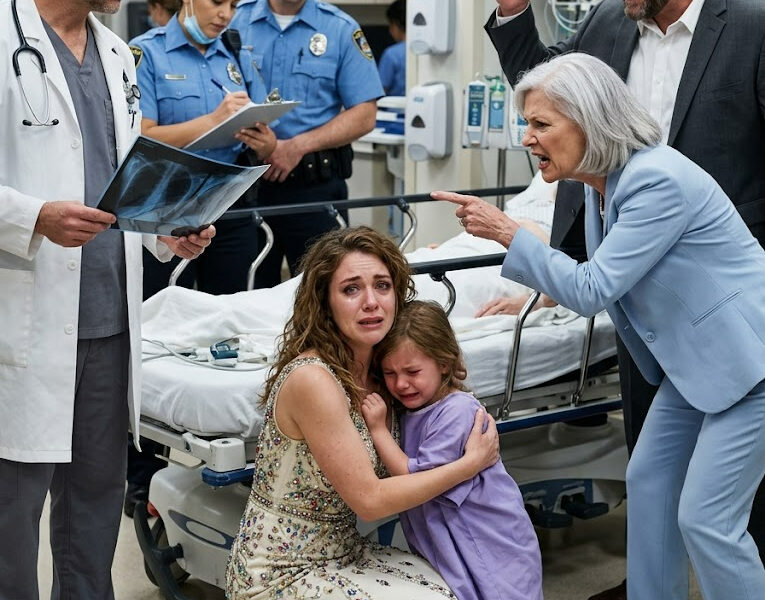
cnu My Five-Year-Old Daughter Woke at 2 A.M. Whispering That “Little Fish Were Biting” Inside Her Stomach—Then Doctors Found 36 Powerful Magnets Tearing Through Her Intestines and Police Suspected Me. Hours Later, a Forgotten Security Camera Revealed Who Had Fed Them to Her One by One… and Why My Own Mother-in-Law Wanted Me Blamed.

The Mermaid Pearls
Part 1
At two in the morning, my five-year-old daughter appeared in my bedroom doorway and whispered, “Mommy, there are little fish in my tummy, and they’re biting me.”
Nancy was bent nearly in half. Her blond curls clung to her forehead, and her lavender pajamas were damp with sweat. One hand gripped the doorframe while the other pressed hard against her abdomen.
I reached her just as her knees gave way.
“Where does it hurt, sweetheart?”
“Everywhere inside.” Her teeth chattered against my shoulder. “The fish keep moving.”
My husband, Brandon, was in Phoenix for a corporate conference. I called him once while carrying Nancy to the car, but the call went to voicemail. Then I drove through the sleeping streets of San Diego with one hand stretched toward the back seat, talking to her so she would keep answering me.
At the pediatric emergency department, a triage nurse took one look at Nancy and moved us past the waiting room. Blood tests led to an X-ray, and the X-ray led to an ultrasound. The technician stopped making small talk halfway through the scan.
She stared at the screen, excused herself, and returned with a pediatric surgeon named Dr. Elena Ruiz.
Dr. Ruiz studied the images, then crouched beside Nancy’s bed.
“Nancy, I need you to tell me whether you ate anything small and shiny yesterday. Maybe something that looked like candy or a bead.”
Nancy’s eyes widened. She shook her head and looked at me.
“She doesn’t play with magnetic toys,” I said. “We don’t have anything like that in the house.”
Dr. Ruiz led me into the hallway.
“The images show a cluster of small, high-powered magnets in her intestines,” she said. “They are attracting one another through different loops of bowel. That pressure can interrupt blood flow and create holes. She needs emergency surgery.”
The hallway seemed to tilt.
“How many?”
“Approximately three dozen. We will know the exact number after removal.”
Because Nancy’s injuries could not be explained as an ordinary accident, the hospital made a mandatory report. Two detectives arrived while the surgical team prepared her. They did not handcuff me or accuse me outright, but they separated me from Nancy and asked the same questions from different directions.
Who supervised her yesterday? Who had access to the house? Were there magnets in any craft supplies? Had Nancy ever swallowed nonfood items? Was anyone angry with me, Brandon, or our child?
I answered until my mouth went dry.
I was Nancy’s primary caregiver. I had left her alone only twice that afternoon—once while folding laundry upstairs and once while taking our puppy into the yard. My mother-in-law, Evelyn, had stopped by briefly, but I remembered only hearing the front door chime. Evelyn had her own key and often entered without knocking.
I called Brandon again. When he finally answered, I could barely speak.
“They’re taking her into surgery. Come home.”
He arrived four hours later with Evelyn beside him. I stood when I saw him, expecting his arms around me.
He stopped several feet away.
“How could you not see her swallow that many objects?” he demanded.
Evelyn pressed a hand to her pearls. “I warned you she was distracted, Brandon. Those online photography classes, that phone always in her hand—”
“Nancy is in surgery,” I said. “This is not the time.”
But it was exactly the time Evelyn wanted. Before either of them had spoken to the surgeon, she was building a story in which I had failed and she had always known I would.
After sunrise, Dr. Ruiz emerged in wrinkled scrubs. She said Nancy was stable, but the magnets had damaged two areas of her small intestine. The surgeons had removed the injured tissue and expected her to recover.
My legs nearly folded with relief.
“Could she have swallowed them accidentally?” Brandon asked.
“One magnet can be an accident,” Dr. Ruiz said. “This many suggests repeated ingestion during a relatively short period. A child might cooperate if she believed they were candy, medicine, or part of a game.”
Beside him, Evelyn went rigid.
I saw fear cross her face before she covered it with outrage.
“This is absurd,” she said. “I didn’t even know there were thirty-six in that jar.”
No one moved.
Dr. Ruiz had given the exact number only to me and the detectives in a private consultation room. In front of Brandon and Evelyn, she had said only “multiple magnets.”
Detective Elliott slowly closed his notebook.
“What jar, Mrs. Andrews?”
Part 2
Evelyn’s mouth opened, but nothing came out.
Then she laughed—a small, brittle sound.
“I assumed they came in a container. Where else would toys be kept?”
Detective Elliott did not argue with her. He simply asked Brandon and me for permission to secure our house while another officer remained at the hospital.
That was when I remembered the camera.
Two months earlier, our puppy had begun chewing furniture whenever we left the room. I had placed a motion-activated camera on the living room bookcase. Its wide lens captured the dining table and part of the entryway. Brandon had teased me for buying it. Evelyn had called it another unnecessary gadget.
“There may be a recording,” I said.
Evelyn stepped between me and the elevator.
“Your daughter just survived surgery, and you want to leave?”
“I want to know who hurt her.”
Brandon caught my arm. “If the police consider you a suspect, you shouldn’t touch anything.”
I looked at his hand until he released me.
“Then the detectives can retrieve it.”
I signed written consent for a search of the common areas. Forty minutes later, we entered the house behind the officers. Nancy’s pink sneakers sat by the stairs. Her coloring book remained open on the dining table beside a blue pencil and a half-finished cup of milk.
The ordinary scene hurt more than the hospital machines.
Detective Elliott removed the camera’s memory card and opened the files on my laptop while his partner recorded the process. A clip from the previous afternoon began at 3:14.
Nancy sat at the table drawing an ocean. I crossed behind her carrying laundry and disappeared upstairs.
Two minutes later, the front door opened.
Evelyn entered without calling my name. She sat beside Nancy and removed a glass jar from her purse.
“What are those?” Nancy asked on the recording.
“Mermaid pearls,” Evelyn said. “They wake up friendly fish inside you.”
She spooned vanilla pudding from a cup I had served Nancy earlier and pressed several silver balls into each bite. Nancy made a face after the first spoonful.
“They taste like pennies.”
“Magic never tastes ordinary,” Evelyn replied. “Drink your milk and be brave.”
When Nancy tried to climb down, Evelyn held her shoulder and reminded her that big girls finished special treats. She alternated pudding with milk until the jar was empty.
Then her voice changed.
“This is our secret. If you tell Mommy, she’ll be angry that you disobeyed. She may take away your dolls—or decide she doesn’t want a naughty girl.”
Nancy began to cry.
On the screen, Evelyn wiped the table, placed the empty jar in her purse, and left. The entire visit lasted nine minutes.
I could hear Brandon breathing beside me. When the video ended, he lowered himself into a kitchen chair as though his bones had disappeared.
“Mom,” he whispered. “Why?”
Evelyn backed toward the refrigerator.
“I didn’t know they would tear anything. I read that swallowed objects usually pass.”
Detective Peters cautioned her not to say more and placed her under arrest. During a lawful search incident to the arrest, he found the empty jar in her handbag and a receipt from an online seller of magnetic desk toys.
Evelyn began screaming as the handcuffs closed.
“I did it for you, Brandon! She was taking Nancy away from our family. You complained that Samantha controlled everything. I was giving you proof for emergency custody.”
Brandon stared at her.
“You almost killed my daughter.”
“I expected a stomachache! The hospital would find the beads, everyone would see Samantha was careless, and you could bring Nancy home to people who truly loved her.”
The officers led her outside while neighbors watched from their windows.
I should have felt victorious. Instead, I felt hollow. My child was in intensive care. My mother-in-law had poisoned her. My husband had needed less than one hour to imagine me capable of doing it.
Detective Elliott remained at the kitchen island, studying the receipt.
“This purchase was made six weeks ago,” he said. “What happened yesterday may have been planned for a long time.”
Brandon covered his face.
The video had shown us the crime.
It had not yet shown us how many people Evelyn had prepared to believe her version of it.
Part 3
Nancy woke the next morning with tubes in her arms and a bandage across her abdomen.
“Did the doctors catch the biting fish?” she whispered.
“Every one of them.” I kissed her hand. “They can never hurt you again.”
Her mouth trembled. “Grandma said you wouldn’t love me if I told.”
I leaned close enough that she could see my face clearly.
“Nothing you say could make me stop loving you. Grandma lied. You did nothing wrong.”
Brandon appeared in the doorway holding coffee. Nancy saw him and pulled the blanket over her head.
He stopped as if she had struck him.
“I won’t come closer,” he said. “I just wanted to see that you’re awake.”
She did not answer.
He left the room crying.
Later that morning, the detectives formally told me the evidence had cleared me. Their apology was careful and sincere, but it could not erase the hours during which every choice I had made as a stay-at-home mother had been turned against me.
The deeper investigation was worse.
After obtaining warrants for Evelyn’s phone and computer, investigators found months of searches about delayed symptoms from swallowed objects, emergency custody petitions, and ways to make household negligence appear habitual. A notebook in her bedroom recorded my routines, including the afternoons I folded laundry upstairs.
She had also spent eight months sending relatives and neighbors misleading messages about me. A photograph of Nancy crying after a scraped knee became evidence that she was “always frightened at home.” A missed birthday dinner became proof that I was isolating Brandon. Every ordinary event had been edited until I resembled the villain Evelyn needed.
Brandon had received many of those messages.
Two days after Nancy left intensive care, he met me at my attorney’s office. My lawyer, Rachel Kim, sat beside me while Brandon faced us across the conference table.
“I didn’t know about the magnets,” he said. “I swear to you.”
“I believe that.”
Hope flickered across his face.
“But you knew your mother despised me,” I continued. “You knew she entered our house without calling. You knew she questioned my parenting and spread stories about me.”
“I thought she was difficult, not dangerous.”
“You gave her stories somewhere to land.”
He looked confused.
“Every time she criticized me, you said that was simply how she was. Every time I asked you to take back her key, you said I was making you choose. Then, when Nancy was hurt, you did choose. You chose the story your mother had been writing.”
“I was terrified.”
“So was I. Terror made me carry our daughter to the hospital. It made you stand between me and the evidence.”
Brandon wept openly then. I felt sorrow, but sorrow was not trust.
Rachel explained that I was seeking temporary sole physical custody, a protective order keeping Evelyn away from Nancy, and supervised contact for Brandon until a family-court evaluator could assess safety. Brandon had not committed the crime, but Nancy’s fear of him was real, and his dependence on Evelyn had affected his judgment.
He signed the temporary agreement rather than fight it.
Nancy remained hospitalized for twelve days. My mother flew in from Oregon, and my best friend Kathleen kept our refrigerator full and screened my calls. Physical healing came slowly. Nancy took careful steps down the hallway, one hand in mine and the other holding a stuffed rabbit against her bandage.
Each small victory felt enormous because pain had made her suspicious of every movement her body required.
Her first supervised visit with Brandon occurred six weeks later at a family center.
He arrived with balloons and an enormous teddy bear. Nancy immediately hid behind me.
“Put them away,” I said. “She doesn’t need a performance.”
For once, he listened. He moved the gifts into the hall, sat on the floor across the room, and opened a picture book.
“I’m going to read,” he told her. “You don’t have to sit near me.”
Nancy stayed behind my chair, but halfway through the story, she peeked around its edge.
Brandon did not reach for her.
It was the first truly fatherly thing he had done since the night she became sick—and it came too late to save our marriage.
Part 4
Evelyn’s trial began nine months later.
By then, Nancy could run again, although sudden stomachaches still frightened her. A child therapist had helped her understand that adults sometimes lie and that secrets involving pain, fear, or touching must always be told to a safe grown-up.
She did not attend court.
I did.
The prosecutor played the dining-room footage for the jury. No one moved while Evelyn’s sweet recorded voice promised “friendly fish.” When Nancy said the pearls tasted like pennies, one juror covered her mouth.
Dr. Ruiz explained how magnets in separate sections of bowel had pulled together, trapping tissue between them. She spoke without dramatics, which made the facts more devastating. Nancy’s prompt arrival at the hospital had saved her from infection, organ failure, or death.
The digital evidence established planning. Evelyn had purchased the magnets six weeks earlier. She had researched symptoms, studied my schedule, and drafted messages she intended to send after Nancy became ill. One unfinished email accused me of leaving dangerous craft materials within reach and urged Brandon to request emergency custody before I could “invent excuses.”
Evelyn’s sister, Diane, testified that she had received vague messages about an approaching custody crisis. She insisted she never knew a child would be harmed, but one saved text was difficult to dismiss:
“By tomorrow, Brandon will finally have the proof he needs.”
When the prosecutor asked why she had not questioned that sentence, Diane looked at the floor.
“In our family, we learned not to question Evelyn when she said she was fixing something.”
Her answer explained the machinery around Evelyn without excusing a single person who had helped it run.
Brandon testified for the prosecution.
He looked older than he had nine months before. Therapy had stripped away the confident explanations he once used whenever his mother crossed a line.
The prosecutor asked whether Evelyn had discussed concerns about my parenting.
“Constantly,” he said.
“Did you believe her?”
“Not at first. Then I heard the same accusations for so long that they started to feel familiar. I confused familiar with true.”
“At the hospital, whom did you suspect?”
He looked toward me.
“My wife.”
“Why?”
His answer took a long time.
“Because blaming Samantha meant I didn’t have to question my mother. I chose the explanation that protected the relationship I had protected my whole life.”
Evelyn stared at him from the defense table with naked fury.
The defense argued that she had intended only to expose supposed negligence, not cause grave injury. The jury rejected that distinction. A person who deliberately fed a child dozens of powerful magnets could not escape responsibility by claiming ignorance of exactly how the damage would occur.
She was convicted of multiple serious felonies related to child abuse, administering a harmful substance, and causing great bodily injury. The judge imposed a lengthy prison sentence and issued a protective order barring all contact with Nancy.
As deputies approached, Evelyn turned toward Brandon.
“Tell them I was protecting you.”
He did not look away this time.
“You were protecting your control over me.”
Then she faced me.
“You destroyed this family.”
“No,” I said. “I stopped you from choosing its next victim.”
Our divorce became final five weeks later. I received sole physical custody and final decision-making authority for Nancy’s medical and educational needs. Brandon retained supervised visits, with future changes dependent on professional recommendations and his continued therapy.
I did not try to erase him from Nancy’s life. I required him to earn a safe place in it.
He attended every visit. He stopped arriving with gifts. He read, colored, or sat quietly while Nancy decided how close she wanted to be. Some weeks she spoke to him. Other weeks she barely looked up.
He accepted both without complaint.
During one visit, nearly a year after the poisoning, Nancy carried a book across the room and placed it beside him.
“You can read this one,” she said.
Brandon’s eyes filled, but he did not make the moment about his feelings.
He simply opened the book.
From my chair near the door, I watched my daughter reclaim one small choice at a time. That was how trust returned—not through promises, blood ties, or apologies, but through hundreds of moments in which the adult with power allowed the child to say yes, no, closer, or not yet.
Part 5
A year and a half after the night Nancy came to my doorway, she and I moved into a sunlit bungalow in another San Diego neighborhood.
The house was smaller, but it felt larger because no one entered with a spare key. Yellow curtains moved in the ocean breeze. The backyard held two lemon trees and enough room for a garden where Nancy planted crooked rows of tomatoes.
Her medical checkups remained good. Scar tissue required monitoring, and certain foods sometimes upset her stomach, but she had regained her strength. Her laughter returned first in short bursts, then in the full-bodied way that once made strangers smile in grocery-store aisles.
I returned to the photography course Evelyn had mocked.
At first, I took pictures only for myself—morning light across the kitchen floor, Nancy’s muddy hands holding a tomato, her stuffed rabbit drying on the clothesline. Eventually, neighbors asked me to photograph birthdays and family reunions. I built a small business slowly, scheduling work around Nancy’s needs rather than treating motherhood and ambition as enemies.
Brandon continued therapy and supervised visits. He never asked me to reconcile. The last time he apologized, his words were different.
“I used to say I didn’t know what my mother was capable of,” he told me. “That was true, but it was also a way to avoid what I did know. I knew what you were capable of. I knew you were patient, careful, and devoted to Nancy. I abandoned that knowledge when trusting you became frightening.”
I nodded.
“I don’t expect forgiveness,” he added. “I just want to become someone Nancy never has to fear.”
For the first time, I believed he understood the difference between remorse and self-pity.
Understanding did not restore our marriage. It gave him a chance to build a healthier relationship with his daughter.
One Sunday afternoon, I found Nancy at our dining table surrounded by colored pencils. Her tongue poked from the corner of her mouth as she worked.
She had drawn an underwater world filled with orange, purple, and blue fish. Some wore tiny crowns. Others hid inside castles made of seashells.
I hesitated before asking, “Are those fish friendly?”
She looked up.
“These ones don’t live in people’s tummies. They stay in the ocean where they belong.”
Then she pointed to the largest fish, which had fierce yellow fins.
“That’s the mommy fish. She watches the gate.”
I laughed, although tears blurred the picture.
“She looks very brave.”
“She was scared first,” Nancy corrected me. “Then she got brave.”
Children sometimes understand courage better than adults. It is not the absence of fear. It is what remains after fear has stripped away every comforting illusion.
That night at the hospital, I lost the illusion that marriage automatically meant partnership. I lost the belief that keeping peace with Evelyn protected anyone. I lost the version of Brandon who had existed partly because I kept forgiving what he refused to confront.
But Nancy survived.
She learned that she could tell the truth and still be loved. Brandon learned that being a father meant protecting his child’s boundaries, even when those boundaries excluded him. And I learned that defending my daughter required more than saving her body. It required building a home where no adult’s pride mattered more than her safety.
Nancy taped her drawing to the refrigerator. The paper tilted slightly to one side, but she refused to let me straighten it.
“It’s swimming,” she explained.
So I left it exactly as she wanted.
The fish remained there through summer, bright and harmless against the stainless steel. Every time I passed them, I remembered the whisper that had awakened me at two in the morning.
The little fish were biting me.
My daughter had told the truth from the beginning, using the only words she possessed for an adult betrayal too terrible to understand.
Now the fish belonged to her again—not as a secret, not as a threat, and never as something hidden inside her.
They lived safely on paper, watched by a brave mother fish, in a home where love would never again require silence.
THE END
Disclaimer: This content is entirely AI-generated for fictional and entertainment purposes only. Any resemblance to actual persons, living or dead, events, or locations is purely coincidental, and the creator assumes no liability for any interpretation of this content.
Disclaimer: This story is fictional and created for entertainment purposes only. Any names, characters, places, or events are fictitious or used fictitiously. No real person or organization is intended to be portrayed.