
cnu My Brother-in-Law Destroyed My $40,000 Pool After I Asked to Borrow a Tent—Then Left a Signed Note Saying He Wanted to “Teach Me a Lesson.” But When I Found His Secret Ledger Showing He’d Been Charging Parents $50 Per Child to Use My Backyard, the Insurance Claim Became the Least of His Problems.
My Brother-in-Law Destroyed My $40,000 Pool Over a Tent
Part 1
The note was pinned beneath a landscaping stone at the center of my patio table.
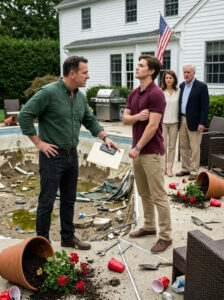
Behind it, the forty-thousand-dollar swimming pool I had spent three years saving for sat nearly empty beneath the July sky. The blue liner had pulled away from the walls. Muddy water surrounded the drain. One circulation unit lay cracked beside the shallow end, and my cedar planters had been overturned across the deck.
My wife, Sarah, stood behind me with both hands covering her mouth.
The handwriting belonged to her brother, Carter.
Matthew,
Pool parties are over. Maybe this will teach you not to depend on other people’s things. You wanted to take what belonged to me, so now you know how it feels to lose something you care about.
The pump may have been left off. Accidents happen.
Carter
Sarah reached for her phone. “I’m calling him.”
“No.”
She stared at me.
“Don’t warn Carter. Don’t call your parents, and don’t put anything in the family group chat.”
“Matthew, look at what he did.”
“I am looking.”
My anger did not arrive as yelling. It became a cold pressure beneath my ribs, sharpening every detail—the soil ground into the stamped concrete, the displaced valve cover, and the missing screws beside the pump housing.
I worked as a forensic financial analyst. Companies hired me after somebody had lied, usually believing the paperwork was too dull for anyone to examine closely.
Sarah’s father called me a paper pusher. Carter said I moved numbers between columns.
Neither understood that the quietest evidence was often the hardest to explain away.
I slid Carter’s note into a clean document sleeve, photographed it in place, then photographed the pool, gate, pump station, planters, and every visible mark around the drainage controls. I saved the home-security footage before the system could overwrite it.
Sarah followed me around the yard, crying.
“What are you going to do?”
“Document what happened.”
“And then?”
“Let people whose job it is decide the consequences.”
At midnight, I opened a claim with our homeowners insurer and filed a police report for property damage. I did not tell either office what I believed beyond the facts I could support.
At seven the next morning, Elijah Ramos, the contractor who had installed the pool, arrived in work boots and a faded baseball cap.
He inspected the plumbing, drain, liner, and control panel for nearly an hour.
“This was not an accident,” he said. “The primary drain was opened manually, the circulation system was shut down, and someone forced the pump cover. Once the water dropped, the liner separated.”
“Repair cost?”
“Twenty-four to twenty-eight thousand, depending on the underground lines.”
Sarah made a broken sound from the patio chair.
I asked Elijah for a written report, photographs, and an itemized estimate. Then I went inside.
Sarah’s phone was filled with messages from her mother.
Mom says Carter was angry about the tent.
She thinks the boys may have damaged something during a party.
She says making him pay will destroy his life.
“A child did not write that note,” I said.
“I know.”
“A child did not open the drain.”
“I know.”
“Then stop repeating explanations neither of us believes.”
Sarah wiped her face. “I could take a second job and help cover the repairs.”
I stared at her.
She was prepared to work evenings to protect the man who had destroyed our property while asking nothing of him.
“This is not your debt.”
“He’s my brother.”
“I’m your husband.”
I walked into the sunroom before anger destroyed whatever remained of the conversation.
That was where I noticed Sarah’s pink spiral notebook beneath a decorative pillow.
The first pages contained grocery lists. Near the middle, her handwriting changed.
Summer kickoff—15 children.
Collected: $750.
Food and drinks: $62.
Net: $688.
Other pages listed children’s names beside fifty-dollar payments. The entries covered two summers.
Carter had not merely invited friends to swim.
He had sold access to my backyard, using my water, electricity, grill, insurance, and labor.
I placed the notebook in front of Sarah.
Her face collapsed before I asked the question.
“How long have you known?”
She lowered her eyes.
“Since last summer.”
The pool had been emptied in one night. The trust inside my marriage had been draining far longer.
Part 2
To understand why Sarah hid Carter’s business, you had to understand the family that trained her.
Her father, Joseph, was a retired car salesman who treated every disagreement like a negotiation he intended to dominate. Her mother, Martha, translated his temper into family policy. Carter, their only son, moved through life protected by both of them.
He never lost jobs. Managers “failed to recognize initiative.” His abandoned businesses were “good ideas with bad timing.” His debts proved he was ambitious.
The pool gave that entitlement a physical address.
For three years, I had packed lunches, postponed replacing my car, and moved every bonus into an account labeled BACKYARD. I wanted one quiet place after days spent tracing corporate fraud through bank records.
For one summer, it was quiet.
Then Carter arrived without asking, followed by his sons, Nathan and Luke. He dropped a cooler beside my lounge chair.
“Family doesn’t need reservations,” he said.
I let them stay because the boys were excited and Sarah looked relieved.
That first concession became a schedule.
Each time I surrendered to avoid conflict, Carter treated my silence as confirmation that the previous boundary had never existed.
Soon Carter was announcing Saturday parties through messages sent to Sarah. He brought children I had never met, used my grill, emptied our garage refrigerator, and left towels, cans, and broken toys across the deck.
When I objected, Sarah said the boys had nowhere else to swim.
“I’m not blaming Nathan and Luke,” I told her. “I’m asking their father to request permission and clean up.”
“You know how defensive he gets.”
“His defensiveness is not a household rule.”
She promised to speak to him. Nothing changed.
At a Sunday dinner, I finally told Carter the children were welcome only when Sarah and I invited them.
Joseph laughed. “You have a large house and no children. Carter is giving his boys memories. You should be grateful you can help.”
I looked at Sarah.
She stared at her napkin.
That silence told Carter I had no authority even in my own home.
The conflict reached its breaking point four years later when Sarah and I planned a camping trip near Yellowstone. Carter owned a four-person tent he had used once, so Sarah suggested I ask to borrow it.
He laughed over the phone.
“You have a big house, a fancy pool, and a comfortable job. Buy your own stuff.”
“You’ve used my pool every summer.”
“A pool sits there. My tent is actual equipment.”
Then he hung up.
Sarah defended him.
“You earn much more than he does. Stop depending on Carter and buy the tent.”
Her words felt like a verdict written by her family and delivered through my wife.
I bought a new tent for $435. At home, curiosity led me to old credit-card statements.
There it was: $435.50 charged two years earlier at the same sporting-goods store—on Sarah’s personal card, paid from our joint account.
“You bought Carter’s tent,” I said.
She froze.
Joseph had asked her to purchase it because his own card was maxed out. He promised repayment and never sent a dollar.
The next morning, Joseph called while we loaded the car.
“Carter works hard for what he owns,” he said over speakerphone. “You should learn to stand on your own.”
Sarah stood beside me and said nothing.
During Yellowstone, we hiked, watched bison, and slept in the tent I had bought after being mocked for requesting access to one I had already funded.
On our third night, I sat alone beside the fire and accepted a truth I had resisted for years.
When we returned, there would be no more unannounced parties, secret purchases, or family decisions governed by Joseph’s anger.
If Sarah could not accept that, our marriage would end.
We came home to the destroyed pool.
Now the pink notebook lay between us.
“I told Carter to stop charging people,” Sarah whispered.
“But you kept his ledger.”
“He said parents were contributing.”
“He calculated profit.”
She covered her face.
“I was afraid of Dad.”
“So you made sure the consequences always landed on me.”
For the first time, she did not ask me to forgive her brother.
She only whispered, “Yes.”
Part 3
That afternoon, I met with Aaron Hale, an attorney and longtime friend.
I placed Carter’s note, Elijah’s report, the photographs, the police-report number, the credit-card statement, and copies of the notebook pages on his conference table.
Aaron read everything twice.
“Your insurer will decide coverage, then may pursue Carter for whatever it pays,” he said. “The association may also fine you because the paid events occurred on your property, even though you didn’t authorize them.”
“Then we deal with the facts.”
He removed his glasses. “Do not use restricted systems from your job to investigate Carter.”
“I won’t.”
“Your profession makes that boundary more important.”
I agreed.
Public payment-app entries supplied what the notebook began. Parents had labeled transactions POOL DAY, SUMMER PROGRAM, and SWIM PARTY. I preserved only records visible to any member of the public and turned everything over to Aaron, the insurer, and the investigating officer.
One parent contacted Aaron after learning about the damage. She had believed Carter managed the property with our permission. He advertised the gatherings as a private summer swim program, promised controlled attendance, and implied that the fee included insurance. No trained lifeguard had been present.
That statement frightened me more than the money.
If a child had suffered a serious injury, Carter’s small bank account would not have been the obvious target. The house, the pool, and our homeowners policy would have carried the risk while he kept the cash.
The insurance adjuster inspected the yard and accepted Carter’s signed note as evidence, not proof by itself. Elijah’s mechanical findings and the security footage showing Carter entering through the side gate while we were away completed the picture.
Our insurer approved covered repairs, subject to the policy deductible. Its recovery department notified Carter that it would seek reimbursement.
The homeowners association assessed us an initial penalty for repeated paid events. The city requested information about whether Carter had operated an unlicensed recreational business.
Consequences reached my household first, which was exactly why Sarah’s secrecy mattered.
Silence had never prevented damage; it had merely decided who would pay for it when the truth surfaced.
When I came home from Aaron’s office, Sarah was at the kitchen table.
“Mom wants you to withdraw the claim,” she said. “She says Carter will lose his apartment.”
“No.”
“She wants a family meeting before this goes further.”
“It has already gone further.”
“Uncle Charles offered to host.”
That changed my answer.
Charles was Joseph’s older brother, a retired judge and trustee of the family trust created by their late mother. He rarely attended family gatherings and did not confuse volume with authority. Joseph behaved differently around him.
“I’ll attend if Aaron approves and if the meeting presents facts,” I said. “I will not negotiate away the insurance claim.”
Sarah nodded.
Then she asked, “Are you leaving me?”
“I’m considering it.”
Her face crumpled, but she did not use tears to interrupt me.
“Since when?”
“Since you called me dependent for asking to borrow a tent we had paid for.”
“I don’t know how to choose you without feeling like I’m abandoning them.”
“You don’t have to abandon your family. You have to stop offering our marriage as the price of keeping them calm.”
Sarah began therapy the next day. It did not repair anything immediately, but it was the first action she took without asking whether Joseph approved.
On Sunday, we drove to Charles’s stone house outside Columbus.
Joseph’s Cadillac and Carter’s truck stood in the circular driveway. Martha waited in the formal living room, twisting her wedding ring. Joseph held a drink beside the fireplace.
Carter sat with his boots on the coffee table.
He smiled when he saw me carrying a leather briefcase.
“There’s the backyard prince. Did you bring another invoice?”
I did not answer.
Joseph laughed. “You’ve made quite a production over an accident.”
Sarah remained beside me instead of crossing the room to comfort her mother.
The study doors opened.
Charles entered wearing a dark suit. He looked first at Carter’s boots.
“Remove your feet from my table.”
Carter obeyed.
Charles pointed toward the chairs arranged in a semicircle.
“Sit down. Everyone. We are going to discuss the documents before anybody discusses forgiveness.”
Part 4
Charles began with Carter’s note.
“You wrote that you wanted to teach Matthew a lesson.”
“I was angry.”
“You wrote that the pump might have been left off.”
“The boys were playing.”
“The contractor found the drainage system opened manually, and security footage shows you entering the property while Matthew and Sarah were away.”
Carter looked toward Joseph.
“So I made a mistake,” he said. “Matthew has insurance.”
“Insurance is not permission,” Charles replied.
“And a claim payment is not free money,” I added. “It can affect premiums, coverage, and future insurability. You transferred those consequences to us without consent.”
Joseph stepped forward. “This does not need lawyers. Carter cannot afford twenty-eight thousand dollars.”
“Then he could not afford to destroy something costing that much to restore.”
I placed the pink notebook on the table.
Carter’s expression changed.
Sarah spoke before he could.
“You left it in our sunroom.”
He stared at his sister. “You showed him?”
“I told him the truth.”
I opened the ledger to the summer-kickoff entry.
“You charged parents fifty dollars per child to use my pool.”
“It covered food.”
“Your own figures show hundreds in profit per event.”
“They offered to contribute.”
“Then why record net profit?” Charles asked.
Carter had no answer.
Martha looked genuinely shocked. “You were charging people?”
Joseph turned on Sarah. “You knew and let Matthew bring this outside the family?”
Sarah’s hands trembled.
“Carter brought paying strangers onto our property. Matthew is not the person who took it outside the family.”
The room went still.
I placed the credit-card statement beside the notebook.
“There is also the tent. Joseph asked Sarah to buy it using our household account.”
Joseph dismissed the amount with one hand. “Four hundred dollars.”
“You never repaid it.”
Carter looked at his father. “You said you bought that.”
“I made sure you got it.”
Charles studied Joseph. “With someone else’s money.”
Joseph’s face reddened. “Why are you taking Matthew’s side?”
“I’m reading documents.”
Carter stood and pointed at me.
“You used your job against me.”
“I used the note you signed, the records you kept, and payment entries you made public. I accessed nothing confidential.”
“You want to ruin me.”
“I wanted to borrow a tent.”
The sentence silenced him.
I closed the folder.
“You had the right to refuse. You did not have the right to mock me with property purchased from my household, rent my backyard, or destroy my pool.”
Joseph looked at Sarah. “Tell your husband to stop.”
She faced him.
“No.”
One word. For Sarah, it sounded like a locked room opening.
“I am your father,” Joseph said.
“And Matthew is my husband.”
“Carter is your brother.”
“He used our money, our home, and my fear of disappointing you. I helped him because I was afraid of your anger. That ends now.”
Martha began crying. “You are breaking the family.”
“The family was already breaking,” Sarah said. “I was trained to hide the cracks.”
Charles waited until the room quieted.
“There is another issue,” he said.
For years, Joseph had spoken about the family trust as if obedience determined inheritance. Charles explained that its terms gave the trustee discretion to protect future distributions for younger beneficiaries.
“I am obtaining independent counsel,” he said. “If permitted, any future share intended to benefit your branch will be structured for Nathan and Luke’s education and welfare rather than used to erase adult debts.”
Carter went pale.
“You’re punishing my sons.”
“I’m protecting them.”
Joseph stared at his brother. “You cannot do this.”
“The trust documents, not your expectations, determine what I can do.”
Charles stood.
“This meeting is over. The insurance, association, and city processes will continue independently.”
Outside, Sarah reached the car before me. She was crying silently.
“I’m sorry,” she said. “I let them treat your patience like something I could spend.”
There was no request hidden inside the apology.
“I don’t know if our marriage can recover,” I said.
“I know.”
“No money to your family without discussion. No secret agreements. Carter does not enter our home.”
“I agree.”
“And when they pressure you?”
“I tell you. I stop solving their anger by sacrificing you.”
We drove home carrying a silence that finally contained the truth.
Part 5
Consequences came slowly, which made them more believable and harder to escape.
Our insurer paid most of the covered pool repairs, minus the deductible, then pursued Carter through its recovery department. The association reduced part of our penalty after reviewing the evidence, but Sarah and I still paid for violations that had occurred on our property.
The city cited Carter for running paid events without the required approvals. He entered a repayment agreement rather than face a civil judgment he could not satisfy at once.
He sold his oversized truck and moved into a smaller apartment. His employer later dismissed him after learning he had used company contacts to promote private cash events during work hours.
I did not celebrate.
Reality had finally reached him without anyone in the family standing between them.
Joseph blamed me. Martha blamed Sarah for failing to control me. After months of calls, Sarah changed her number and continued therapy twice a week.
Our marriage did not recover because she said no once in Charles’s living room.
It recovered through ordinary choices.
She disclosed every request for money. She stopped attending gatherings where Carter’s damage was treated like a joke. When Joseph said forgiveness should restore access, Sarah replied that forgiveness and permission were different things.
The first time, her voice shook.
By the fifth time, it did not.
Three months after the damage, Elijah finished the pool. The new liner was midnight blue. He rebuilt the damaged pump system, replaced part of the deck, and enlarged the shallow ledge where Sarah liked to read.
I installed cameras at both gates and added a coded lock.
The backyard became quiet again.
Then an unknown number called me one Tuesday evening.
“Uncle Matthew?”
It was Nathan, Carter’s nine-year-old son.
“Hey, buddy.”
“Are you mad at me and Luke?”
My chest tightened.
“Never.”
“Dad says we can’t swim at your house because you don’t like us.”
Carter deserved boundaries. His children did not deserve to carry his version of them.
“You and Luke did nothing wrong. Your dad and I have a serious disagreement about respecting property. Until the adults resolve certain things, he cannot visit our home.”
“But you still like us?”
“Always.”
With their mother’s permission, I took Nathan and Luke to an indoor community pool that Saturday. For three hours, they were simply children. No admission scheme. No secret ledger. No family argument.
Carter watched from his apartment balcony when I returned them. He did not come down. I gave him a brief nod and drove away.
A healthy boundary protects innocent people as carefully as it excludes harmful behavior.
By October, Sarah and I could sit beside the repaired pool without every conversation returning to her family.
One evening, she carried coffee onto the patio. The underwater lights reflected against the house.
“I used to believe keeping peace meant preventing Dad and Carter from becoming angry,” she said.
“What do you believe now?”
“I was making sure their anger always landed on someone else.”
“Usually me.”
“Yes.”
She did not defend herself. That was part of the repair.
“Do you forgive me?”
“I’m learning how.”
The answer was not comforting, but it was true.
The following summer, Nathan and Luke returned with their mother. Carter was not invited.
The boys waited outside the coded gate instead of forcing it open.
“Can we come in?” Nathan asked.
I opened the gate.
“Yes.”
They followed the rules, placed their towels in the basket, and helped Sarah carry cups inside before leaving.
As their car disappeared, the yard became quiet again.
Carter’s note remained sealed in an evidence sleeve in my office. Sarah’s pink notebook and the tent statement rested in the same folder.
I kept them because they proved something I had spent years refusing to understand.
Kindness without boundaries does not remain kindness forever.
Eventually, it becomes permission.
Carter believed my silence meant weakness. Joseph believed earning money quietly made me easy to control. Sarah believed my patience had no limit because I had never shown her where it ended.
They had all been wrong.
I did not need to yell louder than Joseph or humiliate Carter more cruelly than he had humiliated me.
I needed dates, receipts, photographs, lawful procedures, and a locked gate.
The note beneath the stone had been intended to teach me that Carter could destroy what I valued.
Instead, it taught all of us something far more useful.
Real family asks.
Real family respects the answer.
And real peace begins when the person who has always absorbed everyone else’s anger finally decides who receives the code.
THE END
Disclaimer: This content is entirely AI-generated for fictional and entertainment purposes only. Any resemblance to actual persons, living or dead, events, or locations is purely coincidental, and the creator assumes no liability for any interpretation of this content.
Disclaimer: This story is fictional and created for entertainment purposes only. Any names, characters, places, or events are fictitious or used fictitiously. No real person or organization is intended to be portrayed.

