cnu A Seven-Year-Old Boy Waited Beside My Police Car and Whispered, “Walk Me Home—I Need You to See Something”—Then He Led Me Into a House Where Eleven Tons of Hoarded Belongings Had Slowly Erased His Childhood, Revealing Why Every Adult He’d Asked for Help Had Failed Him Until He Finally Decided Words Were No Longer Enough.
A seven-year-old boy asked me to walk him home, and I knew before we reached the first corner that he was not afraid of the walk.
He was afraid I would not understand what waited at the end of it.
I had worked patrol around Evergreen Elementary in West Portland long enough to know the rhythm of dismissal. Parents lined the curb in minivans. Teachers stood near the front steps, waving children toward crosswalks. Younger kids chased one another with backpacks bouncing against their shoulders. Every afternoon brought the usual small emergencies: lost lunch boxes, scraped knees, playground arguments, forgotten pickup arrangements, and children who wanted to ask whether my police radio could talk to helicopters.
Then one ordinary October afternoon, a small boy stepped beside me and waited.
He did not tug my sleeve. He did not wave his hands. He simply stood there quietly until I turned.
He couldn’t have been more than seven or eight. His backpack looked too big for him, his sneakers were worn at the toes, and his uneven buzz cut looked like someone had tried to save money with kitchen scissors and determination. But what struck me most was his face.
He did not look panicked.
He looked prepared.
“Officer Dunham?” he asked.
“That’s me.”
“Can you walk me home after school?”
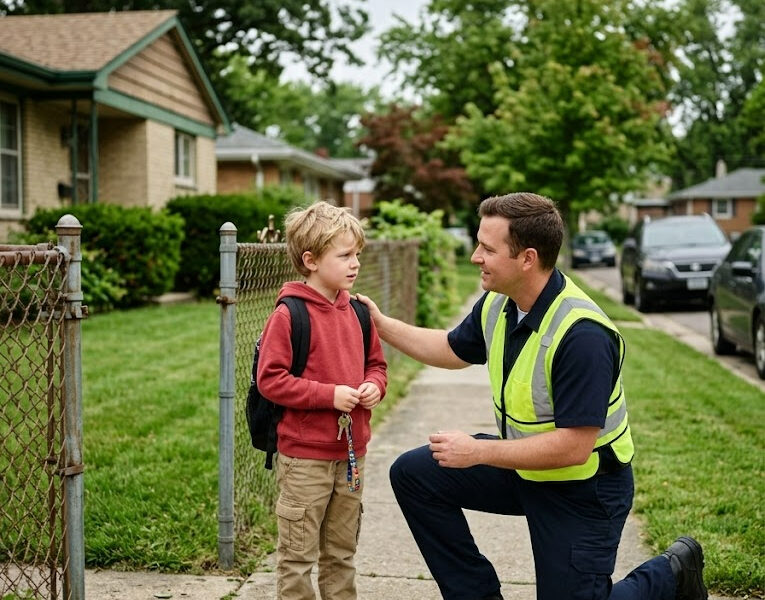
I lowered myself until we were eye level. “Did something happen?”
He looked toward the row of houses beyond the schoolyard.
“I need you to see something.”
“What kind of something?”
“I can’t tell you here.”
Years in law enforcement teach you that children often reveal danger sideways. They rarely begin with the hardest sentence. Sometimes they talk about stomachaches, missing homework, or not wanting to go home. Sometimes they say one thing while their eyes are asking something else entirely.
“Is someone hurting you?” I asked.
He shook his head, but not quickly enough to reassure me.
“They all think it’s normal,” he whispered.
“Who does?”
“Everyone.”
He dug both hands into the pockets of his jacket.
“If I tell them, they’ll say I’m causing trouble. But if you see it yourself, they can’t say that.”
That was not how most seven-year-olds spoke.
It wasn’t dramatic. It wasn’t rehearsed. It was the voice of a child who had already tried explaining and had learned that adults were very good at looking away.
“What’s your name?” I asked.
He hesitated, then said, “Marcus.”
“Okay, Marcus. I can walk with you.”
He nodded once, like a person accepting the terms of an agreement.
We left the school together while the afternoon moved around us as if nothing had changed. Parents called names. Car doors slammed. A crossing guard blew her whistle. Behind us, Evergreen Elementary looked ordinary and safe.
Beside me, Marcus walked with his shoulders slightly hunched.
He did not ask about my badge or my patrol car. He did not make small talk. Instead, he watched every doorway we passed, every parked car, every person on the sidewalk. He moved like a child who had already memorized where attention was dangerous.
The neighborhood was only a few blocks from the school. Small single-story homes stood behind chain-link fences. Wind chimes clinked on damp porches. Older sedans lined the curbs. The lawns were maintained just enough to avoid complaints, the kind of neighborhood people drove through without noticing much.
It did not look dangerous.
It did not look especially warm either.
It looked like a place where everyone minded their own business.
“Does your dad know you asked me?” I said.
Marcus kept walking.
“He thinks this is how families are.”
“That what is?”
He shook his head. “You have to see it.”
“What about your mom?”
“She’s gone.”
There was no explanation attached. Just the fact, set down carefully.
“And who lives with you?”
“My dad and my grandma.”
“Do they know you were going to ask for help?”
“Grandma knows.”
That answer surprised me.
“She knows?”
Marcus nodded. “She said maybe if somebody official saw it, Dad would stop saying it’s fine.”
We stopped in front of a modest one-story house I had driven past many times. No calls from that address. No welfare checks. No domestic reports. Nothing that would have made it stand out on a patrol log.
But standing in front of it, I noticed details I had never noticed from the street.
Every blind was pulled tight despite the bright afternoon sun. There were no toys in the yard, no bicycle leaning near the porch, no ball in the driveway. A cracked front window had been repaired from the inside with old packing tape. The welcome mat sat crooked beneath the door, weathered into something that looked more like habit than invitation.
Marcus pulled a small brass key from his pocket.
His fingers shook as he tried to fit it into the lock.
Before he turned it, he looked up at me.
“Can you promise me something?”
“I can promise I’ll listen.”
“If I show you, you won’t make me go back and pretend everything’s okay?”
The question stopped me cold.
Children ask police officers to find dogs, stop bullies, catch bad guys, or help them call their parents.
This boy was asking me not to return him to a lie.
I placed a hand gently on his shoulder.
“If something is unsafe, we deal with it,” I said. “You won’t face it alone.”
He studied me for several seconds. Then he nodded, unlocked the door, and pushed it open.
The air that drifted out was stale and heavy.
Not rotting.
Not the kind of smell that announces immediate danger.
Worse, somehow.
It was the smell of a house that had been sealed off from ordinary life for far too long.
Then I stepped inside and understood why Marcus had not tried to explain it.
Some things cannot be carried by words.
The house was not merely messy. A narrow path, barely wide enough for one person, twisted from the front door toward the kitchen. On both sides, piles rose like unstable walls: plastic bins, cardboard boxes, garbage bags, old newspapers, broken appliances, unopened packages, bags of clothes, stacks of mail, and household items still in store packaging.
The couch had nearly disappeared beneath belongings. Laundry baskets overflowed with clothes that still had price tags. Three microwaves were stacked near the wall, one still sealed in its box. Bundles of magazines reached almost to my shoulder.
I had seen hoarding before.
I had not seen a child forced to grow inside it.
Marcus watched my face carefully.
“See?” he said.
There was no triumph in his voice. No relief.
Only exhaustion.
He had been waiting a long time for an adult to look disturbed.
“Where’s your grandmother?” I asked.
He turned toward the hall. “Grandma? The officer’s here. The one I told you about.”
For a few seconds, nothing moved.
Then furniture scraped somewhere deeper in the house. Slow footsteps followed, careful and uneven, navigating the narrow path hidden beyond the hallway.
An older woman appeared in slippers and a faded housecoat. Her hair was thin and pinned loosely at the back. Her face looked tired, but her eyes were clear.
She looked at me without pretending.
“He told me he was bringing you,” she said. “I told him he should.”
“You told Marcus to ask a police officer for help?”
She nodded.
“I can’t stop myself anymore.”
The honesty in that sentence quieted the room.
“I’ve known for a long time,” she continued. “But I couldn’t make my son understand. And this little boy should not have to live like this.”
Marcus reached for my hand for half a second, then let go again.
It was not the gesture of a frightened child looking for rescue.
It felt more like confirmation.
Finally, someone else had seen it.
The woman’s name was Loretta. She told me Marcus’s father, Gary, worked long hours and had spent years insisting the house was manageable. Loretta had lived there first. The collecting had started after her husband died. Newspapers at first. Then coupons. Then clearance items. Then appliances she believed someone might need one day. After Gary moved back home with Marcus, the piles had already taken over several rooms.
“I told myself I could clear it,” she said.
“Could you?”
“No.”
Her voice did not shake. That made it sadder.
“I would move one pile and make three more. I knew it was wrong. But if anyone tried to throw something away, I felt like I couldn’t breathe.”
I asked Marcus how he knew to come to me.
“I watched you,” he said.
“For how long?”
“Two weeks.”
That answer stayed with me.
He explained that he had seen me sit beside another student whose parents were divorcing. The boy had been crying on the curb, and instead of rushing him along, I sat beside him until he was ready to speak.
“That’s when I knew,” Marcus said.
“Knew what?”
“You listen.”
He was not complimenting me.
He was explaining his process.
A seven-year-old had spent two weeks observing which adult might believe him.
Children should not have to develop investigative strategies to survive their own homes.
“Have you told anyone else?” I asked.
“My teacher once.”
“What happened?”
“She said maybe my family just needed to clean up.”
He looked down at his shoes.
“I told my aunt too. She said Grandma’s always been like this, and it wasn’t anybody else’s business.”
He did not cry while telling me.
That worried me more than tears would have.
He had cried long before I met him. What remained now was disappointment hardened into planning.
Marcus had learned something many adults never learn.
People can argue with descriptions.
They can dismiss complaints.
They can explain away words.
But they have a harder time denying something when they are standing inside it.
He had not asked me to believe a story.
He had asked me to walk home and see.
I radioed dispatch and requested my supervisor, then asked for Adult Protective Services to be notified. My voice stayed calm, but the situation had already changed shape. This was not a schoolyard concern. It was a welfare investigation.
While we waited, I asked Marcus how long the house had been this way.
He thought for several seconds.
“It was already like this when I was little.”
Then he pointed toward a corner where boxes nearly reached the ceiling.
“There used to be space there.”
“What was there?”
“My homework desk.”
He gave a small, sad smile.
“I don’t remember when it disappeared.”
Sergeant Dwight Kaminski arrived within twenty minutes. He had been in uniform long enough to keep his reactions under control, but I saw his face when he stepped through the door.
He looked once at the narrow pathway.
Once at Marcus.
Then he stepped back onto the porch and made the calls himself.
By the next morning, social workers were inside the home documenting every room. They took photographs, measured pathways, checked exits, and completed a safety assessment. Loretta cooperated fully. She answered questions without defensiveness, though each answer seemed to take something out of her.
She was mentally alert.
She was ashamed.
She was also honest.
“I need help,” she told the social worker. “I should have said it before he had to.”
She looked at Marcus when she said that.
He stood near the doorway clutching one strap of his backpack.
Later that evening, Gary came home from work.
He stepped through the front door and froze.
Investigators stood in the living room. Social workers were speaking with Loretta. Sergeant Kaminski stood near the kitchen path. Marcus sat quietly on the front step beside me.
For several long seconds, Gary did not say a word.
He simply stared at the piles.
The towers of belongings.
The blocked rooms.
The home he had walked through every day without truly seeing.
Then he walked back outside, sat on the steps, buried his face in both hands, and went completely still.
Watching him, I understood something that complicated the whole situation.
Gary was not a monster.
He was not cruel in the easy, obvious way some people are cruel.
He was a father who had slowly gone blind to his own reality.
For fifteen years, the piles had grown inch by inch. Every time a room became unusable, he told himself it was temporary. Every time Marcus lost another piece of childhood, Gary convinced himself there was still enough space, enough safety, enough normal left to get by.
Denial rarely feels like denial from the inside.
It feels like surviving one more day.
But children pay for that kind of survival.
Because the home was not safe, Marcus temporarily moved in with his Aunt Paulette while professionals began clearing the property. It was not treated as punishment. It was protection.
Over the next four days, a specialized cleanup company removed eleven tons of accumulated belongings from the house.
Eleven tons.
Room by room, the home reappeared.
Sunlight came through windows that had not been opened in years. Floors became visible. Doorways widened. The kitchen counters emerged from beneath years of stacked items. A child’s bedroom, half buried under storage bins, was cleared until a bed and desk could fit again.
When Marcus saw the empty corner where his homework desk used to be, he did not cheer.
He stood there quietly and touched the wall.
Sometimes children do not know how to celebrate receiving what should never have been taken.
Adult Protective Services worked with Loretta instead of treating her like a criminal. She began counseling and agreed to treatment for hoarding disorder. The family learned, slowly and painfully, that this was not solved by yelling “clean up” from the doorway. It required treatment, boundaries, support, and hard honesty.
Gary attended every required meeting.
At first, he looked ashamed enough to disappear inside himself. But shame alone is not change. So the social workers made the steps plain.
Counseling.
Home monitoring.
Parenting support.
Safety plans.
Clear pathways.
No blocked exits.
No piles in Marcus’s room.
No excuses dressed up as family privacy.
Gary signed everything.
Loretta signed everything.
Paulette admitted she had dismissed Marcus because she thought the house was simply “how Loretta lived.” That sentence, spoken aloud in the conference room, made her cry.
“I should have listened to him,” she said.
Marcus sat beside her and looked down at his hands.
No one asked him to comfort the adults.
That mattered too.
Several weeks later, I stopped by Evergreen Elementary during dismissal. The playground looked the same as always. Kids raced toward cars. Teachers called out reminders. Parents waved from the curb.
The world has a way of looking ordinary after something extraordinary happens.
I visited Marcus’s classroom.
Mrs. Calloway smiled when she saw me.
“He’s doing better,” she said. “He’ll be back next week.”
She pointed toward the third desk beside the window.
Before staying with his aunt, she told me, Marcus had started raising his hand again. He was speaking during group activities. He had even asked for extra drawing paper.
“He seems lighter,” she said.
That word stayed with me.
Lighter.
Not healed.
Not finished.
Just carrying less than before.
As I left the classroom, I paused on the school steps and watched children stream past me in every direction. Most would go home worried about homework, dinner, soccer practice, cartoons, or whether a friend had saved them a seat on the bus.
Marcus had spent weeks observing adults, calculating trust, and designing a plan to make someone witness what no one wanted to believe.
He had told me on the walk, “Everyone I know thinks this is just how families are.”
That was the sentence I kept returning to.
Because children do not always know what is normal. They learn normal from the people around them. If the adults shrug at danger long enough, a child may begin to believe the danger is just another household rule.
But something in Marcus refused to accept that.
He knew enough to understand that words had failed him.
So he chose evidence.
Walk me home.
See it yourself.
Years of police work had taught me how to document reality, preserve facts, and avoid assumptions. Yet that afternoon, a second-grade boy understood the core of investigation better than most grown people.
He understood that truth sometimes needs a witness before anyone will stop arguing with it.
I worked many cases after that. Some involved violence. Some involved arrests, courtrooms, and newspaper headlines. Some looked far more dramatic on paper than a crowded house on a quiet Portland street.
But when people ask which call stayed with me the longest, I do not think first of flashing lights or handcuffs.
I think of a little boy with an oversized backpack standing beside a school sidewalk, waiting patiently until he found one adult he believed might listen.
He did not ask me to save his whole life in one afternoon.
He asked me to walk beside him.
To step inside.
To look.
Sometimes that is where rescue begins.
Not with a speech.
Not with a promise big enough to sound heroic.
But with one adult finally saying the words a child has been waiting too long to hear.
“I see it.”
“And I believe you.”
THE END
Disclaimer: This content is entirely AI-generated for fictional and entertainment purposes only. Any resemblance to actual persons, living or dead, events, or locations is purely coincidental, and the creator assumes no liability for any interpretation of this content.
Disclaimer: This story is fictional and created for entertainment purposes only. Any names, characters, places, or events are fictitious or used fictitiously. No real person or organization is intended to be portrayed.