cnu A Poor Boy Returned My Son’s Shoes, and One Look Into His Eyes Revealed the Child I Never Knew I Had—Then Hidden Letters, a Forged Family History, and My Father’s Safe-Deposit Box Exposed Why My First Love Disappeared… and Why Someone Had Been Watching Both of My Sons Since Birth.
THE BOY WHO RETURNED MY SON’S SHOES
PART 1: THE EYES ON MY DOORSTEP
The knock was so quiet I almost ignored it.
I had just returned from another fourteen-hour day at Cross Industries and was standing in the marble entryway with my tie loosened and a glass of whiskey in my hand. Rain streaked the tall windows. Beyond them, the driveway disappeared into darkness.
Then the knock came again.
Soft.
Careful.
Almost apologetic.
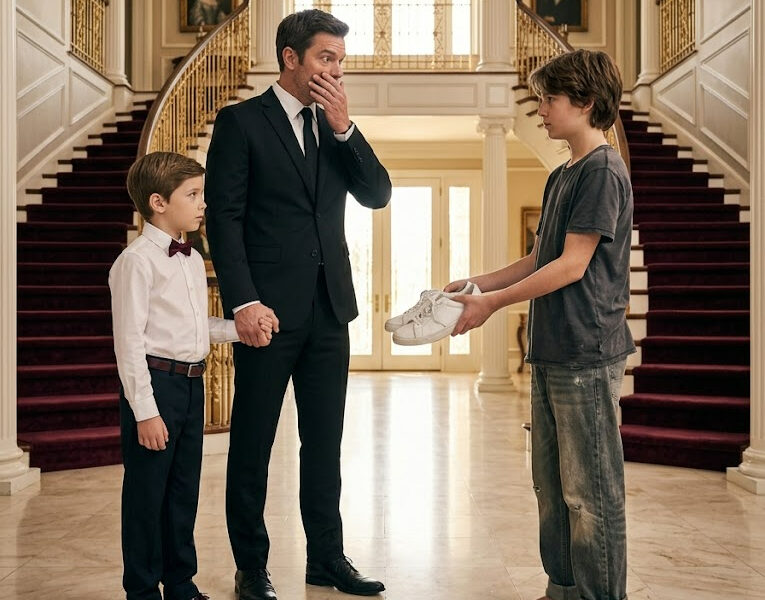
I opened the door and found a barefoot boy holding a pair of brand-new white sneakers by their laces.
He looked about nine. His jeans were faded at the knees, and the collar of his thin shirt had stretched out of shape. Rainwater darkened his hair.
“Sir,” he said, “your son gave me these at school, but my mom says I can’t keep them.”
For a moment, I did not understand what he meant.
Then I looked into his eyes.
Warm amber.
Bright around the edges and darker near the pupils.
The same eyes I had spent ten years trying not to remember.
My fingers went numb.
The whiskey glass slipped from my hand and shattered across the floor.
“Dad?”
My six-year-old son, Caleb, appeared behind me wearing socks and dinosaur pajamas.
I barely heard him.
“What is your name?” I asked the boy.
“Leo Bennett.”
Bennett.
The name struck harder than the broken glass.
Ten years earlier, Rachel Bennett had vanished from my life. Her apartment was empty, her telephone disconnected, and every letter I sent returned unanswered. My mother eventually told me Rachel had left the state with another man.
Months later, she said Rachel had been involved in an accident.
“There is nothing you can do now, Daniel,” Vivian Cross told me. “You must let her go.”
I believed her because she was my mother.
I believed her because grief is easier to survive when someone gives it a shape.
Now a child with Rachel’s eyes stood on my doorstep.
Caleb stepped around me.
“Leo is my friend. His shoes broke at recess, so I gave him mine.”
“You gave him the new pair Grandma bought you?”
Caleb nodded seriously. “He needed them more.”
Leo held them toward me.
“My mom said kindness doesn’t mean I can take expensive things from people.”
I looked down at his bare feet.
“What happened to your old shoes?”
“The bottom came off.”
“You walked here?”
“It’s not far.”
It was nearly three miles.
“You did the right thing returning them,” I said. “But you are not walking home barefoot.”
Leo’s shoulders tightened.
“My mom said not to get in cars with people.”
“She was right.”
I called the number he gave me and put the phone on speaker. A woman answered after the second ring.
“Hello?”
My chest constricted.
“Rachel?”
Silence.
Then a sharp breath.
“Who is this?”
“Daniel.”
The line went dead.
Leo watched me carefully.
“I’ll drive behind you while you walk,” I said. “Caleb can come with us. Your mother can see us from the doorway before you get near the car.”
That arrangement satisfied him.
Maple Row was less than fifteen minutes from my estate but belonged to a different version of the city. The streetlights were dimmer. Several porches sagged, and plastic covered broken windows.
Leo’s house was small but clean. A yellow porch lamp glowed above the door.
It opened before we reached the steps.
Rachel stood beneath the light.
She was older, thinner, and more tired than the woman I remembered. But there was no possibility of mistaking her.
For one terrible second, neither of us spoke.
Then she pulled Leo behind her.
“Stay away from my son.”
“Rachel, I was told you left.”
A bitter laugh escaped her.
“You believed that?”
“I searched for you.”
“Not very hard.”
“Your apartment was empty. Your number was gone. My mother said—”
“Your mother paid me to disappear.”
The rain seemed to stop around us.
“She showed me papers with your signature. She said you knew I was pregnant and wanted nothing to do with us.”
I looked at Leo.
His face had become very still.
“Pregnant?”
Rachel searched my expression. Whatever she saw there surprised her.
“She told you I was dead, didn’t she?”
“Not exactly. She said there had been an accident.”
“That was convenient.”
“I never knew about him.”
Rachel’s anger wavered, but only for a moment.
“Your family always has an explanation.”
“I am not asking you to trust me tonight.”
“I don’t trust anyone named Cross.”
Caleb stood beside my leg holding the white sneakers.
“Can Leo keep these?”
Rachel looked at him.
Then she looked at her son’s bare feet.
“Yes,” she said quietly. “He can keep the shoes.”
Leo accepted them.
I wanted to ask a thousand questions, but his face reminded me that this was not only my mystery.
It was his life.
“I will not return without permission,” I told Rachel. “But please let me speak to you.”
She stepped backward.
“You had ten years.”
“I didn’t know.”
Her eyes filled.
“That does not give the years back.”
“No.”
The door closed.
I remained on the porch until Caleb slipped his hand into mine.
“Dad?”
“Yes?”
“Why are you crying?”
I touched my face and discovered he was right.
“I think Leo may be someone we should have known a long time ago.”
Caleb considered that.
“Like family?”
I looked at the closed door.
“Yes,” I whispered. “Exactly like family.”
PART 2: THE LETTERS I NEVER RECEIVED
I sat outside Rachel’s house until the rain stopped.
Ten years earlier, I had been twenty-five and preparing to take a senior position at Cross Industries. Rachel worked in the public library’s community program. She had no interest in my family’s name or money.
That was one reason I loved her.
My father, Charles Cross, called the relationship a distraction. My mother was more polite.
“She seems pleasant,” Vivian said. “But pleasant is not enough for the life you are expected to lead.”
Rachel disappeared three weeks after I told my parents I planned to move out of the family estate.
I had searched hospitals, called her friends, and hired an investigator. Every path ended in the same answer.
She had left voluntarily.
Eventually, my father told me to stop humiliating myself.
“Some people are chapters, Daniel. They are not the whole book.”
All that time, Rachel had been raising my child fifteen minutes away.
The following morning, I went to the boys’ school and spoke with the counselor, Ms. Avery. I asked her to give Rachel my number and tell her I would respect any boundaries she set.
Rachel called that evening.
“You have ten minutes.”
“Thank you.”
“Don’t thank me yet.”
She agreed to meet at a diner across from the public library.
“You come alone,” she said. “And do not bring money. People in your family think money turns cruelty into a business decision.”
Rachel sat in a booth near the back wearing a gray sweater. A worn envelope rested on the table.
“Tell me what you remember,” she said.
I described the empty apartment, disconnected phone, and returned letters.
She pushed the envelope toward me.
It was addressed in her handwriting and stamped RETURN TO SENDER.
Inside was a letter dated ten years earlier.
Daniel,
I do not know whether your mother told you the truth. She says you have made your decision, but I need to hear it from you.
I am twelve weeks pregnant. I am frightened, but I am not asking you to solve everything. I am asking you to speak to me.
Please call.
Rachel.
“I sent seven,” she said. “They all came back.”
“I never saw any of them.”
“Your mother showed me a legal document bearing your signature. It said you surrendered any claim to the child and would seek sole custody if I contacted you publicly.”
“I never signed that.”
“I know that now.”
“Why did you accept her money?”
Rachel’s expression hardened.
“Because I was twenty-three, pregnant, unemployed, and facing eviction. My mother needed surgery. Vivian said if I fought, your family would bury me in court until the baby was grown.”
“How much?”
“Seventy-five thousand dollars.”
She used most of it on medical bills and Leo’s premature birth. The remainder kept them housed while she trained as a medical-records technician.
“When Leo was eighteen months old, I went to the Cross Foundation,” she continued. “I asked to see you.”
“I was in London.”
“A security guard returned and said you refused.”
“Who gave him that message?”
“I don’t know.”
I covered my face.
Every answer created another betrayal.
Rachel leaned back.
“Do not make this only about what your family took from you. They took something from Leo too.”
“I know.”
“No, you know intellectually. You have not yet watched him ask why other boys have fathers at school events. You did not sit beside him during fevers or explain why his birthday cards had only one parent’s name.”
Her words hurt because they were true.
“I cannot replace those years.”
“No.”
“But I want to know him.”
“That choice belongs partly to him.”
“And to you.”
“Yes.”
We agreed to a DNA test.
“Not because I doubt you,” I said. “Because Leo deserves facts instead of another story created by adults.”
The result arrived two days later.
Probability of paternity: 99.99 percent.
The paper felt like a birth announcement delivered nine years too late.
Before speaking to Leo, I confronted my mother.
Vivian was arranging white roses in the conservatory when I entered.
“I found Rachel.”
The stem snapped between her fingers.
“And the boy?” she asked.
“You know about Leo.”
“I know she had a child.”
“He is my son.”
Her first question was not whether he was healthy.
“What has she asked for?”
“Nothing.”
“She will.”
“Stop.”
My voice struck the glass walls.
I placed Rachel’s returned letter on the table.
“You forged my signature. You intercepted her mail. You had her turned away from the foundation.”
Vivian remained composed.
“I protected you.”
“From my child?”
“From a scandal during a critical period. Your father was ill. The board was unstable. Northbridge was attempting to remove our voting rights.”
“A pregnancy is not a scandal.”
“To that board, it was leverage.”
“You told me Rachel was dead.”
“I told you there had been an accident.”
“You let me believe she was gone forever.”
Her eyes shifted.
The distinction mattered to her because it reduced a monstrous lie to careful wording.
“Did Father know?”
Vivian looked toward the windows.
“He made the final decision.”
My father had sat beside me while I grieved and advised me to move on.
“He knew Leo existed?”
“Yes.”
I thought anger would make me shout.
Instead, it hollowed me out.
That evening, I told my former wife, Caroline, what had happened. Our marriage had ended respectfully three years earlier, and we shared custody of Caleb.
“You need to tell him before the schoolyard does,” she said.
I sat inside Caleb’s cardboard castle that night.
“I think Leo may be your brother.”
His eyes widened.
“A real brother?”
“Yes.”
“Did you lose him?”
“I didn’t know where he was.”
“Did he know where you were?”
“No.”
Caleb thought carefully.
“Then you were both lost.”
Two days later, Rachel and I sat with Leo at her kitchen table. The white sneakers remained in their box beside him.
“Am I in trouble?” he asked.
“No,” Rachel said.
“Then why is Mr. Cross here?”
I leaned forward.
“Your mother and I knew each other before you were born.”
“I know.”
Rachel blinked. “You do?”
“You have his picture in the blue book in your closet.”
Then he looked at me.
“You’re my dad, aren’t you?”
The room became still.
“Yes.”
“Did you know?”
“No.”
“Do I have to move?”
“No.”
“Do I have to call you Dad?”
“No.”
“Does Mom have to marry you?”
Rachel almost laughed.
“Definitely not.”
I smiled despite the ache in my chest.
“I will not change your life without asking you.”
Leo looked at the shoes.
“Can I keep these?”
“They belong to you.”
His smile was small and cautious.
It was also unmistakably mine.
PART 3: THE GRANDFATHER WHO WATCHED FROM A DISTANCE
The weeks that followed did not transform us instantly into a family.
Rachel allowed two visits a week at first. We met in public places—libraries, parks, school events. Caleb joined us on Saturdays, and the boys accepted brotherhood far more easily than the adults accepted history.
I did not bring extravagant gifts.
I brought sandwiches, homework help, and time.
Leo tested me in quiet ways.
He arrived late once to see whether I would leave.
I stayed.
He refused to speak during an entire lunch.
I remained beside him without demanding gratitude.
One afternoon, he asked why I had such a large house.
“Because I inherited advantages most people do not receive.”
“Did you earn it?”
“Some of it. Not all.”
He nodded as though honesty mattered more than the answer.
Trust returned in fragments.
Rachel let me remain with Leo while she visited the pharmacy. She called when his school bus was delayed. Once, she laughed at something I said and did not immediately look guilty afterward.
Then a package arrived at my office.
Inside were a brass key, an old photograph, and a note.
The picture showed Leo at about three years old beside a park fountain.
My father stood next to him.
Alive.
Smiling.
On the back, Charles Cross had written:
For Daniel, when the truth can no longer be buried.
Below it were the name of a bank and a safe-deposit box number.
I called Rachel.
“I have a photograph of Father with Leo.”
Silence.
Not surprise.
Recognition.
“You said you never met him after you disappeared.”
“I didn’t go to him. He came to me.”
When Leo was three, Charles approached Rachel at the park. He apologized for the false documents and admitted that Vivian had acted with his approval.
Then he warned her about Northbridge Holdings.
Northbridge was an old investment consortium that financed Cross Industries during its early years. It owned no obvious controlling interest, but several trusts connected to it influenced board votes, loans, and executive appointments.
My father called it the shadow at the end of the conference table.
“He told me to take Leo and leave the country,” Rachel said.
“Why?”
“He said your child had activated something he could no longer contain.”
“What?”
“He would not explain.”
Rachel refused to uproot Leo for an unnamed danger. Charles then gave her a bank card connected to the safe-deposit box.
Three days after his funeral, the card vanished from her apartment.
That same evening, Rachel’s mother, June, called.
Someone had searched her house while she was at the pharmacy. They ignored cash and jewelry but took an old photograph of Charles with Leo.
Rachel and I drove there together.
June Bennett lived in a small bungalow filled with books and sewing supplies. The lock on her back door had been forced.
She admitted Charles had visited her several times.
“He believed Rachel was targeted because Daniel planned to leave the Cross company,” June said. “Then Leo was born, and Charles became frightened.”
She removed a sealed letter from a sewing basket.
It had been written by June’s mother, Margaret, who worked as a nurse in the private maternity wing where I was born.
The letter described confusion on the night of my birth.
Vivian delivered a baby boy who stopped breathing shortly afterward. Before the death was formally recorded, another newborn arrived under the care of Dr. Jonathan Vale, a physician with close ties to Northbridge.
Identification bands were changed.
By morning, Vivian was holding a healthy infant.
The final line read:
Charles, the child you raised as Daniel was not the child Vivian delivered.
I read it three times.
“My father was not my biological father?”
June shook her head.
“Charles discovered the truth after Leo was born. Your son’s blood tests revealed a hereditary marker Charles knew did not exist in either Cross family line.”
“Whose child was I?”
She looked at the brass key.
“That may be what he left in the bank.”
The next morning, Rachel and I presented the key and Charles’s note to the branch manager.
The safe-deposit box required two registered account holders.
“My father is dead,” I said.
“You are not the second account holder.”
He looked at Rachel.
“She is.”
Rachel went still.
“I have never been here.”
“Your signature was registered ten years ago.”
The date was three months before she learned she was pregnant.
The manager produced a sealed packet containing a second key and a notarized instruction from Charles.
Rachel inserted one key.
I inserted the other.
Inside the box were corporate records, medical files, a digital recorder, and a photograph.
It showed Charles beside a younger Vivian and a man whose face resembled mine so precisely that my knees weakened.
Jonathan Vale.
The physician from Margaret’s letter.
Rachel touched my arm.
“He could be your biological father.”
The recorder activated when I pressed the switch.
My father’s tired voice filled the room.
“Daniel, if you are hearing this, then I failed to keep the truth buried long enough to protect you.”
Rachel took my hand.
“There is something you must understand before trusting anyone named Cross, Bennett, or Vale,” Charles continued.
“Leo is not the first child Northbridge has watched.”
Static crackled.
“They have monitored Caleb since the day he was born.”
PART 4: THE PURPOSE OF NORTHBRIDGE
Charles’s recording lasted forty-three minutes.
He explained that Jonathan Vale had not merely been a physician.
He was one of Northbridge’s principal architects.
Decades earlier, Northbridge created a private succession plan around a portfolio of companies, including Cross Industries. Control would eventually pass through a hereditary trust tied to Jonathan’s biological descendants.
Jonathan had no acknowledged children.
But he had fathered a son.
Me.
Vivian’s newborn died after delivery. Charles, devastated and desperate, agreed to raise another infant rather than expose the hospital’s negligence and his wife’s medical vulnerability.
Jonathan provided the child.
Northbridge provided silence.
In return, Charles signed documents recognizing the consortium’s future influence over any company shares inherited by Jonathan’s biological line.
At first, Charles believed the arrangement was symbolic. Years later, he discovered the trust controlled patents, land, and voting rights worth hundreds of millions.
Its clauses activated when Jonathan’s male descendant had two legally recognized sons.
Leo was the first.
Caleb was the second.
Northbridge had separated Rachel from me to prevent Leo from being publicly acknowledged before it controlled the conditions.
After Caleb’s birth, the full trust became eligible for transfer.
“They do not need the boys dead,” Charles said on the recording. “They need them documented, managed, and dependent. Northbridge intends to place their assets under guardianship while controlling Daniel through the Cross board.”
My stomach turned.
The consortium had manipulated my parents for decades. Vivian protected the company’s image because Northbridge convinced her scandal would destroy us. Charles eventually understood that obedience only strengthened the trap.
He created the safe-deposit box and secretly registered Rachel because she was outside the Cross corporate structure.
“She has every reason to distrust us,” Charles said. “That is precisely why she may be the only person capable of refusing Northbridge’s money.”
The box contained evidence: trust documents, correspondence with Jonathan Vale, hospital records, and board communications proving Northbridge’s interference.
There was also a recent surveillance report.
Photographs showed Caleb entering school, Leo leaving the library, and Rachel shopping with her mother.
They had been watched.
We left the bank through a private exit and went directly to my attorney, Miriam Shaw. She assembled a team specializing in trusts, corporate fraud, and child privacy.
We did not confront Vivian immediately.
We secured the children first.
Caroline changed Caleb’s school pickup list. Rachel temporarily moved with Leo to a protected apartment. Both boys were told only that adults were handling a legal problem and they were not in trouble.
Miriam petitioned the court to seal their records and block any trust action without independent representation.
Then we contacted federal investigators.
Northbridge had survived because each family believed it was facing an isolated problem. The documents connected decades of bribery, forged medical records, concealed inheritances, and market manipulation.
Jonathan Vale was still alive.
He served as chairman emeritus of the Vale Medical Foundation and appeared publicly as a respected philanthropist.
When investigators requested an interview, he invited me to his penthouse.
Miriam advised against going.
I went with federal agents listening through a concealed transmitter.
Jonathan stood beside a wall of windows overlooking the city. Age had narrowed his body but not his authority.
“You look more like me every year,” he said.
“I am not here for a reunion.”
“No. You are here because Charles finally burdened you with the truth.”
“You gave me to another family.”
“I gave you a future.”
“You converted a child into a financial instrument.”
He smiled faintly.
“Every inheritance is an instrument.”
“What do you want with my sons?”
“To protect what belongs to them.”
“They are children.”
“They are beneficiaries of a structure larger than your sentimental understanding of fatherhood.”
I thought of Leo returning shoes he desperately needed because his mother taught him integrity.
I thought of Caleb giving them away without asking permission.
Neither boy belonged to Northbridge.
“They will not sign anything.”
“They do not need to. Guardians sign for children.”
“And who chooses the guardians?”
Jonathan’s expression changed.
He realized I knew.
Northbridge intended to challenge Rachel’s fitness based on poverty and remove Leo from her care. Caleb’s trust rights could then be consolidated under a corporate guardian if I were declared conflicted or incompetent.
Vivian had already supplied information about Rachel’s finances.
“My mother is involved?”
“Vivian understands duty.”
The door opened behind me.
Federal agents entered.
Jonathan did not look surprised.
He only looked disappointed.
“You could have inherited everything without conflict.”
“I already inherited enough lies.”
The investigation moved quickly after his arrest. Search warrants uncovered files on dozens of children connected to Northbridge families. Private investigators had monitored schools, medical appointments, and custody disputes.
Vivian was questioned.
At first, she insisted she protected Caleb.
Then Miriam showed her the report describing him as an “eligible minor asset.”
For the first time, my mother understood that Northbridge had never considered our family important.
Only useful.
She agreed to cooperate.
It did not absolve her.
She admitted forging my signature, intercepting Rachel’s letters, and paying security staff to keep us apart.
When she asked whether she could meet Leo, I said no.
“That decision belongs to him someday.”
“I am his grandmother.”
“You were his first enemy.”
The words wounded her.
They were also true.
PART 5: THE FAMILY WE BUILT AFTER THE LIE
The Northbridge case lasted nearly two years.
Jonathan Vale and several executives were convicted of fraud, conspiracy, unlawful surveillance, and offenses tied to forged trust and medical documents. The hereditary trust was placed under court supervision and dismantled.
Assets legally belonging to my children were transferred into independent trusts managed by professionals selected jointly by Rachel, Caroline, and me.
No corporate board could control them.
No relative could borrow against them.
No one could use wealth to decide where the boys lived or whom they loved.
Cross Industries survived after removing Northbridge directors and accepting independent oversight. I stepped down as chief executive.
For most of my life, I believed leading the company was my duty.
Then I learned duty without choice was only another inheritance someone else had written for me.
I remained a shareholder but spent less time in boardrooms and more time learning how to be Leo’s father.
That process was not dramatic.
It was difficult and ordinary.
I attended his soccer games.
I learned he hated peas, loved astronomy, and became quiet when angry.
The first time he became sick while staying with me, he asked for Rachel every ten minutes. I called her each time instead of taking it personally.
Trust grew because I stopped treating it as something biology owed me.
Caleb and Leo became inseparable.
They argued over video games, traded lunches, and occasionally used the phrase “my brother” when they wanted permission for something neither mother had approved.
Rachel and I did not rebuild our old romance.
Too much had happened, and neither of us wanted nostalgia to make decisions for us.
We built respect instead.
She became director of a legal fund helping parents fight coercive custody cases funded by wealthy families. I supplied initial financing through an independent foundation, but Rachel controlled the program.
“You are not buying redemption,” she warned.
“I know.”
“You cannot donate your way into forgiveness.”
“I know that too.”
One evening, almost three years after Leo appeared at my door, we stood outside the boys’ school while Caleb and Leo argued over whose turn it was to carry a science project.
Rachel looked at me.
“You stayed.”
“I said I would.”
“People say many things.”
“I know.”
She smiled faintly.
It was not a promise of romance.
It was something more valuable.
Belief.
Vivian accepted a plea agreement for forgery, obstruction, and conspiracy. She avoided prison because of her cooperation but lost her positions in the company and foundation.
She wrote letters to both boys.
Caleb read his with Caroline.
Leo refused his.
“I don’t want to know her yet,” he said.
“That is your choice.”
“Are you mad?”
“No.”
He looked surprised.
Adults had spent years making choices for him. Respecting one should not have felt unusual.
Charles’s role remained complicated.
He had participated in the lie of my birth and the destruction of Rachel’s future. Later, he tried to protect us, but fear made him secretive until death.
I could love the father who raised me and still condemn what he did.
Human beings are rarely one thing.
That did not mean consequences were unnecessary.
It meant truth did not require us to simplify people into heroes and monsters.
On Leo’s twelfth birthday, we held a small dinner at Rachel’s house.
Caleb gave him a telescope he had saved for months to buy. Leo gave Caleb the old white sneakers, now too small and carefully cleaned.
“I thought they were mine,” Caleb said.
“They were,” Leo replied. “Now they’re yours again.”
“Why?”
“Because they started everything.”
Rachel looked at me across the table.
The night Leo returned those shoes, I believed the greatest secret was that he was my son.
I was wrong.
The greater secret was how many adults had built entire lives around controlling what children were allowed to know.
The shoes had crossed a boundary money was meant to maintain.
A wealthy child noticed a poor child needed something.
A poor child’s mother taught him to return what was not his.
That simple act of kindness brought Leo to my door and cracked open a lie powerful people had protected for ten years.
Later, while the boys assembled the telescope in the backyard, Leo came to stand beside me.
“Can I ask you something?”
“Anything.”
“Do you wish I knocked sooner?”
The question tightened my throat.
“I wish I had known how to find you.”
“That isn’t what I asked.”
He had inherited Rachel’s refusal to accept evasive answers.
“Yes,” I said. “I wish you had come sooner. But you were a child. Finding me was never your responsibility.”
He nodded.
“Do you wish you never found out about Northbridge?”
I looked toward Caleb, who was holding a flashlight backward while Rachel tried not to laugh.
“No. Truth can hurt your life. A lie decides it for you.”
Leo thought about that.
Then he slipped his hand into mine.
It was the first time he had initiated the contact.
“Dad?”
My chest tightened.
He had called me Daniel for three years.
“Yes?”
“You’re holding the flashlight wrong too.”
I laughed.
Across the yard, Caleb shouted that both of us were useless.
Rachel shook her head.
For ten years, my family believed money could bury anything.
A pregnancy.
A child.
A stolen identity.
A father’s guilt.
But the truth did not return through lawyers, investigators, or corporate records.
It arrived barefoot on my doorstep, carrying a pair of white shoes.
And once I looked into my son’s eyes, every door they had closed began to open.
THE END
Disclaimer: This content is entirely AI-generated for fictional and entertainment purposes only. Any resemblance to actual persons, living or dead, events, or locations is purely coincidental, and the creator assumes no liability for any interpretation of this content.
Disclaimer: This story is fictional and created for entertainment purposes only. Any names, characters, places, or events are fictitious or used fictitiously. No real person or organization is intended to be portrayed.