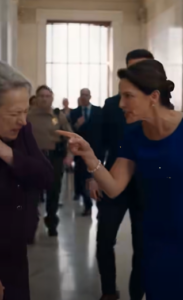
 I found David near the elevators twenty minutes later.
He was standing alone with his phone pressed to his ear, speaking in a low, urgent voice.
I hadn’t gone looking for him.
I had been heading toward the parking garage when I turned the corner and saw him leaning against the wall.
His tie was loosened.
His hair, normally arranged with almost obsessive care, looked as though he had run his hands through it several times.
For a moment, he reminded me of the young law student who used to come home after examinations, exhausted and frightened that he hadn’t done well enough.
Then I heard what he was saying.
“No, Clara, listen to me.
I can’t make that decision for her.”
He paused.
“I know what your father wants.”
Another pause.
“I said I’ll talk to her.”
My footsteps made him turn.
His expression changed immediately.
“I’ll call you back,” he said into the phone.
He ended the call.
“Mom.”
I stopped several feet away.
“David.”
He looked at my arm.
I had left the clinic with instructions to rest my shoulder, and I was keeping it close to my body because certain movements still sent pain down toward my elbow.
For the first time that day, my son seemed to notice.
“Are you okay?”
The question was so late that it almost hurt to hear.
“I’ve been examined.”
“Is anything broken?”
“No.
I have a contusion and a strain.”
He looked relieved.
“Thank God.”
I studied his face.
“David, I need to ask you something.”
He glanced toward the elevator.
“Can we talk somewhere private?”
“We can talk here.”
“Mom, please.”
I looked at the empty stretch of corridor behind him.
“No one is standing close enough to hear us.
And I’m not discussing your case.”
He exhaled.
“Fine.”
I kept my voice quiet.
“Mr.
Bennett told me what you said about the incident.”
David’s expression tightened.
“Okay.”
“You told him you couldn’t say exactly how Clara made contact with me.”
He looked away.
“I didn’t want to speculate.”
I stared at him.
“Speculate?”
“Things happened quickly.”
“Yes, they did.”
“Mom, you were both upset.
Clara was stressed.
Everybody was talking at once.”
“Did you see her push me?”
He pressed his lips together.
I waited.
There had been many times during David’s childhood when I had asked him difficult questions.
Had he finished his homework?
Had he told the truth about a broken lamp?
Had he taken money from my purse without asking?
I never expected perfection from him.
But I expected honesty.
I had taught him that admitting a mistake was the beginning of fixing it.
Now I was asking a grown man a question about something he had watched happen to his own mother.
And he couldn’t look at me.
“David.”
He rubbed his forehead.
“I saw her move toward you.”
“Did you see her hands touch me?”
“Mom—”
“Did you?”
He lowered his voice.
“Why are you doing this?”
The question stunned me.
“Why am I doing what?”
“Interrogating me like I’m a witness on the stand.”
I felt the pain in my shoulder pulse.
“You’re a witness, David.
That’s what you are.”
He looked at me sharply.
“You’re also my mother.”
“Yes,” I said.
“I am.”
Something about the way I answered made him uncomfortable.
He shifted his weight.
“Clara says you stepped into her way.”
I stared at him.
“Is that what you believe?”
“I’m telling you what she says happened.”
“That’s not what I asked.”
He sighed.
“Mom, I’m trying to keep everybody calm.”
“And how is that working?”
“Please don’t do this.”
I took a slow breath.
I had promised myself that I wouldn’t raise my voice.
I didn’t need to.
“David, when your wife put her hands on me, you were three feet away.
You saw me hit the wall.
You heard the bailiff.
You heard the woman who said Clara shoved me.”
He looked down.
“And your response was to ask me to disappear.”
His jaw moved.
“I asked you to wait downstairs.”
“Because you were embarrassed.”
“Because I was trying to avoid a bigger confrontation.”
I looked at him for a long moment.
“With whom?”
He blinked.
“What?”
“Who were you trying to protect from a bigger confrontation?
Me?
Or Clara?”
He said nothing.
I continued.
“You didn’t tell Clara to leave.
You didn’t tell her to calm down.
You didn’t even ask if I needed help picking up my things.”
“Mom, I didn’t think—”
“No,” I said.
“You didn’t.”
That stopped him.
For a moment, I thought he might finally say what I needed to hear.
Instead, he lowered his voice.
“Do you understand how serious this hearing is for Clara’s family?”
I almost laughed.
Not because anything was funny.
Because the answer had become so painfully predictable.
“David, your wife assaulted me in a courthouse hallway.
And you’re still talking about her family’s hearing.”
“It’s an emergency matter involving substantial business interests.”
“I’m aware of the case title.
I haven’t considered the merits, and I won’t.
It has been reassigned.”
He looked startled.
“Reassigned?”
“Yes.”
His eyes widened.
“Because I’m representing the petitioners?”
“Of course.”
He stepped backward, pressing a hand against his forehead.
“Right.
Of course.”
For the first time, he appeared to understand the full situation.
Not simply that I was at the courthouse.
Not simply that I remained an active senior judge.
But that I had been assigned, however briefly, to a case in which my own son was counsel.
“And you’re not going to hear it?” he asked.
“No.”
“Who is?”
“That isn’t something I’m going to discuss with you outside the official notification process.”
He looked offended.
“Mom, I’m your son.”
“And you’re also an attorney.
You know why I can’t discuss a pending matter with you.”
He closed his eyes.
I watched the conflict move across his face.
He wanted to ask more.
I could see it.
He wanted reassurance that the case hadn’t been damaged, that the reassignment wouldn’t create embarrassment, that I would somehow make the morning disappear.
But I had spent my career making sure personal relationships didn’t control legal decisions.
I wasn’t going to abandon that principle because my son found it inconvenient.
Finally, David said, “Clara thinks you planned this.”
I stared at him.
“Planned what?”
“Showing up at the courthouse.
Making a scene.
Having everybody hear you called Judge Warren.”
For a moment, I couldn’t believe what I was hearing.
Then I realized he was serious.
“David, Judge Lawson was hospitalized during the night.
I received a call before six this morning.
I agreed to cover an emergency calendar.
I didn’t know your case was on it, and I didn’t know you’d be in that hallway.”
He looked uncomfortable.
“I know.”
“Then why would you repeat such an accusation?”
He had no answer.
I shook my head.
“Your wife shoved me against a marble wall, and now she’s telling herself that I arranged to embarrass her.”
“She’s frightened.”
“Of what?”
He hesitated.
“Her father.”
There it was.
Clara’s father.
The invisible presence who had occupied so much space in my son’s marriage.
I had met Mr.
Ashcroft enough times to understand the atmosphere surrounding him.
He expected success.
He expected loyalty.
And he disliked anything that made his family appear weak or careless.
Clara had spent her life trying to earn his approval.
David had spent six years trying to help her keep it.
I understood the pressure.
But I could no longer accept it as an explanation for everything.
“Then she should be frightened of what she did,” I said.
“Not of who saw it.”
David looked at me.
I continued.
“If your wife had pushed a stranger in that hallway, would you be telling the stranger to forget about it?”
His expression changed.
“That’s different.”
“Why?”
“Because—”
He stopped.
I waited.
He looked away.
Because there was no answer he could give that wouldn’t expose what he had become.
The elevator doors opened behind us.
Two courthouse employees stepped out and walked past, greeting me politely.
I nodded.
David waited until they were gone.
Then he lowered his voice even further.
“Clara doesn’t want this to become a public issue.”
“I imagine she doesn’t.”
“Her father is already asking questions.”
“That isn’t my responsibility.”
David stared at me.
“Mom, you’re talking like a stranger.”
The words struck harder than he intended.
I swallowed.
“Perhaps that’s because you haven’t treated me like family for a long time.”
He flinched.
I hadn’t planned to say it.
But once the words were out, I couldn’t pretend they weren’t true.
He looked at me with a mixture of hurt and frustration.
“That’s not fair.”
“Isn’t it?”
“We visit.”
“When it suits Clara.”
“Mom—”
“You cancel plans.
You forget birthdays.
You tell me to apologize for things I haven’t done.
And every time your wife humiliates me, you ask me to understand how much pressure she’s under.”
He shifted uncomfortably.
I stepped closer.
“Do you know how many holidays I’ve spent alone while you told me there wasn’t room at the table?”
His eyes dropped.
“That wasn’t my decision.”
“You accepted it.”
He said nothing.
“David, I never asked you to choose between your wife and your mother.
I never wanted that.
I wanted you to be kind to both of us.”
He looked up.
“I am kind to you.”
I stared at him.
Then I glanced at my injured shoulder.
He followed my gaze.
The silence that followed was terrible.
Finally, he whispered, “I didn’t know she was going to do that.”
“I believe you.”
He looked relieved.
“But you knew after she did it,” I said.
“And you still chose to protect her.”
His relief vanished.
I left him beside the elevators.
This time, he didn’t ask me to go downstairs.
He didn’t ask me to disappear.
He simply stood there, holding his phone, while I walked away.
By the time I reached the parking garage, I felt exhausted.
My shoulder hurt.
My head ached.
And beneath all of it was a grief I didn’t know how to name.
Thomas had died thirty years earlier.
I knew what it meant to lose someone.
But no one had prepared me for the experience of looking into my son’s face and realizing that the person I needed him to be might no longer exist.
I sat in my car for several minutes before starting the engine.
Then I drove home.
The house was quiet when I entered.
I placed my keys in the ceramic bowl by the door.
Thomas had bought that bowl during a weekend trip, years before David was born.
It had a small chip along the rim.
I kept it anyway.
In the kitchen, I made tea.
I tried to lift the kettle with my right hand and nearly dropped it.
Pain shot through my shoulder.
I set the kettle down and gripped the edge of the counter.
That was when the anger finally came.
Not the cold anger I had felt in the courthouse.
This was hotter.
Deeper.
I was angry at Clara for putting her hands on me.
Angry at David for standing there.
Angry at myself for spending six years pretending that his silence was temporary.
But most of all, I was angry because I still loved him.
Even after everything.
Even after he had treated me like an inconvenience.
I still wanted to pick up the phone and ask whether his hearing had gone well.
I hated that instinct.
I hated how deeply a mother’s habits could survive her humiliation.
My phone rang.
Clara.
I looked at the screen.
For a moment, I considered ignoring it.
Then I answered.
“Hello, Clara.”
Her voice was sharp.
“Eleanor, we need to settle this.”
I closed my eyes.
“Settle what?”
“This ridiculous misunderstanding at the courthouse.”
“There was no misunderstanding.”
She made an impatient sound.
“I didn’t hurt you.
You stumbled.”
“My doctor disagrees.”
Silence.
Then she said, “You’re really going to use a medical appointment against me?”
I stared at the kitchen wall.
“No, Clara.
I’m going to tell the truth about what happened.”
She laughed without humor.
“Do you have any idea what you’ve started?”
I said nothing.
“My father is furious.
David is miserable.
This could affect our entire family.”
I looked at the framed photograph of Thomas and David on the shelf beside the window.
David was seven in the picture, missing one front tooth.
Thomas had an arm around him.
Both of them were laughing.
“Clara,” I said quietly, “when you pushed me into that wall, did you think about what it might do to our family?”
She paused.
“You’re being dramatic.”
“No.
I’m asking you a question.”
“I barely touched you.”
“Then why are you so afraid of an accurate report?”
Her breathing changed.
For the first time, she sounded uncertain.
But the uncertainty lasted only a second.
“You know perfectly well that people will believe whatever a judge says.
You’re using your position to punish me.”
I looked down at my old charcoal coat, still hanging over the back of a chair.
A faint smear of dust marked the shoulder where I had struck the wall.
“The witnesses spoke before they knew I was a judge,” I said.
Clara said nothing.
“The bailiff intervened before anyone called me Your Honor.
The woman with the yellow legal pad corrected you before she knew my name.”
I paused.
“Those people believed their own eyes, Clara.
My title had nothing to do with it.”
Her voice hardened.
“You’ve never liked me.”
I thought about six years of family dinners, forgotten invitations, and insults disguised as jokes.
“I tried very hard to like you.”
“Well, you’ve certainly made your feelings clear now.”
“No,” I replied.
“You made yours clear when you pushed me.”
There was a long silence.
Then she said something that made my blood run cold.
“David knows who his real family is.”
I tightened my grip on the telephone.
“Clara, I raised that man.”
“And now he’s my husband.”
“I’ve never disputed that.”
“You need to understand that he has a life that doesn’t revolve around you.”
I looked toward the empty chair across my kitchen table.
The chair where Thomas once sat.
The chair where David had done his homework.
The chair that had been empty on far too many holidays.
“I understood that years ago,” I said.
“Then act like it.”
I took a slow breath.
“I am.”
And I ended the call.
I stood in the kitchen for a long time afterward.
The house was silent.
But Clara’s last words kept echoing in my mind.
David knows who his real family is.
I had spent thirty years believing that losing Thomas was the worst thing that could happen to our family.
Now I understood there was another kind of loss.
One that didn’t require a funeral.
One that happened while the person you loved was still alive.
And the next morning, when I looked in the mirror and saw the dark bruise spreading across my shoulder, I knew I was finished pretending that the damage was invisible.
Chapter 4: THE PRICE OF KEEPING PEACE
The bruise was worse the following morning.
Purple near the center.
Blue along the edges.
A broad, ugly mark where the marble had met my shoulder.
I stood in front of the bathroom mirror wearing a sleeveless undershirt and studied it.
I had seen injuries during my years on the bench.
I had heard people describe pain that others had dismissed.
I had listened to victims explain why they hadn’t reported what happened immediately.
Sometimes they were frightened.
Sometimes they were ashamed.
Sometimes they were protecting someone they loved.
I had understood those explanations professionally.
Now I understood them differently.
Because when I looked at my shoulder, my first thought wasn’t about Clara.
It was about David.
What would this do to him?
What would it do to his marriage?
What would happen to his career if the Ashcrofts blamed him for failing to keep the incident quiet?
Even while standing there with a bruise on my body, I was thinking about protecting my son.
I looked at my reflection.
“Eleanor,” I whispered, “enough.”
I wasn’t abandoning him.
I wasn’t seeking revenge.
I was simply refusing to make my own injury disappear so he could avoid an uncomfortable conversation with his wife.
There was a difference.
And for the first time in years, I intended to honor it.
Lila called at eight-thirty.
“How’s your shoulder?”
“Sore.”
“Have you taken the medication the doctor recommended?”
“Yes.”
“Are you resting?”
“I am sitting at my kitchen table.”
“That wasn’t my question.”
I smiled faintly.
“I’m not working today.”
“Good.”
She paused.
“Security completed additional witness interviews yesterday.”
I straightened.
“I don’t need to know anything that would interfere with their work.”
“I know.
Mr.
Bennett only wanted me to pass along that the matter is being handled through the regular process.
He can contact you directly if more information is needed.”
“Thank you.”
There was a small silence.
Then Lila asked, “Have you heard from David?”
“Yes.”
“How is he?”
I looked at the untouched tea in front of me.
“I don’t know.”
She seemed to understand.
Lila had met David many times when he was younger.
She remembered him bringing me flowers after my appointment to the bench.
She remembered the proud young man who had stood beside me at my retirement ceremony, telling everyone how much his mother had taught him.
He had meant those words.
I believed that.
The difficulty was understanding how a person could mean something sincerely and then spend years behaving as though he had forgotten it.
Lila cleared her throat.
“One more thing.
The Ashcroft case was heard by the reassigned judge.
There were no procedural problems with the transfer.”
“Good.”
I didn’t ask what happened at the hearing.
That was no longer my concern.
I had stepped aside precisely because my son’s presence made me unsuitable to decide the matter.
I wanted no information from Lila that I wasn’t entitled to receive.
Still, the name Ashcroft lingered in the air after she said it.
I thought of Clara’s father and the way she had sounded on the phone.
Frightened beneath her anger.
Not frightened because she had hurt an elderly woman.
Frightened because someone might tell her father.
I wondered what growing up in that family had taught her about mistakes.
I suspected it had taught her to hide them.
Or deny them.
Or find someone with less influence to blame.
I could almost feel sorry for her.
Almost.
Then my shoulder reminded me what she had done.
Understanding a person’s behavior does not require accepting it.
That was something I had explained in court many times.
It was time I applied the same principle to my own family.
Around noon, I opened the wooden cabinet in my living room.
Inside was a small collection of family photographs and keepsakes.
There were photographs of Thomas standing beside the lake cabin.
David holding a fishing rod.
A picture of the three of us sitting on the porch, taken the summer before Thomas died.
I pulled it out.
Thomas was smiling.
David was leaning against his father’s knee.
I sat beside them with one hand resting on the porch railing.
The lake stretched behind us, bright and peaceful.
I remembered that afternoon.
David had caught a fish and insisted it was enormous.
Thomas told him it was barely larger than his hand.
They argued cheerfully about its size until I brought out sandwiches.
Later, David fell asleep with his head in my lap.
Thomas sat beside me, looking across the water.
“We’ve done all right, haven’t we?” he said.
I smiled.
“With what?”
“This.
Our little life.”
I leaned against him.
“Yes.
I think we have.”
When I sold the cabin, I told David it was because I didn’t use it much anymore.
That wasn’t entirely true.
I went there less often because every room reminded me of Thomas.
But I still loved it.
I loved the old porch boards and the smell of the fireplace.
I loved the quiet mornings when mist rose from the lake.
And I loved knowing that Thomas had once stood in the doorway and called it our place.
Selling it hurt.
But David’s education mattered.
And I thought Thomas would have agreed.
I never told David how much I cried after signing the papers.
I didn’t want him to feel guilty.
I wanted the money to be a gift.
Not a burden.
Now, sitting on my couch with the old photograph in my hands, I wondered if I had confused love with shielding him from every painful truth.
I had protected him from my grief.
From my financial worries.
From knowing how much I sacrificed.
Later, I protected him from the discomfort of confronting Clara.
Maybe I had made it too easy for him to believe that his mother required nothing.
But that didn’t excuse his choices.
He was forty-two.
He had been an adult for a long time.
I could acknowledge my mistakes without taking responsibility for his.
I placed the photograph back in the cabinet.
Then I heard a car pull into the driveway.
David knocked twice.
I knew it was him before opening the door.
He had knocked that way since childhood.
Two quick taps.
Then a pause.
When he was young, he used to knock on my bedroom door and say, “Mom, are you awake?”
Even if it was the middle of the night.
I opened the door.
He stood on the porch in a dark sweater and dress pants.
No briefcase.
No expensive jacket.
He looked tired.
“Hi, Mom.”
“Hello, David.”
He glanced past me into the living room.
“Can I come in?”
I stepped aside.
“Yes.”
He entered slowly.
For a moment, he stood near the coat rack, looking around as if he hadn’t visited in years.
In truth, it had been almost five months since he last came inside my home.
He had missed my birthday.
He had sent flowers.
Clara had chosen them.
I recognized her handwriting on the card.
David looked toward the kitchen.
“Do you still keep that old coffee maker?”
“Of course.”
He smiled faintly.
“You always said the newer ones were too complicated.”
“They are.”
For a moment, we sounded like ourselves.
Mother and son.
Two people who knew the small details of each other’s lives.
Then his eyes moved to my shoulder.
I was wearing a loose blouse, but part of the bruise was visible above the neckline.
His smile disappeared.
“Mom.”
I didn’t answer.
He took a step closer.
“Is that from yesterday?”
“Yes.”
He stared at the mark.
I watched the color drain from his face.
He had seen me hit the wall.
He had seen me holding my shoulder.
But perhaps he hadn’t allowed himself to imagine what the injury actually looked like.
Now it was in front of him.
Not an accusation.
Not a legal statement.
A bruise.
For several seconds, he said nothing.
Then he whispered, “I didn’t realize it was that bad.”
I looked at him.
“Would it have mattered if it were smaller?”
His eyes lifted to mine.
“That’s not fair.”
“David, I’m not trying to be cruel.
I’m asking whether the size of the bruise changes what you saw.”
He lowered his head.
“No.”
We sat at the kitchen table.
I made coffee for him and tea for myself.
He wrapped both hands around his mug but didn’t drink.
For several minutes, we talked about nothing important.
The weather.
His drive over.
A leaking faucet I had finally repaired.
I knew what he was doing.
He was trying to find a way into the conversation without stepping directly onto the painful part.
I let him try.
Then he said, “Clara’s been crying.”
I looked at my cup.
“Has she?”
“She barely slept last night.”
“I’m sorry she’s distressed.”
He seemed encouraged.
“Her father is furious.
He thinks this is going to make the family look terrible.”
I looked up.
“David, your wife pushed me in a courthouse corridor.
Her father didn’t make her do it.”
“I know.”
“Does Clara know?”
He said nothing.
I leaned back.
“Why are you here?”
He looked hurt.
“I wanted to see you.”
“Then I’m glad you came.”
He shifted.
“And I wanted to ask if we could work something out.”
There it was.
The real reason.
I felt my chest tighten.
“What do you want me to do?”
He looked at the table.
“The report is already filed, but maybe you could clarify that things happened quickly.
That Clara didn’t intend to hurt you.”
I stared at him.
He rushed on.
“You’re not lying if you say you don’t know what she intended.”
“I don’t know everything she intended,” I said.
“But I know she put both hands on me and shoved me.”
He winced.
“Mom.”
“That is what happened.”
“I’m not denying that.”
“Then stop asking me to soften it.”
He rubbed his hands over his face.
“Do you have any idea what kind of pressure I’m under?”
I was quiet for a moment.
Then I said, “Tell me.”
He looked up, startled.
“What?”
“Tell me what you’re afraid of.”
For the first time since he arrived, his expression changed.
The frustration faded.
Beneath it, I saw something I recognized.
Fear.
Real fear.
He stared down into his coffee.
“Clara’s father built that company from almost nothing,” he said.
“He expects everyone around him to protect what he’s built.”
I waited.
“After Clara and I got married, he started giving me more legal work.
Then he trusted me with bigger matters.
The whole family depends on the business.”
He paused.
“I’ve worked hard to prove I belong there.”
“Do you believe you don’t belong unless they approve of you?”
He didn’t answer.
I asked again.
“David?”
He sighed.
“Sometimes it feels that way.”
I studied him.
He was a successful attorney.
Educated.
Experienced.
Respected by people who knew his work.
And he was sitting in my kitchen looking like a frightened boy because an enormously wealthy family might decide he wasn’t good enough.
“Your father would have been proud of what you’ve accomplished,” I said.
His expression softened.
“I know.”
“But he wouldn’t have wanted you to spend your life frightened of disappointing people.”
David looked away.
“It’s not that simple.”
“Most important things aren’t.”
He shook his head.
“Clara says I’m supposed to stand by her.”
“A husband should support his wife.”
He looked at me quickly.
“Exactly.”
“But supporting someone doesn’t mean pretending they didn’t hurt another person.”
“She made a mistake.”
“Then let her acknowledge it.”
His jaw tightened.
“She’s scared.”
I put down my cup.
“So am I, David.”
He looked at me.
I continued.
“I am seventy years old.
I have lived alone for thirty years.
Yesterday, your wife pushed me hard enough to injure my shoulder.
I didn’t know whether I was going to fall.
I didn’t know whether something was broken.”
His face changed.
“And when I looked at my only son, he was looking around to see who had witnessed it.”
“Mom—”
“I was frightened, David.”
My voice cracked.
I hated that.
But I didn’t stop.
“And then I was ashamed that I had expected you to help me.”
He leaned forward.
“Don’t say that.”
“Why not?”
“Because I would’ve helped you if you’d needed it.”
I stared at him.
“I needed it yesterday.”
The words settled between us.
He opened his mouth.
Then closed it.
He had no defense.
I watched tears gather in his eyes.
For one moment, I wanted to reach across the table and comfort him.
It was such an old instinct.
A lifetime of wiping tears and smoothing worries.
But I kept my hands in my lap.
He needed to feel what he had done.
Not because I wanted him to suffer.
Because every time I rushed to make him comfortable, the truth disappeared.
Finally, he whispered, “I didn’t know what to do.”
I nodded.
“That, I believe.”
He looked at me.
“But you knew what not to do,” I continued.
“You knew you shouldn’t ask the injured person to disappear.”
He looked down.
His shoulders began to shake.
He wasn’t sobbing.
But I knew he was crying.
I sat quietly until he could speak.
Then he said, “I’m sorry I asked you to leave.”
I waited.
He wiped his eyes.
“I’m sorry I didn’t check on you.”
“Thank you.”
He drew a long breath.
Then he looked at me.
“But Clara didn’t mean—”
I lifted my hand.
“Stop.”
He froze.
“David, that is the sentence that has damaged our family for six years.”
He stared at me.
“Clara didn’t mean it.”
I let the words hang there.
“You’ve said it when she insulted my clothes.
When she excluded me from holidays.
When she mocked my house.
When she made me feel unwelcome in my own son’s life.”
His eyes dropped.
“And now you’re saying it about a physical injury.”
I leaned closer.
“At what point does what Clara actually does matter more than what you say she intended?”
He didn’t answer.
I continued.
“I am not asking you to stop loving your wife.
I am asking you to stop making her behavior my responsibility.”
He looked at me for a long time.
Then he whispered, “I don’t know how to fix this.”
I felt tears sting my eyes.
“Neither do I.”
That was the truth.
I didn’t have a perfect answer.
I didn’t know whether our relationship could return to what it had been.
I didn’t know whether Clara would ever acknowledge what she had done.
I didn’t know whether David could find the courage to stand up to her family.
But I knew one thing.
I couldn’t repair the damage by lying about it.
“Start by telling the truth,” I said.
He stared at me.
“To whom?”
“To yourself.
To Clara.
And when you’re ready to correct the account you gave security, to the people responsible for documenting what happened.”
He swallowed.
“I wasn’t trying to lie.”
I looked into his eyes.
“Then tell me what you saw.”
He gripped his coffee mug.
For a moment, I thought he would answer.
Instead, he stood.
“I need to go.”
The disappointment was immediate.
But I didn’t stop him.
I walked him to the door.
He turned on the porch.
“Mom, I love you.”
I felt my throat tighten.
“I love you too, David.”
He looked relieved.
I stepped closer.
“But loving me doesn’t mean much if you’re willing to watch someone hurt me and then help them deny it.”
He lowered his head.
I continued.
“I will always be your mother.
But I won’t keep pretending everything is all right.”
He nodded once.
Then walked toward his car.
I stood in the doorway and watched him leave.
For years, I had been terrified that setting a boundary would cost me my son.
Now I understood that refusing to set one had already cost us far too much.
Clara arrived the following afternoon.
There was no phone call.
No warning.
Just a loud knock at my front door.
When I opened it, she stood on the porch wearing a cream-colored coat and dark sunglasses.
Her hair was perfect.
Her expression was not.
“We need to talk,” she said.
I kept one hand on the door.
“About what?”
She removed her sunglasses.
“David came home looking like he’d been hit by a truck.”
I looked at her.
“He’s upset.”
“Of course he’s upset.
You made him feel like a terrible son.”
I felt my grip tighten on the door.
“I told him how I felt.”
“Well, congratulations.
Now he barely speaks to me.”
I stared at her.
“Clara, that is something you and David need to discuss.”
She looked past my shoulder.
“Are you going to invite me in?”
“No.”
The word surprised both of us.
For six years, I had welcomed her into my home no matter how rudely she behaved.
I had made coffee.
Prepared meals.
Smiled through insults.
Acted grateful for visits that left me feeling smaller.
But that afternoon, I didn’t want her inside.
And for once, I said so.
Clara stared at me.
“Excuse me?”
“I don’t want an argument in my house.
We can speak here.”
Her eyes narrowed.
“You really are enjoying this.”
“Enjoying what?”
“The attention.
The sympathy.
Everybody suddenly treating you like some important judge again.”
I took a slow breath.
“Clara, people are responding because you hurt me.”
“Oh, please.
You know exactly what you’re doing.”
She glanced toward the street, checking whether any neighbors were watching.
The gesture reminded me so sharply of David in the courthouse that I felt sick.
I had seen the same reflex in both of them.
Check the audience.
Manage the embarrassment.
Protect the appearance.
Never look directly at the harm.
“Clara,” I said, “you don’t have to like me.”
She blinked.
“What?”
“You don’t have to enjoy my company.
You don’t have to admire my clothes, my house, or the way I live.”
Her mouth tightened.
“But you do have to respect my right not to be physically hurt by you.”
She looked away.
I continued.
“That’s all I’m asking.”
For a moment, she seemed unsure how to respond.
Then she said, “I didn’t mean for you to hit the wall.”
The words were quiet.
I studied her.
It was the closest she had come to acknowledging what happened.
“Then why did you put your hands on me?”
She hesitated.
“Because you wouldn’t leave us alone.”
I felt something inside me settle.
There it was.
Not confusion.
Not a misunderstanding.
She knew exactly why she had pushed me.
She had wanted me out of her way.
“I approached my son to say good morning,” I said.
“You always do this.”
“Do what?”
“Appear at the worst possible moment and make everything about yourself.”
I stared at her.
“I was working, Clara.”
“You’re retired.”
“I serve on temporary judicial assignments when asked.”
She looked irritated by the distinction.
“Fine.
Whatever.
But you could’ve told us that before making a scene.”
I almost smiled.
“I tried to say hello.
You shoved me before I could explain why I was there.”
She folded her arms.
“You could end this.
You could tell everyone it was an accident.”
I shook my head.
“No.”
“Think about David.”
The words were so familiar that I felt tired.
I had thought about David when I sold the lake cabin.
I had thought about David when I worked late and came home exhausted.
I had thought about David when I sat alone on Christmas morning because he was with Clara’s family.
I had thought about David almost every day of his life.
And she was standing on my porch using my love for him as a reason to deny what she had done.
“I have spent forty-two years thinking about David,” I said.
My voice was steady.
“Yesterday, for the first time in a long time, I decided I also needed to think about myself.”
Clara’s expression hardened.
“Then don’t expect him to forgive you.”
I looked at her.
“Forgive me for what?”
“For doing this to us.”
I shook my head.
“No, Clara.
I didn’t do this to you.”
I held her gaze.
“You pushed me.
You denied it.
And now you’re angry that other people won’t deny it with you.”
She stood perfectly still.
I continued.
“The report will remain accurate.
I won’t contact anyone to influence how it’s handled, and I won’t change my account to protect your reputation.”
Her face flushed.
“You think being a judge makes you better than me.”
“No,” I said.
“I think being a human being gives me the same right to safety that you have.”
For a moment, I thought she might say something honest.
Something about fear.
About regret.
About the pressure of living beneath her father’s expectations.
Instead, she put on her sunglasses.
“David will have to decide where his loyalty belongs.”
I looked at her for a long moment.
“He already made that choice once,” I said.
She lifted her chin.
“And he’ll make it again.”
She turned and walked toward her car.
I stood in the doorway until she drove away.
Only then did I realize my hands were trembling.
I closed the door.
And for the first time since the assault, I wasn’t trembling because I was frightened of Clara.
I was trembling because I had finally stopped letting her frighten me into silence.
That evening, just after seven, my telephone rang.
It was David.
His voice sounded different.
Quieter.
“Mom?”
“Yes?”
There was a long pause.
Then he said, “I need to tell you something.”
I sat down slowly.
“What is it?”
He took a breath.
“This time, I’m not going to make excuses for her.”

