 I barely slept that night.
Every time I closed my eyes, I heard the tree breaking.
Sometimes it sounded like the actual crack of the trunk.
Other times, it sounded like Walter calling my name.
At three in the morning, I got out of bed and walked downstairs.
The farmhouse was dark.
I didn’t turn on the kitchen light.
I stood at the window and looked toward the orchard.
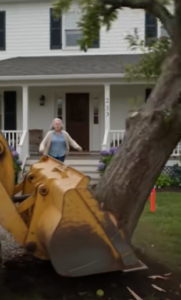
The bulldozer was parked beneath the moon.
Its blade faced the farmhouse.
I knew it was only a machine.
But in the darkness, it looked like something waiting to finish a job.
I made tea and sat at the kitchen table.
Walter’s chair stood across from me.
I had never moved it.
After he died, Rebecca suggested putting it in the spare room because seeing it might make me sad.
But I couldn’t bear to lose that small piece of our routine.
Every morning, Walter had sat there reading the newspaper.
He complained about the price of groceries.
He read articles aloud even when I told him I could read them myself.
And he always saved the crossword for me.
For years, I’d imagined that getting older meant losing things slowly.
A little strength.
A little energy.
A few familiar faces.
I hadn’t imagined someone could come along and try to take half my life in a single morning.
I looked at the clock.
3:26.
Then I took out the property plan.
I spread it across the table and studied the red markings.
The developer had divided the back two acres into a narrow access corridor and several areas that would connect to land beyond our property.
The development itself would extend onto a larger neighboring tract.
My farm wasn’t the whole project.
It was the way into it.
That explained something I hadn’t understood before.
The developers weren’t simply interested in my back field because it was pretty or conveniently located.
They needed access.
The paved county road ran along the front of my property, but the larger tract behind ours had no suitable entrance from that direction.
My driveway gave them a direct route.
Without it, they would have to find another way.
I traced the red line.
It started at the road.
Followed my driveway.
Passed the porch.
Then turned through the orchard and into the back field.
On paper, it looked harmless.
A neat red strip.
Nothing more.
But I knew what stood inside that strip.
The stone border Walter had laid beside the driveway.
The lilac bush his mother had given us.
The little wooden sign Rebecca painted when she was seventeen.
BROOKS FAMILY FARM.
A developer could put those things in a drawing and label them obstacles.
But I remembered the days they became part of our home.
I remembered Walter bringing the stones home in the back of his truck.
I remembered our children kneeling in the dirt, helping him set them into place.
I remembered the first spring the lilacs bloomed.
The smell had filled the porch.
I had stood there holding a basket of laundry when Walter walked up behind me and kissed my cheek.
“Smells like your mother’s garden,” he’d said.
I ran my finger along the red line.
Then I looked at the words printed beside it.
Proposed permanent access easement.
Permanent.
That was the word that frightened me most.
Thomas had told me I could still live in the farmhouse.
As though that settled everything.
But I understood now that I could keep owning the house and still lose the peace surrounding it.
An easement like the one on that plan could allow people to use part of my property indefinitely.
Cars.
Delivery trucks.
Construction vehicles.
Visitors.
Residents driving home at night.
All passing within sight of my front windows.
I imagined sitting on the porch while headlights swept across the flower beds.
I imagined my grandchildren trying to play in the grass while cars turned into a subdivision.
I imagined the orchard reduced to a strip of landscaping between a road and a row of houses.
And I realized Thomas hadn’t simply tried to sell two acres.
He had tried to change the way I would live for the rest of my life.
Without asking me.
Without warning me.
Without even giving me the dignity of saying no.
At dawn, I put on my boots.
Then I went outside with a notebook and a measuring tape.
I started at the county road.
I walked the driveway, comparing the site plan to the orange stakes.
Some of them were just a few steps from the lilacs.
One stood beside the stone walkway.
Another had been hammered into the flower bed where I’d planted yellow daffodils for Walter’s birthday.
I took photographs.
Then I wrote down the approximate locations.
I didn’t know whether the measurements would matter.
But Margaret had told me to document everything, and I intended to follow her advice.
Near the porch, I found a length of orange plastic ribbon tied around one of Walter’s rosebushes.
I stood looking at it.
The ribbon fluttered in the morning breeze.
I remembered the first time Thomas tried to prune that bush.
He was about sixteen.
Walter had asked him to cut away a few dead branches.
Thomas decided to make it look tidy and cut almost everything down.
I had nearly cried.
Walter had looked at the bare stems and said, “Well, son, you certainly gave it a haircut.”
Thomas had been mortified.
But Walter had knelt beside him and explained how roses grew.
The following spring, the bush returned stronger than before.
I touched one of its leaves.
Then I untied the orange ribbon.
I folded it carefully and placed it in my pocket.
I couldn’t remove the surveyed stakes yet.
Margaret had advised me to leave the evidence undisturbed until it was documented.
But I wasn’t going to let a plastic ribbon remain tied around my husband’s roses.
Not one day longer.
Around nine, my neighbor, Helen Miller, came up the driveway.
Helen was seventy-one and lived on the adjoining property.
We had known each other since our children were small.
She carried a covered plate.
“I brought you some muffins,” she said.
Then she looked toward the machinery.
“Oh, Eleanor.”
Her face fell.
She’d heard the equipment the previous morning and assumed I had hired someone to clear part of the land.
Then her husband told her he’d seen surveyors near the fence.
She’d been about to call when she noticed me outside.
“What on earth is happening?”
I invited her into the kitchen.
I explained the situation while she made tea.
When I mentioned Thomas, she stared at me.
“Your Thomas?”
“Yes.”
“The one who was here fixing your porch steps last spring?”
I nodded.
She shook her head.
“But he knows how much this place means to you.”
That was the part I kept coming back to.
He knew.
He had to know.
There was no way Thomas could have grown up in that house without understanding what it represented.
Helen reached across the table and squeezed my hand.
“What are you going to do?”
“I’ve hired Margaret Bell.”
“Good.”
“I’m stopping the agreement.”
“Good.”
Then I looked toward the orchard.
“And I want them to repair whatever they can.”
Helen nodded.
But neither of us said anything about the tree.
Some things couldn’t be repaired.
We both knew it.
After Helen left, I received a call from Margaret.
She had already begun reviewing the county property records.
The four acres were still recorded in my name.
No completed transfer of the back acreage appeared in the records.
And at that point, she had found no recorded easement granting the developer access through my driveway.
“That’s encouraging,” she said.
I sat straighter.
“So they don’t own any of it?”
“Not according to the records I’ve reviewed.
Remember, an agreement to pursue a transfer and a completed transfer are two different things.”
“What about the money they gave Thomas?”
“That’s an issue between the parties who exchanged it.
It doesn’t automatically give them rights over your land.”
I closed my eyes.
“Thank God.”
Margaret paused.
“I’ve also spoken with the developer’s counsel.
They acknowledge receiving our notice and say the construction hold remains in place.”
I looked toward the bulldozer.
“Will they remove the equipment?”
“We’ve asked them to do so.
They’re arranging an inspection of the work already performed.”
“Are they admitting they were wrong?”
“Not yet.
They’re reviewing what happened.”
I sighed.
“That sounds like a careful way of saying nothing.”
Margaret gave a small laugh.
“It often is.”
Then her voice grew serious.
“They’ve agreed to provide copies of the key documents and payment records.
We’re going to compare what Thomas represented with what their staff actually received.”
I looked at the handwritten notes I’d made that morning.
“Margaret, I think they needed my driveway more than the land.”
“What makes you say that?”
I explained the map.
The access corridor.
The property behind ours.
The proposed road.
She listened.
“That’s a useful observation,” she said.
“The access appears central to their plan.”
“Thomas never mentioned the driveway when he talked about selling.”
“That may be because he knew it would be especially difficult to get your consent.”
I looked through the window.
“Then he knew exactly what he was doing.”
Margaret didn’t answer immediately.
“Let’s establish the facts before deciding everything he knew.”
I appreciated that.
She wasn’t there to tell me what I wanted to hear.
She was there to help me distinguish between what I felt and what I could prove.
After our call, I found myself remembering Thomas as a young man.
He hadn’t always been obsessed with money.
When he was twenty, he worked with Walter repairing the barn roof.
They spent an entire weekend in the summer heat, replacing rotten boards and arguing about how to align the new ones.
Thomas wanted to finish quickly.
Walter wanted to do it properly.
They argued so much that I finally threatened to take away their dinner.
But when the roof was finished, Thomas stood beside his father in the driveway.
Both men were sweaty and exhausted.
Walter clapped him on the shoulder.
“Good work, son.”
Thomas looked happier than I’d seen him in weeks.
There had been good years.
So many good years.
When Walter had knee surgery, Thomas drove him to appointments.
When a storm knocked down the old back fence, Thomas helped us rebuild it.
After Walter died, he checked on me regularly during the first few months.
He wasn’t a monster.
He was my son.
A man capable of kindness.
A man who loved his children.
A man who had also made a terrible, selfish decision.
That contradiction hurt more than anything.
If Thomas had always been cruel, I might have understood the betrayal more easily.
But I remembered the little boy who brought injured birds into the kitchen.
The teenager who carried groceries for elderly neighbors.
The young father who cried when his first child was born.
Somewhere inside that man was the person I’d raised.
I didn’t know how he’d convinced himself that this was acceptable.
And I didn’t know whether he would ever be willing to see it clearly.
That afternoon, Thomas came to the house alone.
I saw his truck pull into the driveway.
For a moment, I considered not opening the door.
But then I remembered Margaret’s advice.
I could speak to my son.
I simply needed to avoid negotiating the property without my attorney.
I opened the door before he knocked.
He looked tired.
There were dark circles beneath his eyes.
“Hi, Mom.”
“Hello, Thomas.”
He glanced past me into the kitchen.
“Can I come in?”
I stepped aside.
He sat at the table where he’d eaten thousands of meals growing up.
For a moment, neither of us spoke.
Then he noticed Walter’s empty chair.
His gaze rested on it.
“Feels strange being here without Dad.”
I said nothing.
He picked at the edge of a paper napkin.
“Angela’s pretty upset.”
“I’m sure she is.”
“She’s scared.”
I sat across from him.
“Of what?”
He gave a short laugh.
“Of everything falling apart.”
“What exactly is falling apart?”
“The deal.
The money.
Our plans.”
I folded my hands.
“Your plans.”
He looked up.
“Mom, don’t start.”
“I’m not starting anything.
I’m asking you to hear what you’re saying.”
He sighed.
“We thought this could change our lives.”
“And mine?”
He stared at me.
“What about my life, Thomas?”
“You’d still have the house.”
“Would I still have quiet mornings on my porch?”
He looked away.
“Would I still be able to walk through the orchard?”
“Mom—”
“Would your father’s garden still be there?”
He rubbed his eyes.
“I know you’re upset about the tree.”
I leaned forward.
“Do you?”
“Of course.”
“No, Thomas.
I don’t think you do.”
His face hardened.
“I loved Dad too.”
The words hit me.
Because I knew they were true.
Thomas had loved his father.
And Walter had loved Thomas.
Their relationship hadn’t always been easy, but there had never been a question of love.
“I know you did,” I said.
“Then don’t act like I don’t care about him.”
“I never said you didn’t care.”
“You keep bringing up the orchard like I’m trying to erase Dad.”
I looked at him for a long moment.
“Then why didn’t you come and ask me?”
He opened his mouth.
Closed it.
I waited.
Finally, he said, “Because I knew you’d say no.”
There it was.
The truth.
Not a misunderstanding.
Not confusion about ownership.
Not a simple difference of opinion.
He had deliberately avoided asking because he knew my answer.
I felt tears gathering, but I held them back.
“So you decided my answer didn’t matter.”
He looked miserable.
“I thought once you saw how much money was involved, you’d understand.”
“But you didn’t give me the chance.”
“No.”
“Instead, you let them believe I agreed.”
His shoulders slumped.
“I thought we could get the paperwork straightened out before the work started.”
I stared.
“Did you?”
He didn’t answer.
I thought about the old shed letter.
The signature.
The attached copy.
Then I asked the question that had been haunting me.
“Thomas, who put my signature on that authorization?”
He looked toward the window.
“Mom, please don’t make me answer that right now.”
My heart dropped.
“Why not?”
“Because there’s already enough trouble.”
I sat back.
He had not denied it.
Not once.
I wanted to ask again.
I wanted to demand the truth until he had no choice but to give it to me.
But Margaret had advised me not to turn a private family conversation into an argument over legal documents.
And I was beginning to understand why.
Thomas kept looking at me the way he had when he was young and wanted me to change my mind.
I knew that expression.
He’d used it when he wanted to stay out late.
When he’d damaged the family car.
When he’d borrowed money and couldn’t pay it back.
Only now the stakes were different.
This wasn’t a broken headlight.
This was my home.
He leaned forward.
“Mom, the company says they may come after me for the money.”
I waited.
“Forty thousand dollars, plus whatever expenses they’ve incurred.”
I watched him carefully.
“What do you want me to do?”
He swallowed.
“Just consider letting the deal go through.”
There it was again.
The same request.
Only softer.
More desperate.
He reached across the table.
“Please.
The back field is mostly empty anyway.”
I looked at his hand.
I remembered holding it when he was five years old and afraid of thunderstorms.
Then I gently moved my hands away.
“Thomas, your father spent years turning that field into something beautiful.”
“I know.”
“The fact that I don’t earn money from it doesn’t make it worthless.”
He looked down.
“You don’t understand the pressure we’re under.”
“Then tell me about the pressure.
Ask me for advice.
Ask me to help you make a budget.
Ask me to look at your expenses with you.”
He shook his head.
“That’s not going to solve forty thousand dollars.”
“No.
It won’t.”
He stared at me.
I took a slow breath.
“But taking my land won’t solve the reason you thought this was acceptable.”
His jaw tightened.
“You make it sound like I’m some kind of thief.”
I felt a sharp pain behind my ribs.
I didn’t want to say the word.
I didn’t want it to become part of the way I thought about my own child.
So I chose my words carefully.
“You took money for something that wasn’t yours to give.”
He looked away.
“And until you can face that,” I continued, “we have nothing to negotiate.”
For a long time, he sat silently.
Then he pushed back his chair.
“Angela said this would happen.”
I looked up.
“What would happen?”
“She said you’d choose the farm over your own family.”
I felt as if he’d slapped me.
I stood.
“No, Thomas.”
He hesitated near the door.
“You chose money over your mother’s wishes.
Don’t make me responsible for that.”
His eyes filled.
For a brief moment, I thought he might finally apologize.
Instead, he said, “Dad would have wanted me to take care of my family.”
I felt the anger rise again.
“Your father also believed in keeping your word.”
Thomas looked away.
He opened the door.
“Call me when you’re ready to be reasonable.”
Then he left.
I watched him drive down the driveway, past the orange stakes he’d allowed strangers to place there.
For a long time, I stood at the window.
Then I sat down in Walter’s chair.
I hadn’t done that since he died.
The seat creaked beneath me.
I closed my eyes.
“Did we do something wrong?”
I whispered to the empty kitchen.
There was no answer.
Only the ticking clock.
And the knowledge that loving a child did not give me the power to decide what kind of adult he would become.
The next morning, Rebecca came to visit.
She hugged me so tightly that I could barely breathe.
Then we walked through the orchard together.
When she saw the broken tree, she stopped.
Her hand flew to her mouth.
“Oh, Mom.”
She knelt beside the trunk.
For a while, she said nothing.
Then she touched the bark.
“Dad planted this the day after he brought you and me home from the hospital.”
I nodded.
“He wanted it to grow with you.”
She smiled through her tears.
“Remember how he used to measure me against it?”
I laughed softly.
“He’d mark your height on a board beside the shed.”
“And every year he’d tell me the tree was growing faster.”
I looked at the broken branches.
Rebecca picked up a small apple.
She turned it over in her hand.
“Thomas knew that.”
“Yes.”
“He knew what this tree was.”
“Yes.”
Her voice trembled.
“Then I don’t understand him.”
Neither did I.
We stood together in the orchard.
I wanted to tell her everything would be fine.
That the tree could be saved.
That Thomas would apologize.
That our family would somehow return to what it had been before.
But I was seventy-four years old.
Old enough to know that some things don’t return.
They change.
And you have to decide how to live with what remains.
That afternoon, Rebecca helped me organize the photographs I’d taken.
We labeled them with dates and locations.
I emailed copies to Margaret.
Then we gathered the damaged branches that lay outside the main construction area.
We didn’t move the trunk.
The attorney wanted the damage inspected before anyone removed it.
As the sun began to set, Rebecca found something half buried in the torn soil.
A small wooden marker.
Walter had made it years ago.
The paint was almost gone, but I could still read the words.
REBECCA’S APPLE TREE.
She held it carefully.
“I thought this was lost.”
I stared.
The bulldozer had knocked it down.
But the little sign was still intact.
Rebecca brushed the dirt from the letters.
Then she handed it to me.
“Keep this, Mom.”
I carried it inside.
I washed the mud away.
Then I placed it on the kitchen counter beside Walter’s photograph.
For the first time since the bulldozer arrived, I felt something like determination instead of helplessness.
I couldn’t put the tree back together.
But I could protect what was left.
That evening, shortly after Rebecca drove home, a car pulled into my driveway.
Angela.
She didn’t come to the door.
She walked up the porch steps, placed a large white envelope on the bench, and returned to her car.
I watched through the window.
She drove away without looking back.
I waited until her taillights disappeared.
Then I opened the door.
There was no note.
Only my name written across the envelope.
Inside was another copy of the proposed development agreement.
The same acreage.
The same access road.
The same amount of money.
One hundred and sixty thousand dollars.
But this version had something different.
The signature line was blank.
A yellow sticky note was attached to the bottom.
Eleanor, please sign this so we can put everything behind us.
We can’t afford to lose this opportunity.
No apology.
No explanation.
Not one word about Walter’s tree.
I stared at the empty signature line.
And I understood exactly what Thomas and Angela wanted.
They had used my name once without permission.
Now they wanted me to make their decision legitimate.
They wanted me to take responsibility for the deal they’d made.
They wanted me to sign away my home so they wouldn’t have to face the consequences.
I folded the agreement.
Placed it back in the envelope.
And picked up my phone.
This time, I didn’t call Thomas.
I called Margaret.
Because my son had crossed a line.
And I was finally ready to show him that some lines couldn’t be erased.
Chapter 4: THE PRICE OF A MOTHER’S SILENCE
Margaret asked me to bring the envelope to her office the next morning.
She read the sticky note twice.
Then she placed it inside a clear plastic sleeve.
“Keep the original,” she said.
“And don’t respond to the request.”
I looked at the unsigned agreement.
“Why would they send this after everything that’s happened?”
“Because your signature would solve a great many problems for them.”
I felt sick.
“Even after they already used a false one?”
“Especially then.”
Margaret folded her hands on the desk.
“If you knowingly sign a new agreement accepting the transaction, it could allow the parties to proceed despite the earlier dispute.
It could also complicate your position regarding the damage already done, depending on what you agree to.”
I stared at the pages.
“So they want me to pretend I was part of this from the beginning.”
“That’s one possible effect.
I can’t tell you exactly what Thomas and Angela believe they’re accomplishing, but I would not sign it.”
I shook my head.
“I wasn’t going to.”
“Good.”
She studied me.
“Eleanor, are you afraid of your son?”
The question surprised me.
“No.”
Then I hesitated.
“Not physically.”
She waited.
“I’m afraid of what happens to us after this.”
My voice cracked.
“He’s my boy, Margaret.
I remember the day he was born.
I remember teaching him to ride a bicycle.
I remember every birthday cake I ever baked him.”
I looked down at my hands.
“And now I’m sitting here talking about false signatures and property agreements.”
Margaret’s expression softened.
“You’re allowed to grieve that.”
I swallowed.
“But I still have to stop him.”
“Yes.”
I wiped my eyes.
“Then let’s stop him.”
That morning, Margaret sent a second formal notice.
This one made several things clear.
I disputed every claimed authorization bearing my name.
I had not consented to the sale of any acreage.
I had not granted an easement.
I had not given Thomas permission to negotiate either transaction on my behalf.
And I demanded that the development company cease any entry or disturbance not independently authorized by me.
Margaret also requested the payment records, communications, and documents used to justify beginning construction.
Most importantly, she demanded a written plan for addressing the physical damage.
I didn’t want an apology alone.
I wanted the road stopped.
I wanted the surveying stakes removed after their positions were properly recorded.
I wanted the torn field stabilized and restored.
And I wanted the developer to acknowledge that my property was not theirs to use.
When Margaret finished reading the letter aloud, she asked whether I wanted anything added.
I thought for a moment.
“Yes.”
She looked up.
“Tell them I want the apple tree documented before they remove it.”
She nodded.
“And afterward?”
I took a breath.
“I want the pieces saved until I decide what to do with them.”
Margaret wrote it down.
I knew that might sound strange to someone who thought of trees as landscaping.
But I couldn’t bear the thought of Walter’s tree being loaded into a truck and taken to a dump.
Not after everything it had meant.
I had already watched strangers break it.
I wasn’t going to let them throw it away without asking me.
Two days later, the developer’s legal representative requested a meeting.
Margaret arranged for it to take place at her office.
I attended with her.
I wore the navy cardigan Walter always said made my eyes look brighter.
I don’t know why I chose it.
Perhaps I wanted to feel like myself.
Not a frightened old woman whose son had betrayed her.
Just Eleanor Brooks.
A woman who owned her home.
A woman who had worked hard all her life.
A woman who deserved to be heard.
The developer’s representative was a man named Daniel Foster.
He arrived carrying a briefcase and several thick folders.
Gregory accompanied him.
Gregory gave me a small nod when we entered the conference room.
“Mrs.
Brooks.”
“Good morning.”
Daniel began carefully.
“First, I want to say the company regrets the distress caused by the clearing work.”
I looked at him.
“Do you regret the distress or the clearing?”
He paused.
Margaret glanced at me but said nothing.
Daniel adjusted his papers.
“We understand that a mature tree of sentimental importance was destroyed.”
“That tree was planted the day after my daughter came home from the hospital.”
His expression changed.
“I see.”
“My husband planted it.
He cared for it for thirty-six years.
He died six years ago.”
“I’m very sorry.”
I nodded.
“Thank you.
Now please tell me why your company believed it had permission to cut it down.”
He opened a folder.
“Mr.
Brooks represented that he was authorized to coordinate preliminary access and negotiations for the property.”
“Did you check whether he owned it?”
“The property records identified you as the owner.”
I leaned forward.
“Then why did you pay him?”
Daniel looked uncomfortable.
“The commercial arrangement was structured around his representation that he was acting with your consent and would facilitate the required owner approvals.”
I waited.
He continued.
“The advance payment was made under the preliminary arrangement.
Our internal review is examining why field operations began before the ownership authorization was adequately verified.”
Margaret spoke.
“To be clear, my client denies signing the authorization your company relied upon.”
Daniel nodded.
“That position has been noted.”
I looked at Gregory.
He met my eyes.
“Mrs.
Brooks, when I arrived at the site, I believed the necessary permission had been obtained.
I would not knowingly have directed the crew onto a property whose owner objected.”
I believed him.
He had stopped the machines as soon as I confronted him.
He hadn’t tried to intimidate me.
He hadn’t dismissed me because of my age.
He’d treated my objection seriously.
But I also knew that good intentions wouldn’t repair the orchard.
“I understand,” I told him.
“But somebody should have asked me before the work started.”
He nodded.
“Yes, ma’am.”
Daniel turned to another document.
He explained that the proposed one-hundred-and-sixty-thousand-dollar transaction had not closed.
No deed conveying my acreage had been signed by me.
No valid owner-approved easement had been completed.
The forty thousand dollars paid to Thomas was an advance associated with the proposed land and access arrangement.
The developer now regarded that payment as disputed and was seeking its return.
I listened carefully.
“So Thomas hasn’t sold my land yet.”
“Not through a completed conveyance,” Daniel answered.
“But he told your company that he could.”
“Yes.”
“And someone submitted an authorization with my name on it.”
“Yes.”
“Without my permission.”
“That is your stated position, and we are reviewing the origin of the document.”
I felt my hands begin to tremble.
Margaret placed her pen on the table.
“Mr.
Foster, the document comparison we’ve provided raises a substantial concern that the signature was reproduced from a fifteen-year-old letter concerning an unrelated storage shed.
We expect your company to preserve the original submission and all related communications.”
Daniel nodded.
“We have instructed our staff to do so.”
Then Margaret asked the question I had been waiting for.
“Will the company agree in writing that it will not rely on the disputed authorization to enter or perform further work on Mrs.
Brooks’s property?”
Daniel took a breath.
“Yes.
We can provide that undertaking while the matter is resolved.”
My shoulders relaxed for the first time in days.
He continued.
“We are also prepared to discuss site restoration once the damage has been assessed.”
I looked at him.
“I don’t want you to build a nicer road.
I want the gravel road you started removed.”
“Understood.”
“I don’t want little ornamental trees planted where my orchard stood.”
He nodded.
“I want the land back the way it was, as close as possible.”
“We’ll discuss the appropriate work.”
I looked down.
“And I know you can’t give me the apple tree back.”
The room became quiet.
Daniel closed his folder.
“No, Mrs.
Brooks.
We can’t.”
For the first time, his apology sounded less like something a company had taught him to say.
It sounded human.
I appreciated that.
But appreciation wasn’t forgiveness.
And it wasn’t permission.
When the meeting ended, Gregory approached me near the door.
“I wanted to say something,” he said.
I waited.
“I grew up on a farm in York County.
My grandfather had an old pear tree behind his house.”
I looked at him.
“He’d sit underneath it every evening in summer.
When the property changed hands, the new owners cut it down.”
Gregory shook his head.
“My mother cried for days.”
I swallowed.
He looked at me directly.
“I know I can’t undo what happened.
But I’m sorry I didn’t ask more questions before the crew started.”
I nodded slowly.
“Thank you, Gregory.”
He hesitated.
“Your tree had a strong trunk.
We should be able to save sections of the wood when it’s removed.”
For some reason, those words nearly made me cry.
“Would you?”
“If that’s what you’d like, I’ll make certain the crew understands.”
I took a slow breath.
“Yes.
I’d like that very much.”
When I returned home, the farmhouse was quiet.
I made a sandwich.
I couldn’t eat it.
I sat at the kitchen table looking at the little wooden marker Rebecca had found.
Then I thought about Thomas.
The developer was seeking forty thousand dollars from him.
Perhaps more, depending on what the records showed and what expenses had been incurred.
I knew my son.
He was proud.
Too proud sometimes.
He would be frightened.
Angela would be frightened.
Their children might eventually feel the consequences of the money their parents had spent.
That hurt me.
Of course it hurt me.
But every time I considered rescuing them by signing the agreement, I looked out at the orchard.
And I remembered that Thomas had been willing to make me pay the price instead.
He’d seen my land as a solution to his financial problems.
He hadn’t considered what his solution would cost me.
I picked up the phone.
I called Thomas.
He answered immediately.
“Mom?”
For the first time since the bulldozer arrived, he sounded hopeful.
“I met with the developer today,” I said.
“I know.
They called us.”
“Then you know they’ve agreed not to do any more work on my property.”
A pause.
“Mom, they’re asking for the money back.”
“Yes.”
“We can’t just hand them forty thousand dollars.”
“I understand.”
“No, you don’t understand.
We used it to catch up on things.
The mortgage.
Business expenses.
Bills we’d been putting off.”
His voice was shaking.
I felt my chest tighten.
“Thomas, I am sorry you’re in financial trouble.”
“Then help us.”
“I can help you think through your options.
But I am not giving up my property.”
He made a frustrated sound.
“That’s the only way to fix this.”
“No.
It’s the only way to make me pay for it.”
Silence.
Then he said, “Angela and I are coming over.”
“Thomas, we can talk about family matters, but I’m not discussing agreements without Margaret.”
“Fine,” he said.
He didn’t sound as if anything was fine.
An hour later, their pickup pulled into the driveway.
I watched them climb out.
Angela carried a handbag.
Thomas held a folder.
I knew immediately what was inside.
I opened the door.
They walked into the kitchen without saying much.
Angela glanced toward Walter’s chair.
Then at the stack of photographs beside my laptop.
Her expression tightened.
“Are you still collecting evidence against us?”
I pulled out a chair.
“I’m documenting what happened to my land.”
She sat down heavily.
Thomas remained standing.
“Mom, we need to find a way through this.”
“I agree.”
He seemed relieved.
Then I added, “But that way does not involve selling the back acreage or my driveway.”
His face fell.
Angela leaned forward.
“Eleanor, can you please consider what you’re doing to this family?”
I looked at her.
“What I’m doing?”
“Yes.
Thomas could lose everything.”
I felt the old instinct return.
The one that made me want to make things better.
But I kept my voice steady.
“Angela, I didn’t take that money.”
“No, but you’re the one who can make this right.”
I shook my head.
“Making it right would have meant asking me before anyone signed anything.”
She looked away.
Thomas sat down.
“Mom, nobody intended for the bulldozers to arrive before we’d talked.”
I studied him.
“Then why did they?”
He swallowed.
“The schedule moved faster than we expected.”
“Why was there a schedule at all when I hadn’t agreed?”
He didn’t answer.
I took out the copy of the old shed letter.
I laid it on the table.
Then I placed the developer’s authorization beside it.
Thomas looked at the papers.
Angela went very still.
I pointed to the two signatures.
“These are the same.”
Neither spoke.
“The tiny gap in the ink.
The shape of the letters.
Even the underline.”
I looked directly at my son.
“Thomas, I asked you before who put my signature on that agreement.
You wouldn’t answer.”
He stared at the table.
“I’m asking you again.”
Angela spoke first.
“It wasn’t meant to be a big deal.”
I turned toward her.
“What wasn’t?”
She pressed her lips together.
Thomas looked up sharply.
“Angela.”
She ignored him.
“We needed to show them you supported the preliminary work.
We had that old letter, and it already had your signature.”
My heart began pounding.
“What did you do with it?”
Angela looked uncomfortable.
“We scanned the letter.”
I waited.
“Then we used the signature.”
The room seemed to tilt.
I held the edge of the table.
“You copied my signature?”
She sighed.
“It was supposed to be temporary.”
“Temporary?”
“Until you signed the final documents.”
I stared at her.
Then at Thomas.
He looked miserable.
“Did you know?”
I asked him.
He didn’t answer.
“Thomas.”
“Yes.”
The word came out so quietly that I almost didn’t hear it.
I sat back.
For days, part of me had hoped there was an explanation I hadn’t imagined.
A mistake.
A misunderstanding.
Some piece of paperwork submitted carelessly.
But there was no misunderstanding now.
They had taken an old letter I wrote to my son.
A letter granting permission for a small storage shed.
They had removed my signature from its original purpose and used it to make strangers believe I authorized a development.
They had done it because they wanted the money.
And because they knew I would refuse if they asked.
I looked at Angela.
“Who prepared the document?”
She glanced at Thomas.
“I put the file together.
Thomas submitted it.”
I turned toward him.
“Is that true?”
He nodded.
I felt tears spill down my cheeks.
Thomas reached toward me.
“Mom, we didn’t think—”
I pulled away.
“No.”
He stopped.
“Don’t tell me you didn’t think.”
I wiped my face.
“You thought enough to contact developers.”
He looked down.
“You thought enough to negotiate one hundred and sixty thousand dollars.”
Angela shifted in her chair.
“You thought enough to accept forty thousand dollars.”
Thomas closed his eyes.
“And you thought enough to take a fifteen-year-old letter, copy my signature, and use it to get what you wanted.”
Nobody spoke.
I took a trembling breath.
“The only thing you didn’t think about was me.”
Thomas’s face crumpled.
“Mom, that’s not fair.”
I stared at him.
He lowered his head.
“No.
You’re right.”
Angela turned toward him.
“Thomas—”
He shook his head.
“No, Ange.
She’s right about that.”
It was the first time he’d admitted anything without immediately making an excuse.
For one small moment, I felt hope.
Then Angela spoke.
“We still have to deal with reality.”
I looked at her.
“Reality?”
“Yes.
The company wants its money.
We don’t have it.
They may take legal action.
And our children are going to suffer.”
I could hear the fear beneath her anger.
I believed she was frightened.
I believed their financial situation had become more serious than they had expected.
But fear did not give them the right to use me.
“Angela, I love your children,” I said.
“I would never want them to suffer.”
“Then please help us.”
I shook my head.
“I will not save you by surrendering my home.”
Her eyes flashed.
“That’s incredibly selfish.”
The word hung between us.
Selfish.
I looked around the kitchen.
At the worn wooden cupboards Walter installed.
At the old table where I’d packed school lunches.
At the window overlooking what remained of our orchard.
For decades, this house had been the center of our family.
Every Christmas, Thomas and Rebecca came home.
Every birthday, there was cake.
When Thomas needed someone to watch the children, I was there.
When Angela was ill, I made meals and carried them over.
When their car broke down years ago, Walter and I helped them pay for repairs.
I had never kept a list of those things.
I had never wanted repayment.
They were simply what family did for one another.
But apparently, after everything, I was selfish for not giving away half my property.
I stood.
“Angela, you are welcome to think what you like about me.”
She stared.
“But I am done being told that loving my family means letting them take whatever they want.”
Thomas looked up.
“Mom.”
I turned toward him.
He was crying.
I hadn’t seen him cry like that since Walter’s funeral.
“I messed up,” he whispered.
I said nothing.
“I know I messed up.”
I sat down again.
For a moment, I wanted to reach across the table and hold him.
But I waited.
“I thought…”
He stopped.
Then he tried again.
“I thought Dad would have wanted me to have the land eventually.
I thought if I could make this work, you’d see it was a good deal.”
I listened.
“I was tired of feeling like I couldn’t provide what my family needed.
Every time something went wrong, there was another bill.
Another payment.
Another thing I couldn’t afford.”
His hands were shaking.
“When they told me what the acreage and road access could be worth, it felt like a way out.”
I swallowed.
“So you convinced yourself it was already yours.”
He lowered his head.
“Yes.”
The honesty hurt.
But it also mattered.
Because at last, he was telling me something real.
I leaned forward.
“Thomas, do you remember when your father bought that old tractor?”
He looked confused.
“The blue one?”
“Yes.”
He nodded.
“It barely ran.”
I smiled sadly.
“He saved for almost two years to buy it.
And when he finally brought it home, he spent another six months repairing the engine.”
Thomas nodded.
“I remember.”
“One afternoon, you asked him why he didn’t just buy a new tractor on credit.”
Thomas stared at the table.
I remembered Walter’s answer as clearly as if he were sitting beside us.
“He said, ‘Son, just because somebody will give you money doesn’t mean you can afford what they’re selling.’”
Thomas covered his eyes.
I continued.
“Your father wasn’t perfect.
Neither am I.
But he understood the difference between wanting something and having a right to it.”
Thomas began to cry harder.
Angela looked away.
I waited until he could look at me.
Then I said the thing I had been struggling to say since the bulldozer arrived.
“I love you, Thomas.”
He nodded through his tears.
“You’re my son.
Nothing is going to change that.”
His expression softened.
“But I am not signing that agreement.”
He closed his eyes.
“And I’m not going to lie about what happened.”
Angela stood abruptly.
“Eleanor, if you report this, you could ruin his life.”
I looked at her.
“Who put his life in this position?”
She opened her mouth.
Then closed it.
I turned back to Thomas.
“I’m willing to tell the truth.
I’m willing to cooperate with whatever process is needed to resolve this properly.
But I’m not accepting responsibility for your choices.”
His shoulders sagged.
“Mom, if they come after me for the money, we might lose our house.”
I felt the words strike deep.
Their house.
The place where my grandchildren slept.
The place where we’d celebrated birthdays and Christmas mornings.
I thought of those children.
I thought of the fear in Thomas’s eyes.
Then I looked through the window at the torn orchard.
My home had already been damaged because of his decisions.
I couldn’t undo that.
But I could stop him from making me lose the rest.
I reached across the table and took his hand.
“Then you need to work out how to repay what you took.”
His fingers tightened around mine.
“I don’t know how.”
“I know you’re frightened.”
He looked at me helplessly.
I let my tears fall.
“But, Thomas, you were willing to take my home to save yours.”
He bowed his head.
I held his hand for another moment.
Then I let go.
“You don’t get to ask me to finish what you started.”
Angela gathered her handbag.
Thomas stood slowly.
Neither said anything else.
At the door, he turned around.
“Will you ever forgive me?”
I looked at the man who had once been my little boy.
The man who had held Walter’s hand at the hospital.
The man who had helped me carry his father’s ashes.
The man who had copied my signature so he could sell part of my home.
“I don’t know,” I said.
It was the hardest answer I’d ever given him.
“But forgiveness can’t begin while you’re still asking me to pretend you did nothing wrong.”
He nodded once.
Then he walked away.
I closed the door.
I stood with my forehead against the wood.
And I cried until there were no tears left.
That evening, I called Margaret.
I told her what Thomas and Angela had admitted.
Every word I could remember.
Margaret listened without interrupting.
Then she said, “Eleanor, I think we need to document that account formally.”
I looked at the photograph of Walter on the kitchen counter.
“I know.”
“We should also discuss making an official report about the unauthorized signature.
That may be necessary to protect you and establish a clear record of what occurred.”
I took a deep breath.
“Then we’ll do it.”
“Are you certain?”
I looked out at the orchard.
For years, I’d believed protecting my children meant stepping between them and whatever might hurt them.
But Thomas was no longer a child.
And I had finally understood that protecting him from the truth would mean abandoning myself.
“Yes,” I said.
“I’m certain.”

