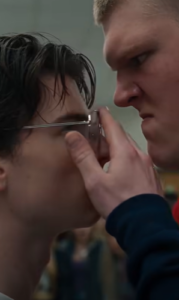
 The punch landed with a sickening crack, snapping Leo Bennett’s head sideways and sending his thick silver glasses sliding halfway off his face, but the most frightening thing about what happened next was that the seventeen-year-old boy didn’t even raise his hands to fight back.
For one impossible second, the cafeteria at Westbridge High School in Atlanta seemed to lose every sound.
The laughter stopped.
Plastic forks hovered above lunch trays.
Conversations died between unfinished sentences.
More than two hundred students stared at the quiet new boy sitting alone beneath the fluorescent lights, watching a thin line of blood appear at the corner of his mouth.
Standing over him was Troy Coleman, an eighteen-year-old football player with broad shoulders, a square jaw, closely cropped blond hair, and the kind of reputation that made other students change hallways whenever they saw him coming.
Troy wore his favorite red varsity jacket, its white sleeves stretched across arms thick from years of weightlifting.
His right fist remained clenched.
His expression carried the furious disbelief of someone who had never expected another student to refuse his orders.
“Next time I tell you to move,” Troy growled, “you move.”
Leo slowly turned his face back toward him.
His short dark brown hair had fallen across his forehead, and the silver frames of his glasses hung crookedly from one ear.
He looked almost painfully ordinary.
A dark navy hoodie.
Faded jeans.
Worn sneakers.
A slender build that seemed completely inadequate against the mountain of muscle standing beside his lunch table.
Nothing about Leo suggested he could survive a confrontation with the school’s most feared athlete.
Nothing, that is, except his eyes.
Because behind those damaged glasses, Leo wasn’t looking at Troy with fear.
He was studying him.
And somewhere inside the right arm of those seemingly ordinary frames, a tiny mechanism continued doing exactly what it had been designed to do.
Recording.
But Troy had no idea.
Neither did the students surrounding them.
And Principal Richard Harris, who believed he controlled everything that happened inside Westbridge High School, was about to make the most expensive mistake of his career.
Twenty minutes earlier, Leo had been enjoying what should have been an ordinary lunch.
He sat at the end of a long cafeteria table beside a window overlooking the school football field.
Outside, the Georgia afternoon sunlight washed across freshly painted yard lines, illuminating the enormous scoreboard bearing the name of the school’s most generous donor.
THE COLEMAN ATHLETIC FOUNDATION.
Leo had noticed the name on his first morning at Westbridge.
He had also noticed it above the gymnasium entrance, beside the trophy cabinet, and on a polished brass plaque near Principal Harris’s office.
The Colemans apparently owned half the school without technically owning any of it.
Leo had learned the rest during his first week.
Troy Coleman was the football team’s star linebacker.
His father, Marcus Coleman, had financed the new training facility.
His coaches described him as passionate.
His teachers called him competitive.
Students who had suffered beneath his temper used considerably different words.
Leo had heard stories about freshmen being shoved into lockers, homework being destroyed, lunch money disappearing, and a boy who had transferred schools after reporting an assault.
None of those stories appeared in the school’s official disciplinary records.
That interested Leo more than anything.
He took another bite of pizza and glanced at his phone.
A message from his nineteen-year-old sister, Lena, waited on the screen.
First week almost finished. Still surviving?
Leo smiled faintly.
So far.
Her response arrived immediately.
Remember what I told you.
He knew exactly what she meant.
The evening before his first day, Lena had stood in their small apartment kitchen, carefully adjusting the unusual glasses now resting on his nose.
“Don’t go looking for trouble,” she’d said.
“I’m not planning to.”
“And don’t let anybody convince you that staying quiet means agreeing with them.”
Leo had looked at her.
“That’s different from what Mom says.”
“Mom wants you safe.”
“And you don’t?”
Lena had stopped tightening the tiny screw beside the right hinge.
For several seconds, she had stared at the glasses rather than answering.
Then she’d whispered, “I want you safe, Leo, but I also want you to know the truth.”
He had never forgotten her expression.
Lena was not the same girl she’d been before leaving Westbridge eighteen months earlier.
Back then, she had been a brilliant senior with dreams of studying engineering.
She had won a regional science competition, maintained excellent grades, and received preliminary scholarship offers from two universities.
Then something had happened at school.
Something involving the football program.
Something Principal Harris had described as a serious disciplinary incident.
Lena had refused to explain everything.
Their mother had fought the school’s decision for months, but her appeals seemed to vanish into a maze of unanswered calls, missing documents, and meetings that accomplished nothing.
Lena’s disciplinary record remained attached to her transcript.
One scholarship disappeared.
Another university withdrew its offer.
Eventually, Lena transferred to another school to finish her senior year.
She graduated, but the future she’d imagined was already slipping away.
Now she worked part-time repairing electronics while taking community college courses.
She rarely mentioned Westbridge.
Yet whenever Leo asked what had happened, her answer never changed.
“Some people aren’t punished because they did something wrong,” she told him once. “They’re punished because they refused to pretend nothing was wrong.”
Leo had thought about those words every day since transferring into the same school.
His mother had moved the family back into the district for work, and Leo’s enrollment had been approved without difficulty.
He hadn’t come seeking revenge.
But he had promised himself one thing.
If he saw something wrong, he would not pretend it was right.
That promise was about to be tested.
“Hey, glasses.”
Leo looked up.
Troy Coleman stood at the opposite end of his table.
Beside him was Jax Miller, an eighteen-year-old student with a stocky build, short dark hair, and an expensive black athletic jacket.
Jax carried a heavy gray canvas backpack over one shoulder.
Two other football players lingered several feet behind them.
Troy pointed toward Leo’s lunch tray.
“Get your tray out of here. Now.”
Leo glanced at the empty seats surrounding him.
There were at least six.
“Why?”
Troy blinked.
It was a simple question, but his expression darkened as though Leo had insulted his entire family.
“Because this is our table.”
“There’s no name on it.”
Jax snorted.
“Man, are you stupid?”
Leo calmly lifted another bite of pizza.
“I actually like sitting here.”
Across the cafeteria, a girl named Maya Torres slowly lowered her fork.
Maya was seventeen, with dark curly hair tied into a loose ponytail and a quiet, observant manner.
She sat two tables away.
Leo recognized her from American history class.
Earlier that week, she had helped him find the science building.
Now she looked genuinely frightened.
“Leo,” she whispered, although he could barely hear her, “just move.”
Troy planted both palms on the table.
His face hovered inches from Leo’s.
“You think you’re funny?”
“No.”
“You think you can come into my school and disrespect me?”
Leo swallowed his pizza.
“I think you’re standing in front of somebody who’s trying to eat lunch.”
A few students exchanged nervous looks.
Someone gave a short, involuntary laugh.
That was enough.
Troy’s jaw tightened.
His right shoulder drew backward.
And before anyone could interfere, his fist slammed into the side of Leo’s face.
Now, with his glasses hanging crookedly and his mouth tasting of copper, Leo remained seated.
He did not shout.
He did not threaten Troy.
He carefully lowered his plastic fork onto his paper napkin.
Then he raised both hands to his glasses.
His fingers paused for the briefest instant near the right hinge.
He straightened the frames.
A tiny vibration, too faint for anyone else to notice, traveled along the metal arm against his temple.
Leo released them.
Troy leaned closer.
“You need to learn some respect.”
Leo looked directly into his eyes.
“Respect is something you have to earn, Troy.”
The words were not loud.
They didn’t need to be.
Half the cafeteria heard them.
Troy stared in disbelief.
Then Jax stepped forward.
“Okay, that’s it.”
He dragged the heavy canvas backpack off his shoulder.
Leo saw the movement reflected in the cafeteria window.
“Jax,” Maya said sharply.
But the warning came too late.
Jax swung the bag toward Leo’s head.
“We’re going to beat you!”
Leo moved.
Not wildly.
Not desperately.
He ducked beneath the swinging backpack with a sudden precision that made the entire attack seem strangely slow.
The bag swept over his shoulder.
In the same motion, Leo caught the edge of his plastic lunch tray.
He lifted it and thrust it toward Jax’s face.
The tray struck Jax across the nose and cheek.
Pizza sauce splashed over his jacket.
A container of ranch dressing burst against his shoulder.
His hand collided with a carton of chocolate milk, sending it spinning across the table.
Students screamed as the carton hit the floor.
Jax staggered backward.
His sneaker landed directly in the spreading puddle.
His feet shot out from beneath him.
He crashed onto the tiles with a tremendous slap.
For one stunned moment, nobody moved.
Then Leo lowered the empty tray.
“Be careful where you’re walking.”
A nervous laugh escaped someone near the vending machines.
Another student gasped.
Jax groaned, rolling onto his side.
Troy’s face turned crimson.
His best friend had just been humiliated in front of half the school.
And the person responsible was a skinny new student wearing crooked glasses.
“You’ve gone too far!”
Troy lunged.
Both hands reached toward Leo’s throat.
Leo pushed his chair backward.
His feet found the floor.
As Troy charged, Leo shifted sideways, caught the larger boy’s outstretched arm, and turned with his momentum.
“You were the one who crossed it first.”
The movement lasted less than two seconds.
Troy’s weight carried him forward.
His balance disappeared.
And suddenly the enormous football player was flying sideways toward a folding cafeteria table.
He hit it with a thunderous metallic crash.
The table buckled.
Its legs folded inward.
Plastic trays shot across the floor.
A bowl of macaroni burst open.
Metal scraped against tile as Troy disappeared beneath the collapsing furniture.
Several students jumped backward.
Someone shouted for help.
A chair overturned.
Then an unnatural silence swallowed the room.
Leo stood beside his original table, breathing steadily.
His jaw ached.
His right cheek had begun to swell.
But his glasses remained on his face.
Across the cafeteria, Troy lay among twisted table legs and spilled lunches.
For the first time in anyone’s memory, the supposedly untouchable bully looked small.
And for the first time, students were looking at Leo without pity.
Some looked impressed.
Others looked terrified.
Maya covered her mouth.
“Leo,” she whispered.
Before she could say anything else, a piercing whistle split the air.
“EVERYBODY STAY WHERE YOU ARE!”
Principal Richard Harris pushed through the crowd.
At fifty-five, Harris was tall and narrow-shouldered, with a stern rectangular face, neatly combed gray hair, and an immaculate charcoal suit.
His expensive black shoes clicked sharply against the cafeteria tiles.
He surveyed the collapsed table.
Then Troy.
Then Jax.
Finally, his eyes settled on Leo.
“What happened here?”
Maya opened her mouth.
But Harris had already made his decision.
He marched directly toward Leo and seized his shoulder.
“Get to my office. Right now.”
Leo looked down at the hand gripping his hoodie.
“Sir, Troy hit me first.”
“We’ll discuss that in my office.”
“Then shouldn’t you ask what happened?”
Harris’s fingers tightened.
“Don’t make this worse for yourself.”
Leo glanced toward Troy.
The football player was climbing unsteadily to his feet with Jax’s help.
Neither appeared particularly frightened of the principal.
That was the first detail Leo noticed.
The second was even stranger.
Harris didn’t ask whether Troy needed medical attention until after ordering Leo toward the door.
And the third detail was something almost nobody else saw.
As Harris turned away, Troy looked directly at him, waiting for a reaction.
Not like a student afraid of punishment.
Like someone expecting an arrangement to be honored.
Leo felt something cold settle beneath his ribs.
He had seen that expression before.
Not on Troy.
On the faces of adults leaving their mother’s unsuccessful meetings about Lena.
The hallway outside the cafeteria smelled of floor polish and old paper.
Harris kept one hand on Leo’s shoulder as they walked.
A school security officer followed several steps behind.
Leo could hear students whispering through the cafeteria doors.
“Did you see that?”
“He threw Troy through a table.”
“Troy punched him first.”
“He’s getting expelled.”
The last sentence lingered.
Leo looked at Harris.
“Am I being expelled?”
“That depends on your cooperation.”
“Cooperation with what?”
“With the facts.”
“You haven’t asked for them.”
Harris stopped.
He turned slowly.
“Let me explain something, Mr. Bennett.”
Leo stiffened.
Harris had said his last name with peculiar emphasis.
“Westbridge is a school of exceptional students, and we do not tolerate violence.”
“Then Troy should be coming with us.”
“Troy is injured.”
“So am I.”
Harris’s gaze flickered toward the swelling along Leo’s jaw.
For a moment, the principal looked almost irritated that the evidence was visible.
“Students who resort to martial arts techniques against their classmates create serious liability concerns,” Harris said.
Leo frowned.
“Martial arts?”
“You threw a fellow student into a table.”
“He was reaching for my throat.”
“That’s your interpretation.”
“No, sir. That’s what happened.”
The security officer shifted uncomfortably.
Harris leaned closer.
“You’ve been here less than a week, Leo. I suggest you think very carefully about how you want the rest of your education to go.”
Leo said nothing.
But his hand drifted toward the right side of his glasses.
Harris noticed.
His gaze narrowed.
“Are those damaged?”
“A little.”
“Maybe you should take them off.”
“I can still see.”
“That wasn’t what I asked.”
Leo held the principal’s stare.
Then he gently adjusted the frames without removing them.
Harris’s expression hardened.
“Walk.”
They continued toward the administrative wing.
The farther they went, the quieter the school became.
Classroom doors remained shut.
Ceiling lights hummed.
Photographs of championship football teams lined the walls.
In nearly every photograph from the previous three years, Troy Coleman stood somewhere near the center.
Leo recognized his father in several pictures.
Marcus Coleman was a wealthy construction executive with silver hair and a broad smile.
His donations had financed much of the school’s athletic expansion.
Beside one photograph hung a framed newspaper clipping.
Westbridge Principal Praises Community Partnership.
Leo scanned the quotation beneath the headline.
“Mr. Coleman’s generosity enables us to maintain the highest standards of student excellence.”
Harris noticed where he was looking.
“Mr. Coleman has done a great deal for this school.”
“I’m sure he has.”
“He expects us to protect the institution’s reputation.”
Leo turned his eyes back toward the principal.
“Is that what we’re doing?”
Harris did not answer.
The principal’s office was larger than Leo expected.
Dark wooden bookshelves covered one wall.
A glass cabinet displayed plaques and framed certificates.
Behind an enormous desk, a photograph showed Harris shaking hands with Marcus Coleman at the opening of the new football facility.
An American flag stood in one corner.
The room smelled faintly of coffee and expensive furniture polish.
Harris pointed toward a chair.
“Sit.”
Leo obeyed.
The principal closed the door.
Then he walked around his desk and opened a drawer.
“Your full name is Leonardo Bennett?”
“Leo Bennett.”
“Seventeen years old?”
“Yes.”
“Transferred from North Fulton High?”
“Yes.”
“And you were involved in a physical altercation less than five school days after arriving.”
“I was attacked.”
Harris took out a yellow disciplinary form.
“According to preliminary accounts, you assaulted two students.”
Leo felt his stomach tighten.
“Whose accounts?”
“Several students witnessed you strike Mr. Miller with a lunch tray.”
“After he swung a backpack at my head.”
“And witnesses saw you throw Mr. Coleman through a table.”
“After he tried to grab my throat.”
Harris picked up a pen.
“You’re becoming argumentative.”
“I’m answering your questions.”
“You have a problem with authority, son.”
Leo’s mouth tightened.
“My sister heard that a lot, too.”
The pen stopped moving.
Harris looked up.
For the first time since entering the cafeteria, genuine surprise crossed his face.
“Your sister?”
“Lena Bennett.”
The principal’s expression changed so quickly that Leo almost missed it.
Surprise disappeared.
Recognition replaced it.
Then came something colder.
“Ah.”
Harris set down the pen.
“So that’s why you’re here.”
Leo leaned forward.
“What does that mean?”
“Your sister had difficulty accepting responsibility for her actions.”
“She said she tried to stop somebody from getting hurt.”
“That was her version.”
“Did you ever prove otherwise?”
Harris folded his hands.
“Your sister’s case is closed.”
“Then why did my mom get three different explanations for what happened?”
“Those records are confidential.”
“Lena authorized the request.”
“And your mother’s attorney was informed that all appropriate procedures had been followed.”
Leo glanced toward the cabinet behind Harris.
Among the trophies sat a small framed photograph.
A group of students stood beside a table displaying science projects.
At the far end of the photograph, a girl with dark brown hair held a delicate electronic device.
Lena.
His sister.
Leo stared.
Harris followed his gaze.
“Your sister was talented,” he said quietly. “A shame she couldn’t control her temper.”
Leo felt anger rise in his chest.
But he remembered Lena’s warning.
Don’t let somebody else choose the moment you lose control.
He inhaled slowly.
“Can I call my mother?”
“When we’re finished.”
“I’m a minor.”
“And I’m the principal responsible for your safety.”
Leo studied him.
“Then why haven’t you asked if I need the nurse?”
Harris’s face reddened.
He pressed a button on his desk phone.
“Mrs. Ortega, come to my office.”
A woman’s voice answered.
“Yes, Principal Harris.”
“And bring the incident report template.”
He released the button.
Then he looked back at Leo.
“Now, take off your glasses.”
Leo’s heart gave a hard thump.
“Why?”
“Because you’re being disrespectful.”
“By wearing glasses?”
“Because I want to see whether you’ve been injured.”
“You can see my cheek.”
“Leo.”
The principal’s voice became dangerously soft.
“Do not test me.”
Leo slowly removed his glasses.
Without them, the room softened into blurred shapes.
Harris reached across the desk.
“Give them here.”
Leo hesitated.
He knew exactly what was concealed inside the frames.
Eighteen months earlier, Lena had built a miniature recording system as part of a student engineering project.
The original design had been intended to help people document dangerous situations without reaching for a phone.
After her disciplinary hearing, she had redesigned it.
She made the components smaller.
Strengthened the frame.
Improved the audio.
Added a secure connection to a paired phone.
And most importantly, she installed a function that preserved recordings beyond the reach of anyone who physically seized the glasses.
Leo had helped her test the new version.
He knew how the system worked.
He also knew its limits.
The recordings were transmitted to his phone in short encrypted segments.
But the phone needed a cellular connection.
And the latest footage still remained inside the frames until transfer was complete.
If Harris destroyed the glasses immediately, the crucial final moments of the cafeteria confrontation might disappear.
Leo looked down at the frames in his hands.
Then at Harris’s outstretched palm.
“These belong to me.”
Harris stared.
“That wasn’t a request.”
A knock interrupted them.
Mrs. Elena Ortega, the assistant principal, entered carrying a folder.
She was a middle-aged woman with dark hair pinned neatly behind her head and an expression that suggested she preferred facts to confrontation.
She noticed Leo’s swollen cheek immediately.
“Oh, my goodness. Has he seen the nurse?”
Harris spoke before Leo could answer.
“We’re handling that.”
“His face is swelling.”
“Mrs. Ortega, I need the disciplinary forms.”
She placed the folder on the desk but did not sit.
“What happened?”
“Mr. Bennett attacked two members of the football team.”
Leo looked up sharply.
“That’s not what happened.”
Mrs. Ortega turned toward him.
“Tell me.”
“Mrs. Ortega,” Harris interrupted, “I’ve already begun the investigation.”
“Then I assume you’ve interviewed the other students.”
A tense silence followed.
Harris adjusted his tie.
“Not yet.”
Mrs. Ortega looked back at Leo.
“Would you like to explain?”
Leo told her everything.
The demand to leave the table.
The punch.
Jax’s backpack.
The spilled milk.
Troy’s charge.
The collapsed table.
He spoke steadily, resisting the temptation to dramatize any detail.
When he finished, Mrs. Ortega turned toward Harris.
“That sounds considerably different from what you described.”
“Of course it does,” Harris replied. “He’s defending himself.”
“Naturally. But he also has a visible injury.”
Harris’s jaw tightened.
“We have surveillance cameras.”
“Good,” Mrs. Ortega said. “Let’s review them.”
Harris paused.
Then he looked toward his computer.
“Unfortunately, the cafeteria system has been experiencing intermittent technical problems.”
Leo felt his pulse accelerate.
“Since when?”
Harris ignored him.
Mrs. Ortega frowned.
“It was functioning yesterday.”
“Technical failures don’t announce themselves in advance.”
“Then I’ll ask our security contractor for the backup.”
“There’s no need.”
Mrs. Ortega became very still.
“Richard.”
Harris looked directly at her.
“I said there’s no need.”
Something passed between them.
Not surprise.
Recognition.
As though they had reached this point before.
Mrs. Ortega slowly closed her folder.
“Mr. Bennett’s mother should be contacted.”
“I’ll handle it.”
She remained beside the desk.
“Today, Richard.”
Harris offered a thin smile.
“Of course.”
But Leo could see the anger behind it.
Mrs. Ortega left reluctantly.
The office door clicked shut.
For several seconds, Harris said nothing.
Then he leaned backward in his chair.
“You really are your sister’s brother.”
Leo kept his glasses in his hands.
“What happened to Lena?”
“I told you. Her case is closed.”
“Then why are you afraid of looking at the camera footage?”
Harris’s expression turned blank.
“Careful.”
“Because if Troy hit me first, the cameras will show it.”
“Unless they didn’t capture the beginning.”
“Then you could ask the students.”
“Students often remember things incorrectly.”
“All of them?”
Harris stood.
He walked toward the door and turned the lock.
The small metallic click seemed unnaturally loud.
Leo’s eyes followed him.
“Why did you lock the door?”
“Because some conversations are better conducted privately.”
Harris returned to his desk.
Instead of sitting, he moved toward the glass cabinet containing the awards.
He unlocked its bottom compartment.
From inside, he removed a small black case.
Leo watched him place it on the desk.
Harris opened it.
Inside lay a pair of silver wire-framed glasses almost identical to Leo’s.
One lens was cracked.
The right arm had been bent sharply backward.
A tiny wire protruded from the damaged hinge.
Leo stopped breathing.
He recognized them instantly.
“Lena’s glasses.”
Harris nodded.
“Your sister left these behind.”
“She said you took them.”
“She was violating school policy.”
“They were her science project.”
“They were an unauthorized recording device.”
Leo stared at the damaged frames.
For eighteen months, Lena had believed those glasses were either destroyed or locked away where nobody would ever find them.
She had cried the night they disappeared.
Not because they were expensive.
Because they contained something important.
Something she had never been allowed to show.
“What’s on them?” Leo whispered.
Harris closed the case.
“Nothing that concerns you.”
“Then why keep them?”
The principal studied him for a long moment.
“Because, Leo, young people have a terrible habit of confusing information with power.”
He returned to his chair.
“Your sister made that mistake.”
Leo’s fingers tightened around his own frames.
“And you think I will, too?”
“I think you’re already making it.”
Harris opened a second drawer.
He removed a document and placed it on the desk.
“Your removal from Westbridge can be handled quietly if you cooperate.”
Leo looked down.
At the top of the document were his name, student identification number, and enrollment details.
Beneath them was a heading:
RECOMMENDATION FOR IMMEDIATE SUSPENSION PENDING EXPULSION REVIEW.
His blood turned cold.
Harris slid the paper closer.
“Sign your acknowledgment, surrender those glasses, and we’ll contact your family.”
Leo barely heard him.
He was staring at a small line near the bottom of the page.
The document had been electronically generated.
The date was that morning.
The time was 8:14 a.m.
Leo slowly lifted his eyes toward the wall clock.
12:47 p.m.
The cafeteria fight had happened less than an hour earlier.
He looked back at the document.
At the exact wording.
At the accusation that he had engaged in dangerous physical violence against members of the football program.
Principal Harris had prepared Leo’s suspension more than four hours before Troy ever threw the first punch.
The realization hit harder than Troy’s fist.
“This was already written.”
Harris said nothing.
Leo raised the paper.
“You knew something was going to happen.”
The principal’s expression didn’t change.
“Sign it.”
“You planned this.”
“Leo.”
“Did Troy know?”
The room fell silent.
Harris slowly reached toward the desk phone.
Then he stopped.
His eyes shifted to the glasses in Leo’s hand.
And for the first time, his composure cracked.
“Tell me something, son.”
His voice was barely a whisper.
“Did your sister teach you how to make those things record after they’ve been damaged?”
Leo’s stomach dropped.
Because Harris had just revealed something far more frightening than a prepared suspension.
He knew exactly what the glasses could do.
And he had been waiting for Leo to bring them.