 The first thing I learned about living in the American West was that silence did not always mean peace.
Sometimes silence was the sound of a horse waiting for someone to open a gate.
Sometimes it was the empty space around the kitchen table after someone you loved was gone.
And sometimes it was the terrible quiet that came when thirty people watched something cruel happen and nobody thought to stop it.
My name is Ethan Hale.
I was seventeen years old that October, and I lived with my mother and younger sister on a small cattle ranch outside the town of Dry Creek, Wyoming.
People at school called me the quiet boy.
They said it as though quietness was something wrong with me.
I never thought of it that way.
Our ranch had taught me that the things worth hearing rarely made much noise.
The creak of a loose fence rail could tell you a storm had damaged the north pasture.
The restless movement of a mare could warn you that her foal was coming early.
My mother’s footsteps on the porch could tell me whether she had enjoyed a good day or spent the afternoon worrying about another bill.
I had learned to listen because listening mattered.
And because, after my father died, our little family had more reasons to listen than to speak.
Our house stood beneath a line of old cottonwood trees, with the Wind River Mountains rising blue and distant beyond the grazing land.
It was a weathered, two-story place my grandfather had built decades earlier.
The white paint had faded, the front steps needed replacing, and the kitchen window rattled whenever the autumn wind came down from the mountains.
But it was home.
On cold mornings, the kitchen smelled of coffee, woodsmoke, and the biscuits my mother made when she could afford the extra butter.

On warm evenings, my sister June and I sat on the porch steps watching the last sunlight spread over the grass.
There were days when the whole valley seemed to belong to us.
And there were others when I understood how hard my mother was working just to keep one small piece of it.
That particular October morning began before sunrise.
I was already pulling on my work boots when my mother called from downstairs.
“Ethan, don’t forget your lunch.”
“I won’t.”
“You said that yesterday.”
“Yesterday I remembered it.”
“You remembered it after I chased your truck halfway down the driveway.”
I smiled despite myself.
When I entered the kitchen, Mom stood beside the stove, wearing an old denim shirt with the sleeves rolled to her elbows.
Her brown hair was tied back, though several strands had already escaped around her face.
She was forty-one, but the last three years had placed lines around her eyes that had not been there before.
There was a time when she laughed at almost anything.
She still laughed, sometimes.
I simply wished it happened more often.
My eleven-year-old sister sat at the table, carefully spreading strawberry jam over a biscuit.
June had inherited Dad’s green eyes and Mom’s stubborn chin.
She also possessed an extraordinary ability to talk before she was fully awake.
“You’re late,” she informed me.
“The sun isn’t even up.”
“That doesn’t mean you’re not late.”
“Late for what?”
“For being my brother.”
I pulled out the chair beside her.
“That’s a serious accusation.”
She pushed half her biscuit toward me.
“Then you should buy me a horse.”
“You already have a horse.”
“Old Copper is practically retired.”
“Old Copper is smarter than both of us.”
“He’s smarter than you.”
Mom turned from the stove.
“Enough, you two.
Eat while it’s hot.”
I took my biscuit.
For a few minutes, we were simply a family eating breakfast.
There were no school hallways, no football players, no laughter that made my stomach tighten.
Only the crackle of the stove and June explaining why she believed Copper deserved a birthday cake.
Mom listened while she packed our lunches into two bags.
Mine was an old brown canvas lunch bag with a leather strap that had broken the previous winter.
She had repaired it with heavy thread from Dad’s saddle kit.
There was a faded dark patch near the bottom where a thermos had leaked.
I had carried that bag since middle school.
Mom had offered to buy me a new one after the previous harvest, but I told her the old one was fine.
The truth was that we had better things to spend money on.
A new water pump for the barn, for example.
Or hay.
Always hay.
The summer had been dry, and the winter stores were lower than they should have been.
Our ranch was small compared with the larger cattle operations surrounding Dry Creek.
We kept fewer than thirty head of cattle, several horses, and a handful of chickens June insisted on naming.
A big ranch could survive a bad season by borrowing against land or selling a few extra animals.
For us, losing one healthy calf could mean putting off another repair.
My father had once handled these worries with quiet confidence.
Since his death, Mom had carried most of them herself.
I helped wherever I could.
I rose before dawn to feed the livestock, repaired fences after school, and worked weekends at the local feed store when the owner needed another pair of hands.
None of those things made me unhappy.
What hurt was watching Mom grow tired and pretending I didn’t notice.
She set my lunch bag on the table.
“Turkey sandwich, apple, and two oatmeal cookies.”
“Thanks, Mom.”
“Your sister helped.”
June lifted her chin.
“I picked the apple.”
“A difficult job,” I said.
“It was the biggest one.”
“Then I’m honored.”
She grinned.
Mom looked at me a moment longer than usual.
“Are you going to be all right today?”
It was a simple question.
But I knew what she meant.
I looked down at the bag.
“Sure.”
“Ethan.”
“What?”
She leaned against the counter.
“You know you can tell me things.”
“I do tell you things.”
“You tell me when a fence is broken.
You tell me when the horses need grain.
You tell me when the truck needs oil.”
She paused.
“You don’t tell me much about school.”
June stopped chewing.
I felt her watching me.
“School’s fine.”
Mom’s expression softened, and somehow that made the conversation harder.
“You don’t have to carry everything by yourself, sweetheart.”
I swallowed.
“I know.”
But knowing something and believing it were two different things.
I finished breakfast, kissed Mom on the cheek, and pulled June’s wool cap down over her eyes as I headed for the door.
She protested loudly.
I heard Mom laughing behind me.
For a moment, the sound followed me out into the cold morning and made the whole world feel lighter.
Then I stepped into the barnyard.
The stars were fading over the eastern hills.
Frost glittered along the fence rails, and our oldest gelding lifted his head when he heard my boots.
“Morning, Copper.”
The horse walked toward me, slow and patient, his gray muzzle already searching for the grain bucket.
I scratched the spot between his ears.
“You’re getting spoiled.”
He nudged my shoulder.
“Yeah.
I know.
You’re starving.”
Copper had been Dad’s favorite horse.
He was seventeen now, with a stiff back leg and a white star on his forehead.
He could still carry June around the pasture, but his days of long rides through rough country were behind him.
Dad used to say that Copper was the finest horse he had ever owned because he understood the difference between strength and stubbornness.
I hadn’t understood that when I was little.
I understood it better now.
While Copper ate, I checked the barn doors, filled the watering trough, and walked along the fence near the eastern pasture.
Our younger mare, Willow, stood near the gate.
She tossed her head when I approached.
“Easy, girl.”
A loose chain rattled against the post.
Willow stepped sideways, nervous and uncertain.
I stayed where I was.
Dad had taught me not to rush an uneasy horse.
“Fear makes a creature move fast,” he used to say.
“Your job is to make sure it has somewhere safe to go.”
He had taught me that lesson when I was twelve.
We had been working with a frightened yearling that refused to walk through a narrow gate.
I thought the answer was to push harder.
Dad stopped me.
“Stand off to the side, Ethan.”
“But he won’t move.”
“He will.
You’re just standing where he wants to go.”
I had stepped aside, and the yearling walked through without a struggle.
Dad laughed.
“See?
Not every problem needs more muscle.”
Then he placed a hand on my shoulder.
“A strong man doesn’t have to prove he’s strong every time somebody pushes him.”
I remembered those words more often than I liked.
Especially at school.
I secured the chain on Willow’s gate, gave her a final pat, and returned to the house as the sky began to brighten.
Our pickup waited near the porch.
It was an old Ford with rust along the wheel wells and a heater that worked only when it felt like cooperating.
Dad had bought it secondhand.
I had spent most of the previous summer learning to repair it.
Before climbing in, I looked toward the small wooden marker beneath the cottonwood tree near the family garden.
Dad wasn’t buried there.
His grave was in the churchyard outside town.
The marker simply held his name and the year he had planted the trees.
SAMUEL HALE.
1989.
The wood had darkened with age, but the letters remained clear.
“See you tonight, Dad,” I whispered.
Then I started the truck.
I was not the kind of boy people expected to become the center of a school cafeteria confrontation.
At least, that was what I believed.
Dry Creek High School sat at the western edge of town, where the paved streets gave way to fields, horse pastures, and dirt roads leading toward the foothills.
The school was ordinary in almost every way.
Brick walls.
Long hallways.
Rows of lockers.
Classroom clocks that seemed to stop whenever somebody mentioned a test.
But football mattered there more than most things.
On Friday nights, half the county gathered around the stadium to watch the Dry Creek Mustangs play.
Farmers came straight from the fields with dust on their boots.
Ranchers stood along the fence in worn jackets, discussing cattle prices between touchdowns.
Younger children ran beneath the bleachers with paper cups of hot chocolate.
The town had suffered several difficult years.
The mill outside the county had closed.
Some families had moved away.
Other people drove an hour or more to reach work.
Friday night football gave Dry Creek something to celebrate together.
And nobody represented that hope more loudly than Travis Benton.
Travis was eighteen years old, six feet four inches tall, broad-shouldered, blond-haired, and captain of the varsity football team.
His father owned a large cattle operation north of town.
His family name appeared on advertisements around the stadium and on the sign outside the agricultural supply store.
Teachers praised his confidence.
Coaches praised his determination.
Younger students asked for photographs with him after games.
On the field, he could be impressive.
Off the field, he enjoyed making people afraid.
Especially people who were unlikely to fight back.
People like me.
My trouble with Travis had started eight months earlier, in February.
It had seemed small at first.
I had been walking through the school corridor when one of his teammates dropped a stack of books belonging to a freshman.
The boy bent to gather them, his ears bright red.
Travis and his friends laughed.
I stopped and helped the freshman collect his things.
It was such a simple act that I forgot about it almost immediately.
Travis didn’t.
As I stood, he blocked the hallway.
“You got a problem, ranch boy?”
“No.”
“Then why are you looking at me?”
“I’m not.”
His teammates chuckled.
He stepped closer.
“You’re pretty quiet, aren’t you?”
I nodded.
“That’s what I thought.”
Then he brushed past me hard enough to knock my shoulder against the lockers.
That was the beginning.
At first, Travis only called me names.
Little guy.
Barn rat.
Cowboy ghost.
Sometimes he imitated the way I spoke.
Sometimes he asked whether I had learned to read or spent all my time talking to cows.
I tried ignoring him.
My father had taught me that most unkind words lost their power if you refused to carry them.
But I discovered something important that winter.
Some people interpret patience as permission.
The jokes became louder.
Travis began shoving my books aside when I sat down, blocking doorways with his teammates, and making sure the entire lunchroom heard his opinion of my clothes.
He especially liked my lunch bag.
One afternoon, he held it up by the repaired strap.
“What’s this?
Some kind of antique?”
A few boys laughed.
I reached for it.
“Give it back.”
“Your grandma sew this thing?”
“My mother repaired it.”
He examined the stitching.
“Looks like she didn’t do a very good job.”
I remember the sudden heat that spread across my face.
Not because he insulted the bag.
Because he insulted Mom.
I wanted to grab him.
I wanted to make him stop smiling.
Instead, I held out my hand.
“Please.”
Travis dropped the bag onto the floor.
“There’s your lunch, little guy.”
The laughter followed me all the way to the table near the windows.
That was where I started eating alone.
Not because I disliked other students.
Not because I believed I was better than anyone.
But because it felt easier than watching people decide whether sitting beside me was worth drawing Travis’s attention.
In the beginning, some classmates still waved me over.
By spring, they had stopped.
They were not all cruel.
Many were simply frightened.
I understood that.
I understood it so well that I almost made excuses for them.
Almost.
One afternoon, after Travis knocked my notebook from my hands, a girl from my history class approached me near the drinking fountain.
“Are you okay?”
I nodded.
She looked toward the hallway.
“You should tell somebody.”
“I already have.”
“Did it help?”
I shook my head.
Her expression changed.
“I’m sorry.”
Then she hurried away before Travis returned.
I never blamed her.
But I remembered the way she looked over her shoulder.
I had gone to a teacher in March.
He told me Travis was probably joking.
In April, I spoke to a school counselor.
She listened kindly and suggested that I try spending more time around other students.
I didn’t know how to explain that spending time around other students was becoming part of the problem.
By May, I had stopped reporting the smaller things.
By June, I was grateful when school ended.
And when September came, I understood why some people grew quiet when the rest of the world expected them to smile.
Summer on our ranch was not a vacation.
It was sunlight before five in the morning, long days repairing fences, cutting grass for hay, and carrying water when the old pump failed.
It was dust in my hair and sore muscles at supper.
It was Mom falling asleep in her chair after working all day and June covering her with a blanket.
And despite everything, it was the happiest I had felt in months.
There was no Travis in our barn.
No laughter following me through a hallway.
No need to think about where I could sit without being noticed.
The horses did not care whether I was popular.
The cattle did not laugh when I dropped something.
Work had a way of making a person feel useful.
Dad had once told me, “You don’t need the whole world to clap for you.
Sometimes it’s enough to know you finished a good day’s work.”
I carried that thought through the summer.
One evening in July, Mom and I worked on the north fence while June gathered loose wire into a bucket.
The sun had already begun sinking behind the mountains.
A warm wind moved through the dry grass.
Mom held a fence post steady while I drove the last nail.
“That should do it,” I said.
She tested the rail with one hand.
“Strong enough to hold a bull?”
“Depends on the bull.”
“Your father would’ve said exactly that.”
I smiled.
Mom watched the horizon.
For a while, neither of us spoke.
Then she said, “He would have been proud of how you’ve taken care of this place.”
I lowered the hammer.
“Don’t say that.”
She turned toward me.
“Why not?”
“Because I didn’t do enough.”
Her face changed.
“Ethan.”
“If I’d known more when he was sick, maybe you wouldn’t have had to work so hard.”
Mom placed her hand over mine.
“Your father didn’t die because you failed him.”
“I know.”
“Do you?”
I looked away.
Dad had died during the winter three years earlier, after a sudden illness that moved faster than anyone expected.
One week he had been chopping firewood and planning which pasture to use for spring grazing.
The next week, he was in a hospital bed two hours away.
I still remembered holding his hand.
It had felt strange to see him so still.
He had always been moving.
Always fixing something.
Always making room for somebody else’s worries.
On the final evening, he squeezed my fingers and whispered something I had never forgotten.
“Take care of your mother and sister.
But remember, son, taking care of people doesn’t mean forgetting yourself.”
I had promised him.
At fourteen, I thought a promise like that meant being strong enough to manage anything.
Three years later, I was beginning to wonder whether I had misunderstood him.
Mom seemed to know what I was thinking.
“You were a child,” she said gently.
“You were allowed to be one.”
“I wasn’t that little.”
“Little enough.”
I tried to smile.
She wiped dust from my cheek with her thumb, just as she had when I was younger.
“I need my son, Ethan.
I don’t need a replacement for your father.”
Something tightened in my chest.
I looked down at the hammer.
Mom squeezed my shoulder.
“You help because you love us.
I know that.
But you don’t have to earn your place in this family.”
I wanted to answer.
Instead, I nodded.
June came running along the fence line, her boots thudding through the grass.
“Mom!
Copper got into the garden again!”
Mom closed her eyes.
“That horse.”
“He ate the carrots!”
“All of them?”
June hesitated.
“Maybe not all.”
I laughed.
Mom looked at me.
And for a brief moment, the sadness between us lifted.
“Go rescue what’s left,” she said.
I put the hammer into the toolbox and ran toward the house, with June racing beside me.
We were still laughing when we reached the garden.
That evening, after supper, Mom brought out the last of the peach pie from Sunday.
We ate it on the porch.
June leaned against my shoulder, half asleep.
The crickets sang in the grass.
The old windmill turned slowly against a sky full of stars.
I remember thinking that if life could stay like that, I would never ask for anything more.
But September was coming.
And with it, the school year.
The county fair arrived in August, as it did every year, bringing bright tents, livestock shows, homemade pies, rodeo events, and families from ranches scattered across the valley.
Dry Creek was never more alive than during fair week.
Pickup trucks lined the dusty parking area.
Children carried paper bags of candy.
Older men gathered beneath the shade trees and argued about rainfall as though their opinions could change the weather.
Women brought quilts and jars of preserves to the exhibition hall.
The air smelled of horses, hay, fried dough, and fresh coffee.
Our family entered three jars of Mom’s blackberry jam and one of June’s photographs.
June had taken a picture of Copper standing beside the pasture gate, his mane blowing in the wind.
She titled it The King of Our Ranch.
I thought it was the best photograph at the fair.
She won second place.
For two whole days, she reminded me that a judge had officially confirmed her talent.
I didn’t mind.
Seeing her happy was worth almost anything.
I worked most of fair week helping an older rancher named Mr.
Bell unload feed and lead animals into the show barns.
He was a tall, lean man in his late sixties with sun-browned skin, silver hair, and hands made rough by fifty years of ranch work.
He had known Dad since they were boys.
After Dad died, Mr.
Bell began appearing whenever something on our ranch needed more than one strong pair of hands.
He never asked for payment.
When Mom protested, he always gave the same answer.
“Your husband pulled me out of enough trouble to last two lifetimes.
I’m just evening the books.”
He had taught me how to reset an old fence post, calm a nervous steer, and mend a broken saddle strap.
He was also the only person outside my family who seemed able to tell when something bothered me without asking a dozen questions.
On the second afternoon of the fair, I was carrying two heavy feed sacks into a storage shed when I heard familiar laughter.
I stopped.
Across the fairground, Travis Benton stood beside a group of football players.
His blond hair shone in the afternoon sun, and he wore a fitted black shirt with the school football emblem across the chest.
A young girl approached them carrying a tray of lemonade.
One of the boys made a joke.
Travis laughed loudly enough that several people turned.
I lowered my eyes and continued toward the shed.
I had almost reached the door when Travis called out.
“Hey, ranch boy!”
I kept walking.
“Ethan!”
Mr.
Bell stood inside the shed, checking a stack of hay.
He looked toward the sound.
“You know that fellow?”
“School.”
Travis approached with two teammates behind him.
“Didn’t know they let you out of the barn.”
I placed the feed sacks on the floor.
“We’re working.”
He smiled.
“Looks like it.”
His eyes moved over my faded shirt and dusty jeans.
“Guess some people don’t get a summer vacation.”
Mr.
Bell stepped into the doorway.
“Most people who eat beef are glad somebody works through summer.”
One teammate snorted quietly.
Travis’s smile faded.
“I was just talking.”
“Then you’ve had your turn,” Mr.
Bell said.
There was no anger in his voice.
That somehow made it more effective.
Travis looked at him, then at me.
“See you at school, little guy.”
He walked away.
I watched until he disappeared into the crowd.
Mr.
Bell picked up one of the feed sacks.
“That boy trouble?”
“No.”
He glanced at me.
“Ethan, I might be old, but I wasn’t born yesterday.”
I shrugged.
“He’s just loud.”
“Some men make a lot of noise because they’re afraid nobody will notice them otherwise.”
I looked toward the door.
“Maybe.”
Mr.
Bell set the sack down.
“Your dad was different.”
I turned back.
“He was?”
“Quietest man I ever knew when he was thinking.”
Mr.
Bell chuckled.
“And the loudest when somebody treated a neighbor unfairly.”
I had heard plenty of stories about Dad.
But that one was new.
“What did he do?”
“Depends on what was needed.
Sometimes he spoke up.
Sometimes he just stood beside the person everyone else had abandoned.”
Mr.
Bell studied me for a moment.
“There’s more than one way to be brave, son.”
I forced a small smile.
“I know.”
He didn’t press me.
Instead, he handed me a bottle of water.
“Drink.
You’ve been hauling feed since morning.”
I took it.
We worked until the afternoon shadows grew long.
But Travis’s words stayed with me.
See you at school, little guy.
He had said it like a promise.
The fair’s final evening was cool and clear.
Mom closed her small jam stall after selling the last jar, and we bought three bowls of stew from a food stand near the rodeo grounds.
June talked excitedly about the horses she had seen.
Mom listened and laughed.
I sat beside them on a wooden bench, watching the crowd.
Across the arena, Travis stood with his father.
Mr.
Benton was a broad man with the same square jaw and pale hair as his son.
He spoke to someone from the football booster club while Travis stood beside him.
A few moments later, Mr.
Benton gestured sharply toward the boy’s shoulders.
I couldn’t hear the words.
Travis straightened immediately.
His father gave him a brief pat on the back, then turned away to greet another man.
Travis remained still.
For a second, he looked less like the confident captain everyone admired and more like a boy waiting to be told he had done enough.
Then one of his teammates called his name.
Travis smiled again.
The moment passed.
I turned back to my stew.
I didn’t feel sorry for him.
Not exactly.
But I wondered whether there was anyone in his life he could disappoint without becoming smaller in their eyes.
Later that night, while we drove home beneath a wide, star-filled sky, Mom spoke quietly.
“Did that boy bother you today?”
I kept my eyes on the road.
“A little.”
“The football player?”
“Yeah.”
“What did he say?”
“Nothing important.”
Mom waited.
That was one of her gifts.
She knew when silence was better than another question.
A mile passed.
Then another.
Finally, I said, “He likes embarrassing people.”
“Does he do it often?”
I tightened my hands around the steering wheel.
“Sometimes.”
“Ethan.”
I let out a breath.
“He’s been doing it since February.”
Mom’s face turned toward me.
“What?”
I kept driving.
“At school.
Just jokes and stuff.”
“What kind of jokes?”
“Mom—”
“What kind?”
I swallowed.
“He takes my things sometimes.
Calls me names.
Makes people laugh.”
June, who had been leaning against the window, sat upright in the back seat.
“Is he mean to you?”
I wished she had stayed asleep.
“It’s not that bad, June.”
“But is he?”
I looked at her in the rearview mirror.
She waited.
“Sometimes,” I admitted.
June frowned.
“Then he’s a bad person.”
Mom spoke softly.
“People can do bad things without being beyond hope, sweetheart.”
June considered this.
“Well, he needs to stop doing them.”
I almost laughed.
For an eleven-year-old, she had a talent for finding the most important part of an argument.
Mom reached across the seat and rested her hand on my forearm.
“You should never have had to handle eight months of this alone.”
I felt my throat tighten.
“I didn’t want you worrying.”
“I’m your mother.
Worrying is part of the job.”
“You have enough.”
She shook her head.
“You are not another bill, Ethan.
You’re my son.”
I stared at the road.
The headlights stretched ahead through miles of darkness.
Mom waited until I looked at her.
“You can be kind without allowing someone to be cruel to you.”
I nodded.
“I’ll be careful.”
“That’s not quite what I said.”
“I know.”
We drove the rest of the way home quietly.
But something had changed.
For the first time in months, somebody knew.
And even though I feared what might happen next, I felt a little less alone.
School began again beneath a sky that still held the warmth of late summer.
By the second week, the Mustangs were winning.
Posters appeared in the hallways.
Students wore navy and white on Fridays.
Travis’s name was announced over the loudspeaker after every game.
Teachers congratulated him.
The local newspaper printed photographs of him carrying the football across the goal line.
For the town, he was becoming a hero.
For me, he was still the boy who waited outside my classroom because he knew I would not shout back.
His teasing had changed over the summer.
It was no longer simply a joke that happened when he was bored.
It had become part of his routine.
On Monday mornings, he asked whether the cows had kicked me in the head.
On Wednesdays, he flicked the back of my notebook as I passed.
On Fridays, he made a performance of asking if I planned to attend the football game.
“Come cheer for us, little guy.”
His teammates laughed.
“Maybe he’ll bring a cowbell,” one said.
I walked away.
The strangest part was how ordinary it began to feel.
I learned which corridors were safest.
I learned how to finish lunch quickly.
I learned not to make eye contact with certain groups of boys.
Most of all, I learned to keep my face still when I felt humiliated.
Sometimes I worried that I had become so good at hiding sadness that I wouldn’t recognize happiness when it returned.
There was one boy on the football team who occasionally looked uncomfortable.
His name was Micah Ward.
He was seventeen, a year younger than Travis, with short brown hair and a lean athletic build.
Micah’s family lived on a small farm south of town.
His father grew alfalfa, and his mother worked at the county library.
I had known him since elementary school.
We were never close friends, but we had ridden the same school bus when we were younger.
In fifth grade, we once spent an afternoon building a fort behind the playground.
It collapsed after about twenty minutes.
Micah had laughed until he couldn’t stand.
I still remembered that boy.
The problem was that I rarely saw him anymore.
At school, Micah stayed near Travis and the other football players.
When Travis made a joke at my expense, Micah sometimes smiled.
Not because he found it funny.
At least, I didn’t think so.
It looked more like the smile people wore when they hoped nobody would notice they weren’t laughing.
One Thursday afternoon, I found him alone beside the school parking lot.
His truck hood was open, and he stared at the engine with a frustrated expression.
I was carrying my books toward my pickup.
He looked up.
“Hey, Ethan.”
“Hey.”
He glanced toward his truck.
“Battery’s dead, I think.”
I stopped.
“Want me to check?”
He hesitated.
“Sure.”
I put my books down, looked beneath the hood, and found a loose battery connection.
It was the kind of small problem Dad had taught me to recognize.
I tightened the connection with a wrench from Micah’s toolbox and asked him to try the ignition.
The engine started.
Micah grinned.
“No way.”
I closed the hood.
“Try not to drive it until you’ve checked that cable again.”
He nodded.
“Thanks, man.”
“Sure.”
I picked up my books.
For a moment, neither of us moved.
Then Micah cleared his throat.
“Listen.
About the stuff in the cafeteria—”
I waited.
He rubbed the back of his neck.
“Travis can get carried away.”
The familiar excuse landed between us.
I looked at him.
“He knows what he’s doing.”
Micah lowered his eyes.
“Yeah.”
I started toward my truck.
“Ethan?”
I stopped.
“Thanks for helping.”
I nodded.
Then I drove home.
That evening, while repairing a broken latch on the chicken coop, I thought about the conversation.
Micah had looked almost relieved when I fixed his truck.
But when he started talking about Travis, his face had changed.
I wondered what it would feel like to spend every day following someone you didn’t really respect.
Then I wondered whether that was any different from spending every day avoiding someone you feared.
The thought bothered me.
Because I didn’t want to become a person whose whole life was shaped by Travis Benton.
October brought cold mornings and the first yellow leaves to the cottonwood trees.
The cattle moved more slowly through the pastures.
The horses grew thicker coats.
Smoke rose from chimneys around town as families began preparing for winter.
Our ranch had survived another summer, but barely.
One afternoon, Mom spread a row of bills across the kitchen table.
I was helping June with fractions.
Mom ran her finger down a page, sighed, and turned it over.
I noticed the numbers before she covered them.
Feed.
Fuel.
Electricity.
Repairs.
The total was larger than I expected.
June looked up from her homework.
“Are we poor?”
Mom went still.
I pretended to concentrate on the fractions.
After a moment, Mom smiled gently.
“We have a home, food, and each other.”
“That’s not what I asked.”
“No,” Mom said.
“It isn’t.”
June waited.
Mom pulled out the chair beside her.
“Money is tight right now.
But we’re working hard, and we’ve been through difficult years before.”
“Are we going to lose the ranch?”
“No, sweetheart.
We’re doing everything we can to keep it.”
June looked at me.
“Do you think we’ll be okay?”
I wanted to say yes immediately.
Instead, I remembered all the times Dad had answered hard questions without pretending life was easier than it was.
I closed her math book.
“I think we’re going to keep trying, June.
And I think that’s worth something.”
She considered my answer.
Then she nodded.
“Okay.”
Mom reached for my hand beneath the table.
She squeezed it once.
I squeezed back.
That night, I checked the barn doors twice.
I counted the feed sacks.
I made a list of repairs we could finish without buying new materials.
Then I stood outside beneath the stars and tried to imagine Dad beside me.
I missed his voice.
I missed the way he could make a difficult day feel manageable simply by standing in the same room.
Most of all, I missed being able to ask him questions.
I wanted to ask what he would do about Travis.
Would he tell me to speak up?
Would he go to the school himself?
Would he be disappointed that I had spent so many months letting another boy humiliate me?
I remembered the lesson about the frightened yearling.
Not every problem needs more muscle.
But I also remembered what Mom had said.
You can be kind without allowing someone to be cruel to you.
I stood there for a long time, trying to understand how both things could be true.
Eventually, I heard the screen door open.
Mom stepped onto the porch wearing Dad’s old wool coat.
“You’ll catch cold.”
“I’m coming in.”
She joined me beside the railing.
For a while, we watched the dark pasture.
Then she asked, “Did anything happen at school today?”
“Not much.”
“That’s not the same as nothing.”
I gave a small smile.
“No.”
She waited.
“Travis took my pencil case.”
Mom’s face tightened.
“Did you get it back?”
“Eventually.”
“What happened?”
“He tossed it to his friends.
They passed it around.
Then somebody dropped it.”
“Did a teacher see?”
“Not the beginning.”
Mom stared toward the barn.
“I want to speak with the principal.”
My heart sank.
“Mom, please.”
“Ethan, this has gone on too long.”
“I know.”
“Then why do you keep protecting him?”
I looked at her.
“I’m not protecting him.”
“What would you call it?”
I thought for a moment.
“I don’t want to make things worse.”
She nodded slowly.
“That’s different.”
I leaned against the railing.
“If you talk to the school, he’ll know.”
“He might.”
“And then he’ll tell everybody I went running to my mother.”
Mom looked at me.
“Is that what you’re afraid of?”
I hesitated.
“Partly.”
“What else?”
I looked down at my hands.
There were small cuts across my knuckles from working on the fence.
“What if I lose my temper?”
She was quiet.
I continued.
“Sometimes I get so angry I can’t think straight.
And then I remember Dad, and I feel ashamed for even wanting to hurt somebody.”
Mom’s eyes filled.
“Oh, Ethan.”
I shook my head.
“I know how it sounds.”
“No, sweetheart.
I don’t think you do.”
She turned toward me.
“Feeling angry when someone hurts you doesn’t make you cruel.
It makes you human.”
I stared at her.
“Your father got angry sometimes,” she said.
“You remember him as patient because he worked hard at being patient.
That doesn’t mean it was always easy.”
I swallowed.
“I just don’t want to become like Travis.”
Mom stepped closer.
“Then don’t.
But don’t let your fear of becoming unkind turn you into someone who believes he deserves unkindness.”
I couldn’t answer.
She placed both hands on my cheeks.
“You are allowed to stand up for yourself.”
I closed my eyes for a moment.
“I don’t want to fight.”
“Then don’t fight if you can avoid it.”
“What if he doesn’t let me?”
Her hands fell gently to my shoulders.
“Protect yourself.
Get help.
And remember that walking away from a fight is not the same as surrendering your dignity.”
The wind moved through the trees.
From inside the house, June called out that she couldn’t find her bedtime book.
Mom smiled sadly.
“Your sister needs us.”
I nodded.
We went inside together.
For the first time, I began to think that maybe being quiet wasn’t my problem.
Maybe the problem was that I had confused quietness with disappearing.
The following Monday, I arrived at school earlier than usual.
The sky was a pale gray, and the mountains beyond town wore their first dusting of snow.
I parked near the edge of the lot, gathered my books, and walked toward the building with my head held a little higher than normal.
Nothing remarkable happened.
Nobody noticed.
That surprised me.
I had spent so much time thinking about what other people might do that I had almost forgotten how ordinary most moments could be.
In English class, I answered a question without first checking where Travis’s friends were sitting.
In history, I volunteered to help carry a stack of textbooks to the library.
At lunch, I chose my usual table near the windows.
Travis wasn’t there.
For twenty wonderful minutes, I ate in peace.
Mrs.
Alvarez, the cafeteria supervisor, passed my table carrying a tray of clean utensils.
She was a middle-aged woman with kind brown eyes, dark hair pulled into a bun, and the patient manner of somebody who had spent many years looking after other people’s children.
She knew nearly every student by name.
When kids forgot lunch money, she sometimes found a way to make sure they still ate.
When someone made a mess, she made them clean it without humiliating them.
She had once told me that growing up was difficult enough without adults making it harder.
“Morning, Ethan,” she said, even though it was nearly noon.
“Morning, Mrs.
Alvarez.”
She looked at my sandwich.
“Your mother still making those big ranch lunches?”
I smiled.
“She says I’m growing.”
“Well, she’s right.”
She placed an extra orange beside my bag.
I looked up.
“Mrs.
Alvarez, I didn’t—”
“I know.
They sent too many.”
I wasn’t sure I believed her.
But I thanked her.
She stood beside the table for another moment.
“You’re doing all right?”
I nodded.
“Yes, ma’am.”
She glanced toward the other tables.
“Remember, my office is right behind the kitchen.
You can always come find me.”
“I know.”
“Good.”
She patted the table and moved on.
I watched her go.
The orange lay beside my sandwich, bright against the scratched wooden surface.
It was such a small thing.
One piece of fruit.
One kind question.
One adult who noticed I was sitting by myself.
Yet I carried that moment through the rest of the day.
At home, June saw the orange in my bag.
“Where’d you get that?”
“Mrs.
Alvarez gave it to me.”
“Why?”
“Because she wanted to.”
June looked pleased.
“Then she’s nice.”
“Yeah.”
“You should give her something back.”
“Like what?”
June thought seriously.
“Maybe one of Mom’s cookies.”
I laughed.
“That’s not a bad idea.”
The next morning, I wrapped two oatmeal cookies in a napkin and left them with Mrs.
Alvarez before classes began.
She looked surprised.
“What’s this?”
“For the orange.”
Her expression softened.
“Oh, honey.
You didn’t owe me anything.”
“I know.”
She took the cookies.
“Tell your mother she makes the best oatmeal cookies in the county.”
“She’ll like that.”
As I turned away, she called after me.
“Ethan?”
I stopped.
“You deserve kindness without having to pay it back.”
I nodded.
Then I continued down the hallway.
For some reason, those words stayed with me all morning.

That Friday, the Mustangs played their biggest game of the season.
Dry Creek’s rival school came from a larger town across the valley, and the stadium was crowded long before kickoff.
Mom wanted to go because the local agricultural association was selling food to raise money for winter supplies.
June wanted to see the marching band.
I would have preferred staying home.
But Mom had been working all week, and June had talked about the game for days.
So I went.
The evening smelled of popcorn, damp grass, and woodsmoke from the concession stands.
The sky turned purple behind the mountains while the stadium lights came on.
Mom volunteered at the food counter.
June helped her hand out napkins.
I carried boxes of supplies from the storage room.
Halfway through the second quarter, I took a break beside the fence.
Travis ran onto the field.
The crowd cheered.
He caught a long pass, broke away from a defender, and scored.
The stadium erupted.
People stood and shouted his name.
His teammates rushed toward him.
For a moment, he looked truly happy.
Not cruel.
Not arrogant.
Just eighteen years old, excited and proud of something he had done well.
Then he removed his helmet and looked toward the bleachers.
His father stood near the front, clapping slowly.
Travis lifted one hand.
Mr.
Benton nodded.
I watched Travis turn back to the field.
It was strange seeing him like that.
At school, he seemed determined to make me feel small.
Out here, surrounded by applause, he was still searching the crowd for one man’s approval.
The thought didn’t erase anything he had done.
But it reminded me that people were rarely as simple as the names we gave them.
A few minutes later, Mr.
Bell joined me beside the fence.
“Good game.”
“Yeah.”
“That Benton boy can run.”
“He’s fast.”
Mr.
Bell glanced at me.
“He’s the one from the fair, isn’t he?”
I nodded.
Mr.
Bell leaned on the railing.
“Been thinking about him?”
“Not really.”
He raised an eyebrow.
I sighed.
“Sometimes.”
Mr.
Bell watched the players line up.
“Your dad once got into an argument with a man who owed him money.”
I looked at him.
“What happened?”
“The fellow shouted.
Your dad stood there listening.
Eventually the man demanded to know why Sam wouldn’t shout back.”
I smiled faintly.
“What did Dad say?”
Mr.
Bell’s eyes crinkled.
“He said, ‘I’ve got enough noise in my barn.
I don’t need to bring more of it home.’”
I laughed.
Mr.
Bell laughed too.
Then his face grew thoughtful.
“But your dad also told the man exactly what he owed and when he expected to be paid.
He didn’t pretend the debt wasn’t there.”
I looked toward the field.
Mr.
Bell spoke again.
“Peace isn’t pretending somebody hasn’t hurt you.
Peace is refusing to let that hurt decide who you become.”
I folded my arms against the cold.
“That’s harder than it sounds.”
“Most worthwhile things are.”
We watched the rest of the quarter in silence.
During halftime, June found me and slipped her hand into mine.
“Are you bored?”
“No.”
“Good.
Come help Mom.
She’s got about a hundred hot dogs to wrap.”
I followed her toward the concession stand.
As we passed the bleachers, several students from school looked my way.
One whispered something.
Another laughed.
My stomach tightened automatically.
Then June squeezed my hand.
“Come on, Ethan.”
I looked at her.
She didn’t know what the whisper meant.
Maybe it had nothing to do with me.
Either way, she was standing beside me, waiting.
And for once, I chose to look at my sister instead of wondering who might be laughing.
By the third week of October, the weather had turned sharply colder.
The first snow fell in thin white sheets across the foothills.
Our mornings became a race against the freezing air.
I carried warm water to the barn when the pipes iced over.
June helped collect eggs before school.
Mom drove into town twice a week to work in the office of a veterinary clinic, then came home to feed cattle and prepare supper.
Some evenings, I found her studying the ranch accounts long after everyone else had gone to bed.
I began leaving a cup of tea beside her paperwork.
She always smiled when she saw it.
One night, I found her asleep at the kitchen table, her head resting on folded arms.
The lamp was still burning.
A stack of unpaid invoices lay beneath one hand.
I switched off the lamp, gathered the papers, and placed Dad’s old wool coat over her shoulders.
She stirred.
“Ethan?”
“It’s late, Mom.”
She sat up slowly.
“What time is it?”
“Almost midnight.”
“Oh, goodness.”
“You should go to bed.”
“I was just going to finish—”
“Tomorrow.”
She looked at the papers.
“I need to figure out the feed order.”
“I can call Mr.
Bell in the morning.
He said we might be able to share a delivery.”
She studied me.
“You’ve thought about that?”
“Yeah.”
Her eyes softened.
“Thank you.”
I helped her stand.
At the doorway, she paused.
“How was school?”
I hesitated.
“Better today.”
“Really?”
“Travis was gone for a field trip.”
Mom gave a tired laugh.
“Well, that’s one way to improve things.”
I smiled.
Then she touched my arm.
“I’m still planning to speak to the principal, Ethan.”
My smile faded.
“Mom.”
“I’m not asking you to fight anybody’s battles for you.
I just want the adults at that school to do their jobs.”
I knew she was right.
But fear settled into my stomach anyway.
“What if he gets worse?”
“Then we keep speaking up.”
“What if nobody listens?”
She looked me straight in the eyes.
“Then we speak to somebody else.
We don’t stop just because the first person closes a door.”
I thought about that long after she went upstairs.
At school, I had begun believing every closed door meant the end of the road.
Mom had spent three years proving the opposite.
When Dad died, people told her selling the ranch might be the sensible choice.
She listened to their advice.
Then she found another way.
She took work at the veterinary clinic.
She learned the accounts Dad had always managed.
She repaired what she could and accepted help with what she couldn’t.
She never pretended it was easy.
She simply kept going.
I realized that being brave didn’t always look like one grand decision.
Sometimes it looked like getting out of bed for another difficult morning.
Sometimes it looked like opening another bill.
Sometimes it looked like a tired woman refusing to give up on the home her children loved.
A few days later, I worked with Willow in the lower corral.
She had become restless after the weather changed and had started resisting the narrow gate that led into the barn.
June watched from the fence.
“Why won’t she go in?”
“She’s nervous.”
“About what?”
“Could be the shadows.
Could be the loose board beside the gate.”
“Can you make her?”
I shook my head.
“I could try forcing her, but it wouldn’t help.”
I loosened my grip on the lead rope.
Willow stepped backward.
I waited.
June rested her chin on her folded arms.
“She’s bigger than you.”
“A lot bigger.”
“What if she pushes you?”
“Then I move.”
June frowned.
“Wouldn’t you push back?”
“Not if I can help it.”
I guided Willow toward the opening again.
This time, I stood slightly to one side.
She lowered her head.
Her ears moved forward.
Then she stepped through the gate.
June clapped.
“You did it!”
“She did it.”
“But you helped.”
I smiled.
“That’s the idea.”
June climbed down from the fence and approached the horse.
“Can I pet her?”
“Slowly.”
She held out her hand.
Willow sniffed her fingers, then allowed June to stroke her neck.
June looked thoughtful.
“Ethan?”
“Yeah?”
“Do you ever get scared?”
I almost answered no.
It was the kind of answer older brothers gave when they wanted to sound dependable.
Instead, I looked at Willow.
“All the time.”
June’s eyes widened.
“Really?”
“Really.”
“But you don’t look scared.”
“That’s because I’m usually trying to figure out what to do.”
She considered that.
“Are you scared of the boy at school?”
I stopped brushing Willow.
June watched me closely.
I set the brush down.
“Sometimes.”
“Even though you’re bigger than me and can fix almost anything?”
I smiled sadly.
“Even then.”
June stepped closer.
“I wish Dad was here.”
I looked toward the house.
“Me too.”
“He’d know what to say.”
“Probably.”
She took my hand.
Then she said something that nearly broke my heart.
“I think he’d tell you that you’re worth being nice to.”
I turned toward her.
She looked embarrassed.
“Did I say it wrong?”
“No.”
I knelt beside her.
“You said it exactly right.”
She wrapped her arms around my neck.
I held her for a long moment.
The corral smelled of hay and cold earth.
Willow shifted quietly beside us.
I could hear the wind passing through the cottonwood branches.
It was an ordinary afternoon.
But I never forgot it.
Because my little sister had given me something I had been struggling to give myself.
Permission to believe I deserved better.
The next Monday, Mom called the school.
She had told me beforehand, and I had agreed.
I was terrified.
But I had grown tired of measuring every day by whether Travis decided to notice me.
Mom spoke to the assistant principal and explained what had been happening.
He said the school took such concerns seriously.
He promised to speak to the students involved.
For a few hours, I let myself hope.
Then Travis found me near my locker.
He wasn’t smiling.
Two teammates stood behind him.
“Having fun making trouble?”
I kept my eyes on my locker.
“I don’t know what you’re talking about.”
“Sure you don’t.”
He leaned closer.
“Somebody’s been telling stories.”
I shut the locker.
“I just want to get to class.”
He stepped into my path.
“Then maybe you should learn to keep your mouth shut.”
The words stung because I had spent eight months doing exactly that.
I looked at him.
“My mouth has been shut.”
His expression changed.
One of his teammates glanced between us.
Travis laughed without humor.
“Look at that.
The little guy learned to talk.”
I tightened my grip on my books.
“Move, please.”
He stared at me.
Then he stepped aside, almost theatrically.
“After you.”
I walked past.
I could feel his eyes on my back.
For the rest of the morning, nothing happened.
But I knew the conversation wasn’t over.
At lunch, I sat alone again.
Travis entered with his teammates.
He looked toward me.
Then he sat at another table.
I ate quickly and left.
The following day was the same.
No words.
No shove.
No laughter aimed directly at me.
It should have felt like relief.
Instead, it felt like waiting for a storm to reach the valley.
That Wednesday afternoon, Micah caught up with me outside the school library.
“Hey.”
I stopped.
“Hey.”
He looked over his shoulder.
“Can I ask you something?”
“Sure.”
“Did your mom talk to the office?”
I watched him carefully.
“Why?”
Micah shifted his books beneath one arm.
“People are talking.”
“What are they saying?”
“Just that Travis got called in.”
I looked toward the windows.
“Then maybe he should think about why.”
Micah nodded slowly.
“Yeah.”
I started to leave.
He stepped closer.
“Ethan, I know the stuff he does isn’t right.”
I turned back.
“Then why do you laugh?”
The question seemed to catch him off guard.
His cheeks reddened.
“I don’t always laugh.”
“Sometimes you do.”
He stared at the floor.
I wasn’t trying to humiliate him.
I simply wanted him to understand.
“When everybody laughs,” I said, “he thinks he’s done something good.”
Micah pressed his lips together.
For a moment, I thought he might argue.
Instead, he whispered, “I know.”
I looked at him.
He seemed tired.
Not physically.
Tired in the way people become when they’ve spent too long pretending they agree with somebody.
“Then you can stop,” I said.
He gave a small, unhappy smile.
“It’s not always that easy.”
“No,” I agreed.
“It isn’t.”
I thought about the past eight months.
About all the times I had told myself that staying quiet was easier.
Then I added, “But easy and right aren’t always the same thing.”
Micah looked at me for a long moment.
He seemed about to say something else.
Then the bell rang.
He stepped back.
“I’ll see you.”
“Yeah.”
I watched him disappear into the hallway.
I didn’t know whether our conversation had changed anything.
But it was the first time I had spoken plainly to one of Travis’s friends.
And I was glad I had.
Thursday evening, Mom made beef stew with potatoes and carrots from the garden.
The cold had settled over the valley, and a steady wind rattled the windows.
June arranged her school drawings along the refrigerator.
I sat at the kitchen table repairing the strap on my old lunch bag.
The thread had begun pulling loose again.
Mom looked over.
“That poor thing.”
“It’s fine.”
“Ethan, the strap is barely hanging on.”
“I can fix it.”
“You know, we could buy you another.”
“I like this one.”
Mom smiled.
“Your father was the same way.”
I looked up.
“He kept things until they fell apart.”
“Then he fixed them and kept them another ten years.”
We laughed.
I held the canvas bag in my hands.
It wasn’t beautiful.
The corners were worn.
The leather had darkened with age.
But Dad had given it to me years earlier when I first started helping at the feed store.
He’d said a hardworking boy needed something strong enough to carry lunch and a few tools.
I hadn’t told Mom that was the real reason I kept it.
She probably knew.
Mothers often did.
June climbed onto the chair beside me.
“Can I sew something?”
“You’ll stab yourself.”
“I will not.”
“You stabbed the table last time.”
“That was one time.”
Mom handed her a piece of scrap cloth and a blunt needle.
“Practice on this, sweetheart.”
June began concentrating fiercely.
I finished stitching the strap, tied the thread, and pulled it to test the repair.
It held.
“Good as new,” I said.
Mom raised an eyebrow.
“Almost.”
June looked up.
“Can you teach me to fix things like Dad taught you?”
I felt a small ache in my chest.
“Sure.”
“Everything?”
“Maybe not everything.”
She smiled.
“Most things?”
“Most things.”
She returned to her sewing.
Then she said, “I think Dad would like that.”
I looked at Mom.
Her eyes were shining.
“Yes,” she whispered.
“I think he would.”
After supper, we cleaned the kitchen together.
June washed dishes while I dried them.
Mom packed the next day’s lunches.
The radio played an old country song about a man returning home after years away.
Outside, the wind continued to rise.
I looked around the room.
At June standing on a stool so she could reach the sink.
At Mom humming softly while she cut apples.
At Dad’s hat hanging beside the back door.
I thought about how much love existed in that little house.
Not perfect love.
Not love that prevented hardship.
But the kind that kept reaching across the table, across an argument, across grief, and saying, I’m still here.
I wanted to carry that love with me.
I wanted it to make me kinder.
But I also wanted to stop being afraid.
That night, before bed, I opened the wooden box where I kept Dad’s old pocketknife, a photograph of him, and several birthday cards he had written.
One card was from my thirteenth birthday.
Inside, in his familiar uneven handwriting, were the words:
“You don’t have to be the loudest man in the room to be the one people can trust.”
I read the sentence several times.
Then I placed the card back into the box.
I didn’t know what Friday would bring.
But I made a small promise to myself.
If Travis bothered me again, I would not pretend I hadn’t heard him.
I would speak clearly.
I would protect myself if necessary.
And I would try to remember that my dignity belonged to me, not to the boy who wanted to take it away.
Friday morning arrived cold and bright.
The sky was clear, and frost covered the grass beyond the barn.
I fed the horses, checked the water trough, and carried a bucket of grain to the cattle.
Copper followed me along the fence.
“You’re getting lazy,” I told him.
He nudged my elbow.
“All right.
You’re getting wise.”
By the time I returned to the house, Mom had breakfast ready.
June was wearing her favorite blue sweater.
She looked up as I entered.
“Guess what.”
“What?”
“I got picked to read my story in front of the class.”
I grinned.
“That’s great.”
“It’s about a horse who saves a lost calf.”
“Sounds familiar.”
“The horse is smarter than everybody.”
“Also familiar.”
She laughed.
Mom placed a plate in front of me.
“You have a test today, don’t you?”
“Math.”
“Ready?”
“As ready as I’m going to be.”
I ate while June practiced the opening sentence of her story.
Mom listened with an expression that made the whole kitchen feel warm.
When it was time to leave, she handed me my lunch bag.
The repaired strap was firm beneath my fingers.
“Don’t forget to eat,” she said.
“I won’t.”
“And Ethan?”
I stopped at the doorway.
She smiled gently.
“Whatever happens at school, remember that you can come home and tell me.”
I nodded.
“I know, Mom.”
This time, I meant it.
June ran over and hugged me around the waist.
“Don’t let anybody be mean to you.”
I hugged her back.
“I’ll try.”
She pulled away.
“That’s not a promise.”
I smiled.
“No.
But it’s the truth.”
I went outside, climbed into the truck, and started the engine.
As I drove away, I looked back once.
Mom and June were standing on the porch.
June waved both arms.
Mom raised one hand.
I waved back.
It was the last peaceful image I carried with me into that school day.
My first three classes passed without trouble.
In math, I finished the test early.
In history, we discussed the early homesteaders who had settled the valley, building cabins and farms through years of hard winters and uncertain harvests.
Our teacher spoke about courage.
Not the kind that appeared in heroic stories.
The ordinary kind.
The courage to plant another crop after the first failed.
The courage to help a neighbor when your own supplies were running low.
The courage to begin again after losing something you believed you couldn’t live without.
I thought about Mom.
I thought about Dad.
I thought about every family in Dry Creek that had struggled through bad seasons.
And for the first time in weeks, I enjoyed being at school.
Then the lunch bell rang.
The hallways filled with voices.
Students hurried toward the cafeteria, laughing and talking about the football game scheduled for that evening.
The Mustangs were expected to win.
Travis was expected to lead them.
His name seemed to float through every conversation.
I tightened the strap of my lunch bag and walked toward the cafeteria.
As I entered, the familiar noise washed over me.
Metal trays clattered against countertops.
Chairs scraped across the floor.
Someone shouted across the room.
A group of students near the vending machines burst into laughter.
The cafeteria was bright, with large windows overlooking the school courtyard.
Long tables filled most of the room.
Posters celebrating the Mustangs covered one wall.
I saw Mrs.
Alvarez speaking with a kitchen worker near the serving area.
She smiled when she noticed me.
I raised a hand.
Then I went to my usual place at the far end of a long table.
There were several empty seats around me.
I set my bag down.
For a few seconds, I enjoyed the sunlight falling across the table.
I opened the flap of my lunch bag.
Inside was a turkey sandwich wrapped in paper, an apple, two oatmeal cookies, and a small folded note.
I recognized June’s handwriting immediately.
I unfolded it.
Good luck on your math test.
You are my favorite brother.
Beneath the words was a picture of a horse.
I smiled.
I was her only brother.
But the note made me happy anyway.
I folded it carefully and slipped it into my pocket.
Then I reached for my sandwich.
That was when I heard Travis’s voice.
“Well, look who’s hiding over here.”
My stomach tightened.
I didn’t turn immediately.
Footsteps approached behind me.
Several boys were laughing.
I could hear the faint sounds of phones being handled and camera apps opening.
One of the footsteps stopped directly behind my chair.
I looked up.
Travis stood over me, six feet four inches of broad shoulders and confidence.
He wore his navy varsity jacket with white sleeves.
His blond hair was neatly cut.
His face held the familiar smile that always seemed to promise somebody else was about to have a bad day.
Three teammates stood behind him.
Micah was among them.
I noticed the phone in his hand.
“Hey, little guy,” Travis said.
I kept my voice calm.
“Hi.”
He glanced at my lunch bag.
“Still carrying that old thing?”
“Yes.”
“Thought your mommy might’ve bought you something new.”
I felt heat rise in my cheeks.
“Can I just eat?”
Travis looked back at his friends.
“Did you hear that?
The cowboy wants to eat.”
A few boys laughed.
I remained seated.
My hands rested on the edge of the table.
There were other students nearby.
Some looked toward us.
Others pretended they hadn’t noticed.
I heard a girl whisper, “Not again.”
Travis placed a hand on the back of my chair.
“You’re sitting in my spot.”
I looked at the empty seats around us.
“There are plenty of places.”
His smile widened.
“Maybe I want this one.”
I took a slow breath.
“Then you can have it when I’m done.”
The laughter stopped for a moment.
Travis leaned closer.
“What did you say?”
I looked up at him.
My heart was beating hard.
But I repeated myself.
“I’ll move when I’m finished eating.”
He stared at me.
One of his teammates shifted uneasily.
Then Travis laughed.
“Well, isn’t that something.”
I tried to turn back to my lunch.
And in that instant, his hand tightened around the chair.
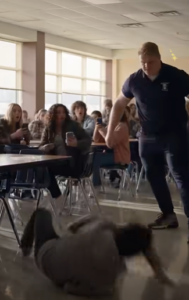
The chair vanished beneath me before I had even finished unpacking my lunch.
One moment, I was sitting at the far end of the cafeteria table.
The next, I was sprawled on the floor while thirty students laughed and aimed their phones at me.
Pain shot through my elbow as it struck the tiles.
My sandwich slid across the table.
The lunch bag tumbled beside me.
Above me stood Travis, grinning broadly.
“Oops.
Didn’t notice you there, little guy.”
His teammates erupted in laughter.
The sound filled the cafeteria.
I slowly pushed myself upright, checking the ache in my elbow.
For one terrible moment, I wanted the floor to swallow me.
I saw students pointing.
I saw phones raised.
I saw the amused expressions of people who had watched this kind of thing happen before.
Then I remembered June’s note in my pocket.
You are my favorite brother.
I pressed my lips together.
Travis kicked my lunch bag across the cafeteria floor.
It skidded beneath a nearby chair.
He pointed toward it.
“Pick that up.”
I looked at the bag.
The repaired strap had come loose again.
Something inside me hurt more than my elbow.
Not because the bag was expensive.
It wasn’t.
Not because the students were laughing.
I had heard laughter before.
It hurt because my mother had packed that lunch with tired hands before sunrise.
Because my sister had placed a little note inside it.
Because my father had once carried that same bag while teaching me how to work.
And because Travis had turned all those small pieces of love into entertainment.
I lifted my eyes.
“Just leave me alone.”
Travis stepped closer.
“What was that?”
I rose onto one knee.
My voice was still quiet.
But every word was clear.
“I said, leave me alone.”
His grin faded.
For a moment, he simply stared.
Then his jaw tightened.
He looked around at the students watching us.
His expression changed.
I knew that look.
It was the look of someone who had been challenged in front of an audience and could think of only one way to answer.
Travis lifted his foot toward my backpack.
Then, deliberately, he swung it toward my side.
I reacted before I had time to think.
I shifted out of the way.
His sneaker missed me and struck the metal leg of the overturned chair with a sharp clang.
Travis stumbled.
One hand shot toward the table as he fought to recover his balance.
He caught himself, straightened, and turned toward me.
His face was red with anger.
The laughter around us began to fade.
He took a step closer.
And then he shouted so loudly that students at the far end of the cafeteria turned toward us.
“YOU THINK THAT’S FUNNY?”
For the first time in eight months, I realized that Travis wasn’t simply trying to embarrass me anymore.
He was furious because I had refused to play the part he had chosen for me.
And now, with the entire cafeteria watching, I could see that he was preparing to come at me again.
The story isn’t over yet.
Select “Next Part” below to see what happens next.
Chapter 2: The Courage to Tell the Truth
For a moment, the whole cafeteria seemed to hold its breath.
Travis stood a few feet away, his fists clenched at his sides.
The metal chair lay between us.
My lunch bag had come to rest beneath another table, its repaired strap hanging loose.
Somebody laughed nervously.
Someone else whispered my name.
I could hear the distant hum of the refrigerators behind the serving counter and the squeak of a student’s sneakers against the floor.
Ordinary sounds.
Sounds I had heard almost every school day for years.
But now they seemed unusually clear.
My elbow throbbed.
My face burned.
And my heart beat so hard that I could feel it beneath my shirt.
Travis stepped toward me.
“What are you looking at?”
I rose carefully to my feet.
I kept both hands open where everyone could see them.
“I don’t want to fight.”
I meant it.
I had never wanted to fight him.
Not in February, when he first pushed me against the lockers.
Not in April, when he took my lunch bag.
Not during the county fair, when he made jokes about my clothes.
And not now, when half the cafeteria seemed to be watching us through their phones.
I wanted to go home.
I wanted to finish the lunch my mother had made.
I wanted to hear June complain about her homework and watch Copper wandering along the fence.
I wanted to live an ordinary life without having to prove that I deserved it.
But Travis seemed incapable of understanding that.
He laughed harshly.
“Then you shouldn’t have made me look stupid.”
I stared at him.
“I didn’t.”
“Don’t lie to me.”
His voice rose again.
Several students moved farther from the table.
A boy near the windows lowered his lunch tray.
I could see Micah standing a short distance behind Travis, holding his phone.
His expression was tight.
He wasn’t laughing anymore.
Travis glanced toward his teammates.
That glance told me something.
It wasn’t enough for him to frighten me.
He needed them to see it.
He needed their approval.
And somewhere in his anger, I think he had begun to believe that my refusal to be afraid in the way he expected was a kind of insult.
He was bigger than me.
Stronger than me.
More popular than me.
Yet he stood there looking as though he had lost something important.
I took a small step backward.
“Please, Travis.
Just stop.”
For an instant, I thought he might.
His expression shifted.
The anger loosened just enough for me to recognize the boy I had seen at the football game, standing on the field and searching the bleachers for his father’s approval.
Then someone behind him murmured something.
Travis’s jaw tightened.
And he lunged.
He moved fast.
Years of football training had taught him how to use his size and weight.
His shoulders lowered, and he charged directly toward me, trying to knock me over.
There was no time to think through a plan.
No time to remember everything Mom had said on the porch.
No time to wonder what the students might think if I moved.
My body reacted before my mind caught up.
I stepped aside.
Travis had aimed for the place where I had been standing.
By the time he reached it, I was no longer there.
His momentum carried him forward.
He struck the edge of the empty lunch table behind me with his hip and shoulder.
The table scraped across the floor.
A plastic cup tipped over.
Travis stumbled, lost his footing, and dropped onto one knee.
The noise was enormous.
Not the impact itself.
The reaction.
Students gasped.
A few shouted.
Someone near the serving line let out a startled cry.
The entire cafeteria erupted in noise.
I stood beside the table, stunned by how quickly everything had happened.
I hadn’t struck him.
I hadn’t pushed him.
I hadn’t even touched him.
But the football captain, the strongest boy in school, was kneeling on the cafeteria floor.
And everybody had seen it.
My first feeling wasn’t triumph.
It was fear.
Because I knew Travis.
I knew how he reacted when someone laughed at him.
He had spent eight months teaching me.
He lifted his head.
His face was red.
For a moment, his expression was almost bewildered.
Then his eyes found mine.
He rose.
“What did you just do?”
I shook my head.
“Nothing.
I moved.”
His breathing grew heavier.
“YOU THINK YOU CAN EMBARRASS ME?”
I glanced toward the serving counter.
Where was Mrs.
Alvarez?
Where were the teachers?
Why wasn’t anyone stopping this?
I took another step back.
“Travis, please.”
He glanced around the room.
Dozens of students were watching.
Some had stopped eating.
Others were standing.
Phones remained raised.
For the first time, Travis seemed to notice that the same audience he had gathered to watch me fall was now watching him lose control.
He didn’t know how to handle it.
I could see that clearly.
And somewhere beneath my own fear, I felt a strange sadness.
If he had simply stepped away, the whole thing might have ended there.
People would have talked.
There might have been consequences.
But he could have stopped.
He still had a choice.
Every person in that cafeteria still had a choice.
Travis chose to charge again.
He came toward me with both arms extended, trying to grab the front of my hoodie.
I remembered working with Willow at the gate.
The frightened mare had been much larger than me.
Trying to overpower her would have been foolish.
Dad had taught me that the safest thing was to remain balanced, avoid standing directly in the path of moving weight, and guide that movement away from danger whenever possible.
Of course, Travis wasn’t a horse.
He was a furious teenager.
And he was strong enough to hurt me badly.
But the same simple understanding helped me.
I didn’t need to match his strength.
I needed to keep him from using it against me.
When he reached for my hoodie, I moved my body away from his direct path.
His hand caught briefly against my sleeve.
I turned with the motion instead of pulling straight backward.
For a moment, we stumbled together.
He tried to regain his grip.
I caught his forearm to keep him from dragging me down.
His own forward movement carried us sideways.
I shifted my feet, stayed balanced, and carefully guided him toward the floor.
It wasn’t graceful.
It wasn’t the kind of movement anyone would have celebrated at a sporting event.
We were both frightened, and he was much stronger than I was.
But he landed without striking his head against the table or falling across the overturned chair.
I released him immediately.
Then I backed away.
Not a single punch.
Not a single kick.
I had no desire to hurt him.
My hands trembled at my sides.
Travis stared up at me, breathing hard.
For several seconds, neither of us spoke.
The quiet kid he had spent eight months bullying had just stopped him in front of the entire cafeteria.
But I didn’t feel like a winner.
I felt exhausted.
I felt frightened.
And I felt unbearably sad that things had reached this point.
All those months of jokes.
All those small humiliations.
All the times people had watched and looked away.
They had led us here.
To a cafeteria floor.
To two boys breathing hard.
To dozens of students holding phones instead of knowing what to do.
I looked at Travis.
His blond hair had fallen across his forehead.
His varsity jacket was twisted around one shoulder.
His face no longer held the easy confidence I had seen that morning.
For an instant, he looked young.
Not like a football captain.
Not like the strongest boy in school.
Just a young man who had made a terrible choice and didn’t know how to take it back.
I wanted him to stand up.
I wanted him to leave me alone.
I wanted the entire day to stop.
Instead, he opened his mouth and shouted:
“HE ATTACKED ME!”
The words struck me harder than the fall.
I stared at him.
“What?”
Travis pushed himself upright.
“He attacked me!”
His voice carried across the cafeteria.
He pointed directly at me.
“Everybody saw it!”
I couldn’t speak.
I had spent eight months worrying that if I defended myself, somehow I would become the person blamed for what happened.
Now the fear was standing in front of me.
It was real.
And it had a voice.
Travis looked toward his friends.
“Tell them!”
Several boys exchanged glances.
Nobody answered immediately.
The silence was different from the laughter that had followed my fall.
It was uncomfortable.
Uncertain.
The kind of silence people make when they know the truth but have not decided whether they are brave enough to say it.
I looked around the room.
A girl from my history class stood near the end of a table.
She was the same student who had once told me to report Travis.
Her face was pale.
When our eyes met, she looked down at the phone in her hand.
A younger boy stood beside the vending machines, clutching a carton of milk.
Another student slowly lowered his tray.
Nobody seemed to know what would happen next.
Then I noticed something that frightened me even more.
Some students were looking at me as though I might be dangerous.
I had moved out of Travis’s way.
I had stopped him from grabbing me.
I had done everything I could to avoid hurting him.
But all they had seen, perhaps, was the school’s biggest football player ending up on the floor.
And Travis was already telling them what to believe.
I thought of Mom.
I imagined the school calling her at work.
I imagined her driving into town, worried and confused.
I imagined someone telling her that her son had attacked the captain of the football team.
My stomach turned.
I could hear her voice from the night before.
Whatever happens at school, remember that you can come home and tell me.
I wanted to believe that would be enough.
But I also knew how much weight Travis’s name carried in Dry Creek.
His father sponsored local events.
His family had supported the school for years.
He was the football captain.
And I was the quiet boy from a small ranch with a patched lunch bag.
I hated myself for thinking those things mattered.
But they did.
At least, they had mattered for eight months.
I took a slow breath.
“I didn’t attack you.”
My voice was quiet.
Travis glared.
“You threw me down!”
“You grabbed me.”
“LIAR!”
A sharp ache spread through my chest.
Not because I believed him.
Because I knew he was counting on everybody else to believe him.
I looked down at my hands.
They were shaking.
A small red mark crossed my wrist where his fingers had caught me.
My elbow still hurt from falling.
I had never felt so exposed.
And yet, beneath the fear, I knew one thing with absolute certainty.
I had not done anything wrong by protecting myself.
For once, I wasn’t going to apologize simply to make Travis happy.
Mrs.
Alvarez appeared near the cafeteria entrance.
She had been in the kitchen area when the first commotion began.
Now she was moving quickly between the tables, her face serious.
“What is going on here?”
Her voice was firm.
Students began talking at once.
“He fell!”
“Travis pushed him!”
“No, the other kid—”
“They were fighting!”
“Somebody moved a chair!”
The noise grew louder.
Mrs.
Alvarez raised one hand.
“Quiet, please!”
Several students stopped talking.
Others continued whispering.
She stepped toward us.
Her eyes moved from Travis to me and then to the overturned chair.
“Are either of you hurt?”
I shook my head, then glanced at my elbow.
“Not badly, ma’am.”
Travis spoke immediately.
“He attacked me.”
Mrs.
Alvarez looked at him.
“Let me hear what happened from the beginning.”
Travis pointed toward me.
“I was just talking to him.
He got mad and threw me on the floor.”
I felt my face heat.
“That’s not true.”
“Yes, it is!”
Mrs.
Alvarez turned toward me.
“Ethan, let me finish with him, please.”
I closed my mouth.
She looked at the chair again.
Then at my lunch bag lying beneath the nearby table.
Something in her expression changed.
She had seen that bag before.
She knew I always sat at the end of the table.
And perhaps, after so many months of watching students move around one another, she knew more than I realized.
But she had not witnessed the beginning.
I understood that.
She needed to know what had happened.
And I needed to explain it without letting fear turn my words into confusion.
I swallowed.
“Mrs.
Alvarez, I was eating lunch.”
Travis made an angry sound.
She lifted one hand toward him without taking her eyes off me.
“Go ahead, Ethan.”
“He pulled my chair out.”
I pointed toward the overturned chair.
“I fell.
Then he kicked my lunch bag.
I asked him to leave me alone.”
My voice shook.
I hated that.
But I kept speaking.
“He tried to kick me.
I moved.
He hit the chair instead.”
Mrs.
Alvarez’s face tightened.
“And then?”
“He came toward me.
I stepped away, and he hit the table.”
Travis interrupted.
“He’s making that up!”
Mrs.
Alvarez turned sharply.
“Travis, I need you to be quiet while he speaks.”
For a moment, he looked astonished.
Then he folded his arms.
I continued.
“He tried to grab me again.
I stopped him and moved him away from the tables.
That’s all.”
Mrs.
Alvarez studied me.
“Did you hit him?”
“No, ma’am.”
“Did you kick him?”
“No.”
“Did you threaten him?”
“No.”
She nodded slowly.
Then she looked toward the surrounding students.
“Did anyone see the entire incident?”
The room went quiet.
So quiet that I could hear a chair scrape near the far wall.
Dozens of students had watched.
Several had recorded.
Yet nobody spoke.
I looked at their faces.
Some were frightened.
Some embarrassed.
Some seemed more interested in watching what happened next than helping anyone understand what had already happened.
A terrible thought crossed my mind.
Maybe it didn’t matter that they had seen everything.
Maybe they would still choose Travis.
I remembered a winter evening years earlier, not long before Dad became ill.
A young calf had slipped through a broken fence and become trapped in a narrow ditch beyond our pasture.
The ground was frozen.
Snow lay along the banks.
Dad and I had gone out with ropes and lanterns to bring it home.
I was fourteen and eager to prove I could help.
The calf struggled whenever we approached.
I tried grabbing the rope and pulling harder.
Dad stopped me.
“You’re frightened, Ethan.”
I remember feeling offended.
“I’m not.”
He looked at the calf.
“Then why are you rushing?”
I had no answer.
Dad knelt beside me in the snow.
“When something scares you, son, don’t let fear make all your decisions.
Fear is useful when it warns you.
It becomes dangerous when you let it lead.”
We worked slowly.
Dad spoke softly to the calf while I cleared ice from the ditch.
When the animal finally stood, it was shaking but unharmed.
We walked it home beneath a sky filled with stars.
Later, Mom gave us hot soup and scolded Dad for staying out so long in the cold.
He laughed and kissed her forehead.
It was such an ordinary memory.
One of hundreds I had collected without knowing how precious they would become.
Standing in the cafeteria, with Travis accusing me and everyone watching, I suddenly understood why that evening had returned to me.
I was frightened.
But I didn’t have to let fear decide what kind of person I would be.
I looked toward Mrs.
Alvarez.
“I didn’t want any of this.”
She heard me.
I could tell.
But before she could answer, Travis spoke again.
“He’s lying because he knows he’s in trouble.”
The words hung between us.
I closed my eyes briefly.
Then opened them.
I wasn’t going to shout.
I wasn’t going to insult him.
And I wasn’t going to pretend I had attacked him just because he wanted me to accept the blame.
“I told you I didn’t want to fight,” I said.
Travis looked away.
It was the smallest movement.
Almost nothing.
But I noticed it.
For one instant, he couldn’t meet my eyes.
Mrs.
Alvarez turned toward the crowd again.
“Someone here must have seen what happened.”
She looked at the nearest students.
“Please.
If you saw the beginning, tell me.”
A boy near the windows opened his mouth.
Then he glanced at Travis and closed it again.
My heart sank.
I recognized that hesitation.
I had lived inside it for eight months.
The fear of making someone angry.
The fear of becoming the next target.
The fear of losing friends.
The fear of standing alone.
I couldn’t hate those students for being afraid.
But I wished they understood what their silence felt like to the person standing in the middle of it.
Then I saw Micah.
He was still standing beside the table where Travis’s teammates had gathered.
His phone was raised halfway between his chest and his face.
He wasn’t recording anymore.
At least, I didn’t think so.
His expression had changed completely.
There was no smile.
No uncertainty disguised as amusement.
He looked sick.
Travis saw Mrs.
Alvarez glance toward the phones.
He straightened.
“Ask them,” he said quickly.
“They saw him throw me down.”
A few teammates looked at the floor.
Micah remained motionless.
Travis pointed toward him.
“Micah.
Tell her.”
The room seemed to shrink.
I watched Micah’s face.
His eyes moved from Travis to me.
Then toward the lunch bag beneath the table.
For a moment, he looked at the floor as though the answer might be written there.
I remembered helping him fix his truck.
I remembered him thanking me.
I remembered our conversation outside the library.
It’s not always that easy.
No.
It isn’t.
I hadn’t expected anything from Micah after that conversation.
Maybe a little less laughter.
Maybe a small gesture of kindness.
I certainly hadn’t expected him to risk angering Travis in front of the whole school.
But now he was standing with the truth in his hands.
And I could see that he understood it.
He knew what his phone contained.
He knew what had happened.
He knew that Travis had started everything.
The question was whether he would say it.
I wish I could say I felt brave at that moment.
I didn’t.
My knees felt weak.
My mouth was dry.
I wanted to sit down, but I was afraid that moving would make everyone look at me again.
I wanted Mom.
Not because I needed her to fight for me.
Because I wanted to hear her tell me that I was still her son, no matter what happened next.
I thought about June practicing her school story at breakfast.
I imagined her standing in front of her class, reading about a horse who rescued a lost calf.
She would be proud.
She would come home holding her paper and tell me every detail.
I wanted to be there to listen.
I thought about Copper waiting beside the pasture gate.
I thought about Willow and the cold barn.
I thought about the stack of feed bills on the kitchen table.
My world was full of unfinished ordinary things.
And suddenly those things felt more important than the entire school cafeteria.
I had spent eight months allowing Travis to become the center of my thoughts.
Eight months planning where to walk.
Where to sit.
What to say.
What not to say.
Eight months trying to make myself so small that he would eventually grow bored.
But standing there, I realized something simple and painful.
I had been measuring my own worth by the behavior of someone who had never taken the time to know me.
Travis didn’t know what it felt like to help June with her homework after a hard day.
He didn’t know how Mom looked when she finally laughed after weeks of worry.
He didn’t know the smell of our barn before sunrise or the sound of Dad’s voice in my memories.
He didn’t know that the patched lunch bag had once belonged to the happiest years of my childhood.
He saw an easy target.
A boy who rarely spoke.
A person he could push around without consequences.
And somewhere along the way, I had almost begun seeing myself that way too.
But I wasn’t only the quiet boy.
I was Mom’s son.
June’s brother.
Dad’s child.
A ranch hand.
A student.
A person who made mistakes, felt afraid, and still tried to treat people with kindness.
I had people who loved me.
I had a home where I belonged.
And I had a future that was bigger than Travis Benton.
I opened my eyes.
The cafeteria was still silent.
Mrs.
Alvarez was waiting.
Micah was looking at his phone.
Travis was growing impatient.
“Well?” he demanded.
Micah swallowed.
The movement was small.
But I saw it.
There are moments when you can almost see a person struggling between two versions of themselves.
One version wants safety.
The other wants to do what is right.
I believe Micah was caught between those two versions that afternoon.
He had spent months standing beside Travis.
He had laughed when he should have spoken.
He had watched things happen that he knew were wrong.
And he had become part of the group that made those things possible.
I didn’t know everything he was thinking.
But I knew enough about fear to recognize it on his face.
His eyes moved toward the cafeteria doors.
For a second, I thought he might leave.
Then he looked at me.
I didn’t plead.
I didn’t shake my head.
I didn’t ask him to save me.
I simply stood there.
And somehow, I think that made his decision harder.
Because he couldn’t pretend I was asking him to choose sides in a childish argument.
He was being asked to tell the truth.
That was all.
I remembered what he had said when I fixed his truck.
Thanks, man.
Two simple words.
I had helped him because he needed help.
Not because I expected him to repay me.
Dad had raised me that way.
Mom had reinforced it every day since.
You helped people because they were people.
You offered kindness because the world needed more of it.
But now, as Micah stood with his phone in his hand, I wondered whether that small act beside his broken truck had reminded him of something he used to know.
Something that had become buried beneath the desire to fit in.
He was still the boy who once built a crooked playground fort with me.
Still the boy who had laughed when it collapsed.
Still capable of choosing something better than what he had chosen before.
I hoped he understood that.
Because I was beginning to understand it myself.
A bad choice could hurt people deeply.
But the next choice still mattered.
Travis stepped toward Micah.
“Come on.
Tell her what happened.”
Micah didn’t answer.
His fingers tightened around the phone.
Mrs.
Alvarez noticed.
“Micah?”
He looked up.
“Yes, ma’am?”
“Did you record this?”
He nodded.
Travis let out a short laugh.
“Good.
Then show her.”
Micah looked down again.
The phone screen glowed against his palm.
I could see that his hands were trembling.
Mrs.
Alvarez extended one hand.
“May I see it?”
Micah hesitated.
He seemed to search Travis’s face one last time.
Travis stared at him.
Not with concern.
Not with friendship.
With expectation.
As though Micah’s only responsibility was to protect him.
I knew that look too.
I had seen it whenever Travis told one of his friends to move my books, block a doorway, or repeat a cruel joke.
It was a look that said, If you’re with me, you’ll do what I say.
Micah lowered his phone.
Something changed in his expression.
The fear was still there.
But there was something else now.
Resolve.
He looked at Mrs.
Alvarez.
“I need to tell you something.”
Travis frowned.
“What?”
Micah ignored him.
Mrs.
Alvarez stepped closer.
“Go ahead.”
Micah’s voice was barely above a whisper.
“It’s about the video.”
My heart began beating faster.
Travis moved his head sharply toward him.
“What about it?”
Micah took a breath.
His cheeks had gone pale.
Mrs.
Alvarez waited patiently.
“Micah, you’re not in trouble for telling me the truth.”
Those words seemed to affect him.
He looked at her.
Then at his phone.
Then finally at me.
For the first time since the incident began, he met my eyes without looking away.
There was shame in his expression.
I could see it clearly.
But there was also an apology he didn’t yet know how to speak.
I didn’t smile.
I didn’t nod.
I simply waited.
Micah looked back at Mrs.
Alvarez.
And he began to tell the truth.
For months, I had thought the hardest part of being bullied was the cruelty itself.
The names.
The pushing.
The laughter.
The way an ordinary lunch hour could become something I dreaded before I even left home.
But that afternoon taught me something else.
Sometimes the hardest part is the silence of everyone around you.
The people who see what is happening but convince themselves it isn’t their responsibility.
The people who laugh because they are afraid not to.
The people who tell themselves that speaking up won’t change anything.
I understood them more than I wanted to.
Because I had spent months telling myself similar things.
Don’t make trouble.
Don’t make it worse.
Just get through today.
And now, for the first time, someone who had helped make those months painful was choosing not to remain silent.
It didn’t erase what he had done.
It didn’t repair every humiliation.
It didn’t take away the ache in my elbow or the knot in my stomach.
But it mattered.
It mattered more than I could have explained at that moment.
Because courage was not always the absence of fear.
Sometimes courage was a boy standing in front of his friends, knowing that the next words out of his mouth might cost him their approval.
And saying them anyway.
Micah took another breath.
His voice grew steadier.
Mrs.
Alvarez listened.
Travis’s face hardened.
I could see him sensing that something was slipping beyond his control.
“Micah,” Travis warned.
Mrs.
Alvarez turned toward him.
“Travis.
Stop interrupting.”
The football captain went still.
Nobody laughed.
Nobody cheered.
The cafeteria had become so quiet that I could hear the clock above the serving counter.
Micah looked down at his phone one final time.
Then he raised his head.
“Ma’am, I recorded the whole thing.”
Mrs.
Alvarez nodded.
“All right.”
“From before he pulled the chair.”
I felt my chest tighten.
Travis took a half step forward.
Mrs.
Alvarez noticed and positioned herself between him and Micah.
“Stay where you are, Travis.”
He stopped.
Micah’s breathing was uneven.
“I shouldn’t have done it.”
Mrs.
Alvarez spoke gently.
“Done what?”
Micah glanced toward his teammates.
None of them met his eyes.
He looked back at her.
“I knew what was going to happen.”
A murmur moved through the cafeteria.
Travis’s face changed.
“Shut up, Micah.”
Mrs.
Alvarez’s voice became firm.
“That is enough.”
Micah flinched.
For an instant, I thought he might retreat into silence.
Then his shoulders straightened.
He looked directly at Mrs.
Alvarez.
And in a clear voice that carried through the entire cafeteria, he said the words none of us had expected.
“Ma’am, Travis gave each of us twenty dollars to record him beating this kid up.”
The supervisor froze in her tracks.
For a moment, she looked from Micah to Travis, as though she needed to be certain she had heard correctly.
My breath caught.
Twenty dollars.
That was what the laughter had been worth.
That was what my embarrassment had been worth to the boys holding their phones.
Twenty dollars each.
I thought of Mom counting money for winter feed.
Of the hours I worked at the feed store.
Of June saving coins in a jar because she wanted to buy a new halter for Copper.
And I stood there trying to understand that somebody had handed out money to turn my fear into entertainment.
But beneath the shock, another thought slowly took hold.
Micah had told the truth.
He had done it in front of everyone.
The same boy who had been too frightened to stop laughing had finally found the courage to speak.
Across the room, several students lowered their phones.
A girl covered her mouth.
One of Travis’s teammates stared at the floor.
The cafeteria remained silent.
For the first time in eight months, that silence no longer felt like everyone was abandoning me.
It felt like people were beginning to understand.
I looked at Micah.
His eyes were wet.
He stood very still, gripping his phone, waiting for the consequences of what he had said.
I wanted to tell him that I had heard him.
That doing the right thing now mattered.
That I didn’t know whether we would ever be friends again, but I hoped this wouldn’t be the last brave decision he made.
Instead, I simply met his gaze.
He gave the smallest nod.
I returned it.
It wasn’t forgiveness.
Not yet.
Some hurts needed time.
Some apologies required more than words.
And some people had to prove through their actions that they were ready for a second chance.
But it was a beginning.
I remembered Dad’s voice.
“A strong man doesn’t have to prove he’s strong every time somebody pushes him.”
I finally understood that he had never been teaching me how to remain weak.
He had been teaching me how to remain myself.
I had not hurt Travis.
I had not tried to embarrass him.
I had not answered cruelty with cruelty.
And now the truth was standing in the middle of the cafeteria, spoken aloud by someone who had once been afraid to say it.
Mrs.
Alvarez slowly turned toward the football captain.
Her expression was no longer simply concerned.
It was grave.
Travis immediately turned toward his teammate.
And in that instant, the entire situation became far more serious.

