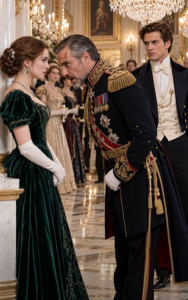
 “Please, Dmitri. Not here.”
Cordelia Hartwell spoke so softly that her words should have disappeared beneath the magnificent chandeliers of Lord Dunmore’s ballroom.
But Count Dmitri Volkov heard them.
And, to Lucian Ashcroft’s growing astonishment, the Russian ambassador obeyed.
For several seconds, the three of them stood in a silence that seemed to stretch across the entire room. Around them, three hundred members of London’s aristocracy watched with undisguised fascination. A moment earlier, these same people had been laughing at the Duke of Rothsay’s unfashionable provincial wife.
Now one of Europe’s most influential diplomats had bowed before her.
And she had addressed him by his Christian name.
Lucian felt something cold settle beneath his ribs.
He had spent three weeks convincing himself that Cordelia was an embarrassment he must endure until his railway affairs were settled. He had assumed that her quietness meant ignorance, that her unfashionable clothing reflected a provincial upbringing, and that her unwillingness to argue was evidence of submission.
Yet the woman standing before him had just silenced a Russian ambassador with four words.
Volkov studied Cordelia’s face.
“Are you quite certain?” he asked.
She gave the smallest nod.
“Tonight, yes.”
The ambassador’s eyes darkened with understanding. Then he turned toward Lucian.
“Your Grace.”
Lucian straightened instinctively.
“Your Excellency.”
“I understand that congratulations are in order.”
The ambassador’s tone was perfectly courteous.
Somehow, that made it worse.
“Indeed,” Lucian answered. “My wife and I were married three weeks ago.”
“Three weeks.”
Volkov repeated the words as though weighing them.
“And I trust Her Grace has found England welcoming?”
Lucian opened his mouth.
Cordelia answered first.
“England has been precisely as I remember it.”
The ambassador looked at her for a long moment.
“I see.”
Lady Philippa Lisle, who had remained nearby despite her obvious discomfort, attempted a bright laugh.
“How extraordinary that you two should be acquainted! Our dear Duchess has been so modest about her accomplishments. We had quite imagined Yorkshire was the limit of her experience.”
Volkov turned.
The movement was unhurried, but Philippa immediately stopped smiling.
“Madam,” he said, “I have known ladies presented at the greatest courts in Europe who possessed less grace than the Duchess of Rothsay.”
Philippa’s cheeks reddened.
“I meant no offense.”
“Then I am pleased to discover that your words were accidental.”
A faint sound escaped someone nearby.
Philippa’s companions lowered their eyes.
Volkov returned his attention to Cordelia.
“May I request a few moments of your time, Your Grace?”
Cordelia glanced toward Lucian.
It was not a request for permission.
It was the habitual movement of a woman who had learned, during three miserable weeks of marriage, that every independent decision might become another accusation.
Lucian recognized the distinction.
For the first time, he found it difficult to meet her eyes.
“Certainly,” he said. “Perhaps we might withdraw somewhere private.”
Volkov’s expression changed almost imperceptibly.
“I had intended to speak with the Duchess.”
Lucian felt the insult like a slap.
Nevertheless, Cordelia intervened.
“My husband may accompany us.”
The ambassador inclined his head.
“As you wish.”
And with that, the three of them left the ballroom, passing through a doorway into a smaller drawing room adjoining the eastern gallery.
Behind them, conversations erupted.
By morning, every drawing room in London would be discussing the same impossible question.
Who was Cordelia Hartwell?
And why had Count Dmitri Volkov bowed before her?
The drawing room was furnished in pale blue silk and polished walnut. A fire burned behind an elaborate brass screen, and tall windows overlooked Lord Dunmore’s moonlit gardens.
Cordelia stopped beside a writing desk.
Volkov remained near the door until the footman had withdrawn.
Then he spoke.
“You should have written to me.”
Cordelia lowered her eyes.
“I considered it.”
“For three years?”
“I did not wish to trouble you.”
“Trouble me?”
For the first time, something like pain crossed the ambassador’s severe face.
“Cordelia, there are debts of gratitude that cannot be discharged with polite letters.”
Lucian stared between them.
“Would someone care to explain what is happening?”
Cordelia’s expression closed immediately.
Volkov noticed.
“Your husband does not know?”
“No.”
“Anything?”
“He knows I was raised in Yorkshire.”
The ambassador released a slow breath.
“And apparently considers that sufficient information.”
Lucian stiffened.
“I do not believe my marriage is an appropriate subject for diplomatic criticism.”
“No,” Volkov replied. “I imagine it is a subject best examined by your conscience.”
“Dmitri,” Cordelia warned.
He stopped.
Lucian had never seen a powerful man accept correction so readily.
Not from a woman.
Certainly not from his wife.
“Cordelia,” he said sharply, “I believe I am entitled to know why the Russian ambassador addresses you as an intimate acquaintance.”
She turned toward him.
There was no anger in her eyes.
That troubled him more than anger would have.
“Are you asking because you wish to know me, Lucian? Or because you fear what people will say about you?”
The question struck too accurately.
“I am your husband.”
“Yes,” she answered. “You have reminded me of that frequently.”
Volkov looked away, granting them a privacy that the small room could barely provide.
Lucian felt heat rise along his neck.
“Whatever has happened between us, you have concealed a connection with a foreign diplomat of considerable importance.”
“I have concealed many things,” Cordelia said.
The answer silenced him.
Then she added, “Not all secrets are kept for dishonest reasons.”
Volkov moved to the fireplace.
“Perhaps,” he said carefully, “I may explain enough to satisfy His Grace without betraying any confidence.”
Cordelia hesitated.
At last, she nodded.
“Only what is necessary.”
The ambassador folded his hands behind his back.
“Six years ago, your wife was living for several months in St. Petersburg.”
Lucian blinked.
“St. Petersburg?”
“Yes.”
“That is impossible.”
Cordelia raised an eyebrow.
“Is it?”
“Your father has scarcely left Yorkshire in a decade.”
“My father has not left Yorkshire in recent years. That does not mean he was born there and remained within its boundaries.”
Lucian said nothing.
Volkov continued.
“Lord Hartwell was once a respected scholar of languages and European commercial law. His daughter inherited both his abilities and his appetite for learning.”
He regarded Cordelia with quiet affection.
“She speaks Russian fluently, as well as French. She reads German, possesses an unusually precise understanding of commercial documents, and has a remarkable memory for details other people overlook.”
Lucian stared at his wife.
He remembered mocking her education in the carriage.
These people can smell ignorance.
Cordelia had answered that they would be very busy.
Now he understood why.
“You speak Russian?” he asked.
“Yes.”
“Fluently?”
“Would you like me to demonstrate?”
The quiet sharpness of her reply made him look down.
Volkov did not smile.
“During her stay in Russia, Miss Hartwell assisted with translations connected to a difficult commercial dispute. Her work was unofficial and confidential. She discovered an important discrepancy in a set of shipping records.”
“What kind of discrepancy?” Lucian asked.
“A dangerous one.”
The ambassador’s face became grave.
“A young Russian officer had been accused of approving the movement of prohibited cargo through a Baltic port. Documents appeared to establish his involvement. The accusation threatened to destroy his career and bring disgrace upon his family.”
Lucian listened.
“The matter concerned British merchants as well,” Volkov continued. “Several of their vessels were detained while authorities attempted to discover who had authorized the shipments.”
“And Cordelia was involved?”
“She was asked to translate correspondence. Instead, she noticed that the dates recorded in the Russian copies did not match those in the English originals.”
Cordelia spoke quietly.
“The documents had been altered after the cargo was loaded.”
Volkov nodded.
“She recognized that the translations had been deliberately arranged to conceal the alterations. When she produced the original sequence of correspondence, it became possible to establish that the officer had signed nothing authorizing the shipment.”
Lucian looked at her.
“Who was the officer?”
For a moment, neither answered.
Then Volkov said, “My son.”
The room became very still.
Cordelia’s expression softened.
“Pavel was innocent.”
“He was,” Volkov replied. “But innocence is not always sufficient when powerful commercial interests are determined to find a convenient man to blame.”
Lucian felt an unfamiliar shame.
He had spent the evening allowing London society to humiliate a woman who had once defended an innocent stranger at considerable personal risk.
“Was he released?” he asked.
“Yes,” Volkov said. “After a formal investigation. His name was cleared. Several companies were examined, although not every question was satisfactorily answered.”
His gaze returned to Cordelia.
“Miss Hartwell could have remained silent. Instead, she signed a statement identifying the discrepancies and accepted the possibility of being called to testify.”
Cordelia shook her head.
“The originals spoke for themselves.”
“Only because you insisted that someone examine them.”
A complicated emotion passed over her face.
“Please don’t turn it into something heroic.”
Volkov’s voice softened.
“You protected my son when many men with greater authority preferred to protect themselves.”
Lucian watched her.
“Why was it kept secret?”
Cordelia looked toward the windows.
“Because the evidence involved commercial interests on both sides of the Baltic. Some of the companies were British. There were people who believed that embarrassing those firms would damage relations between governments.”
“And you disagreed?”
“I believed an innocent man should not be punished for someone else’s dishonesty.”
Volkov continued.
“The investigation eventually reached a settlement, but certain correspondence was never made public. Miss Hartwell was advised that remaining out of the newspapers would protect her from further attention.”
“Advised by whom?” Lucian asked.
The ambassador’s face became unreadable.
“By people whose names are not mine to disclose.”
Lucian looked at Cordelia again.
“Is there more?”
“Yes,” she answered.
“Will you tell me?”
“Not tonight.”
He felt his pride rise instinctively.
Then he remembered the carriage, the marble pillar, Philippa’s laughter, and his own deliberate smile as strangers insulted his wife.
He had offered her no kindness.
Yet he expected her trust.
The realization was profoundly uncomfortable.
Volkov approached Cordelia.
“Forgive me for recognizing you so publicly. I was not aware that discretion remained necessary.”
“It was not your fault.”
“Nevertheless, I regret the distress.”
She smiled faintly.
“You have never been very good at pretending not to know someone.”
“Especially someone to whom my family owes so much.”
He took her gloved hand and bowed over it.
This time, Lucian understood that the gesture was not a display of political calculation.
It was gratitude.
And something close to paternal affection.
“Pavel still remembers you,” Volkov said. “He has two daughters now.”
Cordelia’s face changed.
For the first time that evening, her smile was unguarded.
“Two?”
“Twins.”
“Oh, Dmitri.”
“He has written to you more than once.”
“I know. I kept the letters.”
“Then perhaps you will answer them.”
“I shall try.”
The ambassador squeezed her hand gently and released it.
He turned toward Lucian.
“Your Grace, I must return to the reception. I understand you wished to discuss certain commercial arrangements involving my country.”
Lucian straightened.
“Yes. The matter is of considerable importance to my shipping interests.”
“Then I suggest we arrange a meeting at a later date.”
“I would appreciate that.”
Volkov’s gaze sharpened.
“But I must be clear about one matter. My gratitude toward your wife is personal. It cannot influence any official commercial decision.”
“Of course.”
“And neither should your wife’s reputation be used as a means of obtaining my assistance.”
Lucian felt another surge of humiliation.
“I would never—”
He stopped.
Volkov waited.
Lucian could not finish the sentence with conviction.
The ambassador inclined his head.
“Good evening, Your Graces.”
At the door, he paused.
“Cordelia.”
“Yes?”
“If the old matter begins troubling you again, you must tell me.”
A shadow crossed her features.
“I will.”
The door closed behind him.
Husband and wife were alone.
For several moments, Lucian could hear nothing but the steady ticking of the mantel clock.
Cordelia moved toward the fire.
He watched her profile, searching for something familiar.
Three weeks.
They had lived beneath the same roof for three weeks, shared meals at the same table, and occupied adjoining rooms.
And he knew less about her than a foreign ambassador.
“How long did you intend to conceal all this?” he finally asked.
Cordelia turned.
“Which part?”
“Your education. Russia. Your connection with Volkov.”
“Would you have listened?”
“That is not the question.”
“It is precisely the question.”
Her voice remained steady.
“You asked me where I had learned to read. I told you my father taught me. You laughed and said country gentlemen commonly mistook familiarity with books for an education.”
Lucian remembered.
“You asked whether I had ever traveled beyond Yorkshire. Before I could answer, you informed me that London would be a bewildering place for a woman of my background.”
He looked away.
“And when I mentioned that I understood the railway survey, you told me that matters of engineering and finance were not appropriate subjects for a duchess.”
“Cordelia—”
“You were not interested in learning what I knew. You were interested in proving that I knew nothing.”
The accusation was delivered without bitterness.
Its accuracy made it harder to endure.
“I did not know,” he said.
“No.”
She looked directly at him.
“You did not wish to.”
He took a step toward her.
“I admit I may have misjudged your capabilities.”
Something flickered across her face.
“My capabilities?”
“Your education. Your experiences.”
“Lucian, you did not merely misjudge my education.”
He remained silent.
“You brought me here to be laughed at.”
The words settled between them.
“You knew precisely what society would say about my gown. You stood beside me while they whispered. And when you heard them insulting me, you smiled.”
He felt the blood rise to his face.
“It was a difficult marriage arrangement.”
“For both of us.”
“Your father forced terms upon me that no gentleman would willingly accept.”
“My father demanded a marriage because you wanted his valley.”
“And you agreed.”
“Yes.”
“Then surely you understand why I resented the bargain.”
“I understood your resentment. I did not understand why you believed it entitled you to cruelty.”
Lucian had no answer.
Cordelia moved toward the door.
“Where are you going?”
“Home.”
“The evening is not over.”
“It is for me.”
“We cannot simply leave. People will talk.”
She looked back.
“They have been talking since we arrived. I doubt our departure will interrupt them.”
“Cordelia, please.”
She stopped.
It was the first time he had said the word to her without irritation or condescension.
“I need to understand what has happened tonight.”
“Then begin with what you already know.”
“And what is that?”
“That you have been unkind to someone who has done you no injury.”
She opened the door.
Before leaving, she added, “If you still wish to know the rest tomorrow, you may ask me respectfully.”
Then she walked out.
Lucian stood alone before the fire.
For the first time since his wedding, he felt no satisfaction in the prospect of his wife returning to Yorkshire.
Only the dreadful awareness that she might leave before he had ever truly met her.
Cordelia found the carriage waiting outside Lord Dunmore’s house.
The footman helped her inside, and the door closed against the cold night air.
Only then did she allow her hands to tremble.
The evening had gone terribly wrong.
Not because Lucian had humiliated her.
She had expected that.
Not even because Philippa Lisle had mocked her gown.
Cruel women had worn more expensive jewels than Philippa’s and said considerably worse things.
What frightened Cordelia was Dmitri’s final warning.
If the old matter begins troubling you again, you must tell me.
He suspected something.
Perhaps he knew more than she had imagined.
She reached into her small evening reticule and touched the folded paper hidden beneath her handkerchief.
It had arrived that morning.
A brief note, sent without a signature.
The Baltic accounts were never closed. Ask who now controls the guarantees.
Cordelia had recognized the phrase immediately.
Six years earlier, the investigation in St. Petersburg had exposed a network of falsified shipping documents. The officer accused of approving the cargo had been cleared, but the men who arranged the transactions had escaped complete scrutiny.
The records had passed through several commercial houses. Some were dissolved. Others changed their names.
And the documents Cordelia had translated had disappeared into private archives.
She had tried to put that part of her life behind her.
Then, two weeks after her marriage, she had seen something disturbing in Lucian’s library.
A shipping memorandum bearing a commercial symbol she remembered from Russia.
Three narrow lines beneath a crowned anchor.
It appeared on paperwork belonging to one of the Duke’s subsidiary companies.
At first, Cordelia had assumed it was a coincidence.
But the unsigned note suggested otherwise.
The carriage began moving.
Cordelia closed her eyes.
She had agreed to marry Lucian for reasons he did not understand, but she had never intended to become involved in another diplomatic controversy.
She wanted a peaceful life.
She wanted her father’s valley protected.
She wanted the families who had lived there for generations to remain in their homes.
And, foolishly perhaps, she had hoped that beneath the Duke’s arrogance there might be a decent man.
During their brief engagement, Lucian had been cold but not openly vicious. He had spoken intelligently about industry, employment, and the future of northern England.
Cordelia had listened.
For a few conversations, she had believed he might genuinely care about the people his railway would affect.
Then they married.
And kindness had disappeared from his manner as though it were something he could no longer afford.
She pressed her fingers against her eyes.
She would not cry.
Not over him.
Not tonight.
Lucian did not leave Lord Dunmore’s reception immediately.
He returned to the ballroom because pride demanded it, although he quickly discovered that his presence no longer commanded the attention he expected.
Wherever he went, conversations stopped.
People glanced at him with expressions ranging from pity to amusement.
The humiliation he had intended for Cordelia had somehow become his own.
Near the card room, he encountered Sir Edmund Ashcroft.
His uncle was a distinguished man in his late fifties, handsome in a severe fashion, with graying hair and a habit of speaking as though every sentence contained an instruction.
“There you are,” Sir Edmund said. “I have been looking everywhere.”
“I was speaking with the Russian ambassador.”
“I heard.”
Something in his uncle’s tone caught Lucian’s attention.
“You sound displeased.”
“Not displeased. Surprised.”
“Everyone appears to be surprised tonight.”
Sir Edmund examined him.
“Your wife’s acquaintance with Volkov is rather unexpected.”
“It was unexpected to me.”
“Did she explain?”
“Partly.”
“What did she say?”
Lucian hesitated.
It was an unusual sensation.
All his life, he had discussed family affairs freely with Sir Edmund. His uncle had guided him through complicated investments, negotiated shipping agreements, and helped manage the increasingly burdensome debts inherited from Lucian’s father.
Yet something about Sir Edmund’s eagerness disturbed him.
“She lived in Russia for a time,” Lucian answered.
“Indeed?”
“She assisted with certain commercial translations.”
Sir Edmund’s expression remained composed.
“Commercial translations?”
“Yes.”
“What sort of commerce?”
“I did not inquire into every detail.”
His uncle looked toward the ballroom entrance.
“How unfortunate.”
“Why?”
“Because Volkov is not a man who cultivates casual friendships. Your wife’s connection may be useful, but it might also attract unwanted attention.”
Lucian felt irritation stir.
“She is not a political inconvenience to be managed.”
Sir Edmund raised his eyebrows.
“Good heavens. Three weeks of marriage and you have become protective.”
“Do not be absurd.”
“Then consider the situation practically. We require Russian cooperation. The northern railway depends upon obtaining capital on favorable terms, and our shipping interests are already strained.”
“I know the position of my affairs.”
“Do you?”
The question was quiet.
Lucian stiffened.
Sir Edmund continued, “Your father left you enormous assets and rather less flexibility than the public imagines. Coal alone cannot sustain every investment. We have worked for years to strengthen the estate.”
“We have.”
“And the Yorkshire route remains essential. Lord Hartwell’s valley provides the most economical passage between the mines and the eastern line.”
“I married his daughter, did I not?”
“Precisely.”
Sir Edmund gave a thin smile.
“Then I suggest you ensure that marriage produces the advantages for which you entered it.”
Lucian looked at him.
The words should not have surprised him.
Until that evening, he had considered them perfectly reasonable.
Now he remembered Cordelia standing in the drawing room, asking why resentment entitled him to cruelty.
“She is my wife,” he said.
“And the daughter of the man who controls the valley.”
“She is not a railway concession.”
Sir Edmund studied him.
“No,” he replied slowly. “Of course not.”
But Lucian noticed that his uncle’s fingers had tightened around his glass.
A moment later, Lady Philippa approached.
“My dear Lucian. What a remarkable evening.”
He bowed automatically.
“Lady Philippa.”
“I confess I owe your wife an apology. We had no idea she enjoyed such distinguished acquaintances.”
Sir Edmund looked sharply toward her.
“What exactly did the ambassador say?”
Philippa seemed delighted to have an audience.
“He practically declared her superior to every woman in London. And then he bowed again when they departed.”
“Bowed again?” Sir Edmund repeated.
“Yes. Quite extraordinary.”
Lucian watched his uncle.
The older man’s face had lost some of its color.
“Edmund?”
His uncle blinked.
“Yes?”
“Are you unwell?”
“Merely tired.”
Sir Edmund set down his glass.
“I must return home. We shall discuss the railway documents tomorrow.”
He departed before Lucian could answer.
Philippa watched him go.
“How peculiar.”
Lucian scarcely heard her.
He was remembering something Cordelia had said during their first dinner at Rothsay House.
I believe some of your Baltic shipping contracts deserve closer examination.
He had dismissed her.
He had laughed.
He had told her to leave business to men who understood it.
Now he wondered whether her warning had contained something far more serious than he had imagined.
Rothsay House was quiet when Lucian returned shortly after midnight.
He removed his gloves in the entrance hall and asked the butler whether the Duchess had retired.
“Her Grace is in the library, Your Grace.”
Lucian stopped.
“At this hour?”
“Yes, Your Grace.”
He crossed the hall.
The library door stood partly open.
Cordelia sat at the long walnut table beneath a shaded lamp. Her green gown shimmered in the warm light. Beside her rested several papers, a notebook, and a large volume of commercial registers.
She had removed her gloves.
Her slender fingers moved across the page as she made a careful comparison between two columns of figures.
Lucian remained at the doorway.
For a moment, he simply watched her.
The woman he had imagined incapable of meaningful conversation was examining financial records after midnight with the concentration of a trained investigator.
“You are still awake,” he said.
Cordelia looked up.
“So are you.”
He entered.
“May I?”
She glanced toward the chair opposite hers.
“It is your library.”
“That was not what I meant.”
A brief silence followed.
Then she nodded.
Lucian sat down.
His gaze fell upon the documents.
“What are you studying?”
“Your shipping accounts.”
He frowned.
“Those are private.”
“Yes.”
“Then how did you obtain them?”
“They were in the cabinet beside the fireplace.”
“That cabinet is not intended for—”
He stopped.
Cordelia watched him without expression.
He exhaled.
“Forgive me. I am attempting to avoid another discourteous conversation.”
“That would be welcome.”
He studied the open ledger.
“What are you looking for?”
She considered him.
“May I ask you a question?”
“Certainly.”
“Do you know precisely how much your Baltic shipping interests owe?”
Lucian frowned.
“Sir Edmund manages the details. I receive quarterly reports.”
“That does not answer my question.”
“Our liabilities are substantial, but manageable.”
“According to whom?”
“My uncle.”
Cordelia placed a second document beside the first.
“Then I suggest you ask him to explain these.”
Lucian leaned forward.
He recognized the account headings immediately.
Rothsay Maritime Holdings.
Ashcroft Eastern Trading.
Northern Industrial Securities.
Three companies whose names had appeared in his financial reports for years.
“What is wrong with them?”
Cordelia pointed to a column of guarantees.
“These obligations appear to have been secured against assets in which the same investors hold an interest.”
“And?”
“Certain loans have been represented as secured by revenue that has not yet been earned. Several shipping receipts are listed twice, under different company names.”
Lucian studied the figures.
“An accounting error?”
“Perhaps.”
Her voice made it clear that she doubted it.
“Or perhaps someone has deliberately made the same cargo appear to guarantee two different obligations.”
He looked up sharply.
“That would be fraud.”
“Yes.”
“Are you accusing my uncle?”
“I am asking whether you have independently examined the accounts he prepares.”
Lucian sat back.
Sir Edmund had managed the family’s financial difficulties since the death of Lucian’s father.
He had protected the estate through years of uncertainty.
He had introduced investors, negotiated leases, and helped establish the railway undertaking.
Without him, Lucian might have lost control of substantial portions of his inheritance.
“You do not know him,” Lucian said.
“No.”
“He has served this family faithfully for twenty years.”
“Then he should welcome an honest examination.”
Lucian stared at the papers.
“Why are you telling me this?”
“Because your name appears on these guarantees.”
He looked again.
There it was.
His signature.
Or something very close to it.
Below a declaration of financial responsibility dated six months before his marriage.
“I do not remember signing this.”
Cordelia’s expression changed.
“Are you certain?”
“I sign dozens of documents every month.”
“Then look at the witness.”
He leaned closer.
Sir Edmund Ashcroft.
Lucian felt his heartbeat quicken.
“Where did you find this?”
“In the same cabinet.”
“And the original?”
“I do not know.”
Cordelia closed the ledger.
“There is something else.”
She removed a sheet from her notebook.
On it, she had carefully reproduced three narrow lines beneath a crowned anchor.
Lucian recognized the emblem.
It appeared on a number of shipping documents belonging to a commercial firm that handled some of his Baltic business.
“What of it?”
“I saw that symbol six years ago.”
“Where?”
“In St. Petersburg.”
He looked at her.
“On what?”
“On shipping records connected to the dispute Dmitri described tonight.”
Lucian did not move.
Cordelia continued quietly.
“The firm using that emblem was involved in the same chain of transactions that produced the altered documents. Its precise responsibility was never established.”
“You believe it is connected to my companies?”
“I know its symbol is being used by a company appearing in your accounts. I do not yet know what that means.”
Lucian looked from the drawing to the guarantees.
For the first time in his adult life, the foundations of his fortune seemed less solid than the marble beneath Rothsay House.
“What do you propose?” he asked.
“An independent examination. Before any more obligations are signed.”
“And the railway?”
“That is why I am concerned.”
She hesitated.
Then reached into the folds of her gown and withdrew the unsigned note.
She placed it before him.
Lucian read the words twice.
The Baltic accounts were never closed. Ask who now controls the guarantees.
“Who sent this?”
“I don’t know.”
“When?”
“It arrived this morning.”
“Why didn’t you tell me?”
Cordelia’s eyes met his.
“Would you have believed me?”
He wanted to answer immediately.
But he could not.
She continued.
“The valley you wish to acquire may be less important as a railway route than as security for another loan. I believe your uncle has been arranging financial obligations that you do not fully understand.”
“That is a serious accusation.”
“I know.”
“And you are certain?”
“No.”
Her honesty startled him.
“I have suspicions, several discrepancies, and one anonymous warning. That is not proof. But it is sufficient reason to stop signing papers until we understand them.”
Lucian pushed back his chair and walked toward the window.
Beyond the glass, London lay dark and silent.
He had married Cordelia because he needed a valley.
He had despised her because the bargain offended his pride.
He had brought her into society to break her confidence.
And now that same woman was sitting in his library, attempting to protect him from a danger he had not even recognized.
“Why?” he asked quietly.
Cordelia looked up.
“Why what?”
“Why help me?”
She was silent for a long moment.
“Because if these accounts collapse, innocent people will suffer.”
He turned.
“Is that all?”
“No.”
Something softened in her expression, then disappeared.
“I once believed you might be a better man than you have chosen to be.”
Lucian felt those words more deeply than any insult.
“Cordelia—”
She stood.
“I am tired, Lucian.”
He stepped aside as she gathered her papers.
At the doorway, she paused.
“One more thing.”
He waited.
“Do not confront your uncle until you have obtained independent copies of every document.”
“Why?”
“Because if I am mistaken, the evidence will clear him.”
“And if you are right?”
Her pale eyes held his.
“Then the documents you have trusted for years may be the very things that destroy you.”
She left him alone.
Lucian returned to the table.
He unfolded the unsigned note once more.
Then he examined the guarantee beneath it.
His signature.
Sir Edmund’s name.
The crowned anchor.
He had spent years believing himself the master of a financial empire.
Yet somewhere beneath its polished surface, obligations had been created that he could scarcely explain.
Outside, the first faint light of morning touched the rooftops.
And for the first time, Lucian Ashcroft wondered whether the woman he had married to obtain a valley might be the only person who could prevent him from losing everything.