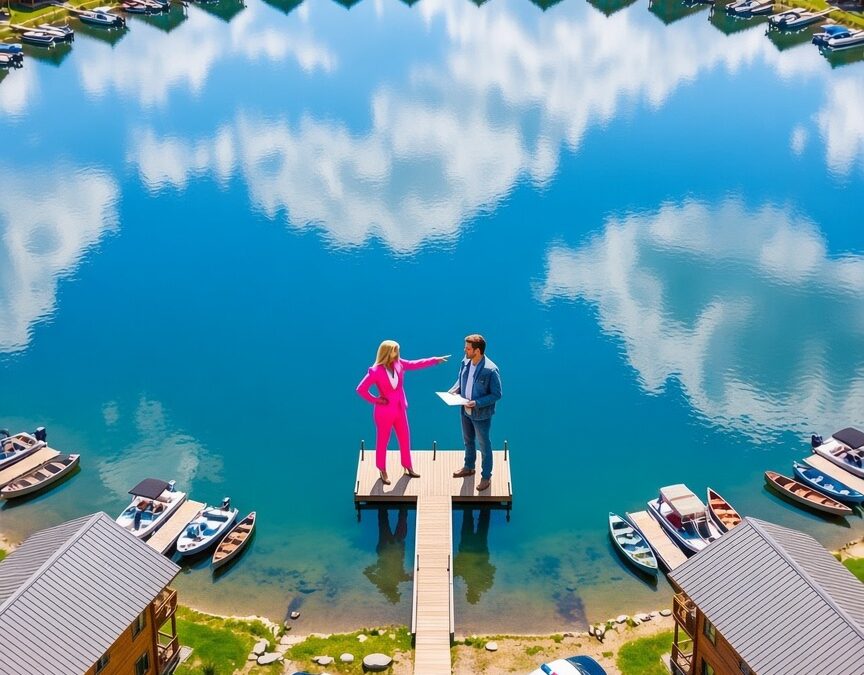
“Let’s be reasonable, Mr. Garrison. Seventy-five thousand dollars is a generous offer for a man in your situation.”
Victoria Sterling Blackwood placed the check on my kitchen table as though she were leaving a tip for a waiter.
I looked at the six figures printed across the bottom, then at the woman who had spent the previous six months turning my Montana lake into a luxury resort.
“You think seventy-five thousand dollars buys my water?” I asked.
“I think it buys you a comfortable retirement.”
“I’m already retired.”
“Then perhaps you should be grateful.”
She smiled when she said it.
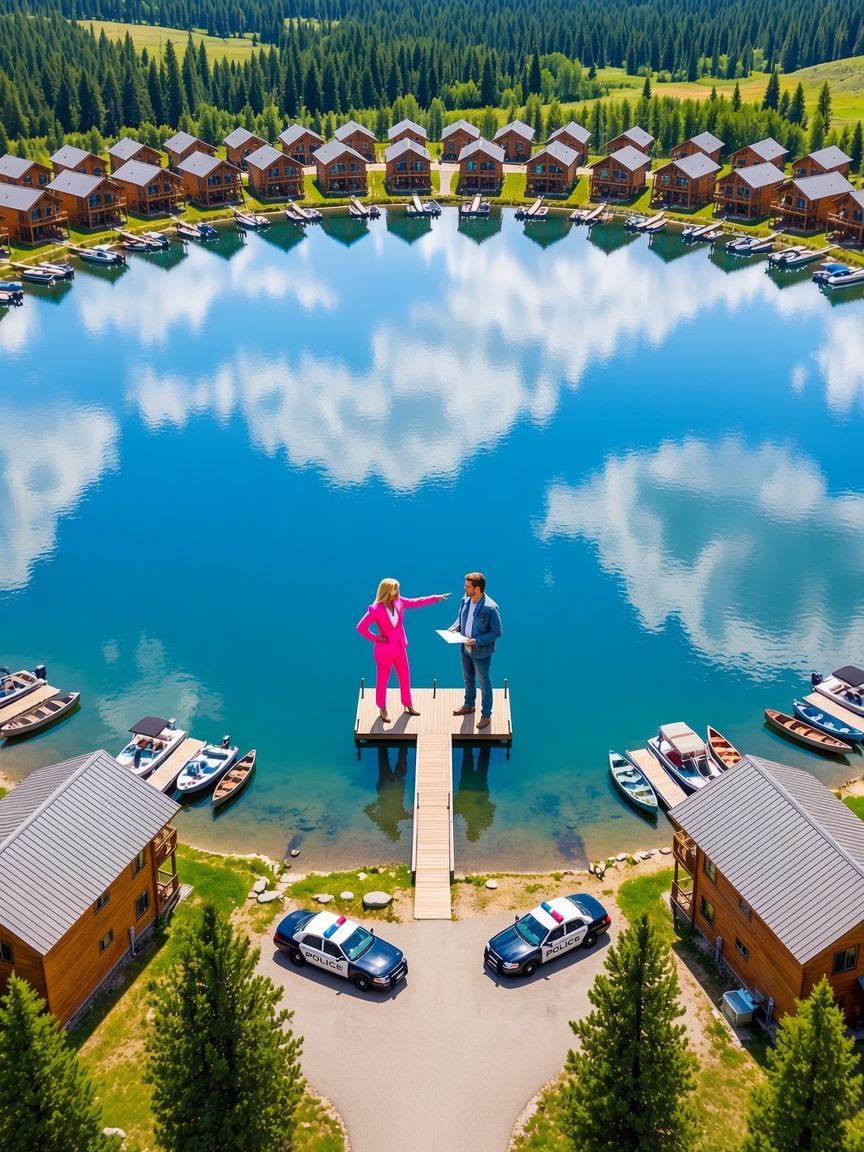
That was the part I remembered later. Not the money. Not the expensive watch on her wrist or the white Range Rover parked outside my cabin. The smile.
She genuinely believed I had no choice.
I was fifty-one years old, a retired Navy Seabee with a prosthetic left leg, a mortgage-free cabin, and a disability pension. She was the president of a multimillion-dollar vacation rental company with lawyers, investors, and half the county’s business community on her Christmas card list.
From where she stood, the outcome must have looked obvious.
What she didn’t know was that my daughter had found a document dated June 15, 1987.
And what that document would eventually do to her business was something no amount of money could prevent.
But to understand how a single piece of paper brought down 127 luxury vacation cabins, you need to understand what that lake meant to me.
My name is Wade Garrison.
For twenty years, I served in the United States Navy Construction Battalions. We were called Seabees, and our job was to build what other people needed, often in places where someone was actively trying to stop us.
I built roads in Afghanistan, repaired airfields in Iraq, reinforced bridges after floods, and learned how to keep water flowing when the nearest replacement part was three countries away.
In 2011, an improvised explosive device took my left leg below the knee.
I survived because the men beside me knew their jobs and refused to leave me behind.
Recovery was another kind of assignment.
There were surgeries, infections, physical therapy, and months when getting from my bed to the bathroom required more effort than building a bridge ever had.
My marriage didn’t survive it.
I don’t blame my former wife for everything that happened between us. We were both different people when I came home. Some marriages can absorb that kind of change. Ours couldn’t.
But we managed to raise a good daughter.
Emma was sixteen when this story began, stubborn in the best possible way, and smarter than I had ever been at her age.
She lived primarily with her mother in Seattle and spent school breaks with me in Montana.
The lake was our place.
My family had held the property since the 1920s, when my great-grandfather, Walter Garrison, acquired the original homestead. Different generations had added and sold small parcels over the years, but the forty acres surrounding the spring-fed lake remained intact.
In 2015, I purchased the remaining family interests from two cousins, paid off an old lien, and became the sole owner.
I wasn’t wealthy. The transaction used most of my savings.
But I owned forty acres of forest, a modest two-bedroom cabin, a dock my grandfather had built, and a lake so clear you could see trout moving over the rocks ten feet below the surface.
On summer mornings, Emma and I would sit on the dock with coffee for me and hot chocolate for her.
She learned to fly-fish there.
Her first rainbow trout was barely longer than my hand. She insisted we photograph it from six different angles before releasing it.
I kept the picture on my refrigerator.
My long-term plan was to open a small fishing program for veterans. Nothing fancy. A few accessible paths, some donated equipment, and enough quiet space for men and women who needed a break from crowded waiting rooms and conversations about what they had lost.
I had already drawn up preliminary plans.
Then I spent six months dealing with complications from my prosthetic.
And when I came home, I barely recognized my own property.
The first thing I noticed was the noise.
Heavy equipment.
Backup alarms.
Diesel engines.
I turned off the county highway onto the gravel road leading toward my cabin and found myself behind a concrete truck.
The truck crawled past a newly erected wooden sign.
LAKESIDE LUXURY RETREATS.
Below it, an artist’s rendering showed expensive cabins arranged around a blue lake.
My lake.
I pulled onto the shoulder and stared.
There were fresh asphalt lanes through the trees. Excavators had cut into the hillside. Utility trenches ran beside the road, and stacks of lumber stood where a stand of lodgepole pines had been.
Beyond them were cabins.
Dozens of cabins.
Modern black roofs, enormous windows, private decks, outdoor hot tubs.
I counted thirty-seven before the road curved out of sight.
By the time I reached my property, I had seen enough construction to know this wasn’t some little campground expansion.
Someone was building a town.
I parked beside my cabin, stepped down carefully onto the gravel, and heard a jet ski accelerate across the lake.
A jet ski.
On the lake where Emma and I used to count nesting waterbirds.
I walked down to the dock.
Across the water, construction crews were installing railings on a row of cabins. A temporary floating platform held rental kayaks. Someone had erected a bright red inflatable obstacle course near the eastern shore.
A plastic cup drifted past my dock.
I picked it out of the water.
Then I noticed the pump.
My well pump was running.
It was still running when I finished unpacking.
It ran through dinner.
At eleven that night, I walked into the pump house and checked the pressure gauge.
The motor was hot.
The pressure was low.
And the main supply line had a new branch connection I had never authorized.
I followed it through the wall and into a recently dug trench.
The pipe disappeared toward the development.
I stood there for a long time.
Then I took photographs.
The following morning, I opened my utility account.
My normal monthly electricity expense for operating the well and water system had averaged around forty-five dollars.
The latest charge attributable to that system was eight hundred and ninety dollars.
I called the utility company.
The representative confirmed that the meter readings were accurate.
“Your usage increased dramatically about five months ago,” she said. “Have you installed new equipment?”
“No.”
“A larger irrigation system?”
“No.”
“Any commercial operations?”
I looked through my kitchen window at a truck carrying hot tubs toward the lake.
“Apparently someone else has.”
I began making calls.
The county planning office told me the neighboring development had received preliminary approval under a company called Lakeside Luxury Rentals.
The property assessor confirmed that the corporation had purchased several adjoining parcels.
The county clerk told me there were recorded easements associated with the original ranch property.
Nobody could immediately tell me whether those easements included my lake or well.
I requested copies of everything.
Three days later, a man in a charcoal suit knocked on my door.
He introduced himself as Richard Vale, attorney for Sterling Blackwood Development Holdings.
He handed me a cease-and-desist letter.
According to the letter, I had interfered with the development’s established water supply by inspecting equipment connected to its distribution system.
I read it twice.
“You’re accusing me of interfering with a pipe attached to my own well?”
“My client believes there are longstanding water access rights.”
“Believes?”
“That is the legal position.”
“Then show me the recorded document.”
He adjusted his cuffs.
“I suggest you retain counsel, Mr. Garrison.”
“I suggest your client stop using my water.”
His expression didn’t change.
“Unilateral interference with an occupied resort’s water supply could expose you to substantial liability.”
I looked at him.
“Are you threatening to sue me for refusing to pay to pump your client’s water?”
“I am advising you of potential consequences.”
“Then we’re done.”
He left without another word.
I watched his BMW disappear through the trees, then opened a fresh notebook.
On the first page, I wrote four questions.
Who owned the water rights?
Who authorized the connection?
How much water had been taken?
And who had approved construction without checking the first three?
I had spent twenty years learning that assumptions were expensive.
Now I intended to find out whose assumptions had built the resort.
The county courthouse was forty-five minutes away.
I arrived at eight the next morning, carrying a thermos, a legal pad, and a folder of my property documents.
The records clerk was a woman named Denise Harper, who had worked there long enough to remember when property maps were drawn by hand.
When I explained what I needed, she studied me for a moment.
“You’re the Garrison place?”
“Yes, ma’am.”
“My father used to fish out there with your grandfather.”
That got my attention.
“Did he?”
“Your grandfather made him put every fish back unless it was big enough to feed somebody.”
“That sounds like Grandpa.”
Denise took me downstairs to the older records.
For three days, I worked through deeds, surveys, easements, plats, and water appropriation filings.
Some documents were digitized. Others existed only as paper copies or microfilm.
I found the original homestead description, subsequent family transfers, and the 2015 transaction that had consolidated ownership in my name.
I also found the record that mattered most.
The spring and well system had been developed on the Garrison parcel. Historic filings documented my family’s beneficial use, and no recorded conveyance transferred that water right to the neighboring ranch.
There had been a limited agreement allowing the rancher to draw water for cattle.
But the recorded references described a temporary arrangement, not a permanent commercial easement.
I copied everything.
On the fourth day, Denise brought me a survey map from 1988.
“Look at the eastern boundary,” she said.
The line ran farther into the hillside than the development’s promotional map suggested.
I compared the measurements.
Then I pulled up recent aerial photographs.
Several cabins appeared to be sitting directly on or across my boundary.
I called the county survey office.
By the time I got home that evening, I had two appointments scheduled and a headache that wouldn’t quit.
I also had a better understanding of what Victoria Sterling Blackwood had done.
She hadn’t merely borrowed a little water.
She had built an entire commercial development around a resource she did not own.
Two weeks later, she came to see me.
Her Range Rover was spotless despite the muddy road.
She wore dark jeans, a cream sweater, and hiking boots that looked fresh from the box.
She introduced herself as though I should recognize her.
“Victoria Sterling Blackwood. I’m pleased we finally have a chance to talk.”
“I’m Wade Garrison. You already know that.”
She glanced toward my cabin.
“Of course.”
I didn’t invite her inside, but she asked whether we could sit down and discuss a practical solution.
I agreed.
I wanted to hear exactly what she thought practical meant.
She placed a folder on my kitchen table.
Inside was a water access agreement granting her company broad, permanent rights to draw water from my system.
There were provisions for expansion, maintenance access, and assignment to future owners.
The document would have given her company far more than the limited access the old rancher had ever possessed.
Then she produced the check.
Seventy-five thousand dollars.
“This resolves everything,” she said.
I turned the agreement over.
“Where’s the compensation for the water you’ve already used?”
“The payment accounts for past inconvenience.”
“Where’s the monthly charge for future usage?”
“We’re proposing a single payment.”
“Where’s the limit on how much you can draw?”
She paused.
“We need operational flexibility.”
I looked up.
“You’ve built 127 cabins.”
“That’s correct.”
“Each one rents for about four hundred dollars a night during peak season.”
“Rates vary.”
“At full occupancy, that’s fifty thousand eight hundred dollars in gross rental revenue every night.”
She folded her hands.
“That isn’t profit.”
“I know the difference.”
Her smile tightened.
“You seem to have done your homework.”
“I’ve been doing it since I got home and discovered your pipes connected to my well.”
“Mr. Garrison, let’s be reasonable. Seventy-five thousand dollars is generous for a man in your situation.”
I set the agreement down.
“What situation is that?”
She looked briefly toward my prosthetic leg.
“You’re retired. You have medical expenses. Litigation can be exhausting.”
“I’m familiar with exhaustion.”
“I don’t think you understand the resources involved here.”
“Then explain them.”
Her patience disappeared.
“I can keep this matter in court for years.”
“Probably.”
“You could spend everything you have.”
“Possibly.”
“And at the end of it, you might receive less than I’m offering today.”
I pushed the check back across the table.
“No.”
She stared at it.
“Excuse me?”
“No agreement. No sale. No more unauthorized water.”
“You’re making a terrible mistake.”
“Then you’ll have no trouble proving it in court.”
She stood.
For a moment, she looked like she might say something else.
Instead, she gathered her folder and walked out.
I followed her to the porch.
Before she got into her vehicle, I called after her.
“Victoria.”
She turned.
“You need to get an independent water supply.”
Her expression hardened.
“You need to learn when to accept help.”
Then she drove away.
That afternoon, I called Jake Morrison.
Jake was a former Marine and a Montana attorney who volunteered time with veterans’ legal assistance programs. A friend from a rehabilitation group had recommended him years earlier.
I explained the situation over the phone.
He listened without interrupting.
When I finished, he asked one question.
“Wade, have you shut off the water yet?”
“No.”
“Good. Don’t.”
I frowned.
“It’s my well.”
“That may be true. But you’ve got paying guests occupying those cabins. Some could be elderly, disabled, or traveling with young children. We are not going to put innocent people at risk to make a point.”
“I wasn’t planning to hurt anybody.”
“I know. That’s why I’m telling you how we win without giving their lawyers an opening.”
He drove up the following day.
We spent six hours reviewing my records.
By dinner, he had identified several legal issues: the water connection, the disputed boundary, possible unauthorized construction, and the question of what permits the development had actually obtained.
He was careful about one thing.
“Montana water law is complicated,” he said. “Owning the land around a spring doesn’t automatically mean you can use every drop however you please. We need to establish the exact historical rights and the legal status of the development’s use.”
“So what do we do?”
“We prove every part of it.”
That answer suited me.
Jake contacted the Montana Department of Natural Resources and Conservation, the county planning office, and a water-rights specialist.
We requested the development’s permit files and hired an independent hydrologist.
I installed flow meters on my own equipment, with Jake’s approval, and began recording usage without interrupting service.
Within a week, the data showed that the development was drawing an enormous volume of water.
The resort’s occupancy varied, but demand could exceed one hundred thousand gallons on busy days.
My well system had never been designed for that load.
The pump was wearing out.
Water pressure at my cabin had become unreliable.
And the lake’s water level was lower than any I remembered seeing.
The hydrologist, Dr. Elaine Porter, examined the spring, well, lake, and surrounding watershed.
Her preliminary conclusion was cautious but troubling.
The development’s withdrawal rate could not continue indefinitely without affecting the system.
I asked how long we had.
She looked at the figures.
“That depends on recharge, seasonal rainfall, and the exact connection between the aquifer and lake. But I wouldn’t recommend continuing this volume while we wait to find out.”
We filed formal complaints.
Then Victoria made her next mistake.
One Tuesday morning, I drove toward town and found a chain-link gate blocking the access road.
Two concrete posts had been installed overnight.
A sign identified the road as private property belonging to Lakeside Luxury Retreats.
Three security guards stood beside the gate.
I stopped my truck.
One approached the driver’s window.
“Authorized resort traffic only, sir.”
“I live up the road.”
“Then you’ll need to contact management.”
“I own the land up the road.”
He checked a laminated map.
“Your parcel appears to be inside the development boundary.”
“Your map is wrong.”
“I’m just following instructions.”
“Then call whoever gave them.”
He refused to open the gate.
I photographed the sign, the concrete posts, the security vehicle, and the map he showed me.
Then I backed up carefully and returned home.
Jake answered on the second ring.
“They’ve blocked the road.”
“Are you safe?”
“Yes.”
“Can emergency vehicles reach you?”
“Not through that gate.”
His tone changed.
“Send me the photographs.”
By late afternoon, Jake had filed for emergency relief to protect my access.
The court scheduled an expedited hearing, and the county surveyor agreed to examine the disputed boundary.
The next morning, a survey crew arrived.
Its lead surveyor was Robert Monroe, a quiet man with gray hair and the patience of someone who had spent thirty years explaining property lines to angry neighbors.
He began by locating the original monuments.
Then he checked the recorded descriptions against modern measurements.
At noon, he asked me to walk with him.
We stopped beside a luxury cabin with a hot tub on the deck.
A survey stake stood several feet beyond its foundation.
Robert pointed toward the trees.
“Your property line runs through this building.”
I stared at him.
“Are you certain?”
“I’m going to verify everything before issuing the final report. But the evidence is consistent.”
We walked farther.
Another cabin.
Another stake.
Then another.
By the time the crew finished, twelve structures appeared to encroach on my land.
Some crossed the boundary by several feet.
Others sat almost entirely on my parcel.
I took a photograph of each one.
One cabin had a sign advertising a private lakeside honeymoon experience.
I wondered what the newlyweds would think if they knew their romantic getaway had been constructed on somebody else’s property.
Jake received the preliminary survey that evening.
He read it in silence.
Then he said, “This changes the case considerably.”
“Can we make them move the cabins?”
“Possibly. But we need the final survey, the construction records, and a court determination. Let’s not assume the remedy before we establish the facts.”
I appreciated that about Jake.
He didn’t promise miracles.
He built cases.
While the legal work continued, Emma arrived for spring break.
She found me sitting at the kitchen table beneath a mountain of paperwork.
“Dad, you look like you’re doing taxes for the entire state.”
“Feels that way.”
She picked up a survey map.
“Is this the resort?”
“Part of it.”
“Why is your property line going through their hot tubs?”
“Excellent question.”
I explained what had happened.
She listened, occasionally asking for clarification.
When I told her about Victoria’s offer, Emma laughed once.
Not because it was funny.
Because she couldn’t believe anyone had been that arrogant.
“She offered you seventy-five thousand dollars for permanent access to the lake?”
“And the well.”
“That’s ridiculous.”
“That’s what I thought.”
Emma looked toward the water.
“Does she know Grandpa taught you to fish here?”
“I don’t think she’d care.”
We spent the next day at my late uncle Frank’s house.
Frank had died several years earlier, leaving me a small house, some tools, and a basement full of boxes.
He had been the unofficial family historian.
If someone in the Garrison family bought a tractor, Frank saved the receipt.
If someone received a letter from the county, Frank filed it.
If a neighbor borrowed twenty dollars in 1973, Frank probably still had the signed note.
Emma volunteered to help sort his papers.
Around three in the afternoon, she called from the basement.
“Dad? You need to see this.”
I came down the stairs.
She held a manila folder.
On the tab, in Frank’s unmistakable block lettering, were the words:
LAKE WATER AGREEMENT — 1987.
Inside was the original signed agreement between my grandfather and the neighboring ranch owner.
It allowed limited agricultural water access for cattle.
The agreement required mutual renewal every five years.
It prohibited assignment for unrelated commercial purposes without written consent.
A later page documented renewal in 1990, expiring in June 1995.
There was no subsequent renewal in the folder.
More importantly, the document identified the connection point and the conditions under which water could be withdrawn.
I compared it with the line Victoria’s contractors had installed.
They had enlarged the old connection and routed it toward the resort.
I looked at Emma.
“Where did you find this?”
“Box fourteen. Under Christmas cards and a broken fishing reel.”
I almost laughed.
But she wasn’t finished.
“There are more papers.”
She handed me a second folder.
This one contained correspondence Frank had apparently received after helping me organize the family property records.
Among the papers were printed emails from 2018.
The messages had been forwarded to Frank by a former employee of Sterling Blackwood Development, who had been concerned about the proposed project.
Frank had kept them without explaining their significance.
I read the first email.
It was from a legal consultant to Victoria’s development team.
The consultant warned that the old agricultural water agreement had expired and could not support a commercial resort.
He recommended obtaining a new agreement from the current owner before construction.
Victoria’s reply was brief.
Proceed with planning. We can address Garrison if necessary.
Another email from the engineering team warned that projected water demand could exceed the existing system’s sustainable capacity.
Victoria’s response instructed them to preserve the planned cabin count and investigate alternatives later.
A third message mentioned my military disability and speculated that I might accept a modest payment rather than pursue litigation.
I read that one twice.
Emma stood beside me.
“Dad?”
“Yeah.”
“She knew.”
I nodded.
“She knew there was a problem.”
“Then why did she build everything?”
“Because she thought the problem was cheaper than the solution.”
Emma pulled out a chair.
For the first time since I’d returned home, she looked genuinely frightened.
“Can she take the lake?”
I sat beside her.
“Not if the documents say what I think they say.”
“What if she keeps fighting?”
“Then we keep fighting.”
She stared at the folder.
“Grandpa would be furious.”
“He’d probably have a few things to say.”
“Mostly words Mom doesn’t let me use.”
That made me laugh.
It was the first real laugh I’d had in weeks.
Jake examined the documents the following morning.
He was especially interested in how Frank had obtained the emails.
“We need to authenticate these,” he said. “A printed message isn’t automatically proof of who sent it.”
“Can we do that?”
“We can seek the original communications through discovery. And we can contact the person who forwarded them.”
He tapped the 1987 agreement.
“This, however, is substantial. It gives us a clear starting point for tracing the historic permission.”
We expanded the legal filings.
The water-rights investigation moved forward.
The boundary dispute became a separate claim.
Jake also requested preservation of the developer’s emails, project records, and financial documents.
Victoria responded with another threatening letter.
Then another.
Her attorneys alleged that I was interfering with business operations, damaging the resort’s reputation, and attempting to extract money.
Jake sent back a short response.
Our client seeks enforcement of his documented property rights. Please preserve all relevant records.
I framed a copy in my mind.
The actual paper went into the file.
By June, Victoria’s operation was attracting attention.
A regional reporter named David Ramirez contacted me after hearing about the boundary dispute.
He wanted an interview.
I initially refused.
I had no interest in becoming a public spectacle.
But Jake pointed out that accurate reporting might discourage further intimidation.
So I agreed to speak with David at my cabin.
He arrived without a camera crew, carrying a notebook and a small recorder.
We sat on the porch.
He asked about my service, my family, and the lake.
Then he asked what I wanted from Victoria.
I thought about that.
“I want my property back,” I said. “I want the water system protected. I want the damage repaired. And I want the people who made these decisions to be held responsible.”
“Do you want the resort destroyed?”
“No.”
He looked surprised.
“You don’t?”
“There are employees who need paychecks. There are families who booked vacations. None of those people connected a pipe to my well. If the development can operate legally without taking what’s mine, that’s between the company and the authorities.”
“Then what would you say to Ms. Blackwood?”
I looked toward the lake.
“I’d tell her she should have asked before she built.”
The article appeared three days later.
It included photographs of the disputed boundary, the unauthorized water connection, and the original agricultural agreement.
David also contacted the company.
Victoria declined to answer specific questions but issued a statement accusing me of making unreasonable demands.
The story spread through local veterans’ groups.
Neighbors began calling.
Some had noticed falling well pressure.
Others complained about increased traffic, litter, and nighttime noise.
One neighbor, Tom Fletcher, came over with a folder of his own.
Tom was a retired mechanic who lived half a mile north of me.
His wife had been complaining about weak water pressure for months.
“I thought our pump was going bad,” he said.
“Maybe it is.”
“Or maybe that development is drawing down the whole area.”
I introduced him to Dr. Porter.
Within two weeks, three neighboring property owners had requested independent water testing.
The results didn’t establish every cause, but they showed enough concern to justify closer review.
For the first time, I wasn’t the only person asking questions.
Victoria didn’t like that.
Her next attempt was more personal.
A county inspector named Jerry Kowalski arrived one Tuesday morning.
He said the health department had received a complaint about my well water.
“Possible contamination,” he explained.
“From what?”
“That’s what we’re here to determine.”
I had no objection to legitimate testing.
I did object to being told I needed to stop using my own well before anyone had taken a sample.
I asked for the complaint number, the inspection authority, and a written explanation.
Jerry seemed uncomfortable.
He provided some of the information and promised the rest.
Then he suggested using a particular laboratory.
I recognized the name.
The laboratory had previously done work for Victoria’s development.
“I’d prefer an independent certified lab,” I said.
“That may delay things.”
“Then we’ll wait for proper results.”
I arranged for split samples, documented collection procedures, and paid for independent analysis.
The results showed that the water met the applicable drinking-water standards for the substances tested.
Dr. Porter cautioned me that one clean test did not resolve the separate questions of groundwater depletion or lake contamination.
I understood.
What mattered was that there was no evidence supporting an emergency condemnation of my well.
A few days later, something else happened.
One of my security cameras captured a county vehicle entering the resort’s administrative parking lot shortly after Jerry’s visit.
The recording showed Jerry meeting Victoria near the office entrance.
An envelope changed hands.
The footage did not show what was inside.
I sent it to Jake.
He told me not to jump to conclusions.
Then he contacted the appropriate investigators and asked them to examine the interaction alongside the inspection records.
That was how I learned another lesson.
A suspicious recording is not the same thing as a proven crime.
But a suspicious recording can give investigators a place to start.
Over the following weeks, investigators obtained additional evidence through lawful procedures.
I wasn’t told everything they found.
I did learn that Jerry had failed to disclose a financial relationship involving a company connected to the development.
He was placed on administrative leave while the matter was investigated.
Victoria’s attorneys stopped calling the contamination complaint an emergency.
They also stopped returning David Ramirez’s questions.
By then, the court had issued temporary orders preserving my access road and restricting further construction in the disputed boundary area.
The development could continue limited operations while regulators evaluated the water issue, but expansion was frozen.
That should have been enough to convince Victoria to negotiate.
Instead, she hired a private security company.
I noticed their black SUVs first.
They began appearing near the access road, sometimes parked for hours.
The guards photographed my truck.
They followed me through the development’s public access areas.
Once, one of them approached me at the grocery store and suggested that people who caused trouble for powerful businesses sometimes regretted it.
I wrote down his words, the time, and the vehicle’s license plate.
Then I called the sheriff’s office.
Deputy Aaron Mills took the report.
He was professional and careful.
“Has anyone directly threatened physical harm?”
“Not in those words.”
“Keep documenting it. Call immediately if they enter your property or interfere with you.”
I did.
The last week of June, someone slashed all four tires on my truck.
They also damaged my mailbox and cut an exterior communications cable.
My cameras recorded two masked men approaching shortly before four in the morning.
One carried a tool bag.
The other kept watch near the driveway.
They left in a dark SUV.
I didn’t recognize either man.
I did recognize the vehicle’s distinctive wheels from photographs I had taken of the resort security fleet.
I called the sheriff.
Deputies arrived before sunrise.
They photographed the damage and collected the recordings.
I stood beside my truck, looking at the ruined tires.
For the first time, I felt genuinely unsafe on my own land.
Not because of my leg.
Not because I couldn’t defend myself.
Because I had no idea what these people might do next.
Emma was supposed to visit that weekend.
I called her mother and asked that she stay in Seattle until things settled down.
Then I called Emma.
She was furious.
“Dad, you can’t let them chase you away.”
“I’m not leaving.”
“Then why can’t I come?”
“Because I don’t know who’s doing this, and I’m not taking chances with you.”
She went quiet.
Finally, she said, “Promise you’ll call me every night.”
“I promise.”
That night, I sat in my living room with the lights off and watched the security monitor.
I thought about Afghanistan.
I thought about the men who had pulled me out of the wreckage.
And I thought about how strange it was that after surviving a war overseas, I was afraid to sleep in the cabin my grandfather had built.
The sheriff’s investigators eventually identified the vehicle and connected two individuals to the vandalism.
Both were associated with a subcontractor hired by the resort’s security company.
The investigation into who had directed them continued.
Jake requested additional protective measures and notified the court.
Victoria denied involvement.
Her lawyers insisted the security company was an independent contractor.
I didn’t argue with her publicly.
I let the evidence accumulate.
Meanwhile, the water investigation was reaching its conclusion.
The 1987 agreement had been authenticated.
The historic water records had been examined.
The developer could not produce a valid current authorization for its commercial withdrawals from my system.
The hydrological assessment also raised serious concerns about continued high-volume pumping.
County inspectors identified separate compliance problems involving several buildings and wastewater facilities.
The twelve boundary encroachments were confirmed by a final survey.
Victoria’s company faced a problem that couldn’t be solved by sending me another threatening letter.
Its entire business model depended on infrastructure it had never properly secured.
Jake called me on a Wednesday afternoon.
“Wade, the court has approved a controlled suspension of the unauthorized connection, subject to the safety plan.”
I sat down.
“Meaning?”
“Meaning the resort has been formally notified. They have a deadline to stop drawing from your system. Regulators will supervise the disconnection. Guests must be relocated or provided lawful alternative accommodations before service ends.”
“When?”
“Friday. Two o’clock.”
I looked at the calendar.
It was the beginning of the Fourth of July holiday weekend.
The resort was fully booked.
“That’s their busiest weekend.”
“I know.”
“Did you plan it that way?”
“No. The court set the compliance deadline based on the notice period and the emergency filings. Victoria had opportunities to arrange an alternative supply. Her company didn’t provide a workable plan.”
I thought about the families who had booked vacations.
“What happens to them?”
“The county is requiring the resort to notify guests and suspend occupancy where safe water and sanitation can’t be maintained. Emergency services have been briefed. Nobody should be stranded without drinking water.”
I nodded.
“Good.”
Jake paused.
“You’re awfully quiet.”
“I’m thinking.”
“About what?”
“How much trouble she could have avoided by knocking on my door three years ago.”
Friday arrived hot and clear.
By noon, the temperature was climbing toward ninety-five degrees.
The lake reflected the mountains so perfectly that, from a distance, it looked almost untouched.
Up close, the damage was visible.
There were tire tracks along the shore, broken branches near the construction roads, and floating debris collected against the reeds.
But there were also signs of recovery.
Since the court had restricted expansion, the heavy equipment had stopped.
I could hear birds again.
At one-thirty, I walked to the pump house.
I wore clean jeans, a blue work shirt, and my old Navy ball cap.
My dress uniform stayed in the closet.
This wasn’t a military operation.
It was a legal enforcement action on civilian property.
Commissioner Sarah Monroe, a county official overseeing the coordinated compliance process, arrived with two inspectors.
Jake came a few minutes later.
A licensed water-system contractor stood beside the main connection.
The sheriff’s department had sent deputies to keep the access road clear and assist if there were problems.
David Ramirez waited beyond the marked work area with a camera operator.
I had agreed to let him document the process.
At 1:47 p.m., Sarah checked her paperwork.
“The resort has received notice,” she said. “The remaining occupied units have been identified. Emergency water is available for staff completing the evacuation. We have confirmation that the county’s safety conditions are met.”
Jake turned to me.
“Any questions?”
I looked at the valve assembly.
For weeks, I’d imagined this moment.
In my angrier moments, I’d pictured myself turning the handle while Victoria watched her profits disappear.
But standing there, I felt something different.
Relief.
The decision was no longer mine alone.
A court had examined the evidence.
The agencies had reviewed the risks.
And the people who might be affected had been given notice.
“No questions,” I said.
At two o’clock, the contractor closed the authorized isolation valve.
The pressure gauge began to fall on the resort side.
He checked the downstream meter, verified the isolation, and secured the equipment.
No shouting.
No dramatic explosion.
Just a mechanical click, a slowly descending needle, and the end of a connection that should never have existed.
I heard tires crunching on gravel.
Victoria’s Range Rover stopped beside the pump house.
She stepped out wearing a white linen suit.
Her face was flushed.
“Who authorized this?”
Sarah approached her.
“Ms. Blackwood, the court order and compliance notices were delivered to your attorneys.”
“You’re shutting down an entire resort.”
“The unauthorized water withdrawal has been suspended.”
“This is sabotage.”
“No,” Jake said. “It’s enforcement of the order.”
Victoria looked past him at me.
“You.”
I said nothing.
She came closer.
“You’ve been planning this.”
“I’ve been asking you to stop using my water since I got home.”
“You have no idea how many people you’ve hurt.”
That got my attention.
“Your guests?”
“Yes.”
“Your employees?”
“Yes.”
“Then why didn’t you tell them the truth when you received the first notice?”
She opened her mouth.
Nothing came out.
I continued.
“You had months to arrange another supply. You could have reduced occupancy. You could have negotiated. You could have followed the permit process.”
“You don’t understand business.”
“I understand that you can’t sell something you don’t own.”
Her expression changed.
For a moment, the anger disappeared, replaced by something close to panic.
“My company has obligations.”
“So do I.”
“You’ll ruin us.”
I looked at the lake.
“Victoria, you built 127 cabins without securing the water they needed. You built twelve of them across my property line. Your engineers warned you. Your lawyers warned you. And when I asked questions, you tried to buy me off.”
She glanced toward David’s camera.
“That’s not what happened.”
“Then explain it under oath.”
Sarah stepped between us.
“Ms. Blackwood, your attorney should direct any challenge to the court. We need you to remain outside the work area.”
Victoria looked from one face to another.
Nobody moved to help her.
Not because we hated her.
Because there was nothing left to negotiate beside that pump.
She turned and walked back to her Range Rover.
Before she reached it, a sheriff’s deputy approached and asked her to remain available to speak with investigators about a separate matter.
She looked back once.
I was standing where she’d left me.
Beside the pump house.
On my own land.
By sunset, the resort had stopped accepting guests.
The company began issuing refunds and arranging alternative accommodations.
Some families were angry.
Others were simply disappointed.
A few stopped near my driveway after hearing about the dispute.
One man from Oregon rolled down his window.
“Are you the owner of the lake?”
“Yes.”
“We drove eight hours to get here.”
“I’m sorry.”
He looked toward the resort.
“They told us the water issue was unexpected.”
I considered my answer.
“It wasn’t unexpected to the company.”
He shook his head.
“My kids have been looking forward to this all year.”
“I know that doesn’t make it easier.”
He studied me for a moment.
Then he said, “I hope they make this right.”
“So do I.”
He drove away.
That exchange stayed with me longer than Victoria’s shouting.
Winning a legal fight doesn’t mean nobody innocent gets hurt along the way.
It means you try to stop the wrongdoing without causing more damage than necessary.
Over the following weeks, the investigation expanded.
The resort’s records showed that senior management had been repeatedly warned about the water rights and property boundaries.
The authenticated emails established that Victoria knew the old agreement was inadequate.
The company’s financial documents showed heavy borrowing against projected rental income.
With the cabins closed, those projections collapsed.
The Sterling Family Trust convened an emergency board meeting.
Victoria was removed from operational control.
The board hired outside counsel and began negotiating with creditors, regulators, and affected property owners.
Then criminal charges followed.
Investigators developed evidence relating to improper payments, falsified compliance records, and intimidation connected to the development.
Not every allegation became a charge.
Some were dismissed or handled through civil proceedings.
But enough evidence survived scrutiny that Victoria eventually faced serious criminal exposure.
I was interviewed repeatedly.
I testified about the water connection, the threatening encounters, and the documents I’d found.
I turned over every photograph, recording, and notebook entry.
I also answered questions that were uncomfortable.
Had I wanted revenge?
Yes, at times.
Had I considered shutting off the water myself?
Yes.
Had Jake warned me not to?
Yes.
Had I followed that advice?
Yes.
I didn’t try to make myself sound better than I was.
I was angry.
I had every reason to be angry.
But anger wasn’t what proved the case.
Documents did.
Measurements did.
Witnesses did.
And the decision to let the legal process work, even when it moved slower than I wanted, mattered more than I understood at the beginning.
The civil settlement took longer.
Victoria’s company initially challenged the damages calculations.
Our experts reviewed metered usage, electricity costs, equipment wear, and the market value of the unauthorized withdrawals.
The boundary dispute required separate appraisals.
Environmental restoration costs were negotiated with input from independent specialists.
There were weeks when I thought the paperwork would never end.
Then one morning, Jake called.
“We have an agreement.”
I was standing on the dock.
“How much?”
“Four hundred twenty-five thousand dollars in compensation and restitution-related payments to you, subject to the final settlement terms. They’re also covering a substantial portion of your legal expenses and funding specified restoration work.”
I sat down.
For several seconds, I couldn’t speak.
Jake continued.
“The company is relinquishing its disputed claims to your water system. Your property boundary will be recognized. The encroaching structures must be removed, relocated, or otherwise resolved under the court-approved plan. No future connection without a valid agreement and all required approvals.”
“And the lake?”
“Restoration is part of the settlement.”
I looked across the water.
A bald eagle was perched in a dead pine on the opposite shore.
“Good,” I said.
Jake waited.
“Wade?”
“Yeah?”
“You won.”
I thought about the hospital.
The prosthetic fittings.
The nights when I couldn’t sleep.
The morning I came home and saw construction equipment where the trees had been.
Then I thought about Emma, standing in Uncle Frank’s basement with that folder.
“We won,” I said.
The criminal case concluded the following year.
Victoria entered guilty pleas to charges arising from the bribery and obstruction investigation. The court imposed a prison sentence, supervised release, and financial penalties.
Jerry Kowalski also faced consequences for his role in the improper payments and inspection misconduct.
The men involved in the vandalism were prosecuted separately.
I attended Victoria’s sentencing.
I didn’t go because I wanted to see her humiliated.
I went because the court had allowed me to make a victim impact statement.
When my turn came, I stood with my cane and faced the judge.
I explained what the lake had meant to my family.
I described the increased pumping costs, the loss of access, the property damage, and the months of intimidation.
Then I talked about the thing that had bothered me most.
“Your Honor, Ms. Blackwood didn’t need to do any of this. She had the money and professional advice to build a lawful business. She could have purchased appropriate rights, designed an independent water system, and respected the boundaries. Instead, she decided it would be cheaper to treat me as an obstacle.”
I paused.
“I don’t want special treatment because I’m a veteran. I want the same property rights and legal protections any other person should have.”
Victoria sat at the defense table.
She didn’t look at me.
I continued.
“She assumed that my disability meant I wouldn’t have the ability to challenge her. I hope this case makes one thing clear: a person’s physical limitations do not make their rights negotiable.”
When I finished, I returned to my seat.
I didn’t feel triumphant.
I felt finished.
Outside the courthouse, David Ramirez asked whether I had anything to say about the sentence.
I told him the same thing I’d told the judge.
“People should be held responsible for what they do, not for how wealthy or powerful they are.”
Then I went home.
The restoration took most of the following year.
Removing the encroaching cabins was complicated.
Some were modular structures that could be moved.
Others required partial demolition.
Contractors worked under strict access agreements, and surveyors verified every boundary before the final work was accepted.
The unauthorized pipe was disconnected and removed.
My pump system was repaired and resized for its intended use.
The company funded shoreline cleanup, erosion control, and water-quality monitoring.
Not everything returned to normal immediately.
Trees take decades to grow.
A damaged shoreline doesn’t recover because a judge signs an order.
And the lake had been subjected to pressures that would require continued monitoring.
But gradually, the changes became visible.
The water cleared.
The constant noise disappeared.
Birds returned to the reeds.
I could sit on the dock at sunrise without hearing a jet ski.
For the first time in years, the lake felt like home again.
Emma came out that summer.
She was seventeen now, taller than I remembered, and already looking at colleges.
We carried two fishing rods down to the dock.
She cast toward the shaded bank and immediately snagged her fly in a branch.
I laughed.
“Excellent technique.”
“Don’t start.”
“Very innovative. Fishing for trees.”
She gave me a look.
“Didn’t you once hook your own hat?”
“That story has been exaggerated.”
“Mom has photographic evidence.”
I helped her free the line.
Then we sat together, watching the water.
After a while, she asked, “What are you going to do with the settlement?”
“Fix what needs fixing.”
“And after that?”
“I’ve been thinking about the fishing program.”
She turned toward me.
“The one for veterans?”
“Yeah.”
“You should do it.”
“It’s a lot of work.”
“You’ve already done a lot of work.”
“That’s different.”
“Not really.”
She looked at the lake.
“You kept telling me this place was supposed to help people. Now it can.”
She was right.
I used part of the settlement to establish a housing assistance fund for veterans facing emergencies.
We started small, working with existing nonprofit organizations to make sure the money went where it was needed.
Jake helped organize a legal referral program for rural veterans dealing with property disputes, predatory contracts, and benefits-related problems.
I didn’t want anyone else to spend months figuring out where to find help.
And with Emma’s encouragement, I finally opened the fishing program.
We called it Warrior Waters.
The first season was modest.
We installed an accessible section of dock, improved the path from the cabin, and purchased adaptive fishing equipment.
A few local businesses donated supplies.
Tom Fletcher helped build storage racks.
Jake came out one weekend and discovered that being a Marine did not automatically make him good at fly-fishing.
Emma took considerable pleasure in teaching him.
Our first official guest was a former Marine named Daniel Reeves.
He had lost both legs in Iraq.
Tom knew his family and had encouraged him to visit.
Daniel arrived with a guarded expression and very little interest in conversation.
I recognized that look.
We spent the first hour getting him comfortable on the dock and adjusting the equipment.
Then I showed him how to cast.
His first attempt landed in the water about six feet in front of him.
His second was worse.
His third sent the line behind us into a shrub.
“I’m terrible at this,” he said.
“That’s the standard starting position.”
He looked at me.
“Seriously?”
“Absolutely. The fish are counting on it.”
He laughed.
We kept practicing.
Just before noon, a rainbow trout took his fly.
Daniel lifted the rod too sharply, nearly lost the fish, recovered, and managed to bring it alongside the dock.
I netted it.
It wasn’t especially large.
Maybe fourteen inches.
But Daniel stared at it like he’d pulled something extraordinary out of the water.
“Look at that,” he said.
I held the net steady while he examined the trout.
Then we released it.
He watched it disappear.
For several minutes, neither of us spoke.
Finally, Daniel said, “I haven’t had a morning like this in a long time.”
I understood exactly what he meant.
That evening, after he left, I sat alone on the dock.
The lake was quiet.
The pump was working properly.
My truck had four good tires.
And for the first time since coming home from the hospital, I wasn’t thinking about Victoria Sterling Blackwood.
I was thinking about what we could build next.
The following year, our veterans’ fishing day attracted more people than we expected.
Families brought food.
Local guides volunteered their time.
Businesses donated raffle prizes.
Veterans came from across Montana, some with visible injuries, others carrying burdens you couldn’t identify by looking at them.
There were children learning to cast.
There were old soldiers telling stories.
There were people who spent most of the day sitting quietly beside the water.
Nobody was required to talk about their service.
Nobody was required to explain why they had come.
That was the point.
At the end of the day, Emma stood beside me near the dock.
She had just finished helping a little boy untangle a fishing line.
“Dad,” she said, “Grandpa would have loved this.”
I looked around.
At Tom carrying folding chairs.
At Jake arguing with a volunteer about the correct way to grill hamburgers.
At Daniel teaching another veteran how to use the adaptive rod holder.
At the lake reflecting the late afternoon sun.
“Yeah,” I said. “He would have.”
Emma slipped her arm through mine.
“You know what I think?”
“What’s that?”
“I think Victoria thought the lake was valuable because of how much money she could make from it.”
“Probably.”
“But she never understood why you wanted to keep it.”
I looked at my daughter.
“No,” I said. “She didn’t.”
A few months later, I received a letter from a young man who had worked at the resort.
He had been a maintenance technician during the final summer.
He wrote that he’d known something was wrong with the water system but had been afraid of losing his job if he spoke up.
After the closure, he had found work with a municipal water department.
He was taking certification classes and hoped to become a licensed operator.
At the end of the letter, he wrote:
I used to think a paycheck meant I had to ignore things that weren’t my responsibility. I don’t think that anymore.
I read it twice.
Then I put it in the same filing cabinet that held the 1987 water agreement.
Not because the two documents were legally connected.
Because they reminded me of the same lesson.
People make choices.
Some choices protect what matters.
Others destroy it.
And the consequences don’t always arrive immediately.
Sometimes they take years.
Sometimes they wait in a folder in an old basement.
Sometimes they arrive in the form of a survey stake driven into the ground beside a million-dollar cabin.
And sometimes they arrive at two o’clock on a Friday afternoon, when a licensed contractor closes a valve under a court order and a company discovers that money cannot create rights it never purchased.
I still wake up early.
Old habits.
I make coffee, attach my prosthetic, and walk down to the dock.
Some mornings, the leg bothers me.
Some mornings, the memories do.
I’ve stopped expecting either one to disappear completely.
But I have a place where I can sit and watch the world wake up.
The lake is usually still before sunrise.
Mist hangs low over the surface.
Trout rise near the reeds.
If I’m lucky, an eagle circles above the eastern shore, then drops toward the water.
I think about my great-grandfather clearing that land with hand tools.
My grandfather building the dock.
My father teaching me how to repair the pump.
Emma catching her first trout.
And all the people who have come here since, looking for a little peace.
The property will be hers one day.
Not because it is worth a certain amount of money.
Because she understands what it means to care for something that existed before you and should continue after you’re gone.
Victoria offered me seventy-five thousand dollars because she believed I had a price.
She thought the injury I carried made me easier to pressure.
She thought my pension made me desperate.
She thought her lawyers could turn my own property into something I would eventually surrender.
She was wrong about all of it.
I didn’t defeat her with a weapon.
I didn’t threaten her employees or punish innocent vacationers.
I found the records, hired people who knew the law, documented what happened, and refused to sign away something that wasn’t hers to take.
The most important thing I learned wasn’t about revenge.
It was about patience.
About knowing the difference between what you can do and what you should do.
About refusing to let someone else’s misconduct turn you into a person you don’t recognize.
That old water agreement is now stored in a fireproof safe.
Emma made me scan it, too.
Three separate digital copies.
She says no member of the Garrison family is ever again going to depend on Uncle Frank’s filing system to protect a lake.
She’s probably right.
Last Sunday, she came out for the weekend.
We sat on the dock just after sunrise, drinking coffee.
She was old enough to appreciate it now, although she still put too much cream in hers.
A trout broke the surface near the far bank.
Emma pointed.
“Big one.”
“Maybe.”
“You want to get the rods?”
“In a minute.”
She leaned back in her chair.
The water was calm.
The mountains were turning gold in the morning light.
No engines.
No construction crews.
No strangers telling us where we were allowed to go.
Just the lake.
Our lake.
And for the first time in a long time, there was absolutely nothing I needed to fight.
THE END
Disclaimer: This is fictional AI-generated content created solely for entertainment purposes and is not intended to offend, target, defame, or harm any individual, group, or organization.
Disclaimer: This story is fictional and created for entertainment purposes only. Any names, characters, places, or events are fictitious or used fictitiously. No real person or organization is intended to be portrayed.

