 Chapter 1 – The Night I Dropped the Roses
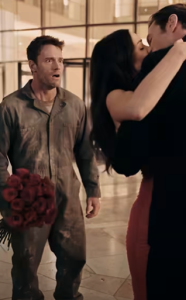
The roses were still in my hand when I saw her.
I had come straight from a job site on the west side, where a burst pipe had turned a finished basement into a swimming pool fourteen hours earlier.
My coveralls were stiff with drywall dust, and there was a smear of joint compound across the back of my right hand that I hadn’t had time to wash off.
I told myself Evelyn wouldn’t care about any of that.
It was our twenty-fourth anniversary, and I had stopped at the florist on Ninth because red roses were what I gave her the first time, back when I couldn’t afford more than three stems.
Twenty-four years later, I could afford the whole dozen, and I wanted her to see me standing there at the Fairmont with them like the man she married.
She was on the sidewalk by the entrance, under the gold lights from the awning.
A man in a dark suit had his arms around her, and she was kissing him — not a polite goodnight kiss, not a mistake, but the kind of kiss two people share when they have done it many times before.
I stopped walking.
The bouquet slid out of my fingers and landed on the pavement with the stems pointing at my shoes.
“WHAT…
ARE YOU DOING?”
I heard myself say it, and I barely recognized my own voice.
She pulled back from him so fast she almost stumbled.
Her hand went to her mouth, and her face went pale under that golden light.
The man in the suit looked me up and down the way people size up a delivery truck blocking the valet lane.
Then he laughed.
“THIS IS YOUR HUSBAND?” he said.
He turned to Evelyn, but he said it loud enough for the doorman, the bellhop, and the two women waiting for their car to hear it.
“HE LOOKS LIKE HE CAN’T EVEN AFFORD TO EAT HERE.”
I didn’t look at him.
I looked at her.
I stood there in my dusty coveralls, waiting for her to say something — one word, one half-sentence, anything that would put me back inside my own marriage.
She lowered her head and said nothing.
I gave her a long moment.
Longer than I should have.
I wanted to believe she was only frozen.
I wanted to believe there was an explanation waiting behind her teeth.
There wasn’t.
I looked at her for a moment I won’t ever get back, and whatever I had left in my chest went quiet.
“ONE DAY, YOU’LL REGRET THIS,” I said.
She didn’t move.
The man in the suit stayed beside her with a smile on his face, one hand resting at the small of her back like a signature on a document.
I walked back to my truck without picking up the roses.
I remember thinking about the doorman, a young guy maybe twenty, who looked at me the way you look at a man who just got hit by something he didn’t see coming.
I could feel him watching me all the way to the parking lot.
I sat in the driver’s seat for a while with the engine off.
My phone lit up on the console.
A text from a client — a woman named Mrs. Patterson on Woodland Avenue — letting me know the final payment for the kitchen she’d had me rebuild had cleared, thirty-one thousand four hundred dollars, and thanking me for getting it done before her daughter’s wedding.
That was my real life.
That was the man in the coveralls the man in the suit had laughed at.
He had no idea.
He wouldn’t have believed it if I’d told him.
I put the truck in gear and headed home, alone, past the florist on Ninth, where somebody was already sweeping up the day’s dropped petals into the gutter.
I told myself I wasn’t going to cry in a work truck.
I was wrong about a lot of things that night, but I was right about one: whatever came next, it was not going to look like the life I thought I was living at seven o’clock that evening.
At two minutes past eleven, I pulled into my own driveway, and the house was dark.
Chapter 2 – Twenty-Four Years in Four Boxes
I sat in the kitchen with the light off and my boots still on.
Twenty-four years, and here is what I could fit them into: four boxes in the closet, two photo albums nobody had opened since Ethan’s high school graduation, and one joint checking account.
I built Hart Remodeling out of the back of a Ford Ranger when I was twenty-eight, after my father died and left me a toolbox, a hammer, and a name people in this town trusted.
I did the work nobody wanted to do — rotted subfloors, cracked foundations, the jobs you have to crawl into — and by the time I was forty, I had six men on payroll and a waiting list.
When Evelyn said she wanted to go back to school for her consulting certificate, I told her to do it.
I took the weekend calls so she could study, and I don’t regret one Saturday of that.
She passed the exam the same spring Ethan started driving, and I was proud of her in a way I probably never said out loud enough.
The last two years, though, I noticed things.
She started shifting to the late schedule — client dinners, evening meetings, a work phone that stayed face-down on the counter.
New clothes, nicer than the weddings and funerals we used to go to.
A locked phone.
I never checked it, because checking it felt like admitting something, and back then I wasn’t ready to admit anything.
Three weeks before the hotel, I did the wash and found a receipt in the pocket of her sweater.
Dinner for two at a restaurant down by the river.
Three hundred forty dollars, which is nearly what I spent on that last set of truck tires, and I would remember those tires longer.
The date on it was a Thursday.
That Thursday I was on a ladder in the rain, re-flashing a chimney for a couple in their eighties, and I got home after nine, and Evelyn wasn’t home at all.
I asked her where she’d been, and she said she’d been with the consultants from her firm.
At the time I told myself consultants have dinner meetings.
I was a man who believed his own lies when they were convenient, and I want to be honest about that, because it’s the only way the rest of this makes sense.
Now it’s past midnight in my own kitchen, and I’m holding that receipt again, and it’s the first time the words *I know* actually stood up in my head.
I heard a car at two in the morning.
It was her car.
I’d know the rattle in the front end anywhere — I keep meaning to fix it and keep not fixing it.
I went to the front window and split the blinds with two fingers.
She parked in the driveway, cut the engine, and then sat there.
She didn’t get out.
I watched the little red clock on the dash flicker and go dark, and I counted.
One minute.
Two.
Five.
At the eight-minute mark she still hadn’t moved, and I stood there in my socks on the cold floor of the house I built our life in, and I understood that whatever she was doing in that car, she was deciding something about me, and she was deciding it without me.
I didn’t turn on the porch light.
I didn’t open the door.
I just stayed there in the dark with my hand on the blinds, counting the minutes, and I made a decision of my own.
Tomorrow, when it was light, I was going to ask her the question I had been avoiding for three weeks.
I just didn’t know yet what she was going to say.
Chapter 3 – The Silence at Breakfast
I sat in the kitchen with the lights off until the sky turned gray.
When she finally came through the door at dawn, she was still wearing the same dress from the hotel, and she didn’t look surprised to see me.
She set her keys on the counter and stood there like she was waiting for me to start yelling.
I didn’t.
I asked her one question.
“How long?”
She looked at the floor for a moment and then said his name like it was something she had been carrying around for months.
“Gerald Voss.
Eight months.”
She said he was a developer, that his company had hired her consulting firm back in the spring, and that one thing had led to another in a way she made sound almost accidental.
Then she said something that I still hear when the house is quiet.
“I’m just tired of pretending, Daniel.”
No apology.
I stood there in my work clothes from the night before and asked her about the dinner receipt I’d found in her coat pocket three weeks ago — the one for three hundred and forty dollars at a restaurant I’d never set foot in.
She didn’t even flinch.
“That was with Gerald,” she said.
So I asked her the only other question that mattered right then.
“What else are you tired of pretending about?”
That’s when she went quiet in a different way.
She walked to the counter, opened her purse, and pulled out a bank envelope with a logo I didn’t recognize — some online bank I’d never heard of.
She told me she’d been moving money out of our joint account for a few months, small amounts at first, then larger ones.
She said she needed “her own account” in case things changed.
Things had already changed.
I just didn’t know how much until that moment.
My phone rang while she was still standing there.
It was our son, Ethan, calling from his apartment across town.
I stepped into the hallway and answered like nothing was wrong, because I didn’t know how to say the words out loud yet.
He asked if we were still doing dinner on Sunday.
I told him yes.
I hung up and stood in the hallway for a minute with my hand on the wall.
When I walked back into the kitchen, Evelyn had her bag on her shoulder.
“I’m going to stay with a friend for a few days,” she said.
She didn’t say which friend.
I didn’t ask.
She walked out, and the door clicked shut behind her, and the house got very still.
I sat at the kitchen table for a while and then I did something I’m not proud of and wouldn’t have done a week earlier.
Her laptop was still open on the counter where she’d left it, still logged in.
I sat down in front of it.
Her email was right there.
I’m not going to pretend I hesitated.
I scrolled through the inbox until I found a thread from a company called Voss Development Group.
The subject line was just two words: “Sycamore Street.”
I opened it and started reading, and the coffee I’d made an hour earlier went cold beside me while I read the same sentence three times.
There were attachments — site plans, parcel maps, a schedule of acquisitions.
I saw my own address listed on one of them, along with a note that said the workshop lease “runs through 2031” and that the tenant “should be approached after closing.”
I sat back in the chair and looked around the kitchen like it belonged to someone else.
That was the first time that morning I felt something other than tired.