 The slap was broadcast to nearly three million people before anyone on the courthouse steps realized the man being humiliated was the most powerful judge in the building.
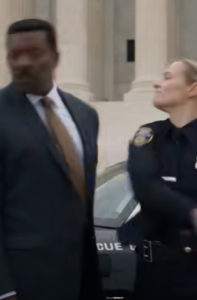
Chief Judge Solomon Reed did not stumble when Officer Paige Whitcomb struck him.
He simply stood motionless beneath the towering marble columns of the Graybridge Federal Courthouse, his dark leather briefcase hanging from his left hand.
At sixty-three, Solomon had spent nearly three decades hearing threats, insults, desperate confessions, and arguments from people who believed that raising their voices could change the law.
But nothing had prepared him for being struck outside his own courthouse by a uniformed officer.
“Did you hear what I said?” Paige demanded.
Her blonde hair was pulled into a tight ponytail, and her polished badge flashed beneath the morning sunlight.
“I told you to move when I speak to you!”
Solomon slowly turned his face toward her.
Behind his wire-rimmed glasses, his dark brown eyes remained steady.
“Officer,” he said quietly, “you have just assaulted me in front of a television camera.”
Paige glanced toward the news crew standing beside the courthouse fountain.
A young cameraman named Theo Brooks was holding a shoulder-mounted camera, its red recording light glowing steadily.
Beside him, reporter Maya Chen had stopped speaking into her microphone.
For several seconds, nobody moved.
Then Paige laughed.
“Shut your mouth and save the lawyer act for somebody who cares.”
She stepped closer and pointed toward the street.
“Now get away from these steps before I arrest you.”
Solomon looked at her badge.
OFFICER PAIGE WHITCOMB — GRAYBRIDGE POLICE DEPARTMENT.
He committed the name and number to memory.
Then he glanced toward the camera.
“Please continue recording,” he said.
Maya had interviewed politicians, criminal defendants, grieving families, and attorneys who treated television cameras like personal mirrors.
She had never seen someone respond to public humiliation with such measured composure.
Her producer spoke urgently through her earpiece.
“Maya, we’re live, and every station in the network is picking this up.”
The reporter swallowed.
“Understood.”
Paige reached toward Solomon’s briefcase.
“Give me that bag.”
“No.”
His answer was quiet but unmistakable.
Paige’s expression hardened.
“I am giving you a lawful command.”
“Then identify the legal basis for taking my property.”
“Because I said so.”
A murmur traveled through the growing crowd.
Several people lifted their phones.
A delivery driver stopped beside the curb.
Two courthouse employees paused halfway down the steps.
Paige seemed to notice the attention only when someone whispered, “Isn’t that Judge Reed?”
She turned sharply.
“What did you say?”
Before anyone could answer, a voice thundered from the courthouse entrance.
“CHIEF JUDGE REED!”
A uniformed court security captain was hurrying down the stairs.
Captain Lena Ortiz had worked federal courthouse security for seventeen years.
She knew every judge assigned to the building, and she recognized Solomon immediately.
“Sir, are you all right?”
Paige stared at her.
“Chief Judge?”
Lena moved between them.
“Officer Whitcomb, step away from him.”
Paige’s face changed.
The contempt disappeared first.
Then came confusion.
Then the terrible recognition that she had made a mistake she could not explain away.
“This man refused to follow my instructions,” she said quickly.
Lena looked at Solomon.
“Sir, what happened?”
“He struck me,” Solomon answered, indicating Paige.
The captain’s gaze dropped toward the officer’s hands.
“The camera recorded it,” Maya said.
Paige turned toward the news crew.
“You can’t broadcast that without permission!”
Maya’s expression tightened.
“We’re reporting from a public sidewalk.”
Solomon adjusted his charcoal jacket.
“Captain, I want the exterior security recordings preserved immediately.”
“Of course, sir.”
“All cameras, all angles, beginning thirty minutes before this incident.”
Lena reached for her radio.
“Security control, this is Ortiz.”
She paused, listening.
Then her expression changed.
“What do you mean, there’s already an alert?”
Solomon noticed.
“Captain?”
Lena lowered her voice.
“Sir, please come inside.”
“Tell me what happened.”
The captain hesitated.
“Someone accessed the restricted evidence archive using your credentials.”
A strange silence settled between them.
Solomon frowned.
“When?”
“Approximately ten minutes ago.”
“That’s impossible.”
“Security is verifying the entry.”
Solomon slowly looked toward the courthouse doors.
He had been standing outside the building for almost half an hour.
At eight twenty that morning, his driver had dropped him beside the fountain.
He had arrived early because a woman named Esther Bell had asked to speak with him before a hearing that could reopen one of Graybridge’s oldest public scandals.
Esther was seventy-nine, a retired court stenographer whose hands trembled when she became emotional.
She had waited on a bench with a small canvas handbag and a yellowed envelope.
“Judge Reed,” she had said, “there is something you need to understand before you open those files.”
Solomon had gently interrupted her.
“Mrs. Bell, if this concerns the pending petition, I cannot privately discuss the evidence.”
“I know.”
She had looked toward the courthouse.
“That’s why I’m not asking you to believe me.”
She had placed the envelope back into her bag.
“I’m asking you to believe what they tried to erase.”
Before Solomon could respond, Esther received a telephone call and walked toward the nearby public garden.
He had remained outside, reviewing the morning’s schedule.
Then Paige Whitcomb approached and ordered him to leave.
Now Esther’s strange warning returned to him.
“What archive?” Solomon asked Lena.
The captain glanced toward Paige.
“Evidence Room Five.”
Solomon felt an unfamiliar uneasiness.
That room held the sealed original records connected to the Riverbend Redevelopment litigation.
At ten o’clock, he was scheduled to hear arguments over whether those records should be opened to the public.
For twenty-seven years, residents of Graybridge’s Riverbend neighborhood had accused city officials and private developers of taking their homes through fraudulent emergency condemnations.
Forty-three families had lost their properties.
Some received small settlements.
Others received nothing.
Most eventually scattered across the state.
The city maintained that every transaction had been lawful.
But three months earlier, a retired surveyor had discovered references to an original property ledger that contradicted the official record.
That discovery brought the case back to federal court.
And now someone had apparently entered the room containing the very documents at the center of the dispute.
Using Solomon’s name.
“Captain,” he said, “who authorized access?”
“We don’t know yet.”
“Then find out.”
Paige suddenly spoke.
“Wait.”
Everyone looked at her.
“I was told there was a security concern involving this man.”
Lena turned.
“Who told you?”
“My supervisor.”
“Which supervisor?”
Paige swallowed.
“Someone from courthouse administration contacted our department.”
Solomon watched her carefully.
“What precisely were you told?”
“That a man matching your description might try to enter the building with restricted court materials.”
Maya’s microphone moved closer.
Solomon said nothing for a moment.
Then he asked, “Were you shown a photograph?”
Paige nodded.
“Yes.”
“Was my name on the alert?”
“No.”
“Did it tell you I was dangerous?”
She hesitated.
“It said you were not authorized to enter.”
Lena looked bewildered.
“An alert identifying Chief Judge Reed as an unauthorized visitor would never have come from my office.”
Paige glanced at the courthouse doors.
“I was just following the information provided.”
Solomon’s expression did not change.
“Information does not authorize violence, Officer Whitcomb.”
He turned toward Lena.
“Secure the recording.”
Inside the courthouse, the mood had already shifted from confusion to alarm.
Security guards closed the side entrances.
Court employees whispered beside the elevators.
Telephones began ringing in offices throughout the building.
By the time Solomon entered the security command center, the footage of Paige striking him had already spread across social media.
But he was no longer thinking about the slap.
The room contained a wall of monitors displaying the building’s entrances, hallways, elevators, and restricted areas.
A technician named Gabriel Torres stood beside the central console.
“Your Honor,” Gabriel said nervously, “we found the access record.”
He turned a monitor toward Solomon.
A digital entry displayed the time.
8:41:17 A.M. — EVIDENCE ROOM FIVE — ACCESS GRANTED.
Below it appeared a name.
SOLOMON REED — CHIEF JUDGE.
Solomon stared.
“Show me the corresponding footage.”
Gabriel selected the archive corridor camera.
The image appeared in grainy color.
A narrow hallway stretched toward a reinforced steel door.
At 8:40, the corridor was empty.
At 8:41, a man wearing a gray maintenance jacket approached the security reader.
His face was partly hidden beneath a baseball cap.
He raised a white access card.
The door unlocked.
Before entering, he turned toward the camera.
Solomon leaned forward.
“Stop.”
Gabriel froze the recording.
The man’s face remained obscured, but something about his posture seemed familiar.
“Can you sharpen the image?”
“I’m trying.”
Lena pointed toward the corner of the screen.
“Someone else is coming.”
Gabriel advanced the recording.
A second figure entered the corridor.
A woman wearing a long gray coat.
She moved quickly, looking over her shoulder.
Then she followed the man into Evidence Room Five.
Solomon stepped closer to the monitor.
The woman turned briefly toward the camera.
Her face appeared clearly for less than a second.
Solomon’s breath caught.
“No.”
Lena looked at him.
“Your Honor?”
He did not answer.
He knew that face.
He had watched it grow from infancy into adulthood.
He had seen those eyes filled with childhood excitement, teenage defiance, and eventually the disappointment of a daughter who believed her father cared more about the law than the people suffering beneath it.
The woman entering the restricted evidence archive was Naomi Reed.
His thirty-six-year-old daughter.
And she had told him she would be hundreds of miles away that morning.
Gabriel’s phone rang.
He glanced at the screen, answered, and listened.
Then he slowly lowered the receiver.
“Captain,” he whispered, “the evidence archive has been opened.”
Lena stiffened.
“What was removed?”
Gabriel looked directly at Solomon.
“Everything in the original Riverbend evidence box.”