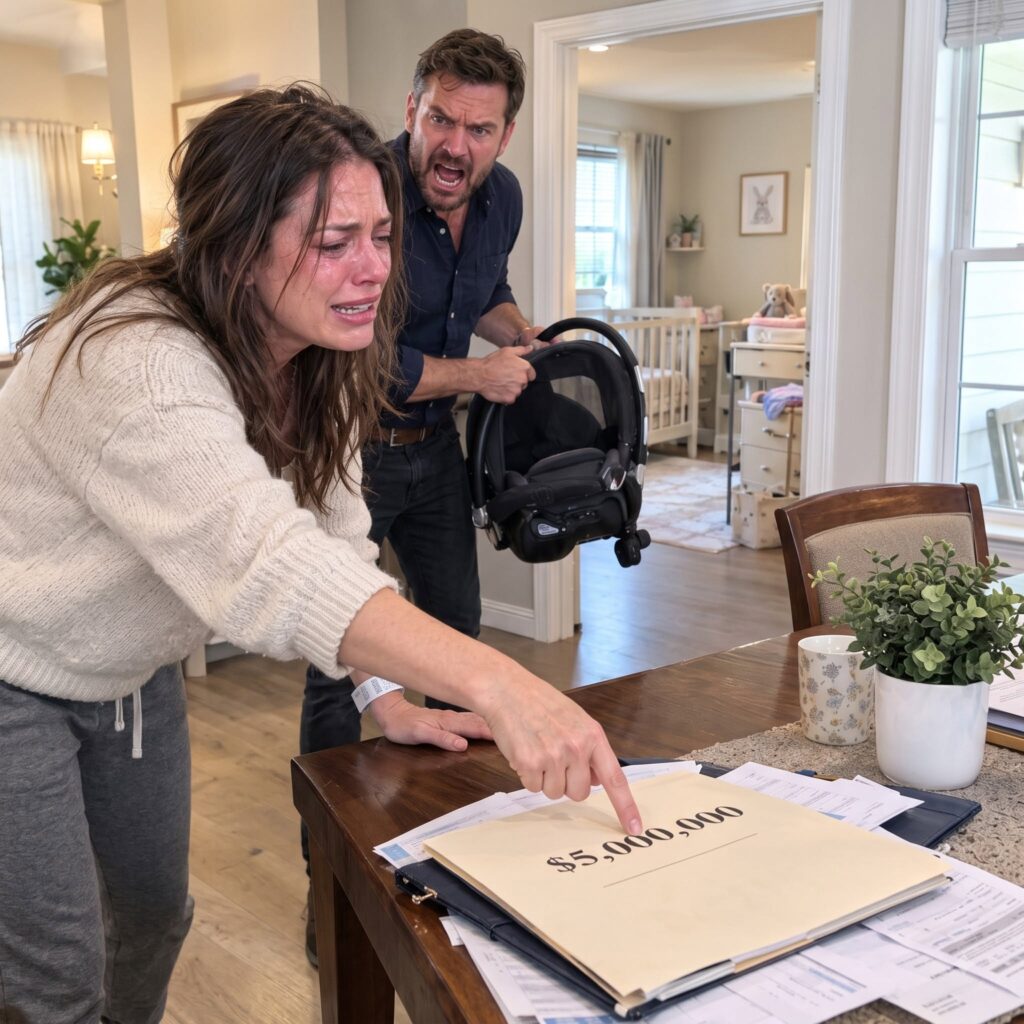
Four days after my emergency surgery, my husband walked into our apartment carrying a car seat and a smug smile.
Then he stopped.
The nursery was empty.
No crib. No baby clothes. No stuffed animals. Nothing.
He looked at me, then at my flat stomach, and his face changed.
“Where is our daughter?”
I stared at him from the couch.
“You should have asked that four days ago.”
He dropped the car seat beside the door.
“What are you talking about? You said you wanted to keep the baby. That was your choice.”
My hands tightened around the blanket.
At nine months pregnant, I had gone into the hospital alone after doctors told me I needed emergency surgery. I had called him three times.
He never came.
Instead, he had texted me:
You wanted this. You handle the cost.
Then another message came:
I’m not paying half for something you chose.
Now he was standing in our apartment acting like an excited father who had simply arrived late.
“Where is she?” he demanded.
I looked him directly in the eyes.
“Our daughter is safe.”
His shoulders relaxed.
“Good. Then let’s go get her.”
“No.”
His expression hardened.
“What do you mean, no?”
“I mean you don’t get to walk in here four days later and pretend nothing happened.”
He glanced toward the empty nursery.
“You can’t keep my child from me.”
I reached beneath the coffee table and pulled out a thick envelope.
“You’re right,” I said quietly. “This isn’t about keeping your child from you.”
He grabbed the envelope.
Then he saw the name of the law firm printed across the front.
His smile disappeared.
“What is this?”
I watched him open it.
His eyes moved across the first page.
Then stopped.
“You’re suing me?”
I said nothing.
He looked at the amount.
$5,000,000.
And for the first time since I entered that hospital, my husband looked genuinely afraid.
The next part gets even more complicated.
He thought the lawsuit was about money. It wasn’t. What he discovered inside the rest of that file would force him to question something much bigger than the cost of raising a child.
He stared at the $5 million figure as if it had personally insulted him.
“This is insane,” Mark said. “Five million dollars? For what?”
“For what happened,” I replied.
“You’re punishing me because I didn’t come to the hospital?”
“No. I’m holding you accountable for what you did before, during, and after it.”
His face reddened.
“You told me keeping the baby was your choice.”
“You told me that repeatedly.”
“Because it was!”
I picked up my phone.
“Then explain these.”
I handed it to him.
The screen showed months of messages.
When I asked him to help prepare for the baby, he had written, You decided to have her.
When I sent him the hospital information, he answered, Don’t expect me to pay for this.
And when I told him the doctors were concerned, he responded with only one sentence:
I’m not getting involved.
Mark shook his head.
“That doesn’t prove anything.”
“Keep reading.”
He scrolled.
Then his expression changed.
There were bank records.
Not mine.
His.
For months, Mark had been transferring money from our joint account into a separate account I didn’t know existed.
Thousands at a time.
He had also canceled several automatic payments connected to the apartment and moved important documents out of our shared filing cabinet.
“Why were you hiding money?” I asked.
“I wasn’t hiding anything.”
“Then why did you open another account?”
He didn’t answer.
That was when my attorney, Sarah Mitchell, stepped into the room.
Mark looked at her.
“You knew about this?”
Sarah placed another folder on the table.
“We discovered something during our initial review.”
Mark opened it.
His eyes widened.
The $5 million claim wasn’t simply about medical expenses or child-related costs.
It involved an insurance policy, financial agreements, and documents Mark had signed months earlier.
He had been quietly trying to establish that I was solely responsible for the pregnancy and future expenses while simultaneously protecting his own assets.
But there was another problem.
One document contained a signature that was supposed to be mine.
I had never signed it.
Mark suddenly went pale.
“That isn’t what you think.”
I looked at him.
“Then tell me what it is.”
He couldn’t.
Sarah closed the folder.
“That’s exactly what we’ll be asking in court.”
Mark looked toward the empty nursery again.
Then he whispered something I never expected.
“I wasn’t planning to leave you with the baby.”
I felt my stomach drop.
“Then what were you planning?”
He looked at me.
And his answer changed everything.
“I wasn’t planning to leave you with the baby.”
Mark’s words hung in the apartment.
I looked at Sarah.
She didn’t react.
“Then what were you planning?” I asked again.
Mark swallowed.
“I was going to leave before the baby was born.”
I felt something inside me go completely still.
“You were going to abandon us?”
“No. I was going to separate from you.”
“You didn’t even come to the hospital.”
“I knew you’d be taken care of.”
I stared at him.
“That is not the same thing.”
He looked toward the empty nursery.
“I thought once everything settled down, I could come back and be a father.”
Sarah finally spoke.
“You’ve been telling people you wanted no financial responsibility because your wife supposedly chose to have the child alone. But your own records tell a different story.”
Mark looked at her sharply.
“What records?”
“The ones showing you planned this months ago.”
She opened the folder again.
There were emails between Mark and an attorney he had privately consulted.
The messages weren’t about leaving because of a sudden disagreement.
They showed that Mark had been researching how to separate his personal assets from our joint finances before the baby was born.
He had also asked how to reduce his future financial obligations.
And then came the detail that shocked me most.
He had been preparing to sell his share of a company he co-owned with two partners.
The expected proceeds were substantial.
He had never told me.
Instead, he had repeatedly told me money was tight.
I looked at him.
“You had money.”
Mark rubbed his forehead.
“I had investments.”
“You told me we couldn’t afford a nursery.”
“I was protecting myself.”
“From your own child?”
He didn’t answer.
Sarah turned another page.
“And that’s only part of it.”
The signature appeared again.
A document stating that I had agreed to assume sole financial responsibility for the pregnancy, delivery, and child-related expenses.
I stared at the page.
“That isn’t my signature.”
“I know,” Sarah said.
Mark immediately interrupted.
“I didn’t forge it.”
“Then who did?”
He looked at the floor.
That silence was an answer of its own.
The investigation eventually led to someone Mark had trusted to handle paperwork for his business. That person had prepared several documents using information already available from Mark’s files.
But the biggest surprise was that Mark had received one of those documents and used it without questioning the signature.
That distinction mattered.
It didn’t make everything disappear, but it changed the legal picture.
Sarah explained that the $5 million lawsuit was not simply a demand that Mark pay five million dollars for having been an absent husband.
The amount represented damages being claimed across several legal issues, including disputed financial conduct, alleged misuse of shared assets, and the consequences of documents that had been presented as legitimate when they were not.
The court would decide what, if anything, was actually owed.
And there was something else Mark had not expected.
The hospital records showed that I had been the one making emergency decisions when he failed to respond.
Our daughter had been delivered safely.
She was being cared for.
And I had never hidden her from him.
I had simply refused to hand our newborn over to a man who had spent months insisting that becoming a parent was entirely my responsibility.
Mark’s attorney eventually contacted Sarah.
Then the negotiations began.
For weeks, there were meetings, financial disclosures, document reviews, and discussions about custody and support.
The five-million-dollar figure became less important than the evidence behind it.
Some claims were challenged.
Some were narrowed.
Some financial issues were settled privately.
The disputed document was removed from consideration after its authenticity was formally questioned.
Mark was also required to account for money transferred from our joint finances.
I didn’t get a dramatic courtroom moment where a judge simply declared me the winner.
Real life wasn’t that simple.
But I did get something more important.
The truth was finally on paper.
Months later, Mark asked to see our daughter.
I agreed to arrangements recommended by the appropriate professionals and court process.
He arrived carrying a small box.
Inside was a stuffed rabbit.
He stood awkwardly near the doorway.
“She looks like you,” he said.
I didn’t answer immediately.
Then he asked, “Can I hold her?”
I looked at my daughter.
Then I looked at him.
“You can be her father,” I said. “But being her father means showing up.”
He nodded.
“I know.”
“No,” I said quietly. “You didn’t know before.”
He looked down.
“I do now.”
I didn’t forgive everything overnight.
I didn’t pretend the hospital experience hadn’t happened.
And I certainly didn’t forget the messages telling me that our daughter was simply “my choice.”
But I also stopped letting anger make every decision for me.
My attorney helped me establish boundaries.
The finances were separated properly.
Important documents were secured.
Custody arrangements were formalized.
And our daughter grew up surrounded by people who understood that responsibility wasn’t something you could accept only when it became convenient.
A few months after everything settled, I finally finished setting up the nursery.
The crib went against the wall.
The tiny clothes were folded into drawers.
The stuffed animals sat on a shelf.
And the room no longer felt empty.
One evening, I stood in the doorway while my daughter slept.
Sarah’s words came back to me:
“Don’t focus on the number. Focus on the evidence.”
She had been right.
The $5 million had shocked Mark.
But that number was never the real story.
The real story was a woman who had been told she should carry every responsibility alone because becoming a mother had supposedly been her choice.
It was a husband who believed he could rewrite his obligations by moving money, signing documents, and refusing to show up when things became difficult.
And it was a newborn daughter who deserved something neither of her parents could undo:
a safe, stable beginning.
Mark eventually became more involved.
Not perfect.
Not suddenly transformed.
But present.
He learned that fatherhood wasn’t a title you picked up when it was convenient.
It was a responsibility you demonstrated.
As for me, I stopped measuring my future by whether Mark would finally understand what he’d done.
I measured it by something much simpler.
My daughter was safe.
I was rebuilding.
And the nursery that had once been empty was finally filled with the sound of her life.
That was enough.
Because four days after my emergency surgery, Mark had walked into our apartment expecting to find a grateful wife and a waiting child.
Instead, he found an empty nursery, a woman who had stopped accepting excuses, and a legal file that forced every hidden decision into the light.
The lawsuit didn’t magically fix my life.
The truth did.
And from that point forward, I made one promise to myself:
No one would ever convince me again that standing up for my family meant standing alone.