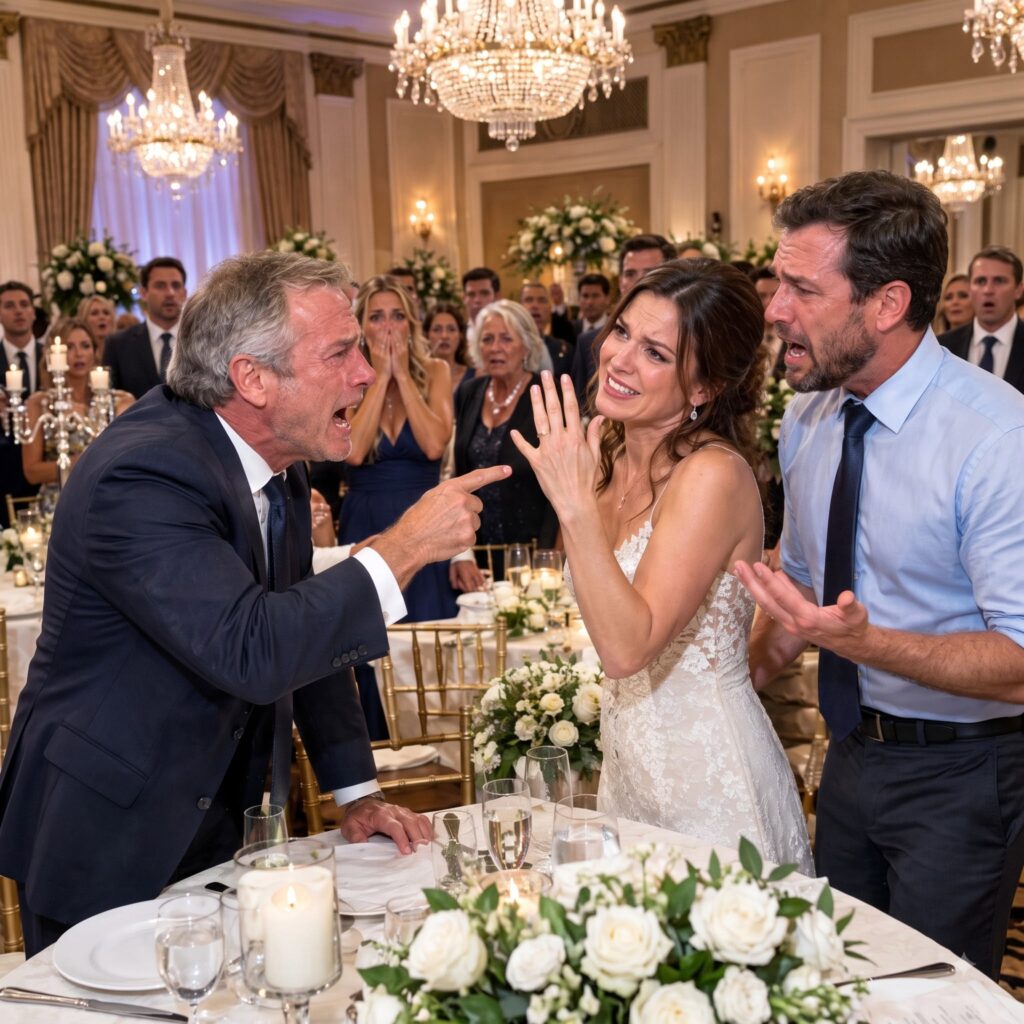
Your late wife’s ring looks better on me.”
I looked at my son, Daniel.
He said nothing.
That silence hurt more than her words.
I held out my hand. “That ring belonged to your mother.”
My daughter-in-law, Claire, glanced at it casually.
“Daniel gave it to me.”
Daniel finally spoke.
“Dad, it’s just a ring.”
Just a ring.
The same ring my wife, Margaret, had worn for thirty-six years.
I walked away before I said something I would regret.
That night, after they left, I returned to the bedroom where Margaret’s jewelry had been kept.
The ring box was still there.
Empty.
Or so I thought.
When I lifted the velvet insert, I heard something scrape underneath it.
I turned the box over.
A folded piece of paper slipped out.
My hands started shaking before I even opened it.
It was Margaret’s handwriting.
“If Daniel ever gives this ring away, please read this before you confront him.”
I read the sentence twice.
Then I unfolded the rest.
Margaret had written the note months before she died.
She mentioned Daniel.
She mentioned Claire.
And she mentioned a document she had hidden because she was afraid someone would pressure our son into signing something he didn’t understand.
Then came the sentence that made my heart pound:
“The ring is not the important thing. What I placed beneath it is.”
I stared at the empty box.
There was one more envelope taped underneath the cardboard.
My wife had left instructions for exactly what I should do next.
I picked up my phone.
I made one phone call.
And three days later, Claire came rushing into my kitchen, crying and furious.
“You need to stop this right now!”
I looked at her.
“What did you find?”
The ring was only the first clue. Margaret had prepared for a family problem she knew might come after her death—and the person who thought she had control of everything was about to discover that Margaret had left one final safeguard behind.
Claire slammed her purse onto the kitchen counter.
“You called an attorney?”
I said nothing.
She stared at me.
“Why would you do that?”
“Because Margaret asked me to.”
Claire’s expression changed.
For a moment, she looked genuinely frightened.
Daniel rushed in behind her.
“Dad, what is going on?”
I looked at my son.
“Ask your wife.”
Claire immediately snapped, “This is ridiculous!”
I placed the envelope Margaret had left on the counter.
Daniel stared at it.
“Mom’s handwriting?”
“Yes.”
He picked it up but didn’t open it.
Claire reached for his arm.
“Daniel, we should leave.”
That was when I realized something.
She wasn’t angry because of the ring.
She was afraid of what was inside the envelope.
The attorney Margaret had named in her note was Thomas Reed, the same estate attorney who had handled our family documents for years.
I had called him that night.
Thomas told me Margaret had contacted him shortly before her death.
She had been concerned about changes someone was trying to make to the family trust.
She hadn’t told me because she wanted to verify everything first.
Then Thomas said something I hadn’t expected.
“Your wife also asked me to preserve the original version of the trust.”
“What changed?”
“We need to compare the documents.”
The following morning, Thomas showed me the records.
The original trust protected several assets for Daniel, but it required his independent approval before certain property could be sold or transferred.
A later document weakened those protections.
The signature appeared to be Daniel’s.
But Daniel insisted he had never signed it.
Then came the twist.
The change hadn’t been filed by Daniel.
It had been submitted by Claire using documents she claimed Daniel had authorized.
Thomas had already requested the original records from the institution that processed them.
Claire apparently learned about the review.
Three days later, she came to my house.
“You’re trying to destroy my marriage!”
I stared at her.
“No. I’m trying to understand why my son’s signature appears on a document he says he never signed.”
Daniel looked at her.
“Claire?”
She started crying.
“I was trying to protect us.”
“From what?” he asked.
She didn’t answer.
Then she looked at me.
“You have no idea what Margaret knew.”
My stomach tightened.
“What does that mean?”
Claire whispered, “Your wife knew I was struggling financially before she died.”
Daniel stared at her.
“You told me everything was fine.”
Claire wiped her tears.
“I thought I could fix it.”
Then she said something even more disturbing.
“The ring wasn’t supposed to be sentimental.”
I looked at her.
“What?”
She swallowed.
“Margaret told me the ring would eventually lead you to the documents.”
I felt the room go silent.
Claire knew about the hidden note.
But if she knew, why had she worn the ring?
Before I could ask, Daniel’s phone rang.
It was Thomas.
He had found the original file.
And one page was missing.
Daniel put the phone on speaker.
Thomas sounded unusually serious.
“I found the original trust file, but one page is missing from the physical copy.”
Claire closed her eyes.
I watched her carefully.
“What page?” Daniel asked.
“The authorization page for the amendment.”
Daniel looked at his wife.
“Claire, what did you do?”
She shook her head.
“I didn’t steal anything.”
“Then why is the page missing?”
“I don’t know.”
Thomas interrupted.
“There is something else. I found a scanned copy in the estate records.”
He emailed it to Daniel.
We opened it together.
The page showed the disputed authorization.
Daniel’s name was typed beneath the signature line.
But the signature itself looked different from the signatures on his other documents.
Thomas explained that the discrepancy would need formal review and that he could not determine from appearance alone whether it had been forged.
Then he revealed why Margaret had been so concerned.
The amendment would have allowed certain assets to be sold with much less oversight.
And Claire had been struggling with substantial personal debt.
Daniel looked devastated.
“You never told me.”
Claire started crying.
“I was embarrassed.”
“You changed our family documents?”
“I didn’t change them!”
“Then explain them!”
She covered her face.
The argument stopped when Thomas spoke again.
“There’s another document Margaret left.”
I froze.
“What?”
“She instructed me to release it only if there was a dispute over the trust.”
I remembered the note.
The ring was not the important thing.
What I placed beneath it is.
Thomas sent the document.
It was a letter from Margaret.
Not a dramatic accusation.
Not a revenge letter.
A warning.
Margaret had written that Claire had once approached her about borrowing money to cover debts.
Margaret had refused to give her unrestricted access to family assets.
Instead, Margaret offered to help Daniel and Claire create a legitimate repayment plan.
But Claire had become angry.
Margaret wrote that she was worried someone might eventually try to pressure Daniel into changing documents he didn’t fully understand.
That was why she had contacted Thomas.
That was why she preserved the original trust.
And that was why she hid the note beneath the ring box.
Margaret hadn’t known exactly what would happen.
She had simply prepared for the possibility.
I looked at Claire.
“You knew she was worried.”
Claire nodded through tears.
“I did.”
“Then why did you wear her ring?”
Claire looked down at her hand.
“Because Daniel gave it to me.”
Daniel said quietly, “I thought Mom wanted you to have it.”
Claire shook her head.
“She gave it to me once.”
I looked up.
“When?”
“Before she died.”
Claire explained that Margaret had called her into the bedroom privately.
She had handed Claire the ring and said, “One day, Daniel may need to understand why I kept certain things protected.”
Claire had interpreted that as permission to keep the ring.
But Margaret had never told her to hide anything.
“She knew I was scared,” Claire said. “I was drowning in debt, and I thought if I lost everything, Daniel would leave me.”
Daniel stared at her.
“You should have told me.”
“I was afraid.”
That didn’t excuse what followed.
Thomas discovered that Claire had indeed provided documents to a financial service while attempting to restructure some debts.
One of those documents included information from the family trust.
However, the investigation did not establish that Claire herself had forged Daniel’s signature.
That distinction mattered.
The evidence showed she had used information she should not have used and had concealed her financial problems from Daniel.
But the disputed signature still required a formal review.
Daniel made his decision before that review was complete.
He would not sign or approve any transfer until every document was independently verified.
Thomas helped restore the original safeguards around the trust while the disputed amendment was examined.
No family property was quietly transferred.
No one simply took the money and disappeared.
The situation became a legal and financial matter rather than a family shouting match.
And slowly, more of the truth came out.
Claire had accumulated debts before marrying Daniel.
She had hidden some of them because she feared judgment.
After Margaret died, Claire became convinced that Daniel would eventually inherit enough to solve everything.
She didn’t initially set out to steal from him.
She made one secret decision after another.
A document here.
A financial conversation there.
A request she didn’t tell Daniel about.
Each step seemed temporary.
Together, they created something much bigger.
Daniel was devastated.
Not because his mother had left him a fortune.
Because she had trusted him to protect what she left behind, and he had never even asked questions when Claire started handling things he didn’t understand.
He also realized something else.
His silence on the night Claire wore the ring had sent the wrong message.
He had seen his father’s hurt.
He had known the ring mattered.
Yet he had said, “It’s just a ring.”
He apologized.
“Dad, I should have said something.”
I nodded.
“Yes, you should have.”
We didn’t hug immediately.
Some wounds need time before gestures mean anything.
A few weeks later, the formal review of the disputed document was completed.
The signature could not be reliably attributed to Daniel based on the available records, and the document was not relied upon for any transfer.
The original trust protections remained in place.
Claire agreed to disclose her finances to Daniel and work through the debts openly rather than trying to solve them through family assets.
Daniel and Claire began counseling—not because everything was suddenly fixed, but because they had finally stopped hiding the problem.
As for the ring, I never asked for it back.
That surprised Daniel.
He asked why.
“Because your mother gave it to your family,” I said. “Not to create another fight.”
Claire eventually took it off herself.
She placed it inside the original ring box.
Then she pushed the box toward me.
“I think this belongs with her things.”
I opened the lid.
The ring sat beside Margaret’s letter.
For a moment, I remembered my wife wearing it at our anniversary dinner years earlier, laughing when I couldn’t remember where I’d put the car keys.
I missed her terribly.
But I also understood something she had tried to teach us without being there to explain it.
Trust isn’t the same as silence.
Love isn’t the same as ignoring warning signs.
And protecting family doesn’t mean protecting secrets that can hurt them.
Months later, Daniel came over with Claire.
There was no shouting.
No accusations.
Just three people trying to figure out what family could look like after trust had been damaged.
Daniel placed a small folder on my table.
“We finished everything with Thomas.”
I opened it.
The estate records were organized.
The trust was clear.
The disputed document was no longer hanging over us.
I closed the folder.
Then Daniel looked at me.
“I finally understand why Mom left the note.”
I smiled sadly.
“She knew we would eventually need the truth.”
He nodded.
“And the ring?”
I looked toward the shelf where the old ring box now sat.
“The ring was never the real story.”
Daniel smiled faintly.
“No.”
“It was just the thing that made us finally open the box.”
That night, I placed Margaret’s letter back underneath the velvet insert.
Not because I wanted another secret.
Because it belonged there.
The next morning, I closed the ring box and put it away.
For the first time since Margaret died, the box didn’t feel like a warning.
It felt like closure.
My daughter-in-law had once smirked and said my late wife’s ring looked better on her.
But three days later, she learned the ring had never belonged to the person wearing it.
It belonged to a story.
And Margaret had made sure that story would eventually be told.

