They never bought new cars, rarely took vacations, and constantly reminded me about the importance of saving every penny.“Money doesn’t grow on trees, Durk,” Dad would say whenever I asked for something as simple as new sneakers or a video game. “You need to understand the value of a dollar.”
My grandma Eleanor, Dad’s mother, lived in Phoenix, Arizona, after retiring from teaching high school mathematics for 35 years. She visited us twice a year, usually around Christmas and during the summer.
Those visits were the highlight of my childhood.
Unlike my parents, Grandma seemed to understand that sometimes small indulgences weren’t just wasteful spending, but necessary joys. She’d take me shopping for school supplies every August, letting me pick out the cool binders and pens that the other kids had.
“A good education requires good tools,” she’d tell me, winking as she slipped me an extra $20 when my parents weren’t looking.
“Our little secret,” she’d whisper.
My parents had a strange attitude about Grandma’s generosity. Whenever she offered to help with big expenses, they’d politely decline, saying they didn’t need handouts.
But I noticed they never hesitated to complain about bills when she was around.
“Eleanor, you don’t understand how expensive kids are these days,” Dad would say, shaking his head over dinner. “Durk’s braces cost us $6,000 last year.”
Grandma would nod sympathetically, and within a week, she’d mysteriously send them a check that my parents would never discuss openly with me.
I only discovered these transactions because I accidentally opened the mail once when I was 13 and saw a check for $3,000 with a note that said, “For Dirk’s expenses.”
When I confronted Mom about it, she quickly took the envelope, saying, “Your grandmother is too generous sometimes. We’re putting this in your college fund.”
I never saw any evidence of this college fund, but I was too young to question further.
By high school, I understood our family’s financial dynamic.
My parents struggled. Grandma helped when they let her. And I was expected to contribute as soon as possible.
I started working at 16, first at a grocery store and then waiting tables on weekends. By my senior year, I was working nearly 30 hours a week while maintaining my grades.
Despite my hard work and several academic scholarships, the cost of my engineering degree at the University of Minnesota was staggering. Even with financial aid, I graduated with $65,000 in student loans.
Throughout college, I continued working multiple jobs: campus IT support during the week, waiting tables on weekends, and tutoring whenever I could squeeze it in.
My parents never contributed directly to my tuition, explaining that they simply couldn’t afford it with Mom’s medical bills.
“This is how you build character,” Dad would say. “When I was your age, I was already supporting myself completely.”
Whenever I mentioned my mounting student loans to them, they’d brush it off.
“Everyone has debt these days,” Mom would say. “You’ll pay it off once you get a good engineering job.”
Meanwhile, Grandma Eleanor called me weekly throughout college, always asking how I was doing financially. She’d send me care packages with homemade cookies, socks, and usually a $50 or $100 bill tucked inside a card.
“For whatever you need, sweetheart,” she’d write.
I used that money for textbooks, groceries, and occasionally, when things were really tight, rent.
I never told my parents about these gifts. Somehow, I knew they’d disapprove or worse, suggest I hand the money over to them for safekeeping. Their constant lectures about financial responsibility made me feel guilty for accepting any help, even from my own grandmother.
As graduation approached, my parents made it clear that the celebration would be modest.
“We’ll take you out to dinner, but nothing extravagant,” Mom said. “We need to replace the furnace this year.”
Grandma called me two weeks before graduation, sounding excited.
“I’ve got something special planned for your graduation gift,” she said. “I’m so proud of you, Durk. First one in the family with an engineering degree.”
I felt a surge of gratitude, but also anxiety.
My first student loan payment would be due six months after graduation, and entry-level engineering jobs in Minneapolis were competitive. I was already applying everywhere, but had no solid leads.
The weight of adult financial responsibility was settling heavily on my shoulders, exactly as my parents had always warned it would.
Little did I know that my understanding of family trust and financial responsibility was about to be completely shattered.
May 15th dawned bright and clear, perfect weather for graduation day.
I woke up early, a mix of pride and anxiety swirling in my stomach. Four years of sleepless nights, impossible exams, and juggling multiple jobs had led to this moment.
I was the first person in my immediate family to earn a college degree, let alone in a field like engineering.
My roommate Jake had already left for the summer, so I got ready in our empty apartment, carefully ironing my shirt and making sure my graduation gown wasn’t too wrinkled.
I took a moment to look around the place that had been my home for the past two years, knowing I’d be moving out within the week since I couldn’t afford the rent without a full-time job.
Mom and Dad arrived at 10:00, coming up to the apartment briefly before we headed to campus.
Dad clapped me on the shoulder, the closest thing to physical affection he typically offered.
“You clean up nice, son,” he said, actually smiling for once. “Big day.”
Mom hugged me tightly, her eyes already teary.
“Your grandmother wishes she could be here,” she said. “But her arthritis is acting up, and the doctor advised against the flight.”
I felt a pang of disappointment. Grandma Eleanor had promised months ago that she’d make it to my graduation no matter what.
“Did you talk to her this morning?” I asked.
“No,” Dad answered quickly. “She called yesterday while you were at your final, said to tell you how proud she is, and that she’ll visit as soon as she can.”
The graduation ceremony was a blur of speeches, cheering, and the surreal feeling of walking across the stage to receive my diploma.
When they called “Dirk Thompson, Bachelor of Science in Mechanical Engineering, cum laude,” I heard my parents’ voices rise above the crowd.
For once, I felt like all the sacrifices had been worth it.
After the ceremony, we met up with a few of my classmates and their families for photos. My parents seemed genuinely proud, posing with me and telling everyone how I’d worked my way through school.
“Complete self-starter,” Dad bragged to my adviser. “Never asked for handouts.”
We went to dinner at Carmela’s, an Italian restaurant that was fancy by my parents’ standards, but still affordable. Dad even ordered a bottle of wine to celebrate, which was unprecedented.
“A special occasion calls for special measures,” he said, raising his glass. “To Durk, the engineer.”
Over pasta, my parents talked about their own college experiences: Mom’s two years at community college before dropping out to work, Dad’s night classes that he never finished.
There was an underlying current in their stories. Life gets in the way of dreams. Practical concerns trump ambitions.
I wondered if they were trying to prepare me for disappointment.
As we finished our tiramisu, Mom reached into her purse and pulled out an envelope.
“This is from your grandmother,” she said, sliding it across the table. “She wanted us to give it to you today.”
The envelope was light blue with my name written in Grandma’s distinctive handwriting.
Inside was a graduation card with a watercolor painting of a mountain scene on the front.
“Reach for new heights,” it said.
The message inside read, “Dearest Durk, I couldn’t be prouder of you. Your hard work and dedication inspire me. This is just a small token to help you start your new journey. All my love, Grandma Eleanor.”
Tucked inside the card were three crisp $50 bills, $150 total.
“That’s nice of her,” I said, genuinely touched.
While I’d secretly hoped for something that might help with my loans, I appreciated the gesture. Grandma lived on a teacher’s pension, after all.
Dad nodded.
That evening, I called Grandma from my apartment to thank her for the gift. She sounded tired, but happy to hear from me.
“Did you have a wonderful day, sweetheart?” she asked.
“It was perfect,” I told her. “And thank you for the card and gift. I really appreciate it.”
There was a slight pause.
“Oh, you’re very welcome, Durk. I hope it helps with everything.”
Something in her tone seemed off, but I brushed it aside.
“That’s… that’s nice,” she replied, sounding distracted. “Listen, my arthritis has been terrible lately, but I’m planning to visit in a few weeks when I’m feeling better. We can celebrate properly then.”
“I’d love that, Grandma. I miss you.”
“I miss you, too, sweetheart. And Durk, I hope my gift helps with something significant. You deserve it after working so hard.”
After we hung up, I sat on my secondhand couch, staring at the three $50 bills.
Something significant.
It was a nice gesture, but hardly life-changing.
Still, I knew Grandma meant well.
The following week, I threw myself into job hunting, sending out dozens of applications and following up on every lead. I had two promising interviews, but no offers.
My meager savings from working through college was dwindling fast, and I needed to find an apartment I could actually afford.
Ten days after graduation, I got a call from the student loan office reminding me that my first payment would be due in November.
The monthly amount: $420.
I did the math quickly. That was almost half of what I expected to pay in rent.
I called my parents to ask for advice, something I rarely did because their advice usually came with lectures.
“That’s just how it is,” Dad said matter-of-factly. “Welcome to adult life. You might need to take whatever job you can find for now, even if it’s not in engineering.”
“The point,” he interrupted, “was to improve your prospects. But nobody owes you a job, Durk. Your mother and I have always lived within our means, and you need to do the same.”I ended the call feeling frustrated and alone.
Later that night, Grandma called again.
“How’s the job search going, sweetheart?”
“Slow,” I admitted. “I might have to take something outside my field just to pay bills.”
“That’s a shame after all your hard work,” she said. “Did my gift help at all?”
Again, I was struck by her phrasing, as if she expected the $150 to make some significant difference.
“I’m saving it for now,” I told her. “Probably for a security deposit once I find a place I can afford.”
“A security deposit?” She sounded confused. “Well, use it however you need to, Durk. I’ll be there in two weeks, and we can talk more then.”
As I hung up, I couldn’t shake the feeling that something wasn’t adding up.
But with the pressure of finding both a job and an affordable place to live, I pushed the thought aside and focused on survival.
By mid-June, nearly a month after graduation, my financial situation had gone from concerning to dire.
After dozens of applications and eight interviews, I finally landed a job not as a mechanical engineer, but as a technical support specialist at a small software company.
The pay was $42,000 a year, significantly less than the $65,000 I’d expected with my engineering degree, but I was in no position to be picky.
I found an apartment in a run-down building in northeast Minneapolis, a far cry from the modern units my classmates were renting downtown.
The one-bedroom unit had water stains on the ceiling, outdated appliances, and neighbors who seemed to argue at all hours. But the rent was only $875 monthly, the cheapest I could find without moving back in with my parents, an option I refused to consider.
Moving day was humbling.
Jake let me borrow his truck, and we loaded up my meager possessions: a futon, desk, the secondhand couch, and kitchen items I’d accumulated through college.
As we carried the futon up three flights of stairs, the elevator was perpetually out of order.
The reality of my post-graduation life hit me hard.
“Dude, this place is…” Jake trailed off, clearly trying to find something positive to say.
“A dump,” I finished for him. “I know, but it’s all I can afford right now.”
He looked uncomfortable.
“My offer still stands. You can crash at my parents’ lake house while they’re in Europe. It’s empty all summer.”
I shook my head.
“Thanks, but I need to figure this out on my own.”
That was what my parents had always taught me. Independence above all else. Accept help and you become weak.
I was beginning to question this philosophy, but old habits die hard.
My first day at the technical support job was mind-numbingly boring. My engineering knowledge was completely wasted as I walked customers through basic troubleshooting steps for eight hours.
My supervisor, Trevor, seemed to sense my disappointment.
“Most of us didn’t plan to end up in tech support,” he said during my lunch break. “I have a master’s in computer science, but the job market’s tight. Stick it out for a year, get some experience, then try again for engineering positions.”
A year felt like an eternity, especially with my student loan payments looming.
I’d done the calculations. After rent, utilities, food, car insurance, and loan payments, I’d have less than $100 left each month for everything else: health care, gas, clothes, any kind of social life.
And that was assuming nothing went wrong.
Something went wrong.
The very next week, my 10-year-old Honda Civic, which had been making concerning noises for months, finally gave out on my way to work.
The mechanic delivered the grim news. The transmission needed replacement, costing $900.
“I can’t afford that,” I told him bluntly.
He scratched his head.
“Well, I can try rebuilding parts of it instead of a full replacement. Might get you another year or so. That would be around $600.”
Even that reduced amount was impossible. I had exactly $742 in my checking account, and rent was due in three days.
I called my parents, swallowing my pride.
“Car’s transmission is shot,” I explained. “I need to borrow some money until my next paycheck.”
Dad sighed heavily into the phone.
“Durk, we just put a new roof on the house. We’re tapped out.”
“I’m not asking for a gift,” I clarified. “Just a loan. $300, and I’ll pay you back next month.”
“Your mother and I stretched ourselves thin putting you through college,” he said, which wasn’t exactly accurate since I’d covered tuition through scholarships, loans, and my own jobs. “This is part of being an adult. Sometimes you have to make tough choices.”
In the end, I put the car repair on my credit card, which already carried a balance from buying professional clothes for interviews. The interest rate was 24%.
But I had no choice if I wanted to keep my job.
For the next two weeks, I ate nothing but ramen noodles, peanut butter sandwiches, and the cheapest frozen vegetables I could find. I walked the two miles to work instead of taking the bus, saving $4 a day.
I turned off the air conditioning despite the sweltering June heat and took cold showers to reduce my electricity bill.
Each night, I’d sit at my rickety desk, updating my budget spreadsheet and watching my debt grow despite my best efforts.
The entry-level engineering positions I dreamed of seemed to be vanishing. Two companies where I’d interviewed told me they were implementing hiring freezes due to economic uncertainty.
The physical and emotional toll was becoming unbearable.
I lost weight, developed dark circles under my eyes, and found myself lying awake at night, calculating and recalculating figures, trying to find a mathematical solution to an impossible equation.
My parents had always emphasized financial responsibility, but they’d never taught me how to handle this level of economic pressure.
When I called them again, desperate for some guidance or encouragement, Mom answered with news of their own.
“We’re thinking of redoing the kitchen,” she said cheerfully. “The contractor came today with samples.”
I was stunned into silence.
They couldn’t loan me $300 for an essential car repair, but they were renovating their kitchen.
“That’s great,” I managed to say. “Listen, I was wondering if you had any advice about managing student loan payments. The first one’s coming up sooner than I expected, and with my current salary—”
“Everyone goes through this, Dirk,” she interrupted. “Your father and I struggled when we were starting out, too. It builds character.”
“I understand that, but—”
“You’ve got a college degree now,” Dad’s voice cut in. He must have picked up the extension. “Time to stand on your own two feet. We can’t keep rescuing you from every little financial hiccup.”
Every little financial hiccup.
I wanted to scream that I wasn’t asking for a rescue. I was drowning and simply looking for a life preserver, or at least acknowledgement that my situation was genuinely difficult.
Instead, I thanked them politely and ended the call.
That night, I broke down completely, sitting on my futon in the dark, saving electricity. I sobbed for the first time since I was a child.
All my life, I’d done everything right. Studied hard, worked multiple jobs, secured scholarships, graduated with honors.
Yet here I was, unable to afford basic necessities, drowning in debt, and working a job that wasted my education and talents.
The worst part was the isolation.
My college friends were either moving away for jobs or came from wealthy families who were supporting them through the transition. My parents seemed completely disconnected from the economic reality facing new graduates.
And Grandma Eleanor, my most reliable supporter, was still in Arizona, though she was scheduled to visit in just a few days.
As I finally fell into an exhausted sleep, I had no idea that her visit would upend everything I thought I knew about my family.
Grandma Eleanor arrived on a sunny Saturday morning in late June, six weeks after my graduation.
Despite my financial stress, I was genuinely excited to see her. I’d cleaned my shabby apartment as best I could, even splurging on a small bouquet of flowers for the coffee table to brighten the place up.
When her taxi pulled up outside, I ran down to help with her bags.
She looked smaller than I remembered, her silver hair cut in a new, shorter style, but her eyes lit up when she saw me.
“There’s my college graduate,” she exclaimed, pulling me into a tight hug that smelled of her signature lavender perfume. “Let me look at you, sweetheart.”
She studied my face, her smile fading slightly.
“You’ve lost weight. Are you eating enough?”
“Just the usual post-college adjustment,” I said, forcing a smile as I took her suitcase. “Nothing to worry about.”
As we climbed the three flights of stairs to my apartment, Grandma paused several times to catch her breath, eyeing the peeling paint and flickering hallway lights with concern.
“This building has seen better days,” she remarked.
“It’s temporary,” I assured her, not mentioning that I was locked into a 12-month lease.
Inside the apartment, I gave her a quick tour, which took all of 30 seconds given the size of the place. She nodded politely, but couldn’t hide her dismay at the water stains on the ceiling and the ancient refrigerator that hummed like a lawn mower.
“Well,” she said finally, “it’s a start. Your first place is never your forever home.”
We spent the morning catching up. I showed her pictures from graduation, carefully steering the conversation away from my financial struggles.
Around noon, I offered to take her to lunch at a nearby cafe, one of the few luxuries I’d budgeted for during her visit.
As we walked to my car, she frowned at the visible rust spots and the duct tape holding one side mirror in place.
“Is this the same car you had in college?”
“Yeah. She’s not much to look at, but she gets me where I need to go.”
I didn’t mention the recent transmission issues or how the check engine light had come on again yesterday.
At the cafe, over sandwiches and iced tea, Grandma asked about my new job. I gave her the sanitized version. Challenging. Good experience. Foot in the door.
Without admitting how soul-crushing I found it or how inadequate the salary was for my needs.
“And what about your engineering career?” she pressed. “That’s what you studied for.”
I shrugged.
“The market’s tight right now. I’m still applying, but this pays the bills in the meantime.”
She nodded thoughtfully, then reached across the table to pat my hand.
“I’m proud of you for making it work, Durk. So many young people expect everything handed to them these days.”
The conversation shifted to her life in Arizona, her book club, and the community garden she’d helped start at her retirement complex.
It was comfortable, familiar territory until she casually dropped the question that would change everything.
“By the way, did the $18,000 I sent for your graduation help with the apartment or car situation?”
I nearly choked on my iced tea.
“The what?”
Grandma looked confused.
“The graduation gift. $18,000. I know it’s not enough to clear all your student loans, but I hoped it might give you a good start.”
The world seemed to tilt on its axis.
I set my glass down carefully, afraid I might drop it.
“Grandma, you sent me a card with $150 in it. That’s the only graduation gift I received from you.”
Her face changed instantly, draining of all color. Her hands, spotted with age, began to tremble on the table.
“$150?” she whispered. “Dirk, I sent a cashier’s check for $18,000 to your parents two weeks before graduation. They promised to give it to you.”
The cafe around us continued its normal lunchtime bustle, but I felt as though we were suddenly enclosed in a bubble of silence.
“Nothing made sense. There must be a mistake,” I said.
Though even as the words left my mouth, pieces began falling into place. My parents’ new kitchen plans. Their refusal to help with even small expenses. Their insistence that I stand on my own financially while they suddenly had money for renovations.
Grandma shook her head firmly.
“There’s no mistake.”
She reached for her purse with trembling hands and pulled out her smartphone. After a moment of navigating with unsteady fingers, she turned the screen toward me.
“See for yourself.”
There on the screen was a bank statement showing a withdrawal of $18,000 on May 1st. Next to it was a scanned copy of a cashier’s check made out to my parents, with “For Durk’s graduation gift, to be given to him” written clearly in the memo line.
“I didn’t want to send it directly to you because I know you move around after graduation,” she explained, her voice quavering. “Your father assured me they would give it to you during the celebration.”
A wave of nausea washed over me.
$18,000 would have changed everything. I could have paid off a significant chunk of my loans, afforded a decent apartment, fixed my car properly, maybe even taken a little time to find an engineering position instead of jumping at the first job offered.
“I don’t understand,” I said.
Though I was beginning to understand all too well.
“Why would they?”
I couldn’t finish the sentence. The betrayal was too enormous to put into words.
Grandma’s expression shifted from shock to a deep, simmering anger I’d never seen on her gentle face before.
“I have some idea,” she said tightly. “But I think we need to hear their explanation directly.”
She closed her banking app and put the phone away with deliberate calm that belied the emotion in her eyes.
“Your parents and I have had disagreements about money over the years,” she continued. “They’ve always felt entitled to my savings because, as they put it, they’re family. But to steal from their own son…”
“Maybe there’s an innocent explanation,” I suggested weakly, though I couldn’t imagine what it might be.
Grandma shook her head.
“Dirk, I love you dearly and I know they’re your parents, but there’s nothing innocent about this. They took advantage of both of us.”
She reached across the table and grasped my hand tightly.
“And we’re going to address it today.”
As we paid for lunch and walked back to my car in silence, I felt as though I was moving through a thick fog.
Everything I thought I knew about my family was being rewritten in real time.
My parents, who had lectured me endlessly about financial responsibility, had apparently stolen $18,000 that was meant for me.
“What do we do?” I asked as we sat in my car, neither of us making a move to start the engine.
Grandma straightened her shoulders, suddenly looking more formidable than her 5’2” frame would suggest.
“First, I’m going to call my bank and get complete documentation of the transaction,” she said firmly. “Then we’re going to visit your parents and get some answers.”
As she made the call, I stared out the windshield, my mind racing through every interaction with my parents since graduation: their newfound generosity at the celebration dinner, their dismissiveness of my financial struggles, the kitchen renovation.
It all made a horrible kind of sense now.
When Grandma finished her call, she turned to me with tears in her eyes.
“I’m so sorry, Durk. I truly thought I was helping you start your life debt-free. I had no idea they would do this.”
I nodded, unable to speak past the lump in my throat.
In that moment, sitting in my run-down car outside a cafe I could barely afford, I realized we had both been betrayed by the people I had trusted most in the world.
We stopped at a print shop on the way to my parents’ house so Grandma could print out the bank records her bank had emailed her. She was surprisingly tech-savvy for a woman in her 70s, navigating the self-service printing station with minimal help from me.
“I want everything documented,” she explained as she organized the papers into a folder. “Your parents can be creative with the truth when it suits them.”
This was a side of Grandma Eleanor I’d never seen: methodical, almost calculating, as if preparing for battle.
It made me wonder how many conflicts with my parents she’d endured over the years without ever letting me see the tension.
The drive to their house took 30 minutes, during which we barely spoke. I was still processing the magnitude of what had happened while Grandma seemed to be mentally rehearsing what she would say.
“We need to stay calm but firm,” she finally said as we pulled onto my parents’ street. “This isn’t just about the money, Durk. It’s about trust and respect.”
My parents’ house looked exactly as it always had.
Neat lawn. Hanging baskets of petunias on the porch. American flag by the door.
It seemed surreal that the people who lived in this picture-perfect home could have done something so profoundly dishonest.
They weren’t expecting us.
Mom answered the door in gardening clothes, genuine surprise on her face.
“Eleanor, we thought you were coming next week.”
She hugged Grandma, then me.
“Dirk didn’t mention he was bringing you by today.”
“It was a spontaneous decision,” Grandma said pleasantly. “Is Thomas home?”
“In the backyard grilling. Come in. Come in.”
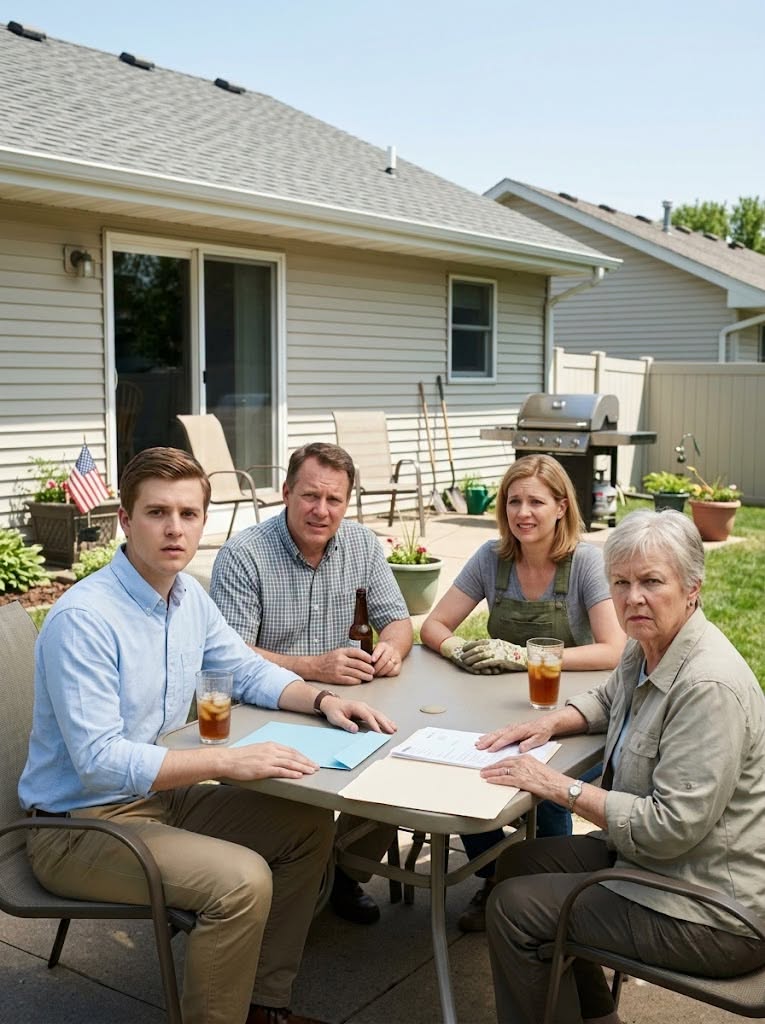
We followed Mom through the house to the back patio where Dad was tending to the charcoal grill, a beer in hand. He looked up and smiled broadly when he saw us.
“Well, this is a nice surprise. Eleanor, you’re looking great. Arizona sun treating you well?”
Grandma accepted his quick hug.
“The weather’s been lovely, yes.”
“You two hungry? I’ve got burgers about ready.”
“Actually,” I said, finding my voice at last, “we need to talk about something important.”
Dad’s smile faltered slightly.
“Sounds serious. Everything okay?”
We sat at the patio table, an uncomfortable silence falling over us. Mom brought out iced tea, chattering nervously about the garden and the neighbors and the weather, anything to fill the void.
Finally, Grandma cleared her throat.
“Thomas, Margaret, there seems to be some confusion about Durk’s graduation gift.”
Mom’s hand froze halfway to her glass.
Dad’s expression remained neutral, but I noticed his knuckles whitening around his beer bottle.
“What confusion?” he asked evenly.
“I gave Dirk the card from you,” Mom added quickly. “With the $150, just like you sent.”
Grandma’s eyes narrowed almost imperceptibly.
“That’s the issue. I didn’t send $150. I sent $18,000.”
The silence that followed was deafening.
Dad took a long swig of his beer while Mom suddenly became very interested in adjusting her napkin.
“Where is the $18,000 that Grandma sent for me?” I asked directly, my voice surprisingly steady despite the thundering of my heart.
Dad set down his beer bottle with deliberate care.
“Eleanor, I think there’s been a misunderstanding. You sent us a check to help with Durk’s education expenses, which we’ve been managing throughout his college years.”
“Don’t lie to me, Thomas,” Grandma said, her voice steel-edged but controlled. “The check was dated May 1st of this year. Durk had already completed his education, and the memo line specifically stated it was for him, to be given to him at graduation.”
Mom jumped in, her voice high and tight.
“We’ve put so much into Durk’s education over the years. Do you have any idea how expensive it’s been? The supplies, the housing costs, the loans—”
“I paid for my own education,” I interrupted, anger finally breaking through my shock. “Scholarships, student loans in my name, and working three jobs. You haven’t contributed to my tuition or housing since freshman year.”
“We put a roof over your head every summer and holiday,” Dad snapped. “Fed you, clothed you, supported you emotionally through all the stress.”
“That’s what parents are supposed to do,” I shot back. “It doesn’t give you the right to steal money that was meant for me.”
Dad’s face reddened.
“Watch your tone, boy. You have no idea what it costs to run a household, to deal with your mother’s medical bills.”
“Then be honest about needing financial help,” Grandma interjected. “Don’t steal from your own son. If you needed money, you could have asked me directly, as you have many times before.”
Mom began to cry, burying her face in her hands.
“We’ve sacrificed everything for you, Durk. Everything.”
The emotional manipulation that had worked so effectively throughout my childhood now felt transparent and hollow.
I pulled out the bank documents Grandma had printed and laid them on the table.
“Where’s the money?” I asked again.
Dad’s defensive posture suddenly shifted to one of righteous indignation.
“After everything we’ve done for you, this is how you repay us? Ambushing us with accusations?”
“Just answer the question, Thomas,” Grandma said.
After a long, tense moment, Dad’s shoulders sagged slightly.
“We needed it.”
“For what?” I pressed.
Mom looked up, tears streaking her mascara.
“The medical bills have been piling up, and the house needed repairs, and—”
“And the kitchen renovation?” I interrupted. “The one you were just excitedly planning while I was eating ramen for every meal because I couldn’t afford groceries?”
Dad’s expression hardened.
“You think you’re the only one who deserves nice things? We’ve lived in this house for 25 years with the same damn Formica countertops while all our friends upgraded. One time, we wanted something for ourselves.”
The admission hung in the air, damning in its selfishness.
“So, you spent it,” Grandma said flatly. “All $18,000. Money that was explicitly meant for your son, who is struggling with student debt and living in an apartment with water damage because it’s all he can afford.”
“We were going to pay him back eventually,” Mom offered weakly.
“When?” I demanded. “After I’ve been eating ramen for five years? After I’ve ruined my credit trying to manage loans you knew I couldn’t afford on my current salary?”
Dad slammed his hand on the table.
“You’re a grown man now, Dirk. Figure it out like the rest of us had to.”
“The rest of you didn’t have parents who stole your graduation money,” I shouted back.
Grandma placed a calming hand on my arm before turning back to my parents.
“This isn’t the first time, is it?”
Dad’s eyes darted to her, then away.
“What are you talking about?”
“The checks I’ve sent over the years, supposedly for Durk’s college fund. The birthday money. The Christmas gifts.” Grandma’s voice was dangerously quiet. “How much of that actually went to him?”
The guilty silence told me everything I needed to know.
My parents had been intercepting Grandma’s financial gifts for years, possibly my entire life.
“We’re his parents,” Mom finally said. “We decide what’s best for the family finances.”
The casual entitlement in her voice made something break inside me.
All those years of struggling, of working to exhaustion while watching classmates enjoy their college experience, of denying myself basic comforts, because I thought my family genuinely couldn’t afford to help.
It had all been built on lies.
“You’re thieves,” I said, my voice barely above a whisper. “You stole from me, and you stole from Grandma, while pretending to be responsible parents teaching me valuable life lessons.”
Dad stood abruptly, pointing toward the door.
“That’s enough. I won’t be spoken to like this in my own home. If you want to choose money over family, then get out.”
“This isn’t about money,” Grandma said, remaining seated. “This is about honesty and respect, neither of which you’ve shown your son or me.”
“What do you want from us?” Mom asked tearfully. “We spent the money. We can’t just give it back.”
“Actually, you can,” Grandma replied. “You can take out a home equity loan or sell some of your possessions or any of the other things you’ve been telling Durk to do to manage his finances. The money was legally his, sent to you as trustees, and you misappropriated it.”
Dad’s face contorted with rage.
“Are you threatening legal action against your own family?”
“If necessary,” Grandma said simply. “But I’d rather you do the right thing voluntarily.”
I stood up, unable to bear any more of the conversation.
“I trusted you,” I said, looking between my parents. “My whole life, I believed you were struggling financially, that you were teaching me important lessons about responsibility. But you were just selfish and greedy.”
“Dirk, please,” Mom sobbed. “We love you. We just made a mistake.”
“A mistake is forgetting to mail a check,” I replied. “This was a deliberate choice you made every day for weeks while watching me struggle.”
Dad’s expression hardened further.
“If you walk out that door with her, don’t bother coming back until you’ve learned some respect.”
I looked at the man who had raised me, seeing him clearly, perhaps for the first time.
“Respect is earned,” I said quietly. “And you’ve just lost all of mine.”
As Grandma and I walked out to my car, Dad shouted after us.
“You’re choosing money over your own parents. Is that the kind of son we raised?”
I turned back one last time.
“No. I’m choosing honesty and integrity, apparently not values you taught me by example.”
The drive back to my apartment was silent, except for Grandma’s occasional sniffle as she tried to hide her tears.
My entire world had just collapsed, and I had no idea what would happen next.
The next morning dawned with a surreal quality, as if the previous day’s confrontation had been a particularly vivid nightmare.
But the hollow ache in my chest and Grandma’s subdued manner as she made coffee in my tiny kitchen confirmed that everything had really happened.
“What do we do now?” I asked, watching her measure grounds with mechanical precision.
She looked up, her eyes tired but determined.
“That depends on what you want, Durk. This is your relationship with your parents and ultimately your decision.”
I stared into my chipped mug.
“I don’t even know what my options are.”
Grandma brought the coffee pot over and filled our cups.
“Well, legally speaking, that money was a gift intended specifically for you. Your parents essentially committed fraud by keeping it. We could pursue legal action.”
The thought made my stomach twist.
“Sue my own parents?”
“It wouldn’t be my first choice either,” she admitted, sitting across from me. “But they need to understand the seriousness of what they’ve done.”
We spent that Sunday researching our options. Grandma called her longtime friend Patricia, a retired attorney, who confirmed that we had a solid case for civil fraud.
The cashier’s check with its specific memo line, combined with my parents’ admission that they had spent the money on themselves, provided clear evidence.
“But legal action is slow, expensive, and will permanently damage your relationship with your parents,” Patricia cautioned over speakerphone. “Consider whether that’s a price you’re willing to pay.”
After the call ended, I paced my small apartment, torn between righteous anger and family loyalty.
“I don’t want to destroy my relationship with them,” I finally said. “But I can’t just pretend this never happened either.”
Grandma nodded thoughtfully.
“What if I simply write you another check? Would that solve the immediate problem?”
“Grandma, no. I can’t ask you to do that. That’s $18,000.”
She waved dismissively.
“I’ve been saving for your graduation since you started high school. This money was always meant for you, and I can afford it.”
“But it’s the principle,” I insisted. “They should face consequences for what they did.”
“They will,” she said grimly. “One way or another.”
The following morning, while Grandma rested at my apartment, I went to work trying to focus on technical support calls while my personal life imploded.
Around noon, my phone lit up with a text from my mother.
“We need to talk. Please come over tonight. Just you.”
I showed the message to Grandma when I got home.
“It’s a trap,” she said immediately. “They want to manipulate you without me there to intervene.”
“Probably,” I agreed. “But I need to hear what they have to say.”
Grandma looked concerned but nodded.
“Just remember everything we discussed. Don’t let them turn this around on you.”
I drove to my parents’ house alone that evening, steeling myself for whatever emotional tactics they might employ.
Mom answered the door with red-rimmed eyes, immediately pulling me into a hug.
I didn’t return it.
“Thank you for coming,” she said, leading me into the living room where Dad sat stiffly in his recliner.
“Let’s make this quick,” I said, remaining standing. “What do you want to talk about?”
“Son, we’ve been doing some thinking,” Dad began, his tone conciliatory, but not quite apologetic. “We realize we should have been more transparent about the money from your grandmother.”
“Transparent?” I repeated incredulously. “You stole it.”
“We borrowed it,” Mom corrected quickly. “For expenses that benefited the whole family.”
“I’m not part of your household anymore. I haven’t been for years.”
Dad leaned forward.
“Look, we’re prepared to make this right. We can pay you back some of the money, say $5,000 over the next year or so.”
“Some of the money. It was all my money.”
“Be reasonable, Durk,” Dad said, an edge creeping into his voice. “We’ve put hundreds of thousands of dollars into raising you. This is just a drop in the bucket compared to that.”
It was the same old manipulation, repackaging their basic parental responsibilities as extraordinary sacrifices that I should be eternally grateful for.
“The check was made out to you as trustees,” I said firmly. “The memo line specifically stated it was for me. You had no right to spend it, legally or morally.”
“And what are you going to do?” Dad challenged. “Sue your own parents? Drag the family through court?”
“If necessary.”
Mom began crying again.
“How can you do this to us? After everything we’ve done for you?”
“This conversation is going nowhere,” I said, turning toward the door. “Either return the full amount, or I’ll be speaking with a lawyer.”
“If you do this,” Dad called after me, “you’re no longer our son.”
I paused, his words hitting me like a physical blow despite their predictability.
“Interesting that you think a parent-child relationship should be conditional on the child allowing themselves to be stolen from.”The next few days passed in a blur of escalating hostilities.
My parents called my aunt and uncle, my cousins, even a few family friends, painting me as a greedy, ungrateful son who was threatening to sue them over a misunderstanding.
Some relatives called to berate me, others to try to mediate.
The family was fracturing along lines of those who enabled my parents’ behavior and those who saw through it.
Grandma, meanwhile, was furious.
“This is exactly what they’ve always done,” she fumed after my cousin Jason called to tell me I was breaking my mother’s heart. “They’re mobilizing the family to pressure you instead of taking responsibility.”
A week after our confrontation, we consulted with an actual attorney, a young woman named Alicia, who specialized in family financial disputes.
“You have a strong case,” she confirmed after reviewing our documentation. “But family lawsuits are messy and emotional. Are you prepared for that?”
I looked at Grandma, who squeezed my hand supportively.
“What if we sent a formal letter from your office first?” I suggested. “Maybe the threat of legal action will be enough.”
Alicia nodded.
“We can draft a demand letter stating the facts and requesting full repayment within 30 days, after which we’ll file suit.”
That afternoon, Grandma did something I hadn’t expected.
She wrote me a check for $18,000.
“I’m not replacing what your parents took,” she explained as I stared at the check in shock. “This is a separate gift to help you get established properly. What your parents did was wrong, and they still need to make restitution.”
“Grandma, I can’t accept this,” I protested.
“You can and you will,” she said firmly. “I’m not going to watch you suffer in that awful apartment with that terrible job while we wait for your parents to do the right thing.”
Tears filled my eyes.
“I don’t deserve you.”
“Of course you do,” she replied simply. “Family is supposed to support each other. Real support, not the conditional kind your parents offer.”
Two days after Alicia sent the demand letter, my father called, his voice tight with rage.
“A lawyer? Really, Durk? You’re actually going through with this?”
“You gave me no choice,” I responded calmly. “Return the money, and the legal action stops.”
“We don’t have $18,000 just sitting around.”
“You spent it on necessary household repairs and a kitchen renovation. And a vacation,” I added, having learned about their Cancun trip from my cousin.
There was a long pause.
“We can give you $5,000 now and work out a payment plan for the rest.”
It wasn’t everything, but it was a start.
“I’ll have Alicia draft an agreement.”
The repayment plan was officially signed the following week. $5,000 immediately, followed by monthly payments of $500 until the balance was repaid with interest.
My parents signed it without looking at me, their faces masks of resentment.
As we left the attorney’s office, Dad muttered, “I hope it was worth it. Destroying your family over money.”
I turned to face him fully.
“You destroyed our family when you chose dishonesty over integrity. This is just the consequence.”
Thanks to Grandma’s generosity and the initial repayment from my parents, I was able to make significant changes to my life.
I put a down payment on a reliable used car, moved to a safer apartment, and had enough breathing room to continue my engineering job search without the suffocating pressure of immediate financial ruin.
Most importantly, I began therapy to process the betrayal and manipulation I’d experienced throughout my life.
Each session helped me recognize patterns of control and emotional abuse that I had normalized, believing they were just my parents’ way of teaching me responsibility.
Grandma extended her visit indefinitely, eventually finding a small apartment near mine.
“Arizona is too hot anyway,” she declared. “I’d rather be near my favorite grandson.”
My relationship with my parents remained strained. Contact was limited to formal emails about payment schedules.
Some family members gradually came around as the full story emerged, while others maintained that I should have kept family business private and forgiven the theft without consequences.
Through it all, I kept reminding myself that standing up for myself wasn’t selfish or greedy. It was necessary for my own healing and growth.
The money had never been just about the money.
It was about truth, respect, and breaking a cycle of manipulation that had controlled me for too long.
Six months after the confrontation with my parents, my life had transformed in ways I could never have anticipated.
Thanks to Grandma Eleanor’s support and the enforced repayments from my parents, I had paid off a significant portion of my student loans, reducing my monthly payments to a manageable amount.
I’d found an engineering position at a renewable energy startup where my skills were valued and my salary reflected my education and abilities.
My new apartment, while still modest, had functioning appliances, no water damage, and neighbors who didn’t scream at each other at 3:00 in the morning.
But the most profound changes were internal.
After 22 years of believing I was never quite good enough, never quite responsible enough, never quite deserving of support or comfort, I was learning to trust my own perceptions and set healthy boundaries.
My parents continued making their court-ordered monthly payments, though rarely on time and never without some passive-aggressive note attached.
“Hope this helps with whatever luxury you’re enjoying this month.”
Or, “Another sacrifice we’re making for you.”
I had stopped responding to these barbs, simply documenting the payments and moving on.
The family remained divided.
My aunt Lisa, Dad’s sister, had surprisingly become one of my strongest supporters after she learned the full story.
“I’ve watched Thomas manipulate money situations my entire life,” she told me during a lunch visit. “He borrowed $3,000 from me in 2009 and conveniently forgot about it when I asked for repayment. I’m sorry it took this for me to speak up.”
Grandma had become a regular fixture in my life, coming over for Sunday dinners and occasionally accompanying me to my therapy sessions when I needed extra support.
“I should have seen what was happening years ago,” she said one evening as we washed dishes together. “All those gifts I sent that you never seemed to receive. I just assumed you were being a typical teenager, not expressing gratitude.”
“You couldn’t have known,” I assured her. “They were very careful to control all communication between us.”
“Still, I feel responsible. If I’d been more direct about the money instead of sending it through your parents—”
“Then they would have found other ways to manipulate the situation,” I finished for her. “This isn’t your fault, Grandma.”
My therapist, Dr. Mariana Santos, had been instrumental in helping me recognize that my parents’ behavior reflected their issues, not my worth as a person or a son.
“Financial abuse is a form of control,” she explained during one session. “By keeping you financially dependent and insecure, they maintained power over your choices and your narrative of self.”
“But why?” I asked, still struggling to understand. “They’re my parents. They were supposed to want what’s best for me.”
“Some parents see their children as extensions of themselves rather than autonomous individuals,” she replied. “Your success threatened their narrative of constant struggle and sacrifice. Your independence meant losing control.”
These insights helped me begin the long process of forgiveness, not for my parents’ sake, but for my own healing.
Forgiveness didn’t mean resuming the old relationship or pretending the theft hadn’t happened. It meant releasing the consuming anger that had initially driven me, the obsessive replaying of every manipulative interaction throughout my childhood.
Around the holiday season, my parents reached out through my aunt Lisa, asking if I would join them for Christmas dinner.
“They’re making an effort,” Lisa said cautiously. “It might be a start.”
I considered declining outright, but Dr. Santos encouraged me to establish clear boundaries instead.
“You can attend on your terms,” she suggested. “Perhaps with your grandmother or aunt present as support, with a set time limit, and with certain topics off limits.”
So, I agreed to a two-hour Christmas lunch, with Grandma accompanying me, and with the explicit understanding that financial matters would not be discussed.
It was awkward and tense, with Mom alternating between excessive cheerfulness and wounded silence while Dad maintained a formal politeness that never quite reached his eyes.
But there were moments, brief, fragile moments, when something like genuine connection flickered between us.
Dad asked about my engineering work with actual interest.
Mom showed me her new watercolor painting hobby without turning it into a story about sacrifice.
We weren’t healed, not even close, but we were acknowledging each other’s existence without immediate hostility.
As winter turned to spring, I found myself thriving professionally and personally.
My boss had assigned me to lead a project developing more efficient solar panel technology. I’d made friends with colleagues who shared my interests without the baggage of family history.
I’d even started dating again, meeting a wildlife biologist named Amaya, who understood family complexity, having navigated her own difficult relationship with her father.
One Sunday evening in April, as Grandma and I enjoyed dinner on my small balcony, she asked a question that caught me off guard.
“Do you regret it? Standing up to them, getting lawyers involved?”
I considered this carefully.
“No,” I finally said. “It was painful and messy, and some relationships may never recover. But for the first time in my life, I feel like I’m living according to my actual values, not just trying to earn approval that was never going to come.”
Grandma nodded.
“You know, there’s an old saying: the truth will set you free, but first it will make you miserable. I’ve watched you go through the miserable part. Now I’m seeing the freedom.”
That freedom extended beyond just my relationship with my parents.
I was making financial decisions based on what was right for me, not on fear or artificial scarcity. I was building relationships with genuine give and take, not one-sided sacrifice. I was pursuing career opportunities that excited me, not just those that promised immediate security.
Most importantly, I was learning that family is defined by actions, not blood. By how people treat each other, not by titles or obligations.
Grandma Eleanor had shown me what real family support looked like. Generous but not controlling, loving without conditions, respectful of boundaries and individual choices.
The money that had initially sparked the conflict had long since been spent or invested, but its true value had been in the harsh light it shed on relationships that had been built on manipulation rather than love.
That illumination, painful as it was, had allowed me to begin constructing a life based on authenticity and mutual respect.
As the sun set over the city skyline, casting golden light across our simple dinner, I realized that some betrayals, while devastating in the moment, ultimately force growth that would never have happened otherwise.
My parents had taken money that was rightfully mine. But in standing up to that injustice, I had reclaimed something far more valuable.
My autonomy, my self-respect, and my right to define family on my own terms.
“I think,” I told Grandma as we clinked glasses in a small toast, “that sometimes the most difficult paths lead to the most necessary destinations.”
Have you ever experienced financial betrayal from someone you trusted? How did you handle it, and what boundaries did you establish afterward?
Share your stories in the comments below and don’t forget to like and subscribe if this resonated with you. Remember that standing up for yourself isn’t selfish. It’s an essential form of self-care.
If you came here from Facebook because of this story, please go back to the Facebook post, hit like, and leave exactly this one word in the comments: Respect. That small action means more than it may seem, and it helps give the storyteller real motivation to keep bringing more stories like this to readers.

