cnu Six Weeks After My Husband Locked Me and Our Six-Day-Old Baby Outside in a Blizzard, He Married a Wealthy New Bride and Told Everyone I Was “Unstable.” So I Walked Into His Wedding Carrying Our Daughter, a Sealed Envelope, and the Recording He Never Knew Existed… Then the Ballroom Heard Exactly What He Said Before Leaving Us to Freeze.
What Came After the Blizzard
Part 1: The Night He Left Us
Six weeks after my husband pushed me and our newborn daughter into a blizzard, I still heard his voice every time the wind struck the windows.
“You’ll be all right, Vivienne. You always survive.”
He said it like survival was something shameful. Not strength. Not courage. A flaw he had been forced to tolerate until he finally found a way to punish me for it.
That night, the storm had swallowed the mountain road in minutes. Snow blew sideways across the porch, hard enough to sting my cheeks raw. I was barefoot because Dominic had dragged me from the nursery before I could find my slippers. One knee was bleeding where I had hit the stone step. Under my coat, Sophia was tucked against my chest, six days old and wrapped in the yellow hospital blanket I had refused to take off her since we came home.
Behind Dominic, the house glowed with heat. Firelight moved across the foyer marble. Another woman’s perfume clung to his shirt.
“Please,” I whispered. “She’s a baby.”
Dominic looked at the bundle beneath my coat, then back at me.
“Then walk carefully.”
The door slammed.
The lock clicked.
For three heartbeats, I stood too shocked to move. Then Sophia made a thin sound against my skin, and the world snapped back.
I should have died on that mountain. Sophia should have died with me. That was what Dominic had counted on. A grieving husband. A tragic postpartum episode. A wife who wandered from a warm house during a storm because motherhood had overwhelmed her.
Before I became Mrs. Dominic Vance, I had worked as a crisis investigator for the state attorney’s office. I had interviewed terrified victims and polished liars. I knew how powerful men cleaned up their stories. I knew evidence disappeared fastest when families had money.
And I had stopped trusting Dominic long before the blizzard.
With one numb hand wrapped around Sophia’s back, I reached beneath her blanket and pressed the button on the emergency recorder clipped inside her diaper bag.
Then I started walking.
A truck driver found us forty minutes later near a service road. I remember the cab heater roaring, the driver saying, “Stay with me, ma’am,” and Sophia’s lips looking faintly blue beneath the dashboard light.
At the hospital, doctors treated us for exposure. Sophia was placed under a warmer. I woke to Dominic standing beside my bed in a camel wool coat, weeping for strangers.
“My wife has been unstable since the delivery,” he told the doctor. “She took the baby outside during some kind of episode.”
His mother, Beatrice, stood beside him with one gloved hand pressed to her pearls.
“Poor Vivienne,” she said softly. “Some women simply break.”
I lay there too weak to lift my head while they buried me alive with concern. Dominic waited until the doctor stepped out. Then he leaned close enough for only me to hear.
“Say one word,” he whispered, “and I’ll make sure they take the baby.”
That was when I stopped being his wife.
I became a witness.
For six weeks, I let them think I was ruined. I let Dominic file an emergency custody petition claiming I had endangered Sophia. I let Beatrice tell her friends I was recovering somewhere private. I let their attorney send letters full of words like instability and supervised access.
Every time I wanted to scream, I remembered the recorder.
My old mentor, Assistant District Attorney Fiona Hale, came to the hospital after a nurse quietly called her for me. She listened to the recording with her jaw locked, then replayed the last ten seconds three times: my begging voice, Sophia’s cry, Dominic’s answer, the door, the lock.
“He put a six-day-old infant outside in a blizzard,” Fiona said.
“Yes.”
“And then filed for custody.”
“Yes.”
Fiona’s expression became very still. “Then we do this properly.”
So we did. We gathered hospital records, weather data, phone logs, a neighbor’s doorbell footage, and financial documents from my inheritance trust. We did not warn Dominic. We did not argue online. We did not give Beatrice the satisfaction of watching me unravel.
Then, in the sixth week after the storm, Dominic announced his engagement to Chloe Whitmore, daughter of one of the richest hospital owners in the county. The invitation appeared online two days later, all white roses and champagne towers, with Beatrice quoted beneath a glossy photo saying her son deserved joy after a painful chapter.
Fiona brought me a printed copy.
“Are you sure?” she asked.
Sophia slept against my chest, warm and alive.
“He wanted me gone quietly,” I said. “So I’ll return with witnesses.”
Fiona folded the invitation once.
“Good,” she said. “Then let’s give him the wedding he earned.”
Part 2: The File Beneath the Flowers
Dominic chose the Whitmore Hotel because the staircase photographed beautifully.
That was what Fiona said three days before the wedding while we reviewed the plan in her office. Photographs of the ballroom, exits, service corridors, and loading dock covered her corkboard. It looked less like a wedding venue than a crime scene waiting for labels.
“He likes spectacle,” Fiona said. “He thinks a room full of expensive witnesses makes him untouchable.”
“It usually does.”
“Not when they hear the right evidence.”
The Whitmore Hotel sat downtown in a restored limestone building with brass revolving doors and balconies trimmed in gold. Chloe’s family used it for hospital galas and donor dinners, the kind where reputations were washed clean under chandeliers. Dominic was not marrying only a woman. He was marrying insulation.
But insulation cracks when pressure hits the right place.
The first document in our file was the life insurance policy. Dominic had increased coverage on me to two million dollars forty-eight hours before the storm. He confirmed the change from his home office while I was upstairs trying to nurse Sophia through a bad latch.
The second document was his custody petition. In it, Dominic swore I had voluntarily left the house with our infant daughter during a postpartum mental health episode and that he feared I might harm Sophia again.
The third was a bank report obtained after my attorney filed an emergency motion to preserve marital and trust assets. Money had been moving from my inheritance into a shell consulting company registered under Beatrice’s maiden name. The invoices were vague and elegant: household transition support, family stabilization services, executive personal planning.
Family stabilization. That was what they called stealing from me while preparing to erase me.
The strongest evidence was still the recording. A court-approved audio technician had enhanced it. Dominic’s voice was clear. Mine was broken by wind. Sophia’s newborn cry threaded through the background until it almost vanished beneath the storm.
I could read every page without shaking.
I could not listen to that recording twice.
“You don’t have to attend,” Fiona told me. “We can execute the warrants without you in the room.”
“If I don’t stand there,” I said, “he’ll tell everyone I was too unstable to face him.”
“He may try that anyway.”
“Then I want the cameras to catch my face when he does.”
Fiona studied me the way she used to study witnesses who were afraid but ready.
“Then you follow the safety plan exactly.”
The safety plan had more moving parts than the wedding itself. Two detectives would attend in hotel security jackets. A family court judge had reviewed the emergency evidence and issued temporary custody orders protecting Sophia until a full hearing. The bank had frozen the shell company. Chloe’s aunt, a retired judge rumored to care more about consequences than appearances, had received the sealed filing through proper channels that morning.
Fiona was strict about the line between justice and theater.
“We are not doing this for revenge,” she said.
I looked at her.
She sighed. “Fine. The public setting is strategically useful.”
On the morning of the wedding, I woke before Sophia in the small protected apartment Fiona had helped me rent. Dawn pressed pale light against the blinds. No snow. No mountain road. Just the sound of traffic, the smell of coffee from downstairs, and my daughter sleeping in a bassinet beside my bed.
I dressed carefully. Not like a grieving woman. Not like a victim. Not like a wife begging to be believed.
I wore a black coat over a navy dress. Sophia wore a cream sweater and the same yellow hospital blanket from the storm. I considered leaving it behind, then folded it around her anyway.
Some objects deserved to testify.
Outside the Whitmore, reporters and society guests gathered behind ropes. Beatrice stood near the entrance giving an interview, every silver hair pinned perfectly in place.
“My son deserves peace after such a painful chapter,” she said into a microphone. “Vivienne has been very troubled. We pray she finds healing.”
I watched from Fiona’s car across the street.
Fiona lowered the volume. “Last chance to stay here.”
Sophia stirred in her carrier.
“No,” I said. “Quiet is how he survives.”
At 3:07 p.m., while Dominic stood beneath an arch of white roses, the ballroom doors opened.
Cold air moved in before I did.
Then I stepped through it.
Part 3: The Wedding He Earned
The music faltered when people noticed me.
It did not stop at first. The string quartet kept playing because professionals recognize disaster before guests do. The violinist dragged one note slightly sharp, recovered, and tried to pretend nothing had changed. Around her, two hundred heads turned in a slow wave.
Dominic saw me when I reached the first row.
For half a second, his face was naked. Not cruel. Not angry. Simply stunned that a person he had discarded could walk back into a room under her own power.
Then the mask returned.
He gave the guests a sad smile and stepped away from Chloe.
“Vivienne,” he said gently. “You shouldn’t be here.”
“You’re right,” I said. “I should be dead.”
Phones rose. Someone near the aisle whispered my name. Chloe turned from Dominic to me, confusion tightening her face.
“Dominic,” she asked, “who is this?”
“His wife,” I said. “Though according to his latest court filing, I am also unstable, dangerous, and missing by choice.”
Beatrice rose so quickly her chair scraped across the marble.
“Security,” she snapped. “Remove her before she humiliates herself.”
“No,” Fiona said from the back of the room.
She stepped into the aisle in a navy suit, followed by two detectives who no longer bothered pretending to be hotel staff. A murmur rolled through the ballroom.
Dominic’s jaw tightened. “Fiona Hale. I should have known.”
“Yes,” Fiona replied. “You should have.”
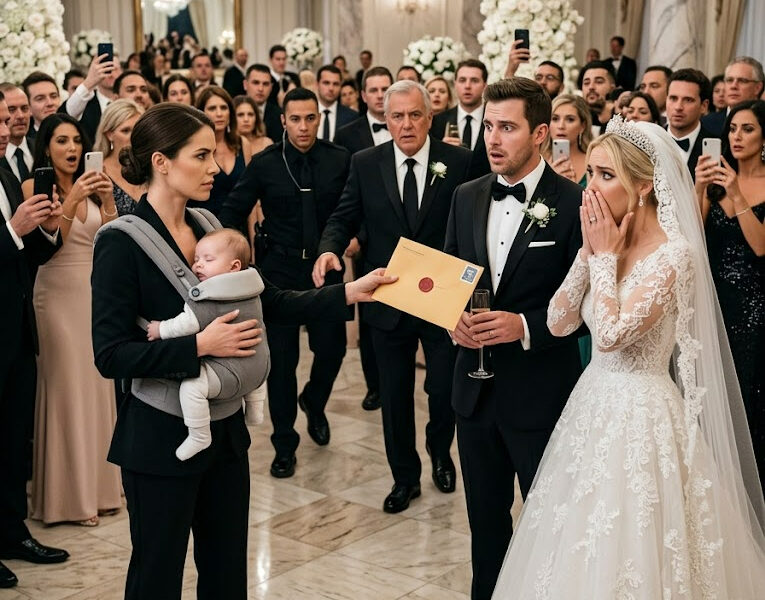
I held up the sealed envelope beneath the chandelier. The red wax gleamed like a fresh wound.
“Dominic,” I said, “you forgot a few things.”
He smiled again, but only his mouth moved.
“Everyone, please forgive this interruption. My wife has been very ill since giving birth.”
“Temporary custody was granted this morning,” Fiona said clearly. “Sophia Vance remains in her mother’s care pending a full hearing.”
Dominic’s eyes flashed. “That order means nothing.”
“It means you do not touch the baby.”
That landed. The guests understood baby before they understood law.
Chloe stepped backward.
I opened the envelope and handed her the first page.
“Ask him why he increased my life insurance to two million dollars two days before he locked me outside in a sub-zero storm with our newborn daughter.”
Chloe stared at the policy. Color drained from her face.
Beatrice’s voice cut through the room. “That is forged.”
“No,” I said. “But the shell company invoices under your maiden name are very real.”
One detective moved closer to Beatrice.
Dominic looked at him, then at Fiona, then finally at me. I saw calculation turn into rage.
“You ungrateful little—”
“Careful,” I said.
He stopped.
I pointed to the small black recorder clipped beside Sophia’s blanket.
“You’re close to a microphone.”
Dominic looked down at our daughter for the first time all afternoon.
Not because he cared. Because he recognized the device.
The ballroom speakers crackled.
That was Fiona’s doing. Hotel audio had been prepared for vows and sentimental speeches. Instead, it delivered the sound of a mountain storm.
Wind filled the ballroom.
Then Dominic’s voice.
“You’ll be all right, Vivienne. You always survive.”
Several guests gasped. He sounded nothing like a grieving husband. He sounded bored.
My voice followed, thin and shattered beneath the wind.
“Please. She’s six days old.”
Then Dominic again, clear enough to turn the chandeliers into courtroom lights.
“Then walk carefully.”
The door slammed on the recording.
The lock clicked.
No one moved.
Chloe covered her mouth. Tears spilled over her fingers, but she did not look away from him. Whatever story he had told her about me died on her face.
“You did that?” she whispered.
Dominic lunged.
He moved toward the recorder, not toward me, not toward Sophia. That detail was captured by six phones, two hotel cameras, and the professional wedding videographer, who never lowered his equipment.
Detective Marquez caught Dominic’s arm before he reached the carrier and twisted it behind his back. Dominic dropped to one knee beneath the white roses.
“You set me up!” he roared.
I looked down at him. Sophia slept between us, warm and peaceful.
“No,” I said. “I survived you.”
Beatrice tried to slip through the side aisle. The second detective blocked her path.
“Dominic Vance,” Detective Marquez said, tightening the cuffs, “you are under arrest on suspicion of attempted manslaughter, child endangerment, witness intimidation, fraud, and filing false statements with the court.”
The room erupted.
Beatrice shouted about lawyers. Chloe removed her diamond ring and dropped it into a champagne flute. It hit the crystal with a clean, bright sound.
As detectives pulled Dominic upright, he twisted toward me.
“You’ll regret this,” he spat.
For the first time since the blizzard, I smiled.
“No, Dominic. I already regretted loving you. This is what comes after regret.”
Part 4: The Cost of Being Believed
People like to imagine justice as one dramatic moment.
A confession. A verdict. Handcuffs beneath white roses while a ballroom full of people finally sees the truth.
That moment mattered. I will never pretend it didn’t. I had needed someone besides me to hear the lock click. I had needed Dominic’s polished world to fall silent under the weight of his own voice.
But what came after was not clean.
What came after was paperwork, hearings, interviews, pediatric evaluations, and nights when I listened for a storm that was not there.
The wedding video traveled faster than any official statement. By midnight, clips were everywhere. Dominic on his knee beneath the roses. Chloe’s ring dropping into champagne. Beatrice screaming that her son was being persecuted. My voice saying, I survived you.
Fiona hated the attention.
“Publicity helps until it starts making people sloppy,” she warned.
So we got careful again.
I gave a recorded statement the next morning with my attorney present. I described the weeks before the storm: Dominic’s absences, Chloe’s perfume on his coats, Beatrice’s comments about women unsuited for motherhood, and the way my trust statements had stopped arriving by mail after Dominic claimed paper clutter stressed him out.
The hardest part was describing Sophia outside in the cold.
“What was the infant’s condition when the truck driver found you?” the investigator asked.
I looked through the interview room glass at Fiona in the hallway.
“Quiet,” I said. “Too quiet.”
My voice cracked. Nobody told me to calm down. Nobody called me emotional. The investigator slid a box of tissues closer and waited.
That kind of patience can feel like a miracle when every tear has once been used as evidence against you.
Chloe became the witness none of us expected.
Two days after the wedding, she contacted Fiona through her aunt and offered everything Dominic had sent her: emails, hotel confirmations, gift receipts, messages where he described me as unstable and nearly gone, and one devastating thread where he wrote that after the custody issue was resolved, Sophia would be raised in a more suitable household.
“He told me you abandoned the baby,” Chloe said when we met once in Fiona’s conference room.
“I believed him,” she continued. “I wanted to believe him because the alternative meant I had helped ruin another woman’s life.”
“You didn’t put us outside,” I said.
“No. But I stood beside him while he lied.”
Beatrice fought everything. She claimed the trust transfers were repayment for household support. She claimed the shell company was legitimate. She claimed my recording had been edited and my old professional connections weaponized.
Then the bank found the note.
It was attached to a transfer request sent from Dominic’s home office account to Beatrice’s private email three days before the blizzard.
Once V is stabilized or removed, move final balance before probate interference.
Removed.
That was the word prosecutors returned to again and again.
Dominic’s attorney argued it meant removed from the marital home through legal separation. Fiona asked why the insurance policy had been increased two days later.
By then, Chloe’s family had stopped protecting him. Her father turned over records showing Dominic had quietly asked about psychiatric placement options for a postpartum spouse. Chloe’s aunt submitted an affidavit explaining that the custody petition contained claims contradicted by physical evidence.
Dominic’s world narrowed quickly.
Bail conditions prevented him from contacting me. Family court suspended visitation pending criminal proceedings. A forensic accountant traced hundreds of thousands in attempted and completed transfers from my trust. The judge froze remaining assets and returned control of my accounts to an independent trustee until the civil case concluded.
Still, money returning to a bank account did not put warmth back into that night.
Six weeks after the wedding, Sophia caught her first cold. It was mild, ordinary, the kind babies survive every day. But when she struggled to breathe through her nose, I sat on the bathroom floor with the shower running hot, holding her in the steam, shaking so hard I called Fiona.
She arrived in sweatpants, took Sophia gently from my arms, and said, “You are not in the storm.”
I repeated it because I needed the words spoken aloud.
I am not in the storm.
Sophia is not in the storm.
The door is open.
That was how healing began. Not with victory. With repetition.
Three months after the wedding, Dominic accepted a plea deal. Beatrice pleaded separately after her attorney failed to explain away the shell company.
Before sentencing, Dominic’s lawyer asked whether I would consider a private apology meeting.
“No,” I told Fiona.
“Good.”
“That was fast.”
She shrugged. “Some apologies are just attempts to enter the room again.”
Instead, I agreed to give a victim impact statement in open court.
Dominic would have to hear me there, with no locked door between us.
Part 5: What Came After
The courtroom was smaller than the ballroom. No chandeliers. No white roses. No champagne. Just wood benches, fluorescent lights, a state seal, and the low shuffle of people trying not to make too much noise while lives changed shape in public.
Dominic sat at the defense table in a poorly fitted dark suit. He had always cared about collars, cuffs, reputation, and obedience. Now his shoulders seemed narrower. Beatrice sat two rows behind him in strategic black, watching me enter with Fiona on one side and my attorney on the other.
Sophia was not there.
That was one boundary I would not bend for symbolism. My daughter had already been made evidence once. She would spend sentencing morning warm, fed, and nowhere near him.
When the judge called my name, I walked to the podium with two folded pages in my hand.
For weeks, I tried to write something powerful. Every draft sounded like I was still trying to win a room.
In the end, I wrote the truth plainly.
“Your Honor,” I began, “my husband did not abandon me in a storm because he lost control. He did it because he believed control was the natural order of our marriage. He believed he could decide whether I was credible, whether I was a good mother, whether my money belonged to me, and whether my daughter and I deserved shelter.”
Dominic stared at the table.
I kept going.
“The night he locked that door, my daughter was six days old. She could not speak. She could not protect herself. She could not understand why the warm house was behind us and the snow was in her face. She only knew the world became cold.”
“For weeks after that, Mr. Vance told doctors, lawyers, friends, and a court that I had endangered my child. He counted on the fact that postpartum women are often doubted. He counted on wealth. He counted on his mother. He counted on my exhaustion. Most of all, he counted on my silence.”
I looked at him then.
He raised his eyes.
“He was wrong.”
The courtroom stayed still.
“I do not ask this court to punish him because I hate him. Hate would require a connection I no longer have. I ask this court to remember that Sophia is alive because a stranger stopped his truck. My daughter should not have needed luck to survive her father.”
Dominic apologized after I sat down. It was polished, tearful, and useless.
If I had not heard him say then walk carefully, I might have believed him.
The judge did not.
Dominic received prison time, restitution, mandatory counseling, and a permanent criminal protective order. His parental rights were heavily restricted.
Beatrice received a suspended portion of her sentence because of her age, but the civil judgment attached to the mansion she loved. Watching her lose it brought me no joy, only a tired sense of balance.
Some things cannot be restored.
Some things can be returned.
By spring, Sophia and I moved into a small house near the coast. It was not grand. The kitchen cabinets stuck in humid weather, and the guest room needed paint. But every room had sunlight. The front door had a lock only I controlled.
Fiona became Sophia’s godmother in everything but paperwork first, then in paperwork too.
For a long time, I avoided cold weather. Even a refrigerator aisle could make my body remember. Therapy helped. So did time. So did the small routines of motherhood: bottles, baths, board books, socks that disappeared in impossible places.
The first time Sophia laughed at the ocean, I cried so suddenly that a woman walking past asked if I was all right.
I was.
That was the strange part.
I was standing on warm sand with my daughter’s hand wrapped around my finger, and the crash of waves did not sound like the blizzard.
“Again,” Sophia babbled, pointing at the foam.
So we walked closer. A wave rolled in, soft and white around our ankles. Sophia squealed, and I lifted her before the next one reached her knees.
That evening, I placed the court folder in a locked drawer. For months, those papers had been my shield. Now they were proof that I had believed myself early enough to prepare.
Then I went to Sophia’s room and stood in the doorway, watching her sleep beneath the yellow blanket with faded ducks along the edge.
Some objects deserved to testify.
Some deserved to be redeemed.
Outside, the coastal wind moved through the dark.
It no longer sounded like Dominic. It no longer sounded like a door closing or a lock clicking.
It sounded like breath.
It sounded like waves.
It sounded entirely like freedom.
THE END
Disclaimer: This content is entirely AI-generated for fictional and entertainment purposes only. Any resemblance to actual persons, living or dead, events, or locations is purely coincidental, and the creator assumes no liability for any interpretation of this content.
Disclaimer: This story is fictional and created for entertainment purposes only. Any names, characters, places, or events are fictitious or used fictitiously. No real person or organization is intended to be portrayed.