cnu My Husband Took the Only Rare Blood Unit That Could Save Me and Our Unborn Baby—and Sent It to His Pregnant Mistress Instead, Telling Me to “Bear With It.” As I Began Hemorrhaging on the Hospital Gurney, the Dying Billionaire in the Next Bed Asked One Question… Then Made a Phone Call That Turned Me Into the Heir to a $50 Billion Empire.
The Unit He Stole
Part 1
The night my husband chose another woman’s life over mine, I was lying in Trauma Bay Four with my hands pressed against my unborn daughter.
Blood soaked through the skirt of my navy dress and pooled beneath my hip on the sheet. Every time the nurses shifted me, pain tore across my abdomen so sharply that my teeth locked together. I could hear monitors. Footsteps. Plastic packaging ripping open. A resident calling for obstetrics. Somewhere close, a woman kept saying my blood pressure was falling.
“Harper, stay with me,” a doctor said.
I tried.
My baby moved once beneath my palm. A small, weak flutter. For six months, I had called her Sweet Pea because, on the first ultrasound, she had looked exactly like one curled little seed of hope.
Carter had not come to that appointment.
He was my husband, the chief executive of Sterling Holdings, and the kind of man who could remember the exact fuel surcharge on a shipping contract from three years ago but somehow forgot my prenatal visits. When I brought the ultrasound to his office, he slid it under a stack of quarterly reports and told me not to interrupt him with “domestic updates.”
Later, I found the picture in his trash.
Now I was in a hospital after a delivery truck struck the side of my car on Lexington Avenue, and the only thing standing between Sweet Pea and death was blood.
“Where is the unit?” the doctor snapped.
A nurse ran in, pale and breathless. She leaned close, but fear makes hearing sharp. I caught enough.
“Transfer order came through. St. Luke’s. Executive authorization from Sterling’s office.”
The doctor went still.
“That unit was crossmatched for this patient.”
“I know.”
“Then why is it leaving?”
The nurse’s eyes flicked toward me. “They said another pregnant patient has priority escalation.”
Cold spread through me faster than the blood loss.
There were very few AB-negative pregnant patients in the city. My maternal-fetal specialist had mentioned that after my second trimester panel. She had said it casually, as a reminder to carry my medical card. Rare blood was not dramatic until suddenly it was the only thing that mattered.
Only one other pregnant woman had been flagged in the metro registry.
Riley Vale.
Carter’s assistant.
The woman whose name appeared on his phone at midnight. The woman he called fragile, brilliant, misunderstood. The woman he said I was cruel to resent because she had “no one else looking out for her.”
My hand shook as I reached for my cracked phone. A nurse tried to stop me, but I already had Carter’s number open.
He answered on the sixth ring.
“Yes?”
No panic. No relief. He sounded irritated, as if I had interrupted a meeting.
“Carter,” I whispered. “The hospital said my blood was transferred.”
Silence.
“Tell them to send it back. I am hemorrhaging.”
He exhaled. “Harper, don’t be dramatic. Riley fell at St. Luke’s. She’s spotting.”
“Spotting?”
“She’s pregnant. She’s terrified.”
“I’m bleeding out.”
“The doctors are managing you.”
I looked at the resident pressing gauze against my thigh, at the obstetrician shouting for the blood bank supervisor, at the nurse whose hands were trembling while she adjusted my IV.
“My hemoglobin is crashing,” I said. “That unit was for me.”
“Riley has the same type and no reserves available there. Sterling is a major donor to both hospital systems. I had operations coordinate the transfer.”
Operations.
He had moved the only compatible blood like it was freight.
“Carter, if you do this, I could die.”
He paused long enough for me to believe, stupidly, that the word die might reach whatever part of him had once held me in a courthouse and promised to protect me.
Then he said, “You’ve always been strong. Bear with it until they locate another unit.”
The line went dead.
The monitor beside me screamed.
I remember the doctor yelling. I remember someone saying fetal heart rate. I remember my hand sliding from my stomach because I no longer had the strength to hold it there.
Then a voice came from the curtained bay beside mine.
Old. Clear. Furious.
“Did he just steal her blood?”
The curtain snapped back.
A woman in her seventies sat upright in the next bed, white hair braided over one shoulder, one hand gripping the rail. Her hospital gown hung loose on a body made fragile by illness, but her eyes were bright enough to cut glass.
“What is your blood type?” she demanded.
The doctor looked startled. “Ma’am, please lie back.”
“Answer me.”
“AB negative,” I managed.
The woman turned to a silver-haired man standing near her bed with a tablet. “Call the foundation. Now.”
He did not ask which foundation.
She looked back at me.
“My name is Margaret Sinclair,” she said. “And if your husband thinks blood can be stolen with a phone call, he is about to learn what happens when someone with a larger phone list disagrees.”
Part 2
I knew the name Sinclair.
Everyone in New York with a hospital, a medical school, or a research wing knew the name. Margaret Sinclair had built Sinclair Logistics with her late husband and later spent half a fortune creating one of the country’s most aggressive rare-blood donor networks after her daughter died waiting for a transfusion.
I had read an article about her once while sitting in Carter’s reception area. He had called her “a difficult old woman with too much money and a savior complex.”
Now that difficult old woman was snapping orders from a trauma bed.
“Julian,” she said to the man with the tablet, “activate the emergency donor chain. Newark first. Philadelphia second. Use air transport if the weather holds. Tell them this is obstetric hemorrhage, AB-negative, immediate release.”
“Already dialing,” he said.
The doctor stepped closer. “Mrs. Sinclair, I appreciate your intention, but donor coordination has to go through hospital protocol.”
Margaret looked at her. “Then put your blood bank director on the phone and let him enjoy protocol at speed.”
Within minutes, the bay changed. Calls came in. Names were repeated. A transfer cooler was rerouted. The hospital’s blood bank supervisor arrived in a wrinkled white coat, looking as if he had been pulled from sleep. A senior administrator appeared and tried to speak quietly until Margaret told him, “Speak up. A woman is dying because someone treated a crossmatched unit like a corporate favor.”
That sentence cut through the room.
No one corrected her.
The first compatible unit arrived forty-one minutes later under police escort from a partner facility in Newark. I learned that later. At the time, I only knew that warmth entered my body through a line in my arm and that the doctor’s voice sounded less desperate when she said, “Pressure is responding.”
Sweet Pea’s heartbeat steadied after the second unit.
I cried when I heard it. Not pretty crying. Not movie tears. A raw, breathless sound that made my abdomen hurt.
Margaret watched from the next bay.
“Good,” she said. “Fight first. Cry later.”
I should have slept after surgery. Instead, I drifted in and out of a fog where Carter’s voice kept returning.
Bear with it.
On the second day, Margaret had herself moved to the private room beside mine.
“Coincidence,” she said when I looked at her through the open connecting door.
Her assistant Julian gave me a look that suggested nothing about Margaret was coincidental.
She came to see me that afternoon in a wheelchair, wearing a burgundy robe over her gown. The illness showed in her hands and the yellow cast beneath her skin, but she carried herself like a boardroom vote was about to go badly for someone else.
“Your daughter is stable,” she said.
“The doctor told you?”
“No. I asked the doctor to tell you, then watched your face when you heard.”
I almost smiled. It hurt my stitches.
Margaret placed a folder on my bedside table.
“This contains three things. First, contact information for the foundation’s patient advocate. Second, the name of a maternal-fetal specialist who owes me more favors than he likes admitting. Third, a temporary legal retainer.”
“I can’t afford that.”
“I did not ask.”
“Why are you helping me?”
Her expression shifted. For the first time, the steel gave way to something older.
“Yesterday morning, before your accident, you picked my glasses up in the lobby and walked me to the elevator. You were six months pregnant, tired, and carrying a work bag heavier than sense allowed. You still noticed an old woman struggling.”
I remembered that. Barely. A small thing before everything became large.
“Kindness is not rare,” Margaret said. “But kindness under exhaustion is worth tracking.”
I touched the folder. “Carter will come.”
“Yes.”
“He’ll try to control the story.”
“Of course.”
“He controls my health insurance. My job. The apartment lease. Sterling Holdings owns almost everything in my life.”
Margaret leaned forward.
“No,” she said. “He owned the version of your life that existed before he stole the unit. That version ended in Trauma Bay Four.”
That evening, Carter arrived with flowers he had not chosen himself and a termination agreement in a blue folder. He walked into my room without knocking.
He did not look at my monitors.
He did not ask about our daughter.
He put the folder on my bed and said, “I need you to sign this before things become expensive.”
Part 3
I stared at the folder first because looking at Carter’s face required more energy than I had.
The flowers he brought were white lilies. I hated lilies. Their smell reminded me of funeral homes, and Carter knew that because I had told him after my mother’s service. He set them on the counter anyway.
“Human resources drafted a separation agreement,” he said. “It gives you fifteen thousand dollars and continued medical coverage through the end of the month.”
“Generous,” I said.
His eyes narrowed. “Don’t start.”
“I almost died.”
“You are alive.”
There it was. The whole marriage in three words. If I survived the harm, he considered the harm resolved.
He opened the folder and placed a pen on top of the signature line. “You have been unreliable at work for months. The pregnancy, the appointments, the mood swings. I protected you as long as I could.”
I laughed once, and pain flashed across my ribs.
“You protected me?”
“You were an executive assistant. Don’t confuse proximity to decisions with importance.”
The door opened behind him.
Margaret rolled in without waiting for an invitation, Julian behind her. On her lap rested a slim leather folio.
Carter turned, irritation already forming. Then he recognized her.
For the first time since I had met him, my husband looked uncertain.
“Mrs. Sinclair,” he said. “I didn’t realize you were a patient here.”
“That is because my medical status is none of your business.”
His smile tightened. “Of course.”
She looked at the folder on my bed. “Is that a legal document?”
“Private employment matter,” Carter said.
“Then your counsel should have contacted her counsel.”
Carter glanced at me.
“Her counsel?”
Julian stepped aside as two attorneys entered the room. One was a woman in a charcoal suit with silver hair cut to her jaw. The other carried a litigation bag thick enough to make Carter’s expression flatten.
“Abigail Price,” the woman said. “I represent Mrs. Sterling in all employment, medical, and marital matters going forward.”
“Mrs. Sterling?” Margaret interrupted.
Abigail gave a small nod. “For now.”
That almost made me smile.
Carter recovered quickly. He always did. “This is absurd. Harper does not have the resources for this.”
“She has standing,” Abigail said. “Resources are not your concern.”
She placed her own folder on the bed.
“Mr. Sterling, we have already requested preservation of all communications related to the transfer of the AB-negative unit from this facility to St. Luke’s, including any calls from your office, Sterling Holdings personnel, hospital administrators, and affiliated donors. We have also contacted the Department of Health.”
Carter’s face did not change, but his left hand flexed once.
“You have no idea what you’re alleging.”
“I know exactly what I am alleging,” Abigail said. “A crossmatched unit allocated for a hemorrhaging pregnant patient was redirected after pressure from a corporate donor’s office. If documentation supports that, this is not simply marital cruelty. It is a regulatory event.”
Margaret’s voice cut in. “And a public one, if necessary.”
Carter looked at me then. Really looked. Not at the patient. Not at the wife. At a problem that had unexpectedly acquired lawyers.
“Harper,” he said softly, switching tactics. “You are being manipulated. You have been through trauma.”
“Yes.”
“Then don’t let strangers use your pain.”
“You used my blood.”
The room went quiet.
He picked up his folder. “You will regret this.”
“I already regret a great deal,” I said. “But not this.”
After he left, Abigail sat beside my bed and walked me through the next steps. Medical records. Insurance records. Employment records. A protective order if needed. Divorce filings when my condition stabilized.
Margaret listened from her wheelchair, satisfied.
But Carter’s first visit had given us more than intimidation. He had admitted, in front of witnesses, that Sterling Holdings’ HR department had prepared to terminate my benefits while I was hospitalized.
Abigail called it useful.
Margaret called it stupid.
Over the next week, the evidence widened. Sterling’s operations director had emailed St. Luke’s administrator using the phrase “executive donor priority.” Carter’s personal assistant had confirmed Riley’s bleeding was minor and stable before the transfer request. The unit had never reached Riley; it was frozen during the audit and later returned to the rare-blood pool.
Then came the file that changed everything.
A hospital compliance officer sent Abigail an encrypted message. Attached was a list of donations Sterling Holdings had made to St. Luke’s through a consulting nonprofit Riley controlled.
The payments began six months before my accident.
Part 4
Riley had always presented herself as helpless.
She was twenty-eight, soft-spoken, and very good at looking overwhelmed near powerful men. At Sterling Holdings, she floated through departments with no clear title and too much access. Carter said she was brilliant. Other executives called her “Carter’s project” when they thought no one could hear.
I had once stayed until midnight correcting a board packet Riley had ruined, only to hear Carter praise her “strategic instincts” the next morning.
I thought that was humiliation.
It was nothing compared to discovering she controlled the nonprofit used to funnel hospital donations.
Abigail explained it plainly. “St. Luke’s received five million dollars in consulting and charitable support connected to Sterling vendors. Some of that money moved through Riley’s nonprofit. We are not alleging every dollar was illegal. We are saying the pattern creates questions regulators will ask loudly.”
“And Carter?”
“Signed two authorizations himself.”
Margaret sat near the window with a blanket over her knees. “Men like Carter believe signatures are for underlings until they want credit. Then they leave them everywhere.”
The Department of Health investigation opened first. Then a federal inquiry followed the money. Sterling’s board issued a statement about full cooperation, which usually meant panic had entered the room wearing a suit.
Carter called me fourteen times in one day.
I did not answer.
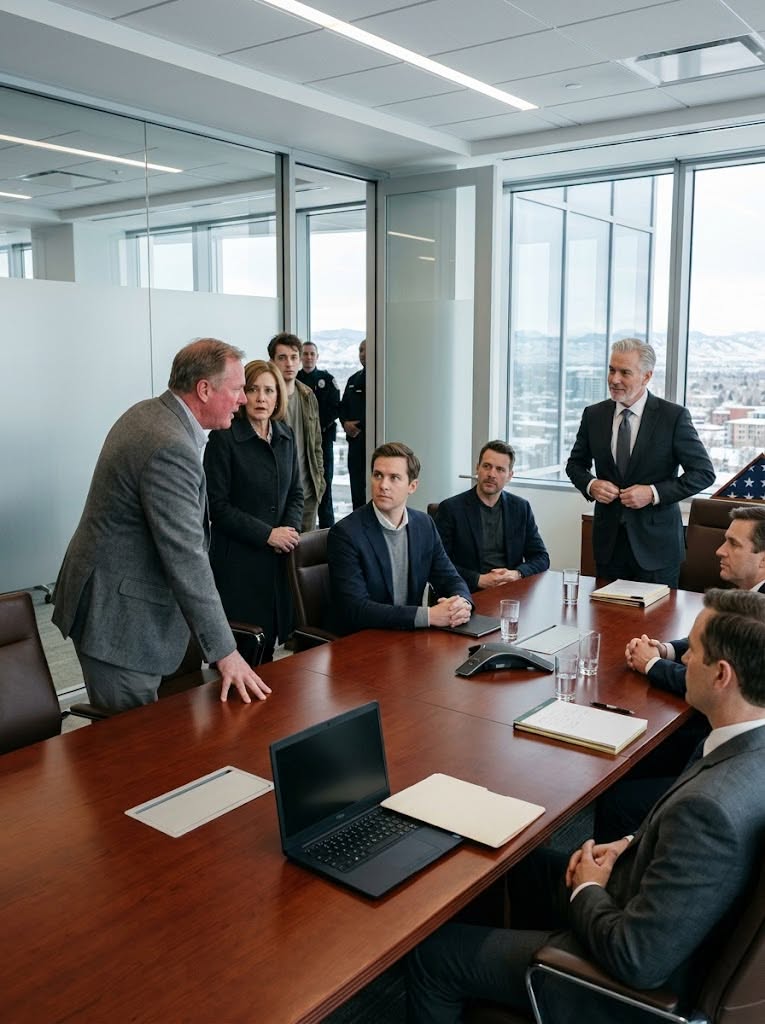
Two weeks later, Sterling Holdings held an emergency board meeting. Abigail had been notified because my employment and benefits were now part of a pending legal matter. Margaret’s foundation had also been asked for documents related to the emergency transfusion response.
“We do not attend,” Abigail said.
“No,” Margaret said. “We send the truth and let it arrive on time.”
At 10:03 that morning, the board received a packet. It contained the transfer timeline, the emails, the donation records, and a forensic report showing Riley had accessed Sterling’s internal files after the investigation began. She had downloaded client lists, then attempted to frame a departing finance manager for the leak.
Self-preservation makes amateurs of most people.
Riley was arrested that afternoon on charges related to data theft and evidence tampering. Carter was not arrested that day, but by evening, Sterling’s largest lender froze a credit line. Two shipping clients suspended contracts. The board placed Carter on leave pending investigation.
The press found the story forty-eight hours later.
Major donor linked to rare-blood transfer scandal.
Pregnant employee alleges benefits manipulation after emergency surgery.
Sterling Holdings board opens internal probe.
Carter had built his image on precision, loyalty, and control. Watching that image unravel publicly did not bring me the pleasure I expected. It brought relief, which is quieter and lasts longer.
Margaret died in her sleep at the end of November.
She had told me it was coming. She had liver cancer that had spread too far, and she hated euphemisms almost as much as she hated incompetent hospital administrators.
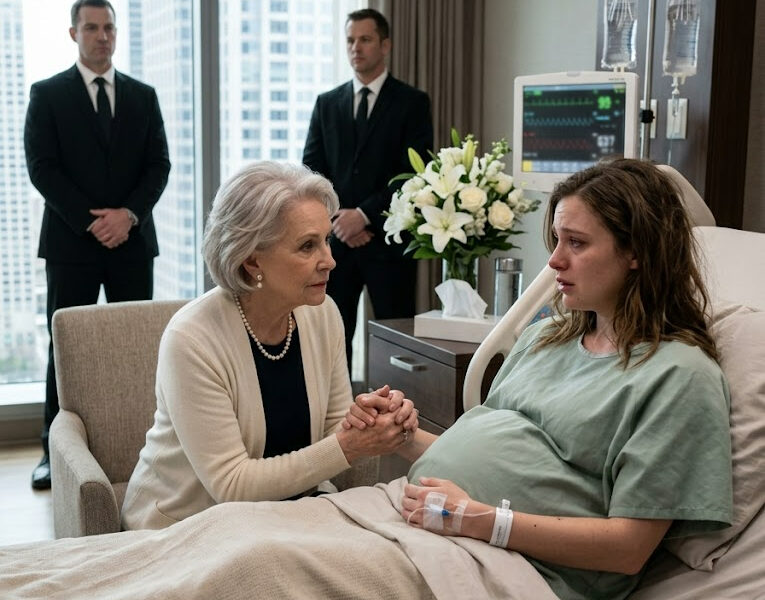
The day before she died, she asked Julian to wheel her into my room. By then, I had been discharged from acute care but remained in a supervised maternity suite because Sweet Pea and I were still considered high-risk.
Margaret looked thinner than paper.
“I changed my will,” she said.
“You shouldn’t have.”
“That is not an argument. That is manners.”
I blinked back tears.
“The foundation needs a chair who knows what it feels like to be treated as less important than a phone call,” she continued. “You will not run it alone. Julian will remain executive director. Abigail will stay counsel. You will learn.”
“Margaret…”
“Don’t waste my final strength protesting a gift.”
So I did not.
She placed one cool hand over mine.
“When you see him again,” she said, “do not perform mercy for an audience. Decide what is true and say that.”
Three days after her funeral, Carter requested a settlement conference at the federal courthouse.
This time, I agreed to see him.
Carter looked smaller in the courthouse hallway.
He was still handsome. Men like him usually remain handsome long after they stop being impressive. His suit was expensive, his shoes polished, his hair combed carefully into place. But the force around him was gone. No assistants trailed behind him. No board members waited for his signal. No one rushed to open a door.
He stood alone outside the mediation room, holding a legal pad he probably had not written on himself.
Part 5
“Harper,” he said.
I stopped several feet away. Abigail stood to my right. Julian stood to my left. For once, Carter had to look at me without being the most powerful person in the hallway.
“You asked to speak,” I said.
His eyes moved to my stomach. “How is the baby?”
“You don’t get to use that tone now.”
He flinched.
Good.
“I made mistakes,” he said.
“No. You made decisions.”
He swallowed. “I thought Riley was in danger.”
“You knew she was stable.”
“I was told there was risk.”
“There was risk in both places. You chose the woman whose fear mattered to you.”
His face tightened, and for a moment I saw the old Carter, offended by accountability. Then it vanished. His lawyers must have warned him that anger would be expensive.
“The board is forcing my resignation,” he said. “The federal investigation is going to ruin me. Riley is cooperating. She’s saying I directed everything.”
“Did you?”
He looked away.
That was enough.
“I need you to understand something,” he said, voice cracking. “I never thought you would actually die.”
The sentence landed with no drama at all. Just a dull finality.
“Because I was useful?”
“Because you were strong.”
I almost laughed. “That is what weak people say when they want permission to keep taking.”
He closed his eyes.
“I saw the insurance claim last year,” he said. “After the miscarriage.”
The hallway narrowed.
My miscarriage had happened before anyone except me knew I was pregnant. Seven weeks. A hotel bathroom in Boston during a Sterling conference. I signed my own discharge papers because Carter was hosting investors and I could not reach him. When I came home, I tried to tell him, but he was on the phone with Riley, calming her through what he called a panic spiral.
I never brought it up again.
“You knew?” I asked.
His silence confirmed it before his words did.
“I didn’t know what to say.”
There it was. The man who could negotiate a three-hundred-million-dollar acquisition could not find one sentence for his grieving wife, so he chose none and called it helplessness.
Something inside me went quiet.
Not numb. Clear.
“Here is the settlement,” I said. Abigail handed him the document. “You resign from Sterling permanently. You cooperate with every medical and financial investigation. You waive any claim to my medical decisions, my residence, and this child until a family court determines otherwise. You repay the benefits you manipulated and the maternity leave funds you withheld. In exchange, I do not pursue additional civil claims beyond what is already filed.”
He stared at the pages.
“You’d keep my daughter from me?”
“I am keeping her alive long enough to decide what kind of father you are allowed to become.”
His hands shook.
“Harper, please.”
“No.”
The word felt clean.
We did not settle that day, but two weeks later he signed a version close enough to count. Sterling removed him. Riley cooperated with prosecutors. St. Luke’s replaced two administrators. The blood-transfer case became mandatory training in three hospital systems.
Sweet Pea was born at thirty-seven weeks by scheduled delivery in a room staffed by people who knew exactly who she was and why her blood type mattered.
I named her Margaret.
Not because the old woman saved us, though she had. I named her Margaret because the name meant that my daughter would begin life attached to a story of intervention, not abandonment.
Months later, Sinclair Foundation bought the bankrupt Sterling tower at auction for far less than Carter once claimed it was worth. The board asked what I wanted done with it.
I stood in the empty lobby with baby Margaret asleep against my chest. The marble floors still reflected the ghost of Carter’s empire. I remembered walking through those doors as his wife and employee, carrying coffee, reports, and hopes too small for the rooms he occupied.
“Tear out the executive floors,” I said. “All of them.”
Julian nodded. “And replace them with?”
“A high-risk maternity center. Rare-blood registry access on site. Emergency transport coordination. Legal advocates for patients whose care is being influenced by money.”
He smiled slightly. “Margaret would approve.”
“She’d complain about the timeline first.”
For the first time in months, I laughed.
In the new lobby, we hung Margaret Sinclair’s portrait. Burgundy suit. White hair. Eyes sharp enough to make donors nervous. Beneath it, a brass plaque read:
No patient is expendable.
On opening day, I carried my daughter past that plaque. She was awake, dark-eyed and serious, one tiny fist curled against my collar.
I thought of Carter telling me to bear with it.
I thought of the unit he stole.
I thought of an old woman behind a hospital curtain asking the only question that mattered.
Do you want to live?
I had answered yes then.
Every day after, I made sure the answer kept meaning something.
THE END
Disclaimer: This content is entirely AI-generated for fictional and entertainment purposes only. Any resemblance to actual persons, living or dead, events, or locations is purely coincidental, and the creator assumes no liability for any interpretation of this content.
Disclaimer: This story is fictional and created for entertainment purposes only. Any names, characters, places, or events are fictitious or used fictitiously. No real person or organization is intended to be portrayed.