cnu At 3:00 A.M., My Husband Collapsed in Another Woman’s Apartment and His Parents Begged Me to Approve Emergency Open-Heart Surgery—But One Look at His Bloodwork Told Me the Diagnosis Was Wrong. Then His “Coworker” Demanded to Know What Right I Had to Stop the Operation… Until I Revealed I Was the Senior Cardiologist Who Might Be the Only Person Able to Save Him.
My Husband Collapsed in His Coworker’s Apartment at 3 A.M.
Part 1
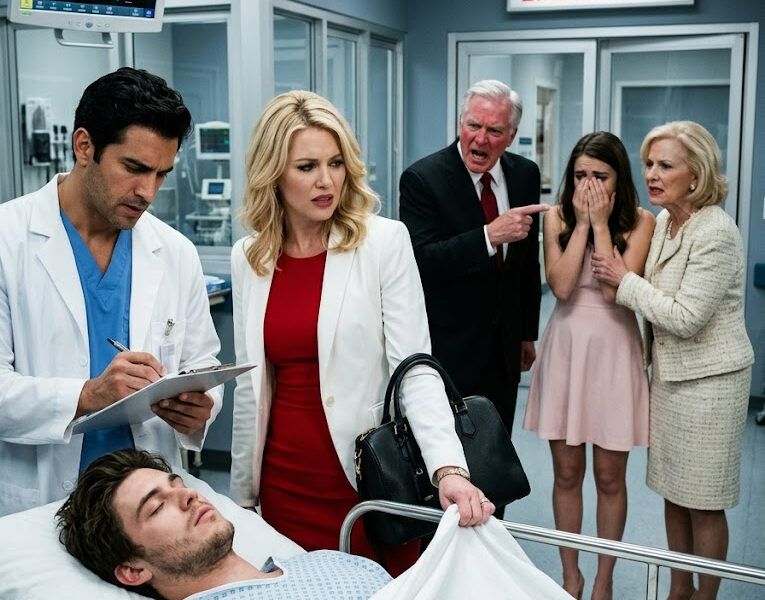
At 3:17 in the morning, a nurse pushed an emergency surgical-consent form into my hands while my husband’s mistress stood twenty feet away wearing a trench coat over silk sleepwear.
“Mrs. Miller, we need an answer,” the nurse said. “The surgical team is preparing now.”
The paper shook, though my hands did not.
Possible acute aortic dissection. Possible pericardial blood. Emergency repair if confirmed.
Beyond the trauma-bay doors, Jason lay beneath an oxygen mask while alarms rose and fell around him. He was thirty-two years old, gray-faced and barely conscious. My mother-in-law clung to my arm. My father-in-law stood beside her in pajama pants and a winter coat.
“Sign it, Sarah,” he demanded. “Whatever else happened tonight can wait.”
Whatever else happened was named Emily Davis.
She had joined Jason’s technology firm three months earlier as a project manager. At 2:41 a.m., she had called from her private apartment to say Jason had collapsed. She claimed they had been finishing a presentation.
Jason was wearing sweatpants, a T-shirt, and no shoes when the paramedics found him.
Emily wore an expensive beige coat over pale silk pajamas. Her hair was damp, and one earring was missing.
I looked back at the consent form.
If Jason truly had a tear in his ascending aorta, every minute mattered. Refusing surgery out of anger would be unforgivable. Signing without understanding the evidence would be equally reckless.
“What imaging has been completed?” I asked.
The nurse blinked. “Portable chest film and a bedside ultrasound. The resident saw a possible flap and fluid around the heart. Cardiothoracic surgery is coming down.”
“Was the ultrasound reviewed by an attending?”
“Not yet.”
“Where is his ECG?”
She handed me the printout clipped behind the consent.
The tracing showed frequent premature ventricular beats, a prolonged repolarization pattern, and waves suggesting severe potassium depletion. I turned to the laboratory page. Potassium 2.6. Sodium 154. Creatinine sharply above Jason’s baseline. His blood gas showed metabolic alkalosis.
Those numbers did not rule out a dissection. But they offered another immediate explanation for his collapse—one made more dangerous by anesthesia and a rushed operation.
I set the pen down.
My mother-in-law cried out. “How can you hesitate?”
“I’m not refusing lifesaving treatment. I’m asking the attending surgeon to confirm which treatment will save him.”
My father-in-law’s face hardened. “This is not the time for you to play doctor.”
He knew exactly what I was. For years, he and his wife had treated my career as an inconvenient hobby that delayed grandchildren.
“Tonight is precisely the time,” I said.
Emily stepped forward. “The emergency doctors know more than you do about what happened.”
I looked at her. “And what did happen?”
“He complained of chest pressure and passed out.”
“Before or after he vomited?”
Her expression changed.
The paramedic report mentioned vomit on the bathroom floor. Emily had omitted it when she called me.
“I don’t remember,” she said.
“Did he have diarrhea? Muscle cramps? Excessive thirst?”
“Why would I know?”
“Because he was in your apartment after midnight without shoes.”
Her face drained of color.
My father-in-law reached for the pen. “Enough. Sarah, sign.”
“Not until the surgeon reviews the ECG, laboratory results, and ultrasound together.”
Emily’s fear turned into contempt. “You’re his wife, not a doctor.”
“I’m both. Dr. Sarah Collins, attending cardiologist and electrophysiologist on staff in this hospital.”
The corridor went silent.
Jason had told his colleagues I worked as an independent medical consultant. He said my actual title made him feel as though people measured his career against mine. I had agreed to the smaller description because marriage teaches women many ways to mistake accommodation for love.
The trauma doors opened. Dr. Nikhil Aris, the on-call cardiothoracic surgeon, hurried toward us. He knew me immediately.
“Sarah? Is Jason the patient?”
I handed him the tracing and labs. “I’m his spouse, so I should not direct his care. But the current findings support a profound electrolyte disturbance and malignant ventricular irritability. The possible dissection still needs urgent exclusion by an attending-level study before anyone opens his chest.”
Dr. Aris scanned the pages, then turned to the team. “Pause transport to the operating room. Get cardiology and anesthesia here. Repeat the focused echo and prepare for an urgent transesophageal study if the images remain unclear. Start controlled electrolyte correction and continuous monitoring.”
Nobody argued.
Then Jason’s monitor erupted into a rapid alarm.
A nurse shouted that he had gone into a run of ventricular tachycardia.
As the team rushed through the doors, I turned to Emily.
“What did he take tonight?”
She clutched her purse against her chest.
Then she whispered, “I gave him two more capsules.”
Part 2
The trauma-bay doors closed between us.
For ninety seconds, I was not a betrayed wife. I was a cardiologist listening to a resuscitation I was ethically forbidden to lead.
The distinction nearly tore me in half.
Jason’s rhythm corrected before a shock became necessary. An independent cardiology attending, Dr. Lena Patel, took control. Potassium and fluid replacement began under continuous telemetry while the team checked magnesium, toxicology, kidney function, and serial blood gases.
Dr. Aris repeated the bedside ultrasound himself. The supposed flap disappeared when he changed the probe angle. A transesophageal echocardiogram then showed no aortic tear and only a small, noncompressive effusion.
The operating room was canceled.
Jason remained critically ill, but his chest would not be opened for a disease he did not have.
Dr. Patel came into the hallway. “You saw the pattern quickly.”
“He is my husband.”
“Which is why you are not managing him. I’ll update you as family, not as the treating physician.”
I thanked her. That boundary protected Jason and me, even if my in-laws did not understand it.
They had always known my profession. They simply respected it only when it benefited their son. During fellowship, my mother-in-law complained that hospital nights made me neglect my marriage. When Mia was born, my father-in-law asked whether I could choose an easier specialty.
Now they looked at me as though the title they had minimized for years had suddenly become a family inheritance they were entitled to use.
Fear had finally granted my work the dignity their love had withheld.
My mother-in-law collapsed into a chair. “So Sarah saved him?”
“The team saved him,” I said. “I made sure they considered the whole picture.”
Emily still held her purse.
“Give the capsules to the toxicology team,” I told her.
“They’re only supplements.”
“Then you have nothing to fear from testing.”
She did not move.
Hospital security arrived after Dr. Patel requested the product involved in a suspected poisoning. Emily finally removed a silver pouch with no pharmacy label. The printing promised rapid fat loss, appetite suppression, and clean energy.
“Where did you buy these?” a toxicology fellow asked.
“Online.”
“From a licensed pharmacy?”
Emily looked down.
My father-in-law began pacing. “Why would Jason take weight-loss pills? He isn’t overweight.”
I knew why before Jason spoke. For two years he had compared himself to younger executives at his company—men who slept four hours, trained before dawn, and treated exhaustion like proof of ambition. Emily had apparently offered him a shortcut.
But the capsules explained only how his body had failed. They did not explain why he was in her bedroom.
“When did he arrive at your apartment?” I asked.
“Around eleven.”
“He told me he was staying at the office.”
Emily tightened her coat. “We were working.”
“For nearly four hours?”
“The deadline is Monday.”
“Why did you wait before calling 911?”
She looked startled. Jason’s smartwatch was linked to our family health account. It recorded a fall at 2:23 a.m. The emergency call had been placed seventeen minutes later.
“I panicked,” she said.
“Or you were hiding something.”
My mother-in-law stepped between us. “Sarah, he is alive. Do not create another disaster tonight.”
“I did not create this one.”
At 5:10, Jason was transferred to the cardiac intensive care unit. His rhythm had steadied, but his potassium remained dangerously low and his kidneys showed injury from dehydration.
Dr. Patel allowed me into his room after reminding me again that I was there as his wife.
Jason opened his eyes when I approached. Panic arrived before recognition.
“Sarah.”
“Do not waste energy explaining yet.”
“Emily called you?”
“Eventually.”
His eyes closed.
The toxicology fellow entered holding a preliminary screening report. The capsules contained an undeclared prescription-strength diuretic combined with a stimulant. Together with poor fluid intake and repeated dosing, they offered a coherent explanation for Jason’s electrolyte loss, dehydration, arrhythmia, and kidney injury.
“We have to notify poison control and the appropriate regulators,” the fellow said.
Outside the glass wall, Emily saw the report in his hand.
She turned and ran toward the elevators.
Jason watched her leave.
Then he looked at me and said the first honest words of the night.
“She wasn’t just my coworker.”
Part 3
I pulled a chair beside Jason’s bed but did not sit close enough to touch him.
“How long?”
“Two months.”
His voice was weak, yet every word landed cleanly.
The relationship had begun during late work sessions. First came private messages, then drinks, then hotel lunches disguised as client meetings. Jason insisted he had gone to Emily’s apartment that night only to end the affair and retrieve the remaining capsules.
I did not ask whether he expected me to believe that final detail. The answer no longer mattered.
“Why the pills?”
“Emily said executives at her old company used them before conferences. I’d gained weight after Mia was born. I was tired all the time.”
“You were tired because we have an eighteen-month-old child and you were conducting an affair after work.”
He turned his face toward the window.
His parents stood near the door. My mother-in-law whispered that people made mistakes. My father-in-law asked whether this conversation could wait until Jason recovered.
“His body needs rest,” I said. “The truth does not require him to stand.”
Jason began crying.
“You never needed me,” he said. “You walk into a room and everyone listens. At home, you handled the baby, your fellowship, everything. I felt useless beside you.”
“So you made me smaller at your office.”
He flinched.
Jason had asked me not to attend company events in my white coat, which was reasonable. Then he asked me not to mention Hopkins or Mayo. Eventually, he introduced me as a consultant without saying I practiced medicine. I had watched my work disappear one careful word at a time and called it supporting my husband.
Emily knew me only as a woman who did occasional contract work from home.
“Did belittling me make you feel taller?” I asked.
“No.”
“Did the affair?”
He covered his eyes.
Dr. Patel entered before his heart rate climbed too far. She ended the conversation, adjusted his treatment, and firmly told his parents that emotional stress could wait.
I respected her order and left the room.
Emily was sitting in the family lounge. Security had stopped her before she reached the elevators because the toxicology team needed purchase information. Her coat was folded beside her now. Without it, she looked younger and far less certain.
“He told me you were separated,” she said.
“Did you believe him?”
“At first.”
“And later?”
She stared at her hands. “Later I stopped asking.”
That was the closest thing to honesty she could offer.
Emily admitted she had bought the capsules through a social-media seller. She had taken them intermittently for months without obvious consequences. Jason wanted faster results, so he doubled the suggested amount. That evening, after vomiting and cramping, he swallowed two more because he believed he had expelled the first dose.
“I told him not to,” she said.
“But you waited seventeen minutes to call for help.”
Her face collapsed. “I was hiding his clothes. There were photographs. I thought if paramedics saw—”
“You protected the affair while his heart was failing.”
She began to cry.
I felt no triumph. She had not stolen a faithful husband. Jason had walked toward her carrying every lie himself.
Her tears made her frightened, not innocent. My anger could hold that distinction without turning her into the sole author of my pain.
The company’s compliance department would later investigate their supervisor-subordinate relationship. Regulators would investigate the pills. Those consequences did not require my help.
At sunrise, I returned to Jason’s room. His potassium was climbing, his rhythm was calmer, and the immediate danger had passed.
“Am I going to recover?” he asked.
“Dr. Patel believes so, if your kidney function continues improving and no further rhythm problems appear.”
“And us?”
I looked at the man I had loved for seven years—the father of my child, frightened and alive because a roomful of strangers had done their jobs.
“I fought for the correct diagnosis because your life has value,” I said. “Do not confuse that with our marriage surviving.”
His mother gasped.
I removed my wedding ring and placed it inside my purse.
“I’m going home to Mia. Your doctors will care for you now.”
Then I walked out while Jason called my name behind me.
Part 4
The moment I stepped into our apartment, Mia ran toward me in footed pajamas.
Our nanny had stayed overnight after my mother-in-law called her. Mia raised both arms, and I lifted her against my chest. She smelled like baby shampoo, warm milk, and the life I had almost forgotten existed beyond hospital walls.
“Dada?” she asked.
“Daddy is sick, but the doctors are helping him.”
She accepted that answer and rested her head on my shoulder.
I did not sleep. I fed Mia breakfast, changed her clothes, and called a family-law attorney recommended by a colleague. I did not empty accounts, change locks, or use Jason’s illness as leverage. I documented what had happened, protected shared funds from unusual transfers, and asked for a temporary parenting plan that prioritized Mia’s stability while Jason recovered.
Anger wanted spectacle. Motherhood required paperwork.
Jason spent seven days in the hospital. His kidney function returned close to baseline, and his electrolytes stabilized. Further testing found no adrenal disease or structural heart problem. The final diagnosis was severe dehydration and potassium depletion caused by repeated exposure to an adulterated weight-loss product.
I did not treat him. Dr. Patel did.
On discharge day, Jason expected me to drive him home. I did, because his parents were too shaken and he was still weak.
For two blocks, neither of us spoke.
“I blocked Emily,” he finally said. “I reported everything to compliance. I’ve started looking for a therapist.”
“Good.”
“Is that all you can say?”
“What response are you hoping for?”
“Something that means I haven’t lost everything.”
I pulled into our building’s parking area and turned off the engine.
“You nearly died because you trusted an unregulated pill, ignored your symptoms, and swallowed more after becoming sick. You lied about where you were, hid my profession because it threatened your pride, and had an affair with someone you supervised. Which part of that should I reassure you about?”
His eyes filled.
“I was insecure.”
“Insecurity explains why you sought validation. It does not explain months of decisions made at my expense.”
He looked toward our windows. “Can I see Mia?”
“Yes. You are her father. But you will stay with your parents while we establish a safe schedule. You are still recovering, and I will not have those capsules or their seller anywhere near our child.”
Jason nodded.
Upstairs, Mia squealed when she saw him. Jason knelt too quickly, became dizzy, and caught himself against the wall. I moved forward by instinct, then stopped when he steadied.
He held our daughter and cried into her hair.
My in-laws arrived an hour later. For once, my mother-in-law did not criticize the nanny, my work schedule, or the absence of a home-cooked meal.
“We failed you,” she said. “We knew he was unhappy about your success. His father told him a man should never feel second in his own home. We thought it would motivate him.”
My father-in-law stared at the floor.
“It taught him that marriage was a ranking,” I said.
He nodded. “I was wrong.”
Their apology did not erase years of contempt, but I accepted the truth inside it.
Before leaving, my father-in-law asked whether I intended to keep Mia from their family. I told him no—provided they never taught her that a woman’s success threatened the men who loved her.
He looked toward Jason, then promised he would not repeat that mistake with his granddaughter.
Two days later, the temporary custody agreement was filed. Jason could see Mia regularly, initially with his parents present until his strength returned and toxicology follow-up was complete. I requested no punishment beyond what safety required.
The company placed both Jason and Emily on administrative leave. I did not contact their employer. Jason’s ambulance report and his own disclosure had triggered the process.
One evening, he came to collect clothes. He paused beside a framed photograph from our wedding.
“You saved my life,” he said. “Does that mean none of what we had matters?”
“It matters,” I replied. “That is why the betrayal hurts.”
I handed him the divorce petition.
His fingers shook as badly as they had in the hospital parking lot.
This time, no dangerous electrolyte level was responsible.
Part 5
Our divorce became final ten months later.
There was no courtroom spectacle. We used mediation, divided property, and built a parenting schedule around Mia rather than our anger. Jason completed medical follow-up, entered therapy, and stopped asking me to transform regret into reconciliation.
Consequences arrived without my assistance.
The company confirmed that he had concealed a relationship with a direct report and misrepresented late-night expenses. Emily resigned during the investigation. Jason lost his management position but remained employed in a non-supervisory role after accepting responsibility.
Laboratory testing found that the imported capsules contained undeclared prescription ingredients. Poison control documented the case, federal regulators issued a warning tied to the seller, and the website eventually disappeared. Another one appeared under a different name weeks later, which was a sobering reminder that accountability rarely ends a market built on desperation.
At Chicago Medical Center, Dr. Patel used Jason’s case—stripped of identifying details—during a quality review. The emergency department strengthened its process for reconciling bedside imaging with ECG findings, laboratory abnormalities, and attending review before major interventions when the diagnosis remained uncertain.
Nobody claimed the first team had been foolish. Emergency medicine is full of incomplete information, and aortic dissection is too deadly to dismiss casually. The lesson was simpler: urgency should sharpen thinking, not end it.
I returned to work without minimizing who I was.
For years, I had let Jason’s discomfort determine how brightly I stood in public. After the divorce, I stopped apologizing when someone introduced me by my correct title. My success had never diminished him. His decision to measure himself against it had.
Jason gradually became a better father than he had been a husband.
He learned Mia’s bedtime routine, attended pediatric appointments, and never missed his scheduled weekends. Therapy did not transform him overnight. It made him more honest about the moments when shame tempted him to lie.
One year after the hospital night, he arrived at my apartment to pick up Mia for the zoo. He looked healthier than before—neither thin nor sculpted, simply rested.
Mia ran toward him carrying a stuffed elephant.
“Dada!”
He lifted her, then looked at me over her shoulder.
“My potassium was normal again yesterday,” he said.
“Good.”
“I still think about that night.”
“So do I.”
He shifted Mia onto his other hip. “If you had signed immediately…”
“The surgical team would still have reassessed before operating. I did not single-handedly rescue you from reckless doctors, Jason. I noticed evidence, spoke clearly, and a good team listened.”
He nodded. “You always correct the story.”
“The correct story is usually less flattering to everyone.”
He almost smiled.
Then his expression became serious. “You saved my life anyway.”
“I protected it. What you did with the life afterward was your responsibility.”
He looked at Mia, who was trying to place the elephant on his head.
“I’m trying to make it worth protecting.”
“Keep trying.”
After they left, I stood at the window and watched them cross the courtyard. The sight no longer filled me with rage or longing. It filled me with something quieter: relief that Mia could love her father without requiring me to remain his wife.
That night had divided my life with extraordinary clarity.
Before it, I believed loyalty meant absorbing humiliation, softening my achievements, and protecting a husband from the consequences of his insecurity.
After it, I understood that compassion and boundaries could exist together.
I could insist that Jason receive the right medical care without signing away the rest of my life to him. I could acknowledge Emily’s fear without excusing the delay that endangered him. I could accept my in-laws’ apology without inviting their contempt back into my home.
Most importantly, I could save a man’s heart and still refuse to let him break mine again.
The monitor alarms eventually stopped. The laboratory numbers returned to normal. Jason’s kidneys healed, and the color came back to his face.
Our marriage did not recover.
Some endings are not failures of treatment.
They are the moment a woman finally stops confusing survival with reconciliation.
THE END
Disclaimer: This content is entirely AI-generated for fictional and entertainment purposes only. Any resemblance to actual persons, living or dead, events, or locations is purely coincidental, and the creator assumes no liability for any interpretation of this content.
Disclaimer: This story is fictional and created for entertainment purposes only. Any names, characters, places, or events are fictitious or used fictitiously. No real person or organization is intended to be portrayed.

