cnu Five Minutes Before My Wedding, My Five-Year-Old Daughter Pulled Our Missing “MOM + ME” Bracelet From a Secret Pocket in Her Stuffed Bunny—and Told Me My Fiancé Said We Wouldn’t Need It Once He Became My “Real Family.” So I Walked Down the Aisle Beside Her… and Stopped Before I Ever Said “I Do.”
Five Minutes Before My Wedding, My Daughter Showed Me the Truth
Part 1
Five minutes before I was supposed to marry Matthew, my nine-year-old daughter locked the bridal-room door and asked me to look inside her stuffed rabbit.
“Please, Mommy,” Emma whispered. “Before you become his wife.”
Nearly two hundred guests waited in the church beyond us. The organist had begun the prelude, my father was standing in the hallway, and my wedding coordinator had already reminded me twice that the photographer needed us on schedule.
None of that mattered when I saw Emma’s face.
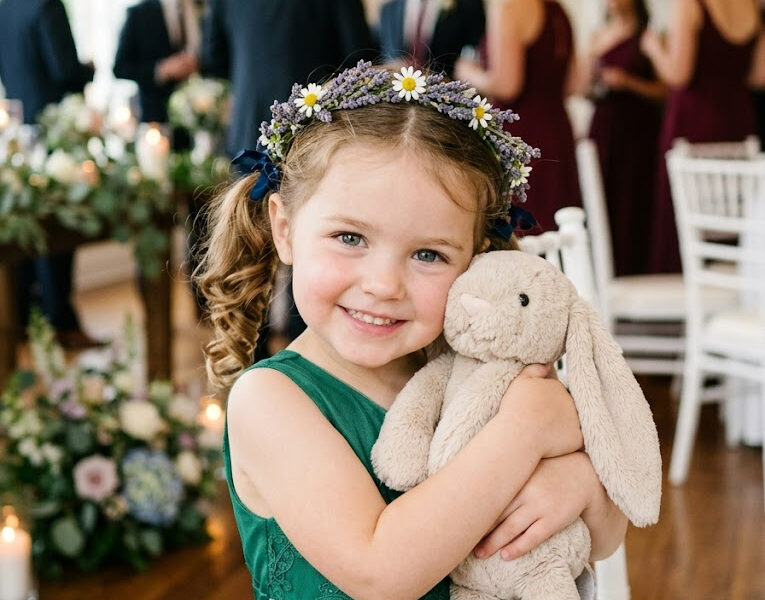
Her flower crown sat crooked over one ear. She held Bunny, the faded gray rabbit she had slept with since she was three, so tightly that its cloth body folded beneath her fingers.
I knelt carefully, gathering my white dress around me.
“What’s wrong?”
She glanced at the locked door. “You won’t be mad?”
“Not for telling me the truth.”
Emma turned Bunny over and loosened the worn blue ribbon around his neck. Beneath it was a crooked opening sewn into the seam with yellow thread.
“I made him a pocket,” she said.
I slipped two fingers inside and touched hard plastic beads.
The bracelet I pulled out was cheap, childish, and more valuable to me than the diamond band waiting at the altar.
Pink, yellow, and blue beads spelled two words across the center.
MOM + ME.
Emma had made matching bracelets in preschool when she was four. For five years, we had worn them every Saturday morning before making pancakes together. Mine was too large. Hers barely fit around her small wrist now. They had disappeared three months earlier, and Emma had told me we no longer needed them.
“Why did you hide this?” I asked.
Her eyes filled. “Matthew said big girls shouldn’t wear baby bracelets.”
I tried to keep my voice calm. “When did he say that?”
“When you were talking to the cake lady. He said things would be different after the wedding.”
The room seemed to narrow around us.
“Different how?”
Emma rubbed Bunny’s ear against her cheek. “You and Matthew would be the real family. Then, if you had another baby, I would need to stop acting like I was the only child who mattered.”
My stomach turned.
“Did he say I would love you less?”
“Not exactly.”
“Did he threaten you or touch you in a way that frightened you?”
She shook her head quickly. “No. He never did anything like that.”
“Then tell me exactly what he did say.”
Emma stared at the floor.
“He said families have an order. Husbands and wives come first because children grow up and leave. He said our Saturdays were making me too dependent on you. He said after the honeymoon he might sign me up for Saturday activities so you and him could have couple time.”
Every strange change I had noticed during the past year rushed back at once.
Emma moving away when Matthew joined us on the couch.
Emma apologizing for asking me to read at bedtime.
Emma refusing pancakes she had once begged to help make.
Emma asking whether I would be happier if she could do everything by herself.
I had praised her for becoming mature.
In reality, my child had been practicing how to need me less because the man I loved had taught her that love came with limited seating.
“Why didn’t you tell me sooner?” I asked, already ashamed of the question.
“You were so happy.”
Those four words hurt more than anything Matthew could have said.
At nine years old, Emma had believed my happiness depended on her silence.
Someone knocked at the door.
“Two minutes, Hilda,” the coordinator called.
I fastened the plastic bracelet around my wrist beside the delicate gold jewelry chosen to match my dress. It looked ridiculous.
It also felt like the first honest thing I had worn all day.
“Listen to me,” I told Emma. “You did nothing wrong. You did not ruin anything. And nobody I marry will ever ask you to disappear so he can feel important.”
“Are you still marrying him?”
I looked toward the door.
I thought about confronting Matthew privately and postponing the ceremony. I thought about the deposits, the guests, my parents, and the humiliation of walking away from a future everyone had already celebrated.
Then I looked at my daughter, waiting to learn whether speaking the truth would cost her my protection.
I took her hand.
“We’re going to find out whether he understands what he did.”
When the church doors opened, every guest rose.
Matthew smiled from the altar.
Then he saw the plastic bracelet on my wrist, Emma walking beside me instead of behind me—and the smile vanished from his face.
Part 2
For five years, Saturday mornings had belonged only to Emma and me.
No errands. No laundry. No phones unless there was an emergency. We made pancakes shaped like animals, states, and objects no reasonable person could identify. Emma once declared a burned oval to be Abraham Lincoln and ate him with whipped cream.
The bracelets always came first.
“So everyone knows we’re each other’s favorite,” she had explained at four.
I never told her favorites could be dangerous language. After her biological father left when she was two, she needed certainty more than precision. I needed it too.
Matthew entered our lives when Emma was seven.
He seemed patient in all the ways I had trained myself to notice. He did not demand affection from her. He attended school performances, remembered she hated tomatoes, and knelt when speaking to her so she never had to stare up at an adult.
My family adored him. My father, who distrusted charming men on principle, told me I had found someone steady.
I believed him.
Yet Emma changed whenever Matthew entered a room.
When we were alone, she talked until she forgot to breathe. Around him, she became careful. If she was curled against me on the couch, she moved when he sat down. If she interrupted us, she apologized before I corrected her.
Matthew called it progress.
“She’s learning boundaries,” he said.
At a family dinner, Emma once pulled a chair between Matthew and me. He smiled, moved it to the other side of the table, and told her grown-ups needed to sit together sometimes. Everyone laughed because the moment looked harmless. Emma laughed too, but she ate almost nothing and held my hand beneath the table.
Later, Matthew said she had deliberately interrupted our connection.
I reminded him she was eight.
He answered, “Eight is old enough to learn she isn’t the center of every room.”
I should have heard the warning in the certainty of his voice.
I told myself he was right. Children resisted change, and I wanted so badly to believe we were becoming a family that I treated every warning as an adjustment problem.
One evening, Matthew stepped outside for a work call. Emma immediately climbed into my lap.
“Please don’t leave me alone with him.”
My whole body went still.
I asked whether he had touched, threatened, or frightened her. She said no to each question.
“He acts mean,” she finally whispered.
“How?”
“He makes me feel like I’m in the way.”
That night I confronted Matthew.
He looked honestly shocked. Then wounded.
“I would never hurt her, Hilda. I’ve been encouraging independence. She’s nine, not four. She can’t climb into your bed whenever she has a bad dream or expect every Saturday to revolve around pancakes.”
His explanation sounded reasonable because he hid the cruel part inside sensible words.
Children did need independence. Couples did need time. But those decisions belonged in conversations between adults—not in private lessons that made a child afraid of being replaced.
I did not understand that distinction then.
I stopped leaving them alone, but I did not stop the wedding.
Instead, the wedding began swallowing everything. Saturdays became dress appointments, cake tastings, invitation meetings, and calls with vendors. Matthew said he loved how involved Emma was, though he usually gave her tasks that kept her away from me.
“You’re the flower girl,” he would say. “That’s your special role.”
I mistook being assigned a role for being given a place.
When our bracelets disappeared, I asked Emma where they were.
“We don’t need them anymore,” she said.
The florist called before I could ask why.
That interruption haunted me as Emma and I walked down the aisle.
Matthew knew what the bracelet meant. I saw recognition flash across his face before he composed himself.
The minister smiled, uncertain whether our altered entrance was a sentimental surprise.
My father reached for my elbow as I approached.
“Are you all right?” he whispered.
“Stay close,” I said.
The music faded. Guests sat. Matthew extended his hand.
I did not take it.
Instead, I positioned Emma between us and raised my wrist.
“Before we make any promises,” I said, “Matthew needs to explain why my daughter believed this wedding meant she was losing her mother.”
Part 3
Silence moved through the church like a sudden draft.
Matthew stared at me, then at Emma.
“Hilda, this isn’t the place.”
“You chose places where I couldn’t hear you. I’m choosing one where Emma knows she will be heard.”
His mother shifted sharply in the front pew. My own mother whispered my name in warning, but my father remained beside me.
I held up the bracelet.
“Did you tell Emma we wouldn’t need these after today?”
Matthew glanced toward the guests. “I told her she would outgrow childish routines.”
“Did you say you and I would become the real family?”
His jaw tightened. “That’s not how I phrased it.”
Emma’s fingers closed around mine.
“How did you phrase it?” I asked.
He exhaled through his nose. “I said marriage creates a new family unit. That is true.”
“We already had a family unit.”
“And I was joining it, but there has to be room for our marriage.” His voice softened, as if calmness made his words kind. “Emma has been the center of your life for years. That isn’t healthy forever. She needs friends, activities, sleepovers—things that don’t involve you.”
“Those things should help her grow. You used them to convince her she was being moved aside.”
“I did not convince her of anything. She misunderstood an adult conversation.”
“She was the child in that conversation. Making sure she understood was your responsibility.”
Matthew looked at Emma. “I am sorry your feelings were hurt.”
It was the kind of apology that blamed the injured person for bleeding.
Emma lowered her head.
I felt something in me become quiet and final.
“Tell me about the Saturday activities,” I said.
His eyes shifted back to mine.
“What activities?”
“The ones you planned after our honeymoon.”
“I researched art programs and a soccer league. You said she needed more confidence.”
“Did you ask me before telling her our Saturdays were ending?”
“I was trying to solve a problem.”
“My relationship with my daughter was not your problem to solve.”
For the first time, his control cracked.
“What about my relationship with you?” he demanded. “Where was I supposed to fit? Every nightmare, every school project, every Saturday—Emma always came first.”
Several guests looked away.
There it was. Not cruelty exactly. Resentment.
Matthew had been kind when kindness made him welcome. Once welcomed, he wanted the structure changed. He did not want to harm my daughter; he wanted her reduced to a size that felt convenient.
I removed my engagement ring.
“Emma does not come first in every decision,” I said. “But her safety comes before your comfort. And anyone becoming her stepfather must understand the difference.”
“You’re canceling our marriage over a bracelet?”
“No. I’m canceling it because you spent months teaching my child that love is a competition, then blamed her for misunderstanding.”
I placed the ring in his palm and closed his fingers around it.
The minister stepped back. Matthew’s mother began crying. My mother looked mortified, but my father moved to Emma’s other side.
Matthew’s voice dropped. “If you walk away now, there is no repairing this.”
“Some things should not be repaired into their old shape.”
Emma and I turned toward the aisle.
Nobody laughed. Nobody whispered. Nearly two hundred people watched a wedding become something else entirely.
Outside, sunlight hit the church steps so brightly that I had to shield my eyes. The photographer stood frozen beside the flower beds. My coordinator was already asking what she should tell the reception hall.
“Tell them the truth,” I said. “There will be no wedding.”
My mother followed us outside.
“Hilda, you could have handled this privately.”
“Matthew handled it privately. That was the problem.”
My father touched her shoulder. “Not now.”
He handed me his car keys and told me he would manage the guests.
An hour later, Emma and I sat in our favorite ice-cream shop. I was still wearing my wedding dress when she dropped chocolate ice cream onto the satin.
Her face crumpled.
“I ruined it. I ruined everything.”
I laughed through tears. “No, sweetheart. Now the dress belongs to the right memory.”
She did not smile.
“Mommy,” she whispered, “if I hadn’t shown you the bracelet, would you have chosen him?”
Part 4
I wanted to answer immediately.
Parents often rush to reassure children because silence feels dangerous. But Emma deserved something stronger than a comforting lie.
“I almost married him,” I said. “I missed things I should have noticed, and I’m sorry. But when you told me the truth, I chose to listen. From now on, I’ll make it easier for you to tell me before you have to hide something inside Bunny.”
She studied me. “So you believe me?”
“Yes.”
“Even if grown-ups say I misunderstood?”
“Especially then. We can always talk about what something meant, but nobody gets to tell you that your fear wasn’t real.”
That was when she finally cried.
She climbed into my lap, smearing chocolate across both of us, and sobbed with the force of a child who had been holding herself together for months.
Our healing did not happen in one dramatic afternoon.
Emma had learned habits that took time to undo. She asked permission to sit beside me. She apologized when she woke from nightmares. At restaurants, she chose the cheapest meal until I realized Matthew had once told her children should not make adults spend unnecessarily.
I found a child therapist named Dr. Alvarez, who helped Emma understand that independence meant gaining abilities, not surrendering comfort. She also helped me face an uglier truth: my hunger for a complete family had made me defend the picture before checking whether the people inside it felt safe.
Matthew called for two weeks.
At first he was angry. Then apologetic. Then angry that his apologies did not restore access to us. Finally, he asked to meet once without Emma.
We sat in a quiet coffee shop. He looked exhausted.
“I never wanted her gone,” he said.
“You wanted her needs moved far enough away that they stopped inconveniencing you.”
He rubbed both hands over his face. “My parents’ marriage came first. We knew that growing up.”
“Were you happy?”
The question stopped him.
“That isn’t the point.”
“It is exactly the point. You inherited a family structure that hurt you and tried to hand it to Emma as discipline.”
He stared out the window.
After a while, he admitted he had been jealous of our closeness. He feared there would never be a part of me that belonged only to him. Instead of telling me, he tried to create distance between Emma and me so I would naturally turn toward him.
It was the most honest thing he ever said.
I believed his regret. I also understood that regret did not make him safe enough to marry.
“Get help,” I told him. “Not to win us back. Because the next person you love should not have to become smaller to make you secure.”
I returned the wedding band, which I had removed at the ice-cream shop, and left.
My family took longer to understand. My mother grieved the public embarrassment as if it were a death. Two relatives suggested Emma had manipulated me because she feared change.
I ended those conversations immediately.
I used the week that should have been my honeymoon to rebuild ordinary trust. Emma and I stayed home, returned unopened wedding gifts, watched old movies, and let the answering machine collect other people’s opinions.
On our first restored Saturday, she stood in the kitchen holding the syrup and asked whether Mom + Me Day could ever change again.
I told her traditions were allowed to change when both people felt secure enough to talk about it. What had happened with Matthew was different. Change had been presented to her as a decision already made, with her feelings treated as evidence that she was immature.
My father surprised me. One Saturday, he arrived carrying pancake mix and a bag of blueberries.
“I told you Matthew was a good man,” he said. “I was wrong.”
“He did good things.”
“Good deeds and good character overlap. They aren’t identical.”
Then he tied on an apron and produced pancakes shaped like several unrecognizable states.
Emma declared one of them to be Vermont and ate it with syrup.
Our matching bracelets clicked together when we reached for the blueberries.
For the first time in months, she did not apologize for taking the last handful.
Part 5
Six months after the canceled wedding, Matthew mailed two letters.
One was addressed to me. The other belonged to Emma.
He did not ask for another chance. He told her that adults sometimes disguise fear as authority and that he had made his fear her burden. He apologized for calling our bracelet childish, for speaking about a future baby as if it would replace her, and for making her think love had an order she could fall out of.
I let Dr. Alvarez read the letter before giving it to Emma.
“Do I have to forgive him?” she asked.
“No.”
“Can I forgive him and still not want to see him?”
“Yes.”
She placed the letter inside Bunny’s pocket beside the bracelet she had outgrown.
“Maybe later,” she said.
That was her decision, and I protected it.
Our Saturdays returned, but they did not remain frozen in preschool. Sometimes Emma invited a friend. Sometimes she had soccer practice and we moved pancakes to Sunday. The tradition changed without disappearing, which taught both of us something Matthew never understood: love can grow without erasing its earlier shape.
I did not date for more than a year.
That choice was not a punishment or a declaration that Emma would always control my personal life. I simply needed to learn the difference between someone who wanted to join our family and someone who wanted to redesign it around himself.
When I eventually met Daniel, a widowed high-school librarian, I told him about the wedding on our third date. I expected sympathy or shock.
Instead, he asked, “What kind of pancakes?”
“Mostly failed animals.”
“Good. Perfect pancakes create unrealistic pressure.”
He did not meet Emma for four months. When he did, he never tried to impress her. He listened when she talked, accepted when she did not, and did not treat access to my daughter as proof of my affection for him.
The first time he joined a Saturday breakfast, it was because Emma invited him.
She was eleven by then, taller, louder, and far less likely to apologize for occupying space. Daniel arrived with blueberries and stood uncertainly in the kitchen.
“There are rules,” Emma told him.
He nodded solemnly. “I respect rules involving syrup.”
“Bracelets first. Pancakes second. Everything else afterward.”
She handed him a bracelet she had made from dark green and white beads. It did not say MOM + ME.
It said EXTRA CHAIR.
Daniel laughed so hard he had to sit down.
“What does that mean?” he asked.
Emma shrugged. “You’re not replacing anybody. We’re just putting another chair at the table.”
I turned toward the stove because tears had filled my eyes.
On a shelf in my bedroom, packed inside a plain garment box, my wedding dress still carried a faint chocolate stain. For a long time, I thought about having it professionally cleaned. Eventually, I decided against it.
The stain reminded me that what looked ruined from the outside had actually been rescued.
People sometimes asked whether I regretted confronting Matthew in front of the church. I regretted that Emma had needed a public moment to feel believed. I regretted every warning I had explained away. I regretted hurting a man who might have changed if he had confronted his insecurity sooner.
But I never regretted walking out.
The most dangerous mistakes are not always made by terrible people. Sometimes they are made by ordinary people who love us and still believe their comfort should determine everyone else’s place.
Matthew was not a monster.
He was simply a man who thought becoming my husband entitled him to stand at the center of my family.
Emma taught me that a healthy family has no center occupied by one person. It has a table sturdy enough to hold everyone’s needs, boundaries, mistakes, and growth.
Years earlier, she had hidden our bracelet because she believed she was being removed from that table.
Now she was strong enough to offer someone else a chair.
That Saturday, three bracelets clicked together over a plate of pancakes that looked nothing like animals.
And nobody at the table had to become smaller to make room.
THE END
Disclaimer: This content is entirely AI-generated for fictional and entertainment purposes only. Any resemblance to actual persons, living or dead, events, or locations is purely coincidental, and the creator assumes no liability for any interpretation of this content.
Disclaimer: This story is fictional and created for entertainment purposes only. Any names, characters, places, or events are fictitious or used fictitiously. No real person or organization is intended to be portrayed.