cnu My Husband Smashed Me Into a Bathroom Mirror While His Parents Ordered Me to “Clean Up the Mess”—But the Red Light Flashing Inside My Pocket Had Already Activated a Federal Distress Signal, and Hours Later Their Mansion Was Swarming With Agents Uncovering $2 Million in Cash, a Fake Children’s Charity, and the Criminal Empire Hidden Behind Their Perfect Family Name…
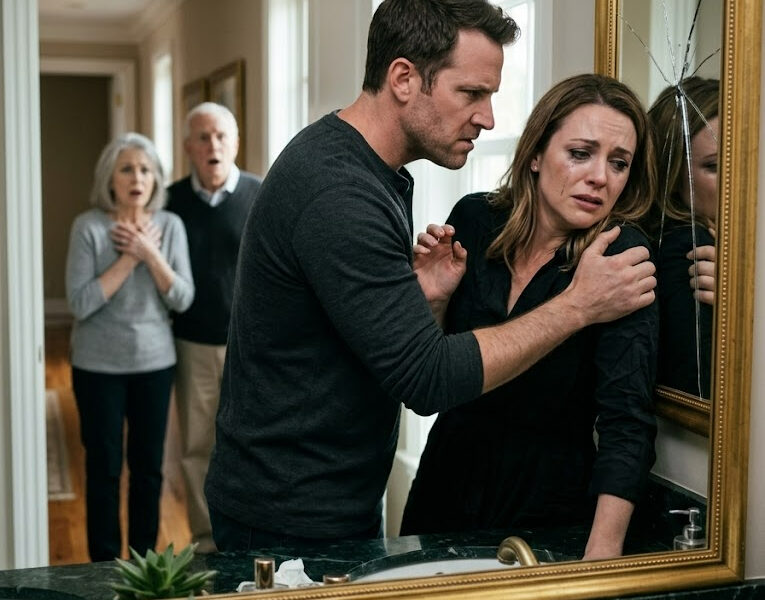
The bathroom mirror cracked before I felt the full force of my head hitting it.
For one stunned second, I stood there looking at my own broken reflection while silver lines spread across the glass like ice on a dark pond. Then my knees gave out, and I slid down the cold tile wall with one hand pressed to my temple.
Grant Whitaker still had his fingers twisted in my hair.
“All I asked,” I whispered, “was where your paycheck went this week.”
He looked down at me with the expression he wore whenever I inconvenienced him. Not regret. Not guilt. Just irritation that I had forced him to be obvious.
“You always ruin everything,” he said.
The bathroom door opened.
His mother, Helena Whitaker, stepped inside wearing cream cashmere and pearl earrings, dressed for the dinner party that was supposed to begin in less than an hour. Board members, donors, and business partners would soon fill the mansion downstairs, raising glasses beneath chandeliers and praising the Whitaker family for its generosity.
Helena looked at me on the floor.
Then she looked at the shattered mirror.
She did not ask if I was hurt.
She did not look surprised.
“Clean up this mess,” she said. “Guests will be here soon.”
Behind her, Conrad Whitaker appeared with a glass of bourbon in his hand. Grant’s father had built the family logistics empire with the same cold ease he used to destroy people at dinner tables.
“Don’t let her provoke you,” Conrad told Grant. “Women get hysterical about money.”
Grant laughed and took the bourbon from him.
That laugh did something to me.
It ended the part of my life that still wanted an apology.
For six years, the Whitakers had taught me to shrink. Helena called me dramatic whenever I questioned missing funds. Conrad said marriage required discipline. Grant spent money that vanished from our accounts, disappeared for nights at a time, and came home smelling of hotel soap and expensive lies.
Every bruise had an explanation.
Every broken object was my fault.
Every question became proof that I was unstable.
Two months earlier, after what Grant called another “misunderstanding,” my older brother Elias visited while Grant was away. Elias had spent fifteen years in federal law enforcement and had the kind of quiet focus that made people tell the truth before they meant to.
We sat on the back porch beneath the bare winter trees. I told him enough to worry him, though not everything. I still carried too much shame then.
He pressed a small matte-black fob into my palm.
“One press opens a distress alert,” he said. “Two sends location and audio to a monitored line. Three means immediate danger.”
“Elias—”
“Sarah, listen to me. You don’t have to decide today what this marriage is. But if one night you know you need help and you can’t make a call, use this.”
I had carried it ever since.
Now, sitting on the bathroom floor while Grant mocked me and his parents watched like supervisors inspecting a problem employee, my hand moved slowly toward the pocket of my cardigan.
Helena noticed first.
“What are you reaching for?”
“Nothing,” I whispered. “Just trying to stand.”
Inside the pocket, my thumb found the fob.
One press.
The device vibrated once.
My location went live.
Grant stepped closer. “What’s in your pocket?”
My heart slammed against my ribs.
Two presses.
Audio began streaming.
A tiny red light flashed beneath the wool.
Grant saw it.
His eyes narrowed. “Give me that.”
If he found the fob before I completed the signal, I knew I would not get another chance.
So I did the only thing I could.
I moved toward the shattered mirror fragments on the floor and let panic become theater. I gasped, slipped, and grabbed blindly at the tile. A sharp piece cut across my palm. Blood appeared fast and bright.
Helena recoiled.
“For God’s sake,” she snapped. “Now look what she’s done.”
Grant stepped back in disgust.
Their eyes went to the blood.
Mine went to my pocket.
Three presses.
The fob pulsed once more.
The final signal went out.
When Grant looked back at me, I could not hide the change in my face quickly enough.
Fear was still there.
Pain too.
But beneath both, something colder had arrived.
Grant saw it.
“What did you do?” he asked.
I said nothing.
His expression changed from anger to calculation.
Then he bent, grabbed my arm, and dragged me out of the bathroom before the first guest ever rang the bell.
They did not let me leave.
Grant hauled me into the master bedroom, wrapped my bleeding hand in a towel so carelessly it hurt worse, and shoved me onto the bed.
“You stay here,” he said. “You keep quiet. You will not ruin this night.”
Then he locked the door from the outside.
I sat in the dim room with the towel pressed to my palm, listening to voices gather downstairs. Laughter drifted up through the floorboards. Glasses clinked. The Whitakers were hosting a dinner party while I bled in a locked bedroom above them.
The signal was out.
But federal response was not magic. They needed confirmation, a warrant, a team, movement. Elias could not materialize the moment I clicked a button.
I had to stay alive long enough for help to arrive.
At first, I thought Grant would leave me there until morning.
I was wrong.
A little after midnight, the lock turned.
Grant entered with Alden Price, the Whitaker family’s corporate attorney. Price was thin, perfectly dressed, and always smelled faintly of expensive soap and printer ink. He carried a black leather briefcase.
Grant’s eyes were bloodshot. His tie hung loose. Whatever control he had performed downstairs had already begun to fray.
“Change of plans, Sarah,” he said. “Mother found the encrypted files on your laptop.”
My stomach went cold.
“She found your little investigation,” he added.
For months, I had been quietly looking into the Whitaker finances. Before marriage, I worked in digital communications and information systems. Grant treated that part of my life as a hobby, something cute I did before becoming Mrs. Whitaker.
That mistake had protected me.
When I started asking where money went, I did not find simple overspending. I found fake charity invoices, forged donation records, shell companies, altered metadata, and logistics payments that made no operational sense.
The real evidence had already been copied to a secure drive and sent through a chain Grant did not know existed.
What Helena found on my laptop was a decoy folder.
Still, decoys are only useful if the enemy believes they matter.
Price opened his briefcase and laid papers across the bedside table.
“These documents transfer your equity interest, trust access, and limited power of attorney to your husband,” he said smoothly. “Given your recent instability, it is for your protection.”
Grant stood beside him, tapping a closed folding knife against his palm.
“Sign,” he said.
I stared at the documents.
If I signed, I would not only lose what little leverage I still held, but give them a weapon to tie me to their fraud.
If I refused, Grant might kill me before Elias arrived.
So I played for time.
My injured hand shook as I reached for the pen. I dropped it once. Then again. I asked questions I already knew the answers to. I misread sections. I asked why one paragraph mentioned irrevocable authority. I let my voice tremble and my eyes stay unfocused.
Price grew impatient.
Grant grew worse.
“Just sign the paper!”
The pen touched the first signature line.
Then white headlights swept across the bedroom window.
Not one car.
Three.
Grant froze.
A second later, the doorbell rang.
Downstairs, Helena’s voice rose sharply.
Then a voice boomed from outside.
“Federal agents. We have a warrant. Open the door.”
Price snatched for the documents, trying to shove them back into his briefcase.
Grant stared at me.
For one second, I saw him understand.
The fob.
The red light.
My sudden coldness.
The front door cracked under force below, followed by the thunder of boots in the foyer.
“FBI! Hands where we can see them!”
Helena screamed.
Conrad shouted about lawyers.
Grant moved faster than I expected. He lunged across the room, grabbed me from behind, and locked his arm across my upper chest and throat.
The bedroom door burst open.
Elias stood there in tactical gear, flanked by two armored agents.
For a fraction of a second, he was not an agent. He was my older brother, and the look in his eyes was something I will never forget.
Then training took over.
“Grant Whitaker,” Elias said, voice low and controlled. “Let her go.”
Grant tightened his grip. “This is my house. This is my wife.”
“No,” Elias said. “This is a federal crime scene. And she is the witness you were stupid enough to touch on an active audio feed.”
Grant’s breath hit my ear in ragged bursts.
I stopped fighting his arm. I forced my body heavy for half a second. His balance shifted. That was enough.
I dropped, twisted away, and fell to the carpet.
The agents moved instantly.
Grant hit the wall hard enough to rattle a framed photograph. Two agents forced him to the floor and cuffed him while he shouted my name like it still belonged to him.
I crawled backward, gasping.
Elias knelt beside me and wrapped his jacket around my shoulders.
“You’re safe,” he said. “I’ve got you.”
Downstairs, the Whitaker mansion had become the only honest version of itself.
The front door hung broken. Guests had been moved into the dining room under supervision. Conrad sat handcuffed on the Persian rug, still shouting that he knew senators. Helena sat on the lower stair in perfect pearls and ruined mascara while an agent read her rights.
Grant was dragged down a few minutes later, stunned and pale.
“This is illegal!” Conrad bellowed. “You have no cause.”
Elias lifted his secured phone.
The audio from my fob played through the foyer.
My voice asking where Grant’s paycheck went.
The impact against the mirror.
Helena ordering me to clean the mess.
Conrad laughing about women and money.
Grant threatening me.
Price instructing me to sign away my authority.
The recording ended.
Silence swallowed the room.
“That covers the assault, coercion, and unlawful confinement,” Elias said. “But that is not why the Bureau is here.”
An agent came up from the basement carrying a sealed evidence bag and a black leather ledger.
“Basement vault is secure,” he reported. “Ledger recovered. Approximately two million in currency. Multiple offshore routing documents.”
Conrad went gray.
Grant looked at the ledger as if it had grown teeth.
He thought that was the worst of it.
It wasn’t.
I stepped forward, still wrapped in Elias’s jacket, my bandaged hand held against my chest.
“Tell cyber division to cross-reference that ledger with the encrypted files I transmitted ten minutes before the raid.”
Conrad’s eyes snapped to me.
“My background is digital communications,” I said. “Did you really think I would miss the metadata on your shell-company invoices?”
Helena’s face tightened.
I looked at her.
“And Children’s Hope? Your charity brochures gave you away. Same printer profile. Same routing error. Same donor IDs recycled through fake logistics grants. You were not hosting galas for sick children. You were laundering money through them.”
Helena made a small, broken sound.
For years, the Whitakers had hidden rot beneath polished floors, charity dinners, and carefully worded press releases. They believed money could turn every witness into an employee and every victim into a rumor.
But files do not fear rich families.
Numbers do not respect pearls.
Metadata does not care who sits on which board.
By sunrise, agents had removed boxes of records, drives, ledgers, cash, and forged nonprofit documents from the mansion. The guests were gone. The staff had been interviewed. Federal seizure notices were already being prepared.
Grant was taken out last.
As they led him past me, he twisted hard against the cuffs.
“This is your fault,” he spat.
I looked at him for a long moment.
“No,” I said. “This is your receipt.”
Six months later, the federal courthouse in Manhattan felt nothing like the Whitaker mansion.
No velvet curtains. No chandeliers. No family portraits staged to make cruelty look respectable.
Just clean stone, bright windows, armed marshals, and rules even Conrad Whitaker could not buy his way around.
I stood outside Courtroom 4B in a charcoal-gray suit. My hand had healed, except for a thin silver scar across my palm. My left ring finger was bare.
There was no long trial.
The evidence was too strong.
The audio recording, the ledger, the cash, the fake charity documents, the digital files, the shell-company records, and Price’s own cooperation agreement left the Whitaker attorneys with one realistic option.
Deals.
Grant pleaded guilty to aggravated assault, unlawful restraint, money laundering, and conspiracy charges. He faced decades in prison.
Helena pleaded guilty to wire fraud and laundering money through a nonprofit. Her beloved charity boards removed her name within hours.
Conrad’s corporate empire was frozen and seized in pieces while he awaited trial on racketeering and financial-crime charges.
The mansion was locked behind federal notices.
The country club stopped returning calls.
Former friends claimed they had barely known them.
That is how fast power disappears when it can no longer pay people to stand nearby.
The courtroom doors opened.
Two U.S. Marshals led Grant out in shackles.
The orange jumpsuit made him look smaller. Older. Ordinary in a way he would have once found humiliating.
When he saw me, he slowed.
“You think you won?” he whispered. “You took everything from me.”
I said nothing.
“I’ll make sure you spend the rest of your life looking over your shoulder,” he said. “You’re nothing without us.”
For six years, a threat like that would have sent fear through my whole body.
Not anymore.
I held his gaze and smiled.
“You should learn to manage your emotions, Grant,” I said softly. “Don’t be so hysterical.”
His face emptied.
Not because the words were clever.
Because he recognized them.
They were the kind of words he and his family had used to make me doubt pain, fear, and truth.
Now they bounced off me and landed where they belonged.
The marshals pulled him away.
I watched him disappear down the corridor and felt no triumph.
Only distance.
That evening, I unlocked the door to my new apartment in Brooklyn.
It was modest. Bright. Full of plants. My furniture did not match yet. The kitchen was small, and one window stuck if I opened it too far.
But every inch of it was mine.
I had secured enough of my own money before the raid to start over. My consulting work had grown quickly once people learned I could trace fraud through digital systems most executives barely understood. The same skills Grant had dismissed as unimportant had helped bring down his family.
I set my purse on the entry table and pulled out the matte-black distress fob.
It was scuffed now.
The night it saved my life had left a mark on it.
I did not hide it in a drawer.
I hung it on a brass hook beside the front door.
Not as fear.
As a monument.
A reminder that survival did not begin when agents kicked through the door.
It began the moment I stopped explaining my pain to people invested in denying it.
It began when I gathered evidence quietly.
When I told my brother enough of the truth to build a way out.
When I pressed that fob the first time with Grant standing over me.
When I pressed it the third time and understood I was no longer waiting to be chosen by my own life.
I walked into the bathroom and turned on the faucet. Cool water ran over my wrists. I splashed my face and lifted my head.
The mirror above the sink was smooth and whole.
For a long time, I stared at my reflection.
I searched for the woman who used to flinch at footsteps in the hall. The woman who apologized when someone else shouted. The woman who believed silence could keep her safe if she just made herself small enough.
I could not find her.
She was gone.
In her place stood a woman with a scar across one palm, a bare ring finger, and eyes that no longer asked permission to exist.
The Whitakers had not destroyed me.
They had underestimated the one person in that house who knew how to keep records.
And the next morning, when sunlight filled my small Brooklyn apartment, I stood in front of that unbroken mirror and finally understood the truth.
I had not escaped their fortress.
I had brought it down from the inside.
THE END
Disclaimer: This content is entirely AI-generated for fictional and entertainment purposes only. Any resemblance to actual persons, living or dead, events, or locations is purely coincidental, and the creator assumes no liability for any interpretation of this content.
Disclaimer: This story is fictional and created for entertainment purposes only. Any names, characters, places, or events are fictitious or used fictitiously. No real person or organization is intended to be portrayed.