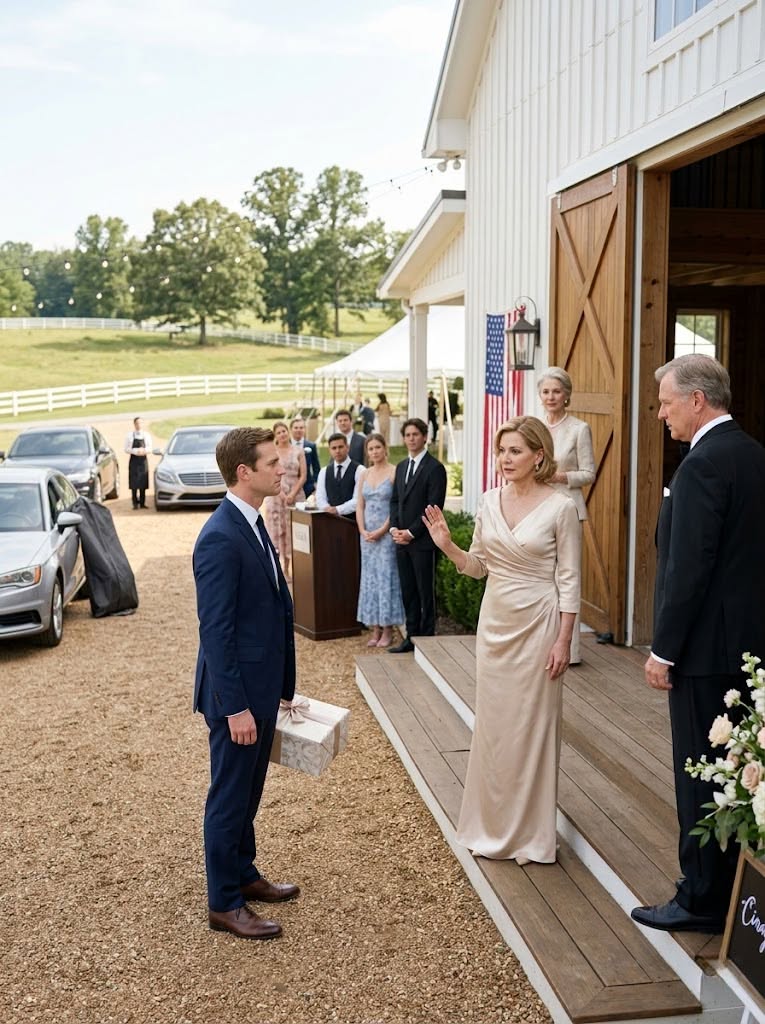
She shifted her weight. She put her hands under the desk. She looked at the expensive floral arrangement next to her computer. She whispered the reason.The Wellington family offered triple. Their daughter’s engagement party will be hosted here instead.
I felt my chest tighten. It felt like a band of metal was squeezing my ribs. The air went out of me fast.
I did not need to ask who the Wellingtons were. I knew the Wellingtons, my aunt Vivian’s family, my mother’s sister, the family who always thought they were better than us, the family who thought they were better than everyone.
And the bride-to-be, my cousin Chloe. Chloe Wellington, the one who used to call me dollar-store Barbie. She said that to me when I was 16. I still remembered it. It felt like yesterday.
She said it because my clothes were never as expensive as hers. She said it because she knew it would hurt me. And it did. It always did.
Before I tell you how everything flipped, like and subscribe. Drop a comment where you are watching from.
I stood there. I gripped the thick, glossy contract in my hands. The contract was signed. It was paid for. I had paid the full amount six months ago. I had saved for two years for this deposit.
I forced the words out. They were shaking.
I did not yell. My voice was steady but cold.
The receptionist flinched. She hesitated. She was shaking now. She looked young. Too young for this fight.
“Good,” I said. “Do that.”
I put the contract down on the glass desk. I did not move. I watched her hand shake as she reached for the phone. I watched her dial.
I felt a strange calm wash over the panic. This felt like the end of something. I just did not know what it was.
What I didn’t know was that one phone call would change everything. I thought it would just be another layer of pain.
I was wrong. I was very wrong.
I sat down in the lobby chair. The leather was soft. I ignored the receptionist staring. I looked out the massive window.
The lawn outside was perfect, green and manicured. It was the perfect, beautiful place. That was why I picked it. It was far from my old life.
I needed this place. I needed this wedding. It was not just a party. It was proof that I had won. Proof that I could build something real, something they could not touch.
My old life was a joke to them. A business transaction.
Three years ago, my parents had disowned me. They had not used that exact word. They did not need to. They just made it clear. They cut me off.
The reason was simple.
I fell in love.
I fell in love with a man they called beneath us.
I met Ethan at the community center. I was volunteering for an art therapy class. He was giving a basic life-saving seminar. He was wearing his uniform. It was clean and pressed. He looked tired but ready.
He ran toward the danger my family ran away from. He saved people. He did not make money from them.
I introduced myself. We talked about art. We talked about his job. He did not talk about money. He talked about life.
He was not rich. He was not from a good family in the way my mother defined it. He lived in a small apartment. He drove an old truck. He worked double shifts without complaining.
But when he looked at me, I felt seen. Truly seen.
He made me feel safe. That was more than my family ever had. They had given me things. They had never given me safety.
I told my mother about him. I was nervous. I was 25. I should not have been nervous, but I was.
We were in the kitchen. The kitchen was all white marble and stainless steel. It looked like a museum. We never really cooked in it.
“He’s a paramedic, Mom,” I said.
She stopped wiping a speck of dust off a cabinet. She stood up straight. Her face was blank.
“A paramedic,” she repeated.
Her voice was flat.
“Yes, he saves lives. He’s a good man.”
“Good men make money, Violet. Good men provide stability. Does he have a retirement fund, a trust, a family name that means something?”
“He has me,” I said.
It sounded weak. I hated that it sounded weak.
She put the cloth down. She did not raise her voice. That was her style. She just made you feel small. She made you feel like you had broken an unspoken sacred rule.
“You have a future, Violet. A life we worked hard to give you. You will not throw it away for a man who drives an ambulance. That is a temporary job. It is not a career. It is not our class.”
The argument did not stop there. It went on for two weeks. It was not shouting. It was cold, calculated pressure.
My father did not speak much. He just watched. His silence was louder than her words. It was judgment without effort.
When Ethan proposed, I said yes immediately. He took me to the park, not a fancy restaurant. He made me a picnic. He gave me a ring he had bought with three months of overtime.
It was beautiful. It was real.
I called my mother to tell her. It was a mistake.
She did not attend our engagement dinner. We had it at a small Italian place. Just us and a few close friends. It was the most peaceful dinner I had ever had.
The next morning, I woke up to a text from my mother.
You’re choosing poverty. Don’t expect our help.
It was simple, direct, a clean break.
My father was even more precise. He did not call. He did not text. He simply wired the money.
It was my college savings. The money he had promised for my master’s degree. All of it.
Then a single bank message came through.
Consider this a goodbye gift.
That was it. Goodbye. Erased.
I cried for a day. Then I stopped.
I looked at the money in the account. It was a lot, but it felt cold. It felt like the price of my freedom.
I used that money for my current apartment’s deposit. I used it to start my art therapy practice. I used it to live. I did not touch it for the wedding.
Since then, I had built a quiet life. Ethan and I had two years of quiet, honest effort.
I taught art to children with special needs. It paid the bills. I saved every dollar that was left over.
I was saving for one thing.
Rosewood Hall.
This venue.
It was the one place that symbolized my new beginning. It was grand, but it was not pretentious. It felt like a space you could fill with real joy.
I wanted my wedding there. I wanted the pictures to be a loud, bright statement to my parents and my cousin and my aunt.
It would say, “I am fine. I am more than fine. I am happy.”
And now my cousin had stolen it.
Chloe.
Chloe was getting married to a banker, a man my father would approve of, a man with a name and a number. Her engagement party was already a headline in the local society pages.
It was huge. It was a strategic move. It was everything my wedding was not supposed to be.
I looked at the contract on the desk again.
My name, Violet Morgan, a quiet woman disowned for choosing love over family reputation. I was here, sitting in the humiliation.
I was the victim again. Always the victim.
I was always the one who lost to the Wellingtons.
I thought about Ethan. He had a shift today. He did not know about this. I could not call him yet.
I did not want him to hear the defeat in my voice. I did not want him to feel bad. He worked too hard.
The receptionist finally finished her conversation. She hung up the phone. She looked even more upset. She was twisting her hands.
“The owner is very sorry, Miss Morgan,” she said, her voice barely a whisper. “We will issue a full refund immediately, plus an extra 10% for the inconvenience.”
“No,” I said.
I stood up. I looked at her directly.
“The contract is signed. The venue is mine. You cannot buy me off.”
“It’s the Wellingtons,” she pleaded. “They threaten lawsuits. They have powerful friends. We are just a family business, ma’am. We cannot fight them.”
“I can,” I said.
It was a lie. I felt sick. I had no lawyer. I had no power.
But I needed to say it.
Just then, the phone rang again. It was a private line.
The receptionist looked at the screen. She frowned.
“It’s the owner’s personal number,” she said.
She picked it up.
“Rosewood Hall. Yes, ma’am.”
She listened for a moment. Then her eyes went wide. She looked from the phone to me. Her face was pale.
She covered the receiver with her hand. She leaned in close to me.
“She wants to talk to you, Miss Morgan. Right now.”
The owner. The person who had decided that my love and my money meant less than Khloe’s party.
My heart began to pound again. This was the moment of complete, total defeat.
I took a deep breath. I reached for the phone. I was ready for the argument. I was ready to lose.
I was not ready for the call that would change everything.
I took the phone from the receptionist. Her hand was cold. Mine was shaking slightly.
I held the phone tight against my ear. It felt heavy.
“Hello,” I said.
My voice was tight. I sounded like I was fighting a cold. I tried to sound formal. I tried to sound like I had power.
A woman’s voice came through. It was not the nervous voice of the receptionist. This voice was calm. It was strong. It was low. It had authority.
“This is Violet Morgan,” I said again, louder. “You’ve canled my venue without notice. I have a valid, paid-in-full contract.”
The woman on the other end did not apologize. She did not argue about the contract. She did not even talk about the Wellingtons.
Instead, she asked one simple question.
The question stopped me. It was strange. It had nothing to do with contract law, nothing to do with the money.
“Why?” I asked.
I did not mean to sound rude. I was just confused.
“Just answer the question, Miss Morgan,” she said.
Her voice was steady. It was a voice that expected to be obeyed.
“His name is Ethan Carter,” I said.
There was a long silence on the line. Too long. It was the kind of silence that made you check if the call had dropped.
The silence stretched. The only sound was the faint crackle on the phone line.
My stomach twisted.
Did the Wellingtons know Ethan? Had they gone after him, too? Was this some new layer of humiliation?
Then the woman spoke again. Her voice was different. It was softer now. It had a new tone. It was one I could not place.
“Miss Morgan,” she said, “please wait in the lobby. Do not move. Do not leave the building. I’ll be there in 10 minutes. I am on my way now.”
The line clicked dead.
I put the phone down slowly. The receptionist was staring at me. Her mouth was slightly open.
“What did she say?” the receptionist whispered.
“She said she’s coming here,” I replied. “In 10 minutes.”
The receptionist looked terrified. She started to straighten the papers on her desk. She fussed with the sugar packets on the coffee bar.
I sat back down. My heart was pounding hard. It felt like a drum hitting the inside of my chest. My legs were numb.
Why did she ask about Ethan? It made no sense.
Did she know him? Maybe he had helped someone she knew. Maybe she was a friend of a friend.
But why would that make her drive all the way here? Why would it change anything about my contract?
I looked at the clock on the wall. The second hand seemed to be crawling.
Seven minutes.
I thought about Ethan again. I pictured his face. He was coming off a night shift. He would be tired, but he would still call me. He would still ask about my day. He would never let me feel alone.
That was the real contract, the one that mattered.
My family had always used things as weapons: money, reputation, the silent, cold approval of others. They used them to control me. They used them to make me feel worthless.
When my mother gave me the goodbye-gift money, I felt like a business had closed down.
The business of being their daughter.
I remembered my father’s annual birthday gifts. They were always expensive. A designer watch, a first-class ticket somewhere.
But they were never personal. They were never what I wanted. They were always a reminder of what they expected me to be, a reflection of their success, not my own.
The year I turned 21, I asked for a simple camera. I wanted to take pictures of the city.
He bought me a new sports car instead. It was red. It was loud.
“This,” he said, tapping the steering wheel, “is how a Morgan travels. Not on a bus, taking pictures of beggars.”
I drove that car maybe five times. I felt sick every time.I sold it when I moved out. I used the money to pay for my art supplies.
I realized I was rubbing the engagement ring on my finger, Ethan’s ring. It was simple gold. It had a small, clear diamond. It was exactly what I wanted.
It felt like mine.
Two minutes.
I stood up. I wanted to look composed. I did not want to look like the poor, desperate girl who had lost her wedding venue.
I pulled my jacket straight. I smoothed my hair. I took a deep breath.
The glass doors of Rosewood Hall opened wide. They made a soft, professional whoosh sound.
The woman who walked in was exactly as her voice sounded: calm, strong.
She was in her 50s. She wore a simple, tailored suit. Her hair was silver and perfectly cut.
She carried herself with quiet power, not the loud, demanding power of the Wellingtons.
This was different. This was authority earned.
As she entered the lobby, everyone in the room suddenly stood straighter: the nervous receptionist, a janitor pushing a cart, even a couple viewing the banquet hall.
They all stopped what they were doing. They acknowledged her presence without a word.
She did not look at the receptionist. She walked straight across the marble floor. Her eyes were fixed on me.
They were kind, but they were assessing.
She stopped right in front of my chair.
“Miss Morgan,” she said.
Her voice was gentle this time.
“I’m Margaret Delaney, the owner of Rosewood Hall, and I’m afraid my staff made a mistake. One that ends today.”
I opened my mouth to thank her, to tell her I was relieved, to ask what had changed.
Before I could get a single word out, the glass doors burst open again.
This time, there was no gentle whoosh. They seemed to fly open with violence.
My aunt Vivian Wellington swept in like a storm. She did not just walk into a room. She attacked it.
She was wearing an expensive, bright-pink coat. It was loud. Just like her.
Khloe Wellington, my cousin, trailed behind her. Chloe was trying to look bored and superior. She was dripping designer perfume. She carried a massive handbag.
The entitlement was a visible cloud around them both.
I felt all the blood rush from my face.
This was it. The confrontation. The real fight.
And I was standing right in the middle of it.
I felt the familiar burn of panic and shame. I was back in the high school cafeteria. Chloe was laughing at my cheap lunch.
Aunt Vivien saw Margaret. She smiled a wide, fake smile. It did not reach her eyes.
“Margaret!” Aunt Vivien exclaimed.
Her voice was too loud for the lobby. It was designed to carry.
She paused for a breath. She looked at me.
Her eyes narrowed. Her smile disappeared. It was replaced by a cold glare.
She looked at me like I was dirt on her shoe.
I took a step back. I felt smaller than I was.
I waited for Margaret to cave. I waited for her to apologize to Vivien. I waited for the money to win.
It always did.
Margaret did not move. She did not flinch.
She just folded her arms across her chest. She looked at Aunt Vivien. Her expression did not change.
“I’m aware,” Margaret said evenly.
Her voice was steady and quiet. It forced Aunt Vivien to lean in slightly to hear her.
It stole Aunt Vivien’s power.
Then Margaret said the most shocking thing I had ever heard.
“Which is why I didn’t call you.”
Aunt Vivien’s perfect smile wavered. The air in the lobby was thick.
Margaret turned away from the Wellingtons. She turned fully toward me.
She looked me in the eye.
“I called my daughter.”
A moment passed. A very long moment.
Aunt Vivien’s face was frozen in confusion. Chloe was looking down at her phone, then back up, trying to figure out the social angle.
I was just stunned.
Margaret, the owner, stood tall. She did not look away from me. It was like a spotlight had been turned on, and I was the only person she could see.
“My daughter is arriving now,” Margaret stated.
It was a fact, not a threat. Just a statement of truth.
The glass doors opened again.
A young woman entered. She was in her early 30s. She was wearing professional clothes, a sharp blazer and dark pants. She had a clipboard in her hand.
She was confident, poised. She was also beautiful in a grounded way.
She was not fragile. She was strong.
She walked up to Margaret. She spoke softly.
“Mom,” she said.
Margaret placed a hand gently on the young woman’s shoulder. She looked from her daughter to me.
“Violet,” Margaret said. “This is my daughter, Savannah.”
The name hit me. It hit me hard.
It was like the name had its own electric charge.
Savannah.
The name felt familiar. It was a name I had heard a hundred times. A name that meant protection and strength.
I stared at the woman. Then I looked back at Margaret. Then back at the woman.
My mouth was dry.
Savannah Carter.
The glass walls around my old life and my new life were shattering. They were falling to the floor.
Savannah Carter, Ethan’s sister.
My fiancé had always spoken about her with such respect. He rarely spoke about his family. He only had one sister, Savannah.
I remembered the stories.
“Savannah worked three jobs to help me pay for my EMT training.”
“Vi, she told me to keep my head up.”
“She’s the smartest person I know.”
“She told me to study harder. She believed in me when I thought I was going to fail.”
The one who had helped him through the toughest years. The one who had believed in him when my family believed only in money.
Savannah was looking at me now. Her eyes were warm. They were kind. They were also sharp.
She smiled faintly. It was a genuine smile. It was not a social performance.
“You must be Violet,” she said.
Her voice was soft. It was a different kind of strength than her mother’s.
It was the strength of conviction.
“Ethan’s fiancée.”
I felt dizzy. The room was spinning slightly. This was too much.
The universe had just played a massive joke on me.
I nodded quickly. I tried to speak. The words caught in my throat.
“He never told me you owned this place,” I stammered.
It was the only thing I could think to say.
Savannah’s smile widened a tiny bit.
“He doesn’t brag,” she said gently. “It runs in the family.”
This exchange, this simple two-line conversation, was too much for Aunt Vivien. The quiet power in the room was suffocating her.
Her face was becoming red.
Aunt Vivien let out a high, sharp laugh. It was fake. It was designed to break the silence. It was a desperate sound.
“Oh, this is adorable,” she drawled.
Her voice was dripping with venom and sarcasm.
“Nepotism and charity rolled into one. Violet finds the only other poor family in the state, and now she thinks she has a leg up.”
She looked at Margaret. Her voice changed to a commanding tone.
“Margaret, be reasonable. My daughter’s engagement will attract the governor, the Hadleys, the mayor’s wife. You’ll get huge press. You’ll be booked solid for a year. That’s business.”
She gestured toward me.
“This Morgan girl’s wedding? It’ll be a handful of paramedics and art teachers. It’s bad for your brand. It’s bad for your business.”
Aunt Vivien was counting on Margaret’s greed. She was counting on the fact that every business owner would choose money and influence over a signed contract.
She did not count on Savannah.
Savannah took a step forward. She stood beside her mother. She spoke clearly.
Her voice was quiet. It was steady. It was dangerous.
“And the tabloids,” Savannah interrupted.
She did not shout. She did not even look at Aunt Vivien. She looked at the main counter of the lobby.
Aunt Vivien stopped talking. She was stunned into silence again.
Savannah turned to face my aunt directly. She did not have a friendly look on her face anymore.
She had a business look, a look that said, I know exactly who you are.
“We’ve hosted enough of your kind, Mrs. Wellington. Enough of the Hadleys and the mayor’s wife. My mother built this hall for real celebrations, not PR cover-ups for failed marriages and bad investments.”
The room went quiet.
The sound of the fountain stopped being loud. It felt like the air conditioning had even turned off.
This was the moment of complete stillness before an explosion.
Aunt Vivien’s face was twisted. She was sputtering. She was trying to form words.
She was not used to being challenged. She was not used to being insulted so publicly. She was especially not used to being insulted by someone who looked younger than her but carried more real power.
“You can’t speak to me that way,” Aunt Vivien finally managed to snap out.
Her voice was trembling with rage.
Savannah smiled a small, cold smile. She leaned slightly toward my aunt.
“Actually,” Savannah said calmly, “I can, because this is my venue. My mother and I own it. We run it. We decide who comes in and who doesn’t.”
She paused.
“You are a customer, Mrs. Wellington. Nothing more. You have no stock here. You have no influence here.”
She let her words sink in.
Then she delivered the final blow to my cousin’s request.
She looked at my contract lying on the desk. She did not even need to touch it.
“And the Morgan wedding stays.”
I felt a surge of energy shoot through me. It was not anger. It was not even relief.
It was a feeling of justice. A feeling I had never felt before in my life.
It was a feeling of being defended, of having an army.
And my army was standing right beside me.
My cousin Chloe stepped forward. Now she was angry. Her face was flushed.
She spoke in a loud, high voice that dripped with spoiled malice.
“You’re ruining everything! Do you even know who my father is?”
Kloe was relying on her father’s reputation, a man known for his aggressive business tactics and his aggressive social spending.
Savannah did not even look at her. She just raised one eyebrow at my aunt.
“Yes,” Savannah said to Aunt Vivien. “I know exactly who Mr. Wellington is. And he’s a man who owes this venue six months of unpaid event fees from last year.”
The atmosphere in the lobby changed completely.
It was no longer a social argument. It was a business demolition.
Aunt Vivien’s face drained of color. The loud, vibrant pink of her jacket seemed to clash horribly with the sudden greyness of her skin.
She looked utterly defeated. She looked like she had been hit by a truck.
She took a shaky step toward Savannah. She lowered her voice, but it was still urgent and desperate.
“That’s confidential, Margaret. You can’t discuss a client’s financials,” she snapped.
She was trying to regain control. She was trying to use the language of the elite.
“Not when you threaten my staff,” Savannah replied.
She did not look at her mother. She kept her eyes locked on Aunt Vivien.
“You came in here trying to bully a young woman into tearing up a valid contract. You brought your entitlement and your money and your threats. You wanted to use your reputation. Fine. We will use the truth of your reputation.”
Savannah walked over to the desk. She picked up a small black notebook that had been sitting near the receptionist’s computer.
She flipped it open. She scanned a page.
“Your last outstanding balance is $62,000, Mrs. Wellington, for the Save the Manatees gala that ended in three police calls and a missing centerpiece. You promised to pay us when your daughter’s engagement party was booked.”
Aunt Vivien was shaking her head slowly. It was a frantic movement of denial.
“No, no, that’s a mistake. We paid half. We had an arrangement.”
“The arrangement was full payment before any new booking was confirmed,” Savannah corrected her.
She spoke like a lawyer reading a statute.
“You jumped the line, Mrs. Wellington. You called us, promised triple the fee and assumed we would take the money and throw Miss Morgan out. You assumed we were as desperate and low-class as you are.”
I watched the whole scene. I did not move. I did not breathe.
I was just a silent witness to my family’s actual character being exposed.
They were not powerful. They were just bullies. And they were bad at paying their bills.
They were bad at business. They were bad people.
Savannah closed the notebook with a quiet click. It was final.
The sound was louder than any shout.
Then she turned. She turned completely away from the Wellingtons. She looked at me.
Her expression softened immediately. The hardness in her eyes was replaced by a look of focused, steady concern.
“Violet,” she said.
Her voice was kind. It was warm.
“Your wedding will proceed as planned. You have the contract. You have the venue. You have our apology.”
She looked down at the contract on the desk. She pointed to a line item.