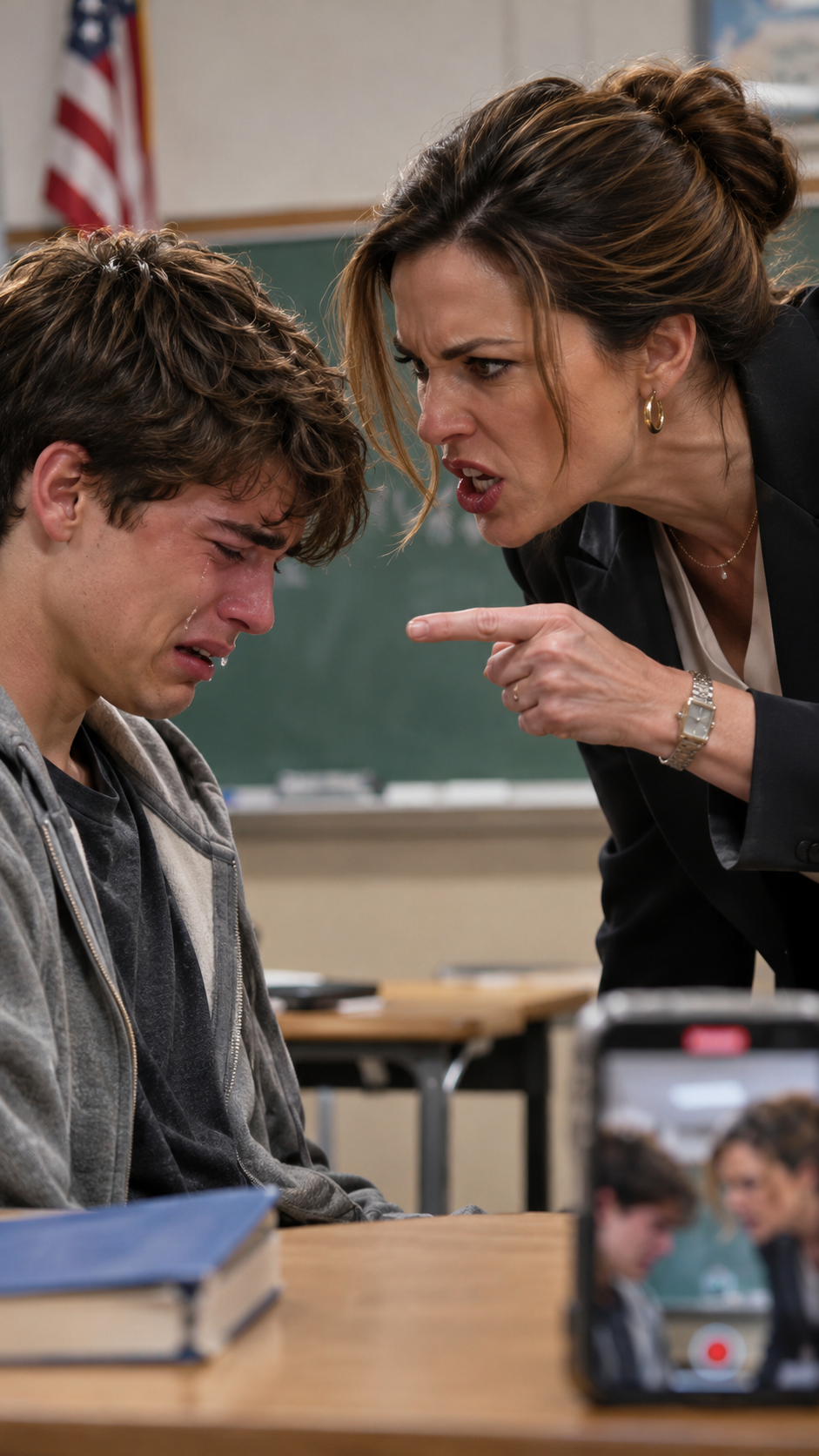
Mrs. Victoria Hale caught my son’s forearm and hauled him away from his desk so sharply that his chair scraped across the floor.
Her other hand closed around the front of his school shirt, bunching the dark fabric under her fist.
Ethan’s feet stumbled as he tried to find his balance, and thirty classmates watched him struggle not to cry.
“Look at me when I’m talking to you!” she snapped.
My son was twelve, and the adult holding his collar was the person responsible for teaching him.
I saw those first seconds through the open classroom door, and later a student’s recording would show me how long the cruelty had been unfolding before I arrived.
The fear on Ethan’s face told me this wasn’t a misunderstanding or a single bad minute; it was the end of a long stretch of mornings when he had felt alone.
What disturbed me most was how familiar that fear looked.
For three weeks, Ethan had been inventing reasons to remain home, and I had mistaken the evidence for a series of unrelated mornings.
There were stomachaches before breakfast, shoes left untied until the last possible minute, and questions about whether I would be there when school ended.
We had lived alone since his mother died when he was seven, and I understood that a small change could unsettle him more deeply than it might another child.
He kept her old blue scarf folded inside his nightstand, and when he was anxious he sometimes smoothed its edges as if tidying a memory could make the day safer.
Still, the child who once argued enthusiastically about spacecraft and the American Revolution had stopped talking about school almost completely.
One morning I found him dressed, sitting on his bed beside an untouched bowl of cereal.
“Are you feeling sick?” I asked.
He inspected the laces of his sneakers before telling me he wasn’t.
“Then help me understand why going to school seems so hard lately.”
He worked a loose thread between his fingers, considering whether honesty might cost him more than silence.
“Mrs. Hale thinks I don’t try,” he finally said.
I sat beside him and waited, careful not to turn the conversation into another interrogation.
Ethan had dyslexia, diagnosed two years earlier, which meant words he understood perfectly could sometimes resist him when he had to read aloud.
He loved history and science, could organize complicated arguments in conversation, and worked patiently with specialists on the techniques that made reading manageable.
His documented learning plan did not excuse him from learning; it explained how the adults around him could help him demonstrate what he knew.
Mrs. Hale seemed to regard every accommodation as a personal challenge to her authority.
“She says being slow isn’t an excuse,” Ethan told me, his voice so quiet I had to lean closer.
“Did she say that to you alone?”
He shook his head, and I heard the answer in the small scrape of his sleeve against the bedspread.
I promised I would not storm into his classroom, but I also refused to pretend that leaving a child frightened was a reasonable way to teach him.
That afternoon I wrote to the teacher, asking for a meeting and explaining the difficulties her assignments appeared to create.
Her response came quickly, framed in polished language about consistent standards and adequate effort.
The point was unmistakable: she considered Ethan’s struggles a matter of attitude, not a learning difference already documented by the school.
I forwarded the exchange to Maria Alvarez, the learning-support coordinator, and asked that the principal join us in discussing it.
When Mrs. Hale called the following day, her voice sounded almost pleasant, which only made the cruelty of her message harder to dismiss.
She portrayed Ethan as oversensitive and described her own approach as preparation for a demanding world.
I told her a demanding world was no justification for teaching a boy to be afraid of asking a question.
The conversation ended without an agreement, and Ethan begged me not to call her again.
“I’m the one who has to sit in that room after you leave,” he said.
I had run a regional engineering firm for years, and when a design failed we examined the fault instead of telling the equipment to develop character.
Yet I had been treating my son’s fear as a problem that better encouragement at home might solve.
I apologized for overlooking the danger he would face after my emails, and I promised to ask what he wanted before deciding how we confronted the school.
He told me he wasn’t afraid of getting a word wrong; he was afraid of becoming an example for thirty watching classmates, none of whom could safely intervene.
I realized then how silence could spread through a class, because no student wanted to see what happened after someone dared to interrupt the teacher.
With his reluctant agreement, I requested a formal meeting with Principal Rebecca Morgan, copied the correspondence, and asked that Maria attend.
The school acknowledged my concern, but nobody explained what would change while the matter was being considered.
Two days later, Ethan carried home a reflection form marked with red circles around observations about delayed responses and avoided eye contact.
Beneath the official notes sat a cruel handwritten remark suggesting he wanted attention rather than help.
He had no idea who had written it, and that uncertainty seemed to make the insult worse.
As I held the paper, I pictured the adults who had handled it before a twelve-year-old was instructed to take it home.
“Do you think I’m pretending?” he asked.
I placed the form face down so he wouldn’t have to stare at it while I answered.
“No. I think you’re working hard in a room where someone has decided not to see it.”
He nodded, but the doubt did not disappear from his eyes.
That evening I arranged every email, form, and dated note into a folder on my computer.
I wanted a clear account, not a collection of accusations written in anger; I owed Ethan accuracy as much as I owed him protection.
Maria called after he had gone to bed, speaking softly as though someone might hear her through the walls.
She said Mrs. Hale had been portraying my requests as an attempt to use my professional influence against her, and other teachers had begun hearing the story.
I asked if Ethan was safe in that classroom, and she hesitated long enough for my hand to tighten around the phone.
She urged me to come to school the next day because an incident had occurred that Ethan had not fully described.
Before she could continue, a woman’s voice interrupted from somewhere behind her, demanding to know whom she was speaking with.
Maria disconnected.
I stared toward the hallway outside Ethan’s bedroom, trying to decide whether waking him would comfort him or frighten him further.
Then an unknown number sent me two short messages, directing me to Room 214 the next day, warning me to bring someone trustworthy, and telling me not to alert Mrs. Hale.
No signature followed, and the sender offered no explanation of how the warning had reached my phone.
I read the messages twice, because somewhere in that school someone was risking something to make sure I arrived.
For the first time, the problem was no longer whether Ethan had exaggerated what was happening.
It was what the people inside Room 214 were afraid would happen when I finally learned the whole truth.
Chapter 2: The Recording No One Could Explain Away
Ethan stood in the kitchen doorway the next morning with his backpack hanging from one shoulder and his breakfast almost untouched.
I asked him what had happened during the reading lesson, and he immediately asked whether a teacher had called me.
His first concern was not the lesson itself but the possibility that speaking about it would make the next day worse.
I told him Maria had contacted me, and I waited until he was ready to describe the part he had hidden.
Mrs. Hale had asked him to read a passage about the Constitution in front of the class, a subject he understood better than many students who read more fluently.
A difficult word stopped him; she required him to begin again, then again, until concentration had been replaced by panic.
When he managed to finish the passage, she treated the effort as a disruption and required him to explain himself before his classmates.
Tyler, a boy in the room, objected to the way she was speaking to Ethan, but the teacher turned her scorn on him too.
Some students laughed nervously, others looked down, and Ethan was told to apologize for occupying time that belonged to the class.
“It’s worse when they all look at you,” he said, studying a crumb on the table.
I wanted to promise that everything would change by lunchtime, but he already knew how easily adults made promises that classrooms did not keep.
Instead I acknowledged what he had been trying to tell me: I could leave a meeting, while he would still be the boy sitting beneath her gaze.
We agreed that I would seek a concrete protective arrangement rather than demand a dramatic apology in front of his peers.
Before we entered the school, I assured him that whatever the staff claimed, I would not blame him for what had happened.
He leaned into my arms for a moment, then stepped away and walked through the entrance without looking back.
I phoned my older brother Michael, a former prosecutor now working in education law, and asked him to accompany me.
He reminded me to preserve original records and distinguish what Ethan reported from what an independent witness could verify.
His caution irritated me until I understood it: we needed a record sturdy enough that no one could dismiss it as a father’s temper.
Michael met me in the administrative office, where the receptionist, Linda, informed us that Mrs. Hale had complained about my conduct toward staff.
I asked to see the accusation in writing, and Michael calmly introduced himself as both family member and legal adviser for our meeting.
Dr. Morgan appeared with a carefully composed expression and led us into a room overlooking the courtyard.
She began by praising Mrs. Hale’s professional experience and questioning whether Ethan had been willing to participate in class.
I placed his signed accommodation plan and the teacher’s emails on the table between us.
“Where is Ethan’s statement?” I asked.
The principal had none, only the teacher’s account that he had been uncooperative and argumentative.
Michael asked whether classmates had been interviewed, and again the answer was no.
A disagreement about a lesson had already become an official version of events, though the child involved had not been invited to describe it.
When I requested protection against retaliation, Dr. Morgan spoke about policies but could not explain what the school would actually do that morning.
As she closed her folder, I noticed another beneath it, marked as earlier parent complaints.
She moved it out of sight and called it an unrelated administrative matter, although the abruptness of the gesture made Michael glance at me.
Outside, he told me to record exactly what I had seen without pretending to know what the folder contained.
My phone vibrated before I could answer him.
The unknown sender had delivered a video file and a warning not to disclose the source.
The recording was unsteady and imperfect: a shifting angle between desks, a cough near the microphone, a book opening at the front of Room 214.
But Mrs. Hale’s voice was unmistakable, and Ethan appeared beside her holding the history text in both hands.
He tried to read, stopped on a word, and faced an adult who treated his difficulty as a public offense.
When he repeated the paragraph more successfully, she still accused him of wasting time, then turned the moment into a lecture about his character.
Tyler defended him briefly before being ordered to sit, and Ethan was compelled to apologize for failing to learn at her chosen pace.
I watched the footage twice, unable to reconcile the boy on the screen with the curious child who debated history over dinner.
Michael instructed me to retain the full file, the message, and its timestamp and not send a clipped version to social media.
I replied to the sender with thanks, asked only when the incident happened, and promised not to expose whoever had filmed it.
The response suggested that this was not the first time children had been singled out, and that nobody wanted to become the next example.
Before we could arrange a formal submission, Maria called again and acknowledged that previous concerns involving Mrs. Hale had been raised.
She knew of a student with anxiety who had experienced similar treatment and a parent who had accepted a transfer after an earlier complaint.
She also described the pressure school employees felt to accept the teacher’s meticulously worded reports over what frightened students said aloud.
I asked whether the principal had been aware of these concerns, and Maria answered yes, though she could not tell me every decision that had followed.
Then she mentioned a district visitor expected that day, someone Mrs. Hale had seemed unexpectedly nervous about meeting.
Michael asked me to keep my voice low as we returned toward Room 214, and I understood that protecting Ethan meant more than arriving angry.
From the doorway I saw him trying to shrink behind his desk while Mrs. Hale leaned over him again.
Her hand caught his forearm; when she pulled him upright and seized the front of his shirt, the cloth tightened across his chest.
I moved immediately toward him, and he stepped back into my embrace as soon as she released him.
“Why is my son afraid of you?” I asked, keeping myself between the teacher and the boy.
The room had fallen quiet enough to hear Ethan’s uneven breathing against my jacket.
Maria displayed the recording on a phone, and Mrs. Hale’s anger changed to unmistakable alarm as she recognized the classroom on the screen.
Jonathan Reed, the State Director of Education, stepped forward with a formal complaint document only after the video had been shown.
“Mrs. Hale, do you recognize the name on this document?” he asked.
I couldn’t read the name from where I stood, but the teacher’s face told me it was not a name she had expected to confront.
Her mouth opened and closed without an answer, while Ethan held tighter to my sleeve.
Only when Jonathan turned the first page toward us did I understand that this was no longer merely a dispute about one frightened boy.
The student named on the document had complained before Ethan ever entered Mrs. Hale’s classroom, and the school had already been warned.

