 1 – The VIP Lounge
I had his passport in my hand when I walked into the VIP lounge at JFK.
It was two o’clock, and I was wearing the beige suit I had worn to a meeting that morning, the one Mark always said made me look like I meant business.
I meant it that day too, but not the way he thought.
He had told me his flight to Chicago left at four, and he had forgotten his passport on the kitchen counter.
I could have called him.
Instead, I decided to surprise him.
I thought we could have a coffee together before he went through security, maybe talk about the merger he had been so tense about for weeks.
I walked past the reception desk, smiled at the woman there, and pushed open the glass door to the lounge.
And then I stopped.
Mark was on the sofa by the window, his blue shirt collar open, his hand on the cheek of a young woman I had never seen before.
He was kissing her.
She was sitting behind a small carry-on, a light scarf wrapped around her, and she was laughing at something he had just said.
I don’t know how long I stood there.
It felt like a long time.
Then I heard my own voice, flat and strange, say, “Who is this woman, Mark?”
He pulled back and stood up so fast he almost knocked over his coffee.
He straightened his shirt, the way he does when he is caught off guard, and said, “Olivia, please don’t do this here.”
Don’t do this here.
As if I were the one making a scene.
I looked at the two of them, at the matching carry-on bags, at the way she had moved closer to him when I walked in.
“Are you traveling with her?”
I asked.
She looked at Mark first, as if asking permission, and then she answered me herself.
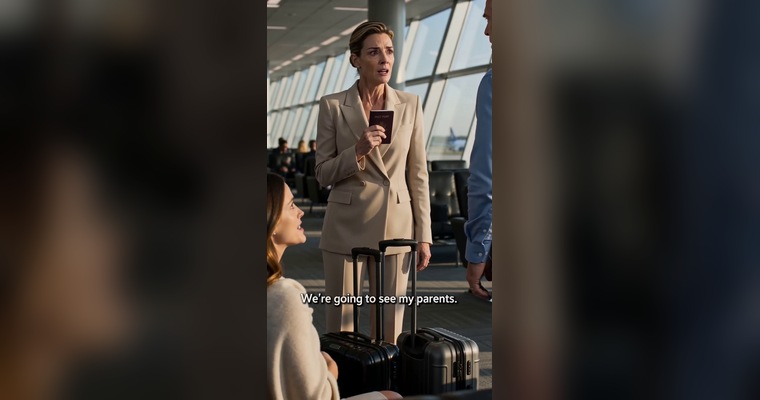
“We’re going to see my parents,” she said.
Her voice was soft, almost apologetic.
And then she stood up to pull her suitcase closer, and the scarf slipped off her shoulder.
The dress she was wearing was a pale cream color, close-fitting, and it showed everything.
She was pregnant.
Five months, maybe more.
I looked at her belly, and I felt my hand drop, the passport suddenly heavy, like it belonged to someone else.
Mark reached out for it.
His fingers were already open, waiting.
“Olivia,” he said, quieter now, “give me the passport.”
I closed my hand around it.
I don’t know why I did that.
Maybe because it was the only thing in that room that was still mine to decide.
He looked at me, and for a second I saw something in his face that I had never seen before, something like fear.
The young woman looked at him too, and then at me, and her expression changed.
She had just realized that I had seen.
I turned around and walked out of the lounge.
I didn’t run.
I didn’t cry.
I walked past the reception desk again, past the woman who had smiled at me, and I pressed the button for the elevator.
The doors opened, and I stepped in.
Just as they were closing, a hand shot between them, and Mark stepped in beside me.
The doors closed.
We stood there, not looking at each other, the elevator humming as it went down.
And then he spoke.
“Before you say anything,” he said, “you need to think about what you’re going to lose.”
I turned and looked at him.
“What did you just say to me?”
He didn’t blink.
“You heard me,” he said.
“If you make a scene, Olivia, you’re the one who pays for it.
Not me.”
Chapter 2 – What You’re Going to Lose
“Before you say anything,” he said, “you need to think about what you’re going to lose.”
I turned and looked at him.
“What did you just say to me?”
He didn’t blink.
“You heard me,” he said.
“If you make a scene, Olivia, you’re the one who pays for it.
Not me.”
The elevator kept going down, and I kept my hand closed around his passport.
I had driven to JFK that afternoon to do something kind.
Mark’s flight to Chicago was at four, and he had left his passport on the kitchen counter that morning, so I took the morning off from my own work and drove out to surprise him.
Twenty-one years of marriage, and I still thought a small kindness could fix a tired week.
The doors opened on the parking level, and he walked out first, the way he always did, expecting me to follow.
I followed, because I wanted to hear whatever came next.
“The Chicago trip isn’t what I told you,” he said.
“Then what is it?”
“It’s a placement meeting,” he said.
“The partners are finalizing my promotion to managing director at Halcyon and Reed.
Monday morning.”
I stopped walking.
“You told me the Chicago trip was about the merger,” I said.
“It is about the merger,” he said.
“It’s about who runs it.”
I asked him the question I already knew the answer to.
“And what happens to me at that firm?”
He looked at the concrete floor, and then he looked at me.
“You’ve been moved aside,” he said.
“Quietly, over the last year.
Your accounts were transferred to the Chicago team.
It’s done.
It was decided before any of this.”
I have worked at Halcyon and Reed for eighteen years.
I built the private client division with my own hands, and I built part of it from our kitchen table while he was still a junior associate.
“Who decided?”
I said.
“The board,” he said.
“With my recommendation.”
There it was.
“So you took my work,” I said, “and you took a twenty-seven-year-old assistant, and you’re going to stand in front of a board on Monday and collect on all of it.”
“I never said assistant,” he said.
He caught himself a second too late.
“You just did,” I said.
He put his hands in his pockets and changed his tone, and that frightened me more than the shouting would have.
“Listen to me,” he said.
“The pregnancy stays quiet until my placement is signed.
After that, we can talk about how this ends.
Not before.”
“You want me to say nothing for three days,” I said.
“I want you to be smart,” he said.
“That’s all this is.”
I looked at the passport in my hand, at the small blue cover that had my husband’s face printed inside it, and I did not hand it over.
“How do you plan to board a plane to Chicago,” I said, “without this?”
For the first time that afternoon, Mark had nothing ready.
I walked to my car and got in and started the engine.
He knocked on the window twice, and I pulled out of the spot without looking at him.
The drive home took an hour because of traffic on the Van Wyck, and I did not turn on the radio.
I kept hearing him say it — you’re the one who pays.
When I came into the house around four, the kitchen was exactly as I had left it, except for one thing.
There was a manila folder on the kitchen island that had not been there that morning.
My name was typed on the label, sent from the office of our family lawyer, Harold Brandt, and the postmark date said three weeks earlier.
Mark must have brought it in from the mailbox and set it down and never opened it, or opened it and decided it didn’t matter.
I sat on the stool where I eat breakfast and opened it.
It was a draft.
An asset-transfer agreement, sixteen pages, prepared by Harold’s office and signed on the last page in Mark’s own handwriting.
It would place our building on Marlborough Road and every joint account we hold under his sole control, effective on filing.
My signature line was blank.
I read the signature page four times.
Then I picked up the phone and called Harold’s office, and his secretary told me he was in court and would call me back in the morning.
The kitchen was very quiet.
I set the folder down and looked at the passport on the counter beside it, and I thought about the fact that Mark had been planning that agreement for weeks while I was making small talk about his tired week.
And then I thought about something else.
If he needed Harold to prepare it, Harold would have needed a reason to believe I was going to sign.
Someone had told him I would.
I got out a legal pad from the drawer and started writing questions down, one line each, because I could feel my hands shaking and I wanted them to have something else to do.
The first question I wrote was the only one that mattered yet.
If he planned to take everything by filing, why was he in such a rush to be in Chicago by Monday?
Chapter 3 – The Folder With Twenty Years Inside
I didn’t sleep that night.
I sat at the kitchen island with a glass of water I never drank and Mark’s passport still in my handbag, and I kept hearing his voice in the elevator.
“Think about what you’ll lose, Olivia.”
Not sorry.
Not I made a mistake.
Think about what you’ll lose.
So I did.
I thought about the building on West End Avenue that my father’s money helped us buy.
I thought about the joint accounts I’d signed on without reading closely, because I trusted the man I’d been married to for twenty years.
And then I thought about the folder.
It had been sitting on the kitchen island for three weeks, under a stack of mail, and I’d assumed it was another closing document from Mark’s office.
At four in the morning I opened it.
Dana Kessler picked up on the second ring.
She’s been my attorney since before Mark and I were married, and she doesn’t waste words at dawn.
“Olivia, it’s four in the morning.”
“Dana, I need you to read something to me and tell me if it’s real.”
I read her the first page slowly.
When I finished, the line was quiet for a moment.
“It’s real,” she said.
“It’s a draft asset-transfer agreement.
It would move the building and the joint accounts into his sole control.
It’s not filed, but it was prepared months ago.
And it wasn’t prepared by me.”
“Who prepared it?”
“His lawyer.
Bradley Voss.”
I closed my eyes.
Bradley Voss had been to our house for Thanksgiving.
“Dana, there’s something else.”
I told her about the VIP lounge.
About the girl in the cream dress.
About the scarf that slipped.
She was quiet again.
“Olivia, listen to me.
Those two things are not separate.
A man doesn’t quietly move his wife’s assets and quietly start a second family by accident.
This was a plan, and he was executing it.”
That was the moment the water in front of me stopped shaking, and something in my chest went very still.
“What do I do first?”
“First, you don’t confront him.
Second, you protect yourself before you do anything else.
Do you have access to the credit cards?”
“Yes.”
“Cancel them.
Every one that has your name on it.
Today.
Then open your own accounts and move your salary direct deposit.
Then call me back.”
I did all three before seven in the morning.
It was not dramatic.
It was just a series of phone calls and a woman at a bank branch on Broadway who looked at me kindly and didn’t ask questions.
When I hung up with the last one, I sat in my car and realized my hands were steady.
That surprised me.
Dana called back at nine.
“Olivia.
I ran a search on the name from the lounge.”
“Hannah.”
“Hannah Reyes.
She works at Halcyon & Reed.”
I waited.
“She’s Mark’s assistant, Olivia.
She’s been on his floor for two years.”
I sat in the driver’s seat and looked at the parking garage wall and felt the whole shape of it come together, the way a photograph develops.
The pregnancy.
The quiet transfer.
The trip to Chicago that was never a merger trip at all.
“Dana,” I said.
“He was going to introduce her to her parents this weekend.
As his girlfriend.
Maybe as his fiancée.
While I was at home with his passport in my bag.”
“Then you already know what kind of man you’re dealing with.”
I did.
And I knew something else.
I was not going to spend the rest of this story crying in a parking garage.
I put the car in gear and drove home to start making a list.
Dana called once more before noon, and her voice had changed.
“Olivia, there’s one more thing.
The transfer agreement was prepared by Voss, but someone paid his retainer.
It came out of an account I don’t recognize.”
“Whose?”
“I don’t know yet.
But I’ll find out.”
I wrote everything down in a notebook and put it in the back of a drawer where Mark would never look.
Then I made a decision that would have horrified the woman I was on Saturday.
I didn’t call him.
I didn’t text him.
I let him believe I was still sitting in the dark, holding his passport, waiting to be told what to do.
And the next morning, I drove to the address Dana found for Hannah Reyes.

