Chapter 1: THE BOY WHO REFUSED TO BREAK
The first sound was my lunch tray striking the cafeteria floor. But what stayed with me long afterward wasn’t the crash. It was the laughter of thirty children—and the sight of a teacher deliberately turning his back while I stood there being humiliated.
Slices of apple scattered across the gray linoleum. A plastic carton of milk rolled beneath a nearby table, leaving a narrow white trail behind it. My worn canvas backpack slid several feet across the floor before one of its straps caught against the metal leg of a chair.
Standing directly in front of me was Damon Vance.
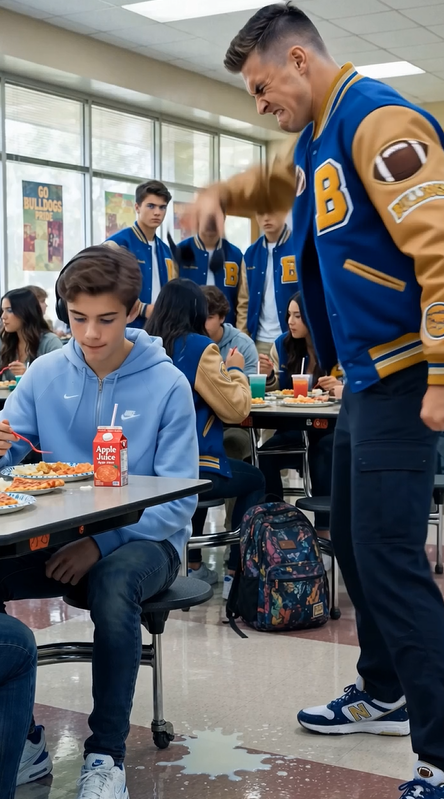
He was smiling.
Damon was larger than nearly everyone else in our grade. He had broad shoulders, expensive sneakers, and the effortless arrogance of someone who had learned that adults would excuse almost anything he did.
I was only ten years old. My gray hoodie had faded from countless washings, and the shoes on my feet had come from a secondhand store where my mother shopped when money was tight.
For months, I had tried to stay out of Damon’s way.
That afternoon, I had finally reached my limit.
“Pick it up,” Damon whispered, leaning close enough that only I could hear him.
“Get down on your hands and knees, scholarship. While you’re down there, you can clean my shoes.”
Behind him, his friends arranged themselves in a loose semicircle, blocking the narrow space between the cafeteria’s metal garbage containers and the entrance to the kitchen.
Trent and Kevin stood among them, grinning.
Two eighth-graders held their phones at chest height, recording everything.
They were expecting another entertaining afternoon at my expense.
For months, that was what I had given them.
Silence.
Apologies.
The spectacle of a smaller boy collecting his damaged belongings while everyone around him pretended not to notice.
But this time, I looked toward the cafeteria entrance.
Mr. Henderson was standing beside the open double doors.
He glanced at Damon.
Then he looked directly at me.
Our eyes met briefly, and I could tell he understood exactly what was happening.
He turned away and walked out.
Something inside me shifted.
I stepped onto a dry section of the floor, positioned my feet firmly beneath me, lowered my chin, and raised both hands.
Damon noticed immediately.
His smile grew wider.
“Oh, look at that,” he announced. “The little charity case thinks he can fight.”
Several students burst into laughter.
I didn’t say anything.
Damon moved another step closer. When I refused to lower my hands, irritation began replacing the amusement on his face.
“You really want to do this?”
I remained silent.
He drew back his right arm and launched a heavy, sweeping punch toward my face.
I didn’t flinch.
I didn’t turn away.
And in that fraction of a second before his fist reached me, I remembered something a seventy-one-year-old retired Marine had spent three years teaching me.
A fight isn’t determined by whoever strikes first.
It’s determined by whoever refuses to surrender control.
But to understand why I was standing in that cafeteria, surrounded by thirty laughing students, you need to understand what Damon had been doing long before that afternoon.
Because his cruelty hadn’t begun with a punch.
It had begun when he discovered how much Oak Ridge Middle School was willing to overlook.
I had arrived at Oak Ridge at the beginning of September after receiving an academic transfer voucher.
The school stood in the wealthy northern part of the county, surrounded by carefully maintained lawns, decorative brick buildings, and expensive homes concealed behind tall hedges.
Everything about the campus seemed intended to remind visitors that money mattered.
Polished brass plaques near the entrance displayed the names of generous donors. The athletic building had recently been renovated, and each morning, luxury SUVs filled the circular driveway as parents dropped off children carrying designer backpacks and wearing sneakers worth more than my mother’s weekly grocery allowance.
The neighborhood where I lived couldn’t have been more different.
Our apartment was beyond the old railroad yards, where abandoned industrial buildings stood behind chain-link fences and streets flooded whenever heavy rain overwhelmed the drainage system.
Our building was aging. The lights in the stairwell flickered, and the heating pipes knocked loudly throughout the winter.
My mother worked overnight shifts at a convalescent home.
Before taking that job, she had spent long days at a municipal laundry, standing beside enormous industrial washing machines until her hands became painfully red and cracked.
She never complained about how hard she worked.
The only thing she complained about was when she suspected I hadn’t eaten enough.
When the district approved my transfer to Oak Ridge, she sat at our kitchen table holding the acceptance letter and crying.
“You’re getting an opportunity I never had,” she told me, gripping the paper tightly. “Promise me you’ll make the most of it.”
“I promise.”
“And don’t worry about trying to fit in with the rich kids. Just be yourself.”
I nodded.
Neither of us realized how difficult keeping that promise would become.
On my first morning at Oak Ridge, I entered the administrative office wearing my old gray zip-up hoodie. Years of washing had left its cuffs badly frayed.
The backpack hanging from my shoulder had once belonged to an older cousin. A faded iron-on patch covered a tear near its side pocket.
The attendance clerk handed me a blue transfer voucher slip.
Standing beside the counter was Damon Vance.
He was waiting for a late pass, apparently because his father had already called the school to explain why he was arriving late.
Damon glanced at the blue slip in my hand.
His gaze slowly traveled downward toward my worn sneakers.
He didn’t speak.
He simply studied me through pale blue eyes, as though trying to calculate how easily I could be intimidated.
At first, I assumed he was curious about the new student.
Three days later, I understood the difference between curiosity and choosing a victim.
It happened during physical education.
We were playing dodgeball.
Coach Miller had divided the gymnasium into two sections. He sat on a rolling chair near the equipment closet, blowing his silver whistle whenever a round ended.
Damon was one of the team captains.
He stood at least six inches taller than most children our age, and whenever he spoke, everyone seemed eager to listen.
His family had contributed money toward improvements to the athletic facilities, including the new scoreboards in the weight room.
Damon behaved as though those donations meant the entire school belonged to him.
During one round, I walked toward the bleachers to retrieve a ball that had rolled away.
I wasn’t watching Damon.
That was my mistake.
He picked up the heaviest red rubber ball he could find, deliberately crossed the center line, and hurled it toward the side of my head.
I heard it rushing past my ear.
An instant later, the ball struck the metal supports beneath the bleachers with a deafening crash.
It had missed me by only a few inches.
The gymnasium fell quiet.
Several feet away, Damon stood with his hands resting on his hips.
“Watch your perimeter, voucher,” he called. “You’re looking pretty slow out there.”
Trent laughed.
Kevin covered his mouth and pretended to cough.
I turned toward Coach Miller.
He had watched the entire incident.
There was no reasonable way he could have missed it.
But he simply raised his whistle.
“Keep the pace up, Vance. Play to the whistle.”
That was all.
No warning.
No explanation.
Not even a question about whether I was okay.
I retrieved the stray ball and returned it to the equipment rack.
I didn’t argue with Damon.
I didn’t threaten him.
I simply walked back to my teammates.
But I could feel him watching me.
He had tested the limits of what he could get away with.
And the adults had just shown him that there might not be any.
Chapter 2: THE PRICE OF BEING DIFFERENT
By the second week of October, Damon had discovered that lunchtime was the perfect opportunity to make my life miserable.
Oak Ridge had an unofficial cafeteria seating arrangement that almost everyone understood.
Damon and his closest friends occupied the large tables beside the windows. Popular athletes and cheerleaders gathered around them. Other students filled the middle rows, while children like me usually ended up near the dish-return station, where the constant clatter of trays made conversation difficult.
I didn’t mind eating alone.
Most afternoons, I used the quiet time to review my algebra notes before sixth period.
Numbers made sense to me.
They followed rules.
If you worked carefully, understood the problem, and checked each step, you could usually find the correct answer.
People weren’t nearly so predictable.
One Tuesday, I was halfway through a peanut butter sandwich when Damon approached my table with Trent and Kevin.
He was carrying an open carton of chocolate milk.
Without asking permission, he rested one hand against the back of my chair, making the metal frame rattle beneath his weight.
“This table’s reserved for team equipment,” he announced. “Pack up your stuff, transfer.”
I looked around the cafeteria.
Four nearby tables were completely empty.
There wasn’t a piece of athletic equipment on any of them.
“There’s plenty of space across the aisle,” I replied quietly.
I wasn’t trying to start an argument.
I simply wanted to finish my lunch.
Damon stared at me for a moment.
Then he smiled.
Without another word, he tipped the carton of chocolate milk directly over my notebook.
The brown liquid spread rapidly across the pages, soaking my carefully written calculations before flowing over the wax paper surrounding my sandwich.
Several students gasped.
Someone laughed.
Trent immediately pulled his phone from his hoodie pocket and pointed its camera toward my table.
I stared down at my ruined schoolwork.
For a moment, my fingers tightened into fists.
I imagined snatching the carton from Damon and throwing the remaining milk straight back at him.
But I forced myself to breathe slowly.
I closed my soaked notebook, collected my belongings, and stood.
Damon shifted just enough to let me pass.
“Good dog,” he muttered. “You know where you belong.”
As I walked around him, his elbow struck my shoulder.
I carried the ruined lunch to the garbage container and dropped it inside. Then I headed toward the nurse’s office to wash the sticky milk from my arms.
My heart was pounding.
Not because I was frightened.
It was pounding because staying calm required more strength than Damon could possibly understand.
I was ten years old.
And patience doesn’t always come naturally to ten-year-old boys.
When someone humiliates you, every instinct urges you to fight back. You want to shout, push, swing your arms, or do anything that proves you aren’t helpless.
But someone had taught me a different lesson.
Anger could warn you that something was wrong.
It couldn’t be trusted to decide what you should do about it.
That lesson became increasingly difficult to remember as October gave way to November.
Because Damon wasn’t satisfied with humiliating me inside the school.
Soon, the cruelty followed me everywhere.
Someone created an anonymous Instagram account called OakRidgeOutcasts.
The account posted blurry photographs of transfer students and children whose families couldn’t afford the expensive clothing that many Oak Ridge students wore.
Within three days, a picture of me appeared near the top of the page.
Someone had photographed me from behind during history class.
The picture deliberately emphasized the worn stitching on my backpack and the damaged rubber along the soles of my sneakers.
Its caption mocked my academic voucher and questioned whether my shoes had come from a charity store or the county landfill.
More than a hundred comments appeared beneath the photograph.
Most came from people associated with Damon’s social circle.
Some posted laughing emojis.
Others made jokes about my clothes.
Several asked whether I depended on free school meals.
One comment even suggested that children from my neighborhood should be required to enter the school through the service entrance.
I read the page once.
Then I switched off my phone.
I told myself their words didn’t matter.
But cruel words have a way of following you long after you’ve stopped looking at them.
The following morning, I noticed students staring at my shoes.
Two girls whispered when I entered science class.
In the hallway, a boy I had never spoken to called me “county voucher.”
By lunchtime, nearly everyone seemed familiar with the nickname.
Damon had discovered something that made his cruelty even easier.
He no longer needed to be standing beside me to make my day miserable.
Other students were willing to do it for him.
And many seemed to enjoy it.
The incident in the stairwell happened on a Thursday.
I was heading to science class between third and fourth periods.
The third-floor stairwell was narrow, with painted cinderblock walls, exposed pipes, and heavy fire doors at both ends.
Teachers rarely used it, and most students preferred the crowded main hallways.
I was climbing the stairs two steps at a time when Trent and Kevin appeared on the upper landing.
They stopped directly in front of the doorway.
I slowed down.
Something about their expressions made my stomach tighten.
I turned to go back downstairs.
Damon was waiting at the bottom.
He leaned against the lower fire door with his arms folded.
The door clicked shut behind him.
The sound echoed through the empty stairwell.
“You didn’t like our post?” Damon asked, beginning to climb toward me.
“We made you famous. You should be thanking us.”
“I have science class, Damon.”
“Then you’d better hurry.”
“Move aside.”
Trent laughed from above.
“Careful, Damon. The scholarship kid sounds angry.”
Damon climbed another step.
“Or what?” he challenged. “You going to tell Mr. Henderson?”
He leaned so close that I could smell the peppermint gum on his breath.
“Maybe you’ll run to the principal. Maybe you’ll cry until somebody gives you another voucher.”
Kevin snickered.
From the upper landing, Trent called down, “His dad bought the gym floor. Who do you think the school will believe?”
I kept my feet shoulder-width apart and maintained my balance.
It wasn’t something I consciously decided to do.
It was a habit.
Damon reached toward me and grabbed the front flap of my backpack.
He jerked it violently.
The stitching along the left strap tore with a sharp ripping sound.
My shoulder twisted as the bag pulled against me.
For a moment, I felt myself being dragged off balance.
But I bent my knees, lowered my center of gravity, and kept both feet firmly planted.
“Let go of the bag,” I said.
My voice remained quiet.
Damon blinked.
For a brief moment, uncertainty crossed his face.
I wasn’t begging.
I wasn’t shouting.
And I wasn’t desperately searching for an escape.
He apparently didn’t know what to make of that.
Then his expression hardened.
He yanked the strap again and shoved me against the wall.
My shoulder struck the painted cinderblock.
Damon finally released the bag.
“Next time you ignore us in the hallway, we’re taking the whole thing,” he warned. “We’ll dump it behind the kitchen.”
Then he turned toward his friends.
“Come on. He’s boring.”
They walked away laughing.
The stairwell door slammed behind them.
I remained motionless.
Above my head, a fluorescent light buzzed.
I looked down at the torn strap hanging from my shoulder.
My backpack wasn’t expensive.
It wasn’t stylish.
It had belonged to my cousin, who had given it to me when I started school. Before my first day at Oak Ridge, my mother had carefully cleaned it so I would have something respectable to carry.
I ran my thumb over the damaged stitching.
Then I sat down on the concrete steps.
For two full minutes, I didn’t move.
I wasn’t crying.
I wasn’t imagining revenge.
I was trying to understand why the adults who were supposed to protect children kept abandoning us to people who enjoyed hurting us.
That afternoon, I finally made a decision I had been putting off for weeks.
I went directly to the school administration.
And I formally reported Damon Vance.

