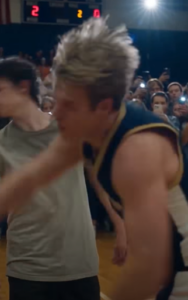
 The basketball slammed into Mason Reed’s chest so hard that he stumbled backward, and the laughter exploding around Lincoln High’s gymnasium made it clear that nobody intended to help him.
“Catch it, janitor boy!”
Trevor Hale stood beneath the championship banners with his arms spread wide, a cruel grin stretching across his handsome face.
At eighteen, Trevor was everything Lincoln High celebrated.
He was six feet three inches tall, broad-shouldered, handsome, and captain of the varsity basketball team. His blond hair was always perfectly styled, his expensive basketball shoes looked brand-new, and his navy-blue jersey carried the number eleven in bold gold lettering.
His father, Grant Hale, was one of the wealthiest businessmen in town and the president of the school’s athletic booster association.
Trevor had grown up believing that the basketball court belonged to him.
Mason Reed had grown up cleaning it.
Sixteen-year-old Mason stood barely five feet seven inches tall. His narrow shoulders disappeared beneath a faded gray T-shirt, his dark brown hair never seemed properly combed, and his basketball shorts had been washed so many times that their original color was almost impossible to identify.
His sneakers were worse.
The soles were worn smooth around the edges, the toes were scratched, and a strip of black tape covered a tear near the left shoe.
But his dark eyes were steady.
And when Trevor laughed again, Mason did something he had never done before.
He looked the captain directly in the face and refused to lower his head.
“Leave my father alone.”
The laughter faltered.
Only moments earlier, the Friday afternoon had been ordinary.
Samuel Reed, Mason’s forty-four-year-old father, had been mopping the hardwood near the western bleachers while Trevor and several teammates finished an informal practice.
Samuel was a quiet, broad-handed man with tired brown eyes, close-cropped dark hair beginning to gray at the temples, and a permanent stiffness in his right leg.
His left hand bore a pale, uneven scar that disappeared beneath his sleeve.
He wore the same dark-green custodial uniform every afternoon, and his battered cleaning cart made a faint metallic rattle whenever he pushed it across the floor.
Most students knew him simply as Mr. Reed.
Some barely acknowledged him at all.
Trevor had developed a habit of making sure nobody forgot what Samuel did for a living.
That afternoon, he had walked directly into Samuel’s freshly cleaned section of the court.
“Careful, guys,” Trevor announced. “The royal janitor’s polishing our palace.”
Several teammates laughed.
Samuel continued working.
Trevor planted one expensive white sneaker in the middle of the wet floor.
“Missed a spot.”
Samuel gently moved his mop toward the shoe.
“Please step back, Trevor. The floor’s slippery.”
“Then clean it better.”
Trevor kicked the yellow bucket.
It toppled sideways, sending cloudy water across the gleaming hardwood.
The splash echoed beneath the basketball hoops.
Samuel froze.
For a moment, he stared at the spreading water as though something far more terrible than a cleaning accident had happened.
Then he reached for the bucket.
His injured right leg buckled slightly.
Mason, who had been waiting near the equipment closet, immediately moved to help him.
But Trevor stepped between them.
“Better tell your daddy he missed a spot!”
The laughter came again.
And Mason felt something inside him finally give way.
He had endured months of insults.
He had ignored Trevor calling him a charity case in the cafeteria.
He had walked away when Trevor’s teammates photographed his worn sneakers.
He had remained silent when somebody taped a handwritten sign reading Future Janitor to his locker.
But watching his father kneel painfully in dirty water while other boys laughed was different.
“Leave my father alone,” Mason repeated.
Trevor tilted his head.
“Well, look at that.”
He glanced toward his teammates.
“The little janitor finally found his voice.”
“Trevor,” Samuel said quietly. “That’s enough.”
Trevor ignored him.
He snatched up a basketball and hurled it toward Mason.
Mason caught it against his chest.
Trevor smiled.
“One-on-one.”
Mason said nothing.
“First to five points wins. If you lose, you’re cleaning this entire gym with your daddy tonight.”
Someone whistled.
Another player shouted, “Come on, Trevor! Don’t hurt him too badly!”
Mason looked toward his father.
Samuel had straightened up, gripping the handle of his mop with his scarred left hand.
Something passed between them.
A warning.
A memory.
Perhaps even a request.
Mason turned back.
“And what if I win?”
Trevor’s grin widened.
He looked down at Mason’s sneakers.
“Then I’ll kneel right here and kiss those filthy shoes.”
The gym erupted.
Mason bounced the basketball once.
Then he held it beneath his arm.
“You just made a promise in front of witnesses.”
For the first time, Trevor’s smile tightened.
But only for a moment.
“Don’t worry. I won’t lose.”
He had no idea that the skinny boy standing opposite him had spent almost eleven years learning the secrets of that very court.
And he knew even less about the man who had taught him.
Samuel Reed had begun bringing Mason to Lincoln High when Mason was five years old.
Back then, Samuel’s wife, Laura, worked evening shifts at a nursing home, and childcare was an expense their family could rarely afford.
Mason would sit on the bottom row of the bleachers with a sandwich wrapped in wax paper while his father cleaned the gym.
Sometimes he completed his homework.
Sometimes he fell asleep beneath Samuel’s old jacket.
But most evenings, he watched basketball.
He watched the way the varsity players moved when they were tired.
He watched how their shoulders turned before their feet followed.
He noticed that the best shooters rarely stared at the basket for long.
And he noticed something else.
When the players left, his father often remained standing at center court, holding a broom as though he were imagining a different life.
One evening, when Mason was seven, he asked a question.
“Dad, did you ever play basketball?”
Samuel looked toward the hoops.
“A little.”
“Were you good?”
His father smiled faintly.
“Good enough to enjoy it.”
“Can you teach me?”
Samuel studied him.
Then he put down the broom.
“Get that ball from under the bleachers.”
That night, with only half the overhead lights burning, Mason learned his first lesson.
It had nothing to do with shooting.
Samuel stood in front of him, holding a basketball.
“Watch my shoulders.”
Mason obeyed.
Samuel moved left.
Mason followed.
His father moved right.
Mason followed again.
Then Samuel dropped the ball, stepped around him, and caught it before Mason understood what had happened.
“Again,” Samuel said.
They practiced until Mason was breathless.
Finally, the boy collapsed onto the hardwood.
“How did you know I would go the wrong way?”
“Because you were watching where I wanted you to look.”
Samuel lowered himself beside him, wincing as he bent his injured knee.
“Basketball teaches you something important, son. People can make a lot of noise with their mouths. But their feet usually tell the truth.”
Mason never forgot that sentence.
Over the following years, Samuel taught him how to read balance, anticipate movement, protect the ball, and shoot without wasting motion.
They practiced with discarded basketballs.
They used faded tape to mark positions on the floor.
When Samuel’s knee became too painful, he coached from a folding chair while Mason repeated drills beneath the dim lights.
There were no expensive trainers.
No private basketball camps.
No custom sneakers.
There was only a father, a son, and an empty gymnasium after everyone else had gone home.
And the strangest part was that Samuel almost never watched Mason’s hands. He watched his feet.
“Again,” he would say.
Mason would drive toward the basket.
“Too early.”
Mason would try again.
“Your right shoulder gave you away.”
Another attempt.
“Better.”
Sometimes Samuel smiled.
Sometimes he said nothing at all.
But whenever Mason finally completed a difficult move perfectly, Samuel tapped the floor twice with the wooden handle of his mop.
That was their applause.
A quiet sound nobody else ever heard.
Six months before Trevor challenged him, Coach Daniel Bennett had accidentally witnessed one of those evening practices.
Bennett was a tall, weathered man nearing fifty, with graying hair, a crooked nose from an old basketball injury, and a reputation for demanding discipline from every player.
He had returned to the gym to retrieve a forgotten folder.
The building was nearly dark.
From the hallway, he heard a basketball bouncing.
At first, he assumed one of the varsity players had ignored the closing time.
Then he looked through the doorway.
Mason was alone on the court.
Samuel sat beside his cleaning cart.
“Left,” Samuel called.
Mason changed direction.
“Stop.”
Mason froze.
“Now.”
The boy pivoted, stepped backward, and released a shot.
The ball fell cleanly through the net.
Samuel tapped his mop handle twice.
Bennett remained motionless.
He had coached basketball for twenty-three years.
He had seen hundreds of promising young players.
But there was something unusual about Mason.
The boy was not simply fast.
He seemed to know where an imaginary defender would be before that defender could move.
Bennett watched another sequence.
Then another.
Finally, he entered.
“Mason.”
The basketball rolled away.
Samuel stood immediately.
“Coach. I didn’t realize anyone was still here.”
Bennett ignored the apology.
He looked at Mason.
“Why aren’t you trying out for varsity?”
Mason glanced toward his father.
“I have things to do after school.”
“What things?”
“Helping my dad.”
Bennett looked at Samuel.
Then he looked at the basketball.
“You could be one of the best guards in this district.”
Mason said nothing.
“Come to practice Monday. I’ll make room.”
The boy shook his head.
“Thank you, Coach. But I can’t.”
Bennett was surprised.
“Can’t, or won’t?”
Mason swallowed.
“Both.”
That was the first invitation.
There were others.
Bennett approached Mason outside the cafeteria.
He left a registration form with the school counselor.
He arranged an opportunity for Mason to attend an early-morning training session.
Every time, Mason politely declined.
Eventually, Bennett stopped asking.
Not because he had lost interest.
Because he had begun to understand that Mason’s refusal had almost nothing to do with basketball.
One afternoon, Bennett found Samuel cleaning beneath an old photograph in the hallway outside the gym.
The picture showed a basketball team from nearly twenty years earlier.
Its edges had yellowed.
A narrow empty rectangle on the wall indicated where another framed item had once hung.
“Does he know?” Bennett asked quietly.
Samuel did not look up.
“Know what?”
Bennett hesitated.
“Everything.”
Samuel tightened his grip on the mop.
“He knows enough.”
“Sam, that boy deserves a chance.”
“He’ll have one.”
“When?”
Samuel stared at the empty rectangle.
“When this place learns the difference between a uniform and a person.”
Bennett wanted to argue.
Instead, he watched his old acquaintance push the cleaning cart down the hallway.
For reasons he could not fully explain, the conversation left him deeply uneasy.
By four o’clock that Friday, the gymnasium was overflowing.
Word of the challenge had raced through Lincoln High.
Students poured out of classrooms.
Members of the cheerleading squad crowded near the baseline.
A few teachers appeared at the entrances.
Dozens of smartphones rose above the bleachers.
A junior named Maya Chen, who helped produce the school newspaper, climbed onto the bottom row for a clear view.
She had witnessed Trevor kick Samuel’s bucket.
She had also captured the entire confrontation on video.
Beside her, another student whispered, “This is going to be embarrassing.”
“For Trevor?” Maya asked.
The girl laughed.
“Obviously not.”
Maya didn’t answer.
She had seen Mason walking through the school for two years.
She knew he never boasted.
She knew he never fought.
But she had also seen the expression on his face when Trevor made that promise.
It had not looked like fear.
It had looked like a decision.
Coach Bennett arrived as Trevor began warming up.
“What is going on?”
Trevor spun the ball on his finger.
“Friendly competition, Coach.”
Bennett saw Mason standing near the free-throw line.
Then he saw Samuel trying to contain the spilled water with towels.
His face hardened.
“Trevor. Did you do that?”
Trevor shrugged.
“Accident.”
Maya lowered her phone.
“Actually, Coach—”
Samuel interrupted gently.
“It’s all right. I’ll clean it.”
Bennett examined the wet floor.
Nobody could safely play until it was dry.
He motioned to two players to help Samuel.
Trevor rolled his eyes.
While they worked, Bennett approached Mason.
“You don’t have to do this.”
Mason kept his eyes on Trevor.
“I know.”
“He’s bigger than you.”
“I know.”
“He’s been playing organized basketball since elementary school.”
“I know that too.”
Bennett lowered his voice.
“Then tell me why you’re doing it.”
Mason finally turned.
Across the gym, his father was kneeling beside the overturned bucket.
“Because he’s spent too many years believing my dad can’t stand up for himself.”
Bennett studied the boy.
“And you think basketball changes that?”
“No,” Mason said. “But maybe losing will make him listen.”
The coach had no answer.
When the floor was finally dry, Bennett reluctantly agreed to supervise the game to prevent anyone from getting hurt.
He established the rules.
First to five baskets.
Every successful field goal counted as one point, regardless of distance.
No unnecessary contact.
Clear possession after each basket.
The player who scored would surrender the ball to the defender for the next possession.
Trevor barely listened.
He had already begun imagining the video his teammates would post that evening.
The great Trevor Hale humiliating the janitor’s son.
It would be another story people told about him.
Another victory.
Another reason everyone would remember his name.
The whistle blew.
Trevor attacked immediately.
He drove hard toward the right side of the basket, using his height to shield the ball.
Mason moved with him.
But Trevor leaned into the smaller boy, rose, and banked the ball off the glass.
One point.
The bleachers erupted.
“ONE NOTHING!” a teammate shouted.
Trevor caught the ball and tossed it toward Mason.
“That all you’ve got?”
Mason said nothing.
He took possession, dribbled twice, and attempted to turn past Trevor.
The captain cut him off.
Mason stepped backward.
Trevor lunged.
The ball clipped Mason’s fingertips and bounced out of bounds.
A turnover.
Trevor took possession and attacked again.
This time, he backed Mason toward the basket before spinning over his left shoulder.
The ball dropped through the net.
Two to nothing.
Trevor threw both arms into the air.
“COME ON, JANITOR BOY!”
His teammates pounded their feet against the bleachers.
Someone yelled, “Just give up!”
Mason stood beneath the basket.
His breathing was steady.
His expression remained unreadable.
From the sideline, Samuel watched his son closely.
The older man’s jaw tightened.
But he did not move toward him.
Mason retrieved the ball.
He glanced at Trevor’s feet.
Then he bounced it twice.
And everything changed.
Trevor expected Mason to drive right.
He had forced the younger boy that direction on the previous possession.
This time, Mason gave him exactly the same opening.
His right shoulder dropped.
His eyes flickered toward the right baseline.
Trevor reacted.
But Mason’s left foot had already planted.
He crossed the ball behind his back, cut sharply left, and slipped past the captain before Trevor could recover.
The ball touched the backboard.
Then the net.
Two to one.
The gym went strangely quiet.
Trevor turned.
“Lucky.”
Mason walked back toward the top of the key.
“Your ball.”
Trevor attacked with greater force.
He tried to muscle past Mason near the free-throw line.
Mason stayed low.
Trevor changed direction.
Mason mirrored him.
The captain hesitated, irritated by the smaller boy’s stubborn defense.
Then he attempted a quick crossover.
Mason’s hand flashed downward.
The ball was suddenly gone.
A clean steal.
Mason sprinted toward the basket.
Trevor chased him.
But Mason slowed just enough to make Trevor rush past his shoulder.
He stepped sideways and released a short, soft shot.
Swish.
Two to two.
The students along the baseline surged to their feet.
Maya stared at her phone.
“Oh my God.”
Beside her, the girl who had predicted Mason’s humiliation stopped smiling.
Trevor’s cheeks reddened.
He snatched up the basketball.
“Don’t get excited.”
Mason walked backward into defensive position.
“I haven’t said anything.”
The captain drove toward him.
Mason followed.
Trevor attempted to push through the narrow space between Mason and the sideline.
For one instant, the ball hung exposed near his hip.
Mason reached.
The ball popped free.
Before Trevor could recover, Mason had possession.
He retreated beyond the three-point line.
Trevor charged toward him.
Mason stepped backward.
The captain’s momentum carried him too far forward.
Mason rose into a jump shot.
His release was effortless.
The ball arced beneath the bright gymnasium lights.
It dropped through the center of the rim without touching metal.
Three to two.
For the first time, Lincoln High’s basketball captain was losing.
The gym exploded.
Students jumped from their seats.
A few began chanting Mason’s name.
Trevor turned scarlet.
“THAT WAS NOTHING BUT LUCK!”
Mason caught the returning ball.
“Then you shouldn’t be worried.”
Someone burst out laughing.
Trevor heard it.
That made everything worse.
He marched toward Mason until their faces were inches apart.
“You think you’re funny?”
Mason held his ground.
“No.”
“Then wipe that look off your face.”
“What look?”
Trevor had no answer.
He simply snatched the ball.
The coach raised his whistle.
“Trevor. Back up.”
For a moment, it seemed the captain might refuse.
Then he stepped away.
The next possession was different.
Trevor abandoned his usual moves.
He attacked with reckless speed, slamming the ball against the hardwood, trying to overwhelm Mason with raw strength.
Mason retreated.
One step.
Two.
Three.
Trevor thought he had forced the smaller boy beneath the basket.
He prepared to shoot.
But Mason had been watching the same thing his father had taught him to watch years before.
The captain’s feet.
Trevor always planted his left foot just before bringing the ball across his body.
Samuel had once told Mason that an impatient player revealed himself before the decisive movement.
Now Mason saw it.
The left foot planted.
The shoulder turned.
Mason struck.
His fingertips knocked the ball loose.
Trevor stumbled forward.
Mason collected the basketball and raced toward the opposite side of the half-court.
The captain spun and chased him.
For a split second, Trevor appeared to have recovered.
He spread both arms, blocking the lane.
Mason stopped.
Trevor skidded.
Mason stepped backward.
And the skinny boy launched another clean jump shot.
Four to two.
This time, nobody laughed at Mason.
Nobody joked about his sneakers.
Nobody mentioned his father’s job.
The bleachers shook with applause.
Even several varsity players had risen to their feet.
Isaac Bell, Trevor’s closest teammate, stared at the scoreboard.
“He’s reading every move Trevor makes.”
Another player shook his head.
“That’s impossible.”
Coach Bennett stood near the sideline.
His arms were folded.
He was not smiling.
He was watching Samuel.
The janitor had lowered himself into a folding chair.
His injured leg was stretched in front of him.
He held the wooden handle of his mop between both hands.
And when Mason’s fourth shot went through the net, Samuel tapped the handle against the floor.
Twice.
Bennett closed his eyes briefly.
He knew that sound.
He had heard it many years earlier.
Back when Samuel Reed’s name still meant something very different inside that gymnasium.
Trevor stormed toward Mason.
The crowd noise seemed to strike him from every direction.
Four to two.
Two points behind.
One basket away from humiliation.
He thought of his father’s face.
He thought of the championship banners.
He thought of the hundreds of students recording him.
Then he looked at Mason’s battered sneakers.
Something ugly rose inside him.
He shoved Mason in the chest.
Hard.
The smaller boy staggered backward.
The crowd screamed.
Coach Bennett blew his whistle.
“Trevor!”
But the captain was already shouting.
“YOU ACTUALLY THINK YOU’RE BETTER THAN ME?”
Mason straightened.
His breathing had quickened.
Sweat darkened the collar of his faded shirt.
But his voice was calm.
“No.”
Trevor stepped closer.
Mason looked into his eyes.
“I just think it’s time you stopped treating everyone like they’re beneath you.”
The words carried farther than Mason expected.
Students in the first rows fell silent.
Trevor’s jaw tightened.
For a moment, he seemed unable to understand what he had heard.
Then he seized the basketball.
“I’m ending this.”
Coach Bennett moved between them.
“One more incident like that and the game ends immediately.”
Trevor pointed toward Mason.
“Then tell him to stop acting like he’s something special.”
Bennett’s expression hardened.
“He hasn’t said he’s special, Trevor. You have.”
A few students gasped.
Trevor backed away.
Mason retrieved his position.
The coach lowered his arm.
Play resumed.
Trevor charged toward the hoop.
But as Mason moved to close the lane, the captain attempted a desperate trick.
He hurled the ball toward the backboard, intending to collect the rebound himself before Mason could turn.
It was an arrogant move.
The kind that thrilled a crowd when it worked.
And Trevor was so desperate to reclaim their admiration that he never considered what might happen if it failed.
Mason saw the angle.
He turned before the ball struck the glass.
Then he jumped.
His fingers closed around the ball before Trevor could reach it.
A clean interception.
Mason landed and accelerated.
Trevor spun after him.
The gymnasium roared.
Students were standing on the bleachers now.
Maya’s hands trembled as she recorded.
“Come on, Mason!” somebody screamed.
Trevor was faster in a straight line.
He had longer legs.
More muscle.
More experience.
But Mason changed pace twice, forcing the captain to adjust his stride.
The first move created a few inches.
The second created a step.
By the time Mason reached the basket, Trevor was behind him.
Mason lifted the ball.
Released it.
And watched it rise.
The basketball seemed to move through the air with impossible slowness.
Beneath the basket, Trevor stretched out an arm.
His fingertips missed.
The ball touched nothing but net.
Five to two.
The game was over.
For perhaps three seconds, Lincoln High’s gymnasium was silent.
Then the world exploded.
Students screamed.
Shoes hammered against the metal bleachers.
Dozens of phones shook in raised hands.
Isaac Bell stood openmouthed.
Coach Bennett lowered his whistle.
And Trevor Hale remained beneath the basket, staring upward.
He had lost.
Not to a rival academy’s star player.
Not to a highly recruited senior.
Not even to another member of his own team.
He had lost to the skinny sixteen-year-old whose father cleaned the gym.
The chant began near the back.
“MA-SON!”
Another section joined.
“MA-SON!”
Then hundreds of voices thundered together.
“MA-SON! MA-SON! MA-SON!”
Mason did not raise his arms.
He did not dance.
He did not shout.
He simply picked up the basketball and walked slowly toward Trevor.
The captain’s face was pale now.
Mason stopped in front of him.
He glanced down at his old sneakers.
Then he looked up.
“You made a promise.”
Trevor’s fists clenched.
A dozen phones moved closer.
“Don’t,” Trevor whispered.
Mason did not move.
Trevor’s eyes darted toward the bleachers.
“Please.”
It was the first time anyone could remember hearing Trevor Hale beg.
“You’ve already won. Just stop.”
Mason studied him.
For an instant, he saw something beneath the captain’s arrogance.
Not anger.
Fear.
The kind of fear that comes when a person realizes the entire world is watching him become something he cannot bear to see.
Mason opened his mouth.
But before he could speak, another voice cut through the gymnasium.
“That’s enough.”
Coach Bennett stepped between them.
The crowd quieted.
Trevor swallowed.
Bennett looked from Mason to Trevor.
Then he spoke clearly enough for everyone to hear.
“Trevor, you don’t need to humiliate yourself.”
The captain exhaled.
But the coach had not finished.
“You are, however, handing over your captain’s jersey.”
Trevor blinked.
“What?”
“Your jersey. Your captaincy. Both.”
“Coach, you can’t be serious!”
Bennett held out his hand.
“I’ve never been more serious.”
Trevor glanced toward his teammates.
No one defended him.
He looked toward the bleachers, where several students were still recording.
“This was just a stupid game!”
“No,” Bennett said.
His voice was quiet, but it carried.
“This became something much more serious the moment you decided another person’s dignity was entertainment.”
Trevor shook his head.
“You’re taking my captaincy because I lost to him?”
Bennett stepped closer.
“I’m taking it because of what you did before the first whistle, what you did during the game, and how you’ve treated people for months.”
Trevor’s face twisted.
He pointed at Mason.
“He isn’t even on the team!”
The coach followed his gesture.
Then he looked back at Trevor.
“That’s the part you should be asking about.”
A ripple moved through the crowd.
Bennett turned toward Mason.
“Because the boy you just tried to humiliate is the same player I’ve spent six months trying to recruit for this team.”
Nobody spoke.
Trevor stared at Mason.
Isaac whispered, “Six months?”
Maya lowered her phone slightly.
The coach continued.
“I’ve watched players come through this gym for more than twenty years. And in all that time, I’ve rarely seen anyone with Mason’s combination of patience, instinct, and discipline.”
Trevor’s mouth opened.
No words came.
“He could have joined our team months ago,” Bennett said. “I asked him repeatedly.”
Mason shifted uneasily.
“Coach—”
“He refused every invitation.”
Bennett looked toward the western entrance.
“And now I think everyone deserves to understand why.”
At that moment, the gym doors opened.
Samuel Reed entered, pushing his cleaning cart.
The wheels rattled against the floor.
His right leg dragged slightly.
He had gone to retrieve fresh towels and cleaning supplies after Trevor’s earlier mess, but the sound of the crowd had brought him back.
He stopped when he saw everyone watching.
“What happened?”
Mason moved toward him.
“Dad, it’s okay.”
Samuel glanced at the scoreboard.
Five to two.
Then at Trevor’s rigid expression.
Then at Coach Bennett.
Understanding slowly crossed his face.
“Sam,” Bennett said.
Samuel shook his head.
“Daniel. Please don’t.”
The use of the coach’s first name startled several nearby students.
Bennett hesitated.
Then he said something Mason had never heard him say publicly.
“I should have told the truth years ago.”
Samuel’s face drained of color.
“No.”
Bennett looked toward the old western bleachers.
“Ten years ago, there was a fire in this gymnasium.”
A murmur swept across the students.
Most had never heard of it.
The gym had been renovated several years before they entered Lincoln High.
Only a few older teachers remembered the scorched walls, the smoke damage, and the emergency vehicles that had surrounded the building.
Samuel gripped the handle of his cart.
Bennett continued.
“Three children were trapped near the old western stairwell. The emergency exit couldn’t be opened. The smoke was so thick that the firefighters couldn’t immediately reach them.”
Trevor’s expression changed.
Something flickered in his eyes.
A sound.
A smell.
A memory he could not quite reach.
Bennett pointed toward Samuel.
“That man went into the smoke and carried those children out.”
The gymnasium became utterly still.
Mason lowered his head.
His father looked at the floor.
“Samuel suffered severe injuries that night,” Bennett said. “His knee was damaged. His hand was burned. He spent months learning to walk without assistance.”
A girl in the first row covered her mouth.
Bennett’s voice trembled.
“Before that accident, Samuel wasn’t simply an employee here. He had been one of the finest basketball players this school ever produced. And for years afterward, he helped train young players without asking anyone for recognition.”
Samuel closed his eyes.
“Please, Daniel.”
But Bennett had spent too long carrying his silence.
“Mason turned down this team because he couldn’t bear wearing its uniform while watching people mock the man who taught him everything he knows.”
The words landed heavily.
Trevor stared at Samuel’s scarred hand.
For the first time, he seemed to notice it.
Then another voice came from the bleachers.
“That’s a touching story.”
The students turned.
Grant Hale, Trevor’s father, was descending the steps.
He was a tall, silver-haired businessman wearing a tailored charcoal suit and a watch that cost more than Samuel earned in several months.
His expression was controlled.
But his eyes were cold.
“Coach Bennett,” he said, “I suggest we end this spectacle before you embarrass the school any further.”
Bennett did not move.
Grant reached the court.
“I have no objection to recognizing Mr. Reed’s service. But dredging up an old accident in front of students is completely inappropriate.”
Samuel looked away.
Grant turned toward him.
“Samuel, perhaps you should return to your work.”
Mason stepped forward.
“Don’t talk to him like that.”
Grant smiled without warmth.
“And you should remember who you’re speaking to, young man.”
Coach Bennett moved beside Mason.
“Grant, this isn’t about your position.”
“Everything involving this athletic program is my responsibility.”
“No,” Bennett said. “Not everything.”
The two men stared at each other.
Then Samuel spoke.
His voice was barely louder than a whisper.
“Daniel. Stop.”
Bennett turned.
Samuel’s scarred hand was trembling.
For a terrible moment, he looked less like a man standing in a high school gymnasium than someone trapped inside a memory he had fought for ten years to escape.
Grant noticed.
And he smiled.
Just slightly.
It was enough.
Mason saw it.
The coach saw it too.
Bennett looked toward the western exit.
The heavy steel door had been painted blue during the renovation.
A faded evacuation diagram still hung beside it.
Bennett reached into the inside pocket of his jacket.
He removed a folded yellow document.
“I kept a copy of the original incident report,” he said.
Grant’s face changed instantly.
“You have no authority to discuss that.”
Bennett unfolded the paper.
“Then perhaps you can explain why the final report doesn’t match the first one.”
Samuel whispered, “Daniel…”
The coach looked directly at Grant Hale.
“The first report says that the western emergency exit was deliberately secured from the outside.”
Grant took a step forward.
“That’s a lie.”
Bennett did not raise his voice.
“Then answer one question.”
He held up the document.
“Why was the emergency door chained shut on the night three children nearly died?”
Grant’s jaw tightened.
Trevor stared at his father.
And Samuel Reed, the man who had endured years of humiliation without complaint, suddenly spoke in a voice that silenced everyone.
“Because somebody ordered that door locked. And I know who it was.”

