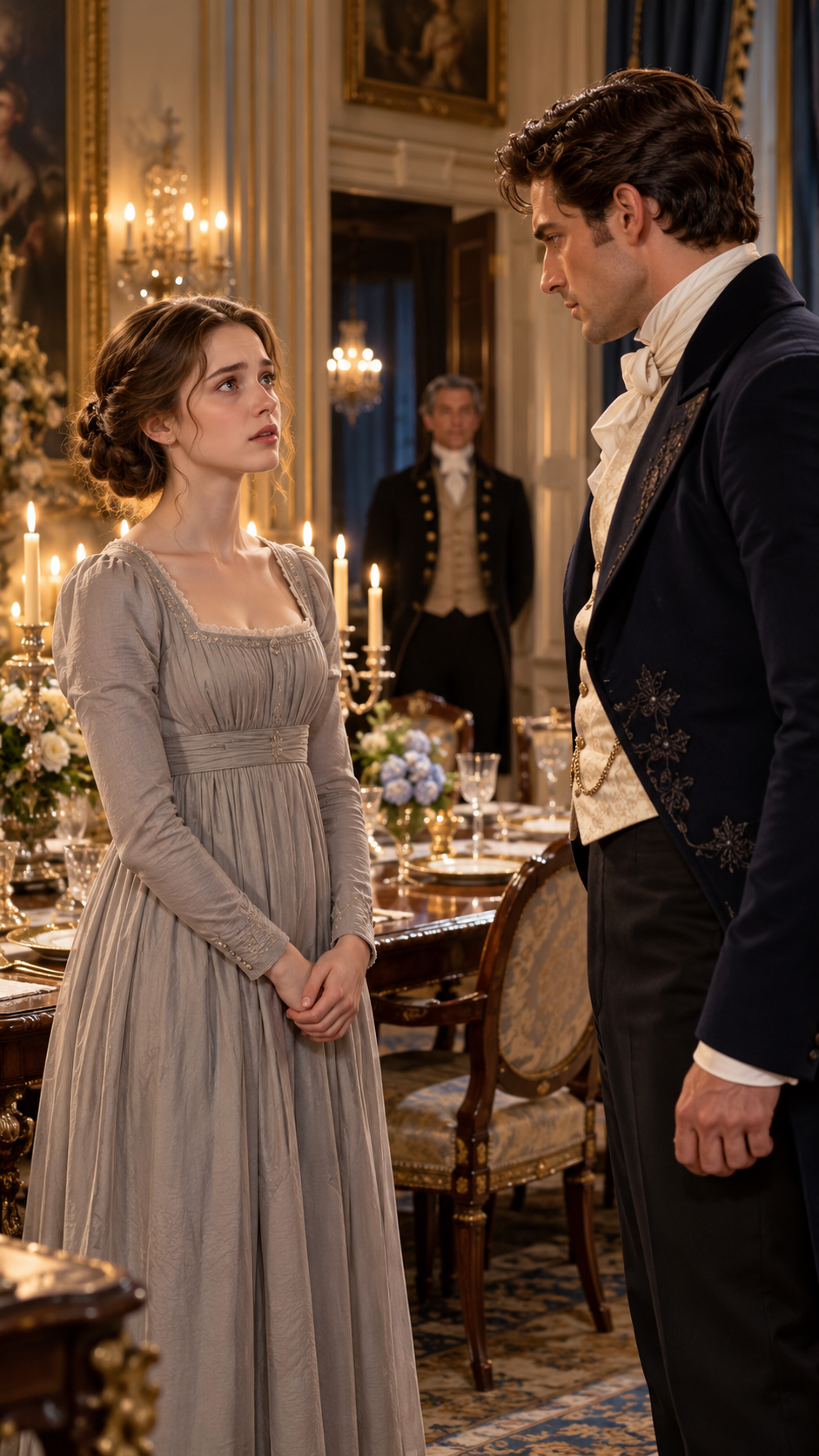
 THEY DRESSED HER PLAINLY SO THE DUKE WOULD SEND HER BACK — HE SENT THE CARRIAGE BACK EMPTY AND KEPT HER
Chapter 1: The Empty Carriage
“Empty, Your Grace?”
The coachman repeated the word as though he had misheard it.
Alaric Dayne, sixth Duke of Rothwell, stood beside the dining room sideboard, holding a folded letter between two fingers.
“Quite empty,” he replied. “You are to return to Frost House without Miss Frost.”
Across the room, Mabel stood motionless.
Only moments earlier, she had been preparing herself for rejection. She had even begun calculating how best to face her mother when she arrived home, how to endure Lydia’s triumphant sympathy, and how many days would pass before the entire county learned that the plain Frost daughter had failed to interest the Duke.
Now, the carriage was leaving without her.
And the Duke seemed utterly unconcerned by the enormous confusion he had created.
“Your Grace,” Mabel said carefully, “I believe there has been a misunderstanding.”
Alaric turned toward her.
“Has there?”
“My family sent me here with the expectation that you would request Lydia.”
“Yes. You have explained that.”
“And your agreement with my father allows you to request another daughter if the first proves unsuitable.”
“Indeed.”
“Then surely—”
“Miss Frost.” His voice remained calm. “Have I said you were unsuitable?”
Mabel opened her mouth.
Then closed it.
It was an unfamiliar experience, having someone take her words seriously enough to challenge them.
“No,” she admitted.
“Then I see no reason to request your sister.”
The coachman waited by the doorway.
Alaric handed him the letter.
“Deliver this personally.”
The man bowed and withdrew.
Mabel watched the door close.
“What did you write?”
Alaric’s expression revealed nothing.
“Something brief.”
“Something disastrous, I suspect.”
“That remains to be seen.”
She studied him for a moment, her brown eyes narrowing.
“Your Grace, my mother will be furious.”
“Will she?”
“She has spent the better part of a year preparing Lydia to become a duchess.”
“A remarkable investment.”
“And she will believe I have interfered.”
“Have you?”
Mabel gave him an astonished look.
“Of course not.”
“Then perhaps she will eventually arrive at the truth.”
For the first time that evening, Mabel laughed.
It was not a polished laugh. There was nothing elegant or carefully measured about it. It escaped before she could stop it, warm and unexpectedly bright.
Alaric found himself watching her.
He had been introduced to accomplished women in London drawing rooms who could laugh on command, blush at precisely the appropriate moment, and make an ordinary compliment sound like the beginning of a courtship.
Mabel Frost appeared incapable of any of those things.
Yet her laughter transformed the room more effectively than any candle.
“You have never met my mother,” she said.
“Clearly, I have an education ahead of me.”
Her smile faded.
“May I ask you something?”
“Certainly.”
“Why?”
There it was again.
The question beneath every careful sentence she had spoken since arriving.
Why had he not dismissed her?
Why had he invited her to stay?
Why would a duke choose the daughter her own family considered least desirable?
Alaric could have answered with courtesy.
He could have told her that a month’s trial was precisely what the contract permitted and that he intended to honor its terms.
Instead, he looked at the glass of claret still standing on the table.
“You noticed something about my household that my own servants have apparently concealed from me.”
“That hardly makes me suitable for marriage.”
“No,” he agreed. “But it makes you interesting.”
Mabel’s expression changed.
“Interesting?”
“Very.”
She looked down at her gray sleeves.
“I have never been called that before.”
Something about the quiet admission disturbed him.
He had meant the word lightly.
She received it as though he had handed her something valuable.
“Well,” he said, “you had better become accustomed to it.”
Outside, the sound of carriage wheels gradually faded down the drive.
For the first time in her life, Mabel Frost remained somewhere because someone had chosen not to send her away.
But as the great doors of Rothwell Abbey closed behind the departing carriage, she could not shake the feeling that her family would soon find a way to make her regret it.
And three days later, the first letter arrived.
Chapter 2: A Mother’s Carefully Written Lie
The letter was addressed to His Grace, the Duke of Rothwell.
It arrived on the fourth morning after Mabel’s entrance into the Abbey, sealed with the familiar crest of Frost House.
Alaric read it in his study.
Mrs. Frost’s handwriting was elegant, elaborate, and unusually restless.
She began with expressions of gratitude.
Then came concern.
Then confusion.
Finally, the accusation emerged beneath several layers of polished language.
There had been a misunderstanding.
Mabel, Mrs. Frost explained, had never been intended as the daughter presented for the trial betrothal. She had merely been sent ahead to convey the family’s regards while Lydia completed preparations.
Naturally, the family appreciated the Duke’s kindness in receiving her.
Naturally, they were certain he would wish to meet Lydia.
Naturally, everything could be corrected without embarrassment.
Alaric read the letter twice.
Then he set it beside the earlier agreement between the families.
The contract did not name Lydia.
It did not name Mabel.
It specified a daughter of Frost House.
That was all.
He had selected one.
The matter, as far as he was concerned, required no further explanation.
Yet he could almost hear Mrs. Frost composing the letter, carefully deciding which words might persuade a duke to surrender his own judgment without appearing to instruct him.
He took out a fresh sheet of paper.
His reply occupied four lines.
There had been no misunderstanding.
Mabel remained at Rothwell Abbey by his invitation and would remain as long as she wished.
He had no present interest in receiving another daughter.
He signed it simply:
Rothwell.
When Mabel entered the library that afternoon, he found her standing before a shelf of books, examining a volume that had apparently escaped several generations of proper cataloging.
“Your mother has written,” he said.
Her hand stopped.
“Ah.”
It was a remarkably small response.
Alaric watched her.
“Would you like to know what she said?”
“I can make a reasonable guess.”
“Try.”
“She expressed gratitude for your hospitality, suggested an unfortunate misunderstanding, and offered to send Lydia at your earliest convenience.”
Alaric stared.
“You have read the letter?”
“No.”
“Then how—”
“She has been my mother for twenty-three years.”
There was no bitterness in the statement.
Somehow that made it worse.
“What did you tell her?” Mabel asked.
“That there was no misunderstanding.”
Her fingers tightened around the book.
“And Lydia?”
“I have no intention of receiving her.”
Mabel lowered her eyes.
“Your Grace, I do not wish to cause trouble between our families.”
“You have caused none.”
“My mother will disagree.”
“Then she may disagree with me.”
That made Mabel look up.
It was one thing for someone to show her kindness privately.
It was quite another for a powerful man to defend his decision openly, especially when everyone expected him to choose her more beautiful sister.
“You cannot understand,” she said softly. “Lydia has always been the one people wanted.”
Alaric considered her.
“And you?”
Mabel smiled faintly.
“I was generally the one people wanted to help them find things.”
“What sort of things?”
“Missing household accounts. Misplaced letters. Incorrect figures. Occasionally a book someone had borrowed without recording it.”
“Useful accomplishments.”
“Not especially attractive ones.”
“Who told you that?”
She hesitated.
Then shrugged.
“No one needed to. The distinction was made quite clear.”
Alaric glanced toward the shelves.
“Are you suggesting that intelligence and attractiveness are mutually exclusive?”
“Society often behaves as though they are.”
“Then society may be wrong.”
Mabel looked at him for a long moment.
The possibility seemed almost too unfamiliar to contemplate.
She turned back to the books.
“Your grandfather’s collection is in a dreadful state.”
Alaric understood the change of subject.
He allowed it.
“What would you suggest?”
“A complete inventory.”
“Then make one.”
She turned so sharply that the volume almost slipped from her hands.
“All of it?”
“All of it.”
“The entire library?”
“Unless there is a second library I have forgotten.”
Mabel stared.
“You would trust me with that?”
“It seems an appropriate use of your talents.”
For several seconds, she could not speak.
Then something remarkable happened.
Her face changed completely.
The restrained, almost apologetic expression she wore in company disappeared. Her eyes brightened. A genuine smile emerged, full of energy and delighted anticipation.
Alaric felt a strange tightening in his chest.
He had seen women smile at diamonds with less pleasure.
“You may regret this,” she warned.
“Why?”
“I dislike disorder.”
“So I am beginning to discover.”
“And I will probably find things your family would prefer forgotten.”
“My family has been accumulating books for generations. I expect you will find a considerable number.”
She laughed again.
The sound followed him out of the library.
That evening, alone in his study, Alaric found himself thinking about the difference between the expression Mabel wore when discussing her family and the expression she wore when discussing books.
He did not yet know what to call the feeling that troubled him.
He only knew that he wanted to see the second expression more often.
Chapter 3: The Secrets in the Accounts
By the end of the first week, the library was almost unrecognizable.
Mabel worked with an energy that astonished the household.
Books that had remained misplaced for decades appeared in carefully organized sections.
Duplicate volumes were identified.
Missing titles were recorded.
An entire system of references emerged from what had previously been little more than an impressive collection arranged according to the whims of dead gentlemen.
Alaric discovered her one morning sitting cross-legged beside a low shelf, surrounded by papers.
“You appear to be dismantling my library,” he observed.
“Improving it.”
“Is that what this is?”
“Your grandfather purchased three copies of the same sermons.”
“A religious enthusiasm, perhaps.”
“An enthusiasm for appearing knowledgeable, more likely.”
Alaric smiled.
Mabel held up an old receipt.
“And someone tucked this inside a hymnal.”
He took it.
“A bookseller’s receipt?”
“Yes. For a volume that is nowhere to be found.”
“You searched every shelf?”
“Twice.”
He studied her.
“You enjoy this.”
“Immensely.”
“Why?”
She considered the question.
“Because things make sense when they are placed in their proper order. A missing volume can be searched for. An incorrect number can be corrected. A mistake can be understood.”
“And people?”
Mabel’s smile faded slightly.
“People are rather less cooperative.”
Alaric could not argue.
When the library was finished, he gave her something more challenging.
The estate steward’s accounts.
He did so partly because she had requested them and partly because he wanted to know whether her extraordinary observations at dinner had been fortunate guesses.
They were not.
Three days later, Mabel entered his study carrying a ledger.
“Your Grace, I believe someone has been stealing from you.”
Alaric looked up sharply.
“That is a serious accusation.”
“I know.”
“Are you certain?”
“Not entirely. But I am certain enough to ask you to examine these figures.”
She opened the ledger on his desk.
Her finger moved along a column of numbers.
The discrepancies were small.
So small that, at first glance, they appeared unremarkable.
A timber payment slightly above expectation.
A delivery credited to a merchant in Bath.
A second payment made several months later.
Then another.
And another.
“The amounts never quite become large enough to attract attention,” Mabel explained. “But they repeat.”
Alaric examined the entries.
“How long has this been happening?”
“Years, I suspect.”
He frowned.
“My solicitor has reviewed these accounts.”
“Then perhaps he was looking at the totals rather than the patterns.”
She turned another page.
“The timber merchant may not exist.”
Alaric looked at her.
“What?”
“There is no clear record of the deliveries matching these payments. And the same name appears repeatedly, always when the figures are most convenient.”
He leaned back.
“You believe my steward is responsible?”
“I believe someone has found a way to remove money from your estate without making any single transaction look suspicious.”
She met his eyes.
“And I believe whoever recommended that person for the position deserves investigation as well.”
Alaric remained silent for a long time.
Mabel began to close the ledger.
“I apologize if I have overstepped.”
“No.”
She stopped.
He looked down at the figures again.
“No, Miss Frost. You have done precisely what I asked.”
Within the week, the matter was investigated.
The discrepancies were real.
The steward had been stealing.
And Mabel’s suspicions proved accurate down to the smallest details that could be verified.
When Alaric informed her, she did not celebrate.
She merely nodded.
“I am pleased you have found the problem.”
“You seem insufficiently impressed with yourself.”
“Someone was stealing from your estate. That is hardly an occasion for celebration.”
“You identified something that escaped four years of review.”
“Then the reviews were inadequate.”
Alaric laughed.
He could not help it.
Mabel looked faintly surprised.
“What is amusing?”
“You.”
“I have said nothing amusing.”
“That is frequently the most amusing thing about you.”
She shook her head and returned to her papers.
But Alaric noticed the small smile she tried to hide.
Soon, the household itself began changing.
A footman who had been concealing a painful limp was sent to a physician at the estate’s expense.
Mrs. Hail, the housekeeper, received assistance with responsibilities she had quietly carried for years.
Menus improved.
Records were corrected.
Waste diminished.
And throughout the Abbey, servants began discovering that the plain young woman from Frost House noticed things other people preferred to ignore.
Yet Mabel did not behave like a future duchess.
She did not demand special treatment.
She did not attempt to impress anyone.
She simply worked.
And Alaric watched.
At first, he told himself he admired her competence.
Then he began taking his morning coffee in the library because she was usually there.
He found reasons to walk through the gallery when she examined the portraits.
He delayed dinner because he wanted to hear what she had discovered that day.
By the second week, he had begun measuring the hours not by estate business but by the likelihood of encountering Mabel Frost.
He realized this one afternoon while waiting outside the library for no reason he could explain.
The realization should have alarmed him.
Instead, it made him smile.
That was when he began to suspect that keeping her at Rothwell Abbey had been the least sensible and most important decision of his life.
And then Lydia arrived.
Chapter 4: The Beautiful Sister
The carriage stopped before Rothwell Abbey shortly after noon.
Lydia Frost stepped down wearing pale blue silk.
She was, by any ordinary standard, exceptionally beautiful.
Her golden hair had been arranged with meticulous care. Her gown was perfectly fitted. Every ribbon and ornament appeared selected to complement her complexion.
She entered the great hall with the confidence of a woman accustomed to being admired.
Alaric received her with the courtesy owed to a guest.
“Your Grace,” Lydia said, sinking into a graceful curtsy. “I hope you will forgive this unexpected visit.”
“Of course, Miss Frost.”
“I felt I simply had to come and correct the dreadful misunderstanding.”
Alaric said nothing.
Lydia continued.
“Mabel was never meant to represent our family’s formal introduction. She came ahead of me, poor thing, and I fear she may have unintentionally given the wrong impression.”
Her smile was exquisite.
Her explanation was not.
Alaric studied her without expression.
“I see.”
“My mother was terribly distressed when she learned of the confusion.”
“I am sorry to hear it.”
“We had always understood that I would be the daughter presented under the agreement.”
“The agreement does not name you.”
For a fraction of a second, Lydia’s smile faltered.
Then she recovered.
“Of course not, Your Grace. But naturally, families come to certain understandings.”
“Naturally.”
He offered no further assistance.
Lydia was shown to a guest room.
That evening, she joined Alaric and Mabel for dinner.
The sisters presented a striking contrast.
Lydia wore luminous blue silk.
Mabel wore her familiar gray gown.
The difference was so pronounced that Alaric wondered whether the Frost family had ever allowed Mabel to appear beside her sister without deliberately emphasizing it.
Lydia began speaking almost immediately.
She described the assemblies she had attended, the compliments she had received, and the admiration inspired by her latest gown.
She was charming.
She was lively.
She spoke beautifully.
And after twenty minutes, Alaric realized he had learned almost nothing about her.
Mabel listened politely.
Occasionally, she asked a question.
Mostly, she seemed content to let her sister enjoy the conversation.
Then Alaric mentioned Gibbon.
Mabel looked up.
“Have you examined the later edition?”
“I have,” he replied.
“And?”
“You were right about the corrections.”
Her face brightened.
“I thought you would find the differences important.”
They began discussing the historian’s treatment of Julian the Apostate.
Lydia glanced between them.
“Mabel does adore her books,” she said with a little laugh.
The tone was affectionate enough to pass for kindness.
Yet something in it made Alaric uncomfortable.
It was the tone one might use to excuse a child’s peculiar habit.
Mabel lowered her eyes.
Alaric looked directly at Lydia.
“Your sister’s observations have been extraordinarily valuable.”
Lydia smiled.
“Oh, she has always been clever.”
“She has corrected several serious deficiencies in my estate management.”
“How fortunate.”
“And reorganized my library.”
“Yes, Mabel has always preferred books to parties.”
The statement was accompanied by a sympathetic look.
Mabel smiled faintly.
“Books generally say what they mean.”
Alaric nearly laughed.
Lydia did not appear to recognize the significance of the remark.
By dessert, the Duke had reached a conclusion.
Lydia was precisely what society expected a duchess to be.
Beautiful.
Accomplished.
Pleasant.
Perfectly prepared to receive admiration.
But throughout the evening, his attention repeatedly returned to the woman in gray.
The woman who could make a careless sentence reveal an entire world of thought.
The woman who did not realize how often he watched her.
The woman whose absence he had begun to dread.
After dinner, Lydia requested a private word.
“Your Grace,” she began gently, “I hope Mabel has not made matters difficult for you.”
“Not in the least.”
“My sister has always been rather unusual.”
“In what respect?”
“She speaks her mind.”
“So I have observed.”
“And sometimes she forgets what is expected in polite company.”
Alaric considered that.
“Does she?”
Lydia hesitated.
“Surely you understand.”
“I understand that your sister is honest.”
“Of course.”
“And exceptionally intelligent.”
“Yes, but—”
“And that she has been of considerable assistance to me.”
Lydia fell silent.
Alaric’s voice remained perfectly courteous.
“I am grateful that you came to explain your family’s position. But I have made my own decision concerning the arrangement.”
Lydia looked at him.
For the first time since entering Rothwell Abbey, she seemed uncertain of what expression to wear.
“You mean to keep Mabel?”
“I mean to continue the trial betrothal with your sister.”
“But surely you must see—”
“I see quite clearly, Miss Frost.”
There was no anger in his voice.
Only finality.
Lydia looked away.
For one moment, her carefully practiced composure gave way to something more human.
Disappointment.
Embarrassment.
Perhaps even the bewilderment of someone discovering that beauty did not guarantee victory.
The following morning, she returned to Frost House.
Mabel watched the carriage depart from an upstairs window.
Alaric found her there.
“Are you unhappy?” he asked.
She shook her head.
“Not exactly.”
“Then what troubles you?”
Mabel considered her answer.
“I think Lydia was certain you would change your mind when you saw her.”
“And you?”
She turned toward him.
“I was rather certain of it myself.”
Alaric looked at her for a long moment.
Then he said quietly, “You should have more confidence in my judgment.”
Mabel stared.
He left before she could answer.
But the words remained with her for the rest of the day.
And that evening, for the first time, she found herself wondering whether the Duke’s interest in her had become something neither of them had expected.
Chapter 5: The Question in the Gallery
Rain pressed softly against the windows of the long gallery.
Mabel stood before a portrait, studying the inscription beneath its frame.
Alaric watched her from several feet away.
She had spent most of the afternoon identifying errors in the gallery’s records.
He had accompanied her on the pretext of assisting.
In truth, he had been waiting for an opportunity to ask something that had troubled him since the day she arrived.
“Miss Frost.”
“Yes, Your Grace?”
“Why did you come in gray?”
She did not pretend to misunderstand.
“My mother chose the gown.”
“I suspected as much.”
“She wanted me to appear as unremarkable as possible.”
Alaric waited.
Mabel looked back toward the portrait.
“She instructed me not to speak unless spoken to. I was to make a poor impression, return home quietly, and allow Lydia to come in my place.”
“And you agreed?”
“I did.”
“Why?”
She smiled a little.
“Because I wanted a holiday.”
Alaric frowned.
“A holiday?”
“A week away from being compared to Lydia. A week without being reminded what I lacked. A week in which nobody would expect anything of me.”
She glanced at him.
“I thought you would send me back quickly. I never imagined you would allow me to stay.”
“Did you want to stay?”
Mabel hesitated.
“At first, I wanted to see your library.”
“And afterward?”
Her cheeks colored.
“That is a more difficult question.”
Alaric moved closer.
“Is it?”
“Yes.”
“Why?”
She turned toward him fully.
“Because I have never quite understood what you expect of me.”
“I expect you to be yourself.”
“That is rather dangerous advice, Your Grace.”
“I have survived it so far.”
“You have.”
Their eyes met.
Neither spoke.
Outside, the rain continued.
Alaric became aware of the quiet distance between them.
He had spent years surrounded by women who understood every rule of courtship, every permissible glance, every calculated silence.
Yet standing before Mabel, he found himself uncertain of a conversation for the first time in his adult life.
“Stay for the rest of the month,” he said.
She searched his face.
“In gray?”
He almost smiled.
“In anything.”
“But—”
“I have never noticed the dress.”
Mabel went completely still.
Something changed in her expression.
For one unguarded instant, she looked as though she might cry.
Then she lowered her eyes.
“You cannot know what that means to me.”
Alaric’s voice softened.
“Perhaps not.”
He paused.
“But I should like to learn.”
She looked up.
For a long moment, neither moved.
Then Mabel turned toward the portraits again, although she no longer seemed particularly interested in them.
Alaric allowed the silence.
He understood that something important had passed between them.
Something neither was prepared to name.
That night, he returned to the gallery alone.
He stood before the same window and watched the darkening hills.
For thirty-four years, he had guarded himself against attachments he could not control.
He had believed affection was something people offered when it served their interests.
Yet Mabel had asked him for nothing.
She did not flatter him.
She did not attempt to secure his wealth.
She did not even seem to believe he could care for her.
And somehow, without effort or calculation, she had become the person he most wanted beside him.
The discovery frightened him.
Not because he doubted her.
Because he no longer doubted himself.
He was falling in love with Mabel Frost.
And he had absolutely no idea whether she would believe him if he told her.
Chapter 6: A Duchess in Blue Silk
The Dowager Duchess of Rothwell arrived without warning.
Alaric learned of his mother’s presence when he heard her voice in the drawing room.
“My dear boy, what in heaven’s name have you done?”
He entered to find her standing beside Mabel.
The older woman was examining Mabel’s gray gown with an expression of profound dissatisfaction.
Mabel sat very straight, an open ledger on her knee.
“Good afternoon, Mother,” Alaric said.
“Do not good-afternoon me. Why is this young woman dressed as though the entire household is in mourning?”
Mabel’s face reddened.
“The gown is perfectly serviceable, Your Grace.”
“Serviceable?”
The Dowager Duchess repeated the word as though it were a personal insult.
“My dear girl, we are not discussing whether it will survive a winter journey. We are discussing whether it is appropriate for a woman who may become Duchess of Rothwell.”
Mabel looked helplessly toward Alaric.
He concealed a smile.
“Mother, Miss Frost is quite comfortable.”
“Comfortable is not the point.”
“It is an important point.”
“Not today.”
The Dowager Duchess turned back to Mabel.
“My modiste must be sent for.”
Mabel opened her mouth.
Then closed it again.
Alaric had seen her face a dishonest steward without flinching.
He had watched her challenge his own decisions with extraordinary composure.
Yet the prospect of being fitted for a new gown appeared to terrify her.
Several days later, a gown of soft blue silk arrived.
It was beautifully made.
The fabric was delicate, the cut elegant, and the color unusually flattering against Mabel’s skin.
Her hair was arranged less severely.
A few soft strands framed her face.
When she entered the drawing room, Alaric rose.
For a moment, he simply looked at her.
Mabel stopped in the doorway.
“Is something wrong?”
“No.”
“You are staring.”
“I am aware.”
Her cheeks warmed.
The Dowager Duchess looked delighted.
“There,” she declared. “That is much better.”
Mabel accepted the compliment politely.
But Alaric noticed something.
She did not look entirely comfortable.
Later that evening, he found her standing before a mirror in the corridor.
She was studying her reflection with the serious attention she usually gave a complicated ledger.
“You appear troubled,” he said.
Mabel glanced toward him.
“I am trying to decide whether I like her.”
“Whom?”
She gestured toward the mirror.
“That woman.”
Alaric stepped beside her.
“She seems familiar.”
Mabel smiled faintly.
“She is rather lovely, I suppose.”
“Undoubtedly.”
“But she doesn’t feel like me.”
He understood.
The blue gown was beautiful.
But it represented the kind of transformation Mabel had been told she required before anyone would consider her valuable.
Alaric looked at their reflections.
“Does she know where my grandfather hid his receipts?”
Mabel laughed.
“Probably not.”
“Can she identify errors in my estate accounts?”
“I doubt it.”
“Then I should prefer the other woman.”
Mabel looked at him.
“The one in gray?”
“The one who told me my wine was watered.”
Her expression softened.
“Your mother went to considerable trouble.”
“Then wear the blue when you please.”
“And the gray?”
“Whenever you please.”
She turned toward him.
“You really do not mind?”
“Mabel.”
It was the first time he had used her name so naturally.
She noticed.
So did he.
“It was never the gown.”
Silence settled between them.
Mabel looked away first.
But not before he saw the expression in her eyes.
Hope.
Small.
Uncertain.
Almost frightening in its vulnerability.
For the first time, Alaric believed she might be beginning to trust him with something more personal than his estate accounts.
He had no intention of betraying that trust.
Unfortunately, there were others who considered Mabel’s happiness an inconvenience.
And the next letter from Frost House would threaten everything they had begun to build.
PART 3 — THE PRICE OF BEING CHOSEN
Chapter 7: The Letter That Changed Everything
The second letter arrived on a gray morning.
Unlike the first, it contained no elaborate expressions of gratitude.
Mrs. Frost had abandoned her carefully disguised persuasion.
This letter was direct.
Formal.
And dangerous.
Alaric read it standing beside the study window.
The Frost family, after consulting its solicitor, had reconsidered the original agreement.
The contract, Mrs. Frost explained, specified only that a daughter of Frost House should be settled upon the Duke.
It did not require the continuation of any particular trial.
It did not name Mabel.
And it certainly did not prevent the family from proposing Lydia instead.
Mabel’s residence at Rothwell Abbey was described as an informal courtesy.
Something that might be ended without consequence.
Alaric read the letter a second time.
His expression hardened.
For weeks, he had believed the Frost family’s behavior arose from ordinary ambition.
He understood ambition.
He understood the desire to secure a distinguished marriage for a daughter.
What he could not understand was their willingness to discard one daughter’s feelings entirely.
Mabel had been sent to him because her family expected her to fail.
When she did not fail, they attempted to remove her.
They had given no consideration to what she wanted.
No thought to whether she had become attached to Rothwell Abbey.
No concern for whether leaving might hurt her.
The letter was not really about the agreement.
It was about control.
Alaric folded it slowly.
He knew the legal argument could be answered.
The contract gave him the right to judge a daughter’s suitability.
He had done so.
Yet something troubled him more than the legal question.
Mabel’s mother had written directly to her as well.
He discovered this an hour later.
The library door stood partly open.
Inside, the room was silent.
No pages turning.
No pencil moving across paper.
No quiet voice commenting on some inconsistency in a ledger.
Alaric entered.
Mabel stood beside a half-packed trunk.
Her books had been gathered into a small pile.
The papers she had been working on were neatly arranged.
Everything appeared painfully orderly.
Except her face.
“Mabel?”
She looked up.
Her expression was composed.
Too composed.
“I received a letter from my mother.”
“So did I.”
“I thought you might.”
He looked at the trunk.
“What are you doing?”
“Packing.”
“Why?”
She gave him a strange little smile.
“Because apparently the matter has been reconsidered.”
Alaric moved toward her.
“Your mother does not decide who remains under my roof.”
“No.”
“Then why are you packing?”
Mabel lowered her eyes.
“Because I have spent my entire life being placed wherever I was convenient.”
Her voice remained steady.
“I was useful at Frost House when something needed correcting. I was invisible when guests arrived. I was sent here because my mother believed you would reject me.”
“Mabel—”
“And then you did not.”
She swallowed.
“For a little while, I thought perhaps things might be different.”
“They are different.”
“Are they?”
The question struck him harder than an accusation would have.
Mabel looked toward the shelves she had reorganized.
“I allowed myself to become comfortable here.”
“Good.”
“I began to believe I belonged.”
“You do.”
Her eyes filled.
She looked away before the tears could fall.
“But now I am being discussed again as though I were a piece of furniture that must be moved to make room for something prettier.”
Alaric felt anger rise.
Not toward her.
Toward every person who had taught her to expect so little.
“Your mother has no authority to dismiss you from my house.”
“I know.”
“Then stay.”
Mabel closed her eyes.
For a moment, he thought she might agree.
Instead, she shook her head.
“I cannot.”
“Why not?”
“Because if I remain simply because you command it, I have exchanged one person’s decisions for another’s.”
Alaric stepped back.
The words were not spoken cruelly.
But they exposed something he had not considered.
He had believed that protecting Mabel meant standing between her and her family.
Perhaps, without intending to, he had begun treating her future as something he could settle for her.
Mabel looked at him.
“I need to decide for myself.”
“You have decided to leave?”
“Yes.”
“Do you wish to return to Frost House?”
“No.”
Her answer came so quickly that both of them fell silent.
Mabel drew a breath.
“But I need to know that I can walk away. That I am not being kept because of an agreement between two men who made decisions before I was old enough to understand them.”
Alaric studied her.
He could have argued.
He could have reminded her that the agreement allowed the trial to continue.
He could have refused to provide a carriage.
His title gave him power.
His household obeyed him.
But none of those things would make Mabel trust him.
And he wanted her trust more than he wanted obedience.
At last, he said quietly, “Very well.”
Mabel stared.
“You will let me go?”
“Yes.”
Her lips trembled.
“I did not expect that.”
“Would you have preferred an argument?”
“A part of me might have.”
He smiled sadly.
“I suspect we have had enough arguments imposed upon us by other people.”
Mabel lowered her gaze.
For several seconds, neither spoke.
Then she said, “Thank you.”
Alaric nodded.
He turned toward the door.
At the threshold, he stopped.
“Mabel.”
She looked up.
“You are not being sent away.”
Her eyes searched his face.
“You are leaving because you have chosen to.”
She nodded.
“And if you should ever decide to return,” he continued, “you will not need a contract to make yourself welcome.”
Something in her expression broke.
He left before either of them could say something that might make the separation impossible.
That afternoon, the carriage was brought around.
Mabel’s small trunk was loaded.
Mrs. Hail came to say goodbye, struggling to maintain her customary composure.
The household seemed unusually quiet.
Mabel looked once toward the library windows.
Then she climbed into the carriage.
Alaric stood on the same front steps where he had first met her.
She leaned forward slightly.
“Your Grace.”
“Yes?”
“I am grateful for your kindness.”
He looked at her.
“You have given this house far more than kindness, Mabel.”
She looked down.
Then the carriage began to move.
Alaric watched it travel down the long drive.
He remained standing until it disappeared.
Only then did he return inside.
And for the first time in years, Rothwell Abbey felt entirely empty.
Chapter 8: The House Without Her
The first evening was unbearable.
Alaric sat alone at dinner.
The claret was excellent.
The meal perfectly prepared.
The servants moved quietly through the room.
Nothing was wrong.
That was what made it worse.
Everything had been corrected.
Everything functioned.
And the person responsible was gone.
He found himself glancing toward the chair where Mabel usually sat.
He remembered her remarks about the accounts.
Her observations about the library.
The quiet humor that emerged when she forgot to guard herself.
He had once considered silence a privilege.
Now it felt oppressive.
The following morning, he entered the library.
Every shelf was organized.
A ledger rested on the table, carefully labeled in Mabel’s handwriting.
He opened it.
Page after page recorded the books she had examined.
Missing volumes.
Duplicate purchases.
Corrections.
Notes about the collection.
He could almost hear her voice explaining each entry.
Alaric sat down.
He had not realized how thoroughly she had entered his daily life.
She was in the library.
In the estate accounts.
In the improved arrangements of the household.
In the conversations he now missed before they had even begun.
For weeks, he had told himself his interest in Mabel was sensible.
She was intelligent.
Capable.
Honest.
She would make an excellent duchess.
All true.
And all insufficient.
Because none of those qualities explained why the sound of her laughter had become the most welcome sound in his house.
Or why he remembered the exact expression she wore when he told her she could remain.
Or why the thought of another man someday discovering what he had discovered filled him with a jealousy he had no right to feel.
He closed the ledger.
The truth was simple.
He loved her.
Not because she could correct his household.
Not because she had exposed dishonesty.
Not because she would manage Rothwell Abbey efficiently.
He loved her because she was Mabel.
And the realization brought with it a painful understanding.
He had spent weeks showing her that he valued her mind.
But he had never clearly told her that he loved her.
He had offered her a place in his house.
He had not yet asked whether she would give him a place in her heart.
Alaric rose.
There was something he needed to do.
Not because a contract required it.
Not because he feared losing an advantageous marriage.
But because Mabel deserved to hear the truth from him.
And because he could no longer bear allowing anyone else to speak for either of them.
He called for his carriage.
“Frost House,” he told the coachman.
The journey gave him ample time to reconsider.
He did not.
Chapter 9: The Duke Returns to Frost House
The drawing room at Frost House became very quiet when the Duke of Rothwell entered.
Mrs. Frost rose immediately.
Her expression passed through surprise, relief, and satisfaction so rapidly that Alaric could almost see her arranging the speech she had prepared.
Mr. Frost lowered his newspaper.
Lydia sat near the window in a beautiful gown, her posture suddenly attentive.
And Mabel stood a little apart from the others.
She wore gray.
Of course she did.
Her hands were folded.
Her chin was lifted.
Her expression was calm.
But Alaric knew her well enough now to see the tension beneath it.
She believed he had come to settle the marriage agreement.
Perhaps even to announce that he had accepted her family’s wishes.
Mrs. Frost stepped forward.
“Your Grace, how pleased we are that you have come. I trust we may finally correct this unfortunate misunderstanding.”
Alaric inclined his head.
“Madam.”
“We have all been terribly concerned.”
“I can imagine.”
“Lydia, of course, remains entirely prepared to fulfill the arrangement between our families.”
Lydia lowered her eyes modestly.
Mabel stood very still.
Alaric glanced toward her.
Then he returned his attention to Mrs. Frost.
“I believe you misunderstand the purpose of my visit.”
Mrs. Frost’s smile faltered.
“Your Grace?”
“I have not come to request Lydia.”
The room fell silent.
Lydia looked up.
Mr. Frost lowered his newspaper completely.
Mrs. Frost blinked.
“But surely—”
“I have come because there is a matter that must be made clear.”
His voice was quiet.
That made the words more commanding.
“Your family’s agreement with mine specifies a daughter of Frost House.”
“Yes, precisely,” Mrs. Frost began.
“It does not specify which daughter.”
“No, but—”
“And it permits me to judge her suitability.”
Mrs. Frost clasped her hands.
“Of course, Your Grace. We are in complete agreement.”
“I have judged.”
He paused.
“I chose Mabel.”
No one moved.
Alaric continued.
“I chose her after our first dinner. Before I knew anything of your family’s objections. Before I understood the extent of her accomplishments.”
Mrs. Frost stared at him.
“Mabel?”
“Yes.”
“But surely you must understand that Lydia was always intended—”
“Madam.”
The word silenced her.
“I understand perfectly what was intended.”
Mrs. Frost’s face changed.
Alaric looked directly at her.
“You dressed your daughter in gray because you expected me to find her unremarkable.”
Mabel lowered her eyes.
Her mother flushed.
“That is a most unfortunate interpretation.”
“Is it inaccurate?”
Mrs. Frost opened her mouth.
No answer came.
Alaric continued.
“You sent Mabel to be rejected. Yet you overlooked something of considerable importance.”
He glanced toward Mabel.
“You never considered that I might see her differently.”
Lydia had gone pale.
Mr. Frost sat motionless.
Mrs. Frost attempted another smile.
“Your Grace, I assure you, Mabel has always been dear to us.”
“Then I trust you will respect her decision.”
The words changed the room.
Mabel looked up sharply.
Her decision?
For the first time, Alaric turned fully toward her.
Everyone else seemed to disappear from his attention.
“Mabel.”
She met his eyes.
“You were sent to Rothwell Abbey so that I would send you home.”
Her lips trembled.
“Yes.”
“I sent the carriage home.”
A faint, uncertain smile appeared on her face.
“Yes, Your Grace.”
“But I have no intention of deciding where you belong without asking you.”
He stepped closer.
“I came here because I want you to return.”
Mrs. Frost drew a breath.
Alaric did not look away from Mabel.
“Not because of the agreement.”
Another step.
“Not because your family wishes it.”
He stopped before her.
“But because I find that Rothwell Abbey is no longer home to me without you in it.”
Mabel stared.
Her eyes filled with tears.
“Your Grace…”
“Alaric,” he said softly.
She swallowed.
“Alaric.”
Hearing his name in her voice almost undid him.
He continued.
“I cannot promise that my mother will stop interfering with your wardrobe.”
A small laugh escaped Mabel.
“I rather doubt she will.”
“Nor can I promise that my library will remain properly organized without your supervision.”
“It certainly will not.”
“But I can promise you something.”
He held her gaze.
“I will never ask you to become Lydia. Or anyone else.”
Mabel’s tears finally slipped down her cheeks.
Alaric lowered his voice.
“I want the woman who corrected my wine. The woman who uncovered dishonesty in my accounts. The woman who can argue with me over books until the candles burn out.”
He paused.
“The woman who arrived in gray and told me the truth before anyone had asked for it.”
Behind them, Mrs. Frost remained utterly silent.
Alaric extended his hand.
“Come home, Mabel.”
She looked at it.
Then at him.
And asked the question that had waited between them since the gallery.
“In gray?”
Alaric smiled.
“In gray.”
Her expression softened.
“Even when everyone thinks I ought to wear silk?”
“In silk if you please. In gray if you please. You may choose whatever makes you happy.”
He took a breath.
“It was never the dress, Mabel.”
The room seemed perfectly still.
“It was always you.”
Mabel looked at him for a long moment.
Then she stepped forward.
She placed her hand in his.
It was her decision.
Not her mother’s.
Not her father’s.
Not her sister’s.
Not even the Duke’s.
Hers.
Alaric bent his head and kissed her hand.
A simple gesture.
Respectful.
Certain.
And entirely unmistakable.
Mrs. Frost watched without speaking.
Mr. Frost remained in his chair.
Lydia looked toward her sister with an expression Mabel had rarely seen before.
Not contempt.
Not amusement.
Something closer to understanding.
Alaric straightened.
“Are you certain?” he asked Mabel quietly.
She smiled through her tears.
“For once in my life, entirely.”
And for the first time, Mabel Frost left her family’s house knowing that she had not been dismissed, exchanged, or reluctantly accepted.
She had chosen her own future.
And it was waiting for her beside the man who had seen her clearly from the beginning.
Chapter 10: The Truth Beneath the Gray
The carriage ride back to Rothwell Abbey was quieter than either of them expected.
Mabel sat opposite Alaric.
She looked through the window for several minutes before finally speaking.
“You were extraordinarily bold.”
“Was I?”
“Yes.”
“I thought myself reasonably restrained.”
“You told my mother exactly what she had done.”
“She already knew.”
“That has never prevented her from disliking the truth.”
Alaric smiled.
“I am becoming familiar with the family habit.”
Mabel laughed.
Then silence returned.
It was not uncomfortable.
But something remained unspoken.
Alaric could sense it.
At last, Mabel folded her hands in her lap.
“May I ask you a question?”
“Always.”
“Why did you come?”
He looked at her.
“I believe I explained that.”
“You explained why you wanted me to return.”
“Yes.”
“But I am asking why you came yourself.”
Alaric considered his answer.
“Because I thought I had made a mistake.”
Mabel’s face changed.
“A mistake?”
“In letting you leave without telling you something important.”
She waited.
He leaned forward slightly.
“I have spent most of my life believing people valued me for my title.”
“I know.”
“And because of that, I became rather skilled at keeping them at a distance.”
“You are not particularly easy to know,” she admitted.
“No.”
He smiled faintly.
“Then you arrived and began correcting everything in my house.”
“Someone had to.”
“Apparently.”
He grew serious.
“At first, I thought I simply admired your intelligence.”
Mabel looked down.
“Then I discovered that I missed you when you were in another room.”
Her fingers tightened.
“And when you left, I discovered that I had been measuring my happiness by your presence without realizing it.”
She looked up slowly.
“Alaric…”
He held her gaze.
“I love you, Mabel.”
The words were quiet.
There was no dramatic gesture.
No theatrical declaration.
Only the truth.
Mabel stared at him.
Her eyes widened as though she had heard something impossible.
“You cannot.”
He almost laughed.
“I assure you, I can.”
“But you scarcely know—”
“I know you prefer honesty to courtesy when the two conflict. I know you become impatient with careless arithmetic. I know you find comfort in books when people disappoint you.”
She remained silent.
“I know that you notice servants other people overlook. That you disguise pain with humor. That you have been taught to think yourself ordinary and have somehow remained extraordinary.”
A tear slipped down her cheek.
“And I know,” he added softly, “that I have never wanted another person’s company as much as I want yours.”
Mabel covered her mouth.
For several seconds, she could not speak.
Alaric waited.
He would not rush her.
He had learned, at last, that loving Mabel meant giving her room to decide.
When she finally lowered her hand, she was smiling and crying at once.
“I think,” she whispered, “I have loved you for longer than I dared admit.”
Alaric went completely still.
“Have you?”
She nodded.
“I tried very hard not to.”
“That sounds familiar.”
“I was afraid you would wake one morning and realize you could have had Lydia.”
Alaric reached for her hand.
“Mabel.”
She looked at him.
“There has never been a morning when I wanted Lydia.”
Her smile trembled.
“Not even when you first saw me?”
“Especially not then.”
She laughed through her tears.
He drew her hand gently between both of his.
Outside, the countryside moved past the carriage windows.
For the first time, Mabel did not feel she was traveling toward a place where she would have to prove her worth.
She was going somewhere she was already wanted.
Not for what she could do.
Not for what she could provide.
Simply for who she was.
And as Rothwell Abbey appeared in the distance, she realized something that made her heart ache with happiness.
She no longer needed to wonder whether she belonged.
She had found her answer.
THE END — A DUCHESS WHO CHOSE HER OWN COLOR
Chapter 11: An Autumn Wedding
They were married that autumn.
The ceremony took place in the small stone church near Rothwell Abbey, where the surrounding trees had begun turning gold.
It was not the enormous society wedding Mrs. Frost might once have imagined for Lydia.
Nor was it the elaborate public spectacle some expected from a duke.
It was quieter.
Warmer.
And far more meaningful to the two people standing before the altar.
The tenants attended.
The households gathered.
Both families were present.
Mrs. Frost behaved with impeccable courtesy, although she still seemed faintly bewildered by the outcome.
Mr. Frost appeared relieved that the entire matter had finally been settled.
Lydia arrived beautifully dressed, as always.
But there was something gentler in her manner toward Mabel.
The sisters spoke before the ceremony.
For a moment, they stood alone near a window.
Lydia examined Mabel’s wedding gown.
“Gray,” she said.
Mabel smiled.
“Gray.”
“Mother was certain you would choose white.”
“I considered it.”
“And?”
“I preferred this.”
The gown was made of deep gray silk.
Its cut was elegant but simple, deliberately reminiscent of the plain wool dress Mabel had worn on the day she arrived at Rothwell Abbey.
There were no excessive decorations.
No elaborate jewels.
Nothing designed to transform her into someone else.
Lydia touched the sleeve gently.
“It is beautiful.”
Mabel looked at her sister.
“Thank you.”
Lydia hesitated.
Then she said quietly, “I think I understand now.”
“Understand what?”
“Why he chose you.”
Mabel studied her.
There was no mockery in Lydia’s voice.
Only a sincerity that surprised them both.
Mabel smiled.
“I am glad.”
Lydia glanced toward the church doors.
“I hope you will be happy.”
“I believe I shall.”
And for perhaps the first time in their lives, the two sisters embraced without one being admired and the other being overlooked.
They were simply sisters.
When Mabel entered the church, Alaric was waiting.
He wore a beautifully tailored dark coat, an ivory waistcoat, and a white cravat.
He turned as she approached.
For a moment, his expression became almost boyish.
Wonder.
Relief.
Happiness.
She had never seen him look so unguarded.
When she reached him, he leaned slightly closer.
“Gray,” he whispered.
“Your mother objected.”
“I expected she might.”
“Only mildly.”
“A miracle.”
Mabel suppressed a laugh.
Then his expression softened.
“You look beautiful.”
She met his eyes.
“Do I?”
“Entirely.”
For once, she did not search his face for hidden politeness.
She believed him.
The vows were spoken.
The promises exchanged.
And when Alaric took her hand, Mabel understood the difference between the arrangement their fathers had made and the marriage she had chosen.
The agreement had brought her to Rothwell Abbey.
But love had given her a reason to remain.
They left the church together beneath an autumn sky.
As they stepped into the carriage, Alaric looked at her.
“Are you happy, Your Grace?”
Mabel smiled at the new title.
“Very.”
“Good.”
She leaned closer.
“Though I must warn you that marriage will not improve the condition of your library.”
“I had hoped it might.”
“Nor will it make me less inclined to correct your accounts.”
“A grave disappointment.”
“And I intend to continue telling you when your wine is watered.”
Alaric laughed.
“Then I have married exactly the woman I intended.”
Mabel took his hand.
“Yes,” she said softly. “I believe you have.”
Chapter 12: The Portrait in the Long Gallery
The following spring, a new portrait was hung in the long gallery of Rothwell Abbey.
It showed Mabel, Duchess of Rothwell, seated with a book open on her knee.
She wore gray silk.
Not pale blue.
Not rose.
Not any of the splendid colors visitors might have expected.
Gray.
The artist had suggested several alternatives.
The Dowager Duchess had offered opinions.
Even Alaric had been asked whether he preferred something more impressive.
He had refused to intervene.
“The Duchess has chosen,” he said.
And that had been the end of the matter.
The book in the portrait was Gibbon.
The correct edition.
Alaric had insisted on that detail.
Mabel had inspected the finished painting and pronounced herself satisfied.
On the morning the portrait was installed, husband and wife stood together in the gallery.
Alaric studied the likeness.
“Well?” Mabel asked.
“It is an excellent portrait.”
“You sound surprised.”
“I am relieved.”
“Why?”
“Because I should have been obliged to defend the artist if you had discovered an error.”
She laughed.
He turned toward her.
“Are you pleased?”
“Very.”
She looked up at the painting.
For a long moment, she was quiet.
Then she said, “It is strange.”
“What is?”
“To see myself there.”
Alaric glanced at the portrait.
“Where else would the Duchess of Rothwell belong?”
Mabel smiled.
“That is precisely what makes it strange.”
She remembered standing on the front steps months earlier.
The cold wind.
The plain gray gown.
The certainty that she would soon be returned to Frost House.
She remembered her mother’s instructions.
Do not speak unless spoken to.
Do not attract attention.
Do not imagine yourself equal to Lydia.
And now she stood beneath her own portrait in the gallery of Rothwell Abbey.
Not because she had become someone else.
Because someone had finally valued the woman she had always been.
Alaric slipped his hand into hers.
“What are you thinking?”
Mabel looked at him.
“That I nearly went home without ever learning how terrible your wine was.”
He laughed.
“A tragedy narrowly avoided.”
“Quite.”
She leaned against him.
They remained together for a while, looking at the portrait.
There was no need to speak.
Their happiness had settled into something quieter than excitement and stronger than surprise.
It was companionship.
Trust.
The daily certainty of being known.
And that, Mabel had discovered, was far more precious than admiration.
Chapter 13: The Woman Who Was Finally Seen
Life at Rothwell Abbey continued.
The estate books remained in excellent order.
The servants were treated with greater care.
Mrs. Hail eventually became accustomed to having a duchess who understood household accounts better than most stewards.
The library became a place of constant activity.
And Alaric, who had once preferred dining alone, now found the evenings too short for the conversations he shared with his wife.
They still disagreed.
Frequently.
Mabel thought his habit of keeping unnecessary correspondence was absurd.
Alaric believed her cataloging system occasionally exceeded what any reasonable person required.
She insisted that accuracy was never unnecessary.
He insisted that some books could survive being placed on the wrong shelf for an afternoon.
Neither persuaded the other.
Both enjoyed trying.
The Dowager Duchess continued to take a lively interest in Mabel’s wardrobe.
Mabel occasionally indulged her.
There were blue gowns.
Cream gowns.
A particularly elegant green dress that earned considerable admiration.
But the gray remained.
Sometimes visitors asked why the Duchess so frequently wore a color considered plain.
On one such occasion, a guest stood beneath her portrait and remarked that such a distinguished lady might have chosen a more magnificent shade.
Alaric, standing nearby, smiled.
“The gray is rather important to me.”
The visitor looked surprised.
“Indeed, Your Grace?”
“Very.”
“May I ask why?”
Alaric glanced toward Mabel.
She stood beside a shelf, speaking with Lydia about a historical text.
Her face was animated.
Her hands moved gently as she explained something.
Lydia listened, smiling.
Alaric watched them for a moment.
Then he turned back to the guest.
“Because the woman in gray was the first person who told me the truth about my wine.”
The visitor appeared confused.
Alaric merely smiled.
It was an explanation he had given before.
He never tired of it.
Later that afternoon, Mabel found him standing before her portrait.
“You have been telling that story again,” she accused.
“Which story?”
“The wine.”
“It is a perfectly respectable subject.”
“You make it sound as though I saved your life.”
“You saved something rather important.”
She tilted her head.
“What?”
Alaric reached for her hand.
“My capacity to be happy.”
Mabel’s expression softened.
Even after months of marriage, he could still surprise her with the simple honesty of his affection.
She stepped closer.
“You were not entirely miserable before I arrived.”
“No.”
“Your house was beautiful.”
“Yes.”
“Your fortune considerable.”
“Unfortunately.”
“Your position secure.”
“Undeniably.”
“And yet?”
He looked at her.
“And yet I was lonely.”
Mabel’s smile faded.
She understood that.
Perhaps better than anyone.
Loneliness was not always the absence of company.
Sometimes it was the absence of anyone who truly saw you.
She had spent years surrounded by her family and still felt invisible.
Alaric had spent years surrounded by admirers and still felt unknown.
They had been lonely in different ways.
And somehow, an old agreement between their families had brought them together.
Mabel laid her hand against his chest.
“I was lonely too.”
“I know.”
“I did not understand how lonely until I came here.”
He kissed her forehead.
They stood together in the long gallery, surrounded by the portraits of generations who had considered marriage an arrangement between families, estates, and titles.
Yet theirs had become something simpler.
And far more extraordinary.
A choice freely made.
A promise willingly kept.
A home built around honesty rather than appearances.
Chapter 14: The Carriage That Returned Empty
One evening, as spring sunlight fell across the terrace, Mabel and Alaric walked together through the gardens of Rothwell Abbey.
The hedges had been trimmed.
The flowers were beginning to bloom.
The gray stone walls glowed softly in the fading light.
Mabel stopped near the steps where she had first arrived.
Alaric followed her gaze.
“What is it?”
She smiled.
“I was remembering that morning.”
“An unfortunate day for my coachman.”
“Why?”
“He was sent all the way to Frost House without a passenger.”
Mabel laughed.
“He must have thought you quite unreasonable.”
“I suspect he still does.”
She looked up at the great house.
“I remember standing here and thinking how cold everything looked.”
“The Abbey?”
“Yes.”
“It often does.”
“And you.”
Alaric raised an eyebrow.
“I see.”
“You were terribly stern.”
“I was a duke receiving a stranger.”
“You looked as though you had already decided I was a nuisance.”
“I had.”
Mabel turned toward him in mock outrage.
“Alaric!”
He laughed.
“Only for the first few seconds.”
“And afterward?”
“Afterward, you informed me that your family expected me to reject you.”
She smiled.
“And you were offended?”
“Interested.”
“In the deception?”
“In the woman who told me about it.”
Mabel looked at him.
He continued.
“You stood there in gray, perfectly prepared to be dismissed. You looked me in the eye and told me the truth.”
“I thought I had nothing to lose.”
“And that,” he said softly, “was when you became impossible to forget.”
Mabel fell silent.
She remembered the fear beneath her composure.
The effort it had taken to stand straight while expecting rejection.
The strange disappointment she had felt when she thought he was sending her away.
And the astonishment when she learned he intended to keep her.
“I did not know,” she whispered, “that my life was about to change.”
“Neither did I.”
She looked toward the long drive.
“Do you ever wonder what would have happened if you had sent me home?”
Alaric considered the question.
“I should probably have continued eating dreadful dinners and drinking watered claret.”
Mabel laughed.
“And Lydia?”
He shook his head.
“Your sister would have deserved someone who admired her for herself.”
Mabel grew thoughtful.
“Yes.”
“And I should have missed the greatest happiness of my life.”
She turned toward him.
“Without even knowing what you had missed.”
“Precisely.”
For a while, they watched the distant trees moving in the wind.
Then Mabel said quietly, “My mother believed the gray dress would make you reject me.”
“She was mistaken.”
“She believed Lydia’s beauty would make her impossible to refuse.”
“She was mistaken about that as well.”
Mabel smiled.
“And I believed I was the daughter nobody could love.”
Alaric turned fully toward her.
“That,” he said, “was the greatest mistake of all.”
He took her hand.
She stepped closer.
The afternoon light softened around them.
Mabel looked up at the man who had once seemed as cold and forbidding as the Abbey itself.
The man who had given her a library.
Who had listened to her opinions.
Who had defended her without asking her to surrender her independence.
Who had followed her home, not to claim her under an old contract, but to ask her to choose him freely.
She thought of the young woman who had arrived in gray.
She wished she could speak to her.
She wished she could tell that frightened, overlooked girl that the day she expected to be rejected would become the beginning of her happiest life.
But perhaps it was enough to stand where that girl had once stood and know how the story ended.
Alaric raised her hand to his lips.
“What are you smiling about?”
“The carriage.”
He looked puzzled.
“The carriage?”
“Yes.”
She glanced down the drive.
“The one you sent back empty.”
Alaric smiled.
“Ah.”
“I used to think it was the strangest decision anyone had ever made concerning me.”
“And now?”
Mabel looked into his eyes.
“Now I think it was the kindest.”
He drew her gently closer.
“I did not know what I was doing that evening.”
“No?”
“No. I only knew that I could not bear the thought of sending you away.”
She smiled.
“And now?”
“Now I know exactly what I am doing.”
He kissed her softly.
When they drew apart, Mabel rested her forehead against his.
The world had not become perfect.
Her mother had not transformed overnight into a different woman.
Society had not ceased caring about beauty, titles, and appearances.
There would still be difficult days.
Disagreements.
Responsibilities.
Ordinary disappointments.
But none of those things frightened her as they once might have.
Because she no longer measured her worth by the approval of others.
She had learned that love did not require her to become more beautiful, more accomplished, or more agreeable than she already was.
She only needed to be herself.
And Alaric loved precisely that woman.
He glanced toward the house.
“Shall we go inside, Your Grace?”
Mabel smiled.
“In a moment.”
She looked once more down the long drive.
Then she took her husband’s arm.
The woman who had arrived at Rothwell Abbey expecting to be returned had found a home.
The duke who had believed himself incapable of surprise had found love.
And the family who had dressed their plainest daughter in gray to ensure her rejection had unknowingly sent the one woman who could change his life.
The carriage had returned empty.
But Rothwell Abbey had never been so full.
THE END.

