Part Two — The Man Behind the Words
Alistair unfolded the second letter.
Outside his tent, someone was swearing at a wagon wheel buried in mud. Rain tapped against the canvas above him. Across the narrow table lay Corporal Thomas Reed’s possessions: a comb with three missing teeth, a few coins, a folded scrap of cloth, and letters the dead man had never opened.
Alistair should have stopped after the first.
He knew that with the same certainty with which he knew his own name.
Instead, he brought the paper closer to the lantern.
Dear Corporal Reed,
They played a waltz tonight. You turn in circles while a gentleman calculates how much your dowry might produce in annual interest. The whole business felt like a transaction wrapped in silk.
I stepped on his foot.
He apologized to me.
I am beginning to suspect that everyone in London has gone quite mad.
A laugh escaped him.
It sounded unfamiliar enough that the young officer asleep in the corner stirred beneath his blanket.
“Your Grace?”
“Nothing.”
The officer settled again.
Alistair looked back at the letter.
For a few moments, he had forgotten the cot where Reed had died. He had forgotten the smell of sickness, the uselessness of the water he had held to the corporal’s lips, the terrible patience required to remain beside a man one could not save.
A woman somewhere in London had deliberately trodden on a gentleman’s foot.
And the absurdity had reached him here.
He lowered the paper.
“You should have heard this,” he said quietly.
But Reed was beyond hearing anything now.
Alistair folded the letter along its existing creases and placed it beside the first.
There were ten more.
He did not open another that night.
If he had discovered something capable of making the world bearable for a few minutes, he would have to make it last.
Over the following weeks, he allowed himself one letter every three days.
He read them after the orders were issued, after the wounded were accounted for, after there was nothing more he could usefully do except wait.
Some made him smile.
Others left him staring at the canvas wall for so long that the lantern burned low.
Aurora Holloway had opinions about everything.
She disliked fashionable conversation, false modesty, and the way people praised sacrifice while taking care never to make any themselves. She distrusted men who described women as agreeable. She suspected that half the acquaintances who called her intelligent meant it as a warning.
But beneath her wit ran a grief he recognized.
In the fifth letter, she wrote about Edward.
My brother laughed during sermons. Not loudly. That would have been easier to forgive. He made a small choking noise and then looked at me, knowing perfectly well that I would lose all composure.
Everyone tells me to remember his courage.
I would rather remember his laugh.
Alistair read that passage twice.
Then he laid the sheet flat and pressed his hand against it, carefully, as though the person who had written it might somehow feel the answer he did not know how to give.
He began to understand that her sharpness concealed effort.
She had to work to sound careless.
He knew something about that, too.
In company, he could become so cold that men mistook his exhaustion for arrogance. It was easier than explaining why he sometimes forgot a question halfway through answering it because another sound, another memory, had seized him.
Aurora used mockery.
He used silence.
Neither method had made them less lonely.
By the time he reached the last letter, he knew the shape of her handwriting better than that of the roads marked on his maps.
Rain had turned the ground outside into a slick, treacherous surface. Men spoke softly. Even the horses seemed restless.
Tomorrow would bring battle.
Alistair broke the final seal.
I do not know whether you are alive, Corporal Reed.
I do not know whether these letters reach you, or whether someone uses them to light a fire.
But writing to you has become the only honest thing I do.
His throat tightened.
Near the bottom, the words grew larger, the pen pressed harder.
Stay alive.
Not for the king. Not for glory.
Just to spite the men who sent you there.
Alistair sat without moving.
Then he folded the letter and put it inside his coat.
The following day, on the field at Waterloo, he thought of those words when his horse fell beneath him.
He thought of them when he found himself on foot, when smoke obscured the men he was trying to reach, when pain opened along his ribs and there was no time to learn how badly he had been hurt.
Stay alive.
It was a small instruction against the vastness of what was happening.
He obeyed it anyway.
And when the firing finally ended, he stood among men who would never return to England and made himself one promise.
If he lived long enough to go home, he would find Aurora Holloway.
Not to claim anything.
Not even to thank her, although gratitude seemed too small a word for what he owed.
He wanted, just once, to hear her speak.
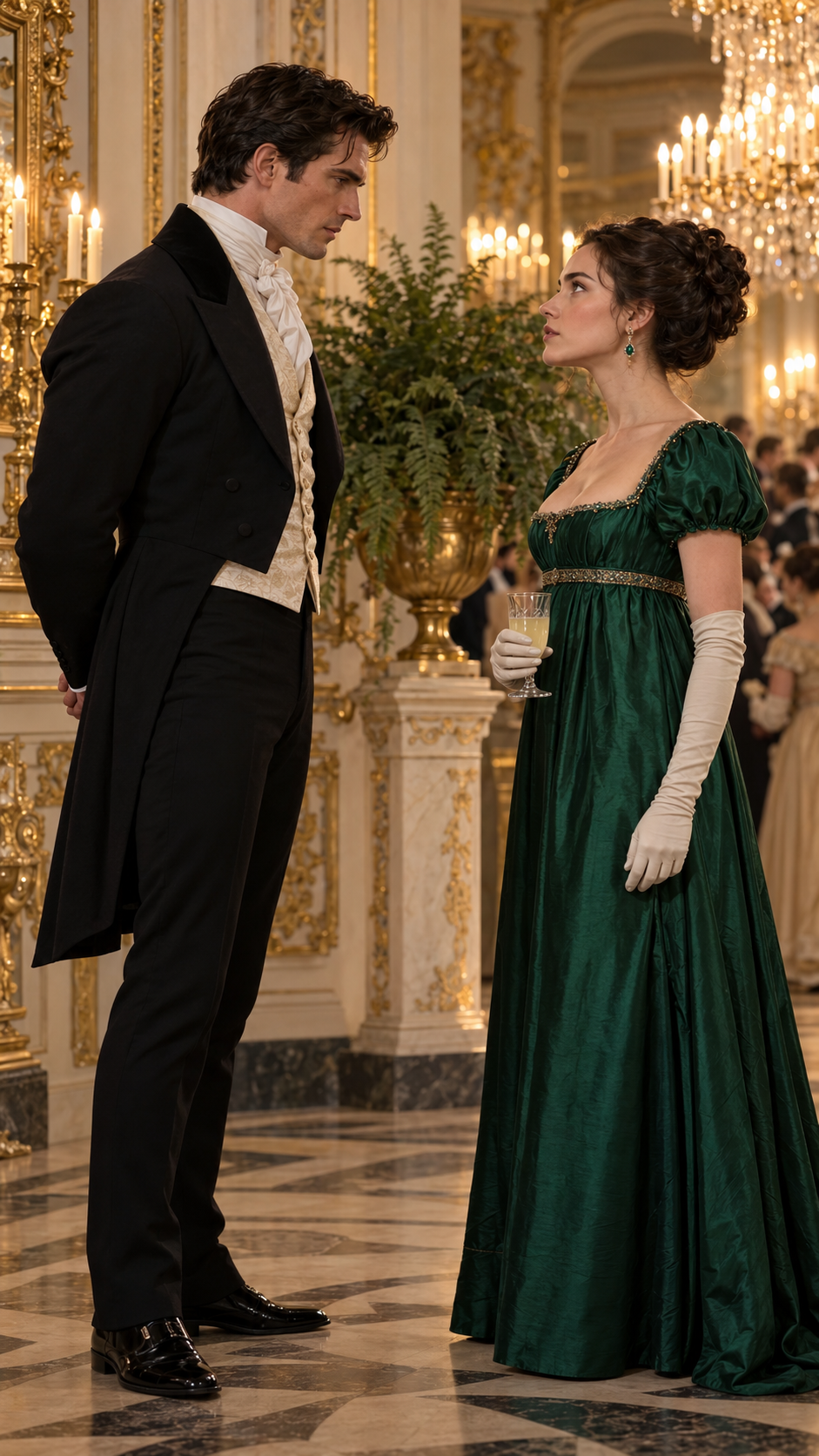
Nearly a year after she had written her first letter, Aurora stood beside a fern at the Earl of Stanhope’s ball, wondering how soon she could leave without provoking a discussion.
Her lemonade had grown warm.
Her father was elsewhere in the room, enjoying the company of men who shared his conviction that financial difficulties improved if one refused to discuss them before supper.
Aurora watched a young woman laugh at something a gentleman had said.
The laugh came half a second too late.
She wondered whether the girl had heard him at all.
“Miss Holloway.”
The voice was low and rough.
Aurora turned.
The Duke of Westmore stood before her.
She recognized him immediately, although she had never been close enough to notice the small signs of wear around his eyes or the stiffness with which he held one shoulder.
“Your Grace.”
She curtsied.
He did not appear interested in the room, the music, or the people watching his approach.
His attention remained entirely on her.
“We have not been introduced,” she said.
“No.”
“How reassuring. I should hate to discover I had forgotten a duke.”
A slight movement touched his mouth.
“I thought we might dispense with the ceremony.”
“That would disappoint a great many people whose lives consist almost entirely of arranging it.”
“It feels rather like a transaction wrapped in silk.”
Her fingers tightened around the glass.
For a moment, she heard nothing.
Then the orchestra returned all at once, painfully loud.
“What did you say?”
He watched recognition enter her face.
“A transaction wrapped in silk,” he repeated more quietly. “Wouldn’t you agree?”
There were phrases anyone might use.
There were coincidences.
This was neither.
“I am sure I do not know what you mean.”
“I considered asking you to dance. But I value my boots.”
Aurora took one step backward.
The alcove wall met her shoulders.
She remembered sitting alone at her desk, writing that sentence. She remembered the tiny spot of ink she had blotted with the corner of a handkerchief.
No one had stood beside her.
No one had read it before she sealed the paper.
“Who are you?”
“Alistair Cavendish.”
“That is not what I am asking.”
“No,” he said. “I know.”
His expression had lost its faint warmth.
“And for much of the last year, Miss Holloway, I have owed you more than you can imagine.”
Her mind caught on the only possible connection.
“Corporal Reed.”
Alistair’s gaze did not leave hers.
“He died in Belgium.”
The words struck with a strange, delayed force.
A man she had never met.
A name she had made into a place to leave her unhappiness.
Dead.
“And you?”
“I was his commanding officer.”
“You read his letters.”
“Yes.”
She looked past him.
A couple passed the alcove, smiling at something neither Aurora nor Alistair heard.
“You opened letters addressed to someone else.”
“Yes.”
“Private letters.”
“I know.”
“No. I do not believe you do.”
Her voice remained quiet through effort.
There was no comfort in his title now. No flattering possibility in the attention of a duke.
He had seen the things she had concealed from everyone who knew her.
Her anger. Her loneliness. Edward.
Especially Edward.
“Did you show them to anyone?”
“No.”
“Did anyone else read them?”
“No.”
“How am I supposed to believe you?”
“You have little reason to.”
The answer unsettled her more than a denial would have done.
He looked neither amused nor defensive.
“I should not have approached you this way,” he said.
“You should not have approached me with my own words.”
“You are right.”
She had prepared herself for arrogance.
His agreement left her without a place to put her anger.
“Why did you keep reading?”
He looked down briefly.
When he raised his eyes again, something in them had changed.
“Because, for a little while, the world sounded like a place I might wish to return to.”
Aurora’s grip loosened.
She disliked that the answer moved her.
She disliked even more that he appeared to see it.
“That does not give you the right.”
“No,” he said. “It does not.”
The orchestra began another dance.
Around them, people rearranged themselves according to rules Aurora had followed all her life without once believing they mattered.
Alistair offered his arm.
“Walk with me. Only around the room. You need not forgive me to permit that.”
She stared at his sleeve.
She could refuse. It would be sensible.
Instead, she found herself noticing the tension beneath his stillness. He looked like a man waiting for an injury he knew he deserved.
At last she placed her gloved hand on his arm.
“If you quote my letters again, Your Grace, I shall do more than step on your foot.”
He looked down at her.
“I understand.”
“No,” she said, lifting her chin. “I do not think you do. I am quite capable of ruining the boots entirely.”
For the first time, he smiled.
And that, against her better judgment, frightened her more than anything he had said.
The Duke of Westmore arrived at eleven the following morning.
Aurora had slept scarcely two hours.
Her father had almost dropped his newspaper when Higgins announced the visitor.
“For you?” he asked.
“So Higgins tells us.”
“Did you speak last night?”
“Yes.”
Her father glanced at her with sudden, uncomfortable interest.
Aurora rose before he could turn it into a conversation about prospects.
“I shall receive him in the sitting room.”
She climbed the stairs slowly.
At the door, she stopped long enough to steady herself.
Alistair stood beside the window.
In daylight, the marks of exhaustion were clearer. His dark riding coat fitted impeccably, but good tailoring could not disguise the fatigue around his mouth.
“You look,” he said, “as though you are preparing for something unpleasant.”
“I had very little notice in which to prepare otherwise.”
“I deserved that.”
She remained beside an armchair.
“Have you come to tell me that I ought to be grateful for your interest?”
“No.”
“Or that a duke may open whatever correspondence he pleases?”
“No.”
“Then we are already having an unusual conversation.”
He turned fully toward her.
“I came to apologize.”
Aurora said nothing.
“I took something that was not intended for me,” he continued. “Then I kept it because it comforted me. That is the plainest account I can give you.”
“Why not return the letters?”
“I should have.”
“Why not write?”
His jaw tightened.
“I could not imagine how to begin.”
“Dear Miss Holloway, I have been reading your private thoughts without permission?”
“Yes,” he said. “Something very like that.”
She looked away first.
He had made no attempt to excuse himself.
That was inconvenient.
“I am sorry for the intrusion,” he said. “I cannot honestly say that I regret what your letters gave me. But that is my difficulty to reconcile. It should not have become yours.”
Before she could answer, a coal wagon struck a rut outside.
The crash was sharp and violent.
Alistair’s whole body changed.
His shoulders drew upward. His hand dropped toward his hip. His eyes fixed on the window without seeming to see it.
Aurora knew that look.
She crossed the room.
“Your Grace.”
He did not answer.
She placed her palm against his chest.
“Alistair.”
His breath caught.
“You are in Mayfair,” she said. “It was a coal wagon.”
His eyes moved toward her face.
“The room smells excessively of potpourri,” she continued steadily. “There is an ugly clock behind you. It is eleven in the morning.”
A long breath left him.
The muscles beneath her hand gradually eased.
He stepped back.
“I beg your pardon.”
“For the wagon?”
His mouth tightened.
“For that.”
“My brother used to start when the hounds barked after his first return home.”
Alistair looked at her.
“He hated anyone noticing,” she said. “I noticed anyway.”
The silence between them changed.
Not forgiveness.
Something less tidy.
“You have nothing to apologize for,” she added.
“Edward.”
She went still.
“You remember his name.”
“Yes.”
“Of course you do.”
He lowered his gaze.
This time, when he spoke, he chose his words carefully.
“I will not use what you wrote to force a closeness you have not offered.”
Aurora studied him.
She believed he meant it.
She was not yet certain whether meaning it would be enough.
“What do you want from me?”
“To call on you properly. To have conversations whose other half you can actually hear.”
“And if I am less interesting in person?”
“I think I might endure it.”
“And if I am more difficult?”
“I have already begun to suspect that.”
A reluctant laugh escaped her.
He looked so openly relieved that she almost wished she had withheld it.
“You may call,” she said.
“Thank you.”
“One condition.”
“Anything reasonable.”
“No flowers.”
His brows rose.
“I will not sit beneath a quantity of roses while you pretend they express something you have not managed to say.”
“No flowers,” he agreed.
“And no quotations.”
He inclined his head.
“Your words remain yours.”
For three weeks, London watched them.
Aurora discovered that society could derive extraordinary excitement from two people having a conversation near a window.
If Alistair stood beside her at a supper, someone remarked upon it.
If he did not, someone wondered whether they had quarreled.
Lady Arbuthnot considered the whole business proof that the war had affected his judgment.
Aurora reported this to him one morning at Kew.
“She speaks with great concern for your health.”
“How generous.”
“She believes you have mistaken me for someone agreeable.”
“Then she has misunderstood the attraction entirely.”
They walked beneath the glasshouse roof. Condensation gathered overhead and fell among broad green leaves. Alistair carried his hat and gloves in one hand.
Aurora had expected him to be different once the first intensity faded.
More conventional, perhaps.
More pleased with himself.
Instead, he asked questions and listened to the answers.
When he disagreed, he said so.
When she was unfair, he noticed.
It was an unsettling pleasure to argue with a man who neither patronized her nor treated contradiction as an injury.
“You cannot dismiss an entire room because one woman says something foolish,” he told her.
“I have generally found one sufficient.”
“An economical system.”
“Very.”
“And does it ever leave you with anyone to speak to?”
She glanced at him.
“That depends on whether you intend to continue.”
He smiled, but his question remained with her.
A little later, they stopped beside a plant whose broad leaves held drops of water like small pieces of glass.
“Alistair.”
He turned immediately.
She had begun using his name only recently.
Each time, he listened as though it mattered.
“You told me Corporal Reed died of illness.”
“Yes.”
“What happened?”
His fingers tightened around his gloves.
“You need not ask for details you would rather not hear.”
“I would rather hear the truth.”
He considered her for a moment.
Then he looked toward the damp stone path.
“Typhus. A field hospital outside Brussels.”
“Was it quick?”
“No.”
The answer settled between them.
“He was ill for several days,” Alistair said. “Frightened. Often confused. He asked for his mother.”
“Were you there?”
“Yes.”
“At the end?”
“Yes.”
Aurora looked at his face.
He had answered without making himself admirable.
She understood how much effort that required.
“Thank you for not telling me he died smiling.”
“He did not.”
“No.”
Water dripped onto a leaf beside them.
“Did he know?” she asked. “That someone had written?”
“He kept the letters wrapped against the rain.”
“But he never read them.”
Alistair shook his head.
Her eyes stung.
For months, she had imagined her words disappearing into some unknowable distance.
She had not imagined a man carrying them carefully because he could not yet discover what they contained.
“I thought the silence made it safe,” she said.
Alistair did not pretend to misunderstand.
“Safe to be honest?”
“Yes.”
She opened her reticule.
The silk wrapping had worn thin at the folds.
Inside lay Edward’s brass button.
Alistair looked down at it but did not touch it.
“This came home with his things,” she said. “A watch as well. And the letter.”
“The one he never sent.”
She nodded.
“He complained about his feet. He wanted to know whether the cook still made the apple tart he liked.”
Her laugh broke before it properly began.
“Such ordinary questions.”
“They usually are.”
“Everyone wished to speak to me about sacrifice. I wanted someone to ask about the tart.”
Alistair’s expression shifted.
Not pity.
Recognition.
She held the button tightly enough for its edge to press into her palm.
He reached out and closed his hand gently around hers.
For several seconds, she let him.
No one had said anything useful about Edward in years.
Alistair had scarcely said anything at all.
Yet she felt, with terrifying clarity, that she was less alone.
A tear escaped before she could prevent it.
His free hand rose slowly.
He brushed it from her cheek.
Aurora’s breath caught.
The tenderness frightened her precisely because it made no demand.
She could have stayed there.
She could have leaned into his hand and allowed herself to want what his face so plainly offered.
Instead, she stepped away.
“We should go.”
He lowered his hand.
“Of course.”
“The heat is rather oppressive.”
“Yes.”
He did not challenge the excuse.
That made it worse.
As they returned along the path, he shortened his stride to hers.
She wished he had been offended.
She would have known what to do with that.
By the third night after Kew, Aurora had become angry with a volume of poetry.
The fault was not the poet’s.
She had read the same page six times and could remember none of it.
Rain struck the library windows. Her father had gone to his club before the storm worsened. The house had settled into the familiar quiet that once suited her so well.
Now she kept listening for a knock.
That admission irritated her enough to turn the page.
At nine, the library door opened.
Alistair stood on the threshold, soaked through.
Rain darkened his hair and dripped from the hem of his coat.
Aurora rose so quickly that the book fell from her lap.
“What on earth—”
“Your butler attempted to refuse me.”
“A reasonable response.”
“I was not reasonable.”
“No,” she said. “You are dripping on a very expensive rug.”
He glanced down as though the floor had only just occurred to him.
Then he looked back at her, and she saw something beneath the urgency.
He was frightened.
Not in the way he had been at the window.
This was a fear with words attached to it, though he seemed unable to find them.
“What has happened?”
“A letter came from the War Office.”
Aurora’s irritation vanished.
“What letter?”
“My regiment is being formally disbanded.”
She waited.
He stood very still.
“At last,” she said carefully, “it is finished.”
“Yes.”
“Surely that is good.”
“I thought so.”
The rain filled the pause.
He unfastened his wet coat with clumsy fingers.
“I thought I would be relieved,” he said. “Instead, I sat looking at the paper and discovered I could not think what I was for.”
Aurora moved toward the bell.
“You need dry things. And something hot.”
“I need you to listen.”
She stopped.
“I am listening.”
He passed a hand over his face.
“For years, there was always another order. Another man who needed something. Even afterward, there were accounts, reports, inquiries. And now there is a document stating that it is concluded.”
“Documents are very confident things.”
He gave a short, humorless breath.
“Yes.”
“You do not have to become someone else tonight.”
“I do not know who is left.”
She looked at him helplessly.
He saw it and misread it.
“A duke,” he said. “There is that, of course. I may return to discussing rents and being introduced to suitable women.”
“Alistair—”
“Exactly the sort of man you despise.”
“I do not despise you.”
“Then why do you withdraw every time I come near?”
The question struck too close.
“This is hardly the moment.”
“It never is.”
She folded her arms.
“You arrive without warning, in a storm, and expect me to account for every expression I have worn for three weeks?”
“No. I expect you to tell me when I am unwelcome.”
“You are not unwelcome.”
“At Kew—”
“I was upset.”
“So was I.”
“I know.”
“Then why was it only permissible for us to be upset separately?”
Aurora looked away.
He removed his coat and laid it over the back of a chair.
Without it, he looked less like a duke and more like a tired man who had walked through rain because he could not bear his own company.
That made her want to go to him.
That made her angry.
“You think you know what this is,” she said.
“What?”
“Us.”
His face became still.
“Then tell me.”
“You found letters at the worst time of your life. They mattered because of where you were. Because of what you needed.”
“Yes.”
“That does not mean you know me.”
“I am trying.”
“You know a woman who wrote alone at night. She had time to cross things out. She could decide what to confess and what to leave hidden.”
“I know.”
“No, you do not. You have made something of her.”
“What have I made?”
“Someone worth all this.”
The last words were almost inaudible.
Alistair stared at her.
Aurora wished she could retrieve them.
Instead, more followed.
“I am difficult. I become cruel when I am afraid. I find fault before anyone can find it in me. I am not always clever in an amusing way. Sometimes I am merely unkind.”
He did not interrupt.
“You survived on a voice,” she said. “That does not oblige you to love the woman.”
The word remained in the room.
Neither of them pretended not to hear it.
Alistair moved closer, then stopped with enough space between them for her to leave.
“I know you dislike yellow because you think it makes you look ill.”
She blinked.
“I know you can read the Greek you claim merely to have glanced at.”
“Those things—”
“Were not in the letters. No.”
Her heart began to beat harder.
“I know you look toward the door when a conversation matters to you,” he continued. “I know you make a joke when you are about to say something you fear I might remember.”
She could not look away.
“I am learning you, Aurora. You may dislike what I learn. You may decide you dislike me. But do not tell me I have spent these weeks speaking to paper.”
The storm rattled the window.
She took a breath that did not steady her.
“Why are you here?”
“Because I received that letter and wanted to see you.”
“Why?”
His answer came quietly.
“Because you are the person I wanted.”
Something in her expression changed.
He saw it.
His gaze dropped to her mouth, then returned to her eyes.
She could have stepped away.
Instead, she reached for his damp sleeve.
He bent toward her slowly enough that she had time to understand what was happening.
Their first kiss was nothing like the careful conversations that had preceded it.
For a moment, Aurora forgot to be frightened.
She put her hands against his shoulders, felt him draw a breath, and moved closer.
He held her as though closeness itself were astonishing.
When they parted, he rested his forehead against hers.
The rain continued.
The room remained.
He was there.
Alive, warm, breathing.
And she wanted him with a force that made every old precaution seem suddenly fragile.
That was when fear returned.
“Please leave.”
He lifted his head.
“Aurora?”
She could barely make herself look at him.
“Please.”
His hands fell away immediately.
The space between them opened.
“I have upset you.”
She shook her head, but the gesture explained nothing.
“I need you to go.”
He stood motionless for one painful second.
Then he stepped back.
She watched him retrieve his coat.
At the door, he turned.
“I am not the man you wrote to,” he said. “And I cannot remain only the man who read.”
Aurora’s throat closed.
“If you want me gone, I will go.”
She could have called him back.
She knew that afterward.
At the time, she merely stood beside the desk while he opened the door.
And then he was gone.
The first day, she told herself relief would come.
On the second, she found herself looking at the clock shortly before eleven.
By the fourth, she had stopped pretending she did not listen when a carriage slowed outside.
No flowers arrived.
No note.
No request that she reconsider.
He had obeyed her so completely that she began to resent him for it.
That was unfair.
Knowing it did not improve her temper.
Her father mentioned the duke once at breakfast.
“Have you quarreled?”
“No.”
“Then perhaps he has business.”
“Perhaps.”
He studied her face for a moment, then returned to his paper.
Aurora was grateful.
She was disappointed.
She could not decide what she would have wanted him to ask.
After a week, the house had recovered all its old habits.
That was the worst part.
The clock still chimed. Higgins still brought tea. Her father still went out. Invitations continued arriving as though nothing significant had happened.
Aurora had believed herself accustomed to solitude.
Now she understood how much difference there was between choosing a quiet room and waiting in one.
She took out Edward’s button.
For years, she had used it to prove that loving someone meant risking a box of belongings in their place.
It had never occurred to her that Edward, given the choice, might object to what she had made of his memory.
He had liked people.
He had liked noise and arguments and bad weather when he could complain about it.
He would have found her grand retreat into superior indifference unbearable.
“You would have liked him,” she told the button.
Then she wrapped it away because the admission hurt.
At a musical evening two weeks after the storm, Aurora sat through an Italian aria and discovered that longing could become a physical irritation.
The empty chair beside her seemed unnecessarily conspicuous.
Lady Arbuthnot sat nearby with another lady.
Their whispers rose during a pause in the accompaniment.
“An unfortunate disappointment.”
A fan moved.
“Though one cannot say it was entirely surprising.”
Aurora kept her eyes on the singer.
“She has always been too sharp.”
The other woman murmured an answer Aurora did not catch.
“Even Westmore must prefer some peace.”
Once, Aurora would have taken satisfaction in being discussed.
It confirmed her opinion of the people doing the discussing.
Tonight she merely felt tired.
She imagined Alistair beside her, leaning close enough to remark that the singer appeared to be taking a personal grievance out on Mozart.
The thought almost made her smile.
Then the absence beside her became unbearable again.
She left as soon as politeness allowed.
Outside, the air was cool and damp.
She sat in the carriage with her hands folded tightly in her lap.
There had been no public humiliation.
No dramatic rejection.
Only a man who had asked to know her and a woman who had told him to leave.
She could not blame Lady Arbuthnot for that.
Higgins waited in the hall when she returned.
“A letter arrived this evening, miss.”
Aurora stopped unfastening her cloak.
“From whom?”
“He did not leave a message beyond the letter.”
The envelope lay on a silver tray.
Plain red wax.
No crest.
Her hand closed around it.
For an instant she could not breathe.
“Will you require anything else, miss?”
“No. Thank you.”
She waited until he withdrew.
Then she broke the seal.
Dear Miss Holloway,
I have begun this letter several times. Most of the earlier attempts would have justified your opinion of my manners.
Despite herself, she gave a small, broken laugh.
Then she read on.
I am leaving London for Somerset tomorrow morning.
Her smile vanished.
You asked me to leave your house. I have respected that request, and I shall continue to respect it. You owe me neither affection nor an explanation you do not wish to give.
But I cannot leave without correcting one thing.
You said I had mistaken a voice on paper for a woman.
At first, perhaps I did. I knew your handwriting before your face. I knew your sorrow before the sound of your laugh. There was a comfort in imagining the person who had written those pages, and I cannot pretend imagination played no part.
Aurora lowered herself onto the hall bench.
Then I met you.
You argued with me. You misunderstood me. You made me laugh at moments when I had forgotten laughter was available.
You noticed that I was frightened and did not make me ashamed of it.
Her vision blurred.
That was not the woman in the letters. That was you.
She pressed her fingers against the edge of the paper.
I should not have come to your house as I did that night. My distress did not entitle me to disregard your peace, and I am sorry.
But the feeling that brought me there was real.
I love you.
She stopped.
The words were short.
There was nowhere for her to hide inside them.
I do not ask you to answer out of pity, gratitude, or fear of hurting me.
I ask only that you be honest with yourself.
If you do not love me, there is nothing more to say.
If you are afraid, that is a different matter.
Aurora swallowed.
You once wrote that bravery is what people do when they have no other choice. I believed you then.
I am less certain now.
There are usually other choices. Silence. Distance. A well-appointed house in Somerset.
I am discovering how respectable retreat can look.
She read that sentence twice.
I cannot promise you an easy husband. I sleep badly. Sudden noises sometimes carry me somewhere I do not wish to go. There will be days when I am poor company.
But I would try to be honest. I would listen when you told me I was wrong. I would not require you to become agreeable before allowing you to be loved.
Her first tear fell onto the margin.
Perhaps I should have said all of this in your library.
Perhaps neither of us was ready to hear it.
I leave at first light.
Yours,
Alistair Cavendish
Aurora remained seated.
The hall clock ticked.
Somewhere above her, a floorboard settled.
First light.
She looked toward the dark window.
For two weeks, she had treated his silence as something inflicted upon her.
It had been obedience.
For two weeks, she had waited for him to take responsibility for the fear she had refused to name.
And now he was leaving.
Not as a punishment.
Because there was only so long a person could stand outside a closed door.
She read the letter again.
Then she folded it carefully, stood, and went upstairs.
Halfway to her room, she began to run.
Part Three — Before First Light
Mary woke when Aurora pushed open the dressing-room door.
“Miss?”
“My boots.”
The maid sat upright.
“Are you ill?”
“No. My walking boots, please.”
Mary looked toward the clock.
“It is nearly one.”
“I know.”
Aurora pulled off her gloves.
Her hands were shaking, but the decision itself felt startlingly calm.
“The heavy cloak as well.”
“Shall I call Higgins?”
“Not yet.”
Mary rose, bewildered, and fetched the boots.
Aurora sat while the maid helped her with the fastenings.
For a few seconds, the small, practical work steadied her.
There were things to do.
A buckle.
A cloak.
A door to open.
She did not need to solve the rest of her life before beginning.
“Where are you going?” Mary asked.
Aurora took Alistair’s letter from the dressing table.
“To see someone before he leaves.”
“Tonight?”
“Yes.”
The maid looked at her face and, wisely, stopped arguing.
Aurora fastened her cloak.
In the mirror, she saw loose hair, tired eyes, and a woman who had spent the evening pretending she did not mind an empty chair.
She barely recognized the determination beneath the exhaustion.
It suited her better than indifference.
“Please tell Higgins I have gone to Westmore House,” she said. “I shall not be long.”
Mary opened her mouth.
Aurora managed a small smile.
“I know.”
She knew everything the maid might say.
It was late.
It was improper.
People might talk.
For once, those considerations seemed exactly as large as they deserved to be.
Not large enough.
A fine rain fell over Mayfair.
Aurora walked quickly, the hem of her gown gathering damp beneath her cloak.
She had refused to wait for the carriage.
That had seemed sensible inside the house.
Halfway down the next street, she acknowledged that panic was not always an efficient organizer.
Still, she kept walking.
The letter remained in her pocket.
At every crossing, she pressed her hand against it as though she needed to confirm that the words had not changed.
If you are afraid, that is a different matter.
She was afraid.
Of course she was.
She had been afraid before the first letter.
Before the ball.
Before Alistair ever knew her name.
Fear had simply acquired better explanations.
She called it judgment.
She called it independence.
Sometimes it had been both.
But the night she asked him to leave, it had been fear.
Nothing more dignified.
Nothing less human.
By the time she reached his house, her breath was uneven and her boots were wet.
Most of the windows were dark.
One downstairs window held a narrow band of light.
She climbed the steps.
Then she lifted the knocker.
The sound seemed appallingly loud.
She waited.
When no one came, she knocked again.
At last, bolts shifted.
An elderly butler opened the door, holding a candle.
His expression moved from irritation to astonishment.
“Miss Holloway?”
“I need to see His Grace.”
The butler glanced past her toward the street.
“At this hour?”
“Yes.”
“He is leaving early.”
“I know.”
“Perhaps a note—”
“No.”
She caught herself.
“Please. Tell him I am here.”
The butler studied her wet cloak and determined face.
Then he stepped aside.
“His study is at the end of the hall.”
Aurora entered.
The house smelled of leather and extinguished candles.
A traveling trunk stood beside the stairs.
She looked at it for half a second too long.
Then she continued.
At the study door, she stopped.
For the first time since reading the letter, uncertainty caught up with her.
He had offered honesty.
He had not promised that honesty would leave everything unchanged.
She might be too late in ways that had nothing to do with the hour.
Aurora lifted her hand.
Then she opened the door.
Alistair stood by the window with a glass in his hand.
His coat was off. His white shirt was open at the throat, the sleeves turned back. Books lay in uneven piles across the desk. Two trunks stood open near the fireplace.
He turned at the sound.
The glass tilted.
He steadied it without looking down.
“Aurora?”
She closed the door.
For a moment, neither moved.
“You are packing,” she said.
“Yes.”
The single word hurt absurdly.
“I received your letter.”
“I thought you might.”
“You said you were leaving.”
“I am.”
She glanced at the trunks.
“I can see that.”
His gaze moved over her cloak, her damp hair, the muddy edge of her gown.
“Did you walk here?”
“Yes.”
“Alone?”
“Yes.”
He set the glass down.
“What happened?”
The concern in his voice nearly undid her.
She had come prepared for anger.
She had not prepared for him to remain kind.
“Nothing happened.”
“You are standing in my study in the middle of the night.”
“Yes. I am becoming aware of how it looks.”
“Aurora—”
“Let me speak before I lose courage.”
He went still.
She took the letter from her pocket.
It had creased during the walk.
“You have very disagreeable handwriting when one is attempting to read through tears.”
His face changed.
Only slightly.
Enough.
“I shall endeavor to improve it.”
“And you make accusations.”
“I tried to make fewer in the final version.”
“You accused me of retreating.”
“I accused myself of it as well.”
“Yes,” she said. “I noticed. That was inconveniently fair.”
Silence settled.
She looked down at the paper.
The humor had taken her as far as it could.
Now there was only the thing she had come to say.
“I was afraid.”
He did not move toward her.
“Of me?”
“Of what I wanted from you.”
He breathed out slowly.
“I thought if I kept it uncertain, it could not hurt me properly.”
“What could not?”
She looked up.
“Loving you.”
The room became very quiet.
Alistair’s hand tightened against the edge of the windowsill.
Aurora saw it.
For once, she did not mistake his silence for an absence of feeling.
“When Edward died,” she said, “everyone kept telling me that time would make it easier. As though time were a servant who had been given instructions.”
Her mouth trembled.
“My mother was already gone. My father became so occupied with everything he could bear to think about that there was very little room left for anything he could not.”
Alistair listened.
“I learned how to live without expecting much. It seemed sensible. I had books. I had a house. I could be useful when necessary and amusing when cornered.”
“You were lonely.”
“Yes.”
The admission surprised her with its simplicity.
“I was lonely,” she repeated. “And I became very proud of how little I appeared to mind.”
She pressed the folded letter between her palms.
“Then you came into that ballroom and knew something true about me before I had agreed to tell you.”
“I should have handled it differently.”
“Yes,” she said. “You should.”
He accepted that without flinching.
“But afterward, you kept coming. You listened. You remembered. Not only the letters.”
“No.”
“And I began to wait for you.”
Her voice broke.
“I hated that.”
“Waiting?”
“Having something to lose.”
Alistair lowered his gaze briefly.
When he looked at her again, the reserve in his face had begun to give way.
“Why did you ask me to leave?”
“Because you kissed me, and for a moment I was happier than I knew how to bear.”
His expression tightened with pain.
“Aurora.”
“I am not saying it makes sense.”
“It makes a kind of sense.”
“I looked at you and understood that if you vanished, it would matter. Not as an inconvenience. Not as something I could dismiss with a clever remark. It would matter every morning.”
Tears slipped down her cheeks.
She let them.
“So I made you leave before you could become necessary.”
He looked toward the trunks.
“And I thought I had become a burden.”
“No.”
“You looked frightened.”
“I was.”
“I thought I had frightened you by wanting too much.”
“You frightened me by offering something I wanted just as badly.”
For several seconds, he did not speak.
Then he crossed part of the room.
He stopped within reach, but did not touch her.
“You might have told me.”
“Yes.”
“I might have listened.”
“I know that now.”
His mouth moved with a sad trace of humor.
“I should like to think there was evidence available earlier.”
A laugh escaped through her tears.
“There was an embarrassing quantity.”
He looked at her as though he had missed the sound.
That nearly broke her again.
“I have not come because you wrote that you loved me,” she said. “I have come because I read it and could no longer pretend that I did not love you.”
Alistair closed his eyes.
For one moment, he looked exhausted beyond any comfort she could offer.
Then he opened them.
“Say it again.”
“I love you.”
His breath shook.
Aurora had never seen him look less defended.
Not in the sitting room.
Not at Kew.
Not even in the library.
“I do not know how to do this well,” she whispered.
“Neither do I.”
“I will be difficult.”
“You have mentioned that.”
“I shall probably say the wrong thing when I am frightened.”
“Then tell me afterward that you were frightened.”
“And you?”
“I shall try to do the same.”
She looked down at his hands.
The scars were pale in the firelight.
“I cannot lose you the way I lost Edward.”
Alistair’s expression softened.
“You cannot make that bargain with anyone.”
“I know.”
“I could promise that nothing will happen to me. It would be a comforting lie.”
“I do not want a lie.”
“No.”
He held out his hand.
She placed hers in it.
His fingers closed carefully around her cold knuckles.
“I cannot promise you a life without grief,” he said. “I can promise that I want the life before it. With you.”
Aurora began to cry in earnest then.
He did not tell her to stop.
He took her other hand and waited while she stood before him, muddy and shivering, finally saying nothing she did not mean.
After a while, she managed, “Your letter was very unfair.”
“Which part?”
“The part where you made sense.”
“I apologize.”
“You do not.”
“No.”
She laughed again.
He smiled.
It was small at first, uncertain.
Then she tightened her hold on his hands, and it changed into the unguarded expression she remembered from the ball.
“I missed you,” he said.
“I was only a few streets away.”
“I know. That made it worse.”
Her tears slowed.
She looked past him at the open trunks.
“Do you intend to go to Somerset?”
“Not if you are asking me to stay.”
“I am.”
“Then I shall stay.”
She swallowed.
“That sounds dangerously simple.”
“For once, perhaps we might permit it.”
Aurora stepped closer.
This time, she did not retreat when he lifted a hand to her cheek.
He paused, giving her the choice he had always needed her to make.
She answered by reaching for him.
The kiss was gentler than the first.
There was no need to prove anything through urgency.
He was there.
She was there.
Neither was leaving the room.
When they drew apart, Aurora rested her forehead against his chest.
He held her loosely enough that she could move, securely enough that she did not wish to.
For a long time, the only sounds were the fire and the rain.
Then she said, muffled against his shirt, “Somerset might be rather pleasant.”
He looked down.
“I had just agreed not to go.”
“I did not say tonight.”
“Ah.”
“And not alone.”
His arms tightened slightly.
“That is a different invitation.”
“Yes,” she said. “It is.”
Eventually, Alistair made her sit near the fire.
A servant brought a towel and warm tea. The butler displayed the admirable composure of a man who intended to remember nothing until instructed otherwise.
Alistair sent word to Aurora’s house and arranged his carriage.
The practicalities, far from diminishing the night, made it more real.
A dry towel.
A cup held between cold hands.
Someone ensuring she would arrive home safely.
Love, Aurora discovered, could contain sensible arrangements without becoming less extraordinary.
While they waited for the carriage, her gaze settled on the desk.
A small bundle lay beside the books.
She knew what it was before he followed her eyes.
“The letters,” he said.
“Yes.”
He stood.
For a moment, she wondered whether he would hesitate.
Instead, he picked them up and brought them to her.
The edges had softened. Some sheets bore faint stains. The plain wax seals were broken, but traces remained.
“I should have returned them before now.”
Aurora took the bundle.
Her own handwriting looked strange after its journey through his life.
“You carried all of them?”
“Yes.”
“Through Waterloo?”
“Yes.”
She touched a worn corner.
“I thought they had gone nowhere.”
“They went a very long way.”
She sat looking at them.
For years, she had imagined honesty as something sent away.
A dangerous parcel best entrusted to distance.
Now the evidence rested in her lap, creased and weathered, and the man who had read it sat opposite her waiting to learn what she would choose.
“You may keep them,” she said.
“Are you certain?”
“Yes.”
“Not because you owe me—”
“I know.”
She handed them back.
“This time, I am giving them to you.”
Alistair accepted them with both hands.
The gesture was so careful that her throat tightened again.
“Thank you,” he said.
She looked toward the window.
The rain had begun to ease.
“Tell me something that was not in them.”
He considered.
“About you,” she added.
His brows drew together.
“I was afraid you would find me dull.”
Aurora stared.
Then she laughed.
“Dull?”
“The letters were better company than I had any right to expect. I could not imagine offering anything equal in return.”
“You offered yourself.”
“I was not certain that was much of an inducement.”
She reached across the space between their chairs.
He took her hand.
“It was,” she said. “Even when I was too foolish to admit it.”
Her father was waiting when she came home.
He stood in the entrance hall in his dressing gown, looking older than he did behind a newspaper.
Aurora stopped just inside the door.
Alistair remained beside her.
For a moment, the three of them regarded one another with the discomfort of people who had avoided an important conversation for years and could no longer manage it.
“I received your message,” her father said.
“Yes,” Aurora replied.
“You might have woken someone before going.”
“I should have.”
His gaze moved to Alistair.
“Your Grace.”
“Sir.”
There were several things her father might have said.
He chose, after a pause, “Is my daughter all right?”
Aurora felt something loosen painfully in her chest.
“Yes,” she said before Alistair could answer. “I am.”
Her father looked back at her.
Not at her damp clothes.
Not at the duke.
At her.
“Good.”
The word was awkward.
It was enough for that night.
Alistair lifted her hand briefly.
“I shall call tomorrow.”
“Today,” she corrected.
He glanced toward the clock.
“So I shall.”
A faint smile passed between them.
Her father saw it.
To his credit, he said nothing about prospects.
Alistair returned at eleven.
Aurora had slept little, but this time exhaustion carried no bitterness.
When she entered the sitting room, he stood.
No flowers.
She smiled immediately.
“You remembered.”
“I am capable of following the occasional instruction.”
“Occasional is accurate.”
He looked at her for a long moment.
In daylight, the night before might have seemed impossible.
Instead, she found she wanted to cross the room just as much.
So she did.
He took her hand.
“I have a question,” he said.
“That sounds serious.”
“It is.”
Her pulse changed.
He noticed.
“I am not asking because of last night,” he added. “Not because you came to my house, or because anyone might hear of it.”
“I know.”
“I would have asked eventually. I had begun to suspect you might require several years to permit it.”
“That was optimistic.”
“Yes.”
She smiled, but her eyes had begun to sting.
“Aurora, will you marry me?”
There it was.
No speech about rank.
No promise that she would never be unhappy.
A question she could answer honestly.
“Yes.”
His fingers tightened around hers.
“Yes?”
“Do not make me repeat it merely to improve the occasion.”
“I might ask anyway.”
She stepped closer.
“Yes, Alistair.”
He bowed his head until his forehead touched hers.
For a moment, neither spoke.
Then she whispered, “You should know that I intend to disagree with you.”
“I have made allowances.”
“Frequently.”
“I have made extensive allowances.”
“And I will not become charming at dinner merely because I am a duchess.”
“I would be deeply disappointed if you did.”
She laughed.
He kissed her hand.
Outside, a carriage passed over the uneven street.
Alistair’s shoulders tightened at the sound.
Aurora felt it.
He drew a careful breath, then looked back at her.
She did not make an occasion of it.
She simply kept holding his hand.
After a moment, he relaxed.
That, more than the proposal, helped her understand the life she was choosing.
Not an ending in which everything broken became whole.
A life in which neither had to conceal the places that still hurt.
Their engagement gave London precisely the entertainment it desired.
Lady Arbuthnot expressed herself delighted.
Aurora admired the flexibility required.
“How fortunate,” she said privately to Alistair, “that your brain fever has become a suitable marriage.”
“Recovery can be remarkable.”
“Shall we thank her for the diagnosis?”
“I would rather survive the wedding.”
They married without the enormous spectacle some people expected.
There were guests, of course. Family obligations could not be abolished merely because the bride had strong views about them.
But the ceremony itself was quiet.
Aurora had feared she might think of Edward at the wrong moment.
She thought of him before she entered the church.
She thought of how he would have shifted impatiently in his formal clothes and grinned when he saw her looking for him.
The grief came.
Then, alongside it, something warmer.
She could miss him without offering the rest of her life in payment.
Her father stood beside her.
His hand trembled slightly when she took his arm.
“You look very well,” he said.
“Thank you.”
He cleared his throat.
“Happy.”
Aurora looked toward the church doors.
“I am.”
Her father nodded.
It was a small conversation.
They had begun, recently, to have those.
At the front of the church, Alistair waited in a dark coat.
When he saw her, his expression changed in a way no title or ceremony could improve.
He looked relieved.
As though, despite everything, some part of him had still been standing in a tent, hoping a voice on paper belonged to someone he might one day meet.
Aurora smiled at him.
His answering smile carried her the rest of the way.
When they made their vows, she listened carefully.
She had distrusted beautiful promises for so long that it surprised her to discover the value of plain ones spoken aloud.
To remain.
To care.
To choose.
None required them to become different people.
All required them to keep trying.
She could do that.
So could he.
Somerset was green when they arrived.
Aurora had expected to feel like a visitor among Alistair’s things.
For the first few days, she did.
The house was large. The passages took time to learn. Servants watched with the careful curiosity reserved for a new mistress.
Alistair did not press her to declare herself at home.
He showed her the library.
Then he let her rearrange a chair so the morning light fell properly across the page.
It was an excellent beginning.
She discovered that marriage contained more ordinary decisions than the novels suggested.
Windows open or closed.
Breakfast early or late.
Whether a book left facedown on a table constituted damage or temporary necessity.
On this last point, they disagreed immediately.
“It breaks the spine,” Alistair said.
“It was already open.”
“That is not a defense.”
“You have survived military campaigning. I had hoped you might survive an untidy reader.”
“I had no adequate warning.”
She looked up from the chair.
“I believe I mentioned being difficult.”
He bent and kissed her before she could continue.
“Yes,” he said. “You were unusually clear.”
There were harder days.
A slammed door once brought him awake from an afternoon sleep with such alarm that she remained beside him for several minutes before he could speak comfortably.
Another evening, she made an unkind remark because he had been quiet at dinner.
He withdrew.
She nearly allowed pride to carry them separately into the night.
Then she remembered the study.
The open trunks.
How little satisfaction there had been in being left alone.
She found him in the library.
“I was frightened you were unhappy with me,” she said.
He looked up.
“I was tired.”
“I know that now.”
“You could have asked.”
“Yes.”
He closed his book.
“I could have told you.”
She sat beside him.
The argument did not become romantic through being resolved.
It became useful.
The next time, they recognized it sooner.
Gradually, their house filled with habits neither had expected to need.
Her hand on his sleeve when a sudden sound startled him.
His question when she grew too sharp: “Are you angry with me, or worried?”
Tea brought to whichever room contained the other person.
Books left open, then carefully marked.
A chair pulled nearer the fire.
Small proofs that love continued after the important speeches.
One afternoon, Aurora found Alistair at the writing desk with the old letters beside him.
He looked up when she entered.
“I was not searching your correspondence,” she said.
“How reassuring.”
“I thought I ought to establish a higher standard.”
He smiled.
She came to stand beside him.
The first letter lay open.
The young woman who had written it had been angry enough to mistake honesty for damage.
Aurora could still recognize herself in every sentence.
She was grateful she no longer had to live entirely inside them.
“Do you ever wish you had left them sealed?” she asked.
He considered before answering.
“I wish Reed had been able to read them.”
“So do I.”
“I wish I had found a better way to tell you.”
“Yes.”
“But no,” he said. “I cannot wish away the road because I am ashamed of parts of how I walked it.”
Aurora rested her hand on his shoulder.
For a while, they looked at the page together.
Then she reached for a clean sheet.
Alistair watched her sit at the other side of the desk.
“What are you doing?”
“Writing a letter.”
“I can see that.”
“Then you are making an unnecessary inquiry.”
“To whom?”
She dipped the pen.
“You may discover that when it is delivered.”
He returned to his work, though she caught him looking across at her more than once.
Aurora wrote slowly.
This time, she did not need distance to be truthful.
The man she addressed sat close enough to hear the scratch of her pen.
When she finished, she folded the sheet.
Plain red wax.
She pressed it flat.
Then she stood and placed the letter beside his hand.
“For you.”
Alistair looked from the seal to her face.
“Am I permitted to open it?”
“Yes.”
He broke the wax carefully.
Dear Alistair,
It rained today.
The path beyond the terrace is muddy, and you have left your boots where someone will certainly trip over them. I believe marriage has encouraged a disappointing decline in your discipline.
His mouth curved.
Aurora stood very still.
He continued reading.
I used to think that a happy life would have to be a life from which nothing could be taken.
I see now why that was impossible.
There is a great deal I do not know how to promise you. I cannot promise never to be frightened. I cannot promise always to say the right thing before first saying the wrong one.
But I can promise to tell you the truth sooner.
His expression softened.
I love you when you laugh at me. I love you when you are quiet. I love the man who came home, including the parts of him that have not quite understood that he is home.
I thought you should have one letter you were meant to read.
Yours,
Aurora
Alistair finished.
For several seconds, he looked at the signature.
Then he rose.
“Come here.”
She lifted a brow.
“That sounded very much like an order.”
“It was intended as a hopeful suggestion.”
“Better.”
She went to him.
He set the letter on the desk and drew her into his arms.
There was no storm outside.
No departing carriage.
No confession waiting at the edge of a desperate hour.
Only rain easing beyond the windows and the comfortable disorder of a room they shared.
“Do you know,” he said, “what I used to imagine when I read them?”
“An intolerably elegant correspondent?”
“A room in which nothing terrible was happening.”
Aurora rested her cheek against his chest.
He continued quietly.
“A window. A chair. Someone turning a page. Such ordinary things that I could hardly believe they still existed.”
She looked up at him.
“And now?”
He glanced at the desk, the books, her abandoned pen.
“Now I am in it.”
Her eyes filled.
She smiled anyway.
“Your boots are still in the passage.”
“I shall move them.”
“Good.”
He kissed her.
Later, they walked down to the terrace together.
The rain had stopped. Water shone along the stone balustrade. Somewhere beyond the garden, a bird began its uncertain evening song.
Aurora slipped her hand into Alistair’s.
There were names neither of them would forget.
Edward.
Thomas Reed.
Others she knew only because Alistair sometimes spoke them when the evening grew quiet.
Their happiness had not erased those men.
It had made room for remembering them without surrendering every good thing that remained.
Alistair looked toward the wet path.
“You will ruin your shoes.”
Aurora considered the mud.
Then she looked at his boots.
“I have been threatening yours for some time.”
“I remember.”
“You remember entirely too much.”
“Only the important things.”
She squeezed his hand.
Together, they stepped out into the evening.
Behind them, in the library, the old letters lay beside the new one.
For the first time, every page was exactly where it belonged.
The End

