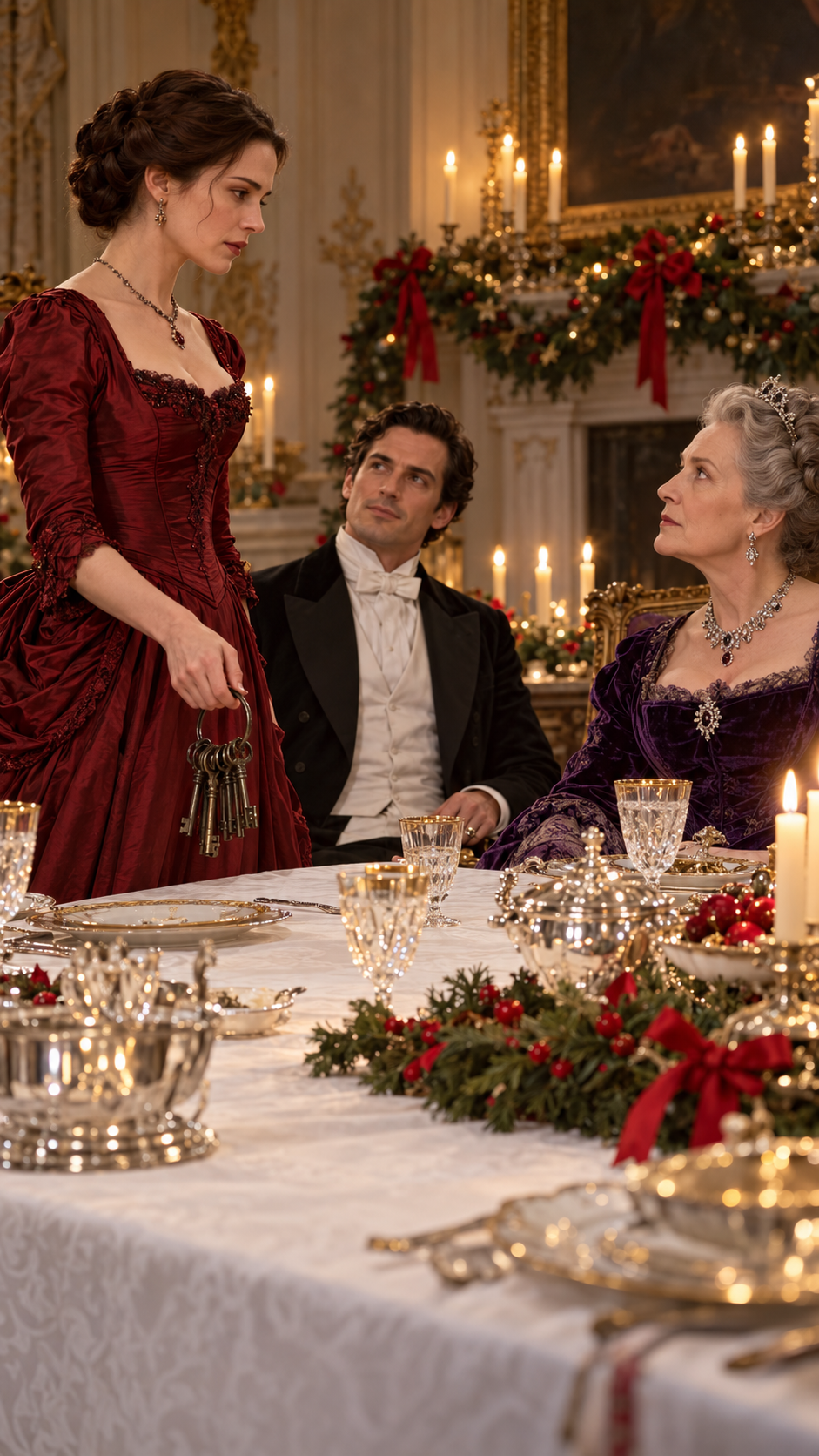
PART TWO
The Duke of Thoroldby stood in the open doorway of the strongroom with the key in his hand.
Number 23.
Behind him, the Dowager Duchess drew her purple dressing gown more closely around her shoulders.
“She had the keys, Jerome,” she said. “She had them all along. And now she has the emeralds.”
Jerome looked again at the empty velvet trays.
The necklace, the earrings, the brooch—every piece had disappeared. His wife had worn the emeralds only once, on their wedding day. He remembered how carefully she had lifted the necklace from its case, and how she had laughed afterward and confessed that she had spent the whole ceremony afraid one of the stones might fall out.
He put the key in his pocket.
“Where are you going?” his mother asked.
“To speak to Hope.”
The Dowager’s mouth tightened. “If she has any sense, she will have gone farther than the village.”
Jerome did not answer. He took his coat and went out into the snow.
Christmas bells were ringing from the little church as he walked down the hill. Families passed him on their way to the morning service, children bundled in scarves and mittens. The villagers greeted him, but he scarcely heard them.
At the last cottage on the green, he knocked.
The door opened a few inches. Nanny Briggs looked up at him, her small face stern beneath her white cap. An orange cat sat behind her, staring through the gap.
“I must see my wife,” Jerome said.
“Must you?”
“She is here?”
“She arrived last night with snow in her hair and her stockings wet through. She could hardly feel her feet.” Nanny folded her arms. “She cried until three in the morning. I have known that girl all her life, and I have never seen her cry as she did last night.”
Jerome lowered his eyes.
From inside the cottage, Hope said, “Let him in, Nanny. It is too cold to leave him standing there.”
Nanny opened the door with evident reluctance.
Hope sat beside the fire in a borrowed brown wool dress and a shawl. Her dark hair was braided down her back, and her eyes were red, but she held her head high.
For a moment Jerome could not speak.
“What is it?” she asked.
He told her about the strongroom and the empty chest.
Her face drained of color.
“All of them?” she whispered.
“All of them.”
“And your mother says I took them.”
Jerome’s silence answered her.
Hope stood. “I put the keys on the dining table in front of sixty guests. Then I walked straight here. I have not left this cottage since.”
“Nanny can tell you that,” the old woman said sharply.
“I know.” Jerome took the key from his pocket. “But this was in the strongroom door.”
Hope held out her hand.
She turned the key over once, then again. She brought it closer to the window.
“This is not mine.”
Jerome frowned. “It has the number.”
“Yes, but look here.” She pointed to the rounded bow. “My key has a small nick. I dropped it on the cellar steps last spring. And the label on mine is worn smooth. This one is newer.”
She held it so that he could see the teeth.
“The iron is bright. Someone has filed it.”
“A copy?”
“I think so.”
Hope sat down slowly. The cat jumped into her lap, but she hardly seemed to notice.
“A week ago, I went to the strongroom for the silver-gilt candlesticks. The key felt sticky in the lock. When I took it out, there was something white between the teeth.”
“What was it?”
“Wax. I thought someone might have pressed the key into it to make an impression.”
Jerome stared at her. “Why did you not tell me?”
“I did.”
The room became very still.
“I told Mrs. Pinder, and I wrote to you that same day. I asked you to send a locksmith from York. I gave the letter to your mother for the postbag.”
“I never received it.”
Hope looked at him for a long moment.
“How many of my letters did you receive, Jerome?”
“Four, perhaps. Short ones. Mostly about the weather.”
“At first I wrote every week. Then every month. When you never answered, I stopped.”
The fire shifted in the grate. Outside, the church bells continued to ring.
Jerome thought of the letters his mother sent him faithfully to London, one every week. She had written of the house, of her health, of her disappointment in Hope. He had accepted them all without question.
“Who was staying at the hall when you found the wax?” he asked.
“Your uncle and Arabella had already arrived. But I am not accusing them. I have no proof.”
Lord Ambrose Fell was his mother’s younger brother. He had always been welcome at Thoroldby. His daughter, Arabella, had spent many Christmases there.
Jerome looked at his wife. “Come home, Hope. Help me find out what happened.”
She stroked the cat’s head. He could see how tired her hands were.
“No,” she said.
“Hope—”
“Not yet. I spent two years in that house, Jerome. I rose at six and worked until midnight, and you never asked me what I did. I wrote to you, and when no answer came, I thought you did not care enough to write back.”
“I did not know.”
“That is what hurts.”
He had no defense against it.
“I will help you find the emeralds,” she continued. “I do not want anyone to think I stole them. But I will not come back simply to be invisible again.”
“What must I do?”
“Find out who I am. Then come and ask me.”
Jerome walked back to the hall alone.
Mrs. Pinder was in the housekeeper’s room, sitting at the table with her hands pressed together. She rose when the duke came in.
“Please sit down,” he said. “I want you to tell me what my wife does here.”
Mrs. Pinder looked at him carefully. Then she went to a shelf and brought down a thick green book.
“Her daybook, your grace. She has kept one since she came.”
Jerome opened it.
The first entry was dated a week after his wedding. Hope had written in a small, clear hand:
Six o’clock with Mrs. Pinder. Stores. Menus for the week. Laundry. Spoke to Mr. Garside about the roof in the west wing. Visit Mr. Hebb. Rosie’s lessons. Accounts.
He turned the page.
There were lists of coal deliveries and household wages, notes about sick servants and tenant families, reminders to mend curtains and replace worn blankets. One entry concerned a laundry maid whose mother was dying in Malton. Hope had paid for the girl’s journey herself.
Another described repairs to the shooting lodge on High Rig Moor: a new coal hatch, fitted with a bolt on the inside to keep out the winter snow.
He read for nearly an hour.
“Did my mother do any of this?” he asked at last.
Mrs. Pinder chose her words carefully. “Her grace the Dowager takes an interest in how a house should be run, sir. She likes to read advice from a book.”
“But does she come down here?”
“Not for eleven years, your grace.”
Jerome rested his hand on the open page.
A small voice came from the doorway.
“Uncle Jerome?”
He turned. Rosie stood there with a rag doll hanging from one hand. She was his late brother’s daughter, seven years old, fair-haired and solemn. Jerome had been her guardian for four years, though he was suddenly ashamed to realize how little time he had spent with her.
“Is Aunt Hope gone forever?” she asked.
He went down on one knee. “I hope not.”
“Grandmama says she is a bad lady and took the green stones.”
Jerome felt his jaw tighten.
“She did not,” he said.
Rosie looked relieved, but only for a moment. “Aunt Hope teaches me my letters. And when I had measles, she sat with me all night. Grandmama never came.”
She twisted the doll’s arm in her fingers.
“Sometimes Aunt Hope cries when she thinks nobody can see. I found her once in the stillroom. I gave her my doll.”
Jerome drew Rosie close. The child rested against him, and he held her longer than he could remember holding her before.
After Rosie returned to the nursery, he went to the library and opened the estate accounts.
Mr. Garside, the steward, kept them, and the Dowager signed payments while Jerome was away. He had trusted them both.
He found the entries in less than an hour.
Every three months, two hundred pounds had been paid to Lord Ambrose Fell. The purpose was written beside each payment: Fell Orphan Fund, Scarborough.
Eight payments. Sixteen hundred pounds.
Beside one entry, in Hope’s neat pencil, was a note:
Asked the Dowager for the address, to send warm clothes. She would not give it. Wrote to the vicar at Scarborough. He knows of no such place.
Jerome read it twice.
His uncle had always been charming, generous with a story and quick with a laugh. He had also lost a great deal of money at cards.
Jerome closed the book but kept his hand on it.
For the first time, he wondered how much else he had accepted because it had been easier than looking.
The next afternoon, Lord Ambrose appeared in the library with snow melting on his greatcoat. His daughter Arabella followed him.
Ambrose was tall and silver-haired, with a handsome face and a manner that usually put people at ease. Arabella, fair and elegant in a pale-gray cloak, stood quietly near the door.
“Jerome, my boy,” Ambrose said. “I have been looking for you.”
Jerome closed the account book.
“I have been to York,” his uncle continued. “I thought that if someone had taken the emeralds, they might try to sell one of them.”
“And?”
Ambrose’s expression became grave. He took a paper from his pocket and laid it on the desk.
It was a pawn ticket. A brooch set with a large green stone and diamonds had been pawned that morning for three hundred pounds.
“The shop is in Micklegate,” Ambrose said. “The proprietor is a man named Bolt.”
Jerome read the ticket.
“He told me the woman who brought it was young, with dark hair and brown eyes. She wore a dark cloak and seemed nervous.”
Jerome said nothing.
“She gave a name,” Ambrose added gently. “Mrs. Lindley.”
Hope’s name before their marriage.
For an instant, Jerome felt the old temptation to let someone else explain what he did not understand. Then he thought of the daybook, the letters that had never reached him, and Hope standing barefoot in the snow at Nanny’s door.
He looked up at his uncle.
“Did you see the brooch?”
“No. Bolt showed me the ticket.”
“And you went to York alone?”
“Arabella accompanied me.”
Jerome glanced toward her. Her face was composed, but he thought he saw the smallest change in her expression before she lowered her eyes.
“I see,” he said.
Sir George Hebden, the local magistrate, arrived the following morning.
Hope returned to the hall in a gray wool dress, accompanied by Nanny Briggs. The Dowager, Lord Ambrose, Arabella, Mrs. Pinder, and Jerome gathered in the library.
Sir George turned his hat in his hands.
“Your grace,” he said to Hope, “I am sorry to trouble you, but the key and this pawn ticket do raise questions. Where were you yesterday morning at eight?”
“At Nanny Briggs’s cottage,” Hope said. “I was there all day.”
“And I will swear to it,” Nanny declared. “She did not leave the house.”
Sir George nodded uneasily. “Of course. But a court might observe that you are very fond of the duchess.”
“A court may observe what it likes.”
Lord Ambrose spoke from beside the fire.
“The first train from Malton reaches York before eight. A person could go and return while the village was still quiet.”
“I was with her,” Nanny said.
“I am merely pointing out what was possible.”
“That is enough, Uncle.”
Everyone looked at Jerome.
He crossed the room and stood beside Hope. For a moment he hesitated, then placed a hand on her shoulder.
“Sir George, my wife did not take the emeralds. I do not believe it, and I will stand surety for her if that is required.”
The Dowager rose from her chair. “Jerome, have you lost your senses?”
“No, Mother,” he said. “I think I have just found them.”
Hope kept her eyes lowered, but she felt the warmth of his hand through the wool of her dress.
Sir George cleared his throat. “I shall make inquiries in York. There is no need for anyone to be arrested today.”
The Dowager swept out. Ambrose followed, shaking his head. Arabella paused at the door and looked back at Hope before leaving.
Nanny stood. “That was overdue, your grace,” she told Jerome. Then she went to find Mrs. Pinder.
When Hope and Jerome were alone, he removed his hand from her shoulder.
“Thank you,” she said.
“I should have stood beside you long before this.”
She looked up at him. “You do not know who took them.”
“No. But I know you did not.”
He hesitated.
“I am going to York tomorrow. I want to speak to Bolt myself. Will you come with me? You notice things I have missed.”
Hope studied his face. She had wanted him to listen for so long that she scarcely knew what to do now that he was asking.
“Yes,” she said.
The train carried them through white fields and past dark hedges. Hope sat by the window, her hands folded over her reticule. Jerome sat opposite, a newspaper unopened on his knee.
They had never traveled together like this.
At last he said, “I read your daybook.”
Hope turned toward him. “Mrs. Pinder showed it to you?”
“Yes.”
“Then you know how much coal we need every winter.”
“I know rather more than I did.”
She almost smiled.
“I also saw your note about the orphan fund.”
The smile disappeared. “I wrote to the vicar because your mother would not tell me where to send the clothes.”
“And he knew nothing about it.”
“He said there was no charity by that name in Scarborough. I wanted to ask you about it when you came home, but there was never a suitable moment.”
“There should have been.”
Hope looked out at the snow. “I could have insisted.”
“You should not have had to.”
They said little after that, but the silence was different from the ones they had shared at Thoroldby.
In York, they found Henry Bolt’s shop beneath the sign of three golden balls. The proprietor was a nervous man with a shabby coat and a new gold watch chain.
“The brooch?” he said when Jerome explained their visit. “Yes, a lady brought it in.”
“What did she look like?” Jerome asked.
Bolt wiped his forehead. “She wore a hood. It was early. I did not see her clearly.”
“You described her very clearly to Lord Ambrose.”
“Did I? I may have been mistaken.”
Hope walked slowly along the counter. An open ledger lay near Bolt’s elbow.
“Do you record every item you receive?” she asked.
“Of course, your grace.”
“May I see the entry?”
Bolt’s hand moved toward the book. Jerome placed his own hand on the counter before him.
“Let her see it.”
The pawnbroker stepped back.
Hope found the date and the description of the brooch. The entry was there, but the ink beside the name was darker than the ink around it.
“Mrs. Lindley,” she read.
Bolt watched her.
“Did she sign your book herself?”
“No. I wrote the name down.”
“Did you know Lord Ambrose before he came to ask about the brooch?”
Bolt looked at Jerome, then at Hope.
“I see many gentlemen.”
“That was not my question,” Jerome said.
The pawnbroker’s face shone with perspiration. “I cannot remember everyone who comes into my shop.”
Hope looked again at the bright new watch chain. She said nothing, but Jerome followed her gaze.
Outside, the cold air felt cleaner than the shop.
“He was frightened,” Hope said.
“Yes.”
“And the name in the ledger was written later, or with different ink. It does not prove anything by itself, but I do not think he has told us the truth.”
“I shall tell Sir George.”
Hope glanced down the street toward Stonegate.
“There is someone else I should like to see while we are here.”
“Who?”
“My friend Polly Quill. Her husband is a publisher.”
Jerome looked at her. “You have friends in York?”
Hope’s expression softened, though there was sadness in it.
“Yes, Jerome. I do.”
Polly Quill welcomed Hope with an embrace and Jerome with such startled politeness that Hope nearly laughed.
Polly had known Hope since childhood. Her husband, Tobias, was a quiet man with spectacles and ink on his fingers. Their home was crowded with books, papers, and the signs of a busy family life.
Hope stayed with them in York while Jerome returned to Thoroldby to speak with Sir George and Mr. Garside. Before he left, he stood awkwardly in the Quills’ hallway.
“I would rather you were somewhere comfortable,” he said. “Until we know what is happening.”
“I am comfortable here.”
“I can see that.”
She put on her gloves. “Rosie will want to know I am all right.”
“I will tell her.”
“And please do not let your mother tell her any more stories about stolen jewels.”
“I will not.”
When he reached Thoroldby, Jerome found more evidence in the estate accounts. Lord Ambrose had received the payments regularly, and the Dowager had signed for every one. Mr. Garside knew only that she had approved the charity.
Jerome also discovered a bank book belonging to Hope. It showed a balance of six hundred pounds.
His mother seized upon it at once.
“Where would a curate’s daughter obtain six hundred pounds?” she demanded.
“I intend to ask her.”
“You need not ask. The pawn ticket tells you enough.”
“It tells me someone used her name.”
The Dowager looked at him as if he were a stranger.
“You trust her more than your own mother?”
“I should have trusted her enough to listen to her.”
That evening Tobias Quill arrived at the hall, anxious and out of breath. He had come from York after receiving a message from Jerome about Hope’s money.
“The six hundred pounds is hers,” he said. “It was earned honestly.”
“How?”
Tobias hesitated. “I promised her I would not tell anyone without her permission.”
Jerome thought of Hope in York, surrounded by friends and books. He thought of the worn brown volume he had seen beside her bed.
“The Well-Ordered House,” he said slowly.
Tobias looked at him.
“My mother reads from it every day,” Jerome continued. “Hope wrote it, did she not?”
Tobias gave a small nod.
The book had been published anonymously as the work of “A Lady.” It had become famous throughout England. Jerome had heard people discuss it at dinners and had seen copies in drawing rooms and libraries. He had never thought to ask who the author might be.
“She wrote most of it before she married you,” Tobias said. “Then she revised it here. She wanted the money to be her own, so she could help where she saw a need without asking permission.”
Jerome picked up the copy from the library table and opened it.
On the first page was a simple passage about the duties of a mistress of a house. Its good sense and quiet humor sounded so much like Hope that he wondered how he had failed to recognize her.
“I must go to York,” he said.
They took the next train.
Polly opened the door before they had finished knocking. The moment she saw Jerome, her face changed.
“Oh, your grace. Thank goodness. But Hope is not here.”
“Where is she?”
“She went to Thoroldby. A boy brought a note from Mrs. Pinder. It said Rosie was desperately ill and asking for her. There was a carriage waiting at the corner.”
Jerome felt the blood leave his face.
“Rosie was well this morning.”
Polly stared at him.
“And Mrs. Pinder cannot write.”
For a moment no one moved.
“What sort of carriage?” Jerome asked.
“Black. Closed. The blinds were down. There was no crest.”
Jerome turned toward the door.
Hope had believed the note as soon as she read Rosie’s name.
She had left without her gloves, thinking only of the child. The carriage was already waiting, and the driver urged her inside.
For the first hour, she watched the dark blind over the window and imagined Rosie struggling for breath. Then the carriage began to climb.
The road toward Malton was not like this.
Hope reached for the blind. It would not lift; it had been fastened down.
She pulled at the door handle. The door was locked.
She sat very still as the carriage continued uphill.
The note had not come from Mrs. Pinder. Rosie was not ill.
When the carriage stopped, the door opened and a lantern shone into her face. The man holding it was Saul Dacre, an underkeeper from the Thoroldby estate.
“Out,” he said.
Snow blew across the moor. Ahead stood a low stone building with a light in one window.
Hope knew it. She had visited the shooting lodge that autumn with Mrs. Pinder to check its supplies.
Dacre took her arm and led her inside.
Lord Ambrose sat by the fire with a glass of brandy.
“Hope,” he said pleasantly. “I am sorry about the message, but I needed to speak to you privately.”
“Where are the emeralds?”
He gave a short laugh. “You are direct, at least.”
“Did you take them?”
He set down his glass.
“They are safe enough. I intend to sell them abroad.”
“And the brooch in York?”
“Arabella took it to Bolt. A dark wig and a hood were all she needed. Bolt was paid to remember a woman who looked rather like you.”
Hope thought of Arabella’s calm face in the library.
“The key?”
“Arabella made an impression while you slept. I made the copy.”
Hope’s hands were cold. She kept them at her sides.
“Why?”
“Because I owe money. More than my sister’s generosity could cover.”
“The orphan fund.”
“There are no orphans, as you discovered.” His smile faded. “You should have left the accounts alone.”
“I could not leave them alone when I knew something was wrong.”
“I realized that. And once the emeralds were gone, Jerome was supposed to believe you had taken them. Your unfortunate departure from the dinner made it easier.”
“But he did not believe you.”
“No. That was inconvenient.”
Ambrose placed a sheet of paper and a pencil on the table.
“You will write to your husband. Tell him you took the jewels and have gone abroad. Tell him not to look for you.”
Hope looked at the paper.
“And then?”
“You need not concern yourself with that.”
She met his eyes. “You mean to leave me here.”
He did not answer.
“No,” she said.
“Think carefully.”
“I will not write a confession to something I did not do.”
Ambrose’s expression hardened. He nodded toward Dacre.
“Put her in the storeroom. She may feel more cooperative after a few hours.”
Dacre pushed her into a small room at the back of the lodge. The door shut, a key turned, and a bolt slid into place.
Hope stood in the darkness, shaking.
For several minutes she could hear only her own breathing and the wind outside. Then she remembered the entry in her daybook.
The new coal hatch.
She knelt and felt along the wall until her fingers found its wooden frame and the iron bolt on the inside.
It was still there.
She did not open it at once. Instead, she searched the shelves and pegs, finding an old coat, a wool muffler, large boots, oatcakes, candles, and a tinderbox. She dressed as warmly as she could and waited until the voices in the main room quieted.
At last, she slid back the bolt and pushed the hatch open.
Snow and cold air rushed in.
Hope crawled through onto the coal heap behind the lodge. Beyond it, a stone wall ran down the hillside toward Thoroldby Dale. She knew from the estate map that there was a roofed sheepfold partway along it.
She placed her hand on the wall and began to walk.
At Thoroldby, Jerome demanded to know where Ambrose was.
No one had seen him since the morning. Arabella sat by the drawing-room fire, embroidery in her lap.
“Where is my wife?” Jerome asked her.
“I have no idea,” she replied.
“Where is your father?”
“Riding.”
Rosie came up behind Jerome and tugged his coat.
“Uncle Jerome,” she whispered, “is Uncle Ambrose being bad?”
He knelt beside her. “Why do you ask?”
“Yesterday he asked me which key was for the lodge on the moor. Aunt Hope ties colored strings to the keys so I can tell them apart. I showed him the one with the red string.”
Jerome stood.
Within minutes he was in the stable yard with the head groom, Joe Hartley, and two footmen. Mrs. Pinder came out carrying the great iron ring.
“The lodge key is on here, sir,” she said. “Her grace saw to every lock.”
The snow made the journey slow. By the time they reached the lodge, it was after one in the morning.
Jerome opened the front door with the key marked by the red string. The fire had burned low. The storeroom door stood open, and snow was blowing through the little hatch.
Outside, Joe lowered a lantern.
“There are tracks, sir. One person going toward the wall. Another following.”
Jerome ran.
The wind tore at his coat as he followed the wall into the dark. He shouted Hope’s name, but the snow swallowed his voice.
Then, somewhere ahead, he heard a gunshot.
Hope had reached the sheepfold after a long struggle through the drifts. Exhausted, she had crawled inside and tried to light a candle.
The small flame had barely caught when she heard footsteps outside.
Dacre appeared in the doorway.
She blew out the candle, but he had already seen her.
“Come along,” he said.
“I am not going back.”
He stepped inside. Hope seized the shepherd’s crook she had carried from the lodge and held it between them.
Dacre caught it and pulled. She lost her footing and struck the stone wall. Pain shot along the side of her face.
He raised his gun.
Hope pushed at it. The shot went into the air.
Dacre stared at her, then at the gun, as if the sound had startled him too.
“You have a daughter,” Hope said, struggling to breathe. “Annie. I have seen her at the school.”
His expression changed, though he did not lower the weapon.
“She will need you,” Hope continued. “Do you think Lord Ambrose will care what happens to her if you are caught?”
The wind whistled through the opening. Dacre looked away.
“I only did what he told me,” he muttered.
“You can stop.”
A voice sounded faintly beyond the wall.
“Hope!”
Jerome.
Dacre heard it too. He lowered the gun at last.
Jerome appeared at the doorway with Joe close behind him. In the lantern light, he saw Hope on the straw, her face bruised, the crook beside her.
He crossed the room and knelt.
“Hope.”
“I am here.”
His hands trembled as he took off his coat and wrapped it around her. She had never seen him so frightened.
“I thought—” He stopped and swallowed. “I heard the shot.”
“I am all right.”
She was cold and hurt, but she was alive. He held her carefully, as if he could not quite believe it.
Joe took the gun from Dacre. The underkeeper did not resist.
On the journey back, Hope told Jerome what Ambrose had said: the false charity, the copied key, Arabella’s visit to the pawnbroker, and the plan to sell the emeralds.
By the time they reached Thoroldby, Jerome knew what he had to do.
THE ENDING
Lord Ambrose did not return to the hall.
He went to York, where preparations were underway for a grand gathering at the assembly rooms. The Dowager had expected to attend with her brother and niece. Society would be there in force, and Ambrose had reason to hope that a public appearance would make him look like a concerned relative rather than a man with something to hide.
But Jerome sent for Sir George Hebden, and Tobias Quill went to speak to Henry Bolt.
The pawnbroker had spent several troubled days watching the story grow beyond his shop. When Tobias told him that Hope had been taken to the moor and might have died, Bolt’s fear of Lord Ambrose gave way to fear of what he had helped conceal.
He agreed to tell the truth.
Dacre spoke too. He described the lodge and the part he had played. He also told Sir George where Ambrose had kept the emeralds: hidden beneath a false bottom in a brown leather traveling case at the George Hotel.
The case was recovered.
Hope rested at Thoroldby while these arrangements were made. The bruise on her face darkened, and she was tired enough to fall asleep in the middle of a conversation with Rosie. Each time she woke, the child was nearby, reading quietly or holding her doll.
Jerome came to her room one afternoon with a cup of tea.
“I brought it myself,” he said.
“I can see that.”
“I thought I should learn where the kitchen is.”
Hope accepted the cup. “Mrs. Pinder will be pleased.”
“She told me I was in her way.”
“That sounds like Mrs. Pinder.”
He sat opposite her. For a while they listened to Rosie turning the pages of a book on the rug.
“I am sorry,” Jerome said.
Hope looked at him. He had apologized before, but this time he did not stop there.
“I believed what was convenient. I left you here and told myself the house was in capable hands. I never asked whose hands they were. When you tried to reach me, I did not notice your silence. I should have noticed.”
Hope held the cup between her palms.
“I thought you did not want to know me.”
“I did, when we first met. Then I let everything else become more important.”
“You cannot give those two years back.”
“No. I know that.”
She watched him. The answer mattered because he did not try to make her forgive him immediately.
“Rosie asked me to read with her this morning,” he said. “I was not very good at the voices.”
“You must practice.”
“I intend to.”
That evening, Hope told him she wanted to go to York.
“You need not face them yourself,” he said.
“I know. But Ambrose accused me in front of everyone. I want to hear the truth spoken where people can hear it.”
Jerome nodded. “Then I will be beside you.”
The assembly rooms were bright with candles. Music drifted through the ballroom as guests gathered beneath chandeliers and greeted the Dowager Duchess, Lord Ambrose, and Arabella.
Then the doors opened.
The Duke and Duchess of Thoroldby entered together.
Hope wore dark red silk. Her hair was pinned simply, and the bruise remained visible along one side of her face. Behind them came Sir George and several constables, Tobias Quill, Henry Bolt, and Mrs. Pinder.
The music stopped.
Ambrose went pale.
“Jerome,” he said, forcing a smile. “Hope. We were so worried.”
“I am sure you were,” Hope replied.
She carried the green estate account book. She opened it and read aloud the dates and amounts paid to the Fell Orphan Fund.
“Eight payments,” she said. “Sixteen hundred pounds.”
She then produced the letter from the vicar in Scarborough, explaining that no charity by that name existed there.
A murmur spread through the room.
Ambrose raised his voice. “She is a thief. There is a pawn ticket in her own name.”
“I can explain the ticket,” Henry Bolt said.
The pawnbroker stepped forward, twisting his hat in his hands.
“The lady who brought the brooch was not the duchess. It was Miss Arabella Fell. She wore a dark wig. I remember her ring—a gold snake with a red stone.”
Several guests turned toward Arabella. Her hand closed instinctively over the ring.
“And the money in the duchess’s account,” Tobias Quill said, “was earned from her writing.”
He held up a small brown book.
“The Well-Ordered House was written by Hope, Duchess of Thoroldby.”
For a moment there was silence. Then voices broke out across the room.
The Dowager stared at Hope.
“I have read it every morning,” she said faintly. “I have quoted it to you.”
“I know, ma’am,” Hope said. “I was there.”
Jerome signaled to one of the constables. The recovered traveling case was brought forward and opened. Beneath the false bottom lay the emeralds.
Ambrose took one look at them and moved toward a side door.
Mrs. Pinder was already standing nearby. She stepped into his path and called to the constables, who reached him before he could get through.
Arabella remained where she was. For the first time, her composure deserted her. She looked at her father, then at Hope, but said nothing as Sir George’s men approached.
The guests drew back to let them pass.
Hope stood very still. She had imagined this moment often during the journey to York, but now that it had come, she felt mostly tired.
Jerome took her hand.
“You were right,” he said quietly.
“I wish I had not been.”
“I know.”
The musicians eventually began again, cautiously at first. Several women came to speak to Hope about her book. One thanked her for a recipe; another said she had kept the volume beside her bed for years.
Hope answered them with a smile that grew easier as the evening went on.
Later, Jerome asked her to dance.
“In front of everyone?” she said.
“If you will let me.”
She placed her hand in his, and he led her onto the floor.
The investigation continued through the winter.
Lord Ambrose was tried for theft, fraud, and his part in taking Hope to the moor. Dacre gave evidence, as did Henry Bolt and Tobias Quill. The false charity and the missing emeralds were no longer matters of rumor.
Ambrose was convicted and sentenced to transportation. Dacre went to prison for his part in the crime.
Hope visited Dacre’s wife afterward. She found work for her in the Thoroldby laundry and made sure little Annie had boots for school.
Arabella’s family paid a considerable sum to those who had been cheated, and she was not tried. In the spring, she left Yorkshire to live with a relative in Ireland.
The Dowager remained at Thoroldby.
For several days after the ball, she avoided Hope. When they passed in a corridor, she gave a stiff nod and continued on her way.
Then, on New Year’s Day, she knocked at Hope’s door.
Hope was sitting by the fire. Rosie slept on the rug with her doll beneath one arm.
“Come in, ma’am.”
The Dowager entered and stood just inside. Without her usual air of certainty, she looked older.
“I have come to say something,” she began. “I do not know how to say it well.”
Hope waited.
“I kept your letters from Jerome. I wrote things about you that were not true. You did the work of this house, and I allowed people to thank me for it.”
Her hands trembled. She clasped them together.
“I gave Ambrose the money because he asked. I believed him because I wanted to believe him. And because of what I did, you were nearly killed.”
Hope looked at the sleeping child.
“Why did you keep my letters?”
The Dowager moved closer to the fire.
“When Jerome’s father died, Jerome was only twelve. I was frightened of losing the life I had known. I held on to my son, and then to this house. When he married you, I thought there would be no place left for me.”
“You had a place.”
“I could not see it.” Her voice faltered. “The servants went to you. The tenants went to you. Rosie loved you. And you could do what I had spent years pretending to do.”
Hope was quiet for a long time.
“I cannot forget what happened,” she said.
“I do not expect you to.”
“But I would like things to be better here.”
The Dowager looked up.
“The village school needs someone to hear the younger children read on Wednesdays. And Rosie has asked me more than once why her grandmother never comes to the nursery.”
The older woman glanced down at Rosie.
“Would she want me there?”
“You could ask her.”
The Dowager’s eyes filled. She sat carefully in the chair beside the fire, and when Rosie woke, she was still there.
The change was gradual. The Dowager remained proud, and she still had strong opinions about almost everything. But she began visiting the village school. She brought peppermints for the children and listened to them read. She spent time with Rosie and taught her to play cards, though Rosie soon learned to watch her grandmother closely.
And she stopped quoting The Well-Ordered House at breakfast.
Hope did, however, see her reading it privately with a pencil in her hand.
Jerome changed his habits too.
He gave up his railway committees and traveled to London only when his duties required it. He learned the tenants’ names, visited the farms with Mr. Garside, and asked to see the repairs that had been delayed for years.
He also began joining Hope and Mrs. Pinder in the housekeeper’s room.
The first morning, he arrived at six with his hair untidy and a cup of tea in his hand.
Mrs. Pinder looked at him.
“Good morning, your grace.”
“Good morning.”
Hope opened the daybook. “We need to discuss the coal deliveries.”
Jerome sat down.
An hour later, after hearing about the coal, the laundry, a broken pump, and the kitchen accounts, he said, “I had no idea.”
“You have said that four times,” Mrs. Pinder replied.
“I keep discovering things.”
“If you say it once more, I shall put you in charge of the coal.”
Hope laughed so suddenly that both of them looked at her.
It was a small moment, but Jerome remembered it.
He spent time with Rosie as well. He read to her, walked with her through the gardens, and listened when she explained which keys opened which doors. She took his education seriously and corrected him whenever he made a mistake.
The great ring of forty keys no longer hung from Hope’s waist. Mrs. Pinder kept it on a hook in the housekeeper’s room, where it could be shared by those who needed it.
One evening Jerome asked Hope whether she wanted the keys back.
“Not yet,” she said.
“Will you tell me when?”
“Yes. When you can give them to me in front of the same people who heard you thank your mother.”
He understood.
So he waited.
The following Christmas Eve, Thoroldby Hall was bright with candles again.
Holly and red ribbons decorated the dining room, and the long table was set for sixty guests. Many had attended the previous year. There were new faces too: Tobias and Polly Quill, Nanny Briggs in her best black silk, and Rosie, allowed to stay up late for the occasion.
The dinner went smoothly. The food was hot, the carriages had been arranged, and the plum pudding arrived with blue flames dancing over its surface.
Mrs. Pinder watched it enter with quiet satisfaction.
When the plates had been cleared, Jerome stood and lifted his glass.
The room grew still. Several guests remembered his toast from the year before.
“A year ago,” he said, “I stood at this table and thanked my mother for running Thoroldby so well. I was wrong about who deserved that thanks.”
The Dowager sat at the other end of the table. She looked at Hope, then back at her son.
“My wife rises early to plan the work of this house. She knows the servants and the tenants, and she notices when they need help. She kept the accounts and found a fraud that I had overlooked. She has written a book that many of you know, and she did all of this while I was away, believing I understood our life here.”
Jerome turned toward Hope.
“I know now how much I failed to see. I also know how fortunate I am that she gave me the chance to see it.”
He raised his glass higher.
“To my wife, Hope, Duchess of Thoroldby.”
The Dowager lifted her glass first. Then the others followed, and the room filled with applause.
Hope’s eyes shone, but she held Jerome’s gaze.
Mrs. Pinder came forward carrying the ring of keys. She placed it in his hands.
Jerome walked around the table and knelt beside Hope’s chair.
“I believe these are yours,” he said. “Will you take them back? Will you run this house with me?”
Hope looked at the keys. She remembered their weight against her hip, the long days, and the night she had laid them down.
Then she stood and began removing keys from the ring.
The guests watched as she counted out twenty: the cellar, the linen room, the pantry, the storeroom, and others, including the true strongroom key with its small nick.
She turned to Mrs. Pinder.
“These are yours. You have earned them many times over.”
Mrs. Pinder took them, too moved to speak.
Hope looked at the keys remaining in her hand.
“I think twenty will be enough for me,” she said. Then she offered Jerome her free hand. “I would rather share the work.”
He rose and kissed her. Rosie stood on her chair and clapped until Nanny Briggs told her to be careful, though Nanny was clapping too.
Mrs. Pinder held her twenty keys against her chest and wiped her eyes with the corner of her apron.
On Christmas morning, Hope and Jerome renewed their vows in the little village church where they had first met.
The church was full. Polly cried through the hymns, Tobias held their children, and Rosie carried the ring. Nanny Briggs sat in the front pew with Wellington in a basket at her feet.
White lilies filled the church. Jerome had sent for them from every hothouse he could find.
Hope came up the aisle in a plain white dress, her dark hair simply arranged with one lily pinned in it. Jerome waited near the altar.
When he saw her, he glanced down at his feet.
He was standing in the middle of a pot of lilies.
Hope stopped in front of him.
“You are standing on my lilies, your grace,” she whispered.
“I know.”
“You did it on purpose.”
“I did. I wanted to remember the first time you spoke to me.”
She smiled. “You were in the way then, too.”
“I am learning to move when asked.”
He stepped carefully aside and took her hand.
“I cannot promise I shall never make another mistake,” he said. “But I can promise to listen when you tell me.”
Hope looked at him, at the man who had finally learned to ask and to hear the answer.
“That will do very well,” she said.
They spoke their vows while snow fell beyond the windows. When the service ended, they walked out together into the cold, with Rosie between them and the bells ringing over the village.
Hope carried no keys that morning. She took Jerome’s hand, and this time he held on.

