PART TWO
The Secret of Lord Nathaniel Ashcombe
I did not sleep that night.
The three words remained before my eyes long after I had extinguished the candles.
Do not tell Edmund.
I read them beneath the light of dawn, then again after breakfast, hoping that the passage of several hours might somehow make them less alarming.
It did not.
Someone knew that Lord Nathaniel Ashcombe was connected to the mysterious payments. Someone had deliberately concealed that knowledge from my husband. And someone had apparently anticipated that I might one day discover the truth.
But who?
I considered writing to Edmund’s solicitor, Mr. Harcourt. I considered sending a message to the Duke himself. Yet each possibility brought me back to the same uncomfortable conclusion.
I could no longer trust anyone who had enjoyed Edmund’s confidence.
At ten o’clock, my aunt entered my chamber carrying a small silver tray.
Lady Margaret was sixty-three, possessed of a sharp mind, and had never been particularly impressed by the privileges of noblemen.
She had also been the only person in my family who had questioned my marriage to Edmund.
Not because she disliked him.
Because she believed he was accustomed to being obeyed.
“You have not slept,” she observed, placing the tray upon my writing desk.
“I am afraid not.”
She looked at the papers scattered before me.
“Is this about yesterday?”
I nodded.
For a moment, she said nothing.
Then she pulled a chair towards mine.
“Eleanor, I shall not ask you to tell me anything you are unwilling to share. But I would like you to remember something.”
“What is that?”
“Being married to a powerful man does not make his judgment more valuable than your own.”
I looked down at the papers.
“I believe I have forgotten that.”
“Then it is time to remember.”
I wanted to tell her everything. About Beatrice, about the money, and about the name that had appeared in the banking instruction.
Instead, I handed her the final page.
She read it slowly.
When she reached the name, her expression changed.
“Nathaniel?”
“Yes.”
“But Nathaniel Ashcombe is dead.”
“That is what Edmund told me.”
My aunt examined the figures.
“Where did you obtain these?”
“From the household accounts. I copied the entries before leaving Ashcombe House.”
She looked at me over the edge of the paper.
“Does Edmund know?”
“I do not believe so.”
“Then do not be in a hurry to inform him.”
Her words echoed the message on the page.
I turned towards her.
“Do you know something?”
“No. But I know enough about men who value their positions to understand that secrets rarely remain harmless when they threaten an inheritance.”
I looked again at the banking instruction.
“I need to visit the bank.”
“Then you shall not go alone.”
The following morning, my aunt accompanied me to the banking house of Harbury and Sons in Lombard Street.
It was an imposing establishment, with dark wooden counters, polished brass fittings, and several gentlemen who appeared to regard every visitor as a potential inconvenience.
I presented the copied account entries and requested to speak with the senior partner.
At first, the clerk was reluctant.
“His Grace’s financial affairs are private, my lady.”
“I am aware of that. I am the Duchess of Ashcombe.”
“Naturally, Your Grace. Nevertheless—”
“My name appears on several of the household accounts. I am not requesting information about another gentleman’s private fortune. I am asking about repeated transfers from accounts over which I have a legitimate interest.”
The clerk hesitated.
My aunt placed her gloved hand upon the counter.
“I should advise you not to mistake a woman’s patience for an inability to pursue a matter properly.”
The young man disappeared into an adjoining office.
A few minutes later, a silver-haired gentleman emerged.
“Your Grace. Lady Margaret. I am Mr. Harbury. Please, come into my office.”
He closed the door behind us.
I placed the copied pages upon his desk.
“I would like to know why these payments have been made to an account bearing the name of Lord Nathaniel Ashcombe.”
Mr. Harbury looked at the papers.
Then he looked at me.
“May I ask why you are making this inquiry?”
“Because Lord Nathaniel is supposed to have been dead for seven years.”
The banker removed his spectacles.
For several seconds, he studied my face.
“Your Grace, I believe there are certain matters that should have been explained to you long ago.”
My heart began to beat faster.
“Then please explain them now.”
He rose, crossed to a large cabinet, and unlocked one of its lower drawers.
From inside, he removed a thin leather folder.
“This account was opened under Lord Nathaniel’s name some years ago. The original instructions were delivered personally by a gentleman acting on his behalf.”
“Who?”
“I cannot disclose that without his permission.”
“Was it Edmund?”
Mr. Harbury hesitated.
“No, Your Grace.”
I felt the room become strangely quiet.
“Then who authorized the transfers?”
“The original account was established through a private arrangement involving the Ashcombe estate. The payments were subsequently made under instructions delivered by an intermediary.”
“An intermediary?”
“Yes.”
“Do you know where the money went?”
“Some of it was withdrawn. Some remains in the account.”
I looked at him.
“Is Lord Nathaniel alive?”
Mr. Harbury did not answer immediately.
Instead, he opened the folder and removed a folded letter.
“This was left with us under very particular instructions. We were told that if Lady Eleanor Ashcombe ever came to inquire about the account, the letter was to be placed in her hands.”
My fingers went cold.
“By whom?”
“Lord Nathaniel himself.”
I stared at the envelope.
The handwriting was unfamiliar, yet the signature at the bottom was unmistakable.
Nathaniel Ashcombe.
“May I?”
Mr. Harbury nodded.
I unfolded the letter.
Your Grace,
If this letter has reached you, then you have discovered something that was never intended to become part of your husband’s explanation of our family’s affairs.
I beg you not to confront Edmund until you have heard the truth from me.
I am alive.
I have been alive for seven years.
I stopped reading.
My aunt reached for my hand.
I continued.
There are reasons for my absence, and there are reasons why my brother has preferred the world to believe otherwise. I shall explain them when we meet.
For the present, there is one matter you must understand.
The money being transferred into this account is not entirely Edmund’s money to spend.
Some of it belongs to you.
I have tried to prevent this matter from becoming your burden. I fear that I have failed.
If you wish to know the full truth, come to the White Hart Inn at Richmond on Thursday afternoon. Ask for Mr. North. Come with someone you trust.
And, above all, do not tell Edmund that you have received this letter.
Your obedient servant,
Nathaniel Ashcombe.
I read the final paragraph twice.
Then I lowered the letter.
“Your Grace?” Mr. Harbury asked.
“Who has been transferring my money?”
The banker looked uncomfortable.
“That, I believe, is precisely the question Lord Nathaniel wishes to answer.”
Thursday seemed an eternity away.
I spent the intervening days examining every document I had brought from Ashcombe House.
My father had left me a substantial settlement when he died. Edmund had assured me that the funds were invested securely and that the income was being used for the maintenance of our London residence and the country estate.
I had never questioned his explanations.
Why would I?
I had married him believing that a husband and wife did not need to protect themselves from one another.
Now I discovered that several transfers had been made from an account associated with my marriage settlement.
The amounts were not enough to ruin me immediately.
But they were considerable enough to matter.
And the payments had continued for almost three years.
On Wednesday afternoon, another letter arrived.
It was from Beatrice.
The handwriting was unmistakable.
I almost sent it back unopened.
Instead, I broke the seal.
My dearest Eleanor,
I know that I have no right to address you in this manner. I know that nothing I write can undo what you witnessed.
I have been trying to find the courage to write since you left Ashcombe House.
I did not intend for you to discover us as you did.
I nearly laughed.
She had not intended for me to discover her in my own home.
How considerate.
The letter continued.
I know that you believe our friendship was a lie. Perhaps you are right to believe it. But there were many years when I loved you as sincerely as I have ever loved anyone.
I do not ask you to forgive me.
I only ask that you understand there are things Edmund has not told you.
My fingers tightened around the paper.
Three years ago, he began receiving letters from someone he believed was dead. I know because I saw one on his desk. It bore the name Nathaniel Ashcombe.
I stopped.
The room seemed to tilt.
Edmund was furious when I asked him about it. He told me that if I valued my position, I would never mention his brother’s name again.
I do not know where Nathaniel is. I do not know what happened between them. But I believe Edmund has been frightened of something for a very long time.
I am sorry, Eleanor.
Beatrice.
I placed the letter upon the desk.
For the first time since discovering the affair, I felt something other than humiliation.
I felt curiosity.
Beatrice had betrayed me.
That was beyond dispute.
But she had also confirmed that Edmund knew something about his brother’s survival.
And if she was telling the truth, his fear had begun long before his relationship with her.
My aunt entered as I was folding the letter.
“Another apology?”
“Something rather more interesting.”
I handed it to her.
She read it without interruption.
When she finished, she looked at me.
“Do you believe her?”
“I believe she saw the letter. I do not know whether I believe her explanation.”
“Then you must ask Nathaniel.”
I nodded.
“Tomorrow.”
My aunt rose.
“And I shall accompany you.”
The White Hart Inn stood beside a quiet stretch of road overlooking the Thames.
It was not a grand establishment, but it was respectable, with a clean dining room, a modest private parlour, and a small courtyard where several carriages could be accommodated.
We arrived shortly after two.
A manservant approached us.
“Lady Eleanor Ashcombe?”
“Yes.”
“Mr. North is expecting you.”
He led us upstairs.
A gentleman stood beside the window of a private room.
He was perhaps forty years old, with dark hair beginning to silver at the temples. He wore a plain brown coat, a white cravat, and carried himself with the restrained dignity of a man who had once been accustomed to better surroundings.
When he turned, I saw his eyes.
They were the same grey eyes I remembered from the few family portraits I had seen.
He looked at me for a long moment.
Then he bowed.
“Lady Eleanor.”
I could not speak.
“Lord Nathaniel?”
He nodded.
“Yes.”
I had imagined many things during the preceding days.
I had imagined a sickly man, a prisoner, perhaps even someone who had been living under another identity because of some dreadful crime.
I had not imagined standing before a living man whose funeral I had attended seven years earlier.
“You are alive,” I whispered.
“I am.”
“But Edmund told everyone you were dead.”
Nathaniel looked towards the window.
“That is the first part of the truth.”
I approached him.
“Then I should like to hear the second.”
He gestured towards the chairs.
“Please. There is much to explain.”
My aunt remained beside me.
Nathaniel glanced at her.
“Lady Margaret. I am grateful that Her Grace has brought someone she trusts.”
“I have no intention of leaving her alone with a gentleman whose existence has been concealed for seven years,” my aunt replied.
For the first time, a faint smile crossed his face.
“Quite understandable.”
We sat.
Nathaniel folded his hands.
“Seven years ago, I was travelling north to inspect one of the Ashcombe estates. My carriage overturned during a storm. The driver was killed, and I was thrown from the vehicle.”
He paused.
“I was found by a family living near the road. I had suffered a serious head injury and remained unconscious for several days.”
“Did you send word to Ashcombe House?”
“I attempted to, once I was able to write. But my first letters were never answered. When I eventually returned to London, I discovered that I had already been declared dead.”
I stared at him.
“By whom?”
“Edmund.”
“Why?”
Nathaniel looked down.
“Our father had been dead for some years. I was the elder son, and therefore the heir. Edmund had always resented living in my shadow, although I never understood the depth of that resentment.”
He took a breath.
“When I returned, Edmund told me that the family had already accepted my death. He said that if I appeared again, there would be a public scandal. He also told me that certain financial matters would be exposed if I challenged his succession.”
“What financial matters?”
Nathaniel looked directly at me.
“Our father’s estate was in considerably worse condition than either of us had understood.”
I frowned.
“How could that be?”
“Because our father had concealed several debts. Edmund discovered them after his death. Rather than seek assistance, he attempted to manage them privately.”
“With my money?”
Nathaniel did not answer immediately.
“Eventually, yes.”
I felt my stomach tighten.
“How much?”
“Enough that I became concerned.”
“Why did you not tell me?”
“Because I was not certain how much Edmund had already taken. And because I believed I could resolve the matter without involving you.”
I gave a bitter little smile.
“That appears to have been a popular decision among the men in my life.”
Nathaniel lowered his eyes.
“You are right to be angry.”
He reached into his coat and removed several folded documents.
“Three years ago, I discovered that Edmund had begun using part of your marriage settlement to cover obligations attached to the estate. He had also been moving funds through several accounts to prevent the creditors from discovering the true condition of his finances.”
“Was the account at Harbury’s one of them?”
“Yes.”
“Why was it in your name?”
“Because I had instructed the bank to preserve the records. I believed that if Edmund knew I was keeping evidence, he would attempt to destroy it.”
I looked at the papers.
“Then why did money continue to be transferred?”
“Because Edmund was attempting to settle the debts without admitting that the estate was insolvent. Some payments were intended to compensate me for my share of the property. Others were intended to cover expenses connected with my recovery.”
“Your recovery?”
Nathaniel gave a faint nod.
“I was not well when I first returned. I had nowhere to go, and I had no desire to make a public appearance while Edmund was still trying to establish himself as Duke. He agreed to provide me with an income while I remained away.”
“An income paid from my settlement?”
“Not all of it. But some.”
I looked at the documents.
“And he allowed me to believe that the estate was perfectly secure.”
Nathaniel’s expression became grave.
“Yes.”
For a long moment, nobody spoke.
Then I asked the question that had been troubling me since I opened the first account book.
“Does Edmund know that you are meeting me?”
“No.”
“Does he know you are in England?”
“Yes.”
My heart sank.
“He knows?”
“He has known for some time.”
I looked at him.
“Then why has he allowed you to remain alive?”
Nathaniel’s expression hardened.
“Because he believes that keeping me away from London is preferable to explaining why I disappeared in the first place.”
“What happened between you?”
He was silent.
Then he reached for another document.
“This is a copy of a letter Edmund sent me shortly after my return.”
He placed it before me.
I recognized the handwriting immediately.
You cannot come back now. Too much has been arranged. Your return would destroy everything.
I read it again.
Beneath the words was another sentence.
You must remain where you are. I shall see that you are provided for.
I looked up.
“Was that a threat?”
Nathaniel’s expression was difficult to read.
“It was intended as a warning.”
“From your own brother?”
“Yes.”
My aunt leaned forward.
“Why did you obey him?”
Nathaniel looked at her.
“Because at the time, I believed he was protecting more than his own position. There were tenants, employees, and people whose livelihoods depended upon the estate. If the truth had emerged suddenly, the consequences would have been severe.”
I turned towards him.
“And what do you believe now?”
He looked at me for a long moment.
“That Edmund has mistaken silence for permission.”
Something inside me settled.
For seven years, Edmund had allowed the world to believe his brother was dead.
For three years, he had concealed financial dealings that involved my settlement.
And for six months, he had betrayed me with the woman I had trusted most.
I had spent twelve years trying to make my marriage work.
Perhaps I had been the only person doing so.
“Lord Nathaniel,” I said quietly, “I want every document you possess.”
He studied me.
“Are you certain?”
“Entirely.”
“Once you have them, there will be no easy return to the life you knew.”
I met his gaze.
“That life no longer exists.”
Nathaniel slowly nodded.
Then he handed me the leather folder.
And inside it, beneath the financial statements and correspondence, I found one final document.
A copy of my marriage settlement.
My father’s signature appeared at the bottom.
I read the first paragraph.
Then the second.
And suddenly I understood why Edmund had been so frightened when I told him that I would not simply walk away.
My father had included a clause protecting my inheritance from precisely the sort of conduct I had just discovered.
Edmund had never owned the money he was spending.
He had merely been entrusted with its management.
And he had broken that trust.
The Inheritance My Father Had Protected
My father had been a cautious man.
He had never disliked Edmund, but he had understood that affection and financial prudence were two entirely different matters.
When I married, he had insisted upon a carefully prepared settlement. At the time, I had regarded the endless discussions between solicitors as an unnecessary inconvenience.
Now I understood.
The document provided that the principal of my inheritance could not be transferred, pledged, or used to satisfy the personal debts of my husband without the written consent of the appointed trustees.
Edmund had been permitted to manage the income.
He had never been permitted to spend the capital.
And if evidence of misuse were presented, the trustees could immediately revoke his authority.
I looked at Nathaniel.
“Did you know about this clause?”
“Yes.”
“Then why did you not tell me?”
“Because I was attempting to obtain proof before making an accusation against my brother.”
I closed the document.
“You were protecting him.”
“I was protecting the estate.”
“At my expense.”
He lowered his eyes.
“Yes. And I regret that.”
I did not answer.
It was difficult to remain angry with a man who had himself been kept away from his family for seven years. Yet I could not pretend that his good intentions had made the consequences any less painful.
My aunt examined the settlement.
“Who are the trustees?”
Nathaniel named two gentlemen.
“Mr. Jameson, your father’s solicitor, is one. The other is Sir William Pembroke.”
I recognized both names.
Mr. Jameson had handled my father’s affairs for many years. He was an elderly gentleman with a reputation for careful work and an almost unreasonable dislike of unnecessary complications.
I had not spoken with him since my wedding.
“Can he help us?”
Nathaniel nodded.
“More than anyone else.”
I gathered the papers.
“Then we shall see him tomorrow.”
Nathaniel stood.
“Lady Eleanor, there is something else.”
I turned.
“Yes?”
“Edmund may attempt to persuade you that everything he has done was necessary. He may say that he was saving the family from financial ruin. He may even tell you that he intended to replace every penny.”
I looked at him.
“Would that make it acceptable?”
“No.”
“Then I do not see why I should listen.”
Nathaniel gave a small, almost sorrowful smile.
“You have changed.”
I considered that.
“No, Lord Nathaniel. I believe I am simply beginning to understand the difference between being patient and allowing myself to be deceived.”
Mr. Jameson received us at eleven the following morning.
His office smelled of leather, old paper, and the faint tobacco smoke that seemed to cling permanently to the curtains.
He was a thin gentleman with a silver beard and spectacles that rested low upon his nose.
When I entered, he rose immediately.
“Your Grace.”
“Mr. Jameson.”
His expression softened.
“It has been a long time.”
“Indeed.”
He glanced at the gentleman accompanying me.
Then his face became completely still.
“Good heavens.”
Nathaniel stepped forward.
“Good morning, Jameson.”
The solicitor stared at him.
“Lord Nathaniel?”
“I am afraid so.”
Mr. Jameson sat down rather abruptly.
For a few moments, he seemed incapable of deciding whether to speak or summon someone.
Then he removed his spectacles.
“I had been told that you were dead.”
“I know.”
“Seven years.”
“Yes.”
The solicitor looked at me.
“Does His Grace know you are here?”
“No,” I replied.
Mr. Jameson nodded slowly.
“Then I suggest we begin with the documents.”
For the next two hours, he examined every page.
He compared the banking instructions with the settlement, checked the dates, and made several notes in a large ledger.
At one point, he asked me to confirm whether I had ever signed an authorization allowing Edmund to use the principal of my inheritance.
“I have not.”
“Have you ever granted him permission to borrow against it?”
“No.”
“Did he ever inform you that your settlement was being used to cover obligations of the Ashcombe estate?”
“No.”
The solicitor removed his spectacles again.
“Then there is a serious matter requiring immediate attention.”
Nathaniel leaned forward.
“How serious?”
“Potentially very serious.”
Mr. Jameson turned towards me.
“Your Grace, the money was placed in trust for your protection. The Duke’s authority was limited. If these documents are genuine, several transfers appear to have been made without the necessary consent.”
I looked at the pages.
“Can the money be recovered?”
“Some of it, certainly. The remainder will depend upon the present position of the accounts and the persons to whom it was transferred.”
“And Edmund?”
Mr. Jameson folded his hands.
“Your husband may have an explanation. But an explanation does not automatically excuse a breach of trust.”
I looked towards the window.
For twelve years, I had believed that the greatest danger to a marriage was indifference.
I had been wrong.
Sometimes the greatest danger was the quiet certainty that one person could make decisions for two.
“What must I do?”
“First, I shall contact Sir William Pembroke. The trustees must be informed. Second, I recommend that no further funds be released until the accounts have been independently examined.”
“Agreed.”
“Third, Your Grace, I must ask whether you intend to return to Ashcombe House.”
I considered the question.
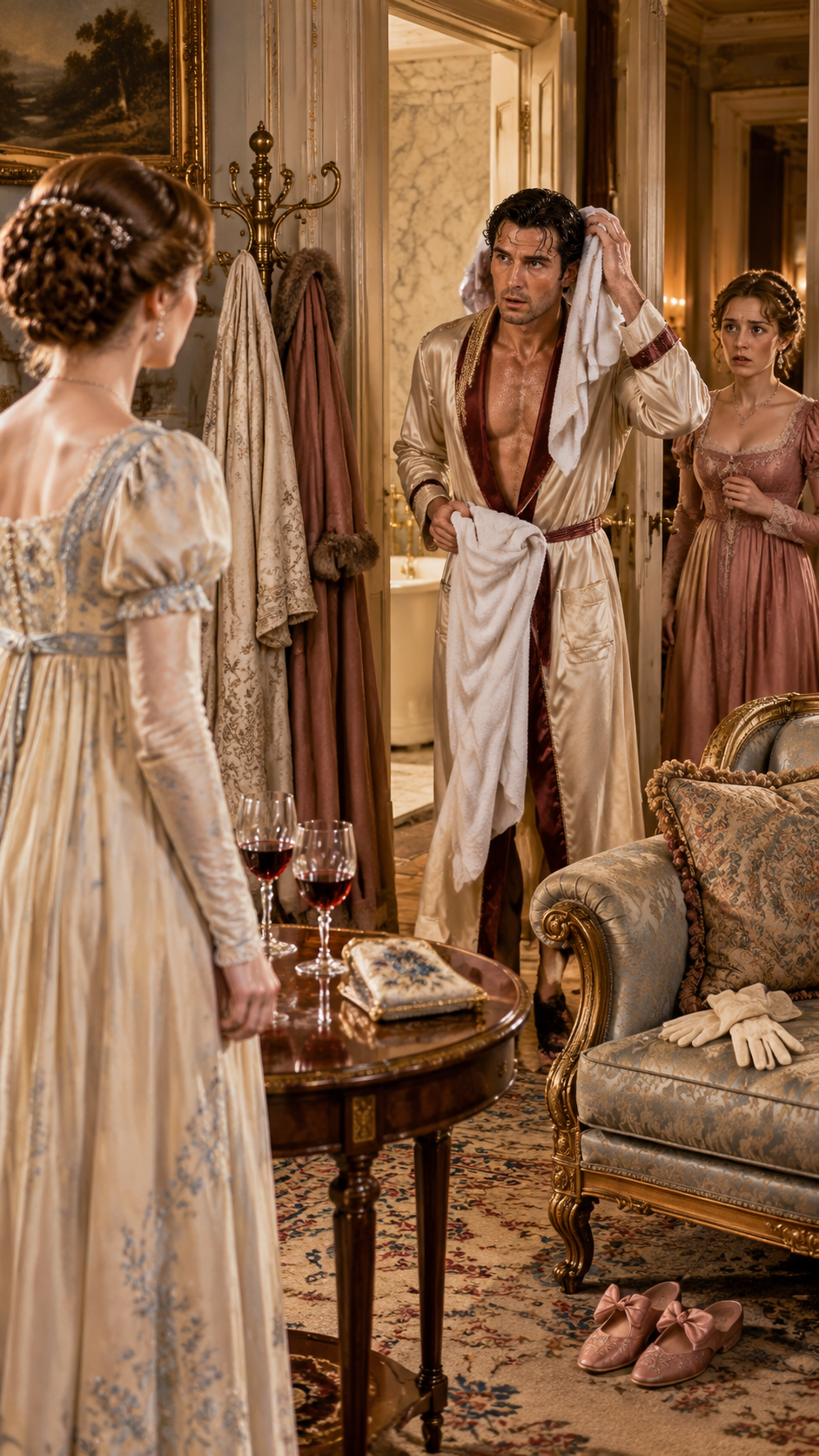
I remembered the drawing room.
Beatrice’s slippers beside the sofa.
The two wineglasses.
Edmund emerging from the bathing room, looking more inconvenienced than ashamed.
“No,” I said.
Mr. Jameson nodded.
“Then we shall proceed accordingly.”
He paused.
“May I ask whether you intend to seek a separation?”
I looked at Nathaniel.
He remained silent.
Then I turned back to the solicitor.
“Yes.”
The word came more easily than I expected.
“I intend to seek a separation.”
The first consequence of Mr. Jameson’s actions arrived sooner than I had anticipated.
On Friday afternoon, a messenger delivered a letter from Ashcombe House.
The handwriting was Edmund’s.
Eleanor,
I have been informed that you visited Harbury’s banking house and have since been making inquiries into the family’s affairs.
I should be grateful if you would return home so that we may discuss this matter privately.
There is no reason to involve solicitors or strangers in what is essentially a domestic misunderstanding.
I expect you at Ashcombe House tomorrow.
Edmund.
I read the letter twice.
Then I handed it to my aunt.
“Domestic misunderstanding,” she repeated.
“Apparently.”
“What would you like to tell him?”
I considered it.
“Nothing.”
My aunt smiled.
“An excellent beginning.”
I placed the letter in the drawer.
Edmund had not asked whether I was well.
He had not asked whether I had slept.
He had not even mentioned Beatrice.
He wanted to know why I had visited the bank.
That told me more than any apology could have done.
He arrived the following morning.
I was sitting with my aunt in the small morning room when the butler announced him.
“His Grace, the Duke of Ashcombe.”
I did not rise.
“Show him in.”
Edmund entered wearing a dark blue coat, a perfectly tied cravat, and the familiar expression of a man who believed the world had inconvenienced him.
He looked at my aunt.
“Lady Margaret.”
“Your Grace.”
Then his attention returned to me.
“Eleanor.”
“Edmund.”
He waited.
I did not invite him to sit.
After a moment, he took the chair opposite me.
“I should like to speak with my wife.”
My aunt remained where she was.
“Then speak.”
Edmund’s jaw tightened.
“Alone.”
“That will not be necessary.”
He turned towards me.
“Have you become so determined to make a spectacle of this?”
I looked at him.
“Which part would you prefer to discuss? Your relationship with Lady Beatrice, or the money taken from my settlement?”
His expression changed.
Only slightly.
But I saw it.
“I knew it,” he said.
“That is an interesting response.”
“You have been examining private accounts.”
“My own accounts.”
“They are part of the Ashcombe household finances.”
“They are part of my inheritance.”
He leaned forward.
“Eleanor, you do not understand the circumstances.”
“Then explain them.”
He glanced towards my aunt.
“I would rather discuss this with you privately.”
“You have had twelve years to speak privately with me, Edmund. You chose not to.”
He looked away.
For the first time, I noticed that he seemed tired.
There were faint shadows beneath his eyes, and his usual confidence appeared somewhat strained.
“I made certain decisions because the estate was under considerable financial pressure.”
“How considerable?”
“That is not something you need concern yourself with.”
I almost smiled.
“Three years of unexplained transfers from my settlement, and I am not supposed to concern myself?”
“I intended to replace the money.”
“When?”
“When circumstances permitted.”
“How much have you taken?”
He said nothing.
“Edmund.”
“I do not have the exact figure before me.”
“Then you should obtain it.”
His expression hardened.
“You have no idea what it takes to maintain a family such as ours.”
I looked at him for a long moment.
“And you have no idea what it means to trust someone.”
He stood.
“Enough. You will return to Ashcombe House, and we shall settle this properly.”
“I will not.”
His eyes narrowed.
“You are my wife.”
“I am aware.”
“You cannot simply abandon your responsibilities.”
I rose.
“Nor can you abandon yours.”
For a moment, neither of us spoke.
Then I said the words I had rehearsed the previous night.
“I want a formal separation. I want my settlement placed beyond your control, and I want a complete account of every transfer made without my consent.”
He stared at me.
“Separation?”
“Yes.”
“You cannot be serious.”
“I have never been more serious.”
He gave a short, incredulous laugh.
“And what do you imagine will happen? You will leave this house, take your fortune, and live comfortably while I am left to answer for every difficulty that has arisen?”
“I did not create those difficulties.”
“You have enjoyed the benefits of this marriage.”
“And I have paid for them.”
He stepped closer.
“Do not be foolish, Eleanor.”
I looked directly into his eyes.
“You have mistaken my patience for an inability to act. That mistake ends today.”
He opened his mouth.
Then the butler appeared at the door.
“Your Grace, there is a gentleman requesting to see you.”
Edmund turned sharply.
“Who?”
The butler hesitated.
“Lord Nathaniel Ashcombe, Your Grace.”
The silence that followed was unlike anything I had ever experienced.
Edmund’s face lost its colour.
My aunt slowly rose from her chair.
I did not move.
For several seconds, my husband stared at the butler as though he had spoken in a foreign language.
Then he looked at me.
“You told him?”
“No.”
“Who has been speaking to him?”
I said nothing.
The butler remained at the door.
“Shall I show him in, Your Grace?”
Edmund’s fingers tightened around the back of his chair.
“Yes.”
A moment later, the man he had allowed the world to believe was dead entered the room.
Nathaniel bowed to my aunt.
Then he looked at his younger brother.
“Good morning, Edmund.”
My husband did not answer.
Nathaniel took another step.
“I believe we have some matters to settle.”
The Brother Who Had Returned from the Dead
Edmund finally found his voice.
“What is the meaning of this?”
Nathaniel regarded him calmly.
“I might ask you the same question.”
“You have no right to enter this house.”
“On the contrary. I believe I have rather more right than you suppose.”
Edmund looked towards the butler.
“Leave us.”
The man glanced at Nathaniel.
I spoke before he could move.
“Mr. Collins may remain.”
Edmund turned towards me.
“This is a family matter.”
“Then I am certain he has heard worse.”
My aunt made a small sound that might have been a cough.
Nathaniel approached the fireplace.
“Edmund, I have no intention of creating an unnecessary disturbance. I came because Eleanor deserves to know the truth, and because the arrangements we made three years ago can no longer continue.”
Edmund’s expression became cold.
“You should have remained where you were.”
“I did. For seven years.”
“And you were provided for.”
“At considerable cost to a woman who had no knowledge of the arrangement.”
Edmund glanced at me.
“That money was used to preserve the estate.”
“Some of it,” Nathaniel replied. “The rest was used to maintain a lifestyle you could no longer afford.”
“That is a lie.”
“Then you will have no difficulty explaining the accounts.”
Edmund looked towards the documents in my hands.
I had brought the copies of the banking instructions and the settlement.
He recognized them immediately.
“You have been sharing private family correspondence?”
“I have been investigating the use of my inheritance.”
“You have no understanding of the circumstances.”
“Then explain them.”
He looked at Nathaniel.
“Tell her.”
Nathaniel did not move.
“You are perfectly capable of speaking for yourself.”
Edmund’s jaw tightened.
For several moments, he remained silent.
Then he walked towards the window.
“Our father left considerable debts,” he began. “More than either of us knew. When Nathaniel disappeared, I was left to manage the estate. The creditors were already demanding payment. The tenants expected their rents to be reduced. The servants expected their wages. Everyone wanted something.”
He turned towards his brother.
“You had no idea what I was facing.”
Nathaniel answered quietly.
“I know more than you think.”
“Then you know why I could not simply announce that you were alive. The family would have been ruined. There would have been questions about the succession, the estate, the accounts. Everything would have been thrown into confusion.”
“Yet you managed to find time to write to me.”
Edmund’s face tightened.
“Because I wanted to protect the family.”
“You wanted to protect your position.”
“I was the one who remained!”
Nathaniel’s voice grew firmer.
“And I was the one who spent months recovering from an accident while the world mourned a man who was still breathing.”
Silence filled the room.
I looked between them.
“Did you intend to return?”
Nathaniel turned towards me.
“Eventually, yes. But I had no wish to challenge my brother while the estate was struggling. I believed he would settle the debts and restore the accounts.”
“And you never considered telling me?”
“I should have.”
He lowered his head.
“I made a mistake.”
Edmund gave a humourless laugh.
“A mistake? You disappeared, and now you return with accusations.”
Nathaniel did not respond to the provocation.
Instead, he took a folded document from his coat.
“This is the original agreement between us.”
Edmund stared at it.
“You kept that?”
“I kept everything.”
Nathaniel placed the paper upon the table.
It was a simple agreement, dated three years earlier.
Edmund had promised to provide Nathaniel with a temporary allowance while he remained away from London. In return, Nathaniel would not challenge the succession until the estate’s financial difficulties had been resolved.
There was also a provision requiring the Duke to preserve the separate property of his wife.
I read that sentence twice.
Edmund had agreed in writing not to use my inheritance for his personal obligations.
Yet he had done precisely that.
“Why did you sign this?” I asked.
Nathaniel answered before Edmund could.
“Because I believed my brother.”
I looked at Edmund.
“And why did you violate it?”
He stared at the paper.
“I intended to repay everything.”
“When?”
He rubbed his forehead.
“When the estate recovered.”
“Did it?”
He did not answer.
“Did you ever intend to tell me?”
His silence was answer enough.
I looked at him for a long time.
“You allowed me to believe that we were building a secure future together.”
“We were.”
“No. I was.”
He looked up.
“Eleanor—”
“You knew my inheritance was protected. You knew I had never consented to those transfers. Yet you continued to use the money.”
“I was trying to prevent a financial disaster.”
“And you were willing to make me pay for it without my knowledge.”
His expression changed.
For a brief moment, I thought he might finally understand what he had done.
Then he said something that removed every remaining doubt.
“You were never going to need all that money.”
I stared at him.
“What?”
“You had more than enough. The estate required assistance. I believed you would understand if I explained everything.”
“Then why did you not explain it?”
He looked away.
I nodded slowly.
“Because you knew I would refuse.”
He said nothing.
“And because you believed that being my husband gave you the right to decide for me.”
Edmund’s shoulders stiffened.
“Do not turn this into something it is not.”
I gave a quiet laugh.
“I believe you have already done that.”
The meeting ended with Mr. Jameson arriving later that afternoon.
He had been summoned by Nathaniel to witness the discussion and ensure that the necessary documents were properly recorded.
Edmund was visibly displeased to see him.
“This is becoming ridiculous.”
Mr. Jameson removed his gloves.
“Your Grace, I assure you that the matter is quite serious.”
He explained that the trustees had been notified and that further withdrawals from my settlement had been suspended.
Edmund objected immediately.
“You cannot freeze the family’s accounts.”
“Not the family’s accounts, Your Grace. Her Grace’s settlement.”
“It is necessary for the estate.”
“That is not a legal justification.”
Edmund looked at me.
“You are going to destroy everything.”
I felt an unexpected sadness.
Not because I believed his accusation.
But because I finally understood that he had spent so many years thinking of our marriage as an arrangement in which my loyalty was guaranteed and his authority was unquestionable.
He had never imagined that I might choose myself.
“I am not destroying anything, Edmund. I am simply refusing to continue paying for your decisions.”
Mr. Jameson placed a final document before him.
It outlined the proposed terms of a formal separation and the restoration of my financial independence.
Edmund refused to sign.
He said he would consider it.
He demanded more time.
He insisted that the accounts be examined privately.
And when Nathaniel informed him that he intended to establish his identity publicly, Edmund became almost speechless.
“You cannot do that.”
“I can.”
“The title—”
“Was never yours to keep if I was alive.”
Edmund turned towards him.
“You have no idea what you are asking.”
Nathaniel’s expression softened slightly.
“I know exactly what I am asking. I am asking you to stop pretending that your brother’s life ended simply because his absence was convenient.”
Edmund looked at me.
For the first time since our marriage, I saw genuine fear in his face.
Not fear of losing his wife.
Not even fear of losing his money.
Fear of losing the identity he had constructed around himself.
And I understood that there was nothing I could say that would make him feel the loss I had experienced.
I left the room without another word.
Lady Beatrice’s Last Visit
Three days later, Beatrice came to see me.
I almost refused her.
The thought of seeing her again made my stomach tighten. Yet I eventually agreed to receive her in the small sitting room at my aunt’s residence.
She entered wearing a simple blue walking dress.
Her face was pale, and there were shadows beneath her eyes.
She looked nothing like the confident woman I had seen in my drawing room.
“Eleanor.”
“Lady Beatrice.”
She flinched at the formality.
“May I sit?”
I indicated the chair opposite me.
She lowered herself into it and placed her hands in her lap.
For a while, neither of us spoke.
Then she began.
“I have left Ashcombe House.”
I looked at her.
“Have you?”
“Edmund asked me to remain. He said that everything would eventually be settled. But I could no longer bear to stay there.”
I said nothing.
She swallowed.
“I thought he loved me.”
The words were so quiet that I almost missed them.
I looked towards the window.
“That is between you and him.”
“He told me your marriage had been unhappy for years. He said you had become distant. That you no longer cared whether he was home or not.”
I turned back towards her.
“Did you ask me?”
Her eyes filled.
“No.”
“Did you ever ask whether I was happy?”
She shook her head.
“Did you ever consider that I might have been confiding in you because I believed you were my friend?”
“I know.”
“Do you?”
She pressed a handkerchief against her mouth.
“I was selfish.”
I looked at her.
“Yes.”
She began to cry.
“I am sorry.”
I believed she was.
That did not mean I could forgive her.
“Beatrice, do you remember the summer we spent at my father’s estate? We were both seventeen. You had fallen from your horse, and I stayed beside you until morning because you were frightened.”
She nodded.
“I remember.”
“You told me then that you had never had a sister and that you wished I could be one.”
“I remember every word.”
“I believed you.”
Her tears fell more freely.
“And I believed you,” I continued. “That is what makes this so difficult. I cannot look at the last twelve years and decide that every moment was false. But I also cannot look at what you did and pretend it was a small mistake.”
“I never wanted to take your place.”
I looked at her.
“Then you should not have sat in it.”
She lowered her head.
There was nothing more to say.
After a moment, she rose.
“I shall not trouble you again.”
I did not stop her.
At the door, she turned.
“Eleanor?”
“Yes?”
“Do you think you will ever forgive me?”
I considered the question.
“I do not know.”
She nodded.
Then she left.
I watched her carriage disappear through the window.
For the first time, I did not feel the need to follow her with my eyes.
Some friendships ended not with an argument, but with the quiet understanding that the person you once knew no longer existed in the same way.
And sometimes, the kindest thing you could do was allow the ending to remain an ending.
The Price of a Duke’s Pride
The weeks that followed were difficult.
Mr. Jameson and Sir William Pembroke conducted a thorough examination of the accounts.
The investigation revealed that Edmund had used a substantial portion of my settlement to cover debts connected with the Ashcombe estate.
He had also authorized several payments without the consent required by the settlement.
Some funds had gone towards the maintenance of the London residence. Others had been used to satisfy creditors, while a smaller amount had been transferred to Nathaniel’s account.
There was no evidence that Nathaniel had participated in the misuse of my inheritance.
He had received the agreed payments, but he had not known that part of the money had been taken from my protected capital.
When he learned the truth, he immediately offered to return what remained in his account.
I declined to accept his personal money until Mr. Jameson had established the correct legal position.
“I do not want to create another debt between us,” I told him.
Nathaniel looked at me thoughtfully.
“You have had enough of other people’s arrangements.”
“Indeed.”
He smiled.
The more I learned about Nathaniel, the more I understood why he had once been loved by the tenants of Ashcombe.
He was not an especially charming man, nor did he possess Edmund’s ability to command a room.
But he listened.
When a tenant complained about a damaged roof, Nathaniel asked for the name of the village carpenter. When the estate steward mentioned that several families had fallen behind with their rents, he asked whether their circumstances had been examined before any demands were made.
He seemed genuinely interested in the people whose lives depended upon the estate.
Edmund had been interested in its appearance.
Nathaniel was interested in its condition.
The distinction was considerable.
Meanwhile, the question of the dukedom could no longer be avoided.
Nathaniel had been the elder son. His disappearance had been accepted as death, and Edmund had succeeded him.
But Nathaniel was alive.
The family solicitors began the formal proceedings necessary to establish his identity and correct the succession records.
Several witnesses from the northern village where he had recovered were located. The surviving driver of a neighbouring estate, who had helped search for him after the accident, provided a statement.
There were also letters Nathaniel had written during the first year after his disappearance.
The evidence was overwhelming.
Edmund initially resisted.
He argued that his brother had abandoned the family and that he had acted in good faith.
But the documents, dates, and correspondence could not be dismissed.
Eventually, he agreed to cooperate with the inquiry.
He would remain a member of the family, but he could no longer claim that his brother’s death had entitled him to retain the dukedom once Nathaniel’s survival had been established.
The news was received quietly.
There were no public accusations in the newspapers, no dramatic confrontations in the House of Lords.
There were simply letters, legal discussions, and a formal correction of a matter that had remained unresolved for seven years.
Nathaniel became the Duke of Ashcombe.
Edmund became Lord Edmund Ashcombe.
I was no longer the Duchess of Ashcombe.
And, to my surprise, I found that I did not care.
My own separation was concluded several months later.
Mr. Jameson was careful to ensure that the agreement protected my settlement and established an independent income.
The remaining capital was returned to the trustees, and the unauthorized transfers were recorded as obligations to be repaid.
Edmund was required to relinquish control of my inheritance.
He also agreed to the terms of our separation.
There was no public trial.
There was no need for one.
The evidence was sufficient, and neither of us wished to spend another year making our private misery a subject of public entertainment.
Before the final papers were signed, Edmund requested one last meeting.
I agreed to receive him at Mr. Jameson’s office.
He arrived without his usual confidence.
His dark coat was well made, but the man wearing it seemed somehow diminished.
He looked at me for a long moment.
“You look well.”
“Thank you.”
“I suppose you are pleased.”
I considered that.
“I am relieved.”
He nodded.
Then he looked down at the papers.
“I never intended for matters to become so complicated.”
“Neither did I.”
He gave a faint, tired smile.
“You always believed the best of people.”
“I believed the best of you.”
He looked at me.
“Do you think there was ever a time when we were happy?”
The question surprised me.
I remembered our wedding day.
His hand beneath mine.
The first winter at Ashcombe House, when he had insisted upon walking with me through the snow because I had never seen the countryside covered in white.
I remembered the evenings we had spent reading beside the fire, the dinners with friends, and the summer mornings when we had breakfast in the garden.
There had been happiness.
That was perhaps the saddest part.
“Yes,” I answered. “There was.”
He looked almost relieved.
“Then perhaps we need not remember everything as a failure.”
“I shall remember what was good. But I will not allow it to excuse what came after.”
He looked down again.
For a moment, I thought he might apologize.
Instead, he asked, “Do you truly believe you will be happier without me?”
I met his eyes.
“I believe I will be happier without having to wonder whether the person beside me is telling me the truth.”
He said nothing.
I signed the papers.
He signed after me.
And just like that, twelve years of marriage became a collection of documents, signatures, and memories that belonged to the past.
When I left the office, the afternoon sunlight was falling across the pavement.
I stopped beside the carriage and took a deep breath.
For the first time in months, I felt no need to look behind me.
A Different Kind of Home
I did not return to Ashcombe House.
Instead, I settled at my father’s old country residence, Willowmere, in Wiltshire.
It was a modest estate compared with Ashcombe, but it had always been my favourite place.
The house stood beside a small lake, surrounded by old trees and gardens that my father had loved.
The windows needed repairing. The library required attention, and the eastern wing had not been properly occupied for years.
But I found comfort in the work.
I chose new curtains for the drawing room. I reopened the library. I employed a gardener to restore the rose beds that had become overgrown.
I also began spending more time with the village families.
My father had established a small school on the estate many years earlier. It had fallen into disrepair, and I decided to restore it.
I wanted the girls of the village to have opportunities beyond those available to their mothers.
There was no grand announcement.
No newspaper correspondent arrived to record my generosity.
I simply arranged for the building to be repaired, hired a teacher, and ensured that the children could attend without their parents worrying about the expense.
One afternoon, while examining the newly repaired windows, I found a small girl standing outside the schoolroom.
She was perhaps eight years old and wore a faded brown dress.
“Are you Lady Eleanor?”
“I am.”
“Will the school really open next week?”
I smiled.
“That is the intention.”
“Will girls be allowed to borrow books?”
“Of course.”
Her eyes widened.
“Even the big ones?”
“Especially the big ones.”
She smiled so brightly that I found myself laughing.
As she ran towards the village, I stood in the doorway for a long time.
It occurred to me that I had spent years trying to make a beautiful home for a husband who had not valued it.
Now I was building something that belonged to me.
And it was enough.
Nathaniel visited Willowmere several times during the following months.
He never arrived without sending word, and he never presumed that his position as Duke gave him any special claim upon my time.
During one visit, he stood with me in the garden while the gardener worked among the roses.
“You seem happier here,” he observed.
“I am.”
He looked towards the house.
“Have you missed Ashcombe?”
I considered the question.
“I miss certain memories. I do not miss the life I was living.”
Nathaniel nodded.
“I understand.”
He was now fully occupied with the responsibilities of the dukedom.
The estate required considerable attention, and he had begun reviewing the tenants’ leases, repairing several cottages, and reorganizing the accounts.
He had also made arrangements to ensure that the remaining debts were settled without placing an unfair burden upon the people who lived on his land.
One afternoon, he brought me a small wooden box.
“I found this among our mother’s belongings.”
I opened it.
Inside lay a delicate silver brooch.
It was shaped like a small branch of rosemary, with tiny blue stones set among the leaves.
“I remember this,” I said.
“Our mother wore it when she visited Ashcombe.”
Nathaniel smiled.
“She once told me that rosemary was a plant associated with remembrance.”
I touched the brooch.
“It is beautiful.”
“I thought you might like to have it.”
I looked up.
“Are you certain?”
“Quite.”
I closed the box carefully.
“Thank you.”
He hesitated.
“Eleanor, there is something I have wanted to say.”
I waited.
“I should have intervened sooner. When I learned that Edmund was using your settlement, I ought to have told you immediately.”
I looked at him.
“Yes. You should have.”
He accepted my answer without argument.
“I cannot change what happened. But I can tell you that I am sorry.”
I believed him.
And unlike the apologies I had received from others, his did not seem to demand anything in return.
“Thank you, Nathaniel.”
He smiled.
Then we walked back towards the house.
We never spoke of marriage or affection.
He was my former husband’s brother, and whatever friendship might grow between us would have to exist without the expectations of the past.
That suited me perfectly.
For the first time, I was content to allow relationships to become what they naturally were, rather than what I believed they ought to be.
The Final Letter
Almost a year after I had discovered Beatrice’s slippers beside my drawing-room sofa, another letter arrived.
This time, it was from Beatrice.
I recognized her handwriting immediately.
I considered leaving it unopened.
Then I decided that I no longer needed to be afraid of what she might say.
I broke the seal.
Dear Eleanor,
I hope this letter finds you well.
I have heard that Willowmere has been restored and that the village school has reopened. I am glad.
I have been living with my sister in Hampshire. It has been a quiet year, and I have had more time to think than I once believed possible.
I will not pretend that I have become a different person overnight. I still regret what happened, and I expect I shall regret it for the rest of my life.
Edmund and I are no longer together.
I have learned that a man who is willing to deceive his wife may also be willing to deceive the woman who believes she has replaced her.
That is not an excuse for what I did. I merely wish I had understood it sooner.
I do not expect a reply.
I only wanted to tell you that I hope you have found peace.
Beatrice.
I folded the letter.
For a long time, I sat beside the window.
I did not feel the anger I had once imagined I would feel whenever I heard her name.
Nor did I feel the desire to write back.
I simply understood that she had become part of a chapter of my life that was finished.
I placed her letter inside a drawer with the other papers from that year.
Then I returned to my book.
Outside, the gardeners were preparing the grounds for spring.
The first roses had begun to appear along the southern wall.
And I had something far more important to attend to than the mistakes of two people who had once occupied so much of my thoughts.
THE END
A Life That Belonged to Me
Two years passed.
Willowmere became the home I had once dreamed of having.
The school flourished, the gardens were restored, and the old library became a favourite place for the village children.
I continued to receive occasional letters from Nathaniel.
He was a thoughtful Duke, though he often complained that the responsibilities of his position involved considerably more paperwork than he had anticipated.
I always replied with the same suggestion.
“Perhaps you should employ someone who enjoys reading accounts.”
He never seemed to find that advice particularly helpful.
As for Edmund, I heard that he had taken a house in the country and spent much of his time away from London.
We did not meet again.
I sometimes wondered whether he had ever understood what he had lost.
But I no longer needed an answer.
One spring morning, I was walking through the garden when I found a small envelope resting upon the hall table.
It contained a note from Nathaniel.
Eleanor,
I shall be passing Willowmere next Thursday and wondered whether I might have the pleasure of joining you for luncheon.
I have been informed that your school has received a generous collection of books, and I should very much like to see it.
If you are agreeable, I shall arrive at one.
Nathaniel.
I smiled.
I wrote a brief reply and handed it to the footman.
Then I walked towards the schoolroom.
The children were already gathering outside, their voices carrying through the open windows.
One little girl was reading aloud from a book, while another was trying to help her younger brother find his place.
I stood in the doorway and watched them.
For years, I had believed that a woman’s happiness depended upon the affection of the man she married.
I had believed that patience could mend almost anything, that loyalty would eventually be rewarded, and that the greatest kindness one could offer a husband was to stand beside him even when he made mistakes.
I no longer believed those things.
Love could be generous.
Marriage could be beautiful.
Friendship could be precious.
But none of them required a woman to surrender her judgment, her dignity, or her right to know the truth.
Edmund had once told me that I could not simply walk away with everything.
He had been right about one thing.
I could not take the past with me.
I could not recover the years I had spent trusting the wrong people. I could not undo the betrayal or erase the memories of that terrible afternoon.
But I had recovered something far more important.
My inheritance.
My independence.
My peace.
And, most importantly, myself.
I looked towards the garden, where the sunlight rested upon the newly opened roses.
Then I turned back to the children.
“Shall we begin, ladies and gentlemen?”
They hurried towards their desks.
I smiled and opened the book.
For the first time in twelve years, I was exactly where I wanted to be.
And nobody had to give me permission to remain there.
The End.

