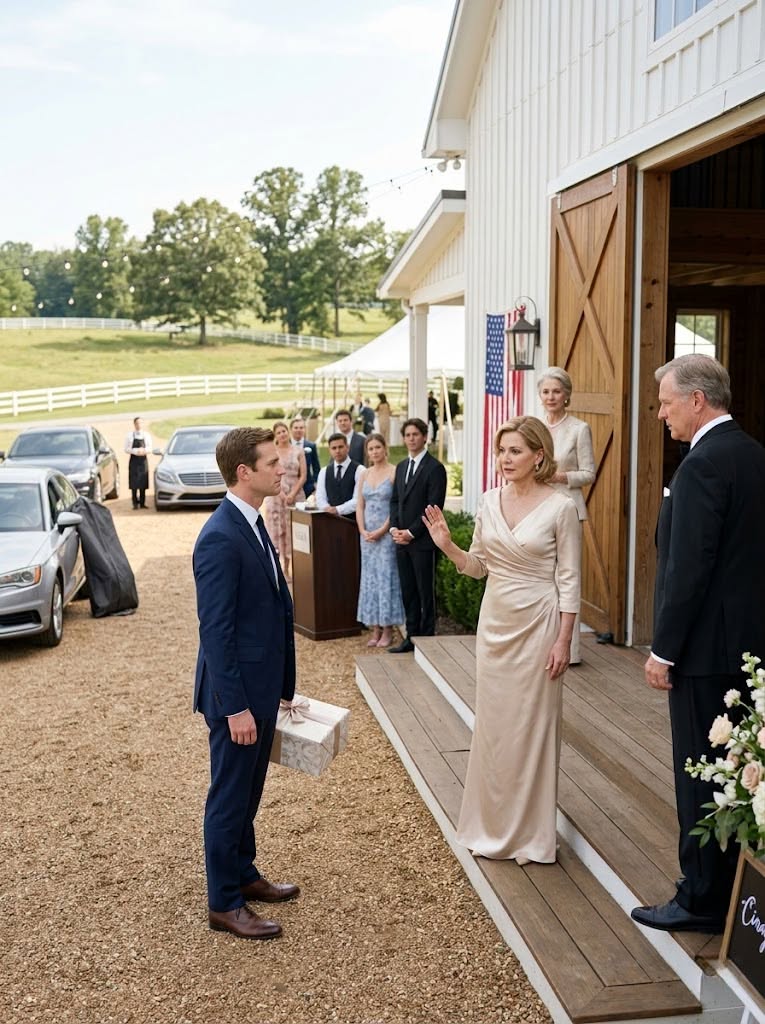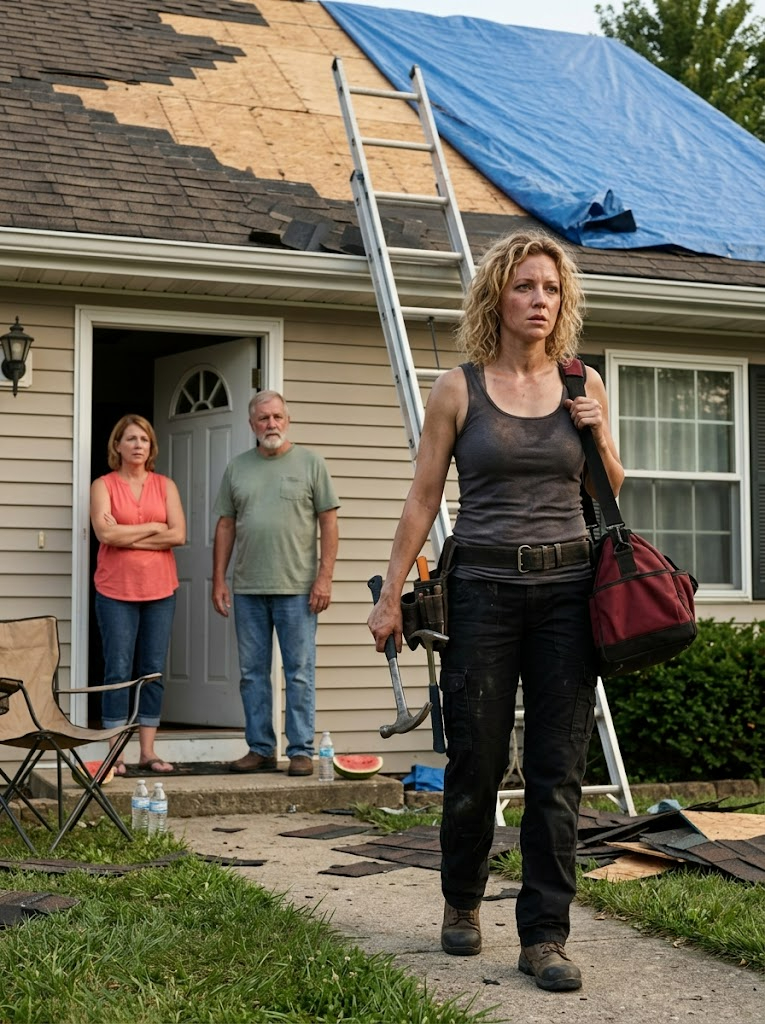
“Look at this joke trying to prove she’s useful,” my father captioned the video of me hauling shingles across his roof in brutal July heat while my mother and sister laughed from the air-conditioned house. They claimed they could not afford the $12,000 labor bill, so I worked unpaid for three exhausting days—until I discovered first-class flights, luxury hotels, and a European cruise already booked with the money my labor had saved them. I secured the unfinished section, packed my tools, and drove away. Three nights later, a violent storm tore through the exposed roof, collapsed their bedroom ceiling, and triggered thirty-seven furious calls demanding I return immediately. I mailed them $15,000 to create a clean boundary, but instead of gratitude, my mother claimed I still owed an old debt. Then I opened ten years of bank records—and discovered exactly how long my family had been turning my love into an obligation that could never be fully repaid…
The Roof I Refused to Finish
Part 1
By the end of the first day, the back of Audrey Bennett’s neck felt as though someone had pressed a hot iron against it.
Her shoulders had passed through pain into numbness and somehow returned to pain again. Every time she bent to lift another bundle of shingles, a muscle in her lower back tightened with a warning she could no longer pretend not to understand. The July sun hung over the Ohio neighborhood like a lid, trapping heat against the steep roof beneath her boots.
She reminded herself that she was fortunate to know how to do the work.
That was the story her family had always told about her.
Audrey was capable. Audrey was practical. Audrey would figure it out.
Her parents repeated those words not with pride but with relief—the relief of people who had found the family member who could be depended upon so completely that no one else had to examine how little they contributed.
Her father, Martin, had called three weeks earlier to say the roof was leaking over the primary bedroom.
“We’ve gotten three estimates,” he complained. “These contractors think we’re made of money.”
Her mother, Elaine, sighed loudly in the background.
“The lowest labor quote was twelve thousand dollars,” Martin continued. “That doesn’t even include materials.”
Audrey had worked roofing jobs during college. She now managed construction projects for a commercial property company, and although she no longer spent her days carrying shingles, she knew exactly how the work should be done.
She drove over the next weekend, measured the roof, calculated the pitch, inspected the attic, and created a material list. She even called Frank Delgado, a contractor she had once worked for, to confirm current labor prices.
“Twelve thousand?” Frank said. “For that roof, they’re getting off easy.”
Audrey had imagined how grateful her parents would be when she offered to do the labor herself.
Instead, Martin whistled and said, “Thank God we raised a daughter who knows her way around a ladder.”
Elaine clapped her hands once. “This is why it pays to have smart children.”
In their family, smart had never meant valued.
It meant available.
Audrey arrived before seven on Friday morning. Her husband, Daniel, helped her unload the compressor, tarps, nail gun, extension cords, safety harness, and tools before leaving for work.
“You call me if you feel dizzy,” he told her.
“I’ll be fine.”
“That sentence is why I’m worried.”
She kissed him and promised.
Her parents stood on the porch drinking coffee as she positioned the ladder and carried the first bundles toward the house. For a while, Audrey thought nothing of their watching. Homeowners often stared at roofers. There was something compelling about seeing another person work confidently at a height most people feared.
Then she noticed her father’s phone.
Martin filmed her climbing the ladder with a bundle balanced against one shoulder. He recorded her tearing away brittle shingles and scraping old nails from the decking. When loose granules shifted beneath her boot and she dropped to one knee to catch herself, he followed the movement with his camera.
He was not documenting the repair.
He was collecting entertainment.
Around noon, Audrey climbed down, dizzy with thirst.
Martin lifted the phone toward her. “Don’t worry, honey. This is great content.”
Elaine laughed from the kitchen doorway. “Maybe we’ll make you famous.”
Audrey gave them the small, careful smile she had perfected over thirty-eight years.
“You could make yourselves useful. I need someone to steady the ladder while I carry up the next stack.”
Martin took another drink of iced tea. “I don’t want to get in your way.”
By sunset, Audrey had removed the damaged kitchen section, replaced two sheets of rotted decking, installed synthetic underlayment, and laid several rows of shingles. Tar coated her gloves. Sweat soaked through her shirt. Her legs trembled when she finally reached the ground.
Her parents were sitting beneath the maple tree in lawn chairs, sharing a bowl of cherries.
“You’re a machine,” Elaine called.
“I need water.”
“There’s a pitcher in the refrigerator.”
That night, Audrey showered in the upstairs bathroom because she was too exhausted to drive home covered in grime. As she passed the living room, she heard her own strained breathing coming through the television speakers.
She stopped in the doorway.
Martin had projected his phone onto the large screen. Audrey appeared there, bent beneath a bundle of shingles, her hair plastered to her forehead.
A message from Martin’s family group flashed across the bottom.
Look at this joke trying to prove she’s useful.
Uncle Gary had replied with a cartoon raccoon wearing a hard hat.
Audrey’s younger sister, Rachel, wrote, At least hire somebody hot next time.
A cousin added, HGTV, but make it tragic.
They were laughing.
Not nervously. Not guiltily.
They laughed with the ease of people who had assigned Audrey a role years ago and trusted her never to stop performing it.
Martin noticed her but did not turn off the television.
“Don’t be sensitive,” he said. “Everyone knows we’re kidding.”
Elaine smiled. “If you can’t laugh at yourself, who can you laugh at?”
Audrey looked at the screen one last time.
Her body was laboring beneath the July sun while the people she had come to help transformed her exhaustion into a family joke.
Something inside her became quiet.
There was no speech. No confrontation.
Only a small, clean click, like a lock finally turning after years of remaining loose.
She slept in the guest room because she had promised to finish the roof, and she had not yet understood that some promises were made to versions of reality that no longer existed.
The following morning was hotter.
By ten, the shingles were almost too warm to touch. Audrey worked through two pairs of gloves and developed blisters beneath three fingers. At eleven, Elaine called from the back door.
“You want tuna or turkey?”
For one foolish second, hope rose inside Audrey.
Then her mother added, “For your father. He can’t decide.”
Audrey laughed once, a sharp sound that surprised her.
At two, she climbed down to refill her bottle. The kitchen was cool and smelled of lemon cleaner and chicken salad. Her parents sat at the table beside a laptop and several glossy pages.
Paris. Florence. Nice. Barcelona.
First-class flights. Private transfers. A river-cruise upgrade. Vineyard dinners. A luxury suite overlooking the Mediterranean.
Everything had already been booked.
Audrey stood in the doorway with heat radiating from her body.
“You said you couldn’t afford the labor,” she said.
“We couldn’t afford both,” Elaine replied.
Martin leaned back. “You offered to help. Nobody forced you.”
There it was—the family’s oldest trick.
They never forced Audrey. They merely arranged every situation so that refusing made her selfish, ungrateful, or cold. Then they called her surrender generosity.
She returned to the roof.
The following afternoon, while finishing the section above their bedroom, Audrey looked through the kitchen window and saw her father imitating the way she had carried the shingles. He exaggerated her limp and hunched his shoulders while Elaine laughed so hard she had to hold the counter.
Audrey climbed down.
She secured the unfinished section with a heavy tarp, packed the nail gun, and coiled the air hose.
Inside, she told them Daniel was having a medical emergency.
Martin grinned. “Try not to leave us on a cliffhanger.”
Audrey drove away with her hands shaking against the steering wheel.
Daniel listened to everything when she reached home.
When she finished, he asked, “Are you going back?”
“No.”
Three nights later, at 12:17 in the morning, a violent storm rolled across the county.
Audrey’s phone began vibrating.
Rachel called first.
Then Elaine.
Then Martin.
Audrey let every call go to voicemail as rain hammered the bedroom windows.
Rachel’s message was mostly screaming.
“The ceiling came in! Audrey, what the hell did you do?”
Her mother’s voice was colder.
“You need to fix this immediately.”
Martin’s recording began with several seconds of heavy breathing.
Then he said, “You’d better pray the damage is limited.”
Audrey turned the phone facedown.
Outside, thunder shook the glass.
By morning, she had thirty-seven missed calls—and a message from her cousin Leah saying two police cruisers had just pulled into her parents’ driveway.
Part 2
Leah lived four houses down from Audrey’s parents and possessed the neighborhood awareness of someone who worked from home beside a front window.
Audrey called her.
“You’re not going to believe this,” Leah whispered. “Your father is standing on the sidewalk telling the police you sabotaged the house.”
Through the phone, Audrey heard Martin’s raised voice.
He claimed his daughter had performed unauthorized construction, left the roof unsafe, and abandoned the project intentionally. One officer asked whether there had been a written contract.
“No,” Martin admitted.
“Was she paid?”
“No, but that’s not the point.”
“Did you ask her to do the work?”
Martin hesitated. “She volunteered.”
The officer apparently told him that inviting an unpaid relative to replace a roof, insulting her while she worked, and then blaming her when she stopped sounded less like a crime and more like a disastrous family decision.
Martin insisted on filing a report anyway.
The police classified the matter as civil and advised him to contact a licensed contractor.
Once Audrey’s parents realized they could not turn her departure into a criminal case, they began presenting it as a moral failure.
Rachel posted photographs in the family group. Water had destroyed the bedroom ceiling. Wet insulation hung over the bed. Elaine’s antique nightstand was swollen, and Martin’s camera case had been soaked.
This is what happens when an amateur pretends to know what she’s doing, Rachel wrote.
Uncle Gary contributed another meme.
Elaine posted about adult children who offered help they were incapable of providing. Martin wrote that he had confused generosity with responsibility.
Not one person mentioned the three days Audrey had worked without pay.
No one mentioned the videos.
Daniel sat across from Audrey at the kitchen table, reading the messages in silence.
“They’re trying to make you feel guilty enough to finish the roof for free,” he said.
“I know.”
“Are you going to?”
“No.”
The answer was firm, but guilt still lived in her chest. She had left the roof exposed. She had secured it as carefully as possible, but the tarp had failed. Regardless of how her parents behaved, the damage was real.
The following morning, Audrey withdrew fifteen thousand dollars from savings.
It was more than the original labor quote and likely more than the emergency repairs would cost. Writing the check made her hands tremble, but she wanted a clean boundary.
She mailed it without a note.
Four days later, Elaine called from an unfamiliar number.
“We reviewed our records,” she said. “You never fully repaid the two-thousand-dollar loan from five years ago. We may hold your check until the debt is settled.”
Audrey stood in the kitchen, staring at the refrigerator.
She had repaid the loan through six bank transfers. She remembered skipping a wedding gift one month to make the final payment. She remembered sending an additional amount because she had misread her notes.
She pulled up the records.
Every transfer was there.
She had repaid the full two thousand dollars and overpaid by one hundred and eighty.
They knew it.
But the debt was not the point.
The mechanism was.
If Audrey paid, they would discover another obligation. If she explained, they would challenge her evidence. If she gave them money, they would call it insufficient or insulting.
Nothing she did could complete the obligation because the obligation had never been financial.
Her assigned position required her to remain in motion toward them forever.
Daniel listened to Martin’s next voicemail, which ended with the words, “You owe us.”
Without asking permission, he opened his laptop and created a spreadsheet.
The title read:
What Audrey Owes Versus What Audrey Gave.
At first, she refused to participate.
“This is pointless. They won’t care.”
“It isn’t for them,” Daniel said. “It’s for you.”
He entered the roof materials, the check, and the six loan repayments.
Eventually, Audrey sat beside him.
She added the utility bills she had paid during Martin’s supposed medical emergency, only to discover later that he had used his money to buy a fishing boat. She added repairs, yard work, grocery deliveries, and the payments she had made when Rachel forgot her children’s school fees.
She added every shift she had exchanged, every birthday rescued, every tank of gas, and every weekend surrendered.
Viewed separately, each favor had resembled family love.
Arranged chronologically, they formed a decade of exploitation.
The total exceeded sixty thousand dollars, not including the value of her labor.
Audrey stared at the screen until the numbers blurred.
Sunday morning, Martin arrived at her house.
Audrey was watering plants when his silver SUV stopped at the curb. He walked toward her with deliberate calm, his shoulders squared as though entering a negotiation he expected to win.
“We need to talk.”
He spoke about stress, the damaged house, Elaine’s anxiety, and the importance of their European trip.
“Your check felt insulting,” he said. “Like you were throwing money at us to avoid responsibility.”
“I paid more than the contractor’s labor estimate.”
“That’s not the point.”
It never was.
Martin sighed. “Maybe we overreacted. But you need to understand how this looks from our perspective.”
Audrey waited.
Then he said the words that severed whatever connection remained.
“You used to be so grateful. What happened to you?”
Audrey did not answer.
She walked inside and closed the door.
Two nights later, someone broke into her truck.
The driver’s-side lock had been gouged. The glove compartment hung open, and papers were scattered across the floor. Nothing valuable was missing.
The police officer who took the report said it might have been random.
Audrey wanted to believe him.
The following evening, she found a note tucked beneath her windshield wiper.
The paper carried traces of Elaine’s perfume.
We won’t forget what you did. This won’t end until you fix it the right way.
Audrey photographed the note, placed it in a plastic bag, and added it to Daniel’s documentation file.
Then her phone rang from a restricted number.
Elaine was sobbing.
She said the family was collapsing. She said Audrey had poisoned everyone against them.
Near the end, her voice became quiet.
“You aren’t the only one who knows how to cut people off.”
Audrey listened to the message twice.
The tears did not frighten her.
The calm warning did.
Part 3
The family’s version of events began to fracture because Martin had enjoyed humiliating Audrey too much to keep the evidence private.
Her cousin Eric called first.
He said he had mostly believed the story that Audrey had torn apart the roof, lost control of the job, and abandoned their parents out of spite.
Then he remembered the video Martin circulated on the first day.
Eric had saved it because he wanted to send the raccoon meme to a coworker. When he replayed the clip, he noticed details he had ignored before.
Audrey’s clothes were soaked through with sweat.
Martin was laughing as she struggled with a bundle.
Elaine could be heard asking whether Audrey could “do that funny limp again” after nearly falling.
Eric showed the recording to his father. His father shared it with two relatives.
The shift was not dramatic. There was no family intervention or public apology.
Instead, messages arrived one at a time.
A cousin admitted she had always wondered why Audrey was expected to repair everything while Rachel was praised for merely attending family dinners.
An aunt confessed that Elaine had once manipulated her into paying for a vacation rental, then claimed the money had been a gift.
Another relative wrote, I thought the video was funny at first. Watching it again, I feel ashamed.
The messages did not erase what had happened, but they loosened something inside Audrey. For years, her parents had treated her discomfort as proof that she was too sensitive. Now other people were finally seeing the pattern.
Audrey had not invented it.
She was simply the first person who had refused to keep participating.
Martin and Elaine’s threats arrived in waves. They mentioned lawyers, property-damage claims, emotional distress, and repayment demands. Daniel documented each contact by date, time, source, and content.
Eventually, the file stopped feeling like a defense.
It became a history Audrey had needed to see clearly.
Then Rachel appeared at Audrey’s workplace.
She entered the lobby of Northline Properties wearing dark sunglasses and the expression she always used when she wanted something while pretending to offer peace.
Audrey met her near reception.
“Mom isn’t sleeping,” Rachel said. “Dad’s blood pressure is out of control. You need to end this.”
“I mailed them fifteen thousand dollars.”
“They want an apology.”
“For what?”
“For leaving.”
“They mocked me while I worked. They lied about why they couldn’t afford a contractor.”
Rachel folded her arms. “Families joke. You always take everything personally.”
Audrey almost laughed.
The accusation had been repeated so often it had become meaningless.
Rachel lowered her voice. “Mom found a notebook proving you still owe part of that loan. But they’re willing to forgive it if you apologize and make things even.”
“I repaid it and overpaid by one hundred and eighty dollars.”
“That isn’t what her records say.”
“I have bank statements.”
Rachel’s mouth tightened.
Audrey finally understood that evidence had never mattered. Rachel had not come to learn the truth. She had come to restore the old arrangement.
“I’m not giving them another dollar or another hour,” Audrey said.
“You’re selfish.”
“Then you can fix their roof.”
Rachel stared at her as though the possibility had never occurred.
She left without another word.
That night, Audrey wrote a letter.
She wrote about every favor that became an expectation and every insult disguised as humor. She wrote about Christmas mornings when Rachel received jewelry while Audrey received tools because “she could actually use them.” She wrote about being praised for reliability immediately before being assigned another burden.
She wrote until midnight.
Then she read the letter aloud to Daniel.
When she finished, he asked, “Are you sending it?”
Audrey looked at the pages.
“No.”
She deleted the document.
Some words were not meant to persuade the people responsible for the pain.
Some existed only to release the person carrying it.
Audrey blocked her parents, Rachel, the family group, and every relative who had watched silently while their voices might have mattered.
She expected guilt.
Instead, relief moved through her body so strongly that she slept for twelve uninterrupted hours.
Four weeks later, the doorbell rang.
Rachel’s nine-year-old daughter, Kira, stood on the porch holding a small terracotta pot containing a fern. Her knees were dusty, and her thin shoulders were raised almost to her ears.
“Aunt Audrey,” she whispered. “Mom said to give you this.”
Audrey opened the door wider.
Kira offered the pot with both hands.
“She said she’s sorry.”
There was no letter.
No adult courage accompanied the message.
Only a child carrying an apology that should never have been placed in her hands.
Before Audrey could invite her inside, Rachel called sharply from the sidewalk.
“Leave it, Kira. Come on.”
Kira flinched.
It was a tiny movement, but Audrey recognized it immediately—the involuntary response of a child learning to measure every adult mood.
Kira ran back across the lawn.
Audrey remained in the doorway holding the neglected plant as Rachel drove away.
Daniel came up behind her.
“You okay?”
“I don’t know.”
He touched one of the drooping leaves. “It needs a bigger pot.”
They carried the fern into the unfinished sunroom they had been building together. Daniel loosened the crowded roots while Audrey filled a new pot with fresh soil.
The metaphor was obvious.
It was also true.
Two people cared for something that had been neglected—not by demanding that it become healthy immediately, but by placing it in conditions where healing was possible.
When they finished, the fern still looked fragile.
But it no longer looked trapped.
Part 4
On Kira’s birthday, Audrey mailed her a card and a bookstore gift certificate.
She wrote only one sentence:
You are always welcome here.
She did not mention Rachel or their parents. No adult conflict would be carried through a child again.
One week later, Kira sent a thank-you card in careful block letters. At the bottom, she had drawn a tiny green fern.
It was the first thing in months that made Audrey cry.
Soon afterward, Martin’s older brother called.
Uncle Thomas had avoided the conflict because, as he admitted, he expected Audrey to surrender eventually.
“I thought it would resolve itself,” he said.
“You mean you thought I’d go back.”
A long silence followed.
“Yes.”
At least he was honest.
Thomas told her Martin and Elaine had used similar tactics before. They borrowed money, manufactured emergencies, and turned favors into permanent obligations. Several relatives had distanced themselves over the years, but each eventually returned after enough guilt or pressure.
“You’re not the first person they treated this way,” Thomas said. “You’re just the first one who walked away and didn’t come back crawling.”
Audrey leaned against the kitchen counter and closed her eyes.
It was not an apology for his silence.
It was not permission.
It was confirmation, and she needed that more.
After the call, Daniel looked up from the trim he was sanding in the sunroom.
“I think I’m done carrying the part of this that was never mine,” Audrey said.
He gave her the small nod he always used when she had finally spoken a truth he already understood.
The roof dispute never reached court.
Martin and Elaine hired a contractor, repaired the interior damage, and canceled the river-cruise portion of their trip. They still traveled to Europe, though photographs later appeared online showing smaller hotel rooms and economy-class seats.
Audrey felt no satisfaction.
Their vacation had never been the real issue. The problem was the belief that her labor belonged to them and that her refusal constituted betrayal.
The fifteen-thousand-dollar check cleared.
No one returned the excess.
Audrey had expected that.
Months passed.
Unknown numbers stopped causing her heart to race. A car slowing near the house no longer made her reach for her phone. Silence ceased feeling like punishment and became something gentler.
Distance, she discovered, could be a form of health.
She and Daniel finished the sunroom in early autumn.
It had broad windows, pale oak floors, and a deep chair positioned where afternoon light crossed the room. They built most of it themselves, but the work felt nothing like her parents’ roof.
Daniel carried materials without being asked. He brought water. When Audrey grew tired, they stopped. No one filmed her mistakes. No one transformed exhaustion into a joke.
The difference was not that the work was easier.
The difference was that love stood beside her instead of watching from the shade.
The fern rested on a shelf near the southern window. Its leaves became darker and fuller. New growth uncurled from the center in pale green spirals.
Audrey watered it every Thursday morning.
Sometimes she remained there after the soil was damp, thinking about the complicated shape of forgiveness.
Forgiveness was not always reunion.
It was not forgetting, excusing, or reopening a door to someone who still intended to walk through carrying the same weapons.
Sometimes forgiveness meant refusing to let another person’s cruelty harden every tender part that remained.
If Elaine ever chose to apologize honestly, she knew where Audrey lived.
An honest apology would require accountability. It would not arrive through tears, threats, invented debt, or a frightened child carrying a dying plant.
Perhaps that day would come.
Perhaps it would not.
Audrey no longer organized her life around the possibility.
She and Daniel began planning small trips. A long weekend on the coast of Maine. Seattle in spring. Places chosen because they wanted to see them, not because someone else needed rescuing.
One Saturday morning, Audrey received a letter from Rachel.
She almost threw it away unopened.
Instead, she carried it into the sunroom and sat beside the fern.
Rachel did not apologize.
Not exactly.
She wrote that Kira often asked about Audrey. She admitted their mother had pressured her to deliver the plant and had dictated the message. She said she had begun remembering moments from childhood differently—times when Audrey had been assigned work while Rachel was excused, times when everyone laughed because it was easier than questioning why the same person was always expected to sacrifice.
Near the end, Rachel wrote:
I don’t know how to fix this without admitting how much I benefited from it.
Audrey read the sentence several times.
It was not enough to restore a relationship.
But it was the first honest thing her sister had offered.
Audrey answered with three lines.
You begin by telling the truth without asking me to make it comfortable. Kira is welcome here. What happens between us will depend on what you do next.
She mailed the letter and returned to her life.
That was another lesson she had learned.
A boundary did not need anger to remain strong.
Years of obligation had trained Audrey to believe love meant climbing higher while everyone she cared about remained safely below. It meant lifting more because she was capable, staying longer because she was reliable, and forgiving faster because conflict made other people uncomfortable.
The roof had never been merely a roof.
It represented every gift that became a duty. Every compliment that concealed another demand. Every joke delivered to an audience while Audrey continued working.
When the bedroom ceiling collapsed during the storm, more than shingles and plaster gave way.
The entire family structure they had pretended was stable finally failed.
What still surprised Audrey was that when it collapsed, she was no longer standing beneath it.
She had already climbed down.
She regretted the money and the lost years. She regretted every apology she swallowed to preserve a peace whose cost fell entirely on her.
She did not regret leaving.
She did not regret refusing to repair everything according to their terms.
One Thursday morning, Audrey watered the fern and noticed that a new leaf had opened during the night. It leaned toward the window, catching the sunlight.
Daniel entered carrying two mugs of coffee.
“Looks healthy,” he said.
Audrey touched the edge of the new leaf.
“It had healthy roots,” she replied. “It was just trapped in the wrong place.”
Daniel handed her a mug and sat beside her.
Outside, autumn sunlight moved across the yard. The room they had built together stood warm and quiet around them.
Some things could recover after being confined too long inside conditions that diminished them.
They did not recover by returning to those conditions.
They recovered because someone finally gave them enough room, enough care, and enough light.
Audrey sat beside the window, no longer waiting for another demand.
For the first time in her life, being capable did not mean being available.
It meant she was finally strong enough to choose where her effort belonged.
THE END
Disclaimer: This content is entirely AI-generated for fictional and entertainment purposes only. Any resemblance to actual persons, living or dead, events, or locations is purely coincidental, and the creator assumes no liability for any interpretation of this content.
Disclaimer: This story is fictional and created for entertainment purposes only. Any names, characters, places, or events are fictitious or used fictitiously. No real person or organization is intended to be portrayed.