cnu My daughter-in-law declared that two of her friends would be moving into my home, then ordered me to give up the bedroom I had shared with my late husband and sleep on the couch. My son remained silent.
My daughter-in-law announced that two of her friends were moving into my house, then told me to surrender the bedroom I had shared with my late husband and sleep on the sofa. My son said nothing. At sixty-five, I finally understood what my silence had cost me, but neither of them noticed the envelope I quietly slipped beneath my coffee cup.My daughter-in-law stood in my kitchen, scrolling through her phone as she dropped the kind of announcement that divides a life into before and after.
“I’ve got some exciting news,” Sarah said, barely glancing up from the screen. “My friends Jessica and Chloe are moving in today. Their lease ended, so they need a place until they get settled.”I paused with my coffee mug halfway to my mouth. Outside the bay window, late-summer sunlight lay across the lawns of our quiet Ohio neighborhood, catching on sprinklers, mailboxes, and the silver maple my husband had planted the year David started kindergarten. Inside, the refrigerator hummed and the old wall clock above the pantry counted off three deliberate seconds before I lowered my mug to the granite counter.
“Moving in?” I repeated.
Sarah studied her fresh manicure as if the pale pink polish required her full attention. “Yeah. They have a lot of stuff, so they’ll take the master bedroom. David and I will stay in our room, and you can sleep on the living room couch. Honestly, Melinda, you hardly use all that space in your room anyway.”For a moment, I thought I had misunderstood her. At sixty-five, I was old enough to know that disbelief sometimes protects the mind by slowing down what the ears have already heard. I looked from Sarah to my son, waiting for the sentence that would restore the natural order of the room.
David stood beside the refrigerator with one hand in the pocket of his khaki shorts. He was thirty-two years old, broad-shouldered like his father and still prone to lowering his chin when he knew he had done something wrong. Instead of meeting my eyes, he stared at a grocery list held to the refrigerator by a magnet shaped like the state of Florida.
“Mom, it’s just for a little while,” he muttered.That was all. No defense of me, no reminder that we were standing in my home, and no recognition that the bedroom Sarah had casually assigned to two strangers was the room where I had slept beside my husband for thirty-eight years.
The house sat on a curved street outside Columbus, four bedrooms, three bathrooms, a redbrick chimney, and a front porch Tom had rebuilt with his own hands. We had bought it when our children were small enough to leave fingerprints on the hallway walls. We had paid the mortgage through layoffs, medical bills, tuition payments, and all the ordinary emergencies that make up a marriage.
Tom had been gone five years. His side of the closet was mostly empty now, but his cedar shoe box remained on the upper shelf, holding a necktie, two anniversary cards, and the cuff links I had given him the year Rachel was born. His silver pocket watch still rested in my dresser, and on cold mornings, before I was fully awake, I sometimes reached toward his side of the bed expecting to find the warmth of his shoulder.Sarah knew all of that. She had seen the framed photograph on the nightstand and watched me smooth the quilt Tom’s mother had sewn for us. Yet she had looked around my home and decided my memories could be folded away as easily as spare sheets.
David and Sarah had moved in ten months earlier. The arrangement was supposed to last six months, perhaps eight at most, while they saved enough for a down payment on a starter home. They arrived with a rented truck, a sectional sofa too large for my living room, and assurances that I would barely know they were there.
At first, I believed them. I cleared out the guest room, emptied two kitchen cabinets, and made room in the garage for David’s tools. I told myself that helping adult children through a difficult season was what families did.Six months became seven. Seven became ten. They did not contribute to the mortgage, groceries, electricity, water, internet, or property taxes, although the arrangement had originally included a modest monthly payment.
Whenever I raised the subject, Sarah had a reason. Her car needed repairs. David’s hours had been cut. They had attended a destination wedding. There had been unexpected dental work, although the following weekend they posted photographs from an expensive restaurant downtown.
I noticed these things, but I did not confront them. I had spent much of my life confusing patience with kindness and silence with peace. Tom used to tease that I could find an excuse for anyone, including a burglar if he wiped his feet before entering.Sarah took advantage of that instinct gradually. She rearranged my pantry because my system was “inefficient.” She replaced my floral sofa with the enormous gray sectional because the old couch looked “like something from a retirement home.” She moved Tom’s gardening boots from the mudroom to the garage without asking because she disliked seeing them near the back door.
Each act was small enough to forgive by itself. Together, they formed a quiet occupation.
I had accommodated them because David was my son and because grief had made an empty house feel larger than it was. I liked hearing footsteps upstairs again. I liked finding a second coffee mug in the sink, even if no one rinsed it. Some evenings, David sat beside me and watched baseball the way he had with his father, and those moments convinced me the inconvenience was worth it.Now he stood in my kitchen while his wife instructed me to surrender my bedroom, and I saw our arrangement clearly for the first time. They were no longer saving for a future. They had built their comfort on my reluctance to disappoint them.
I did not feel the urge to cry. I did not feel devastated or even angry in the way I would have expected. Instead, something inside me became very quiet, as if a door had closed against a storm.
The boundary had not merely been crossed. It had been erased, and David’s silence told me he expected me to accept that too.I wrapped both hands around my mug. “Okay.”
Sarah’s face brightened at once. “I knew you’d understand. You’re amazing.”
She leaned over and kissed the air near my cheek, leaving behind the faint perfume she wore whenever she went out with friends. “We’re going to brunch. The girls will bring their things over this afternoon, so maybe clear out your closet before then.”David finally looked at me, but only for a second. There was relief in his face, the grateful relief of a man whose mother had once again spared him the discomfort of disagreeing with his wife.
They gathered their coats and walked through the front hall. Sarah called back that they would probably be gone two hours, maybe three, depending on how crowded the restaurant was.
The door shut. Their SUV backed down the driveway and disappeared around the curve.I stood at the window until the street was empty again. Then I carried my coffee to the sink, rinsed the mug, and placed it upside down on the drying mat.
There was no dramatic music, no shattered glass, no trembling collapse against the kitchen cabinets. The moment that changed my life sounded like water running from an ordinary faucet.
My first call was not to Rachel, my sister, or one of the women from church. I had learned from watching other families that if you ask too many people whether you are allowed to defend yourself, someone will eventually persuade you to surrender.Instead, I called Fischer Lock and Key, a local business Tom had used after a break-in occurred two streets over. A man named Ron answered, and I told him I needed the exterior locks changed immediately.
“Is this an emergency, ma’am?” he asked.
“It is to me.”He did not ask for details. He quoted the service fee and said he could have someone there within forty-five minutes.
My second call was to a residential moving company whose advertisement promised same-day emergency packing. The dispatcher hesitated when I explained that everything in one bedroom and one bathroom needed to be removed before late afternoon.
“We can do it,” she said. “But I need to confirm that you own the property and have authority to move the belongings.”“My name is the only name on the deed. I can show your crew identification, tax records, and the original purchase documents if necessary.”
There was a pause while she typed. “Then we’ll send three people and a truck.”
After hanging up, I went upstairs and opened the drawer of the small writing desk in my bedroom. The house deed lay inside a fireproof document pouch beside Tom’s death certificate, our wills, and insurance papers. I carried the pouch downstairs and placed it on the kitchen island.That was when I noticed my hand was steady.
Forty-two minutes later, a gray van pulled into the driveway. Ron, a locksmith with a sunburned neck and wire-rimmed glasses, examined my identification, walked the perimeter of the house, and began replacing the front, back, and side-door deadbolts.
The metallic scrape of his tools traveled through the rooms. Each time an old lock came free, I felt as though the house were exhaling something it had held too long.Tom had chosen the original brass hardware. I kept one of the old keys after Ron finished, not because it could open anything now, but because it had hung from my husband’s key ring for more than twenty years. I set it beside the fruit bowl while the locksmith programmed the new keypad and handed me two fresh keys.
“Would you like extra copies?” he asked.
“No. Two are enough.”He looked toward the staircase, perhaps wondering why a woman living alone needed so few. If he had questions, he kept them to himself.
I paid him, thanked him, and watched his van pull away just as a white moving truck turned onto the street. Three movers stepped out wearing gray uniforms: a crew chief named Marcus, a younger man called Eli, and a woman named Denise who carried a clipboard.
I showed them my identification, the deed, and the rooms containing David and Sarah’s belongings. The guest bedroom smelled of Sarah’s perfume and the vanilla candles she burned even after I told her they gave me headaches. Clothes spilled from an overstuffed rack, shoes crowded the floor, and unopened shopping boxes leaned against the wall.“Pack everything in this room and the second bathroom,” I said. “Those items belong to my son and his wife. Please be thorough, label every box, and handle their belongings carefully.”
Marcus studied my face. “You want all of it taken today?”
“All of it.”“What about the furniture?”
“The bed and dresser belonged to me before they arrived. The television, clothing rack, and small desk are theirs.”
He nodded and marked the distinction on the inventory form. There was no judgment in his expression, only professional concentration, and I appreciated him for that.They moved quickly. Denise wrapped cosmetics and perfume bottles in paper. Eli packed shoes, electronics, chargers, and stacks of clothing. Marcus disconnected the television and photographed each item before boxing it.
I did not hover, and I did not throw anything. When Denise found Sarah’s pearl earrings beneath the bathroom cabinet, I asked her to place them in a small padded box and record them separately. When Marcus discovered cash inside David’s desk drawer, we counted it together and sealed it in an envelope with both our signatures across the flap.
I was not acting out of malice. I wanted my home returned to me, but I did not want a single object damaged or lost. Anger might have justified carelessness to some people; to me, carefulness was part of the boundary.While the crew worked, I sat at my laptop and searched for storage facilities nearby. I selected a clean, climate-controlled building three miles away, rented a unit under David’s name, and paid the first three months in advance.
The manager sent an access code and a digital agreement. I printed two copies, placed one with the movers, and kept the other on my desk.
I also photographed the guest bedroom before and after packing. It occurred to me that Sarah might later claim I had destroyed her property, and that thought brought back a memory from the previous Christmas.She had borrowed one of my mother’s crystal serving bowls for a party and returned it chipped. When I mentioned the damage, she insisted the chip had always been there. David agreed with her even though he had watched me unwrap that bowl every Thanksgiving since he was a child.
At the time, I let it go. Now I understood that truth without evidence had become negotiable in my own house.
By two o’clock, every trace of their ten-month stay had been removed from the bedroom and bathroom. The closet rods were bare. The vanity drawers were empty, and the carpet showed pale rectangles where boxes had sat for months.The room looked almost exactly as it had before they moved in. I stood in the doorway remembering the afternoon I prepared it for them, placing clean towels on the bed and a vase of yellow daisies on the dresser. I had been so hopeful then, not because I wanted them dependent on me, but because I believed proximity might bring us closer.
Instead, Sarah had treated every kindness as evidence that more could be taken.
Marcus handed me the inventory. It ran seven pages and included numbered boxes, photographs, and signatures. I reviewed each page before signing.“We’ll place everything in the unit and send you confirmation when the lock is secured,” he said.
“Thank you for being careful.”
He gave me a small, sympathetic nod. “Sometimes careful is the best way to end something.”After the truck left, I swept the empty bedroom even though the movers had already vacuumed it. I opened the window and let fresh air enter. The curtains shifted in the breeze, and somewhere down the block, a lawn mower started.
Thirty minutes later, Marcus texted photographs of the packed storage unit and the secured lock. I printed the storage address, unit number, access code, keys, paid receipt, and complete inventory, then slid everything into a clear plastic sleeve.
I taped the sleeve to the center of the newly locked front door at eye level. It looked orderly, almost official.Then I brewed a fresh cup of tea and sat in the blue armchair that had been mine since before Sarah replaced the sofa. Tom and I had found that chair at an estate sale during our twenty-fifth year of marriage. One leg was slightly shorter than the others, and he had repaired it with a thin wedge of oak.
The house was so still that I could hear the clock in the hallway. For the first time all day, I allowed myself to wonder whether I had gone too far.
David was my son. I had rocked him through ear infections, sewn patches onto his Little League uniform, and driven through an ice storm to reach him after his first college car accident. A mother’s body remembers the child even when the child becomes a grown man capable of hurting her.But memory was not permission. Love did not require me to disappear from my own life so he could avoid an argument.
The afternoon sun slipped lower behind the maple trees. At four thirty-seven, tires crunched across the driveway.
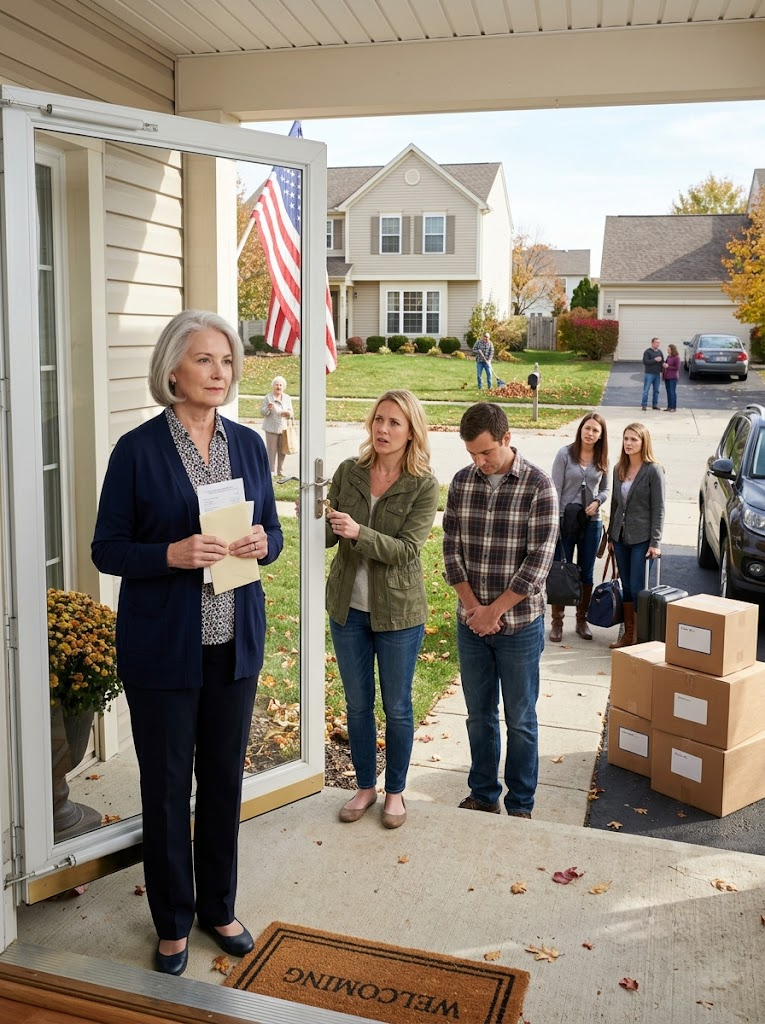
I set down my tea and walked into the hallway. Through the edge of the blinds, I saw Sarah’s SUV parked directly in front of the house. Behind it was a second car packed with suitcases, plastic tubs, garment bags, and two lamps wedged against the rear window.Jessica and Chloe had arrived.
David climbed the porch steps first, pulling his key from his pocket. He slid it into the lock, frowned, withdrew it, and tried again. Then he pushed his shoulder against the door as if swollen wood were the problem.
Sarah came up behind him carrying a handbag and a restaurant takeout container. “What’s taking so long?”“The key isn’t turning.”
She shoved the container into Jessica’s hands and grabbed the handle. When the door did not open, irritation flashed across her face.
That was when she noticed the clear sleeve taped in front of her.She ripped it from the door so hard that the tape snapped. The plastic tore beneath her fingernails, and several pages slid onto the porch.
David bent to pick them up. Sarah snatched the storage receipt and read it first, her lips moving silently across the printed lines. The color rose from her neck into her cheeks.
She thrust the inventory toward David. He read the first page, then looked through the front window as if he expected to see a different mother standing inside.My phone began ringing. David’s name appeared on the screen.
I let it ring.
A few seconds later, a text from Sarah appeared.WHY ISN’T THE KEY WORKING? LET US IN RIGHT NOW.
Another call came, then another message.
THIS ISN’T FUNNY.I waited three full minutes. It was not cruelty; it was space. I wanted them to absorb the truth before they tried to turn it into a misunderstanding.
When the phone rang for the third time, I answered.
“Mom!” David shouted. “What is going on? We can’t get inside. Why did you change the locks?”“Your belongings were professionally packed and moved to a climate-controlled storage unit. The first three months are paid. The address, access code, keys, receipt, and inventory are in your hands.”
He made a sound between a breath and a protest. Before he could respond, Sarah grabbed the phone.
“You are out of your mind,” she said. “You can’t throw us out. We live here.”“No, Sarah. I live here. You were guests.”
Her voice sharpened. “We receive mail here. Our things were here. You can’t just decide we don’t belong because of one conversation.”
“You invited two strangers to move into my house and informed me that I would sleep on the couch. That arrangement is over.”“It wasn’t an order. We were discussing options.”
“You did not ask me a question.”
Behind her, Jessica and Chloe stood beside their overloaded car. I could see Jessica reading the discomfort on David’s face and beginning to understand that the invitation had not been Sarah’s to extend.Sarah lowered her voice, perhaps because she realized the neighbors could hear. “We have nowhere to go.”
“You have two cars, all your belongings, and a storage unit paid through November. Four capable adults can arrange a hotel.”
“Melinda, open this door right now.”“No.”
The word came easily. I had spent sixty-five years believing no required an argument strong enough to survive every objection. That afternoon, I discovered it could stand alone.
Sarah began speaking again, but I ended the call and set my phone to silent. The living room became peaceful at once.Outside, the chaos was only beginning.
Through the window, I watched Sarah pace across the lawn, waving her arms and yelling at David. He remained near the driveway, holding the inventory pages while she pointed toward the house, then toward him, then toward her friends.
Jessica said something to Chloe. Chloe folded her arms and looked at Sarah with an expression that was not sympathetic.Instead of leaving, Sarah marched back up the porch steps and pounded on the door.
“Melinda, open this door! You cannot do this to us!”
The doorbell chimed repeatedly. I did not argue through the wood, because arguing would have suggested this was still a negotiation.After nearly ten minutes, Jessica joined Sarah on the porch and leaned toward the doorbell camera. Her face filled the small screen on the hallway control panel.
“Mrs. Barker, we gave up our apartment,” she said. “We don’t have anywhere else to sleep tonight. Please just let us in.”
Her voice was anxious, and for a moment I felt sorry for her. Then I remembered the second car packed with belongings and the casual certainty with which they had arrived to occupy an older widow’s bedroom without ever speaking to her.They had not been misled by a landlord or displaced by a disaster. They had accepted an offer from someone who did not own the house and had never bothered to verify it.
“I’m sorry Sarah misrepresented the situation,” I said through the camera speaker. “But you cannot move into my home.”
Sarah pressed the button again and shouted over me. “Stop pretending you’re the victim.”I looked at the smart-home panel. Tom had loved technology, especially devices that solved problems no one else believed existed. Two years before he died, he installed automated irrigation around my rose garden and programmed every zone with the seriousness of a man preparing a space launch.
Zone one covered the flower beds beside the porch and the front walkway. I selected it, tapped manual override, and pressed start.
A mechanical hiss moved across the lawn. Six sprinkler heads rose from the grass and sent bright arcs of cold water over the walkway and porch steps.Sarah shrieked when the first stream struck the legs of her designer jeans. Jessica jumped backward and dropped her purse. Chloe grabbed one of the packed boxes from the edge of the spray, then nearly collided with Sarah as all three scrambled toward the driveway.
David did not move. He stood beside the SUV holding the papers, water darkening one shoulder of his shirt, and stared at the house with the expression of a man seeing consequences arrive in physical form.
I let the sprinklers run for less than twenty seconds, then turned them off.The message had been delivered.
Sarah spun toward the house and opened her mouth, but David caught her arm. Whatever he said was too quiet for me to hear. She jerked away at first, then looked at Jessica and Chloe, both wet and visibly angry, and seemed to recognize that her audience was no longer entirely on her side.
Within a minute, both vehicles backed out of my driveway. Sarah’s SUV accelerated too fast around the corner. The second car followed more cautiously.I stood behind the blinds until the red taillights disappeared.
Only then did my knees begin to shake.
I sat in the blue chair and pressed my palms against my skirt. The body has its own schedule for fear. Mine had waited until the danger was gone.For several minutes, I listened to the fading tick of the sprinklers and the sound of water dripping from the porch rail. A woman walking a golden retriever glanced toward the wet driveway, then continued down the street.
Nothing looked changed from outside. Inside, nearly every relationship in my family had shifted.
That evening, I made tomato soup and grilled cheese, the same meal Tom used to prepare when I had a cold. I ate at the kitchen island because the dining table felt too large, and I kept expecting my phone to light up even though it was still on silent.When I finally checked, there were twenty-seven missed calls. Fourteen were from Sarah, nine from David, two from Jessica, and two from numbers I did not recognize.
The messages moved from outrage to pleading and back again. Sarah called me unstable, heartless, selfish, controlling, and cruel. David’s were shorter.
Please answer.We need to talk.
Mom, I’m sorry. Just call me.
I read that last message several times. He was sorry now, after losing the room, the utilities, the groceries, and the shelter I had provided. He had not been sorry when he expected me to sleep beneath a throw blanket on a sofa Sarah had chosen.I turned the phone facedown and carried my bowl to the sink.
Before bed, I checked every door and window. I had never done that when Tom was alive; he was always the one who walked the house at night, testing locks and turning off lamps.
At the top of the stairs, I stopped outside my bedroom. The door stood open, revealing the quilt, the two nightstands, and the photograph from our thirtieth anniversary. Tom was laughing in that picture because the wind had blown my hair across his face just as Rachel pressed the camera button.I entered the room and placed the old brass key from the replaced lock in his cedar box. It no longer opened the house, but it belonged with the years when home had meant something simpler.
The next morning, I woke to birds outside the window and pale sunlight spreading over the bedroom wall. No heavy footsteps crossed the hallway. No television blared from the guest room. No cabinet slammed downstairs.
The silence felt unfamiliar but not empty. It felt clean.I brewed coffee and sat at the kitchen island with my laptop. Moving their belongings had reclaimed the physical space, but over ten months, I had surrendered parts of my financial life too.
It was time to take those back.
I logged into my bank. Several years earlier, after David’s car broke down on a highway outside Cincinnati, I had added him as an authorized user on a backup credit card intended for emergencies.When he moved home, I let him keep it because I wanted him to feel secure. I had not examined the charges closely, trusting that he understood what emergency meant.
The transaction list told a different story. There were charges from sushi restaurants, boutique clothing sites, coffee shops, a wine bar, and a salon Sarah visited twice a month. One weekend contained nearly six hundred dollars in purchases, including dinner at a steakhouse where the least expensive entrée cost more than my weekly grocery budget.
I printed the statements. In the corner of the kitchen, the printer produced each page with a soft mechanical sigh.The records showed more than overspending. They showed the quiet transformation of generosity into expectation.
With a few clicks, I locked the card and removed David’s authorized access. A confirmation email arrived immediately.
Next, I reviewed the joint checking account. Tom and I had opened it for David when he was sixteen, and after Tom died, I continued funding it so my son would have a safety net.Over the previous year, David had deposited less than two thousand dollars. I had deposited nearly eighteen thousand. Automatic payments for their car insurance, subscriptions, and several utility bills came directly from that account.
I left enough money to cover transactions already pending and transferred the rest to a private account in my name alone. Then I removed my overdraft protection.
The cellular plan came next. Both of their phone lines remained part of my family account, along with device payments for expensive phones they had promised to reimburse me for but never did.I checked the boxes beside their names and selected “remove lines.” The website warned that they would need to establish new service. I confirmed the change.
Then I went through every streaming account—Netflix, Hulu, HBO, and the sports package David insisted he needed. I changed each password and chose the option to sign out of every active device.
That last step felt almost absurdly satisfying. Somewhere in a hotel room, a television screen was likely returning Sarah to a login page.Around noon, my phone buzzed. David’s name appeared.
“Mom?” His voice sounded tight and tired. “My credit card just declined at the gas station, and my phone says it doesn’t have a cellular network.”
“I know.”“What do you mean, you know?”
“I canceled your access to the emergency card and removed both lines from my plan. You and Sarah are independent adults. It’s time to manage your own expenses.”
He lowered his voice. I could hear traffic behind him and the electronic chime of a gas station door.“We need the card right now. We spent most of our cash on a hotel last night.”
“The emergency card was for emergencies, not sushi dinners, clothes, salon visits, or weekend entertainment.”
There was a long pause. “You looked through the charges?”“They appear on my monthly statement because it is my account.”
“Sarah thought—”
I stopped him gently. “I am not interested in what Sarah thought. You were the authorized user, David. Your name was on the card, and you were responsible for it.”He breathed into the phone. “We barely have anything left.”
“Then I suggest you review your budget.”
“Mom, please.”“I love you, David, but the free ride is over.”
I ended the call before he could beg. If I had listened longer, the mother in me might have searched for another way to rescue him from the lesson he needed most.
That afternoon, my daughter Rachel called. She lived in North Carolina with her husband and taught history at a community college. Unlike her brother, she had inherited Tom’s instinct for confronting problems directly, which was perhaps why Sarah rarely involved her in family disagreements.“Mom, what in the world is happening?” Rachel asked. “Sarah called me crying. She says you had some kind of mental breakdown, threw them onto the street without warning, and ruined her friends’ lives. She wants me to talk sense into you.”
I smiled despite myself. Sarah never wasted time when assembling an audience.
“I didn’t have a breakdown, Rachel. I stopped being a doormat.”“That doesn’t sound like the whole story.”
“It isn’t.”
I opened my messages and found the text Sarah had sent the previous week.Jessica and Chloe’s lease is ending soon. They might stay with us for a while. It’ll be fun having more people around.
At the time, I had responded with a question mark. Sarah never replied.
I took photographs of that message, the inventory, and the paid storage receipt. Then I sent them to Rachel along with the message Sarah had written after announcing that I would sleep on the sofa.Can you start clearing your room before we get back? The girls have lots of clothes.
“Check your phone,” I told my daughter.
The line went quiet. I could picture Rachel at her desk, pushing her glasses higher on her nose as she read.“She actually told you to give up the master bedroom?” she said at last. “For her friends?”
“Yes.”
“And David was standing there?”“Right beside her.”
“What did he say?”
“That it was only for a little while.”Rachel released a sharp breath. “Wow.”
The word carried anger, disappointment, and the recognition that her brother had become someone neither of us fully knew.
“You didn’t throw their things outside,” she said. “You hired movers and paid for storage.”“For three months.”
“Good for you, Mom.”
Hearing those words nearly undid me more than Sarah’s cruelty had. I looked toward the empty guest room doorway and swallowed.“Do you want me to fly up?” Rachel asked. “I can take a few days off.”
“No, sweetheart. Everything is handled.”
“Are you sure?”“I’m sure. But thank you for asking.”
After we ended the call, messages began arriving from unknown numbers. Sarah had apparently contacted cousins, aunts, and family friends, offering each person her revised account of what had happened.
How could you do this to family?They trusted you.
Sarah says you sprayed them with water.
You need to apologize before you destroy your relationship with your son.One message came from Sarah’s aunt Lorraine, a woman I had met twice.
A mother should never turn her back on her child.
I began typing a response, then deleted it. Explaining myself to people who had already accepted Sarah’s version would only invite them into a matter that did not belong to them.I silenced unknown callers and placed the phone in a kitchen drawer.
My peace was no longer available for public debate.
Two days passed. I weeded the rose beds, polished the cabinet doors, and returned the pantry shelves to the arrangement I had used for years. Flour went beside sugar, canned tomatoes returned to the lower shelf, and Tom’s chipped blue cookie jar came out of the garage.Sarah had called it tacky. Tom bought it at a roadside pottery shop during a trip through Kentucky, and for years he had filled it with ginger snaps even though the children preferred chocolate chip cookies.
I washed the jar and placed it on the counter. The kitchen looked like mine again.
On Thursday afternoon, the doorbell rang. I checked the camera before approaching.David stood alone on the porch. His shoulders were slumped, his shirt was wrinkled, and the shadows beneath his eyes made him look older than thirty-two.
I opened the wooden door but kept the metal screen locked between us.
“Hi, Mom,” he said.“Hello, David.”
He glanced at the screen door, then at me. “Are you going to let me in?”
“Not today.”He looked down at his shoes. They were the brown loafers Tom had given him after college, polished but badly worn at the heels.
“We found an apartment,” he said. “It’s tiny, and the rent is insane. We had to put the deposit and first month on Sarah’s credit card, but we moved in this morning.”
“I’m glad you found shelter.”His mouth tightened at the word shelter, perhaps because it made his circumstances sound temporary and practical instead of tragic.
“The storage place was fine,” he said. “Everything was there.”
“I told you it would be.”He rubbed the back of his neck, a habit he had carried since childhood. “Mom, why did it have to end like this? If you didn’t want Jessica and Chloe moving in, you could’ve just said no. We could have talked about it.”
I studied my son through the mesh. A pale moth had caught in the corner of the screen, its wings fluttering against the wire.
“I shouldn’t have had to say no, David.”He frowned.
“The moment your wife suggested I sleep on a couch in my own home, you should have stopped her. You knew what that bedroom meant to me. You knew the house was mine. Instead, you stared at the refrigerator because disagreeing with Sarah would have made you uncomfortable.”
“I didn’t want to fight with her.”“So you let her fight with me.”
“That’s not what I meant.”
“It is what you did.”He swallowed. For several seconds, neither of us spoke. A delivery truck moved slowly along the street, stopping two houses away.
“You always accommodate everyone,” he said. “I assumed you would go along with it.”
The honesty of that answer hurt more than an excuse would have. He had not believed Sarah’s demand was reasonable. He had simply believed my needs were the easiest ones to sacrifice.“And that,” I said, “is exactly the problem.”
He pressed his fingertips to the metal screen. “I’m sorry.”
“I know you are.”“Can’t we just start over?”
“Starting over does not mean pretending this never happened.”
His eyes filled, and suddenly I saw the ten-year-old boy who once broke a neighbor’s window and hid the baseball beneath his bed. Tom made him knock on the door, admit what he had done, and spend six Saturdays helping that neighbor clean his garage to repay the damage.At the time, I thought Tom was being hard on him. Now I understood that accountability was one of the purest forms of love, because it asks a person to become better rather than merely feel better.
“Wait here,” I said.
I closed the wooden door and went upstairs. From my closet, I retrieved a small cardboard box I had separated before the movers arrived.Inside were two childhood photo albums and Tom’s silver pocket watch. The watch had belonged to his grandfather and bore a fine scratch across the back from the day Tom dropped it while repairing our first house.
I returned to the porch and unlocked the screen just far enough to hand David the box.
“I didn’t let the movers pack these,” I said. “They belong with you.”He lifted the watch from its velvet pouch. The chain slipped across his fingers, catching the afternoon light.
“Dad said I could have this someday.”
“He did.”David turned it over and found the engraving on the back: Time is what we give each other.
Tom had added those words before David’s twenty-first birthday, though he decided at the last minute that his son was not ready for the watch. He placed it back in the dresser and said he would know when the right moment came.
Standing on the porch, I wondered whether this was the moment Tom had been waiting for.David closed his hand around the watch. “I’m sorry, Mom.”
“I know. But apologies do not erase entitlement. You have a lot of growing up to do, and I hope the apartment helps you do it.”
He nodded. A tear moved down one cheek, and he wiped it away impatiently.I wanted to open the screen, pull him into my arms, and tell him everything would be fine. Instead, I stepped back.
Love could remain without access. Concern could remain without rescue.
“I’ll call you,” he said.“When you’re ready to speak honestly, I’ll answer.”
I closed the wooden door. The new lock clicked firmly into place, and this time the sound did not feel like rejection. It felt like definition.
The following morning, I walked into the living room and stared at Sarah’s enormous gray sectional. It consumed nearly half the room, blocking part of the bay window and leaving only a narrow path to the fireplace.She had insisted we buy it three weeks after moving in. My floral sofa was dated, she said, and made the house look old. I reminded her that the house was old and that I liked the sofa, but she ordered the sectional anyway and arranged for the delivery crew to haul mine away.
I had paid for it because her card was supposedly near its limit. Sarah promised to reimburse me in installments. She never made one.
It was, fittingly, the same couch on which she intended me to sleep.I took three photographs and listed it on a local marketplace app for one hundred dollars, pickup required that day. Within two hours, a young couple named Mateo and Lauren arrived in a rented van.
Lauren walked around the sectional with delight. “Are you sure you only want a hundred for it?”
“Completely sure.”They struggled to maneuver it through the front door. Mateo apologized twice when one corner brushed the frame, but I told him not to worry.
As the final section disappeared into their van, the living room seemed to expand. Sunlight reached the hardwood floor for the first time in months.
Lauren handed me a crisp hundred-dollar bill. “Thank you. We just moved into our first place, and we’ve been sitting on folding chairs.”“I hope you make good memories on it.”
After they drove away, I stood in the open room and laughed. The sound surprised me.
I took the money downtown to a small furniture shop Tom and I had visited for years. A green reading chair stood near the back, upholstered in olive fabric with a matching ottoman and curved wooden arms.It was not fashionable, and Sarah would have hated it. I sat down and knew immediately that it belonged beside my window.
The owner, Mr. Landry, recognized me. He had sold Tom the blue chair nearly twenty years earlier.
“Making a change?” he asked.“Returning to myself.”
He did not ask what I meant. He arranged delivery for that afternoon and included a small reading lamp at a discount.
When the chair was positioned beside the bay window, the room finally breathed. I placed Tom’s old brass floor lamp behind it, arranged a knitted blanket over one arm, and set the blue cookie jar on the nearby table for no reason other than it pleased me.That evening, I made chamomile tea and opened my laptop. A lengthy email from Sarah waited in my inbox.
The subject line read: LET’S FIX THIS.
Her first paragraph contained what appeared to be an apology. She said emotions had been high and that her comment about the couch had been a joke I took too seriously.By the second paragraph, she described the humiliation of being locked out in front of her friends. By the third, she explained that she and David were under enormous financial stress, as if that stress had forced her to offer my bedroom to Jessica and Chloe.
The final paragraph revealed the true reason she had written.
If you truly care about us, you’ll help cover the security deposit on our new place. It’s the least you can do after traumatizing us.I read the sentence twice, then laughed aloud. The sound filled the living room and faded into the newly open space.
Sarah did not want reconciliation. She wanted access to the same bank account in a different form.
I did not compose an angry response. I did not correct her version of events or explain why consequences were not trauma. I clicked the button that marked the message as spam.Some people become so loyal to their own story that truth cannot reach them. I had spent years trying to explain myself clearly enough to people who benefited from misunderstanding me.
That night, I slept for eight uninterrupted hours.
Autumn arrived slowly, first cooling the mornings and then painting the neighborhood in copper, yellow, and deep red. Leaves gathered along the curb, and the silver maple dropped small spinning seeds across the lawn.My days settled into a rhythm I had forgotten was possible. I joined a morning walking group at the community center, returned to knitting, and began attending the Thursday book club I had repeatedly skipped because Sarah complained that my friends were noisy.
I cooked smaller meals and enjoyed the leftovers. I played jazz while cleaning the kitchen. Sometimes I left a coffee cup beside the sink until evening simply because no one was there to criticize it.
Freedom did not arrive as a grand celebration. It appeared in small permissions: opening a window, using the good towels, leaving a lamp on while I read, choosing what the house smelled like.In late October, I walked to the mailbox after lunch. Among grocery flyers, an electric bill, and a catalog was a small white envelope addressed in David’s uneven handwriting.
I recognized it from birthday cards, permission slips, and the notes he used to leave on the refrigerator when he borrowed my car as a teenager. My chest tightened before I even opened it.
I carried the envelope inside and sat in my green chair. Using Tom’s old letter opener, I sliced carefully beneath the flap.A handwritten note and a check for three hundred dollars fell into my lap.
Mom,
I took weekend shifts at a hardware store to make extra money. This check covers the first month of the storage unit you paid for. I know it doesn’t fix what I let happen, but I want to repay you for everything. I’m learning how to stand on my own two feet. I miss you.David
I read the note three times.
There were no excuses. He did not say Sarah had pressured him, that money was tight, or that I had misunderstood. He wrote what I let happen, words that placed responsibility where it belonged.For the first time in years, my son was not asking me to remove the consequences of his choices. He was trying to carry them.
I set the check on the side table. I had no intention of cashing it. The money had never been the point, though I suspected earning it had been important for him.
I placed his note in my desk drawer beside Tom’s anniversary cards. It was not evidence for a future argument. It was proof that people sometimes begin changing only after the door they relied upon finally closes.I sent David a short message.
Thank you for the note. I’m proud of you for working hard. Take care of yourself.
His response arrived almost immediately: a single red heart.It was not a complete reconciliation. I did not invite him for Sunday dinner or hand him a new house key. Trust rebuilt too quickly is often only fear wearing a hopeful face.
But it was a beginning.
A week later, David called and asked whether I had received the check. I told him I had.“You didn’t cash it,” he said.
“No.”
“Why not?”“Because paying for the storage was my decision. But earning that money and sending it was yours. Keep saving.”
He was silent for a moment. “Sarah thinks you’re trying to control us by not taking it.”
“Sarah is free to think whatever she chooses.”“I told her it wasn’t about her.”
That answer stayed with me. It was perhaps the first time I had heard him draw a line between his responsibility and his wife’s interpretation.
“How is the hardware store?” I asked.“Harder than I expected. I unload trucks at six on Saturdays. Dad would probably laugh if he saw how sore I am.”
“Your father would tell you to lift with your legs.”
David laughed softly. “Yeah. He would.”We spoke for eleven minutes. Neither of us mentioned the house, the sprinklers, or Sarah’s friends. When we ended the call, I sat with the phone in my lap and cried quietly—not from regret, but from the strange tenderness of recognizing someone you love beneath the habits that had nearly hidden him.
Winter arrived before Thanksgiving. Snow covered the lawn in a thin white sheet and softened the rooftops along our street.
By then, the guest bedroom had become a sewing room. I painted the walls a pale blue, moved my mother’s old sewing machine beneath the window, and filled the closet with folded fabric instead of Sarah’s overflowing wardrobe.The room smelled faintly of cedar and clean cotton. On one shelf, I placed a photograph of my mother wearing the navy dress she had sewn for Rachel’s baptism.
I spent several afternoons making curtains. My stitches were uneven at first because I had not used the machine in years, but I liked the work. There was satisfaction in guiding loose fabric beneath a needle and watching two separate edges become a seam.
On the Friday before Christmas, I hosted book club. Six women filled my living room with coats, casseroles, wine bottles, and opinions about the mystery novel we had just finished.Patricia believed the sister had committed the crime. Evelyn insisted the husband was too obvious. Joan finished half the pecan pie before admitting she had not read the final three chapters.
Their laughter rose into the hallway. No one told us to lower our voices. No one rolled her eyes when Patricia spilled wine on a napkin or when Evelyn moved the ottoman closer to the fireplace.
The house was not quiet that evening, but it was peaceful. I had once mistaken those conditions for the same thing.After the women left, I carried empty glasses into the kitchen and found a folded paper beneath one plate. Patricia had written, Your house feels happy again.
I placed the note beside David’s in my desk.
Later, I stood by the bay window watching snow drift through the streetlights. David had visited twice since autumn, both times alone.On his first visit, he knocked and waited on the porch. When I opened the door, he asked whether he could come inside.
The question mattered more than he knew.
He wiped his shoes, carried his mug to the sink, and stayed less than an hour. Before leaving, he paused in the living room.“What happened to the sectional?”
“I sold it.”
“For how much?”“One hundred dollars.”
He stared at me, then began to laugh. “Sarah paid almost three thousand for that thing.”
“I paid almost three thousand for it.”His smile faded. “Right.”
There were still moments like that, small collisions with truths he had avoided. I did not soften them, but I did not use them as weapons either.
On his second visit, he brought a loaf of bread from the grocery store bakery and a package of coffee. He said he had been promoted to shift supervisor at his regular job and might soon be able to leave the hardware store.He looked healthier. Tired, but more present.
Sarah remained angry. According to Rachel, she continued telling relatives that I had destroyed the family over a joke. She posted vague messages online about toxic mothers-in-law and the courage required to cut off controlling people.
I did not respond. I did not read past the first post after Rachel warned me about it.A person shouting from outside your boundary is still outside it.
David rarely mentioned his marriage. When he did, he chose his words carefully.
One afternoon, while helping me carry boxes of Christmas decorations from the basement, he found the wooden train set Tom used to arrange beneath the tree. He sat on the bottom stair holding the chipped red engine.“Sarah says I choose you over her whenever I disagree with her now.”
“Do you?”
“I’m trying to choose what’s right.”“That may disappoint both of us sometimes.”
He looked up. “Would you be okay with that?”
“I would rather have an honest son who sometimes tells me no than an obedient one who resents me.”He turned the little train engine in his hands. “I wish I’d understood that earlier.”
“So do I.”
The words were gentle, but I did not erase their weight.We assembled the train beneath the Christmas tree together. When David left, he took a photograph of it, perhaps to remember his father or perhaps to remember the home he could enter only by respecting the woman who owned it.
On Christmas morning, Rachel and her husband arrived before ten. They carried too many gifts and a cooler containing a ham she insisted was better than anything sold in Ohio.
David came alone around noon.I did not ask why Sarah stayed away. He did not volunteer an explanation.
We ate in the dining room beneath the brass chandelier Tom had installed crooked and refused to admit was crooked. Rachel told stories about her students. David described a customer at the hardware store who tried to return a snow shovel after using it for three winters.
For an hour, we laughed like a family that had not nearly broken apart.Then Rachel asked whether Sarah might join us for dessert.
David set down his fork. “She doesn’t want to come unless Mom apologizes.”
Rachel looked at me, but I kept my attention on my plate.“For what?” she asked.
“For humiliating her.”
“You mean after she ordered Mom out of her bedroom?”David’s jaw tightened. “I’m not defending what she did.”
“Then why are you carrying her demand into Mom’s house?”
The old David might have stared at the refrigerator or changed the subject. This time, he folded his napkin and answered.“Because I’m still learning when sharing someone’s message becomes helping them apply pressure.”
Rachel leaned back, surprised. So was I.
“And now?” she asked.“Now I think I shouldn’t have brought it up.”
The tension eased, not because the conflict was solved, but because David had recognized it while it was happening. That was new.
After dinner, he washed every dish without being asked. Before leaving, he hugged me in the front hall.“I’m sorry she didn’t come.”
“I’m sorry too.”
“Do you think you’ll ever forgive her?”“Forgiveness and access are not the same thing.”
He nodded slowly. “I’m starting to understand that.”
January brought heavier snow and a silence different from the one I had known after Tom died. Back then, the house seemed to echo with absence. Now it held routines, friendships, and the quiet confidence that nothing within its walls happened without my consent.I kept one spare key in a lockbox for emergencies. Rachel knew the code. David did not ask for it.
The storage unit’s prepaid term expired in November, and David transferred the account into his name. He sent me the confirmation without comment.
By February, he had repaid the remaining two months even though I told him it was unnecessary. This time, he sent money electronically, so I could not refuse without turning his accountability into another argument.I accepted it and used the amount to buy a sturdy worktable for the sewing room. Whenever I cut fabric across its smooth surface, I thought of the difference between receiving repayment and expecting obedience.
Sarah sent one more email in early March.
It was shorter than the first. She said David had changed since leaving my house and blamed me for creating distance in their marriage. She claimed he questioned expenses, refused to let her use his credit cards, and no longer agreed to plans without discussing them first.She described these changes as evidence that I had manipulated him.
I read the email in the morning light while drinking coffee beside the bay window. Then I closed it without replying.
If basic responsibility threatened their marriage, I could not repair it by teaching David to become irresponsible again.A few weeks later, he asked if he could stop by. He arrived carrying a paper bag from Miller’s Diner, the place Tom used to take him after early Saturday baseball games.
“I brought pie,” he said. “Apple for you, cherry for me.”
We sat at the kitchen island with two forks and ate directly from the takeout containers. The diner’s crust tasted exactly as I remembered—too much sugar, a hint of cinnamon, and the unmistakable comfort of something unchanged.David pushed a piece of cherry filling around with his fork.
“Sarah and I are seeing a counselor.”
I waited.“She says the counselor takes my side.”
“Does the counselor?”
“She mostly asks us to be specific. Sarah doesn’t like that.”Specificity had always been difficult for people who relied on emotional fog.
“What do you want?” I asked.
“I want my marriage to work. But I don’t want to go back to being afraid of every disagreement.”“That sounds like something worth telling the counselor.”
“I did.”
He looked toward the hallway. From where he sat, he could see the green reading chair and the empty space where the sectional once dominated the room.“Did Dad ever avoid fighting with you?” he asked.
“Of course.”
“What happened?”“Sometimes nothing happened, and that was the problem. Resentment collected in quiet places.”
I told him about the year Tom agreed to lend his brother money without consulting me. It was not a dramatic betrayal, but we needed that money for Rachel’s dental surgery, and his decision frightened me.
Tom initially insisted that helping family was nonnegotiable. I accused him of caring more about being a good brother than being a good husband. For three days, we spoke only about groceries and the weather.“Then what?” David asked.
“Your father called his brother, changed the arrangement, and apologized to me. I apologized for saying something cruel. We made a rule that neither of us could give away shared money without asking the other.”
“So you worked it out.”“Yes. But working it out required both of us to admit where we were wrong. Love didn’t do that work for us. We did.”
David nodded and took another bite of pie. “Sarah says admitting fault gives people power over you.”
“Your father believed the opposite.”“What did he believe?”
“That a person who cannot admit a mistake is controlled by it.”
David looked down at the pocket watch attached to his belt. He had begun carrying it every day.When he left, he hugged me longer than usual.
Spring returned to the neighborhood in damp earth, daffodils, and the first green haze on the trees. The rosebushes Tom planted needed pruning, and for the first time, I did the work without hearing his instructions in my head.
I cut away dead wood, tied the climbing stems, and replaced one plant that had not survived winter. Grief had taught me that keeping everything exactly as it was did not preserve a life. Sometimes it only prevented new growth.One Saturday, David arrived in work clothes and asked whether growth.
One Saturday, David arrived in work clothes and I needed help spreading mulch. He brought his own gloves and did not enter the house until I invited him.
We worked side by side for three hours. The physical rhythm made conversation easier.“Jessica and Chloe don’t speak to Sarah anymore,” he said while opening a bag of mulch.
“What happened?”
“They blamed her for losing the apartment. Apparently, they had another option but turned it down because Sarah promised them the master bedroom.”I rested the rake against the fence. “Did they know it was my room?”
“They knew it was the master bedroom. Sarah told them you preferred sleeping downstairs because of your knees.”
For a moment, the garden blurred.My knees were healthy. I climbed the staircase several times a day and had never once suggested otherwise.
The lie was small, almost practical, but it revealed planning. Sarah had not made a thoughtless suggestion in the kitchen. She had already described my bedroom to her friends as available and invented a reason I would willingly leave it.
“Why are you telling me this?” I asked.“Because you were right. She never intended to ask.”
The admission cost him something. I could hear it in his voice.
“I wish you had believed me without needing proof from Jessica.”“So do I.”
He emptied the mulch beneath a rosebush and spread it with gloved hands. We continued working, the truth resting between us without being softened.
Later, while drinking lemonade on the porch, David told me that he and Sarah had separated temporarily. She was staying with her aunt Lorraine.“I’m not asking you to be happy about it,” he said.
“I’m not.”
“You never liked her.”“I disliked the way she treated me. That does not mean I wanted your marriage to fail.”
He stared across the lawn. “I don’t know if it failed or if I just stopped pretending it was working.”
The sentence sounded like one he had carried for a long time.“You don’t need to decide everything today,” I said.
He nodded, and we sat quietly beneath the porch fan Tom had installed during a July heat wave. One blade still made a faint clicking sound every fourth rotation.
There was a time I would have filled that silence with advice. I would have told David what to do, whom to forgive, and how long to wait. That afternoon, I let him own his uncertainty.In June, nearly a year after they had moved into my house, David signed a lease on a one-bedroom apartment in his name alone. He continued counseling with Sarah, but they lived separately.
He invited Rachel and me to see the place after he unpacked. It was modest, with beige walls, narrow windows, and a kitchen barely large enough for one person.
Yet it was clean, paid for, and entirely his responsibility.On the living room shelf stood Tom’s pocket watch, two childhood photographs, and the three-hundred-dollar check I had never cashed.
“You kept it,” I said.
“It reminds me where I started.”In the kitchen, he had written a monthly budget on a magnetic whiteboard. Rent, insurance, groceries, phone service, savings, therapy. Each line had an amount beside it.
I smiled at the final category: miscellaneous emergencies.
“What counts as an emergency now?” I asked.“Not sushi.”
We both laughed.
There was no grand reconciliation scene. No one delivered a perfect speech that repaired every fracture. Sarah did not arrive at my door transformed by remorse, and I did not decide that love required me to forget.What changed came slowly.
David called before visiting. He offered to bring groceries. If I declined, he accepted the answer. When we disagreed, he remained in the conversation instead of retreating into silence.
Rachel came north more often, and our family beganreed, he remained in the conversation instead of retreating into silence.creating new traditions that did not depend on my endless labor. On Thanksgiving, everyone brought a dish. David made mashed potatoes badly, and we ate them anyway.
The house changed with me. The sewing room filled with fabric and half-finished quilts. The olive chair developed a slight indentation where I sat each morning. Tom’s blue cookie jar remained on the counter, usually holding ginger snaps.
I kept the clear plastic sleeve from the front door in the back of a desk drawer with the moving inventory and photographs. I no longer needed the evidence, but I did not throw it away.It reminded me that details matter. A text message dismissed as casual can reveal intention. A credit-card statement can show what affection has been financing. A changed lock can say what years of gentle hints could not.
Mostly, though, it reminded me that I had not imagined the disrespect.
For years, I believed being a good mother meant remaining available no matter how I was treated. I thought keeping the family together required me to absorb every inconvenience, pay every bill, excuse every silence, and surrender each small piece of myself before anyone needed to ask twice.Tom’s death intensified that belief. Losing him made me terrified of losing anyone else, so I made myself useful enough that I hoped my children would always need me.
Need, however, is not the same as love. Dependency can imitate closeness until the person providing everything finally stops.
The afternoon Sarah ordered me onto the couch, she gave me an unwanted gift: clarity. She showed me exactly how far my accommodation had taught others to go.David’s silence hurt more than her demand because it confirmed that my sacrifice had become ordinary to him. He had watched me give so much for so long that he no longer recognized giving as a choice.
I had helped create that expectation. Recognizing my part did not excuse his behavior, but it explained why changing the pattern required more than an apology.
It required the door to remain closed long enough for him to build a life that did not depend on walking through mine whenever things became difficult.The following winter, almost eighteen months after the lockout, David came over to help me bring down the Christmas decorations. Snow had begun falling, the soft dry kind that powdered his coat without melting.
He stood on the porch holding a small wooden box.
“I found this at an antique shop,” he said after I invited him inside.The box contained an old brass key mounted beneath a glass cover. A small engraved plate read: HOME IS WHERE RESPECT ENTERS FIRST.
I ran my thumb across the lettering.
“It might be a little corny,” he said.“Your father would have loved it.”
“I thought maybe you could hang it near the front door.”
We did. David measured twice, marked the wall with a pencil, and adjusted the frame until it was level.When he finished, he stepped back and looked at the new lock.
“I hated that door for a long time,” he said.
“I know.”“I thought you were shutting me out.”
“I was shutting out the way you treated me.”
He nodded. “It took me too long to understand the difference.”Outside, the snow thickened, whitening the front steps where Sarah and her friends had once stood. The sprinkler heads were hidden beneath the frozen ground.
David put on his coat. Before leaving, he paused beneath the framed key.
“I’m glad you did it, Mom.”“Changed the locks?”
“All of it.”
I touched his cheek the way I had when he was small. “So am I.”After he drove away, I turned off the porch light and walked through the quiet house. The sewing room door stood open. A loaf of bread cooled on the kitchen counter, filling the rooms with the smell of yeast and rosemary.
In the living room, the green chair waited beside the window. Snow collected along the sill, and the streetlights cast warm circles onto the white road.
I went upstairs to the master bedroom—my bedroom—and placed Tom’s pocket-watch pouch back in the dresser drawer. The watch belonged to David now, but I had kept the empty pouch because the velvet still held the shape of what it once protected.That small hollow no longer made me sad. An object can leave its place without making the place meaningless.
I changed into my nightgown, folded back the quilt, and looked at Tom’s photograph. For years, I had asked myself what he would think of every decision I made without him.
That night, I already knew.Tom had loved our children fiercely, but he never believed love meant abandoning common sense. He would have grieved David’s choices, argued with him, and then insisted he face the consequences.
He would also have checked every new lock twice.
I climbed into bed and pulled the quilt over my shoulders. The house settled around me with the familiar sounds of old wood, winter wind, and the furnace beginning another cycle.The silence was not punishment. It was not loneliness, revenge, or victory over another person.
It was the sound of a life returned to its rightful owner.
And if a grown child stands silently while someone pushes his aging mother out of her own bedroom, how much more should she sacrifice before protecting herself is no longer called selfish?If you’re still here, thank you. That means more than you know.
Hit subscribe if you want to hear more stories like this one.
Until next time, take care of yourself.THE END!
Disclaimer: Our stories are inspired by real-life events but are carefully rewritten for entertainment. Any resemblance to actual people or situations is purely coincidental.
Disclaimer: This story is fictional and created for entertainment purposes only. Any names, characters, places, or events are fictitious or used fictitiously. No real person or organization is intended to be portrayed.