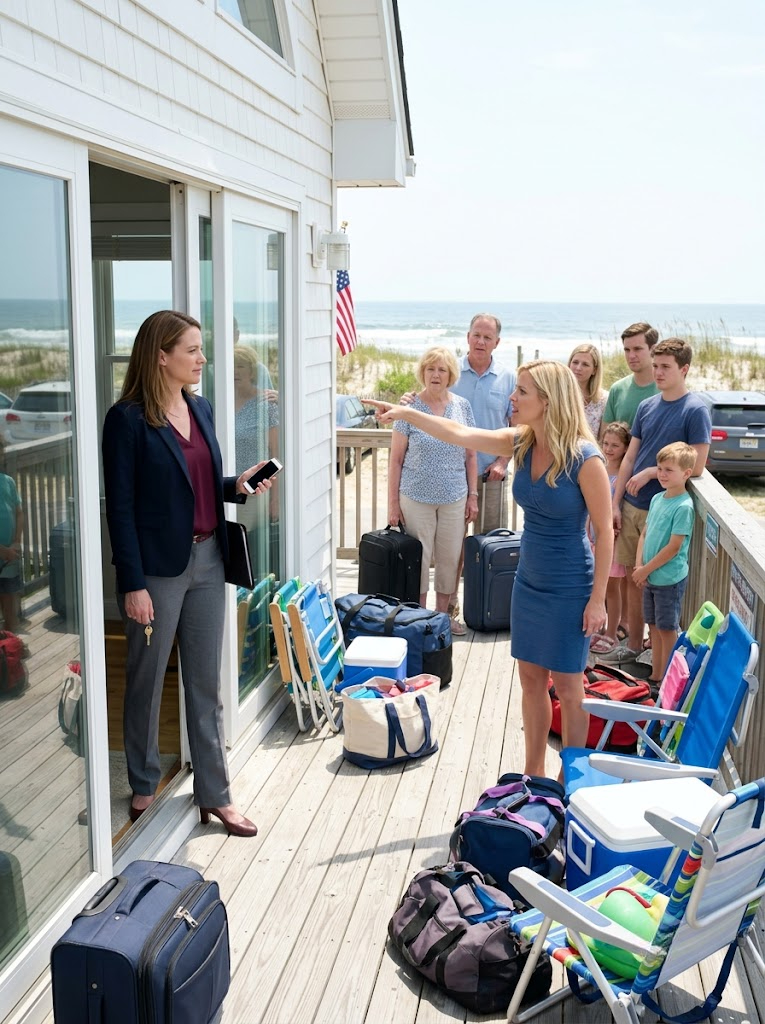
Ich hatte den Kauf meines Strandhauses kaum abgeschlossen, als meine Schwester anrief und verkündete, dass sie mit 22 Familienmitgliedern ihres Mannes kommen würde. Sie befahl mir, die Schlafzimmer zu räumen, alle Mahlzeiten zuzubereiten und sie alle zwei Wochen lang zu beherbergen. Ich blieb ruhig, änderte meine Pläne und sorgte dafür, dass sie erfuhren, wem das Haus wirklich gehörte.
Ich hatte gerade den Kauf meines Strandhauses abgeschlossen, als meine Schwester anrief und verkündete, dass sie mit zweiundzwanzig ihrer Schwiegereltern anreisen würde.
Sie befahl mir, die Schlafzimmer freizuräumen, alle Mahlzeiten selbst zuzubereiten, Handtücher bereitzustellen und sie zwei volle Wochen lang zu beherbergen.
Ich blieb ruhig, änderte meine Pläne und sorgte dafür, dass sie erfuhren, wem das Haus wirklich gehörte.
Die Tinte auf den Abschlussdokumenten war noch nicht ganz trocken, als mein Handy vibrierte.
Ich stand barfuß im leeren Wohnzimmer und blickte durch die breiten Glastüren auf den Atlantik, dessen graue und silberne Wellen hinter den Dünen dahinflossen. Das Haus roch nach frischer Farbe, salziger Meeresluft und neuen Möglichkeiten.
Zum ersten Mal seit zwölf Jahren gehörte mir etwas ganz und gar.
Dann erschien der Name meiner Schwester auf dem Bildschirm.
Marissa.
Ich hätte beinahe nicht geantwortet.
Marissa rief nur selten an, es sei denn, sie wollte etwas.
“Hallo?”
„Endlich“, schnauzte sie. „Ich habe dir doch die ganze Zeit geschrieben.“
„Ich bin im Haus. Ich habe gerade die Schlüssel bekommen.“
„Gut. Deshalb rufe ich ja an.“
Ihre Stimme klang vor Aufregung schärfer, aber die Aufregung galt nicht mir.
„Hört gut zu. Wir kommen am Freitag mit 22 Mitgliedern von Gregs Familie an. Räumt die Zimmer auf, sorgt für genügend Handtücher und plant die Mahlzeiten für alle. Wir bleiben zwei Wochen.“
Für einen Moment verschwand der Ozean draußen aus meinem Bewusstsein.
Ich sah mich im Haus um.
Drei Schlafzimmer.
Ein kleines Büro.
Ein Arbeitszimmer, kaum groß genug für ein Sofa.
Eine Küche mit neuen Geräten, für die ich jahrelang gespart hatte.
Eine Terrasse, auf der ich mir vorgestellt hatte, allein Kaffee zu trinken.
„Marissa, du bleibst nicht hier mit zweiundzwanzig anderen Personen.“
Sie lachte, als hätte ich einen harmlosen Witz gemacht.
„Fang bloß nicht damit an. Du hast ein Strandhaus gekauft. Was hast du denn erwartet?“
„Dass ich darin wohnen würde.“
„Du bist egoistisch. Gregs Familie hat sich schon freigenommen. Seine Eltern freuen sich. Seine Cousins bringen ihre Kinder mit. Ich habe allen gesagt, dass du genug Platz hast.“
„Du hast es ihnen erzählt, ohne mich zu fragen?“
„Ach, bitte. Wir sind Familie.“
Dieses Wort war seit ihrer Kindheit ihre Lieblingswaffe gewesen.
Family meant I surrendered my bedroom whenever her friends slept over.
Family meant I covered her overdue car insurance because she cried.
Family meant I planned her baby shower and then listened while she complained that the cupcakes looked inexpensive.
Family meant her needs arrived loudly and mine waited silently until they disappeared.
I stared at the ocean and felt something inside me become completely still.
“No.”
There was a pause.
Then her voice dropped.
“Excuse me?”
“No. You and twenty-two other people are not staying in my house.”
“You owe me.”
I almost laughed.
“For what?”
“For leaving town after Mom died. For acting like you’re better than everyone. For buying that house when you knew I wanted a beach vacation.”
I closed my eyes.
Mom had been gone five years.
Marissa had used her death like a receipt for every demand since.
“I’m not discussing this.”
“Fine,” she said. “Then I’ll discuss it with everyone else.”
She ended the call.
Ten minutes later, my phone exploded.
Messages arrived from cousins, aunts, Greg’s mother, and people I had met only once at Marissa’s wedding.
Screenshots of her social-media post filled my notifications.
My sister bought a huge beach house and invited us, then suddenly decided to humiliate my husband’s family. Pray for her heart.
The statement was false in three different ways.
The house was not huge.
I had never invited anyone.
And Marissa’s concern had nothing to do with humiliation.
She wanted a free vacation.
My name is Evelyn Harper. I was thirty-eight years old, and I had spent most of my adult life being described as fortunate by people who never saw what my life cost.
I worked in corporate risk management for an insurance company. The job sounded dull at family dinners, which suited me.
Marissa never asked what I actually did.
She only knew I earned more than Greg.
The truth was that I spent twelve years evaluating disasters before they happened.
I read contracts.
Studied liability.
Examined the small details people ignored because they assumed optimism was protection.
That work helped me save enough to purchase the beach house near Emerald Isle, North Carolina.
No inheritance paid for it.
Mom’s estate had been modest and divided equally between us.
I sold my condominium, used my savings for the down payment, and accepted a thirty-year mortgage at an interest rate that made me briefly consider living in my car instead.
The house was beautiful, but it was not a resort.
Its septic permit allowed eight overnight occupants.
The insurance policy excluded unapproved commercial gatherings.
The private road had parking for four vehicles.
Twenty-three people would have overloaded the plumbing, violated occupancy limits, blocked emergency access, and transformed my peaceful first two weeks into an unpaid catering operation.
Marissa would not have cared.
She did not distinguish between my ownership and her access.
The moment she learned something existed, she began deciding how it should serve her.
I set my phone on the kitchen counter.
Then I began my plan.
First, I photographed every closing document and uploaded copies to secure storage.
Then I called my attorney, Nina Patel, who had handled the purchase.
She answered while leaving the courthouse.
“You closed three hours ago,” she said. “What happened?”
“My sister invited twenty-two people to stay here for two weeks.”
“Did you invite them?”
“No.”
“Did you ever suggest they could use the property?”
“No.”
“Have you given your sister a key, code, or written permission?”
“No.”
“Then send her a clear denial in writing. Do not argue about family history. Do not use emotional language. State that she and her guests have no permission to enter or occupy the property.”
I drafted the message while Nina remained on the phone.
Marissa, I have not invited you, Greg, or any member of his family to stay at my property. The house cannot accommodate twenty-three guests, and no one has permission to enter, park, install equipment, receive deliveries, or remain overnight. You must cancel any plans connected to my address.
Nina approved it.
I sent it by text and email.
Marissa replied almost immediately.
Too late. Everyone is coming. You can be angry after the vacation.
I forwarded the response to Nina.
“That is useful,” she said.
“For what?”
“Showing that any arrival will be intentional after explicit denial.”
Next, I called the locksmith.
The previous owners had given me all known keys, but I no longer trusted that “all” meant all. By evening, every exterior lock had been replaced.
The keypad code was changed.
The garage remotes were reprogrammed.
A local security company installed cameras facing the driveway, front entrance, deck, side gate, and beach walkway.
I hired them for permanent service rather than a temporary emergency.
The house was mine.
Protecting it was not overreacting.
It was maintenance.
Then I contacted the homeowners’ association and explained that uninvited guests might arrive claiming family permission.
The association manager, Mrs. Delgado, was not amused.
“Our roads cannot handle that many cars,” she said. “If they block access, they will be towed.”
She emailed me the parking and occupancy rules.
I forwarded them to Marissa.
She responded with a laughing emoji.
That evening, I learned something that changed the situation.
Greg’s mother, Elaine, called me.
I had met her twice.
She was a retired middle-school librarian with a soft voice and a habit of apologizing before asking reasonable questions.
“Evelyn, I’m sorry to bother you.”
“You’re not bothering me.”
“I’m confused about the house.”
“What did Marissa tell you?”
“She said you offered it for a family reunion.”
“I did not.”
The silence lasted several seconds.
“She said the rooms were complimentary because you wanted to make amends.”
“For what?”
“For not attending several family events after your mother died.”
That was how Marissa had rewritten my grief.
After Mom died, I accepted a promotion in Raleigh and moved four hours away. I had spent the previous eighteen months coordinating Mom’s chemotherapy, transportation, medication, and bills while Marissa visited on weekends when convenient.
When the funeral ended, I left because I had nothing remaining in town except exhaustion.
Marissa described that as abandonment.
Elaine continued carefully.
“She also collected money from everyone.”
My hand tightened around the phone.
“What money?”
“A household contribution. For groceries, cleaning, linen service, and beach equipment.”
“How much?”
“Seven hundred and fifty dollars per adult household. Some families paid more because they’re bringing children.”
“Who received it?”
“Marissa. She said you requested that one person collect everything.”
I sat down on the empty living-room floor.
“How much has she collected?”
“I don’t know exactly. There are nine households.”
At minimum, Marissa had collected nearly seven thousand dollars.
Possibly more.
She was not only commandeering my home.
She was using it to make money.
“Elaine, I have never authorized this trip. I have not received one dollar. The house legally accommodates eight overnight guests, and I explicitly told Marissa no.”
“Oh, dear.”
“I’m sorry she misled you.”
“She showed us a message from you.”
“What message?”
Elaine sent me a screenshot.
The image displayed what appeared to be a text conversation between Marissa and me.
Marissa:
Thank you for letting us use the beach house. Everyone is thrilled.
Me:
Family should enjoy it. Stay as long as you need.
I had never written those words.
The screenshot showed no date, no phone number, and no identifying header.
It could have been created with any messaging application or image editor.
“Did she show you anything else?”
“A welcome guide.”
Elaine forwarded the document.
Across the top, in large script, were the words:
THE HARPER FAMILY BEACH RETREAT
Hosted by Evelyn Harper
The guide included sleeping assignments.
Greg’s parents would receive my primary bedroom.
Marissa and Greg would use the second bedroom.
Two families would share the third.
Children would sleep in the office and den.
Several adults were assigned inflatable mattresses in the living room.
The final page listed household expectations.
Evelyn will prepare breakfast and dinner.
Guests should provide lunch for themselves.
Laundry service will be available every other day.
Beach chairs, towels, and umbrellas will be provided.
Alcohol requests should be sent to Evelyn in advance.
I read the final line twice.
Marissa had not merely promised my property.
She had promised my labor.
Elaine sounded ashamed.
“I thought you had offered.”
“Why would I charge your family if I invited you?”
“She said you wanted everyone committed so no one canceled.”
That explanation was almost clever.
Marissa had transformed a fee into proof of my generosity.
I asked Elaine to preserve every message, receipt, and document.
She agreed.
“Are you going to confront her?”
“Not yet.”
“What should we do?”
“You should not travel to the house.”
“I’ll tell the others.”
“Please send them my written statement. I don’t want families driving hours with children because of her lie.”
Elaine hesitated.
“Some have nonrefundable hotel rooms for the night before and after.”
“I’m sorry.”
“So am I.”
After the call, I opened a spreadsheet.
Marissa had always mocked my spreadsheets.
Now one would document exactly what she had done.
I created columns for names, payments, promised services, messages, travel costs, and requested refunds.
By midnight, six households had contacted me.
The payments ranged from $500 to $1,200.
The total Marissa collected was $8,650.
She told one cousin the money covered a private chef.
Another believed it paid for a boat rental.
Greg’s brother had contributed extra for groceries and a deep-sea fishing excursion.
None of those reservations existed.
At 12:18 a.m., I received a message from Greg.
Did you seriously tell my mother we can’t come?
Yes.
Marissa said you approved everything.
She is lying.
Be careful how you speak about my wife.
Ask her to show you the actual messages from my phone.
He did not answer.
The next morning, Marissa called.
I recorded the conversation after the automated announcement informed her the line was being recorded, as state law required.
“You contacted Elaine.”
“She contacted me.”
“You made me look dishonest.”
“You collected money using my house.”
“It was for expenses.”
“What expenses?”
“Food. Cleaning. Supplies.”
“You planned for me to pay for and prepare the food.”
“That was before you became difficult.”
“You collected money for a private chef and boat excursion.”
Her silence lasted half a second too long.
“People misunderstood.”
“You created a guide promising those things.”
“You’re trying to destroy my marriage.”
“No. I’m stopping you from bringing twenty-two people into my home.”
“They’ve all taken time off.”
“Refund them.”
“I already used some of the money.”
“For what?”
“That is none of your business.”
“It became my business when you used my name.”
Her voice hardened.
“You owe me after everything I did for Mom.”
That sentence angered me more than the house.
“What exactly did you do?”
“I was there.”
“You visited while I handled her appointments, medication, insurance appeals, transportation, and hospice paperwork.”
“I had children.”
“I had a dying mother.”
“You always need credit.”
“No. I need you to stop billing me for a version of history that did not happen.”
She began crying.
Not softly.
Marissa cried like someone opening a faucet when words stopped working.
“I just wanted Greg’s family to think mine cared about them.”
“So you lied.”
“I wanted to give them something special.”
“With my house.”
“You have more than you need.”
There it was.
The belief beneath everything.
My extra bedroom.
My salary.
My time.
My quiet.
Anything beyond Marissa’s immediate need became evidence of selfishness.
“Refund the money,” I said.
“You’ll regret humiliating me.”
Then she ended the call.
By Wednesday, most of Greg’s family had canceled.
Three households received partial refunds.
Two received nothing.
Marissa told them I had frozen the vacation account.
No such account existed.
She also continued telling Greg that I had originally agreed and changed my mind because I resented their marriage.
I sent Greg the original denial message, Elaine’s screenshot, the fake welcome guide, and confirmation that no funds had ever entered my accounts.
He replied with one sentence.
I need to speak with my wife.
I did not hear from him again that day.
On Thursday afternoon, Mrs. Delgado from the homeowners’ association called.
“A woman identifying herself as your sister attempted to register nine vehicles for guest parking.”
“What did you tell her?”
“That only the homeowner can authorize permits.”
“Did she submit anything?”
“A letter signed with your name.”
My stomach tightened.
The letter stated that Marissa had full authority to manage the property during my absence.
The signature looked nothing like mine.
Nina immediately sent a formal cease-and-desist letter.
It required Marissa to stop using my name, property address, or supposed authorization.
It also informed her that any entry would constitute trespass.
Marissa posted the letter online with the caption:
Imagine hiring a lawyer against your own sister because she wants children to see the ocean.
Comments appeared quickly.
Some called me cruel.
Then Elaine commented.
Evelyn never invited us. We were charged money by Marissa and shown messages that do not appear to be real.
Greg’s brother added:
Still waiting for my $1,200 refund.
The post disappeared within twenty minutes.
I assumed the trip was over.
I was wrong.
Friday morning, I woke before sunrise in my new bedroom.
I had changed my original plan of moving gradually.
Instead, I had purchased a bed, a table, basic kitchen supplies, and enough furniture to make the house functional immediately.
The house would not stand empty while Marissa treated it as available.
At 8:37 a.m., the driveway camera sent an alert.
A large white passenger van had stopped near the entrance.
Behind it were two SUVs and Greg’s pickup truck.
They had come anyway.
Not twenty-two people.
Fourteen.
Several relatives had canceled, but Marissa had convinced the others that I would surrender once children were physically present.
The van doors opened.
Adults climbed out.
Then children.
Suitcases.
Coolers.
Beach toys.
A folded crib.
Marissa stepped from the passenger seat wearing a wide-brimmed hat and a flowing white cover-up.
She walked toward the front door as though arriving at a hotel.
Greg followed more slowly.
His expression was strained.
I remained inside.
Nina sat at the dining table with a folder.
Mrs. Delgado stood near the front window.
Two private security officers waited outside near the side driveway.
The local sheriff’s department had copies of the no-trespass notice and false parking letter. A deputy had agreed to drive past because the HOA expected traffic problems.
Marissa reached the keypad and entered a code.
The screen flashed red.
She tried again.
Red.
Then she took a key from her bag.
It did not fit.
She struck the doorbell.
I answered through the camera.
“You do not have permission to be here.”
Her eyes lifted toward the lens.
“Open the door, Evelyn.”
“No.”
“We drove six hours.”
“I told you not to come.”
“You are not doing this in front of Greg’s family.”
“I am not the person who brought them.”
She leaned closer.
“There are children standing in the heat.”
“Then take them somewhere you were invited.”
One of Greg’s cousins approached carrying a toddler.
“Marissa, you said she changed her mind.”
“She will.”
The woman looked at the locked door.
“She does not sound as though she will.”
Greg stepped forward.
“Evelyn, can we talk?”
“We can speak through the camera.”
He looked embarrassed.
“Open the door for five minutes.”
“No.”
Marissa turned toward him.
“Stop begging her.”
Then she looked back at the camera.
“You owe this family.”
“No.”
“You left when Mom died.”
“I cared for Mom while you visited for photographs.”
Several relatives glanced at one another.
Marissa’s face reddened.
“This is not the time.”
“You made it the time when you used her death to justify trespassing.”
Greg stared at her.
“You told me you handled hospice together.”
Marissa ignored him.
She lifted her phone and began recording.
“Everyone watching this should see what my sister is doing. She has three bedrooms and is leaving children outside.”
I opened the front door.
A security officer stepped nearer but remained on the walkway.
Marissa smiled, believing the camera had forced me to surrender.
I stayed inside the threshold.
“This house has a legal overnight limit of eight people. You attempted to bring fourteen after I denied permission in writing.”
She angled the phone toward my face.
“Tell everyone why you hate your family.”
“I don’t hate them.”
“Then let us inside.”
“No.”
The simplicity of the answer unsettled her.
People like Marissa depend on explanations because explanations create material to argue with.
No left her nothing to reshape.
Greg’s mother stepped out of the second SUV.
She had traveled separately despite warning the others not to come.
“Elaine,” I said, surprised.
“I came because I knew she would bring the children anyway.”
She looked at Marissa.
“You said Evelyn called last night and approved one week.”
Marissa’s expression shifted.
“I said she was reconsidering.”
“No. You said she approved.”
Greg slowly turned toward his wife.
“Did Evelyn ever agree?”
“She would have if everyone stopped interfering.”
“That isn’t what I asked.”
Marissa glanced toward the relatives, the cameras, and the locked house.
Then she did what she always did when facts cornered her.
She attacked.
“You are all ungrateful. I planned this vacation. I found the house. I collected the money. I organized everything.”
“You found my address,” I said. “You did not find the house.”
A deputy’s vehicle entered the private road.
Marissa lowered her phone.
Deputy Harris parked behind the passenger van and approached.
“Who owns the property?”
“I do,” I said.
Nina stepped outside and handed him the deed, identification, written refusal, cease-and-desist letter, parking forgery, and occupancy rules.
He reviewed the documents.
Then he looked at Marissa.
“Ma’am, the owner has denied you entry. You need to leave.”
“This is a civil family dispute.”
“Ownership is not disputed.”
“She invited us.”
“Do you have evidence?”
Marissa raised her phone.
“I have messages.”
“Show me.”
She opened the edited screenshot.
Deputy Harris examined it.
“This image does not display a phone number or date.”
“She deleted the original.”
“I did not,” I said.
Nina handed him a printout from my phone records showing no message granting permission.
Elaine provided the fake welcome guide.
Greg’s brother showed payment confirmations.
The deputy’s expression changed.
“Did you collect money from these individuals for use of this property?”
Marissa folded her arms.
“It was a family contribution.”
“Did the owner authorize you to charge them?”
“She knew.”
“No,” I said.
Greg moved several feet away from Marissa.
“How much money did you collect?”
She did not answer.
His brother did.
“More than eight thousand dollars.”
Greg looked stunned.
“You told me it was three thousand.”
Marissa’s face lost color.
“I had expenses.”
“What expenses?”
“Planning. Food. Deposits.”
“Show me.”
“This is not the place.”
Greg laughed once, but there was no humor in it.
“You brought us to someone else’s house with children and luggage. This is exactly the place.”
The relatives began comparing stories.
One family had been promised a fishing charter.
Another had paid for a private chef.
Elaine believed her contribution covered groceries.
Greg’s cousin had paid an extra fee for the bedroom with an ocean view.
That bedroom was mine.
“I paid four hundred dollars extra for that room,” she said.
Marissa snapped, “You’ll get it back.”
“With what money?”
The argument spread across the driveway.
Children watched adults accuse one another.
A toddler began crying.
I hated that part.
The children had done nothing.
I stepped toward Elaine.
“There is a hotel fifteen minutes inland with several vacancies. I checked this morning. I can give you the information.”
Marissa laughed bitterly.
“How generous.”
“I’m not paying for it.”
Her smile disappeared.
Elaine nodded.
“That is fair.”
Greg’s brother turned toward his family.
“We’re leaving.”
Marissa grabbed his arm.
“Don’t let her win.”
He pulled away.
“This is not a contest.”
One by one, people began returning luggage to the vehicles.
Greg remained near the driveway.
He looked at me.
“I’m sorry.”
“You should have contacted me directly.”
“Yes.”
“I warned your mother.”
“I know.”
“I sent you the evidence.”
“I wanted to believe my wife.”
“That is understandable until belief requires ignoring records.”
He nodded.
Marissa stood alone beside a pile of beach bags.
“You planned this,” she said.
“I changed the locks on my own house.”
“You brought a lawyer and security.”
“Because you said you were coming after being told no.”
“You wanted everyone to turn against me.”
“No. I wanted everyone to stay away.”
Deputy Harris instructed her to remove her belongings and leave the private road.
She refused at first.
Then the tow company arrived.
Mrs. Delgado had called after two vehicles blocked the emergency lane.
Marissa screamed that the HOA was persecuting families.
No one answered.
Greg loaded the remaining bags.
She climbed into the truck only after the deputy warned her that refusal could result in a trespass citation.
As the vehicles left, she leaned out the window and shouted, “You’ll be alone in that house forever!”
The words should have hurt.
Instead, I looked at the ocean beyond the dunes.
Being alone in a home I controlled no longer sounded like a threat.
It sounded peaceful.
The financial consequences began the following week.
Greg’s relatives demanded refunds.
Some filed chargebacks.
Two brought claims in small-claims court for payments and nonrefundable travel expenses.
Marissa initially insisted the money was gone because she had purchased supplies.
Bank records told another story.
She had used part of it to pay overdue credit cards.
She spent nearly two thousand dollars on new clothes for the trip.
Another fifteen hundred went toward a social-media consultant who promised to help her build a “family travel brand.”
The private chef, boat rental, linen service, and grocery delivery had never been booked.
Greg learned that she had hidden other debt.
He moved into his parents’ home with their two children while he decided what to do.
I did not celebrate the strain in their marriage.
But I refused to accept blame for exposing what already existed.
Nina sent formal demands related to the forged authorization letter and use of my name.
Because Marissa reimbursed several relatives, withdrew the false documents, and cooperated after obtaining counsel, the matter did not become a dramatic criminal prosecution.
She entered a diversion agreement connected to the forged property authorization and attempted unauthorized access.
She paid fines.
Completed community service.
Reimbursed my legal and security expenses.
Agreed never to use my name, address, financial information, or supposed authority again.
The relatives’ civil claims resulted in repayment plans.
Greg remained separated from her for nearly a year.
My family reacted as it always did.
Several aunts accused me of destroying Marissa’s reputation.
A cousin said I should have allowed one weekend to preserve peace.
My father, who had remained mostly silent since Mom’s death, called from Arizona.
“Was it necessary to involve police?”
“She arrived after written notice denying access.”
“You could have talked to her.”
“I did.”
“You know how she is.”
That sentence had protected Marissa for decades.
Yes, we knew how she was.
Therefore, everyone else was expected to adjust.
“I know how she is,” I replied. “That is why I changed the locks.”
Dad sighed.
“Your mother would hate seeing you two divided.”
“Mom spent her final year asking Marissa to visit more often.”
“She had children.”
“So did many of the nurses who cared for Mom.”
He became quiet.
I had never said that aloud.
I continued.
“I am done allowing Mom’s memory to be used against me.”
“You left town.”
“After eighteen months of caregiving.”
“You didn’t tell us how overwhelmed you were.”
“Would it have changed anything?”
He did not answer.
That silence gave me the truth.
I ended the call kindly.
Not warmly.
Kindness and access were no longer the same thing.
For the first several months, I worked remotely from the beach house.
I furnished it slowly.
The primary bedroom received a simple oak bed and linen curtains.
The second bedroom became a guest room.
The third became a reading room with a narrow daybed.
The office held my desk and a shelf containing every closing document.
I installed a small plaque beside the entryway.
PRIVATE HOME. ENTRY BY INVITATION ONLY.
It was not decorative.
It was accurate.
Elaine wrote me a letter three months after the failed vacation.
Evelyn,
I am sorry I believed Marissa without contacting you. She sounded so certain that I treated certainty as proof.
Thank you for protecting the children from a worse situation. We would have arrived eventually, even if you had not prepared.
I hope you enjoy your home in peace.
I kept the letter.
Greg’s brother repaid the cost of the hotel room Elaine used that first night because he felt responsible for encouraging her to travel.
None of them asked me for money.
That was one of the clearest differences between their family and mine.
They had been deceived, but once they knew the truth, they adjusted.
Marissa believed adjustment itself was an injustice.
Her apology came eleven months later.
Not by phone.
By certified letter.
Evelyn,
I told myself you owed me because you had money and I had responsibilities.
I used Mom’s death because I knew it made you feel guilty.
I created the messages and welcome guide because Greg’s family admired you, and I wanted them to admire me for arranging the vacation.
I collected the money intending to replace some of it later.
When you said no, I believed bringing everyone would force you to give in.
I was wrong.
I am sorry for using your house, your name, and Mom’s memory.
I read the letter twice.
Then I placed it inside the same folder as the no-trespass notice.
I did not invite her to visit.
An apology can be meaningful without functioning as a key.
Greg and Marissa eventually reconciled under strict conditions.
They separated their finances.
She attended counseling.
She found part-time work and completed the repayment plan.
Their marriage became smaller and less performative.
Perhaps that was healthier.
Perhaps not.
It was no longer mine to manage.
Two years after the incident, Greg’s mother asked whether I would meet her for lunch while she was visiting the coast.
We chose a restaurant overlooking the marina.
She brought a small framed photograph of the entire extended family at a state park.
“We finally held the reunion,” she said.
“How many people?”
“Twenty-four.”
“Where did everyone sleep?”
“Three different hotels.”
I laughed.
“Very practical.”
“Everyone paid for their own rooms.”
“Even better.”
She smiled.
“We also confirmed the reservations.”
That meal was more enjoyable than the imaginary two-week vacation Marissa had planned in my kitchen.
No one expected me to cook.
No one assigned themselves my bedroom.
No one discussed my house.
Years later, my father visited.
He asked first.
That mattered.
He stayed in the guest room for three nights.
On the second morning, we sat on the deck with coffee while the Atlantic moved beneath a pale sky.
“Your mother would have loved this,” he said.
“She would.”
“I was unfair when I said she would blame you.”
“Yes.”
He looked into his cup.
“I let Marissa do too much because correcting her was exhausting.”
“It was more exhausting for the people she used.”
“I know.”
“Do you?”
“I’m beginning to.”
He did not ask for a key.
He did not suggest a family gathering.
When he left, he stripped the guest bed and placed the towels beside the washing machine.
A small act.
But I noticed.
I had purchased the beach house because I wanted proof that years of work could create something other than another family rescue.
Marissa called three hours after closing and attempted to turn that proof into a free resort.
She expected twenty-two guests.
Fourteen arrived.
They brought luggage, children, coolers, and payment receipts.
They believed I had invited them because my sister had manufactured my consent.
What they found was a locked door.
A recorded deed.
An occupancy limit.
A written refusal.
A lawyer.
Security cameras.
And an owner who finally understood that calm did not require surrender.
Marissa told me I would be alone in the house forever.
She was wrong.
Friends visited.
My father stayed once.
I hosted Elaine for lunch.
I invited colleagues for a weekend after asking how many people felt comfortable sharing the guest rooms.
Every visit began with permission.
Every guest left without claiming permanent access.
Sometimes I spent entire weeks alone.
Those were not empty weeks.
They were quiet.
There is a difference.
For most of my life, Marissa treated family like an all-access pass.
She believed blood opened doors, erased costs, and transformed my boundaries into personal attacks.
The beach house taught her something she should have learned much earlier.
A family relationship is not a deed.
A demand is not a reservation.
A fabricated message is not consent.
And the person who pays the mortgage does not become the household servant simply because someone else arrives carrying suitcases.
I still have the first key the closing attorney handed me.
It no longer fits any lock because I replaced them that same day.
I keep it inside a small wooden box in my office.
Not as a symbol of fear.
As a reminder.
Ownership is more than having your name on paper.
It is the moment you stop allowing other people to decide what your no means.
The house smelled like fresh paint, salt air, and possibility when Marissa called.
Years later, it still smells like the ocean when I open the doors in the morning.
The difference is that now, when the phone rings, I do not mistake answering for obligation.
Und wenn jemand sagt: „Wir sind Familie“, höre ich keinen Befehl mehr.
Ich höre eine Frage.
Vertraue ich dir genug, um dir die Tür zu öffnen?
Manchmal lautet die Antwort ja.
Manchmal ist es nein.
So oder so, die Entscheidung liegt bei mir.
DAS ENDE.
Diese Geschichte ist ein fiktives Werk, das von realen Ereignissen inspiriert wurde. Namen, Charaktere, Schauplätze, Eigentumsverhältnisse, finanzielle Gegebenheiten und juristische Ergebnisse wurden verändert. Jegliche Ähnlichkeit mit realen Personen oder Ereignissen ist rein zufällig.
Haftungsausschluss: Diese Geschichte ist frei erfunden und dient ausschließlich der Unterhaltung. Sämtliche Namen, Charaktere, Orte und Ereignisse sind fiktiv oder werden in fiktiver Form verwendet. Es wird keine reale Person oder Organisation dargestellt.