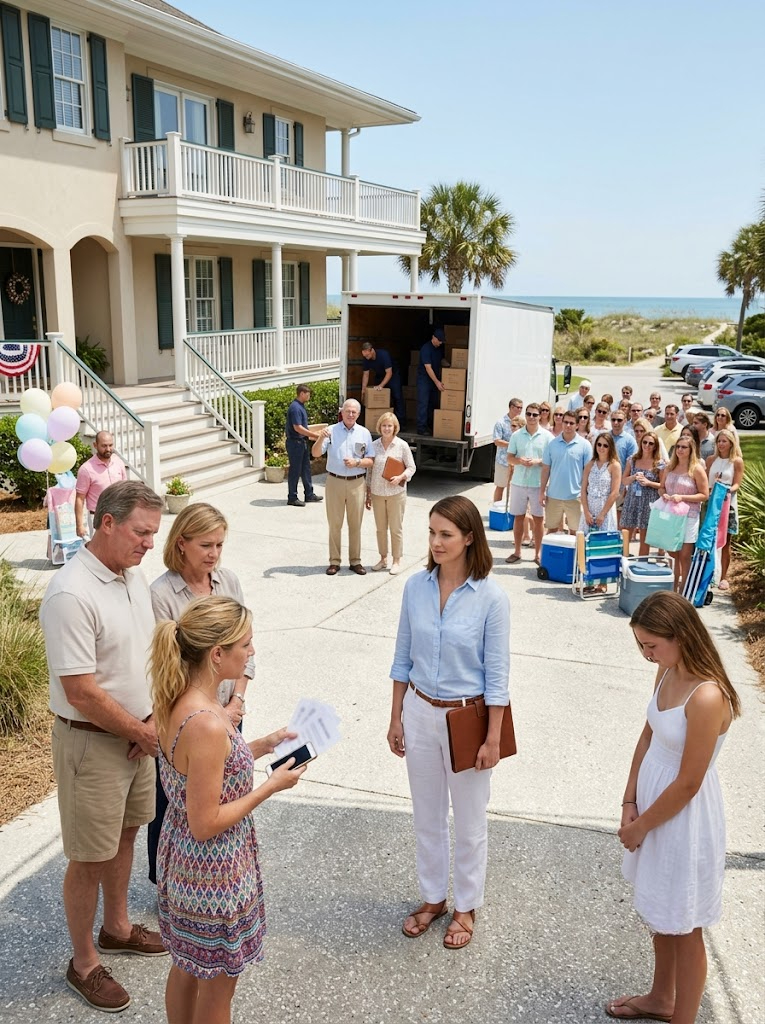
cnu My sister somehow learned that I owned a villa near the beach and casually announced that eighty-two guests would be attending her daughter’s graduation celebration there. When I asked my parents why they had allowed her to use it, they warned me not to act selfishly because it was “for the family.”
My sister somehow discovered that I owned a villa beside the beach and casually informed me that eighty-two people would be attending her daughter’s graduation party there.
When I asked my parents why they had given her permission, they told me not to behave selfishly because it was for the family.
What none of them knew was that I had already sold the villa.
By the time the guests arrived, the property belonged to a retired couple from Vermont, the locks had been changed, and a sheriff’s deputy was waiting beside the gate.
I owned the beachside villa in Hilton Head for nearly four years without telling my sister.
I kept it secret because, in my family, anything beautiful became a shared resource the moment Rachel discovered it existed.
My name is Amanda Collins. I was thirty-six years old, and I purchased the villa after selling the small logistics company I had spent nearly a decade building.
It was not meant to be an investment.
It was the first peaceful place I had ever owned that did not come with endless family demands.
The property had white shutters, pale hardwood floors, a wraparound balcony, and a private walkway through sea grass that led directly to the beach.
The living room faced the Atlantic through tall glass doors. The kitchen had a wide marble island where I drank coffee on quiet mornings. From the upstairs bedroom, I could hear the waves after dark.
I bought the villa because I wanted one place where no one called to ask for money, childcare, transportation, or access to something I had worked for.
My parents had visited twice.
Both times, they promised never to mention the villa to Rachel because they understood why I needed one place untouched by her entitlement.
At least, that was what they said.
Rachel had been taking things from me since childhood.
Not stealing in the ordinary sense.
She took through expectation.
When she wanted my bicycle, Mom told me I was too old for it.
When she wanted the larger bedroom, Dad said I should be mature.
When she needed help paying for her wedding, my parents reminded me that I was single and had fewer obligations.
When Rachel’s marriage became difficult, I watched Madison every weekend for nearly two months without being asked whether I had plans.
Every sacrifice was described as temporary.
Every boundary was treated like a personal attack.
Rachel was thirty-nine now, married to a man named Travis, and still capable of turning a request into an announcement.
On a Wednesday morning, she called while I was reviewing contracts in my new consulting office in Charleston.
“We have eighty-two people coming to your beach house for Madison’s graduation party this weekend,” she said cheerfully. “Make sure everything is ready by Friday.”
I remained completely still.
Madison was Rachel’s eighteen-year-old daughter. She was a kind girl, far more thoughtful than her mother, but she had been raised inside a family where permission was treated as an unnecessary delay.
“How did you find out about the villa?” I asked.
Rachel laughed.
“Mom told me. Anyway, don’t start acting strange. We’ll need tables, parking spaces, bathrooms, and probably a lot of extra towels.”
I looked down at the contract on my desk.
“You invited eighty-two people to a property you have never seen?”
“Mom showed me photographs.”
That hurt more than I expected.
My parents had not simply mentioned the villa.
They had photographed it.
They had apparently saved pictures from their visits and handed them to Rachel like a brochure.
“When is this supposed to happen?”
“Saturday. Guests arrive at two. The caterer will come around eleven.”
“You already hired a caterer?”
“And a tent company. The weather might change.”
“My yard is not large enough for an event tent.”
“It will fit near the dunes.”
“You cannot install anything near protected dunes without approval.”
Rachel sighed.
“This is exactly why I did not ask you to organize it. You turn everything into a legal problem.”
“You are planning a party for eighty-two people at my house without my permission.”
“We are family.”
There it was.
The sentence that had excused every theft of time, money, and space for most of my life.
“Cancel it.”
The line became silent.
Then her voice changed.
“You owe Madison a proper graduation.”
“I sent her a gift.”
“A check is not a celebration.”
“I am not hosting eighty-two people.”
“You do not have to host. Just unlock the house, clear the rooms, and stay out of the way.”
I almost admired the confidence.
She had transformed my refusal into a staffing issue.
“No.”
“Amanda.”
“No one has permission to use the villa.”
“You’re being ridiculous.”
“And you are trespassing before you have even arrived.”
Rachel ended the call.
I immediately called my parents.
Dad released an irritated sigh, as though I had already exhausted him.
“Amanda, it is only one party.”
Mom quickly added, “Do not be selfish. This is for the family, and Rachel has already sent out invitations.”
That sentence explained everything.
They had not accidentally revealed the existence of my villa.
They had deliberately handed my private home to my sister and expected me to serve as unpaid staff for eighty-two guests.
“What exactly did the invitations say?” I asked.
Mom hesitated.
“They said the party would take place at the Collins family beach villa.”
I nearly laughed.
The Collins family beach villa.
My name was the only one on the deed.
My money had paid the taxes.
My insurance covered every possible risk.
Yet before a single paper plate arrived, my family had renamed my property.
“There is no Collins family villa.”
Dad’s voice sharpened.
“Your grandfather would be ashamed to hear you talk like that.”
“My grandfather never owned the property.”
“That is not the point.”
“It is exactly the point.”
Mom lowered her voice.
“Rachel has spent money.”
“Then Rachel should cancel before she spends more.”
“She cannot cancel graduation.”
“She can change the location.”
“Where is she supposed to find another venue in three days?”
“That is not my responsibility.”
Dad interrupted.
“You always make everything harder than it needs to be.”
“No. I said no once. Rachel decided it did not count.”
“You have more than enough room.”
“The house has three bedrooms.”
“People are not sleeping there.”
“Then why do I need to clear the rooms?”
Mom became quiet.
Another lie had almost escaped.
“What else has Rachel planned?” I asked.
“No one knows every detail.”
“You do.”
“She thought Travis’s parents might stay for a few nights.”
“How many people are sleeping there?”
“Only immediate family.”
“Which means?”
Mom sighed.
“Twelve or fourteen.”
I closed my eyes.
They had planned to fill my bedrooms, use my kitchen, occupy my bathrooms, park dozens of cars near the property, place an event tent beside protected dunes, and host eighty-two people around a swimming pool.
If someone was injured, my insurance would be involved.
If alcohol was served to minors, my property would be tied to it.
If the dunes were damaged, I would face fines.
None of those risks mattered to my parents because they would not pay for them.
“There is one thing I need to make absolutely clear,” I said. “I do not authorize this party. I do not authorize anyone to enter the property. I do not authorize vendors, guests, overnight stays, or equipment delivery.”
Mom’s tone became cold.
“Do not humiliate this family.”
“I am putting my refusal in writing.”
Then I ended the call.
There was only one problem my family knew nothing about.
I had sold the villa three weeks earlier.
The closing had been completed that Monday.
The new owners, Thomas and Elaine Mercer, were a retired couple from Vermont. They had spent years visiting Hilton Head and wanted a permanent home near the ocean.
They were scheduled to move in Friday morning.
I had not sold because I stopped loving the villa.
I sold because my consulting company had grown faster than expected, and I wanted to purchase a smaller property closer to Charleston.
The villa had also become too large for the amount of time I spent there.
For weeks, I mourned the decision.
Now I felt relieved.
Rachel could not pressure me into surrendering property I no longer owned.
But Thomas and Elaine were about to move into a house targeted by eighty-two uninvited guests.
They deserved warning.
I called my closing attorney, Dana Pierce.
“I need to tell you something strange.”
Dana had worked in property law for twenty years. Very little surprised her.
By the time I finished, even she was silent.
“Did you clearly revoke permission in writing?”
“I am doing it now.”
“Copy me, the buyers’ attorney, and the property-management company.”
“I don’t want the Mercers frightened.”
“They will be more frightened if buses and catering trucks arrive without warning.”
I wrote one email addressed to Rachel, my parents, Travis, and the vendors whose names I had been able to obtain from the invitation screenshot.
I stated that I had not authorized an event at the property.
I explained that no person had permission to enter, park, install equipment, or use the beach access.
I did not mention the sale.
Dana advised me not to disclose the buyers’ information to people already ignoring boundaries.
Within minutes, Rachel replied.
You cannot cancel an event after people have taken time off. We will be there Saturday.
Dad wrote:
Stop escalating this.
Mom wrote privately:
Just stay away if you cannot behave pleasantly.
I forwarded everything to Dana.
Then I contacted Thomas and Elaine through their attorney.
We held a conference call that afternoon.
Elaine was quiet for several seconds after hearing the situation.
“Eighty-two people?” she asked.
“Yes.”
“At our new home?”
“Yes.”
Thomas muttered something under his breath.
“I am deeply sorry,” I said. “I have explicitly denied permission, but my sister may still arrive.”
“You did not invite them,” Elaine said. “This is not your fault.”
That simple sentence nearly made me cry.
My own family had spent the day blaming me for a party I had never approved.
A woman I had met twice understood immediately.
Thomas had worked as a municipal attorney before retiring. He responded practically.
“We’ll notify local law enforcement, install temporary cameras, and hire security for the driveway.”
Dana contacted the sheriff’s office and provided the emails.
Because no crime had yet occurred, officers could not prevent people from traveling toward the property. But the department agreed to note the dispute and send a deputy if anyone refused to leave.
The Mercers changed every access code after receiving the keys Friday morning.
The caterer canceled when Dana warned that the person who signed the event contract did not own or control the venue.
The tent company did the same.
That should have ended everything.
Instead, Rachel began lying faster.
She told guests I was having an emotional episode.
She said the vendors had been canceled by mistake.
She claimed the party would continue as planned and that food trucks had been arranged.
Then Dana discovered something worse.
The caterer sent us the authorization Rachel had provided.
It appeared to be an email from me.
The address looked nearly correct, but one letter had been changed.
The message said:
I authorize Rachel Collins Harper to use my Hilton Head property for Madison Harper’s graduation event, including vendor access, overnight guests, alcohol service, and temporary installations.
At the bottom was my full name.
Rachel had impersonated me.
She had also attached a scanned utility bill showing the villa’s address. The bill came from a photograph Mom had taken during one of her visits.
Dana preserved everything.
“Do not call Rachel,” she said. “We now have an identity and fraud issue. Let her continue communicating in writing.”
On Friday evening, Madison called me.
Her voice was small.
“Aunt Amanda, is the party really canceled?”
“I never agreed to host it.”
“Mom said you did and then changed your mind because you were angry with Grandma.”
“That is not true.”
Silence.
“Did you know about the villa before this week?” I asked.
“No. Mom showed me pictures and said it was part of the family.”
“It was never family property.”
“Was?”
I hesitated.
Madison heard it.
“You sold it?”
“Yes.”
“When?”
“The sale closed Monday.”
“Oh.”
She was quiet for so long that I thought the call had ended.
“Does Mom know?”
“No.”
“Are the new owners there?”
“They moved in today.”
Madison began crying.
Not loudly.
“I told people to come.”
“You believed your mother.”
“I should have called you.”
“Yes.”
I did not lie to protect her from learning something important.
She was eighteen.
Old enough to understand that a parent’s confidence was not proof.
“What should I do?” she asked.
“Tell your friends the venue is unavailable.”
“Mom will be furious.”
“She created this.”
“I know.”
That was the difference between Madison and Rachel.
Madison could still recognize a fact even when it caused discomfort.
She posted a message to her friends that night explaining the party location had changed unexpectedly and asking them not to travel to the villa.
Rachel deleted it within twenty minutes.
Then she posted her own message saying Madison’s account had been hacked.
By Saturday morning, I knew the disaster could not be prevented.
Only documented.
At eleven, the first vendor arrived.
It was not the original caterer.
Rachel had hired two food trucks and told them the event had private-property approval.
A security guard stopped them at the gate.
Thomas showed the drivers the ownership documents and my written denial.
They left after calling Rachel.
At twelve-fifteen, a rental truck carrying folding chairs and tables arrived.
It was turned away.
At one, Rachel pulled into the driveway in a white SUV decorated with gold graduation ribbons.
Travis sat beside her.
My parents followed in their sedan.
Behind them came a van filled with balloons, decorations, and serving trays.
The security camera recorded Rachel stepping out in a white linen dress.
She walked to the gate and entered the old keypad code.
Red light.
She tried again.
Red.
Dad took out the emergency key Mom had copied during their last visit.
There was no longer a matching lock.
Rachel began pounding on the gate.
“Amanda!”
Elaine stepped onto the porch.
Rachel stopped.
“Who are you?”
Elaine remained near the house.
“I own this property.”
My mother laughed nervously.
“No, our daughter owns it.”
Thomas joined his wife holding a certified copy of the deed.
“Your daughter sold it to us.”
For several seconds, no one spoke.
Rachel looked at my parents.
Mom stared at Dad.
Travis stepped away from the SUV.
“What does he mean, sold?”
Rachel’s face reddened.
“This is some kind of stunt.”
Thomas approached only as far as the inner walkway.
“The deed was recorded Monday. You do not have permission to enter.”
Rachel gripped the gate.
“Amanda promised this property for my daughter’s graduation.”
“No,” Elaine said. “She warned us you might attempt to use it without permission.”
Mom finally found her voice.
“She would never sell without telling us.”
I was watching through the security application from Dana’s office in Charleston.
Dana sat beside me.
“Do not call them,” she said.
“I wasn’t going to.”
At one-thirty, the first guests arrived.
Then more.
Cars began lining the road.
Several drivers attempted to enter the private lane before security redirected them.
Families climbed out carrying gifts, coolers, beach bags, and folding chairs.
They had traveled from Georgia, North Carolina, and different parts of South Carolina.
Rachel stood near the gate telling everyone there had been a misunderstanding.
Brittany, one of her closest friends, began recording.
My aunt asked why strangers were occupying the villa.
Mom announced that I had sold it “out of spite.”
That lie lasted less than a minute.
Thomas held up the recorded deed.
“We signed the purchase contract six weeks ago.”
The sale had been underway before Rachel knew the property existed.
Guests began asking Rachel where the backup venue was.
There was none.
She told them to wait.
By two, more than sixty people had gathered along the road and neighboring shoulder.
Children were crying.
Food was warming inside parked vehicles.
An elderly relative needed a bathroom.
One of the neighbors complained that cars were blocking emergency access.
The sheriff’s office arrived.
Deputy Aaron Bell spoke first with Thomas and Elaine.
Then with the security guards.
Finally, he approached Rachel.
“Ma’am, the owners have asked everyone to leave the private road.”
“This party was authorized.”
“By whom?”
“My sister.”
“Your sister no longer owns the property.”
“She owned it when she invited us.”
“She has provided written records showing she denied permission.”
Rachel’s voice rose.
“She is vindictive.”
“That is not relevant to ownership.”
My father stepped forward.
“We were told this was family property.”
“Who told you?”
He looked toward Mom.
Neither answered.
Deputy Bell requested the invitation.
Rachel handed him a printed copy.
It bore my name.
The deputy compared it with the denial email Dana had already sent to the sheriff’s office.
“Did Ms. Collins send this invitation?”
“Yes,” Rachel said.
Travis looked at her.
“Rachel.”
She ignored him.
“She invited everyone and then sold the house to embarrass us.”
The deputy asked, “Do you have the original email?”
Rachel showed him her phone.
The sender address contained the altered letter.
Dana leaned closer to the live security feed.
“There,” she said. “That is the impersonation account.”
I called Deputy Bell through the number he had provided.
He placed me on speaker.
“Ms. Collins, did you create or send this invitation?”
“No.”
Rachel shouted toward the deputy’s phone.
“She is lying!”
“I refused the party during our first call,” I said. “I repeated the refusal in writing. The invitation came from an email address Rachel created to resemble mine.”
Travis stared at his wife.
“You created the invitation?”
Rachel’s expression changed.
“It was only to make things easier.”
“For whom?”
“Everyone knew Amanda would eventually agree.”
Mom stepped in.
“She was supposed to.”
That sentence traveled through the crowd.
People stopped talking.
My aunt looked at Mom.
“Supposed to?”
Mom folded her arms.
“It was for Madison.”
Madison had arrived with friends shortly before two.
She stood near the back of the crowd wearing her graduation dress.
Now she stepped forward.
“No, Grandma.”
Rachel turned.
“Stay out of this.”
“You told me Aunt Amanda invited us.”
“She should have.”
“That is not the same thing.”
A terrible silence followed.
Madison looked around at the guests.
“I’m sorry. My aunt did not invite us. I found out last night.”
Rachel’s face twisted.
“Do not humiliate me.”
“You humiliated me.”
Then Madison walked toward me—not physically, but through the phone in the deputy’s hand.
“Aunt Amanda, I’m sorry.”
“You are not responsible for the fake invitation.”
“I helped share it.”
“You did not know.”
“I should have checked.”
“Yes,” I said gently. “Next time, check.”
Rachel began crying.
Not from remorse.
From losing control of the audience.
The deputy directed everyone to leave the road.
Most guests complied immediately.
Several apologized to Thomas and Elaine.
One man helped clear parked cars.
Another family offered to take Madison and her friends to a restaurant for a smaller celebration.
The nightmare belonged mostly to Rachel.
She had no venue.
No caterer.
No tent.
No access.
And dozens of people now understood that she had lied using her sister’s identity.
Then the rental-company manager approached the deputy.
He had arrived to recover the tables after learning the property owner had denied delivery.
Rachel had paid only a deposit.
The remaining balance was due that afternoon.
The food trucks also demanded cancellation charges.
The balloon company required full payment because the decorations were customized.
The party she had designed around my home had cost nearly eleven thousand dollars.
None of it was refundable.
Travis looked at the invoices.
“Where did this money come from?”
Rachel wiped her cheeks.
“Our account.”
“How much?”
“It doesn’t matter.”
“It matters to me.”
She looked toward our parents.
Mom avoided his eyes.
That was when Travis understood they had all participated.
Rachel had used five thousand dollars from their joint savings.
My parents had promised to cover the rest because they believed I would reimburse them after the party.
They had already begun discussing how much I “owed” for Madison’s graduation.
The celebration was not only an invasion.
It was a future invoice.
At three-fifteen, the final guests left.
Madison departed with two friends and Travis’s sister.
Travis remained long enough to apologize to the Mercers.
“I believed my wife had permission,” he said.
“You should have confirmed it with the owner,” Thomas replied.
Travis nodded.
“Yes.”
Rachel refused to leave until Deputy Bell warned that she could be cited for trespassing and obstruction if she continued blocking the gate.
My parents drove away without speaking to her.
The family unity they had used to justify everything lasted only until public consequences arrived.
I called Thomas and Elaine that evening.
“I am so sorry.”
Elaine surprised me by laughing softly.
“We survived.”
“You should never have had to.”
“No,” she agreed. “But your warnings protected us. Imagine if we had arrived next week instead.”
The thought made my stomach turn.
Rachel would have filled the house, placed guests in bedrooms, moved furniture, and possibly damaged the property before anyone stopped her.
The Mercers could have walked into their new home and found eighty-two strangers inside.
Dana filed reports regarding the impersonation account, the false authorization, and the attempted vendor access.
Rachel claimed she had not intended fraud because she believed I would eventually consent.
That belief did not make the documents genuine.
The matter did not end with a dramatic prison sentence.
The financial losses were primarily hers and the vendors were paid.
But the evidence supported a formal investigation.
Through a negotiated diversion agreement, Rachel admitted creating the false email account and using it to misrepresent property access.
She paid fines, covered the legal expenses caused by the incident, completed community service, and agreed not to use my name, identity, or property information again.
My parents were not charged.
They had not created the account.
But they had supplied photographs, an old utility bill, and the copied key.
Their consequences were personal.
Travis separated from Rachel three months later.
The villa incident was not the only reason.
It was simply the first lie large enough to force him to examine the others.
Rachel had hidden credit-card debt.
She had used money from their joint savings.
She had told Travis that my parents planned to reimburse the graduation expenses.
My parents had told Rachel I would pay.
Each person had built plans around money and property that did not belong to them.
Madison moved into a college dorm that fall.
Before leaving, she asked to meet me.
We sat at a café halfway between Charleston and her hometown.
“I’m embarrassed,” she said.
“You were lied to.”
“I still should have called.”
“Yes.”
She looked relieved that I did not pretend otherwise.
“Mom says you ruined graduation.”
“Do you believe that?”
“No.”
“Then why are you telling me?”
“Because part of me still feels guilty for not agreeing with her.”
“That feeling takes time to unlearn.”
She stirred her coffee.
“Did you sell the villa because of us?”
“No. The contract was signed before your mother found out it existed.”
“I’m glad.”
“Why?”
“Because if you had sold it because of Mom, she would still have taken something from you.”
I reached across the table and squeezed her hand.
She understood more at eighteen than Rachel had learned by thirty-nine.
My parents did not speak to me for nearly eight months.
Mom told relatives I had chosen strangers over family.
The accusation was almost funny.
Thomas and Elaine had respected my ownership before the house was theirs.
My parents had ignored it while it was mine.
Dad eventually sent a letter.
Amanda,
Your mother and I believed the villa would become family property eventually. We thought one party would not matter.
We gave Rachel the pictures and key because we expected you to object and then calm down.
We did not consider the insurance, legal risks, or the possibility that you had plans for the property.
That was wrong.
We treated your success as something the family had earned.
It was yours.
I am sorry.
Mom’s letter arrived two weeks later.
She wrote that Rachel’s disappointment had always frightened her more than mine because Rachel expressed pain loudly.
I had been easier to sacrifice.
She admitted that telling Rachel about the villa was deliberate.
She had wanted to surprise me with the completed party arrangements so I would feel too guilty to cancel.
I read both letters and placed them inside a drawer.
I did not call immediately.
An apology did not create a new emergency.
Rachel’s apology took almost a year.
It arrived in an email.
Amanda,
I created the invitation because I knew you would say no.
I told myself I was doing it for Madison, but I also wanted everyone to see that my family had access to a beach villa.
I wanted Greg’s relatives and my friends to be impressed.
When you refused, I believed public pressure would force you to agree.
I did not think about the fact that you had sold it because I did not think your plans mattered more than mine.
I am sorry.
Her honesty did not repair our relationship.
But it was the first time she described her actions without turning my boundary into the offense.
I replied with one sentence.
I received your apology.
I did not invite her to my new home.
The smaller house I purchased near Charleston had two bedrooms, a screened porch, and a view of the marsh.
No private beach.
No wraparound balcony.
No room for eighty-two guests.
It was perfect.
Thomas and Elaine occasionally sent photographs of the villa.
They repainted the upstairs bedroom.
Planted herbs near the kitchen.
Installed a small bench beside the sea-grass path.
The house remained beautiful after it stopped belonging to me.
That mattered.
My family had always treated ownership as the right to consume something before anyone else could enjoy it.
Selling the villa taught me a different lesson.
Something could leave my hands without being stolen.
A boundary could protect both the past owner and the new one.
And peace did not have to remain attached to one set of walls.
Two years after the failed graduation party, Madison graduated from college.
She organized the celebration herself.
It took place in the private room of a modest restaurant.
Thirty people attended.
She confirmed the reservation in writing, paid the deposit, and asked every guest before adding their name.
When I arrived, she hugged me.
“Everything is authorized,” she whispered.
I laughed.
Rachel stood across the room.
She did not approach immediately.
Later, she came over and said, “Thank you for coming.”
Not thank you for paying.
Not thank you for arranging.
Just for coming.
That was enough.
My sister once believed eighty-two invitations could transform my private home into family property.
My parents believed my eventual surrender was so certain that they could distribute keys before asking.
They thought the greatest danger was public embarrassment.
They were wrong.
The greatest danger was their confidence that my no would never survive an audience.
But it did.
By the time the guests arrived, the villa belonged to someone else.
The locks were new.
The deed was recorded.
The security guards had my written refusal.
And every person standing outside that gate learned the difference between a family story and legal ownership.
Rachel called it the Collins family beach villa.
It never was.
It was mine.
Then it belonged to Thomas and Elaine.
At no point did it belong to the loudest person carrying an invitation.
THE END.
This story is a work of fiction inspired by real events. Names, characters, locations, financial circumstances, and legal details have been altered. Any resemblance to actual people or events is purely coincidental.
Disclaimer: This story is fictional and created for entertainment purposes only. Any names, characters, places, or events are fictitious or used fictitiously. No real person or organization is intended to be portrayed.

