Chapter 1 – Handcuffs in Laurelhurst: A New U.S. Attorney, a Neighbor’s 911 Call, and the Arrest That Never Happened
October 30, 2026
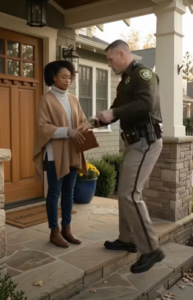
Chapter 1: Gray Morning on Juniper Street
Renée Calloway woke before her alarm on Saturday, the way she had woken every day since the Senate vote, listening first and deciding about the day second. Rain worked steadily against the roof of the Craftsman on Juniper Street, a soft percussion that found the gutters and ran down in thin, bright lines past the porch posts. She lay still a moment, cataloguing the sounds that now belonged to her: the furnace kicking on below, a branch tapping the west window, the distant hiss of tires on wet pavement in Laurelhurst.
She had bought the house a month earlier, after years of apartments chosen for proximity to courtrooms rather than comfort. At forty-seven, newly confirmed as United States Attorney for the District of Oregon, she had wanted a place that asked something of her in return. It had given her plenty: a faucet that sighed, a back door that stuck when damp, a porch swing whose chain complained. She loved all of it honestly.
In the kitchen she ground coffee and stood barefoot on the cold boards while the machine sputtered. Through the window, the garden showed as shapes in gray light. Portland in late November did not so much dawn as gradually relent. She carried her mug past boxes finally emptied the weekend before and stepped onto the covered porch.
The porch was why she had chosen the house. It ran the width of the front, deep enough for the swing and two chairs, sheltered enough that she could sit outside in almost any weather and keep her papers dry. She settled onto the swing in a thick sweater, a legal pad balanced on her knee out of habit, though she had forbidden herself work until Monday. Below her, three wet stone steps descended to a walkway slick with fallen leaves. Across Juniper Street, houses woke one by one, kitchen lights warming the gloom.
For a while she watched the rain and let her mind wander backward. She thought of her years as chief counsel to a state attorney general, of the long Terminal Six investigation at the Port of Portland that had consumed two years before her nomination. That case was with her team now, with First Assistant Tom Beckett and FBI Agent Sarah Lindqvist, and she trusted them, but trust had never cured her urge to reread one more page herself.
She sipped her coffee and corrected that thought. Trust was not an urge problem. It was a discipline. Her confirmation had changed the shape of her vigilance; she no longer chased every loose thread, but she still noticed threads. It was why, halfway through her second cup, she registered the curtain movement in the house three doors down without quite deciding to register it. A blind slat bending. A pause. A slat settling crooked and staying crooked longer than wind or accident explained.
Renée turned a page of the pad she was not writing on and kept her eyes lowered, giving whoever it was the courtesy of privacy she was not being given. In a month, she had learned the street’s habits, and she knew the woman three houses down: Peggy Thornton, who had arrived on Renée’s second day with a casserole, a printed map, and a list of phone numbers she called essential for block safety.
Peggy had asked where Renée worked, and Renée, tired from moving, had said only that she worked downtown in law. Peggy had nodded as if filing the answer in a drawer that did not quite close. Since then there had been waves from driveways, a talk about recycling bins, and nothing warmer. Renée did not mind reserve. She practiced it herself.
Yet this morning the watching had a different quality. It persisted through her coffee going lukewarm. It persisted when she stood, stretched, and carried damp firewood from the box by the door to just inside the threshold, an errand of thirty seconds that somehow required two lifted slats instead of one. She felt it along her shoulder blades, the ancient arithmetic of being assessed by someone who had already reached a conclusion she had not been invited to hear.
She returned to the swing and sat deliberately still, mug cradled, gaze on the rain beyond the porch roof. She told herself she was a public official in a new neighborhood, and that being noticed was simply the tax on arrival. She believed most of that. But when she finally glanced up, unhurried, toward the window three houses down, the slats snapped flat in a hurry no honest accident ever made, and the small gray house went blind again. Renée looked at the closed blinds for a long moment. Then she looked down at her cooling coffee, and understood with quiet certainty that she was being watched, and that the watching was not finished.
Chapter 2: The Woman Behind the Blinds
EM
EMILY
Content published under this byline is prepared by our editorial team, drawing on a mix of original reporting, research, and AI-assisted drafting, with each piece reviewed before publication. Our focus is on delivering clear, accurate, and engaging coverage across the topics our readers care about most.
Ils m’ont regardé droit dans les yeux et ma mère a prononcé une phrase que je n’oublierai jamais. Elle a croisé les bras, m’a fusillé du regard comme si j’étais…
Sie sahen mir direkt in die Augen, und meine Mutter sagte etwas, das ich nie vergessen werde. Sie verschränkte die Arme, funkelte mich an, als wäre ich ein Eindringling, und…
Mein Vater Arthur stand am anderen Ende und erhob triumphierend ein Glas teuren Rotweins. Mein jüngerer Bruder Oliver lachte lautstark neben seiner neuen Freundin. Ich erkannte Tanten, Onkel und sogar…
Mon père, Arthur, se tenait à l’autre bout de la salle, levant son verre de vin rouge coûteux en signe de triomphe. Mon jeune frère, Oliver, riait aux éclats à…
My father Arthur was standing at the opposite end raising a glass of expensive red wine in a triumphant toast. My younger brother Oliver was laughing uproariously next to his…
 Chapter 1: Gray Morning on Juniper Street

