Part 2: Their Christmas Plans Collapse While My Son Learns Silence
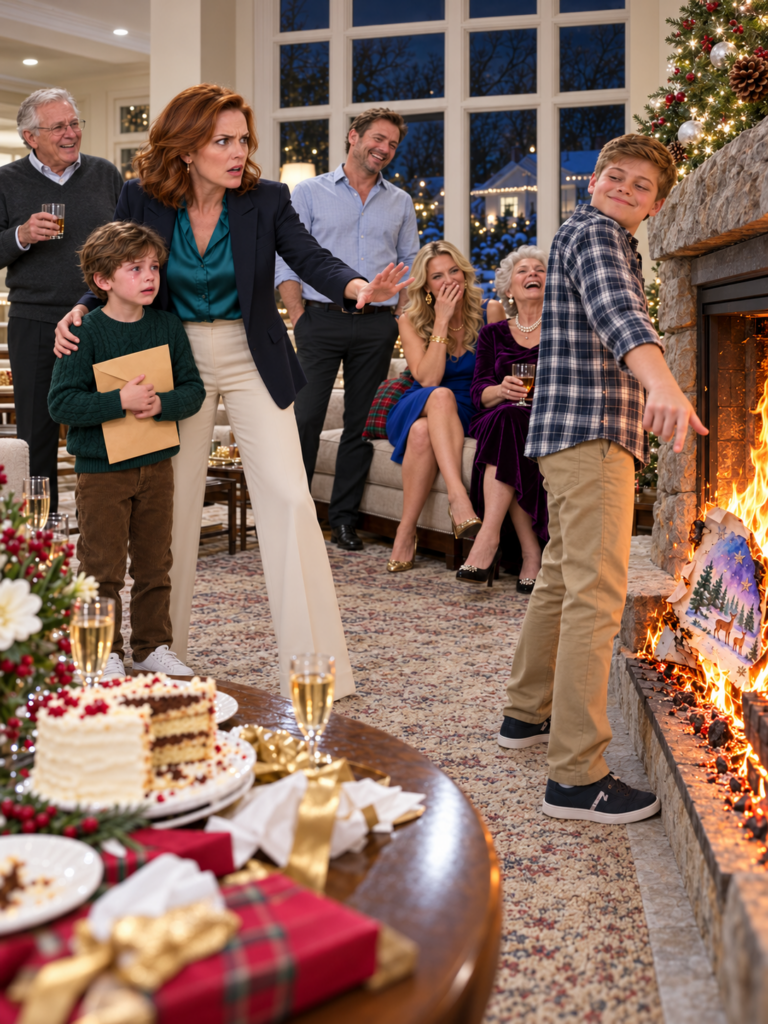
The messages started before breakfast the next day. My mother wrote that everyone had been joking and Jamie needed to develop thicker skin, while Trish accused me of ruining Christmas over a piece of paper. Evan sent a shorter message asking whether I understood how much money was already tied up in the ski vacation, and my father left a voicemail saying the resort had a nonrefundable deposit and the remaining payment was due. None of them mentioned the burn marks on Jamie’s destroyed picture or the bandage around his elbow.
I listened to my father’s voicemail that evening while Jamie sorted colored pencils at the dining table. His voice had the stiff politeness he used with bank employees when something wasn’t going his way. He explained that the children had already received new ski equipment, that canceling would mean losing the deposit, and that my mother had been looking forward to the trip for months. Then, almost as an afterthought, he added, “We really counted on you this year, Gloria.”
I looked at Jamie, who was lining up his pencils by shade, carefully placing a broken green one beside a new green one. They had counted on my money, my flexibility, and my willingness to overlook things, but apparently not on my son needing kindness. I sent my father a simple response saying I wouldn’t be contributing to the trip, that my previous gifts didn’t create an ongoing obligation, and that I needed some distance from the family.
Two evenings later, my parents arrived at my door wearing the same solemn expressions they used when somebody’s car had broken down. This time they knocked, and I let them into the living room because some stubborn part of me wanted to believe they’d come to apologize. My mother sat on the edge of the couch, clasped her purse with both hands, and said she hadn’t realized how hurt I’d been. My father added that maybe Caleb’s joke had gone too far, though he hoped we’d all stop dwelling on an unfortunate misunderstanding.
“Have you spoken to Caleb?” I asked. “Has anyone explained why what he did was cruel?”
My parents exchanged a quick glance, and my mother adjusted the strap of her purse. She said Caleb was an impressionable boy and they didn’t want to burden him with guilt over something so small. I pointed toward the staircase, where Jamie was upstairs drawing alone, and asked why protecting Caleb from discomfort mattered more than protecting Jamie from humiliation. My father rubbed his forehead and said we could discuss parenting another time, then asked whether I might reconsider helping with the resort balance just once.
I walked to the front door and opened it. My mother stared at me as though I’d forgotten the ending of a conversation she’d already rehearsed. “Please leave,” I said, and this time neither of them argued for long.
That night, I found Jamie at his desk making another forest picture. There were no glitter stars this time, no deer, and no cheerful birthday message, only dark trees surrounding a small boy standing alone near a frozen pond. When I asked whether he wanted to talk about it, he shook his head and asked me to sharpen his gray pencil. I sat beside him until he finished, trying not to let my own regret become another burden he had to carry.
By the week before Christmas, the ski trip had officially collapsed. I discovered that through Trish’s social media account, where she’d posted a photograph of her dining room centerpiece beneath the caption “Plan B Christmas. Thanks for nothing.” There were sympathetic comments from people who evidently knew a version of events involving a selfish relative and a ruined family vacation. I closed the app, put my phone facedown, and went back to cutting paper snowflakes with Jamie.
We baked sugar cookies, made ornaments from salt dough, and decorated a little artificial tree beside the living room window. Jamie refused the glitter when I offered it for the ornaments, and I accepted his choice without asking why. On Christmas Eve morning, however, my mother called with a bright, careful voice and invited us to a family dinner that evening. She said everyone missed Jamie, that his cousins would be opening presents, and that surely Christmas was a good time to put disagreements aside.
I told her I’d think about it, but Jamie had overheard enough to understand the invitation. He stood beside me in his pajamas, holding a wooden ornament we’d painted the night before, and asked whether Grandma might be nicer this time. I wanted to say no, yet the hope in his face was so familiar that I recognized it as the same hope I’d carried for decades. I agreed to go for a short visit, promising him privately that we would leave the moment he felt uncomfortable.
At six that evening, we pulled into my parents’ driveway beneath the same oversized ceramic reindeer they’d displayed every December since I was a teenager. My mother greeted Jamie with an enthusiastic hug, and for an instant, he looked like the little boy who used to run straight into her arms. She told us how wonderful it was to have everyone together again, then guided us toward the dining room, where her finest china had been arranged around a perfectly folded linen centerpiece.
I wanted to believe that this time, somebody had learned something.
Part 3: One More Holiday Dinner Ends With A Police Car Outside
Dinner began pleasantly enough, with my father carving the roast and my mother passing dishes as though nothing unpleasant had ever happened. Halfway through, Dad raised his glass and spoke about forgiveness, family loyalty, and putting differences behind us. Then Trish leaned across the table, glanced at Jamie’s empty hands, and smiled. “Let’s hope nobody throws a tantrum over a piece of paper tonight.”
My mother laughed, followed by Evan and my father. Jamie lowered his eyes to his mashed potatoes, and I remembered standing at that same table as a child, pretending jokes about my sensitivity didn’t hurt. I picked up my mother’s antique porcelain plate and deliberately let it fall against the hardwood floor. It shattered beneath my chair, and I took Jamie’s hand and walked out without offering an explanation.
In the car, Jamie asked whether I was angry with him. I pulled into a parking lot, turned toward him, and told him he’d done nothing wrong, although I had handled my own anger badly. Later, after we’d settled beneath a blanket with hot chocolate, a police officer arrived to investigate a report that I’d behaved violently at my parents’ house. I admitted breaking the plate, explained the argument, and offered to pay for the damage, which the officer noted before leaving.
Three days after Christmas, my mother posted a photograph of Caleb holding a new puppy with a gold ribbon around its neck. On New Year’s Day, my father’s handwritten letter appeared in our mailbox, declaring that we were unwelcome until I apologized and made things right. Jamie discovered it before I could put it away and asked whether we were still Grandma and Grandpa’s family.
I took him to a quiet lakeside cabin for two nights, away from the calls and arguments. On our last evening, he drew the two of us beside the wood stove, with cocoa mugs on the windowsill and snow outside. Underneath, he wrote, “This is what family feels like.” I folded the drawing carefully and placed it inside my wallet.
Part 4: A Final Visit Reveals Which Family Bonds Cannot Be Repaired
For two weeks in January, my parents didn’t contact us, and I found myself wondering whether I’d left anything unsaid. One Saturday, I took Jamie to their house for a final conversation, hoping they might at least acknowledge what had happened. My mother listened while I asked whether she truly believed Caleb’s behavior had been acceptable. She sighed and answered that children fought, I overreacted, and she had always loved Jamie.
When I reminded her that nobody had apologized to him, she looked toward my father for support. He lowered his newspaper and said, “This is what happens when you raise a boy without a real man in the house.” Jamie heard him, and I watched my son’s fingers tighten around his sketchbook. I told my parents we wouldn’t be visiting again, then guided Jamie outside.
In February, Trish left a voicemail claiming Caleb missed his cousin and suggesting that the boys meet. I didn’t return the call, because Jamie had never asked to see Caleb again, and I wasn’t willing to expose him to another humiliation disguised as reconciliation. I removed the joint holiday account from my financial records and stopped offering money or explanations. My parents could arrange their celebrations without me, and I would take responsibility for the broken plate without accepting responsibility for their choices.
One evening, Jamie handed me a drawing of houses beneath a snowy sky. Every window was dark except one, where warm yellow light spilled across a little front porch. When I asked why he’d drawn only one house with its lights on, he said, “Because that’s where it’s warm.”
I taped the picture to our refrigerator beside the other drawings he’d made since the birthday party. Later, I found an old family photograph in a drawer, all of us smiling in matching Christmas sweaters, and put it away without displaying it. I still wished my parents had chosen differently, but I could no longer sacrifice my son’s sense of safety to preserve the appearance of a happy family. The next morning, Jamie asked for silver glitter to finish the stars above his glowing house, and I handed it to him.
The End .
All characters and events in this story are fictional, created for storytelling and entertainment purposes. Thank you sincerely for reading. Your feedback and support are invaluable and motivate me to continue sharing more stories with you.

